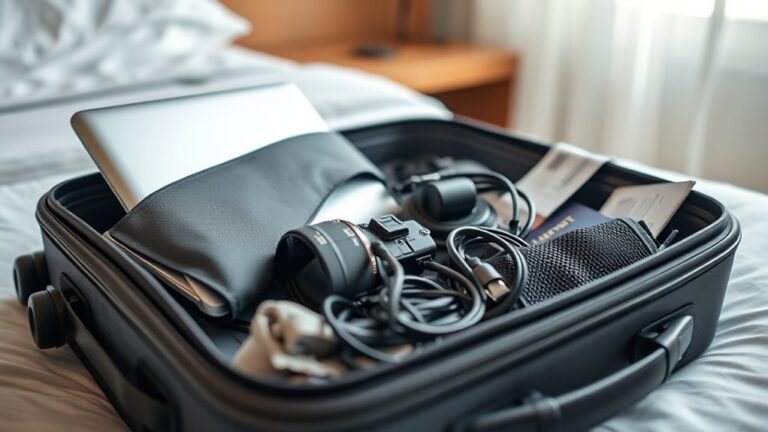
What Happens if You Have a Lithium Battery in Checked Luggage
If you pack a lithium battery in checked luggage, expect it to be flagged, removed, and possibly confiscated because airlines tightly restrict spares for safety; you’ll face delays, inspections, or fines if rules aren’t followed. Fires from damaged batteries can start unseen in cargo and spread rapidly, so carriers require batteries in carry‑on with terminals taped or in original packaging and larger cells often need approval. Keep it with you for safe transport, and continue to learn what to do next.
Why Lithium Batteries Are Risky in Air Travel
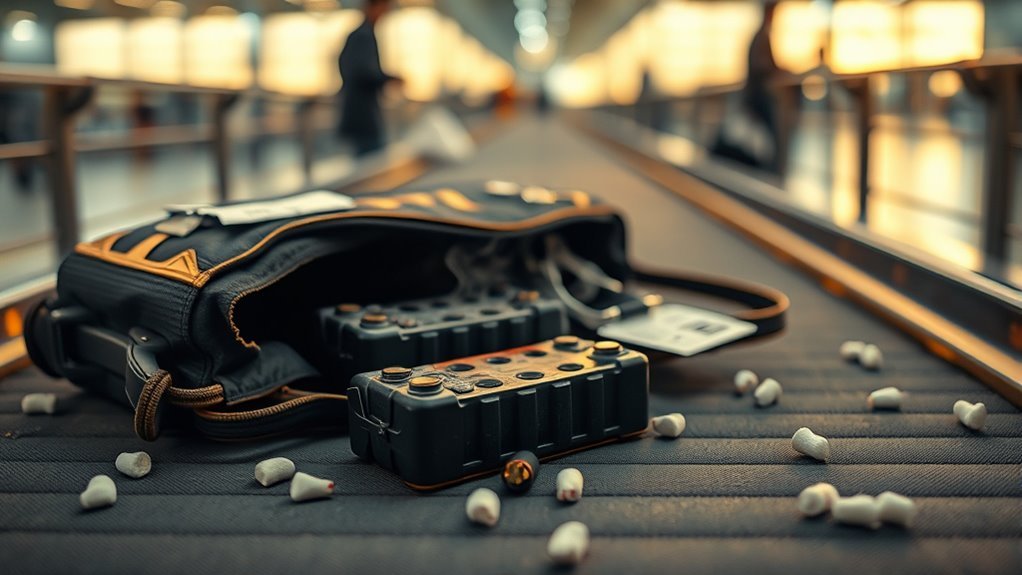
Because lithium batteries store a lot of energy in a small package, they can overheat, catch fire, or even explode if damaged or improperly handled. You should know that thermal runaway spreads quickly, igniting nearby materials and creating toxic smoke.
In cargo holds, fires may go unnoticed longer and suppression systems mightn’t stop battery-driven blazes.
Physical damage, short circuits, manufacturing defects, and improper storage raise risks. You can lower danger by keeping batteries in carry-on, protecting terminals, avoiding loose batteries, and following airline limits.
Being cautious helps prevent incidents that threaten passengers, crew, and aircraft integrity.
What Happens If a Lithium Battery Is Checked?
If you check a lithium battery in your luggage, airlines usually prohibit or restrict it and may require you to remove it before departure. Doing so can trigger safety responses—from baggage inspection and delays to confiscation or fines—if rules are broken.
In the worst case, a thermal event in the cargo hold can cause fire and serious consequences, so you should follow airline and TSA guidelines.
Airline Rules Summary
When airlines find a lithium battery in checked luggage, they follow strict safety protocols that can include removing the item, reclassifying the bag as carry-on, or refusing transport altogether.
You should know standard rules: spare lithium-ion batteries must stay in carry-on, terminals taped or in original packaging, and batteries over allowed watt-hours often need airline approval or are forbidden.
Installed batteries in devices are usually permitted in carry-on only.
Airlines and countries vary, so check carrier policies and departure/arrival regulations before travel.
Declare anything unsure to staff at check-in to avoid delays or confiscation.
Risk And Consequences
You’ve just learned the rules; now consider the risks and consequences of checking a lithium battery. If one overheats, it can ignite surrounding luggage and spread quickly in a cargo hold where firefighters can’t access it midflight.
You’re risking smoke, fire damage to belongings, emergency diversion, delays, and potential injury to crew or ground staff. Airlines may fine you, confiscate the battery, or ban you for repeated violations.
Insurers often exclude damage from prohibited items, so you might bear costs. For safety and liability reasons, keep spare and installed lithium batteries in your carry-on, not checked baggage.
Immediate Steps If You Discover a Checked Battery
Because a loose lithium battery can pose a fire risk in flight, act quickly and calmly if you find one in checked luggage. First, alert airline staff or airport security immediately—don’t try to repackage it yourself.
Move away from crowds and avoid placing the bag near heat sources or flammable materials. If staff ask, describe the battery type, size, and condition (damaged, swollen, leaking). Follow their instructions; they may isolate the bag or transfer it to a safe containment unit.
Don’t reinsert the battery into a device, tape terminals, or attempt repairs. Document the interaction and keep contact details for follow-up.
Why Lithium Batteries Are Treated Differently
You need to understand that lithium batteries are treated differently because they pose a unique fire risk if damaged or shorted.
Regulators classify them separately from other batteries and set specific limits and packaging rules to reduce that risk.
Knowing those classifications helps you follow the right precautions when packing or reporting a battery in checked luggage.
Fire Risk Management
Why are lithium batteries singled out for special handling? You must manage their fire risk because they can overheat, short-circuit, or suffer internal damage that triggers thermal runaway.
In baggage, that can produce intense, fast-spreading fires fueled by electrolyte and cell materials, which are hard to detect early and extinguish once sealed in cargo holds.
You should keep batteries protected from crushing, heat, and metal contact, carry spares in carry-on when possible, and ensure devices are powered off.
Packing batteries with insulation, original packaging, or terminal covers reduces short risks and helps prevent incidents during transport.
Regulatory Classification
When regulators single out lithium batteries, they’re responding to unique hazard traits—high energy density, propensity for thermal runaway, and difficulty extinguishing fires—that don’t fit standard hazardous-material rules, so you’ll see specific classifications, restrictions, and labeling requirements that govern how cells and batteries are packed, declared, and transported. You must follow ICAO/IATA, UN, and national rules that distinguish lithium-ion vs lithium-metal, watt-hour or lithium content limits, and packaging standards. Airlines restrict checked carriage, require terminals protected, and often forbid spares in checked baggage. Know the class, check limits, and declare properly to avoid confiscation or fines.
| Category | Limit/Label | Typical Restriction |
|---|---|---|
| Li-ion cell | ≤100 Wh | Allowed carry-on |
| Li-ion battery | 100–160 Wh | Airline approval |
| Li-metal | ≤2 g Li | Often banned checked |
| Spare batteries | Protected terminals | Carry-on only |
| Damaged/recall | Prohibited | No transport |
How Lithium Batteries Start Fires on Aircraft
Because lithium batteries store a lot of energy in a small space, a single internal short or external crush can trigger rapid, uncontrolled heating known as thermal runaway.
Because lithium batteries pack intense energy, a single short or crush can spark rapid, uncontrollable thermal runaway.
When cells heat, pressure builds, separators melt, and flammable electrolyte vaporizes. You’ll see sparks, venting, and flames that can spread to nearby materials.
Heat from one cell can ignite adjacent cells, creating a chain reaction. In cargo hold conditions, limited suppression and delayed detection let fires grow.
You should avoid placing damaged or loose batteries in checked bags; secure, protected cells and proper packing reduce the chance of mechanical damage that initiates failure.
Common Battery Types Travelers Carry
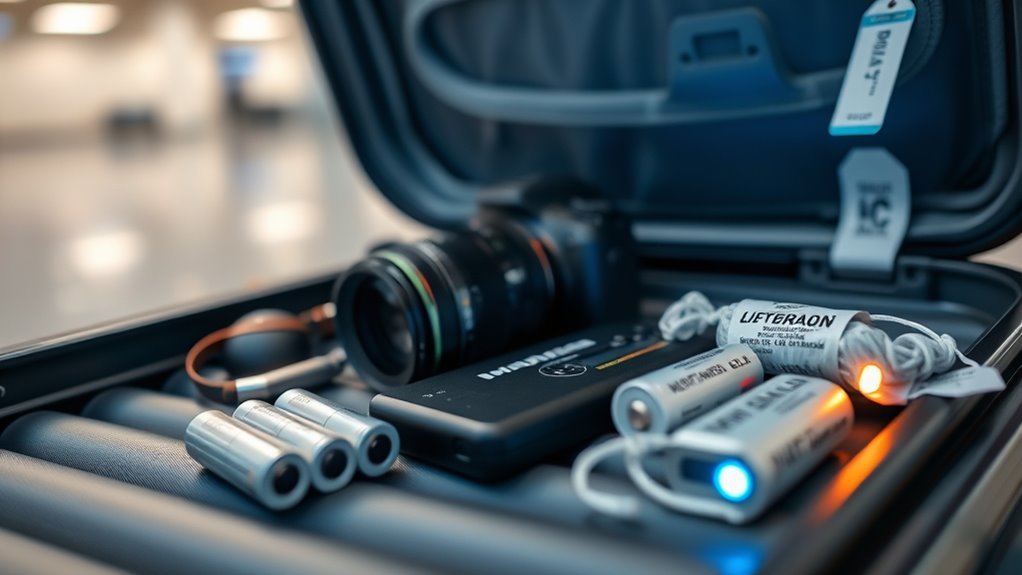
You probably carry several battery types when you travel, from AA and AAA to rechargeable lithium-ion packs in phones, cameras, and power banks.
Know that lithium batteries pose higher fire risks than alkaline cells because they can short or overheat if damaged or improperly packed.
As you pack, you’ll want to distinguish battery types and follow rules that minimize those risks.
Common Battery Types
Curious which batteries you’re likely to pack? You probably carry alkaline AAs and AAAs for remotes and toys, coin cells for watches and key fobs, and rechargeable NiMH packs for cameras.
Many travelers bring lithium-ion cells in phones, tablets, laptops, power banks, and some e-cigarettes. Disposable lithium primary batteries appear in some cameras and flashlights.
You might also pack sealed lead-acid batteries for mobility aids or larger equipment, though those’re less common.
Keep devices powered down and terminals protected. Knowing what you have helps you follow airline rules and avoid surprises at security or baggage check.
Lithium Battery Risks
Many of the batteries you pack—especially lithium-ion cells in phones, laptops, and power banks—pose different fire and thermal-runaway risks than alkaline or NiMH types. You should know how risks vary so you can decide what goes in carry-on versus checked luggage.
Lithium batteries can short, overheat, or vent if damaged, improperly packaged, or exposed to high temperatures. Take precautions:
- Keep devices powered off and insulated to prevent short circuits.
- Protect spare batteries in original or insulated cases to avoid contact with metal.
- Follow airline and TSA rules on watt-hours and quantity limits to reduce risk.
Lithium‑Ion vs Lithium‑Metal: Key Differences
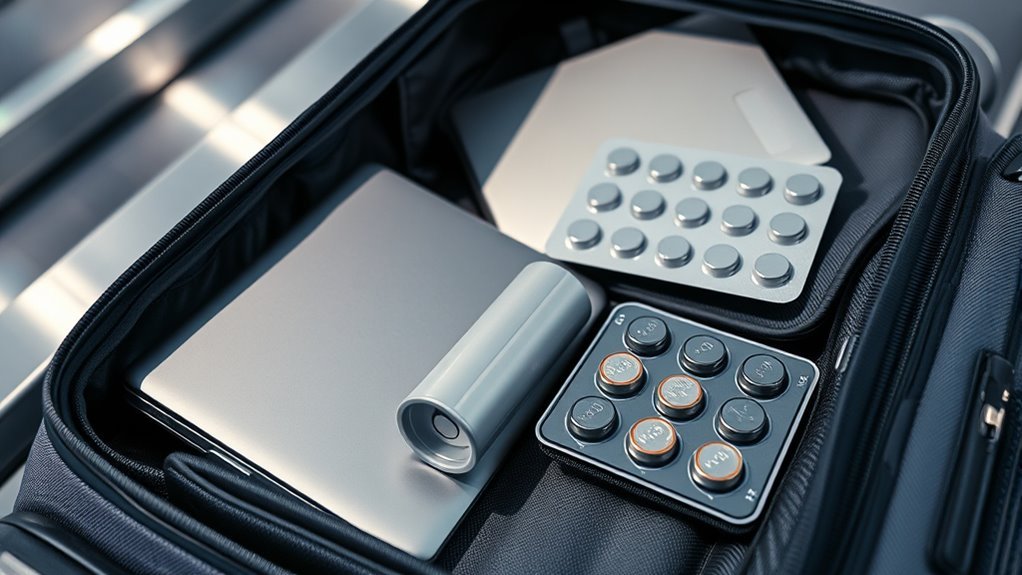
How do lithium‑ion and lithium‑metal batteries actually differ in construction, performance, and risk? You’ll find lithium‑ion cells use a reversible lithium‑ion flow between graphite anodes and metal‑oxide cathodes, making them rechargeable and common in phones and laptops.
Lithium‑ion cells shuttle lithium ions between graphite anodes and metal‑oxide cathodes, enabling rechargeable power for phones and laptops.
Lithium‑metal cells use a reactive metallic lithium anode, giving higher energy per weight but usually single‑use.
Performance-wise, lithium‑ion offers many charge cycles and stable voltage; lithium‑metal gives greater specific energy but can be less stable.
Risk: lithium‑metal is more prone to thermal runaway if damaged; lithium‑ion can also catch fire if shorted, but safety features mitigate that.
What Counts as a Spare Battery or Power Bank
You should know that “spare” batteries and power banks include any removable lithium cells or portable chargers not installed in a device, with common examples like phone power banks, camera spares, and external laptop packs.
Check capacity limits—airlines and regulators usually restrict cells above certain watt‑hours and may require special handling or approval.
Also follow packaging and airline rules for how spares must be carried, protected against short circuits, and declared.
Definitions And Examples
Because airlines and regulators treat loose lithium cells differently from installed ones, it helps to be clear about what counts as a “spare battery” or power bank: a spare battery is any removable lithium cell or pack not installed in a device, and a power bank is a portable, self-contained battery pack designed primarily to recharge devices.
You should identify items correctly so you pack safely and comply with rules. Examples include:
- Camera or drone batteries removed from the device (spares).
- USB battery packs labeled with capacity and output (power banks).
- Replaceable phone batteries or cartridge-style laptop cells kept loose.
Capacity And Watt-Hour Limits
When airlines and regulators set limits on lithium batteries, they do so by capacity—measured in watt-hours (Wh) for larger cells and milliamp-hours (mAh) for many consumer batteries—so you need to know how to read those ratings to determine whether a spare battery or power bank is allowed in checked luggage.
Generally, spares above 100 Wh are restricted and those between 100–160 Wh often need airline approval; most phones and small power banks are below 100 Wh.
To convert mAh to Wh: Wh = (mAh × V)/1000.
If a battery lacks markings, treat it as potentially prohibited and carry documentation or keep it in carry-on instead.
Packaging And Airline Rules
How should you package spare lithium batteries and power banks to meet airline rules? You must carry most spares in carry-on luggage, protect terminals, and declare oversized units. Follow airline and IATA limits to avoid confiscation.
- Tape or cover terminals and place each battery in a separate plastic pouch.
- Keep power banks under the airline’s watt-hour or ampere-hour threshold and carry them onboard.
- Declare batteries over allowed capacity or quantity at check-in; airlines may require documentation or deny carriage.
Check your carrier’s specific rules before travel, as policies and limits can vary and enforcement is strict.
How Airlines and Regulators Set Battery Rules
Regulators and airlines set lithium battery rules by balancing safety data, incident reports, and operational practicality, then translating those findings into clear limits and procedures you must follow. You’ll see limits on watt-hours, state-of-charge, and quantity because regulators analyze failures, test thermal runaway, and assess fire suppression capacity in cargo holds. Airlines add handling, labeling, and passenger notification rules to fit operations. You need to comply to avoid confiscation or fines and to keep flights safe.
| What they study | Airline actions | Your obligations |
|---|---|---|
| Failure modes | Limits | Declare batteries |
| Incident trends | Training | Pack properly |
| Test results | Procedures | Follow limits |
ICAO and IATA: Key International Rules
Those airline limits and handling rules are built on international standards set by ICAO and IATA, which you should understand before packing batteries for a flight. They define classifications, carriage conditions, and documentation that airlines follow globally.
You’ll see watt-hour (Wh) and lithium content thresholds, restrictions on spare batteries, and packaging/terminal protection requirements. Know these core points:
- Classification: lithium-ion vs lithium metal rules and Wh limits per cell or battery.
- Carriage modes: in checked baggage, carry-on, or as cargo with different allowances.
- Packaging and labeling: insulation, individual packaging, and hazard labels or paperwork.
U.S. DOT and FAA Rules Travelers Need
When you fly within or from the United States, the DOT and FAA set specific rules you’ll need to follow for lithium batteries in checked and carry-on baggage, and they enforce stricter limits than many other authorities.
You must follow packaging, labeling, and state-of-charge requirements for spare and installed batteries.
Spare lithium metal and lithium-ion cells generally aren’t allowed in checked baggage; carry them in the cabin with terminals protected.
Airlines may require approval for larger batteries and can impose quantity limits.
You should check airline policies and comply with hazmat declarations to avoid fines, delays, or confiscation.
Watt‑Hour (Wh) and Lithium Limits Explained
You need to know watt‑hours (Wh) to compare battery sizes because airlines set limits based on Wh, not just milliamp‑hours (mAh).
Check your carrier’s Wh caps—most allow batteries up to 100 Wh in carry‑on and require approval for 100–160 Wh.
To find Wh, multiply voltage (V) by amp‑hours (Ah) or convert mAh by dividing by 1000 and then multiplying by V.
Understanding Watt‑Hours (Wh)
Curious how airlines decide which lithium batteries are allowed in checked bags? You’ll want to understand watt‑hours (Wh): a measure of energy capacity that directly affects safety rules. Wh equals volts times ampere‑hours, and that number helps determine handling and packaging.
Check the device or battery label, or calculate if needed.
- Look for “Wh” on the battery or in product specs.
- If only volts and mAh are listed, convert: Wh = (V × mAh) / 1000.
- Keep records of your calculations and labels when packing.
Knowing Wh lets you assess risk and follow airline requirements confidently.
Airline Wh Limits
How much battery you can pack in checked luggage depends on the watt‑hour (Wh) rating. Airlines and regulators limit cells and batteries: most lithium ion batteries under 100 Wh are allowed in carry‑on but usually prohibited in checked baggage.
Batteries between 100 Wh and 160 Wh may be approved with airline permission and are typically limited to a small number per passenger. Batteries above 160 Wh are generally forbidden on passenger aircraft.
Spare batteries must be protected against short circuit. You should always check specific airline policy before travel since carriers can impose stricter limits than international rules.
Calculating Battery Capacity
Calculating a battery’s watt‑hour (Wh) rating lets you determine whether it meets airline and regulatory limits, and you can do it quickly with the cell’s voltage and ampere‑hour (Ah) values.
You’ll multiply volts (V) by ampere‑hours (Ah) to get Wh.
For milliamp‑hours (mAh), convert: mAh ÷ 1000 = Ah.
Compare the result to airline thresholds (usually 100 Wh standard, 100–160 Wh may need approval).
- Example: 3.7 V × 2000 mAh = 3.7 × 2 Ah = 7.4 Wh
- Convert larger packs the same way
- Check manufacturer labels for Wh or Ah to avoid mistakes
How to Find a Battery’s Wh Rating
To find a battery’s watt-hour (Wh) rating, you’ll usually multiply its voltage (V) by its ampere-hour (Ah) capacity — if the cell lists Ah — or convert milliamp-hours (mAh) to Ah first by dividing by 1,000.
Check the label for V and Ah or mAh. If you see mAh, divide by 1,000 to get Ah, then multiply by V: Wh = V × Ah.
For multi-cell packs, use the pack voltage, not single-cell nominal voltage.
If the label lacks info, consult the manufacturer’s specs or product manual to avoid miscalculating capacity.
Which Batteries Must Be Carry‑On Only
When packing, you should keep spare lithium batteries in your carry‑on rather than checked baggage.
Installed batteries in devices are usually allowed in the cabin, but check airline rules for large capacity packs and whether they need special handling.
Batteries over certain watt‑hours, like high‑capacity power banks, generally must travel in carry‑on and may require airline approval.
Spare Lithium Batteries
Because spare lithium batteries pose a fire risk if they’re damaged or shorted, airlines and regulators require you to carry them in the cabin rather than in checked luggage. You should protect terminals, keep spares in original packaging or individual pouches, and follow airline watt-hour or cell count limits.
Common rules include:
- Remove batteries from devices and tape terminals or use plastic caps.
- Limit to a certain number of spare batteries (check your carrier; often two to four high-capacity batteries).
- Declare oversized or many spares to the airline in advance.
Doing this guarantees fire risk reduction and ensures compliance with safety regulations.
Installed Device Batteries
Spare batteries aside, installed batteries in devices—like laptops, cameras, e-cigarettes, and power banks built into equipment—also carry fire risk but are treated differently by airlines. You must keep most installed lithium-ion batteries in your carry-on so crew can access and extinguish any incident quickly.
Airlines and regulators typically allow devices with batteries installed to travel in checked baggage only if specifically approved, powered off, and protected from damage, but policies vary, so check with your carrier.
Remove batteries from devices when possible, use original packaging or insulating tape on terminals, and declare high-capacity or damaged batteries to the airline.
Large Capacity Packs
If you’re carrying power banks or battery packs with high watt-hour ratings, you must pack them in your carry-on so crew can deal with any thermal event quickly. Airlines and regulators typically require lithium-ion batteries over 100 Wh to stay in the cabin, and those over 160 Wh are usually prohibited or need airline approval.
You should check labels, airline rules, and get approval for anything near limits. Keep terminals protected and devices off. At security, declare oversized packs if asked.
- Verify Wh rating and airline policy
- Tape terminals or use original packaging
- Carry documentation for approved units
Batteries Allowed in Checked Baggage (Exceptions)
While most lithium batteries must travel in your carry-on, a few specific types and situations let you place them in checked baggage under strict conditions. You can check devices with non-spillable, properly secured lithium batteries installed if the device is protected from damage and accidental activation.
Spare lithium batteries still belong in the cabin, but some airline-approved equipment—like wheelchairs or mobility aids—may have installed, secured batteries allowed in checked hold when you notify the carrier and follow packaging, terminals insulation, and capacity limits.
Always check airline and country rules, declare regulated items, and get written approval when required.
Baggage Screening: What Happens If a Battery’s Found
When screening finds a battery in checked luggage, airline or security staff will inspect it to confirm type, condition, and whether it’s installed or loose. You should expect them to remove, declare, repack, or, in some cases, prohibit the item from travel.
If a battery is found in checked luggage, staff will inspect it and may remove, repack, or prohibit it for safety.
You’ll be informed if action’s needed and given options depending on regulations and safety risk. Follow instructions promptly to avoid delays or confiscation.
Typical outcomes include:
- removal and return to you at the gate if allowed,
- packing adjustments or labeling for safe transport,
- prohibition and disposal if the battery poses an immediate hazard.
How Airport Security Handles Prohibited Batteries
Because prohibited batteries can create serious fire risks on aircraft, security staff take immediate, standardized steps to deal with them. You’ll be asked questions, and staff will isolate the item from other baggage to reduce risk. They’ll document the find, photograph the battery, and label the bag for follow-up.
Depending on airport policy and airline rules, you may be allowed to remove or surrender the battery, or the item may be retained and disposed of. Security may notify airline operations and cargo handling.
You’ll receive instructions on next steps, possible fines, and how to retrieve permitted items after compliance checks.
If a Battery Ignites in the Hold
If a lithium battery starts a fire in the hold, you’ll first rely on the plane’s smoke and heat detectors to alert the crew immediately.
The flight crew is trained to follow strict response procedures, including isolating the affected cargo area and using built-in suppression systems.
You’ll want to know what those detection methods and crew actions are so you can understand how such incidents are managed.
Immediate Fire Detection
Should a lithium battery ignite in the cargo hold, prompt detection is critical to stopping a small incident from becoming catastrophic. You rely on smoke detectors, temperature sensors, and crew vigilance to catch problems early. Early warning limits spread and gives the crew time to act without delay.
- Smoke detectors trigger alerts to the cockpit and systems monitoring, giving clear indications of combustion.
- Temperature probes spot abnormal heat before visible smoke, often indicating thermal runaway onset.
- Cargo cameras or sensors let you confirm location and severity, guiding prioritized response while minimizing false alarms.
Quick detection saves lives and aircraft integrity.
Crew Response Procedures
How will you act when a lithium battery ignites in the hold? You’ll follow procedures: notify the cockpit and cabin, and don protective breathing equipment.
Assess the fire location using sensors and reports. You’ll coordinate with the captain to request descent or diversion if needed.
Use fire suppression systems per checklist—discharge built-in extinguishers and seal cargo compartments to starve the fire of oxygen.
If smoke enters the cabin, deploy oxygen masks and start smoke evacuation.
Keep communication clear with ATC and cabin crew, document actions and times, and prepare for an expedited landing and emergency services on arrival.
Aircraft Fire Suppression Systems and Limits
When lithium batteries ignite in the cabin or cargo hold, aircraft rely on engineered fire suppression systems and strict limits to stop flames and smoke from spreading. You should know systems are designed for small, contained fires; they’re not foolproof against thermal runaway.
Cargo holds have smoke detectors, built-in fire extinguishers, and controlled ventilation limits. Crew follow protocols to isolate affected compartments and land as soon as practical.
You should understand regulatory limits on battery carriage—capacity caps and packaging rules—reduce risk but can’t eliminate it.
- Smoke detection and automatic suppression
- Ventilation control and compartment isolation
- Regulatory capacity and packaging limits
Notable Incidents Involving Checked Batteries
Although regulators and airlines set strict limits, several high-profile incidents have shown checked lithium batteries can still cause serious fires in cargo holds. You’ve likely read about baggage fires that forced emergency landings or destroyed cargo.
Investigations often trace origins to spare batteries packed with clothing or inside devices, overheating and igniting nearby materials. In some cases, damage was contained by crew response and suppression systems; in others, aircraft sustained significant harm.
These events underscore why you should carry spare lithium batteries in carry-on bags, protect terminals, and follow airline limits—simple steps that reduce the real risk of catastrophic cargo fires.
Legal Consequences for Knowingly Checking Banned Batteries?
If you knowingly check banned lithium batteries, you can face criminal penalties including prosecution and possible jail time.
You’ll also be exposed to civil fines levied by regulators or airlines.
In addition, carriers can impose enforcement actions like travel bans, ticket cancellations, or added fees.
Criminal Penalties Risk
Because airlines and regulators treat knowingly checking banned lithium batteries as a serious safety breach, you can face more than just a confiscation or fine—criminal charges are possible in some cases.
Prosecutors may pursue charges when your conduct involves deliberate concealment, repeated violations, or actions that create significant risk.
You should understand potential penalties and how they apply.
- Criminal charges: possible for willful endangerment, smuggling, or falsifying declarations.
- Investigation: law enforcement and aviation authorities can interview you, seize devices, and gather evidence.
- Consequences: convictions can bring jail time, criminal records, and travel restrictions.
Civil Fines Possible
Civil authorities can impose substantial civil fines when you knowingly check banned lithium batteries, and these penalties often come on top of confiscation or criminal probes.
You can be fined for violating transport safety rules, failing to declare hazardous items, or ignoring airline and regulatory warnings. Agencies set fine schedules based on battery type, capacity, and risk, so penalties vary widely.
Fines may hit individuals and sometimes escalate for repeat offenses or commercial intent. You’ll get notices, can contest fines administratively, and should consult a lawyer if assessed.
Paying fines won’t block other enforcement options or civil claims.
Airline Enforcement Actions
Beyond fines, airlines themselves can take direct enforcement actions when you knowingly check banned lithium batteries. They’ll treat the offense as a safety violation and may impose immediate penalties that affect your travel.
You could face:
- Confiscation of the battery and possible destruction without compensation.
- Denied boarding, revoked frequent-flier privileges, or added travel bans for repeat offenses.
- Incident reports submitted to regulators, leading to longer-term enforcement or shared blacklists.
Acting knowingly increases consequences and limits your options for appeal. Always declare batteries, follow carrier rules, and pack spare cells in carry-on to avoid enforcement actions and preserve your travel record.
Penalties and Fines Airlines Can Impose
What happens if you try to check lithium batteries without declaring them? You can face fines, immediate confiscation, or denied boarding.
Airlines often levy penalties varying by carrier and jurisdiction — modest administrative fees up to several hundred dollars. Repeat or egregious violations may prompt higher civil fines imposed by aviation authorities.
You might also be assessed costs for special handling, inspection, or disposal. In serious cases, carriers can ban you from future flights or refer matters to law enforcement, which could lead to criminal charges where laws were willfully broken.
Always declare batteries and follow carrier limits to avoid penalties.
Insurance and Liability for Battery Damage
Who pays if a lithium battery causes damage during transit? You, the airline, and insurers each share possible responsibility depending on disclosure, packing, and policy terms. If you didn’t declare prohibited batteries or packed them improperly, you’ll likely be liable.
Liability for lithium battery damage can fall on you, the airline, or insurers—disclosure and proper packing determine responsibility.
Airlines limit liability for hazardous items, so insurance matters. Check policies and keep receipts.
- Review your travel insurance and credit card protections for electronics coverage.
- Keep proof of battery specs, purchase, and packing methods to support claims.
- Notify the airline immediately, document damage with photos, and file claims fast to improve recovery chances.
How Airlines Detect Batteries After Loading
If you suspect a battery caused damage or have to make a claim, you’ll also want to know how airlines can find batteries after bags are loaded. You’ll learn from X-ray images, anomaly sensors, and handler reports. Security reviews footage, inspects suspect baggage, and flags items with high heat or smoke traces. You can expect documentation and photos if they open your bag. Below is a quick summary of detection cues:
| Cue | What it shows |
|---|---|
| X-ray pattern | Cell packs visible |
| Thermal sensor | Overheat spots |
| Odor/smoke | Chemical/soot traces |
| Handler note | Suspicious label |
| CCTV | Bag handling events |
Ground Handling Steps When a Suspect Battery Is Found
If you find a suspect lithium battery in checked luggage, isolate the bag immediately to prevent contact with other items.
You’ll then assess the battery’s condition—look for swelling, burn marks, or leakage—while keeping a safe distance and using protective gear if available.
Only after the initial assessment should you decide whether to move the item to a secure containment area or call specialized response teams.
Isolate The Luggage
When you suspect a lithium battery in checked luggage, act quickly to isolate the bag and minimize risk. Move the suitcase away from people, aircraft, and other baggage, and secure the area. Keep a clear perimeter and enforce no-smoking rules.
- Place the bag in a designated, ventilated containment area away from high-traffic zones.
- Prevent handling; mark the bag with visible tags and rope off the spot until specialists arrive.
- Notify supervisors and emergency responders immediately, giving exact location and description.
You’ll limit exposure and make it easier for trained personnel to manage the situation safely.
Assess Battery Condition
Because damaged lithium cells can escalate quickly, you should first do a visual and olfactory check from a safe distance to judge the battery’s condition.
If you see swelling, discoloration, leakage, scorch marks, or smell solvents/ozone, don’t touch the item. Note the battery type, size, and any visible labels, then record photos and location for responders.
If the battery appears intact and cool, still avoid moving it; tag the bag and inform supervisory staff.
Communicate findings clearly to emergency or fire teams, provide photos, and follow their instructions for containment, cooling, or removal.
How Checked‑Baggage Fire Events Are Investigated
Though a baggage fire can seem chaotic, investigators follow a clear, methodical process to determine cause and prevent recurrence. You’ll see teams secure the scene, document damage, and remove smoldering materials safely.
Though chaotic at first, baggage-fire investigators methodically secure the scene, document damage, and safely remove smoldering materials.
They then trace the item’s origin, examine fire patterns, and test residues to identify heat sources.
- They photograph and map the baggage layout and seat location.
- They inspect batteries, packing, and device damage for internal short signs.
- They analyze maintenance logs, passenger declarations, and CCTV for handling clues.
You’ll receive a report with findings, recommended safety actions, and evidence for regulatory follow‑up.
Operational Disruptions From Battery Incidents
If a battery in checked luggage ignites, you’ll face immediate operational disruption: flights can be delayed or diverted, cabins and cargo holds need inspection, and baggage systems may be shut down for safety checks.
You’ll see crews mobilize to control fire and assess damage, and ground operations will pause while emergency procedures run. You’ll experience passenger rebooking, missed connections, and increased screening of remaining luggage.
Airlines will document the event, coordinate with authorities, and may ground aircraft for maintenance. You might encounter longer-term schedule ripple effects as resources, staff, and aircraft are reassigned to restore normal operations.
Avoid Accidentally Checking Lithium Batteries
Before you pack, check your airline’s rules on lithium batteries so you know what’s allowed in checked luggage. If devices or spare cells aren’t permitted, remove the batteries and carry them in your cabin bag or leave them at home.
Taking these simple steps prevents accidental violations and reduces fire risk during flight.
Check Airline Battery Rules
Check your airline’s battery rules before you pack so you don’t accidentally check devices with lithium batteries. You’ll avoid fines, delays, or confiscation by confirming permitted devices, watt-hour limits, and packing methods. Policies vary, so check the airline site or call customer service. Note any required carry-on placement or protective measures.
- Confirm watt-hour (Wh) or cell count limits for spare batteries.
- Learn whether power banks must be in carry-on and terminals insulated.
- Check rules for e-cigarettes, laptops, and camera batteries; some need airline approval.
Follow rules closely to keep your trip smooth and compliant.
Remove Batteries Before Packing
When you pack devices that use lithium batteries, remove the cells and spares and stow them in your carry-on so they don’t get accidentally checked; this reduces fire risk and keeps you compliant with airline rules.
Before you zip a bag, inspect gadgets—power banks, cameras, e-cigarettes, spare cells—and extract batteries. Use original packaging or insulating tape over terminals to prevent short circuits. Label or separate removed batteries so security can see them easily.
If a device can’t be powered down or batteries are nonremovable, contact your airline for guidance. Being proactive avoids delays, confiscation, or safety hazards at the airport.
Preparing Devices for Checked Baggage Safely
If you’re packing devices that contain lithium batteries for checked baggage, power them down completely. Remove any removable batteries when possible, and protect exposed terminals against short circuits by taping or using original covers. Check device manuals for transport guidance and disable features that might activate (alarms, timers, wake functions).
Pack lithium-battery devices powered down, remove batteries if possible, and tape terminals to prevent short circuits.
Cushion devices in hard-sided cases or between clothing to prevent crushing or puncture. Keep originals or proof of battery capacity when possible.
- Place devices where they won’t shift during handling.
- Use non-conductive tape or terminal caps for removed cells.
- Avoid packing devices in checked baggage if they show damage or swelling.
Securing Spare Batteries for Carry‑On Transport
How should you carry spare lithium batteries through security? Pack them in your carry‑on, not checked luggage, and keep terminals protected. Use original packaging, individual plastic battery cases, or cover terminals with tape to prevent short circuits.
Place batteries in a dedicated pocket or pouch so security can inspect them without rummaging. Know and follow airline and TSA limits on watt‑hour ratings and quantity; declare oversized units if required.
Keep batteries separate from metal objects and devices that could accidentally power on. Carry documentation for unusual or high‑capacity cells.
Handle batteries gently; avoid crushing, puncturing, or exposing them to extreme temperatures.
Best Practices for Power Banks on Planes
When you travel with power banks, keep them in your carry-on only and never in checked baggage.
Check the capacity rating so you don’t exceed airline limits and declare anything near the cutoff if required.
Handle and store them with care—protect terminals, avoid extreme heat, and don’t pack damaged units.
Carry-On Only Policy
Because airports and airlines treat power banks as potential fire risks, you should always pack them in your carry-on rather than checked luggage. You’ll keep them accessible for inspection and quickly remove or disconnect them if crew asks. Follow airline rules and security guidance so screening goes smoothly and you avoid confiscation.
- Keep power banks in original packaging or a protective pouch.
- Turn off devices and cover exposed terminals to prevent short circuits.
- Present power banks separately at security if requested.
Carry-on storage also lets you monitor device condition during travel and respond to any overheating promptly.
Power Bank Capacity Limits
If you plan to bring a power bank on a flight, check its watt-hour (Wh) rating and your airline’s limits before you pack it. Most carriers allow devices under 100 Wh in carry-on without approval, while units between 100–160 Wh usually need airline approval and are still forbidden in checked baggage.
You’ll find Wh on the device or calculate it (Wh = mAh × V ÷ 1000). Keep capacity labels visible, carry the power bank in your cabin baggage, and avoid bringing multiple high-capacity units that could trigger questions.
When in doubt, contact the airline for specific limits and approval procedures.
Safe Battery Handling
Although airports screen for oversized batteries, you should still handle power banks carefully to prevent shorts, damage, or overheating. Treat them as carry-on items, protect terminals, and keep them accessible for inspection. Follow airline rules and local regulations, and never check loose or spare power banks.
- Cover terminals with tape or use a case to avoid accidental contact.
- Keep capacity labels visible and bring original packaging or documentation if possible.
- Avoid extreme temperatures, physical shocks, and avoid charging unattended on board.
You’ll reduce fire risk and delays by staying informed, packing thoughtfully, and inspecting your power bank before travel.
Packing Laptops, Cameras, and E‑Bikes for Flights
When you’re packing laptops, cameras, or e-bikes for a flight, knowing airline and transport rules for lithium batteries keeps your gear safe and your trip smooth.
Pack laptops and cameras in carry-on when possible; remove spare batteries and store them in carry-on with terminals taped or in original packaging.
Installed batteries in devices are usually allowed in checked baggage if permitted by the carrier, but check watt-hour (Wh) or lithium content limits first.
E-bike batteries often exceed airline limits and are typically prohibited in both checked and carry-on luggage; arrange freight shipping or battery removal and transport separately under carrier guidance.
Traveling With E‑Cigarettes and Vape Batteries
Because vape batteries pose fire risks in cargo, you should carry e-cigarettes and spare lithium cells in your carry-on, with devices powered off and batteries protected from short circuits. You’ll follow airline rules, remove batteries from mods if possible, and keep tanks empty to avoid leaks.
Carry e-cigarettes and spare lithium cells in carry-on luggage, powered off and protected from short circuits to prevent fires.
Pack batteries in original packaging or a protective case, and never mix loose cells with metal objects. At security, present devices separately if asked. Know local laws—some countries restrict vaping.
- Use insulated battery cases for spares
- Keep devices switched off and tanks uncoupled
- Declare oversized battery capacity when required
Rules for E‑Skateboards, Scooters, and Bike Batteries
If you plan to travel with an e-skateboard, scooter, or e-bike, know that their bulky lithium batteries are treated far more restrictively than small spare cells and usually can’t go in checked baggage.
Airlines and regulators often require them in carry-on only, have watt-hour limits, and may demand prior approval or removal of the battery from the device.
You should check the battery’s watt-hour rating, since many carriers prohibit batteries above 100–160 Wh or allow higher only with airline approval.
Remove or disconnect batteries if required, protect terminals, and notify the airline during booking to avoid refusal at the gate.
International Trip Tips for Differing Country Rules
Travelers should remember that countries and airlines take wildly different approaches to lithium batteries, so you can’t assume rules you follow at home will apply abroad. You should research destination and carrier regulations before packing, check local battery limits, and prepare documentation for high‑capacity cells.
Keep spare batteries in carry‑on when allowed, protect terminals, and label items clearly.
- Verify airline and country rules online and with customer service.
- Carry proof of battery capacity (Wh) and purchase receipts if available.
- Pack tools and insulation to prevent short circuits and follow security staff instructions.
What to Do at Check‑In If Your Bag Has Batteries
When you check in and your bag contains lithium batteries, tell the agent right away and show any documentation for high‑capacity cells or spare batteries; this lets staff advise you on whether items must move to carry‑on, be declared, or meet special packaging requirements. Be ready to separate spares, display power tools or e‑bikes paperwork, and use original packaging or insulating tape as requested. Follow staff instructions calmly; they’ll note restrictions on your baggage tag or in the system. If unsure, ask about airline and country rules now to avoid delays or confiscation.
| Item shown | Likely outcome |
|---|---|
| Spare cells | Move to carry‑on |
| Device with fixed cell | May stay checked |
| High‑capacity docs | Reviewed by staff |
| No paperwork | Possible removal |
If Staff Ask You to Remove Batteries at the Gate
Should staff ask you to remove batteries at the gate, stay calm and comply promptly so the process goes smoothly. You’ll be guided where to open your bag and show the items. Follow instructions, keep explanations brief, and don’t argue—staff enforce safety rules.
If staff ask you to remove batteries at the gate, remain calm, comply quickly, and follow instructions without argument.
- Tell staff which devices contain lithium batteries and their approximate capacity.
- Remove spare batteries and present them separately, terminals taped or in original packaging.
- Offer installed batteries still in devices; they may be allowed if terminals covered and device powered off.
If you cooperate, delay is minimal. If unsure, ask for a supervisor or airline policy reference.
How Security Confiscation of Batteries Works
If security identifies lithium batteries that don’t meet rules or look unsafe, officers will remove them to keep the flight safe. You’ll be told why and where the battery goes — disposal, secure storage, or evidence — and you’ll get a receipt or report if required. Officers follow protocols: tag item, document chain of custody, and prevent power or fire risks. Expect brief questioning and return of non-prohibited components when allowed. Visualize the process:
| Item inspected | Action taken | Outcome |
|---|---|---|
| Loose cell | Secured in pouch | Disposed safely |
| Device battery | Removed | Stored |
| Damaged pack | Photographed | Logged |
Options If You Discover a Battery Was Checked by Mistake
If you realize a lithium battery was checked by mistake, notify the airline staff immediately so they can advise on next steps and any safety procedures.
If you’re still at the security checkpoint, ask staff to remove the battery for you or to direct you to the proper handling area.
Follow their instructions closely to avoid delays and guarantee compliance with regulations.
Notify Airline Immediately
When you discover that a lithium battery was checked by mistake, tell the airline right away so they can assess the risk and advise you on next steps. You’ll need to describe the battery type, capacity, and device, and follow crew or ground staff instructions. Don’t try to retrieve luggage yourself; airline personnel are trained for safety.
- Provide device make/model and battery label details.
- Follow any containment or inspection directives from staff.
- Expect possible re-screening, removal, or documentation procedures.
Act promptly and calmly—cooperating minimizes risk and helps the airline resolve the situation efficiently.
Remove At Security
After notifying the airline, you can still act at the security checkpoint to remove the battery yourself in many cases; tell the TSA agent or security officer immediately and show the device so they can inspect and advise.
If allowed, you’ll be escorted to retrieve your bag or directed to a secure area to open it. Remove the battery, pack it in carry-on following airline rules (terminals protected, insulated against short circuits), and declare it if required.
If you can’t access the bag, the agent will arrange containment, return to gate staff, or document the incident. Follow their instructions and get confirmation in writing.
When to Report a Suspected Battery Issue in Flight
Although you mightn’t be sure a device is failing, you should report any unusual heat, smoke, popping sounds, strong chemical odors, or visible swelling from a battery-powered item immediately to a flight attendant.
If a battery-powered device emits heat, smoke, popping, chemical odors, or swelling, tell a flight attendant immediately.
Tell them the device type, location, and what you observed. They’ll assess risk, isolate the item if possible, and may request passenger cooperation like moving items away.
- Describe signs succinctly: smell, sound, heat, swelling.
- Follow crew instructions; they’re trained for containment.
- Don’t try to move or open a compromised device yourself unless directed.
Prompt reporting helps crew act fast and protect everyone onboard.
How to Document a Battery Incident After Travel
If you discover a battery problem once you’re home, document it promptly and clearly so authorities and airlines can investigate and prevent future incidents.
Photograph the device, battery, packaging, and any damage from multiple angles with scale references.
Note the date, time, flight number, baggage claim details, and any odor, heat, or residue you observed.
Keep the original packaging and receipt if available, and record serial numbers or model information.
File a written report with the airline and local aviation authority, attaching photos and receipts.
Keep copies of all correspondence and tracking numbers for follow-up and possible insurance claims.
Replacing or Disposing Batteries After Confiscation
When airport security confiscates a lithium battery, act quickly to replace or dispose of it safely and in line with regulations to avoid fines or future travel disruptions. You’ll first ask why it was removed and whether you can retrieve it later.
If you must replace it, buy a compliant, properly packaged battery from an airport vendor or authorized retailer.
If disposing, follow airline or security instructions and local hazardous-waste rules. Keep proof of disposal or purchase for records.
- Ask security about return or disposal options.
- Buy replacements meeting airline watt-hour limits.
- Obtain and keep a disposal receipt or documentation.
Consumer Battery Labels: What They Mean
Because labels pack essential safety and regulatory info into a tiny space, you should learn how to read them before travelling with batteries.
Look for capacity (Wh) or milliampere-hours (mAh); airlines limit watt-hours for checked and carry-on batteries.
Spot chemistry codes like Li-ion or Li-metal to know applicable rules.
Check voltage and serial/manufacturer info for identification during inspections.
Warning symbols — flammable battery, don’t puncture — tell you handling risks.
Certification marks (UN, CE) indicate tested compliance.
If a label’s unclear or missing, treat the battery as higher risk and consult carrier rules before packing.
How Manufacturers Help Travelers Comply
Although manufacturers can’t change airline rules, they make complying a lot easier by designing clearer labels, providing transport guidance, and offering packaging solutions that meet regulatory tests. You’ll find instruction sheets sized for quick airport checks, watt-hour markings that clarify allowed batteries, and dedicated support pages that explain limits and packing methods.
Manufacturers also collaborate with regulators to update standards and publish certification details so you can verify compliance before travel.
- Clear, readable labels with watt-hour and hazard info
- User guides outlining allowed carriage and shipping steps
- Tested protective packaging and certified spare-battery cases
Use these resources before packing.
Airport Services and Retail for Compliant Batteries
Manufacturers make packing simpler, but airports fill the gap with on-site services and retail options that help you comply at the last minute. You’ll often find bag wrapping, battery check counters, and kiosks selling compliant replacement batteries or battery cases near security.
Customer service agents can inspect devices, advise on removal, and issue tags or documentation required by the airline. Some airports offer disposal bins for noncompliant cells and rental power banks that meet carry-on rules.
Before departure, check airport maps or apps for these services so you can swap, secure, or declare batteries without delaying your trip.
How Upcoming Regulations May Change Rules
As international safety bodies and airlines update their guidance, you’ll see clearer, tighter limits on lithium cells—covering capacity thresholds, packaging standards, and documentation—phasing in over the next few years.
You’ll need to check updated airline rules before travel, declare batteries when required, and follow new packaging or carry-on mandates.
Expect coordinated enforcement and fines for noncompliance. Regulatory changes will aim to reduce fire risk and simplify inspections.
- New watt-hour caps and allowed quantities per passenger.
- Standardized labeling and tamper-evident packaging requirements.
- Mandatory documentation or digital declarations for certain batteries.
Alternatives to Carrying Large Batteries on Trips
Given stricter limits and new documentation you’ll face, it’s smart to explore alternatives to hauling large lithium batteries in checked bags. You can pack smaller, airline-approved batteries in carry-on, split power across multiple devices, or use device-integrated batteries to avoid loose cells.
Consider renting gear or buying local replacements for single trips. Portable battery rentals, power banks within airline watt-hour rules, and solar chargers for extended stays reduce checked-bag risks.
If you need high capacity, ship batteries via approved freight services that handle dangerous goods. Each option keeps you compliant and minimizes damage or loss on travel.
Quick Checklist to Avoid Checked‑Luggage Battery Problems
When you’re packing, run through a short checklist to keep lithium batteries out of checked bags and avoid surprises at the airport. Keep your carry-on organized so devices and spare batteries stay with you. Label or note high-capacity packs and remove them if needed. Double-check TSA and airline rules before you fly.
- Put spare batteries in carry-on and shield terminals with tape or original caps.
- Power devices off and protect them from accidental activation.
- Store large batteries in protective cases or their original packaging to prevent damage.
Follow this checklist and you’ll reduce delays and possible confiscation.
Further Resources and Official Rule References
If you want authoritative guidance, check the official rules from regulators and your airline before you travel. Visit ICAO, IATA, FAA, EASA, or your national aviation authority websites for clear limits on watt‑hours, spare batteries, and packaging.
Review airline policy pages and contact customer service if policies seem inconsistent.
Check airline policy pages and contact customer service when policies appear inconsistent.
For technical details, consult battery manufacturers’ datasheets and UN Manual of Tests and Criteria guidance.
Keep screenshots or printed rules when you fly. Use official checklists and published enforcement summaries if you face a dispute.
These sources help you comply, reduce risk, and resolve issues quickly and confidently.
Frequently Asked Questions
Can Airlines Refuse Boarding if My Carry‑On Contains Spare Batteries?
Yes — airlines can refuse boarding if your carry-on has spare lithium batteries that violate their rules. You’ll be asked to remove, dispose of, or check them per regulations, and you might miss your flight if you don’t comply.
Can Checked Baggage Screening Delay My Flight at Security Checkpoints?
Yes — checked baggage screening can delay your flight at security checkpoints if they pull your bag for additional inspection, find prohibited items like loose lithium batteries, or need time to resolve alarms; expect possible hold or recheck.
Are Damaged or Swollen Batteries Allowed in Carry‑On Luggage?
No, you’re not allowed to carry damaged or swollen batteries in carry‑on luggage; airlines and TSA/ICAO rules prohibit transporting compromised cells because they can short, overheat, or ignite, so you must dispose of them safely first.
Can I Ship Large Lithium Batteries Separately by Courier Instead?
Yes, you can usually ship large lithium batteries separately by courier, but you’ll need to follow strict packaging, labeling, and hazardous‑goods regulations, declare them, and choose a carrier experienced with dangerous goods to avoid refusal or penalties.
Do Rental or Loaner Devices at My Destination Come With Battery Restrictions?
Yes — rental or loaner devices often have battery restrictions; you’ll encounter limits on removable batteries, watt-hours, and shipping. Check the provider’s policy, and don’t assume you can swap or carry oversized lithium cells in the device.
Conclusion
If you accidentally check a lithium battery, don’t panic—but act. Airlines and regulators treat them seriously because they can overheat and ignite, so you’re likely to face delays, confiscation, fines, or having to remove the battery before flight. Next time, pack spare batteries and power banks in carry‑on, keep terminals protected, and declare any installed large batteries. Follow airline rules and upcoming regs to avoid problems and keep flights safe for everyone.