What Counts as Personal Item on Plane Rules and Examples
A personal item is a small bag you stow under the seat—think slim backpack, laptop case, tote, or large purse—that holds essentials like documents, meds, electronics, and chargers. Airlines judge by dimensions (usually about 16–18 x 12–14 x 6–8 inches) and sometimes weight (roughly 7–15 lbs), so measure including handles and wheels. If your bag’s bulky it may be gate-checked or moved to the overhead bin; keep it compact and accessible to avoid surprises, and you’ll find more tips ahead.
What This Guide Answers: Personal-Item Basics and Exceptions
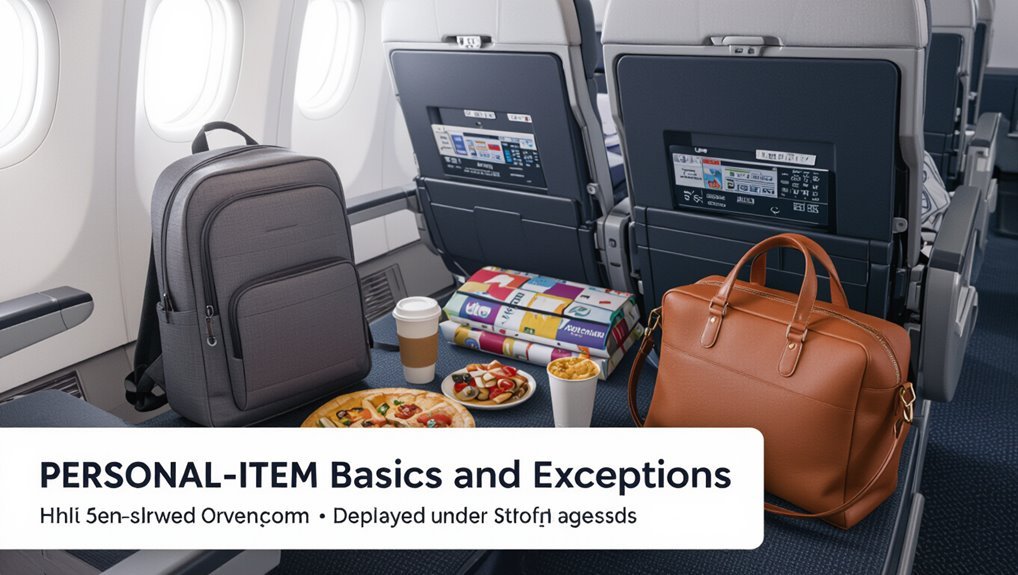
Because airlines and security rules vary, you’ll want a clear snapshot of what counts as a personal item and when exceptions apply.
This guide answers which small bags typically qualify, which items are allowed onboard regardless of size (like medical devices and infant essentials), and how gate agents or TSA may interpret rules.
You’ll learn practical tips for avoiding surprises and packing efficiently.
Quick Answer: What Counts as a Personal Item on a Plane
Most airlines treat a personal item as a small bag you can stow under the seat in front of you — think a backpack, tote, laptop bag, or large purse — and it should fit within the carrier’s size limits and contain items you’ll need during the flight.
You can also bring essentials like medication, travel documents, electronics, and a compact change of clothes.
Standard Personal-Item Size & Weight Ranges
Now that you know what typically counts as a personal item, you should check the size and weight limits before you pack.
Most airlines allow roughly 16–18 x 12–14 x 6–8 inches and weights from 7–15 lbs (3–7 kg).
Compact backpacks, slim tote bags, or laptop sleeves usually meet these limits; always measure and weigh your item to avoid surprises at the gate.
How Airlines Decide Personal Item vs Carry-On (Fees & Rules)
You’ll find airlines mostly look at size and dimensions first to decide if an item counts as a personal item or a carry-on.
They’ll also consider contents and purpose—like a laptop bag or handbag versus a small suitcase—since some items get exceptions.
Knowing both measurements and what you’re carrying helps you avoid unexpected fees.
Size And Dimensions
Airlines classify a bag as a personal item or a carry-on mainly by its dimensions and how it fits under the seat or in the cabin bin, so you should check exact size limits before you pack.
Measure length, width, height including handles and wheels. Slim backpacks, purses, laptop bags often qualify.
Overly large items may be forced into overhead bins or gate-checked.
Contents And Purpose
Think of a personal item as whatever you need quick access to or that’s crucial for the flight—medications, travel documents, electronics, and a small change of clothes are common examples.
Airlines judge items by purpose and practicality: if it’s essential, compact, and fits under the seat, it’s a personal item.
Larger or duplicate items become carry-ons and may incur fees.
How to Measure Your Bag Fast at Home or the Airport
You can measure your bag quickly by checking its length, width, and height against the airline’s size limits.
Use a tape measure, a ruler, or even a phone app to get fast, accurate numbers.
If your dimensions exceed the allowed personal item size, you’ll know whether to stash items or upgrade to a carry-on.
Measure Bag Dimensions Quickly
Need to size your bag fast? Stand it upright, measure height from base to top, then width across the widest points, and depth from front to back including pockets.
Record rigid handles or wheels that add length. If under airline limits, you’re set; if not, compress soft sides or remove bulky items and remeasure.
Quick checks prevent surprises at the gate.
Use Simple Tools Fast
Once you’ve done a quick size check, grab a few simple tools—tape measure, ruler, or even a piece of string and your phone—to get precise dimensions at home or the gate.
Lay the bag flat, measure height, width, depth at widest points, and note any protruding handles.
Record numbers in your phone for quick reference before boarding or packing.
Check Airline Size Limits
Before you head to the gate, check your airline’s specific size limits—carry-on and personal-item dimensions vary by carrier and fare class, and overstaying them can mean gate-checking or extra fees.
Measure length, width, depth including wheels and handles. Use a tape, ruler, or a marked box; if unsure, test-fit under your seat or in the overhead bin mock-up to avoid surprises.
What Fits Under the Seat: Practical Space Tips
When you board, think of the space under the seat as a shallow drawer: it fits a slim backpack, tote, or briefcase laid flat, plus a small personal item like a purse or laptop sleeve.
Slide items flat, keep liquids upright in a clear bag, and avoid bulky tripods or large shopping bags.
Stow essentials you’ll need during the flight.
Laptop Bags & Briefcases as Personal Items
When you pack a laptop bag or briefcase as your personal item, check its dimensions to make sure it fits under the seat.
Keep only permitted items inside—electronics, chargers, documents, and a few small personal effects—to speed security screening.
If you also have a carry-on, plan what goes where so you don’t exceed size limits or duplicate bulky items.
Size And Fit
Think of your laptop bag or briefcase as a strict carry-on companion: it needs to fit under the seat or in the overhead bin without crowding other passengers.
Measure dimensions before travel, including handles and wheels. Choose slim, structured designs that slide under seats easily.
If an airline enforces strict limits, be ready to gate-check oversized items to avoid delays or fees.
Allowed Contents
Although airlines vary, you can generally carry electronics, documents, basic toiletries, medications, and small personal items in a laptop bag or briefcase; just keep liquids within the 3-1-1 rule and any sharp objects packed according to security rules.
You should also stow chargers, headphones, wallets, and travel-size cosmetics. Avoid oversized items, valuables in checked bags, and anything prohibited by TSA or airline policy.
Carry-On Combining
If you plan to bring both a suitcase and a laptop bag or briefcase, know that airlines treat those small bags differently: most allow one carry-on plus one personal item, and your laptop bag usually counts as the personal item as long as it fits under the seat.
Pack essentials in the laptop bag, keep documents handy, and check size rules before you fly.
- Laptop + suitcase = standard combo
- Fit under seat = personal item
- Measure to avoid gate checks
Backpacks: Personal Item vs Carry-On – How to Tell?
One simple way to tell whether your backpack counts as a personal item or a carry-on is to check its size and where you plan to stow it: personal items are smaller and fit under the seat in front of you, while carry-ons are larger and go in the overhead bin.
Measure dimensions, test under-seat fit, and review your airline’s rules—if it fits under the seat, you’re fine.
Purses, Totes & Crossbody Bags That Qualify
When you’re picking a purse, tote, or crossbody as your personal item, check the airline’s size and dimension limits so it fits under the seat.
Choose structured materials that hold their shape and protect contents without bulking up.
Also note carrying style rules—some carriers restrict oversized totes or shoulder bags that hang off the seat.
Size And Dimensions
Although airlines vary, most let you bring a purse, tote, or crossbody as your personal item as long as it fits under the seat in front of you; typical maximum dimensions are about 18 x 14 x 8 inches (45 x 35 x 20 cm) but budget carriers often enforce smaller limits.
Choose a bag that’s streamlined and light.
- Measure before you fly
- Consider compressible styles
- Keep essentials organized
Material And Structure
After you’ve confirmed size and fit, check what the bag’s made of and how it’s built—those details determine whether a purse, tote, or crossbody will hold up under airline handling and still slide under the seat.
Choose durable fabrics (nylon, leather, canvas), reinforced seams, and sturdy zippers.
Structured bags keep shape and protect contents, while lightweight padding prevents crushing without adding bulk.
Carrying Style Limits
Because airlines limit what counts as a personal item, pick a carrying style that fits both their rules and your needs: small purses, compact totes, and slim crossbody bags usually qualify if they sit low enough to slide under the seat and meet size limits.
You should choose lightweight, structured pieces that compress when needed and keep essentials accessible.
- Slim crossbody
- Compact tote
- Small structured purse
Diaper Bags & Baby Gear: Allowances and Exceptions
When you’re traveling with infants or toddlers, airlines and security agencies generally let you bring diaper bags and essential baby gear in addition to your standard personal item, though specific size and quantity rules vary by carrier.
You can usually carry a diaper bag plus a collapsible stroller or car seat, but confirm limits, gate-checking policies, and whether items count toward carry-on allowances to avoid surprises.
Duty-Free Purchases: Carrying Them as Personal Items
If you’ve packed a diaper bag or stowed a stroller, you’ll also want to think about how duty-free purchases fit into your carry items.
You can usually carry sealed duty-free bags as personal items, but rules vary by airline and connection.
Keep receipts, keep liquids sealed, and confirm size limits before boarding.
- Keep receipts accessible
- Leave items sealed
- Check airline rules
Medical Devices Treated as Personal Items
Although airlines and security staff have specific rules, you can usually carry essential medical devices—like CPAP machines, mobility aids, insulin pumps, and portable oxygen—as your personal item without gate check.
Check airline policies and TSA guidelines, notify staff at check-in or boarding, pack batteries or chargers separately, and bring documentation if needed.
Keep devices accessible for inspections and in-flight use.
Mobility Aids: What Airlines Will Carry for You
Because airlines recognize the importance of mobility aids, most will carry items like wheelchairs, walkers, canes, and crutches free of charge and transport them to the aircraft door or gate.
They often store them in the cabin or cargo hold as needed. You should notify the airline in advance, tag items at check-in, and understand retrieval procedures.
- Wheelchairs
- Walkers
- Canes/crutches
Camera Bags, Instruments & Hobby Gear Rules
You’ll want to know how camera bag size limits affect whether your gear counts as a personal item or carry-on.
Check airline rules for carrying musical instruments, since policies and fees vary widely.
Also confirm restrictions for sporting and hobby gear to avoid surprises at the gate.
Camera Bag Size Limits
Many airlines let you bring a camera bag as a personal item, but size and placement rules vary, so check limits before you pack.
You should measure your bag, consider padded gear taking space, and confirm stowage under the seat. If oversized, expect gate-checking or carry-on fees; pack lenses and batteries in carry-on-compliant cases.
- Measure dimensions precisely
- Protect fragile gear
- Know battery rules
Carrying Musical Instruments
Just as you checked camera-bag dimensions and battery rules, you should confirm how airlines handle musical instruments before you fly.
Treat instruments as either a personal item or carry-on depending on size and fare class. Bring a hard case, measure dimensions, and call the airline if unsure.
Consider gate-checking larger pieces or purchasing a seat for fragile, valuable instruments to avoid damage.
Sporting And Hobby Gear
When packing gear for a trip, know that airlines treat camera bags, instruments, and hobby equipment differently from regular carry-ons.
So check size limits, battery rules, and any special handling policies before you get to the airport.
You should pack fragile items in padded cases, declare large instruments at check-in, and carry lithium batteries in carry-on only.
- Use padded cases
- Declare oversized items
- Carry batteries onboard
Food, Snacks & Sealed Liquids Allowed as Personal Items
If you’re packing food for a flight, you can bring solid snacks and factory-sealed beverages as part of your personal item, subject to security rules and airline size limits. You should pack perishables in coolers that fit under the seat and keep liquids over 3.4 oz sealed in checked luggage when required.
| Item | Allowed? | Tips |
|---|---|---|
| Sandwiches | Yes | Wrap tightly |
| Soda (sealed) | Yes | Follow size rules |
| Yogurt | No (liquid) | Check TSA limits |
Souvenirs & Shopping Hauls: Fitting Them Under the Seat
Souvenirs and shopping hauls can usually ride as your personal item as long as you pack smart and respect under-seat dimensions.
Compress soft items into a tote or packing cube, place fragile purchases between clothing layers, and keep receipts accessible for security.
Travel with one compact bag to avoid gate checks and unexpected fees.
- Compress soft items
- Cushion fragile souvenirs
- Keep receipts handy
Airlines That Allow Larger-Than-Average Personal Items
You’ll want to know which airlines let you bring a larger-than-average personal item so you can pack smarter and avoid gate-checking.
Compare their allowances and how those sizes stack up against standard carry-on dimensions to spot the best options.
Use packing cubes, roll clothes, and prioritize heavy items in your personal bag to maximize the space you’re allowed.
Airlines With Generous Allowances
While many carriers stick to tight size limits for personal items, a few airlines give you noticeably more space—both in dimensions and flexibility—so you can bring a small backpack, tote, or rolling personal bag without gate-checking.
You’ll find these carriers let you pack essentials, gadgets, and a light jacket with fewer surprises at boarding.
- JetBlue
- Alaska Airlines
- Southwest
Carry-On Size Comparisons
Compare a few key carriers side-by-side to see exactly how much extra room you get when an airline labels a personal item as “larger-than-average.”
You’ll notice some domestic low-cost airlines permit wider or deeper bags — often by a few inches — while certain international carriers allow noticeably taller items.
Check exact dimensions per airline, as allowances vary and determine what fits under or beside your seat.
Tips For Maximizing Space
Now that you’ve seen how dimensions differ across carriers, let’s look at practical ways to take full advantage of airlines that allow larger-than-average personal items.
You can pack smarter, prioritize essentials, and avoid gate check stress by choosing expandable bags, rolling clothes tightly, and using packing cubes.
Follow permit limits and carry fragile items onboard.
- Choose expandable, structured bags
- Use packing cubes and compression
- Pack valuables and documents onboard
Airlines Known for Strict Personal-Item Enforcement
Because carriers set their own carry-on limits, some airlines enforce personal-item rules more strictly than others. You’ll notice differences in gate checks, boarding-zone scrutiny, and fee policies.
Expect tighter size checks on full flights, staff measuring bags at the gate, and strict overhead-bin policies.
Familiarize yourself with airline-specific limits before travel, pack compactly, and have a backup plan if your item is flagged.
Low-Cost Carriers: Common Personal-Item Fee Traps
When you fly budget airlines, small differences in baggage rules can turn into surprise charges—many low-cost carriers advertise a free “personal item” but then limit dimensions, require it to fit under the seat, or charge for anything that looks like a second bag.
You should measure, pack light, and know policies to avoid fees.
- Oversized laptop bags
- Packed totes that look like carry-ons
- Strollers counted as bags
International Flights: Different Expectations and Limits
When you fly internationally, remember carry-on and personal-item rules can differ, so check which bag counts as which.
Countries and airlines set their own size, weight, and allowance limits, and you’ll want to confirm those before packing.
Also factor in security screening and customs rules that can affect what you can carry on or must declare.
Carry-On Versus Personal
If you’re flying internationally, expect stricter and more varied rules for carry-ons and personal items than on domestic routes, since airlines and countries set their own size, weight, and content limits.
You’ll need to confirm which bag counts as your personal item versus carry-on and pack accordingly. Check dimensions, weight, and prohibited items before you arrive.
- Measure bags precisely
- Weigh to avoid fees
- Know restricted contents
Country-Specific Allowances
Rules that apply on domestic routes won’t always hold up abroad, so you should check each country’s allowances before packing.
Airlines and countries set different size, weight, and item rules for personal items. Review your carrier’s international policy and destination regulations for electronics, liquids, duty-free, and medical supplies.
Confirm dimensions and allowed contents to avoid surprises, fees, or forced gate check.
Security And Customs
Because international security and customs procedures vary widely, you should prepare for different screening practices and documentation checks than you see on domestic flights.
Pack transparently, keep receipts and prescriptions handy, and know prohibited items for both countries. Expect stricter liquid rules, electronic device inspections, and declaration forms.
- Pack documents accessibly
- Separate liquids and meds
- Declare valuables when required
Code-Share & Alliance Flights: Which Policy Applies?
When you’re booked on a code-share or alliance flight, the operating carrier’s personal-item rules generally take precedence, though fare conditions and the marketing carrier’s policies can still affect what you’re allowed to carry; always check both airlines before you travel.
You should confirm size, weight, and prohibited-item lists with the operating airline, note tier or fare exceptions, and print or save confirmations to avoid gate disputes.
Seat Selection and Whether Your Item Will Fit Under the Seat
When you pick your seat, think about seat pitch and how much clearance you’ll actually have under the seat in front of you.
Compare your bag’s dimensions to that space, since some aisles and bulkhead areas offer less room than they look.
Also watch for underseat obstructions like life vests, electronics boxes, or seat supports that can eat into usable space.
Seat Pitch And Clearance
Seat pitch and under-seat clearance determine whether your personal item can actually stow where you need it, so check both before you pick a seat.
Measure height and length under the seat, consider recline from the row ahead, and account for legroom. Choose seats with open space or bulkhead restrictions in mind.
- Measure before boarding
- Watch recline impact
- Pick roomy rows
Bag Dimensions Versus Space
Pick a bag that actually fits the space: measure your personal item’s length, width, and height and compare those numbers to the under-seat and overhead clearances for your chosen row before you select a seat.
Choose aisles or bulkhead seats based on clearance; remember recline and tray stowage affect fit, and pack to allow quick sliding under the seat without blocking access.
Underseat Obstructions
Because underseat space varies by row and aircraft, check for obstructions—life vests, speaker boxes, wiring, or bulkhead supports—before assuming your bag will slide under.
You’ll want to select a seat with genuine underseat clearance, measure your bag, and stow bulky items in overhead bins if needed.
Plan for access during flight and respect crew directions.
- Check row type
- Measure bag
- Be ready to relocate
Tips for Stowing Personal Items on Regional & Small Jets
When you board a regional or small jet, think ahead about where your personal item will go—overhead bins are tiny and under-seat space can be limited, so you’ll want a compact bag that slides easily beneath the seat in front of you or a soft-sided tote that can be squeezed into an overhead compartment.
Place heavier items under the seat, keep essentials accessible, and stow bulky gear early to avoid gate-checking.
Packing Habits That Reliably Keep Items Small Enough
Pick dual-purpose items so you carry less and still cover your needs.
Use packing cubes to compress clothing and keep everything organized.
Cut bulk toiletries down to travel sizes or solid alternatives to save serious space.
Choose Dual-Purpose Items
If you focus on multipurpose items, you’ll carry less without sacrificing function: choose a scarf that doubles as a blanket, a phone charger that’s also a battery pack, or a jacket with ample pockets so you skip a bag.
Pick items that replace single-use gear, prioritize lightweight combos, and test comfort before travel.
- Convertible scarf/blanket
- Charger+power bank
- Jacket with hidden pockets
Compress With Packing Cubes
Start by slipping your clothes into packing cubes—compressing them into neat, space-saving blocks that make a tiny carry-on behave like a magician’s hat.
You’ll group outfits, protect delicate items, and spot what you need without rummaging. Choose varied cube sizes, squeeze air out, and stack them to fit corners and under seats.
That disciplined packing keeps your personal item compact and compliant.
Limit Bulk Toiletries
One simple rule keeps toiletries from ballooning your personal item: swap bulky bottles for travel-sized essentials and multi-use products.
You’ll pack lighter, speed through security, and avoid checked-bag hassles by limiting liquids and choosing solids. Keep items compact and organized so they’re accessible.
- Solid shampoo/conditioner bars
- 100ml reusable travel bottles
- Multipurpose balm (face, lips, cuticles)
Combining a Personal Item and Carry-On: Smart Balancing
Balancing a personal item and a carry-on lets you take more without checking baggage, so plan what goes where before you pack.
Put essentials—documents, medications, valuables—in your personal item for quick access and security.
Pack essentials—documents, medications, and valuables—in your personal item for quick access and added security.
Use the carry-on for bulkier items and extras like shoes or electronics.
Distribute weight evenly to fit airline size limits and avoid gate hassles.
When Gate Agents May Reclassify Your Bag : What to Expect
Be ready for gate agents to use their discretion when deciding if your bag counts as a personal item or a carry-on.
They’ll often make that call at boarding, especially when flights are full or the jetway is crowded.
If your bag looks close to the carry-on size limit, expect stricter enforcement and possible gate-checking.
Gate Agent Discretion
When a gate agent inspects your carry-on, they can reclassify it anytime if it clearly exceeds the airline’s personal-item size or stowage rules; you’ll usually be asked to check it or pay a carry-on fee.
Trust their call, stay polite, and know appeal options.
- Know the posted size limits
- Be ready to gate-check or pay
- Ask for manager if needed
Timing And Crowding
Gate agents don’t only check bags against posted sizes; they also reclassify items based on timing and how crowded the gate area is.
If boarding’s busy or overhead space is scarce, you may be asked to gate-check a bag that would otherwise count as a personal item.
Move quickly, keep essentials accessible, and be ready to comply to avoid delays or missed boarding.
Carry-On Size Enforcement
If boarding gets hectic or overhead bins fill fast, agents can reclassify what you’re carrying and ask you to gate-check items that might otherwise fit as personal gear; expect a quick measurement or visual check and follow their instructions to keep boarding moving.
You should comply, pack smart, and know airline limits.
- Have dimensions ready
- Move oversized items promptly
- Gate-check politely and stash essentials
What to Do if the Agent Says Your Bag Is a Carry-On
Sometimes an agent will call your personal item a carry-on and ask you to gate-check it; stay calm and handle it efficiently so you don’t miss boarding.
Ask politely why, measure or compare quickly, and show dimensions if you’ve got them.
If they insist, decide whether to gate-check or consolidate essentials into your pockets.
Keep receipts and note the agent’s name.
When and How to Gate-Check a Personal Item Safely
When an agent asks you to check your personal item at the gate, act quickly and deliberately to protect valuable or fragile contents: secure or remove electronics, jewelry, and documents; use a visible tag or ask for a fragile sticker; request a receipt and confirm delivery to the jet bridge or baggage claim.
- Remove laptops and passports
- Wrap fragile items in clothing
- Ask for a gate-check tag and receipt
Apps and Tools to Check Personal-Item Rules Quickly
Because airline rules change often, you’ll want quick tools that tell you whether a bag qualifies as a personal item and what to expect at the gate.
Use airline apps for size limits, carry-on calculators to compare dimensions, and scanner tools to photograph and measure bags.
Check frequent traveler forums and aggregator sites for recent gate experiences and enforcement trends before you pack.
Airline Fine-Print: Policy Language to Look For
As you scan airline policies, focus on the specific terms and exclusions that determine what counts as a personal item—words like “must fit under the seat,” “no additional personal item,” “subject to size and weight limits,” and “at gate discretion” change how strictly an item will be enforced.
Read definitions, exclusions, and enforcement notes so you pack accordingly.
- defined dimensions and weights
- listed exclusions (e.g., instruments)
- enforcement and gate-check rules
Loyalty Status & Fare Class: How Rules Can Change
Those policy details you just reviewed can still be applied unevenly depending on your loyalty status and fare class.
If you’re elite, you may get larger or extra personal items free; higher fare families often include more generous allowances.
Discount or basic fares and nonstatus flyers usually face stricter size or count limits.
Travelers on discount or basic fares—especially without status—typically encounter tighter size and item limits.
Always verify your booking’s specific baggage entitlements before travel.
Buying or Modifying a Bag to Meet Most Airline Rules
If your current bag doesn’t meet an airline’s personal-item rules, you can either buy a compliant bag or modify what you already own to avoid gate-checks and fees.
Choose a slim tote or backpack under size limits, remove bulky straps or frames, and compress contents with packing cubes.
Check dimensions before travel to avoid surprises.
- Slim tote or compact backpack
- Remove/alter bulky hardware
- Use packing cubes
Eco-Friendly Tips to Keep Your Personal Item Small
Once you’ve slimmed down your bag or modified its hardware, think about sustainable swaps that keep items compact and reduce waste.
Pack multi-use toiletries in reusable silicone travel tubes, choose a collapsible water bottle, and use a slim solar charger or shared power bank.
Replace bulky paper with a lightweight e-reader and carry washable cloths instead of disposable wipes to cut weight and trash.
Security Screening: What Happens to Personal Items at TSA/CBP
When you reach TSA or CBP screening, agents will separate and inspect your personal item to guarantee it doesn’t contain prohibited objects or pose a security risk. They’ll ask you to remove electronics, liquids, and sometimes shoes or outerwear for X-ray or manual inspection.
You should cooperate, declare restricted items, and retrieve belongings promptly.
- Remove electronics and large liquids
- Expect random hand inspections
- Keep receipts and IDs handy
International Customs: Bringing Duty-Free as a Personal Item
After screening, you’ll still need to evaluate customs rules if you bring duty‑free purchases onboard, because allowances, declarations, and prohibited items vary by country and can affect what you can carry as a personal item. Check limits, keep receipts, and declare when required to avoid fines or confiscation.
| Item | Limit | Tip |
|---|---|---|
| Alcohol | Varies | Keep sealed |
| Tobacco | Varies | Declare |
| Food | Often restricted | Check rules |
Photo Examples: Borderline Personal Items and Quick Fixes
If an item looks like it might be too big or too bulky to count as a personal item, compare it to the photos below and try one quick fix — compress, detach, or stash — before you reach the gate.
You’ll spot common borderline pieces and practical tweaks to meet size rules. Try these visuals and fixes:
- Compress soft bags into smaller profiles
- Detach straps or removable pockets
- Stash slim items under a coat
Real Passenger Stories: Gate Disputes and Resolutions
Anyone who’s traveled knows gate disputes happen—sometimes you can settle them without drama, other times they turn into a stubborn standoff.
You might calmly show your bag fits under the seat, trade seats with a fellow passenger, or accept gate-checking to avoid delay.
If staff misapply a rule, politely ask for supervisor review; clear photos and receipts often resolve the issue fast.
Checklist to Confirm Your Item Will Be Accepted as a Personal Item
Before you reach the gate, run through a short checklist to confirm your item counts as a personal item and won’t be gate‑checked or rejected.
Check carrier size limits, including strap or pocket protrusions. Confirm permitted contents (no restricted items).
Verify it fits under the seat when packed; test by placing it under a chair or similar space if possible.
- Measure dimensions
- Inspect contents
- Test fit under seat
Preventing Surprise Fees: Proactive Steps Before Check-In
Although airline rules change fast, you can avoid surprise fees by checking your carrier’s baggage policy, seat class allowances, and any ancillary charges at least 24 hours before check-in. Confirm dimensions, weight, and carry-on counts, print receipts, and prepay fees if needed. Review loyalty benefits and credit-card perks to skip charges.
| Item | Action |
|---|---|
| Dimensions | Measure |
| Fees | Prepay |
Quick Reference: Common Airline Personal-Item Limits
When you’re packing, remember that “personal item” rules vary widely by airline and fare class, so check dimensions and weight limits for carriers you’ll use—most allow a small bag that fits under the seat, typically about 9x14x18 inches (23x35x45 cm) or similar.
You’ll usually see:
- Domestic budget: strict size, low weight
- Legacy carriers: slightly larger allowed
- International: varies, often stricter
Frequently Asked Questions
Can I Bring Duty-Free Liquids in My Personal Item on International Flights?
Yes — you can usually carry duty-free liquids in your personal item on international flights, as long as they’re sealed in tamper-evident bags with receipts and you follow airline and destination security rules; restrictions may still apply.
Are Wearable Items (Jackets, Baby Carriers) Considered Personal Items?
Yes — you can usually wear jackets and baby carriers without them counting as your personal item, but airlines vary; check specific carrier rules and gate agents might ask you to stow bulky items if cabin space is limited.
Can I Carry Pet Supplies or a Small Pet Carrier as a Personal Item?
Usually you can, but it depends on the airline and size; you’ll often be allowed pet supplies and a small carrier that fits under the seat, though you should check airline rules and gate agent policies beforehand.
Do Personal-Item Rules Apply to Codeshare Segments With Different Carriers?
Yes — you’ll follow the operating carrier’s personal-item rules for each flight segment, even on codeshares. Check both airlines’ policies before travel, and pack to meet the stricter carrier’s size and allowance to avoid issues.
Will Boarding Group or Seat Row Guarantee Under-Seat Space for My Personal Item?
Not necessarily — boarding group or row doesn’t guarantee under-seat space. You’ll want to board early, choose an aisle/window with less obstruction, or request gate/flight attendant help; overhead bin space isn’t affected by row alone.
Conclusion
Now you know what counts as a personal item, typical size and weight ranges, and how airlines draw the line between a personal item and a carry-on. Use the measuring tips, checklist, and proactive steps to avoid gate hassles and surprise fees. Measure before you travel, pack smart, and have a backup plan (like a lightweight tote). When in doubt, check your airline’s specific policy so you’re not stuck paying or repacking at the gate.