Is Cream Allowed in Hand Luggage and Liquid Limits Explained
Yes — you can carry creams in hand luggage, but each container must be 100 ml (3.4 oz) or less and all your creams, gels and liquids must fit into a single clear resealable 1‑liter bag. Solid balms and duty‑free items in sealed tamper‑evident bags may be exempt, and medical creams get special consideration. Keep containers labeled, caps on, and present the bag separately at security; continue for practical packing tips and exceptions.
Quick Answer: Is Cream Allowed in Hand Luggage?
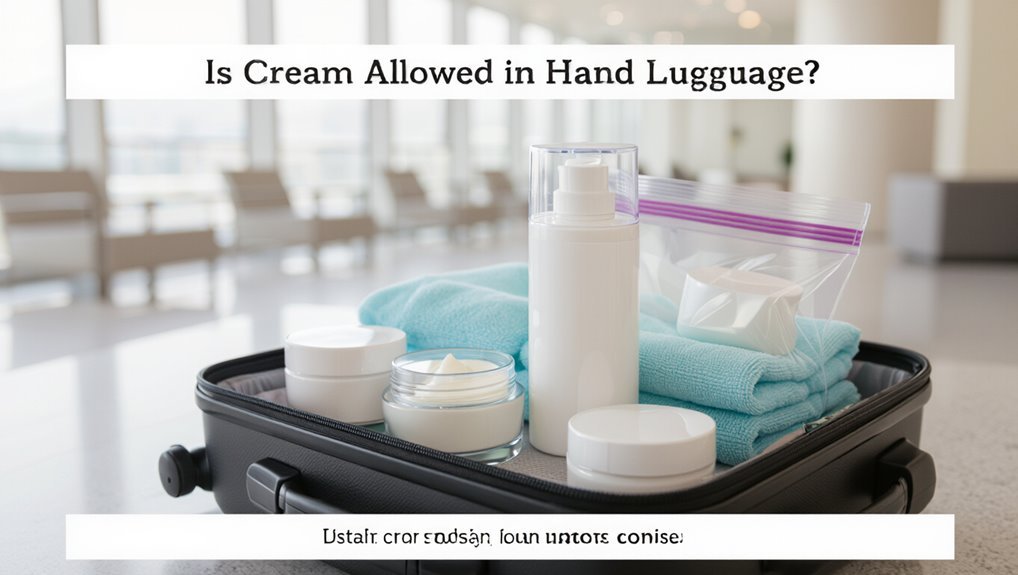
Wondering whether you can bring cream in your carry-on? Yes, but it must follow liquid rules: containers no larger than 100 ml (3.4 oz), fit inside a single clear resealable bag, and comply with airport security.
Solid creams or sealed retail items often pass if within limits. Always check specific airline and country rules before packing to avoid delays or confiscation.
Primary Intent: Quick Answer Plus Step-by-Step Guide
How should you pack cream in your carry-on to meet security rules and avoid delays?
Pack travel-size containers (≤100ml), seal lids tightly, place each in a clear, resealable 1‑litre bag, and present it separately at security.
If you need more, check it in or obtain duty-free after screening.
Label containers if possible and keep receipts for medical creams.
How Aviation Authorities Define Liquids, Gels, and Creams
When you check rules for creams in hand luggage, you’ll first see how regulators define “liquids, gels, and creams” and why those categories matter.
Agencies use simple consistency tests to classify a product’s texture and behavior under pressure or when spread.
You’ll also need to follow strict measurement and packaging rules—like container size limits and clear bag requirements—so pack accordingly.
Regulatory Definitions Overview
Because security rules hinge on categories, you should know exactly how aviation authorities classify liquids, gels, and creams: they’re generally defined by texture and pourability — liquids flow freely, gels hold shape but deform under pressure, and creams sit between the two — and these classifications determine allowance, container limits, and screening procedures.
| Type | Typical examples |
|---|---|
| Liquid | Water, perfume |
| Gel/Cream | Hair gel, hand cream |
Product Consistency Tests
Although definitions vary slightly by authority, aviation security teams use simple, hands-on consistency tests to decide if a product counts as a liquid, gel, or cream.
You’ll be asked to squeeze, spread, or invert containers: pourable or dripping items are treated as liquids; wobble or hold shape items are gels; thicker, non-flowing substances classify as creams.
Follow instructions to avoid delays.
Measurement And Packaging Rules
If you’re packing creams for carry-on, aviation authorities set clear measurement and packaging rules so security can quickly decide what stays and what goes; typically each container must be 100 milliliters (3.4 ounces) or less and all containers need to fit comfortably in a single, transparent, resealable plastic bag of about one liter capacity.
You should:
- Label containers clearly.
- Keep original caps.
- Combine samples cautiously.
- Present bag separately.
- Check local variations.
Why the 100ml Rule Exists and Who Enforces It
You’ll see the 100ml limit came from safety risk assessments that aim to prevent liquid explosives being carried onboard.
Authorities like national aviation regulators and airport security agencies enforce the rule at checkpoints.
Knowing who sets and enforces the limit helps you understand why it’s applied consistently.
Safety Risk Assessment
Because liquids can be turned into explosive aerosols or used to conceal dangerous materials, airports limit carry-on creams to 100 ml to reduce risk while keeping screening practical.
You should assess products for volume, composition, packaging, threat potential, and detectability.
Follow screening guidance and pack accordingly.
- Volume thresholds
- Chemical properties
- Packaging integrity
- Concealment risk
- Screening visibility
Regulatory Enforcement Bodies
When regulators set the 100 ml limit, they’re balancing security, screening practicality, and international harmonization; airlines, airport authorities, and national aviation security agencies then enforce that rule at checkpoints. You should follow limits, declare exceptions, and cooperate during inspections. Enforcement varies by country but aims to keep screenings consistent and efficient.
| Body | Role |
|---|---|
| Airlines | Policy, passenger checks |
| Airports | Screening operations |
| Security Agencies | Regulation, penalties |
| TSA/EU | Standards, guidance |
| You | Compliance, packing choices |
How the 100ml Limit Actually Works
Most airlines let you carry creams in hand luggage as long as each container holds 100 ml (or less) and you place them all in a single, transparent, resealable plastic bag that fits airport rules.
You should measure bottles, seal lids, and present the bag separately at security.
- check volumes
- tighten caps
- avoid bulky containers
- label if needed
- keep accessible
Why All Containers Must Fit a Single 1‑Liter Clear Bag
Although the 100 ml rule limits individual containers, airports require you to put all your liquids and creams into a single 1‑liter clear bag so security officers can quickly scan and verify contents without opening each item.
You’ll speed up screening, reduce handling, and avoid delays or confiscation. Packing neatly in one bag keeps inspections efficient and helps you move through security with fewer issues.
Which Creams Are Treated as Liquids at Security?
If you’re wondering what counts as a liquid at security, think regarding consistency and container: creams, lotions, gels, pastes, and anything you can squeeze, smear, or pump out will generally be treated as a liquid and must follow the 100 ml and single 1‑liter bag rule.
- Tube or pump dispensers
- Soft jars
- Squeezable sachets
- Roll‑on or stick creams
- Semi‑solid balms
Examples of Creams Counted as Liquids (Moisturizers, Ointments, Sunscreen)
When you pack your toiletries, remember that everyday moisturizers, ointments, and sunscreens are treated as liquids at security and must fit the 100 ml/container and single 1‑liter bag rule.
That includes facial creams, body lotions, medicated ointments, zinc or chemical sunscreens, after‑sun gels, and BB or CC creams.
Pack travel sizes, label medications, and place items visibly in your clear bag.
Cosmetic Exceptions: Which Products May Be Screened Differently and Why
Beyond the standard 100 ml rule, some cosmetics can be handled differently at security because of their form, purpose, or packaging.
You should expect exceptions for items that aren’t liquid-like, medically necessary products, duty-free sealed purchases, solid makeup sticks, and small sample pots—provided you declare them when asked and follow officer instructions.
- Solid balms and sticks
- Medical creams
- Sealed duty-free
- Compact powders
- Travel-size samples
How to Read Product Labels to Spot Liquid-Like Formulations
Because security distinguishes liquids by texture and ingredients, you should learn to spot labels that reveal liquid-like formulations.
Check ingredient lists for water (aqua), alcohol, oil blends, glycerin, and emulsifiers like cetyl or stearyl alcohol.
Look for “gel,” “serum,” “lotion,” or “creamy liquid” descriptors and viscosity clues.
If uncertain, treat the product as a liquid for packing.
Pack Multiple Creams to Meet the 1‑Liter Rule
If you’ve identified which products behave like liquids, plan how to combine them so you don’t exceed the 1‑liter bag limit.
Measure volumes, prioritize essentials, and redistribute to stay compliant. Use travel‑size jars and label contents. Keep totals visible for quick checks at security.
- Check each container’s milliliters
- Prioritize daily necessities
- Share bulk between bottles
- Opt for smaller tubes
- Record totals before packing
What Counts as an Acceptable Clear Resealable Bag?
When you prepare your liquids and creams for security, choose a clear resealable bag that’s transparent, fully closable, and sized to meet your airline’s 1‑liter (or 1‑quart) requirement so officers can quickly inspect contents.
Use durable plastic with a reliable zip seal, avoid colored or opaque pouches, and guarantee items fit without overstuffing.
Replace torn bags and present them separately during screening.
How to Handle Full-Size Jars Versus Travel-Size Tubes
If you pack a full-size jar of cream, you’ll usually have to stow it in checked luggage because it exceeds the typical 100 ml limit for carry-ons.
Opt for travel-size tubes or decant a small amount into compliant containers so you can keep your essentials in a clear resealable bag.
Check airline and security rules before you travel, since some carriers may have stricter limits.
Full-Size Jar Restrictions
Full-size jars often exceed the liquids rule, so you’ll need to transfer creams into travel-size tubes or place the jar in checked baggage to avoid having it confiscated at security.
You should inspect labels, declare dermatological products, and pack smartly to speed screening.
- Check volume markings
- Use leak-proof seals
- Keep receipts for prescriptions
- Pack in clear bags
- Label contents clearly
Travel-Size Tube Options
One simple swap can save you time and headaches at security: transfer creams from jars into TSA-compliant travel-size tubes or buy the same product in a mini tube.
You’ll pack lighter, fit within the 100ml/3.4oz rule, and present items in the clear bag easily.
Label tubes, avoid cross-contamination, and check capacity so you don’t risk confiscation.
Can You Bring Creams Over 100ml in Checked Baggage?
Can you pack creams larger than 100 ml in your checked baggage? Yes, you can, but you should follow airline and destination rules, secure lids, and bag leaks.
Yes — creams over 100 ml are fine in checked luggage; follow airline rules, seal lids, and prevent leaks.
Declare restricted substances if required and know duty rules for alcohol-based products.
- Check airline allowance
- Seal containers tightly
- Use leak-proof bags
- Declare when needed
- Know destination regulations
What to Do If Your Cream Is Sold in a Pump Bottle
If your cream comes in a pump bottle, check the volume—many airports allow pumps but only if they’re 100 ml (3.4 oz) or less for hand luggage.
If it’s bigger, you’ll need to transfer the product into a clear, resealable travel container that meets the 100 ml limit.
Keep the original bottle for checked luggage or dispose of it before security to avoid delays.
Pump Bottle Allowed?
When your cream comes in a pump bottle, you’ll still need to follow the 100 ml/3.4 oz liquids rule for carry-ons, so check the bottle’s capacity before packing.
If it’s over the limit, you can’t bring it through security. If it’s within, seal it and place it in a clear bag.
Consider airline rules and destination restrictions.
- Check capacity
- Seal pump
- Use clear bag
- Confirm airline
- Know limits
Transfer To Travel Container?
If your pump bottle is larger than 100 ml (3.4 oz) but you’d still like the cream in your carry-on, transfer it into a compliant travel container before you get to security.
Use a clean, leakproof 100 ml (3.4 oz) bottle or jar, label it if needed, and seal it in your quart-sized clear bag.
Dispose of or check the original.
How Solid Bars and Balms Are Treated at Security
Although solid bars and balms often seem exempt from liquid limits, security still inspects them closely and may treat them like gels if they’re soft or stored in containers, so pack with care.
Solid bars may seem exempt, but security can treat soft or containerized ones like gels—pack carefully.
- Keep bars dry and solid
- Use original packaging when possible
- Avoid bulky tins that look like creams
- Expect removal for screening
- Label ingredients to speed checks
When Ointments and Pastes Are Considered Liquids
You’ll want to check texture and consistency first, since soft, spreadable ointments and pastes are usually treated like liquids.
Note how the product is packaged and dispensed—sprays, pumps, and squeeze tubes often trigger liquid rules.
Finally, remember security screens judge both appearance and container, so items that flow or can be squeezed through openings will likely be counted as liquids.
Texture And Consistency Test
When packing ointments or pastes, think about how their texture behaves under pressure and heat: containers that smear, squeeze, or flow are treated like liquids by airport security.
You should test firmness, temperature sensitivity, and spreadability to predict screening outcomes.
- Apply pressure to check for smearing
- Warm to see if it softens
- Squeeze tube gently
- Observe flow rate
- Note residue left behind
Container And Dispensing Method
After checking texture and how a product responds to pressure and heat, look at how it’s packaged and dispensed—those factors often decide whether an ointment or paste is treated as a liquid.
If it’s in a squeezable tube, pump, spray, or jar allowing flow or aerosolization, you’ll likely face liquid rules.
Solid sticks or sealed single-dose pods may be exempt.
Security Screening Criteria
How do security agents decide if an ointment or paste counts as a liquid? You should expect screening to assess texture, packaging, proposed use, odor, and volume.
Officers may swab, request opening, or test density. If it behaves like a fluid or fits liquid limits, it’s treated as one.
- Texture and spreadability
- Container type
- Declared purpose
- Odor/testable residue
- Measured volume
Rules for Medically Necessary Creams and Topical Medications
Because medically necessary creams and topical medications are treated differently from general liquids, you can usually carry them in your hand luggage even if they exceed the typical 100 ml limit—provided you follow airline and security rules.
Pack them separately for screening, declare them when asked, keep original labels, and carry only reasonable quantities for your trip.
Follow crew or security instructions.
How to Document Prescriptions and Letters for Medical Creams
When you travel with medically prescribed creams, document them clearly so security and airline staff can verify the need quickly; include a copy of the prescription or a physician’s letter that names the medication, dosage, and the medical condition.
Carry originals and copies, translate if needed, and keep documents accessible.
- Patient name and DOB
- Medication name and dosage
- Prescribing physician details
- Diagnosis or medical justification
- Date and signature
Baby Formula, Breast Milk, and Creams for Infants: Exceptions?
If you’re traveling with infants, security rules make special allowances for baby formula, breast milk, and creams used for childcare; you should still document any prescribed topical medications but expect relaxed quantity limits and separate screening for these items. You can carry reasonable amounts for the journey, declare them, and expect testing.
| Item | Screening |
|---|---|
| Formula | Separate inspection |
| Breast milk | Possible testing |
| Infant creams | Declare and screen |
| Ice packs | Allowed if frozen |
How to Declare Baby Creams and Liquids at Security
Although security officers generally expect you to declare baby creams and liquids, do so clearly and early in the screening process so they can inspect them without delaying you.
Declare baby creams and liquids early and clearly at screening so officers can inspect them without delay.
Explain quantities, present containers separately, keep receipts handy, and follow officer instructions.
- Say what it is
- Show containers openly
- Offer amounts in millilitres
- Keep items accessible
- Comply promptly with requests
Duty-Free Creams: Can You Carry Larger Sizes Onboard?
If you buy creams at duty-free, you can sometimes carry larger bottles onboard, but you’ll still need to follow airline and airport rules.
You’ll usually have to keep the items sealed in the tamper-evident bag and declare them at security if asked.
Check the specific carry-on declaration rules for your departure and transfer airports to avoid surprises.
Duty-Free Size Exceptions
When you buy creams in duty-free shops after clearing security, airlines and many airports let you carry sizes larger than the standard 100 ml in a sealed, tamper-evident bag (STEB), provided you keep the receipt and the bag remains sealed for the duration of your journey.
You should:
- Keep the original receipt visible
- Guarantee STEB is intact
- Verify airline rules
- Confirm transfer connections
- Present items if asked
Carry-On Declaration Rules
Curious whether that oversized duty‑free cream will clear security? You must declare purchases bought after security at the transfer desk or on the plane when requested.
Keep receipts accessible and place sealed duty‑free bags in your carry‑on. If connecting through countries with strict liquid rules, you’ll often need to show proof to retain exemptions; follow officer instructions promptly.
How Sealed Duty-Free Purchases Are Handled During Connecting Flights
Because connecting flights often mean passing through different security zones, you’ll need to know how sealed duty-free bags are treated at each transfer point.
You should keep receipts and original tamper-evident bags; declare purchases when needed; expect resealing or additional screening; follow airline rules; and check transfer airport policies.
- Keep receipt visible
- Maintain seal
- Expect screening
- Declare if asked
- Check airline rules
Airport Security: Country and Airline Differences
When you travel, remember that countries set different rules for creams in carry-on bags, so what’s allowed at one airport might be banned at another.
Airlines can also add their own restrictions or require special packaging, so check your carrier’s policy before you pack.
And be prepared for varying security screening procedures that may mean declaring or removing creams at the checkpoint.
Country-Specific Rules
While many countries follow the basic 100 ml/1 L liquids rule, security policies can vary enough that you should always check rules for the specific airport and airline you’ll use.
You should:
- Verify national exemptions for medications and baby food.
- Confirm container sealing and packaging requirements.
- Check duty-free allowances and transfer rules.
- Note differing enforcement strictness.
- Consult official airport or government sites before travel.
Airline Policy Variations
Although national security rules set the baseline, airlines can impose their own restrictions on creams and other toiletries in carry-on bags.
You should check your carrier’s policy before packing. Airlines may limit container sizes, total liquid allowances, or require declaration of medical creams.
Low-cost carriers and international flights often have stricter rules, so confirm limits and packaging to avoid delays or confiscation.
Security Screening Procedures
Because security procedures vary by country and airline, you’ll face different screening steps and presentation rules for creams and other toiletries, so check local guidelines before you pack.
You’ll usually need to present liquids separately, follow size limits, remove containers from bags, and accept additional inspections. Be prepared to dispose of noncompliant items.
- Present liquids in a clear bag
- Follow size limits
- Remove toiletries from carry-on
- Accept extra checks
- Know local rules
EU, UK, US Liquid Rules: Key Differences
If you’re flying between or within the EU, UK, or US, you’ll find similar liquid limits but important differences in container size, packaging rules, and enforcement that can affect what you can carry in hand luggage. You’ll follow 100 ml/100 g concepts, but rules on clear bags, carry-on counts, and enforcement vary—pack conservatively and expect checks.
| Region | Typical nuance |
|---|---|
| EU | Clear bag required |
| UK | Strict enforcement |
| US | Inspection focus |
| Tip | Pack 100 ml bottles only |
How to Check Specific Airline and Airport Policies Before Travel
Wondering whether your cream meets the rules at every step of your trip? Check airline and airport sites, contact customer service, and review security pages before you pack.
Confirm allowable sizes, packaging, and exceptions so you won’t be surprised at the checkpoint.
- Visit the airline FAQ
- Check departure and arrival airport rules
- Email or call customer service
- Review transit country regulations
- Save screenshots of policies
Packing Tips for Skincare Routines While Flying
When you pack your skincare for a flight, prioritize essentials, travel-size containers, and a clear, organized layout so you can breeze through security and stay refreshed on board.
Pack cleanser, moisturizer, SPF, lip balm, and any prescription items. Use leakproof zip bags, label bottles, and keep wipes handy.
Stow heavier jars in checked luggage and carry small, compliant containers in an accessible pouch.
Best Travel-Size Creams and How to Decant Them Safely
Because space and security rules are strict, choose travel-size creams that give the same benefits as your full-size products—think lightweight moisturizers for daytime, richer night creams, and a compact SPF—then decant into leakproof, clearly labeled containers no larger than 100 ml (3.4 oz).
Pack smart, seal caps with tape, and store in a clear bag for inspection.
- Use silicone travel jars
- Sterilize tools first
- Fill below rim
- Label with date
- Cushion against impact
Sunscreen Rules for Carry-On and Beach Trips
After you’ve decanted creams into travel-safe jars, sunscreen needs a bit more attention since it’s often larger, liquid, and sometimes restricted by airline rules.
You should pack SPF bottles 100ml/3.4oz or smaller in a clear resealable bag for carry-on, check larger tubs, and consider solid sticks or spray restrictions.
Label and declare if asked to speed security.
How to Transport Medicated Creams That Require Refrigeration
If your medicated cream needs refrigeration, plan ahead so temperature-sensitive potency stays intact during travel.
Carry a doctor’s note and prescription, use an insulated cooler bag with ice packs, pack the cream in a leakproof container, keep it in your carry-on, and alert cabin crew if you need extra assistance.
Store items upright and monitor temperature when possible.
What Happens at Security If Your Cream Is Flagged?
Sometimes security will flag creams for further inspection, and you’ll be asked to present them separately for screening.
Stay calm, follow officer instructions, and remove the container from your bag if requested. Officers may test, open, or x‑ray the item.
If it exceeds limits or is prohibited, they’ll confiscate it. You can retrieve allowed items after screening or at a designated point.
How to Politely Dispute a Screening Decision at the Checkpoint
Anyone can feel put on the spot when an agent flags your cream, but you can challenge the decision calmly and respectfully.
Stay polite, ask for a brief explanation, offer evidence like labels, request a supervisor if unsure, and accept final rulings.
If needed, note the agent’s name and follow up with the airline or authority later.
- Stay polite
- Ask why
- Show labels
- Request supervisor
- Note details
Options If You Need More Cream Than Allowed in Hand Luggage
Need more cream than the 100 ml limit allows?
Check regulations for medical or infant exemptions before you travel; carry documentation if applicable.
Consider concentrating product into a smaller container, transferring into multiple compliant travel-size jars, or using solid alternatives like balm sticks.
Label containers clearly and pack them in a transparent resealable bag to smooth the security screening process.
Using Checked Baggage, Shipping, or Local Purchases as Alternatives
If you need more cream than the hand-luggage limit allows, pack the extras in your checked baggage to avoid restrictions.
You can also ship creams ahead to your destination or plan to buy them locally if that’s easier.
We’ll compare the pros and cons of each option so you can pick the best approach.
Pack In Checked Baggage
When you want to travel with larger or liquid creams that won’t fit carry-on limits, pack them in checked baggage instead—just make sure containers are well sealed, cushioned, and placed upright to prevent leaks and spills.
Store creams in sturdy bags, wrap with clothing, and label fragile items so handlers take care.
- Use leakproof containers
- Cushion with soft items
- Place upright
- Seal with tape
- Label fragile
Ship Or Buy Locally
Although flying with large creams can be tricky, you’ve got solid alternatives: check the items in your luggage, ship them ahead, or buy replacements at your destination.
If checked baggage’s allowed size fits, pack securely. Use reliable couriers for time-sensitive or valuable creams, watch customs rules, and insure shipments.
Or save hassle: purchase trusted brands locally to meet weight limits and avoid delays.
Travel-Friendly Cream Containers and Leak-Proof Packing
Think small: choose sturdy, travel-sized cream containers that meet airline rules and won’t leak in your bag.
Think small: pack sturdy, airline-friendly travel cream containers that won’t leak or bulk up your bag.
You’ll pick screw-top jars, silicone tubes, or rigid pump bottles, label them, and place them in a clear quart-sized bag.
Seal lids with tape or heat-shrink bands and nest containers to save space.
- Screw-top jars
- Silicone tubes
- Pump bottles
- Heat-shrink bands
- Clear quart bag
How to Avoid Spills and Contamination in Your Luggage
Make sure you screw lids on tightly and press down any pump tops to prevent leaks.
Put creams in clear, leakproof bags so a single spill won’t soak the rest of your items.
Keep toiletries separated from clothes by packing them in a dedicated pouch or compartment.
Seal Containers Properly
When you pack creams and lotions, seal their containers tightly and add an extra layer of protection so you won’t end up with sticky clothes or ruined electronics.
Check caps, use tape on screw tops, invert tubes briefly to test, wrap fragile jars in soft cloth, and place small containers upright in a dedicated compartment.
- Check caps
- Tape screw tops
- Test by inverting
- Wrap jars
- Use dedicated compartment
Pack In Leakproof Bags
One simple step you should always take is slipping creams, lotions, and other liquids into clear, leakproof bags before they go into your luggage; that extra barrier keeps spills contained, protects clothes and electronics, and makes security checks faster. Use sealed bags, double‑bag when needed, and label contents.
| Item | Benefit | Tip |
|---|---|---|
| Creams | Containment | Fold top |
| Electronics | Protection | Separate |
| Clothes | Clean | Roll tightly |
Isolate Toiletries From Clothes
If you want to keep clothes pristine, tuck toiletries into a separate compartment or pouch so leaks and residue can’t migrate into fabrics; zipping creams and liquids away also makes it easier to grab them during security checks without rifling through your wardrobe.
You’ll reduce mess, speed inspections, and protect garments.
Consider:
- Clear resealable pouch
- Hard-sided case
- Individual travel bottles
- Absorbent cloths
- Double-bagging liquids
How Temperature and Altitude Affect Cream Consistency in Flight
Because cabin pressure drops and temperatures fluctuate during a flight, your cream can change noticeably in texture and performance.
Air expansion, cooling, and lower humidity can separate emulsions, thin gels, or stiffen balms. You’ll notice altered spreadability and absorption on skin.
Store creams in airtight, well-sealed containers, keep them insulated inside your carry-on, and test a small amount after landing.
Tips for Maintaining Skincare While on Long Trips
On long trips you’ll want to prioritize hydration on the go—drink water regularly and carry a hydrating mist for instant refresh.
Stick to a simplified skincare routine of a gentle cleanser, lightweight cream, and SPF to keep things manageable in transit.
Pack travel-sized staples so you can maintain consistency without overloading your hand luggage.
Hydration On The Go
Traveling long hours can dry out your skin fast, so plan simple, portable steps to stay hydrated and comfortable.
Pack a small mist, lip balm, travel-sized moisturizer, and drink water regularly. Use breathable layers and avoid long hot showers. Keep routines minimal to prevent overpacking.
- Carry a facial mist
- Use SPF lip balm
- Bring a 100ml moisturizer
- Sip water often
- Wear breathable fabrics
Simplified Skincare Routine
Keeping your skin cared for during long trips doesn’t need to be complicated—stick to a few multitasking products and a quick routine you can do anywhere.
Pack travel-sized cleanser, SPF, a hydrating serum, and a moisturizer that doubles as a night cream.
Cleanse morning and night, apply serum, then moisturizer and SPF each morning.
Use sheet masks for a quick boost.
Why Some Creams Are Prohibited (Safety & Legal Reasons)
Because certain creams can pose real risks or violate regulations, authorities restrict them in carry-on bags to keep everyone safe and compliant.
Because some creams pose safety or regulatory risks, carry-on restrictions help keep travelers safe and compliant
You should know banned formulations often include hazardous chemicals, flammables, large aerosolized quantities, unknown compounds, and items lacking proper labeling.
Check ingredients and packaging before packing to avoid confiscation, fines, or travel delays.
- Hazardous chemicals
- Flammable bases
- Aerosolized creams
- Unlabeled mixtures
- Large-volume containers
How TSA PreCheck, Global Entry, and Other Programs Impact Screening
If you have TSA PreCheck or Global Entry, you’ll usually move through security faster and with fewer interruptions.
Those programs can mean you keep shoes and jackets on and leave compliant creams in your carry-on without separate screening.
Still, TSA officers can screen items differently, so be ready to remove or declare creams if asked.
Faster Security Lines
When you’re trying to get through the airport quickly, programs like TSA PreCheck and Global Entry can make a big difference by letting you skip the longest security queues and keep shoes and laptops in your bag on many U.S. flights.
They speed up screening, reduce pat-downs, and often mean shorter wait times for families and frequent travelers.
- Faster queues
- Less removal of items
- Reduced stress
- Predictable timing
- Family benefits
Screening Process Differences
While enrollment in TSA PreCheck, Global Entry, or similar programs won’t eliminate all screening, they’ll change what you experience at checkpoints: you’ll usually keep shoes, belts, and light jackets on in PreCheck lanes and avoid removing laptops or compliant liquids.
Global Entry speeds up passport control for international arrivals, and other trusted-traveler or airline-specific programs can grant priority lanes or expedited document checks—so it’s worth choosing the program that matches your travel patterns.
You’ll still face random checks, but benefits reduce time and hassle; verify eligibility, costs, and renewal requirements before applying.
How Accessibility Needs Change Liquid and Cream Allowances
Because airlines and security are meant to balance safety with reasonable accommodation, your accessibility needs can change how liquid and cream rules apply to your carry-on.
You should declare medical creams, request alternative screening, and carry documentation when possible.
- Notify staff before screening
- Pack creams separately for inspection
- Carry prescriptions or medical notes
- Request visual or tactile assistance
- Ask for private screening if needed
What to Pack for International Connections and Customs Inspections
If you’re connecting internationally or expect customs inspections, pack with both transit rules and destination regulations in mind:
keep creams in visible, resealable bags meeting the strictest liquid limits you’ll encounter, carry receipts and ingredient lists, and separate any restricted items.
Declare goods honestly, know duty-free allowances, and place items for easy inspection to avoid delays or confiscation during transfers and customs checks.
Bringing Creams With Medical or Sports Gear
When you pack creams alongside medical supplies or sports gear, keep them accessible and clearly labeled so you can show prescriptions or usage instructions quickly at security or customs.
Pack creams with medical supplies or sports gear, clearly labeled and accessible for quick inspection at security or customs.
You should separate medicated creams from cosmetics, carry copies of prescriptions, and pack small quantities within allowed limits; declare large or unusual items proactively to avoid delays.
- Label medications
- Carry prescriptions
- Use clear bags
- Separate from toiletries
- Declare when needed
Common Mistakes Travelers Make With Creams at Security
Ever wondered why your cream gets flagged at security?
You’ll often pack tubs over the allowed size, forget clear resealable bags, or leave containers unlabelled.
You might carry multiple jars that cumulatively exceed limits, or place creams in checked luggage when they’re needed onboard.
Also avoid obscure homemade mixes—officers may question them.
Stay organized to speed screening and prevent confiscation.
Checklist: Preparing Creams for Your Carry-On in 5 Steps
Follow these five simple steps to make sure your creams clear security and stay handy on the flight.
Pack only travel-size containers, label each clearly, seal lids with tape or plastic, place them in a single transparent resealable bag, and keep the bag accessible for screening.
Pack travel-size creams, label and seal them, stash in one clear resealable bag, and keep it handy for screening.
- Use ≤100ml bottles
- Consolidate similar products
- Remove bulky outer boxes
- Check airport rules
- Keep receipts if needed
Packing Examples: Weekend Trip, Business Travel, Long-Haul Flight
Although your overall carry-on checklist stays the same, you’ll pack creams differently for a weekend, a business trip, or a long-haul flight to match trip length, climate, and routine.
For a weekend, bring travel-size essentials.
For business, include multitasking creams and a sealed spare for meetings.
For long-haul, pack moisturizers, lip balm, and a small balm for inflight dryness; keep everything 100ml or less.
How to Label and Organize Creams for Faster Security Checks
Label each cream clearly with its name and volume so security can spot compliant items at a glance.
Put them in separate transparent bags and seal each one to avoid spills and speed inspection.
Arrange those bags where they’re easy to reach in your carry-on so you can pull them out quickly at the checkpoint.
Clear, Legible Labels
Want your creams through security faster? Use clear, legible labels so officers identify contents instantly.
Print or write in block letters, include product name and volume, and date opened. Stick labels flat and avoid smudges.
- Use waterproof labels
- Prefer printed text
- Include volume in ml
- Add opening date
- Keep labels unobstructed
Separate Transparent Bags
When you pack creams in separate transparent bags, security officers can spot and inspect them without rifling through your carry-on. This speeds the process by bagging by type and size.
Label each bag with contents and volume using a waterproof marker or printed tags. Keep similar items together—face creams, sunscreens, medicated ointments—and seal bags fully to prevent leaks and simplify checks.
Arrange By Accessibility
Although security lines move faster when officers can see and access your creams quickly, you should still organize them by how you’ll use them during the flight—place frequently used items like moisturizer or lip balm near the top of your bag, travel-size sunscreens in an easy-to-reach pocket, and medicated ointments together in a clearly marked pouch.
- Top pocket: daily use
- Front pocket: carry-on inspection
- Clear pouch: liquids rule
- Labelled pouch: meds
- Separate pouch: cosmetics
Where to Find Official Guidance and Up-to-Date Liquid Rules
If you need the definitive rules on creams and other liquids, check the transport authority or airport website for your departure country first, then the airline and destination’s official pages for any additional restrictions.
Also consult government travel advisories and TSA or equivalent security pages for current liquid limits, pack size rules, and exemptions.
Bookmark official pages and verify before travel to avoid surprises.
Final Action Steps to Avoid Screening Delays With Creams
Before you reach the security line, sort creams into a clear, resealable bag and place that bag on top of your carry-on for quick access; this simple habit cuts screening delays and keeps you from scrambling to dig items out.
Sort creams into a clear resealable bag and place it atop your carry-on for faster, hassle-free security screening
- Check container sizes before packing
- Label medicated creams clearly
- Keep receipts for purchased items
- Present the bag separately
- Replace bulky jars with travel tubes
Frequently Asked Questions
Can Creams in Samples or Sachets Exceed the 100ML Rule?
No, samples or sachets can’t exceed the 100ml rule; you’ll need individual containers of 100ml or less, and they must fit within your single resealable transparent bag unless airport-specific exceptions apply for medications or baby formula.
Are Aerosol Cream Sprays Treated Differently at Security?
Yes — aerosol cream sprays count as liquids/pressurised aerosols, so you’ll need to follow the 100ml rule for carry-on; larger cans must go in checked baggage, and some airports may impose extra restrictions.
Do International Transit Lounges Enforce the Same Cream Limits?
Yes — transit lounges usually follow the same 100ml/3.4oz liquid and cream limits, but you should check specific airport or airline rules since some lounges or countries may enforce stricter policies or require repackaging for transfer security.
Can Airline Crew Carry Larger Personal Creams on Board?
Yes — you can usually carry larger personal creams in crew-only baggage, but you’ll need to follow your airline’s policies and security regulations; don’t assume exemptions at checkpoints, and always declare anything unusual.
How Are Specialty Cosmetic Tools (Jade Rollers) Screened With Creams?
If you bring a jade roller with creams, you’ll place the roller through screening normally while creams must follow liquid rules; officers may inspect or swab the roller and cream, so pack accessibly and expect brief checks.
Conclusion
Yes — you can take creams in your hand luggage, but they must follow the liquids rule. Stick to containers of 100 ml (3.4 oz) or less, and pack them in a single clear, resealable plastic bag no larger than 1 litre. For travel-sized or solid alternatives, check airline and airport guidance before you go. Place the bag where you can easily remove it at security to speed up screening and avoid delays.