How Much Liquid in Hand Luggage: Tsa Limits Explained
You can bring liquids, gels, and aerosols in your carry-on only in containers 3.4 ounces (100 ml) or less, and all must fit inside a single clear 1‑quart plastic bag—one bag per passenger. Exceptions include medicines, baby formula, and breast milk, which you should declare at security and keep accessible. Place the bag near the top of your carry-on for quick screening, use leakproof travel bottles, and keep prescriptions handy if you carry larger amounts to learn more about specifics.
Quick Answer: TSA 3‑1‑1 Rule Explained
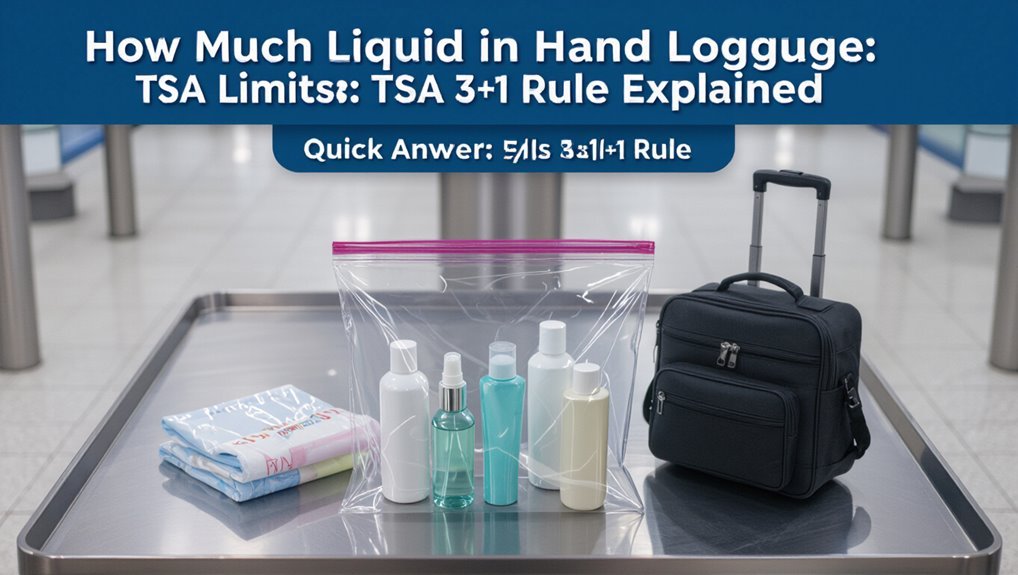
The TSA 3‑1‑1 rule limits the liquids, gels, and aerosols you can carry in your carry‑on to make security screening faster and safer: each container must be 3.4 ounces (100 milliliters) or less, all containers must fit in a single 1‑quart clear plastic bag, and you’re allowed one bag per passenger.
Pack essentials, avoid oversized bottles, and keep the bag accessible for screening to prevent delays.
Exactly How Much Liquid You Can Bring in Carry‑On
You can bring liquids in carry‑on if each container is 3.4 ounces (100 ml) or less, all fit in a single clear quart‑sized bag, and you’re limited to one bag per passenger under the 3‑1‑1 rule.
There are exceptions for medications, baby formula, and duty‑free purchases, but you should declare them at security and keep receipts handy.
Follow tips like using travel‑sized bottles, prepacking toiletries in the bag, and checking specific airline or international rules before you fly.
3‑1‑1 Rule Explained
When you fly, the “-1 rule” limits each liquid container in your carry‑on to 100 milliliters (3.4 ounces) and requires them all to fit inside a single transparent, resealable bag no larger than about one liter.
You should pack toiletries, gels, and aerosols in that bag, show it separately at security, and keep containers sealed and readable so officers can verify compliance quickly and avoid delays.
Exceptions And Tips
Most travelers can stick to the 100 ml/3.4 oz limit, but a few common exceptions let you carry more—like medications, baby formula and food, and duty‑free purchases—so pack those items separately and be ready to explain them at security.
Declare meds and liquids over the limit, carry prescriptions or doctor’s notes, seal duty‑free bags, and keep baby supplies accessible for inspection.
What Counts as a Liquid, Gel, or Aerosol
Because security rules hinge on physical state and packaging, knowing what counts as a liquid, gel, or aerosol helps you pack correctly.
Because rules depend on physical state and packaging, recognizing liquids, gels, and aerosols ensures you pack correctly.
You must treat items by texture and container: liquids flow, gels hold shape but smear, aerosols spray under pressure. Pack compliant containers and declare anything unusual.
- Liquid: water, drinks, creams
- Gel: toothpaste, hair gel
- Aerosol: deodorant, spray sunscreen
Common Exceptions: Meds, Baby Formula, and Breast Milk
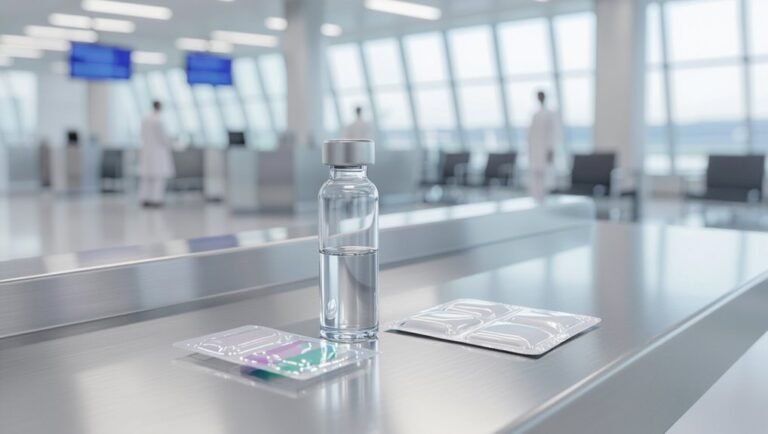
If you need medication, baby formula, or breast milk in carry-on, tell security and keep them accessible — these items are allowed in quantities greater than the usual 100 ml limit but may be inspected.
You’ll separate them for screening, declare any syringes or pumps, and be ready to open containers if asked.
Pack prescriptions with labels and bring documentation for unusual amounts.
Checked Baggage vs. Carry‑On: Liquid Limits
When you’re packing, remember checked baggage usually lets you carry larger quantities of liquids than your carry‑on.
You’ll still need to follow airline and country-specific rules for anything flammable or restricted.
Check limits before you fly so you don’t have to discard items at the gate.
Checked Baggage Allowances
Although carry‑on liquid rules are strict, checked baggage lets you pack larger quantities and many items that aren’t allowed in the cabin.
So you’ll want to know each airline’s weight, size, and restricted‑item policies before you check your bag.
Check fees, declare aerosols, and secure containers to prevent leaks.
- Confirm airline weight limits
- Pack liquids upright and sealed
- Declare restricted substances
Carry‑On Liquid Rules
Because cabin security limits what you can carry on, you’ll need to follow strict liquid rules that differ from checked baggage: you must pack liquids in 3.4oz/100ml containers, fit them in a clear quart‑size bag, and present them at security. Violations risk disposal or delay.
| Item | Limit |
|---|---|
| Bottle | 3.4 oz |
| Bag | Quart |
| Exceptions | Meds/baby |
| Checked | Larger OK |
International Travel: How Rules Differ From TSA 3‑1‑1
If you’re flying internationally, take note that many countries don’t follow the TSA’s 3-1-1 rule exactly, so you’ll need to check each destination’s liquid limits, packaging requirements, and duty-free allowances before you pack.
You’ll encounter different size limits, sealed-bag rules, and allowances for duty-free purchases — confirm rules for both departure and arrival.
- Varying container sizes
- Sealed/transparent bag rules
- Duty-free carry-on limits
Packing Tips to Stay Within TSA 3‑1‑1 Limits
To stay within TSA’s 3-1-1 rule, choose travel-size containers that hold 3.4 ounces or less and label them if needed.
Consolidate toiletries by pouring small amounts of creams and lotions into single bottles to cut down on duplicates.
Pack liquids strategically—place the clear quart bag near the top of your carry-on for quick screening.
Choose Travel-Size Containers
When you’re packing liquids for carry-on, pick travel-size containers that fit the TSA’s 3-1-1 rule: each container 3.4 ounces (100 mL) or less, all placed in a single quart-sized clear bag.
Choose sturdy, leakproof bottles and label them. Keep essentials accessible and replace bulky items with smaller formats.
- Refillable travel bottles
- Solid or paste alternatives
- Prepackaged travel kits
Consolidate Toiletry Bottles
Although the 3‑1‑1 rule limits you to small containers, you can still bring everything you need by consolidating products into a few multiuse, leakproof bottles that fit a quart‑sized bag.
Choose travel‑sized pump, squeeze, or roll‑on bottles and decant essentials—shampoo, conditioner, lotion, and sunscreen—label each clearly.
Seal lids with tape or plastic wrap to prevent leaks and save space.
Pack Liquids Strategically
Now that you’ve consolidated toiletries into a few leakproof bottles, think about how you pack them to stay within the TSA 3‑1‑1 limits.
Organize by necessity, keep the quart bag accessible, and prevent spills. Use travel sizes, label items, and distribute weight to avoid crushing.
Pack smart to pass security quickly and protect your gear.
- Place liquids in a clear quart bag
- Cushion bottles with clothing
- Keep medicines and essentials handy
Best Containers and Travel‑Size Container Rules
Pick spill‑proof, clear, and appropriately sized containers to make security checks quick and keep your liquids safe. Use leakproof travel bottles, labeled bags, and original small packaging to comply with limits. Organize items in an easily accessible quart‑size bag for screening.
| Container Type | Best Use |
|---|---|
| Clear bottle | Toiletries |
| Refillable vial | Cosmetics |
| Sealed pouch | Gels |
What to Do if You Accidentally Bring Too Much at Security
If you find yourself at the security checkpoint with liquids that exceed the allowed amount, stay calm and be ready to act quickly:
- Offer the excess items for disposal or check them at the airline counter.
- Ask if a gate-check or checked-bag option is available to avoid wasting purchases.
- Remove items into carry-on-accessible spots to speed re-screening and answer TSA agents’ questions politely.
Quick Packing Checklist to Sail Through Security
Bring only what you need and arrange it so security is straightforward: place your liquids bag, electronics, and travel documents in an easily reachable spot, have belts and bulky jewelry off, and tuck shoes you’ll remove near the top of your carry-on for quick access.
Pack liquids in a clear 1-quart bag, power up devices, carry boarding pass accessible, wear slip-on shoes, empty pockets, and avoid metal.
Frequently Asked Questions
Can I Bring Powdered Supplements or Protein Powder in Carry‑On?
Yes — you can bring powdered supplements or protein powder in your carry‑on, but you’ll need to declare any amounts over 12 ounces (350 milliliters) for screening, and TSA may require additional inspection or testing at security.
Are Duty‑Free Liquids Exempt From the 3‑1‑1 Rule on Connecting Flights?
Yes, they’re usually exempt if you buy them after security in an international departure area and keep the receipt and sealed bag; you’ll need to follow the connecting country’s rules, so check onward security procedures.
Do TSA Officers Allow Partially Used Travel‑Size Toiletries?
Yes — you can bring partially used travel‑size toiletries in your carry‑on, as long as each bottle is 3.4 ounces (100 ml) or less and all fit inside one clear quart‑sized bag for screening.
Can I Bring Liquid Medications Without Original Pharmacy Labels?
Yes — you can bring liquid medications without original pharmacy labels, but you’ll need to declare them to TSA, carry supporting documentation if possible, and be prepared for additional screening to verify contents and medical necessity.
How Are Aerosols Like Hairspray Treated on International Partner Airlines?
You’ll find international partner airlines treat aerosols like hairspray variably: many follow 100ml/3.4oz carry-on limits, require protective caps, and may ban flammables in checked bags, so check each airline’s rules before flying.
Conclusion
You’ve got this: remember the TSA 3‑1‑1 rule—containers 3.4 oz (100 ml) or less, all in a single 1‑quart clear bag, one bag per person. Keep meds, baby formula and breast milk accessible for inspection. Put larger liquids in checked luggage or buy after security. If you accidentally bring too much, declare it and be ready to dispose of excess. Use travel‑size containers and a checklist to breeze through security. Safe travels!