How Long to Travel to Mars With Current Technology
You can expect a one-way crewed trip to Mars with today’s chemical rockets to take about 6 to 9 months, though exact time depends on launch timing, vehicle performance, and how fast you want to arrive. Launch windows every 26 months and transfer choices like a Hohmann orbit drive most efficient timings. Faster trajectories cut time but need much more fuel or advanced propulsion. Keep going and you’ll see how windows, delta‑V, and future tech change the picture.
How Long Does a Trip to Mars Take Today? (Quick Answer)
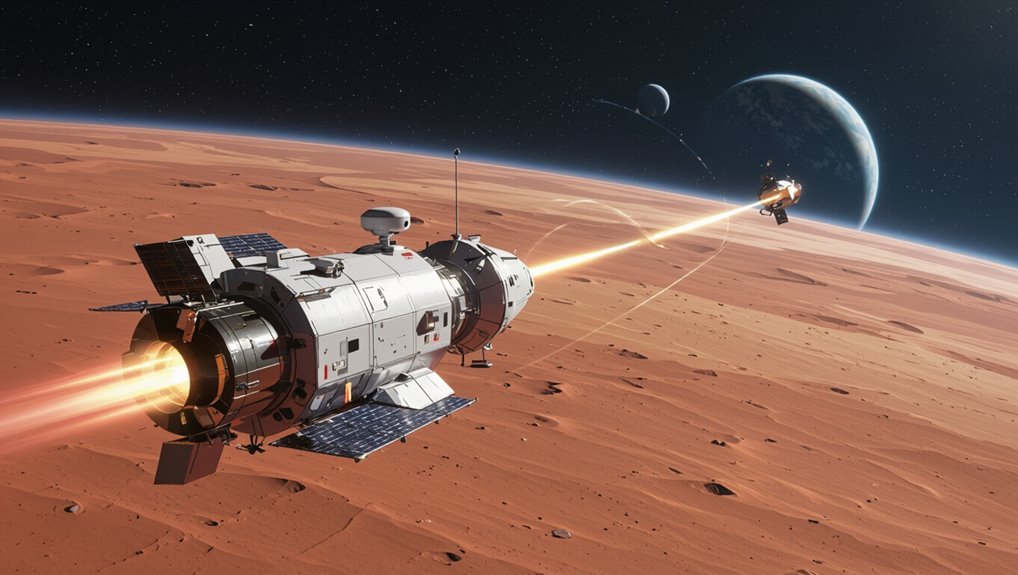
You’d generally spend about six to nine months aboard a spacecraft using current chemical rockets on a Hohmann-like transfer or slightly faster trajectories.
Factors like launch vehicle performance, mission profile, and desired arrival speed shift duration.
You’ll face long transit times, so life support, radiation shielding, and supplies become mission-critical considerations.
Why Orbital Alignment Matters for Mars Trips
You need to time your launch to when Earth and Mars are positioned for the shortest, most efficient transfer.
Using a Hohmann transfer during the proper launch window minimizes fuel and travel time, which is why missions wait for that alignment.
Because Earth and Mars line up only about every 26 months (the synodic period), you can’t just go whenever you want.
Launch Window Timing
Because Earth and Mars orbit the Sun at different speeds and distances, you can only launch on certain dates when their positions line up efficiently.
You schedule missions around these windows to minimize fuel and time, and you plan backups for missed opportunities.
- Check synodic period timing.
- Reserve launch vehicle and crew slots.
- Optimize spacecraft trajectory.
- Prepare contingency plans.
Hohmann Transfer Advantage
When Earth and Mars sit at the right points in their orbits, a Hohmann transfer gives you the most fuel-efficient path between them by matching orbital energies with two well-timed engine burns.
You’ll leave Earth into an elliptical transfer orbit, coast for months, then perform a capture burn at Mars. This minimizes propellant use, though it fixes departure timing and transit duration.
Synodic Period Effects
If you want to reach Mars efficiently, timing your launch to the planets’ synodic period is essential: it’s the roughly 26-month cycle that determines when Earth and Mars line up favorably for low-energy transfers.
You plan around these windows to minimize fuel and travel time.
Consider:
- Launch every ~26 months.
- Wait reduces Δv needs.
- Missed windows add months or years.
- Synodic timing guides mission design.
Synodic Period and How Launch Date Changes Transit
You work with the synodic period—the roughly 26-month cycle that resets favorable Earth–Mars geometry—to pick your launch windows.
If you miss a window your transit time can change because different launch dates require different transfer trajectories and energy, which alters travel duration.
I’ll explain how launch timing affects transit time variability and what that means for planning.
Synodic Period Basics
Because Earth and Mars orbit the Sun at different speeds, the window for efficient launches opens only at specific intervals: the synodic period.
You use it to plan when planets align favorably. It repeats about every 26 months and shifts trajectories and travel time.
Consider these effects:
- Alignment frequency
- Relative orbital speeds
- Ideal departure geometry
- Impact on fuel and duration
Launch Window Timing
When Earth and Mars line up within the synodic window, pick your launch date carefully—shifting it by days or weeks can change the spacecraft’s transit time and fuel needs considerably.
You’ll choose a Hohmann-like or faster trajectory depending on mission priorities. Earlier or later departures alter required delta‑v, encounter geometry, and arrival conditions, so mission planners trade fuel, time, and payload to meet constraints.
Transit Time Variability
Although Earth and Mars reach opposition roughly every 26 months, the exact synodic geometry shifts each cycle, and that shift changes how long your trip takes.
- Launch a few days earlier or later and your Hohmann-like coast can vary by weeks.
- Faster trajectories require more fuel; timing dictates fuel penalties.
- Planetary alignment alters transfer angle and delta-v.
- Ideal windows minimize time and propellant trade-offs.
What a Hohmann Transfer Is and Typical Durations
A Hohmann transfer is the most fuel-efficient way to move a spacecraft between two circular orbits in the same plane, and for Earth-to-Mars trips it’s the baseline trajectory mission planners use. You’ll use two engine burns: one to leave Earth orbit, one to enter Mars orbit. It minimizes delta-v but takes longer than faster, fuel-hungry alternatives.
| Phase | Burn | Purpose |
|---|---|---|
| Departure | 1 | Inject to transfer ellipse |
| Coasting | 0 | Cruise along ellipse |
| Arrival | 1 | Capture at Mars orbit |
Typical Hohmann Transit Times to Mars
When you plan an Earth-to-Mars Hohmann transfer, you’ll usually expect a one-way transit of about six to nine months depending on the launch window.
The exact duration hinges on factors like departure timing, spacecraft velocity and allowable fuel for trajectory adjustments.
I’ll next explain how those factors change the trip time and what trade-offs you’ll face.
Earth-to-Mars Hohmann Transfer
Hohmann transfers give you the most fuel-efficient way to move between Earth’s and Mars’ orbits.
You’d launch into an elliptical orbit touching both planets’ paths, firing once at departure and once at arrival to match velocities. Typical one-way transit is about seven to nine months.
- Single push departure
- Elliptical coast
- Arrival insertion burn
- Ideal launch windows
Transit Duration Factors
Most missions take about seven to nine months to coast from Earth’s orbit to Mars’ using a Hohmann-like transfer, but that range depends on several key factors you’ll want to take into account.
Launch window timing, relative planetary positions, spacecraft delta-v, and chosen trajectory (low-energy vs fast transfer) all affect duration.
Propulsion performance and mission constraints ultimately set the transit time.
Delta‑V Basics: How It Controls Trip Time
Because delta‑V measures the total change in velocity your spacecraft can achieve, it directly dictates which trajectories and trip times are possible, from slow, fuel‑efficient transfers to fast, fuel‑hungry rides.
Because delta‑V sets the total velocity change available, it governs your trajectory choices — fast or fuel‑efficient.
You choose speed by trading propellant for maneuvering. Higher delta‑V lets you shorten transit but raises mass and complexity.
Consider:
- Hohmann transfer: minimal delta‑V, longest time.
- Fast transfer: high delta‑V, shorter time.
- Gravity assists: delta‑V savings, routing constraints.
- Continuous thrust: variable delta‑V, flexible profiles.
Launcher Performance Limits for Mars Missions
When you’re planning a Mars mission, the launcher sets the hard ceiling on how much payload and initial delta‑V you can put on an interplanetary trajectory.
So understanding its thrust, payload-to-orbit, and injection accuracy is essential. You’ll balance launcher capability against spacecraft mass, propulsion type, and required C3.
Higher injection energy or accuracy reduces on‑board fuel needs but demands more capable, often costlier, rockets.
Direct Transfer vs. Gravity Assist: Time Tradeoffs
Though a direct Hohmann- or fast-transfer puts you on the quickest ballistic route to Mars, you’ll pay in propellant and launch energy; gravity assists can cut fuel needs but add months or even years of flight time and operational complexity.
- Direct: shorter flight, higher Δv, simpler ops.
- Assist: lower Δv, longer time, complex planning.
- Hybrid: tradeoff balance, staged burns.
- Decide by mission mass, timeline, and risk tolerance.
Fast Transfer Trajectories and Mission Uses
You can choose fast transfer options—like high-energy Hohmann variants or continuous-thrust trajectories—when time is critical.
These approaches cut transit time but need much more propellant or advanced propulsion. They’re best for crewed missions, time-sensitive cargo, or rapid response scenarios where shortening travel outweighs the costs.
Fast Transfer Options
Because fast transfer trajectories cut transit time to weeks rather than months, they change what missions to Mars are possible and how you plan them.
You’ll choose higher Δv, precise launch windows, and robust thermal control.
Consider these fast transfer options:
- Direct Hohmann-boosted short transfers
- Conjunction-class fast burns
- Gravity-assist slingshots
- Solar electric high-thrust hybrids
Mission Applications
Fast transfer trajectories open up mission profiles that aren’t feasible with months-long Hohmann trips, so planners can aim for short-stay science, rapid cargo delivery, or time-sensitive crew rotations.
You’d use them to reduce surface exposure, rush critical supplies, or swap crews after emergencies. They demand higher energy, precise navigation, and robust life‑support, but they shorten risk windows and increase operational flexibility.
Typical Durations for Fast Direct Transfers
When you pick a direct transfer to Mars, mission planners typically aim for transit times between about 6 and 9 months; this range balances propulsive capability, launch windows, and acceptable crew exposure to radiation and microgravity.
- You’ll face ~180–270 day cruises.
- Faster trajectories need more fuel.
- Launch timing narrows opportunities.
- Life support and shielding scale with duration.
Slower, Fuel‑Efficient Trajectories and Times
If you trade travel time for propellant, you’ll use trajectories that take much longer but cut fuel needs dramatically: low‑energy transfers and gravity‑assist orbits can stretch transit times to a year or more while reducing the delta‑v required, easing launch mass and propulsion demands. You’ll accept slower, quieter journeys that lower risk and cost.
| Hope | Fear |
|---|---|
| Patience | Isolation |
| Savings | Delays |
| Safety | Uncertainty |
| Wonder | Loneliness |
Ion and Hall Thrusters: Realistic Trip Durations
Low‑thrust electric propulsion like ion and Hall thrusters offers a middle ground between the slow, fuel‑saving gravity assists and high‑burn chemical burns, giving you sustained, efficient acceleration that reshapes realistic Mars trip times.
- You’ll see gradual spiral departures lasting months.
- Transit can compress to ~3–9 months depending on power.
- You’ll trade trip time for massive propellant savings.
- Operational complexity and power limits constrain top speed.
Nuclear Thermal Propulsion: Expected Time Savings
If you switch to nuclear thermal propulsion, you can cut transit times to Mars considerably while using propellant more efficiently than chemical rockets.
That efficiency opens up mission profile flexibility, letting you choose faster trajectories or carry more payload without massive fuel penalties.
We’ll compare likely time savings, fuel reductions, and how those choices change mission planning.
Reduced Transit Times
Because nuclear thermal rockets can produce much higher thrust-to-weight and specific impulse than chemical engines, they’ll cut Earth-to-Mars transit times by weeks to months depending on mission profile and trajectory constraints.
- You’ll reach Mars faster, reducing crew time in deep space.
- Shorter trips lower radiation and microgravity exposure.
- You can use more flexible launch windows.
- Faster transfers simplify life-support mass and mission risk.
Propellant Efficiency Gains
When you swap chemical rockets for nuclear thermal propulsion (NTP), you get markedly better propellant efficiency that translates directly into shorter Mars transit times:
NTP delivers higher specific impulse—typically 1.5–2× that of chemical engines—so you need less propellant for the same delta‑v or can generate greater delta‑v for the same propellant mass, enabling faster, more direct transfer trajectories and reducing crew time in deep space.
You’ll cut fuel mass, shorten burns, and depart sooner, trimming transit duration by weeks to months depending on mission scale.
Mission Profile Flexibility
Although nuclear thermal propulsion doesn’t change orbital mechanics, it gives you far more flexibility in choosing trajectories and timelines: higher thrust and specific impulse let mission designers trade propellant for time, use faster transfer windows, perform midcourse plane changes, or adopt near-continuous burns that cut transit times by weeks to months compared with chemical-only profiles.
- Shorter direct transfers
- More launch window options
- Midcourse corrections without huge penalties
- Faster emergency return capability
Beamed Energy and Other Speculative Concepts
If you want to slash transit time to Mars beyond chemical rockets, beamed-energy concepts offer a bold alternative: ground- or space-based lasers or microwaves push lightweight sails or heat propellants remotely, letting spacecraft accelerate without carrying massive fuel loads.
You’d rely on high-power infrastructure, precise pointing, and lightweight, heat-resistant materials; risks include beam safety, atmospheric losses, and huge initial investment.
How Spacecraft Mass Affects Achievable Transit
When you plan a Mars transit, mass drives the delta-v you can realistically achieve and consequently the trip time and trajectory choices.
You’ll confront limits on propellant fraction—adding fuel helps up to the point where the extra mass demands even more fuel.
Balancing structural mass against payload and fuel is a key tradeoff that sets practical performance.
Mass Versus Delta-V
Because every kilogram you add increases the propellant you need, spacecraft mass has a direct, often nonlinear impact on the delta‑v you can achieve and consequently on transit time to Mars.
- Heavier payloads need exponentially more propellant.
- Higher delta‑v demands raise travel speed or transfer energy.
- Engine specific impulse moderates mass penalties.
- Mass reductions often yield bigger time savings than minor engine gains.
Propellant Fraction Limits
Although you can add more tanks and bigger engines, there’s a hard limit to how much of your spacecraft can be propellant before structure, payload, and systems leave too little mass for anything else. You must balance propellant fraction against needed dry mass; beyond ~85% propellant returns diminish. Practical fractions set achievable delta-v and transit time for chemical systems.
| Propellant % | Effect |
|---|---|
| 60% | Modest range |
| 85% | Practical limit |
Structural Mass Tradeoffs
If you increase your spacecraft’s structural mass, you directly reduce the fraction left for propellant and payload.
That tradeoff tightens the achievable delta-v and consequently transit time. You must optimize structure versus fuel to hit mission delta-v without wasting mass.
- Minimize structure weight.
- Use high-strength materials.
- Trade payload for fuel when needed.
- Apply mass-efficient design.
Staging and In‑Space Refueling to Shorten Trips
Staging and in‑space refueling change how you plan a Mars mission by letting you break the trip into shorter, higher-performance segments: you launch a heavy payload into low Earth orbit, top up propellant at orbital depots or drop tanks, and then ignite powerful transfer stages optimized for fast transits.
You can shed empty stages, replace depleted tanks, and use higher thrust-to-weight stages for quicker transfers, cutting travel time.
Using Gravity Assists to Speed or Extend Trips
When you swing past a planet or moon, its gravity can bend your path and change your speed without burning fuel, letting you shave days or even weeks off a Mars transfer—or deliberately slow down to enter a different trajectory.
You plan flybys to boost or brake, optimize timing, and save propellant.
- Increase heliocentric speed
- Reduce delta‑v needs
- Adjust arrival angle
- Conserve fuel
Crew vs. Cargo: Differing Time Priorities
When you plan missions to Mars, crew health constraints push you to prioritize faster transits to limit radiation and microgravity effects.
For cargo, you can accept longer trips or heavier shielding because mission mass tradeoffs make slower, fuel-efficient trajectories more attractive.
Balancing transit speed priorities between people and payloads is key to mission design.
Crew Health Constraints
Because human bodies respond to time differently than hardware, mission planners juggle competing priorities for crewed and cargo transfers to Mars. You need shorter transit to limit radiation, muscle loss, and psychological strain, but you also rely on reliable life-support and redundancy.
Consider these constraints:
- Radiation exposure limits mission duration.
- Microgravity causes bone and muscle atrophy.
- Psychological stress grows with isolation.
- Medical emergency response is time-sensitive.
Mission Mass Tradeoffs
Although crewed missions demand the fastest possible transit to limit radiation, deconditioning, and psychological strain, cargo transfers can tolerate slower, more mass-efficient trajectories.
Transit Speed Priorities
Shifting focus from mass tradeoffs, you’ll find that crew and cargo legs impose very different clock-speed demands on mission design.
You’ll prioritize speed and radiation shielding for crewed transfers to reduce exposure and microgravity effects, while cargo missions favor slower, more efficient trajectories to save propellant and cost.
- Crew: fast, robust life support
- Cargo: fuel-efficient arcs
- Risk vs. cost tradeoffs
- Scheduling flexibility
Conjunction vs. Opposition Mission Profiles
When planning a trip to Mars, you’ll choose between two broad timing strategies—conjunction and opposition profiles—that trade travel time, propellant use, and mission flexibility.
Conjunction missions launch when Earth and Mars move roughly together in their orbits, favoring shorter coast phases but longer stays.
On the other hand, opposition missions strike when the planets are opposite, enabling quicker returns at the cost of higher energy and tighter windows.
You’ll pick based on risk, fuel, and operational constraints.
Transit Time Impacts on Life Support and Supplies
Choosing between conjunction and opposition windows also changes the demands you’ll place on life support and consumables during the transit.
Longer trips need more oxygen, water recycling efficiency, and food mass; shorter trips let you reduce reserves but demand higher propulsion.
Plan margins for contingencies and system failures.
- Oxygen and CO2 control
- Water recovery rate
- Food quantity and packaging
- Spare parts and redundancy
Radiation Exposure: Doses vs. Transit Length
Although a faster transit cuts the time you’re exposed to galactic cosmic rays and solar particle events, it usually requires more powerful propulsion and higher launch energy; conversely, slower or waiting-for-conjunction trajectories lengthen cumulative radiation dose and raise the need for shielding, medical monitoring, and operational limits on crew exposure.
| Transit | Dose risk | Mitigation |
|---|---|---|
| Fast | Lower time-integrated | Heavy shielding, bursts |
| Slow | Higher cumulative | Robust monitoring, limits |
Microgravity Effects During Months‑Long Trips
Because you’ll spend months in low or microgravity, your body will undergo predictable and cumulative changes that affect muscles, bones, cardiovascular function, balance, and vision.
- Muscle atrophy—use resistive exercise daily to preserve strength.
- Bone density loss—counter with loading and nutrition.
- Fluid shifts—monitor intracranial pressure and eyesight changes.
- Vestibular deconditioning—expect balance issues on return; train and rehabilitate.
Operational Constraints That Lengthen Transit (e.g., Slips)
When systems fail, windows slip, or launch schedules shift, your transit time can stretch well beyond the planned cruise: mission ops must wait for safe planetary alignments, spare-parts deliveries, or acceptable crew health windows.
Those constraints force trajectory changes, longer loiter periods, or slower burns that add weeks or months to the trip.
You’ll face added consumable margins, resupply timing, and regulatory or range conflicts that delay departure.
How to Estimate Trip Time for Your Mission Concept
If you want a realistic trip-time estimate, start by defining mission goals, propulsion type, and acceptable risk margins, because those parameters drive trajectory choices, Delta-V budgets, and required consumables.
- Choose launch window and transfer type (Hohmann, fast transfer).
- Calculate Delta-V and thrust-to-weight constraints.
- Estimate consumables, crew limits, and margin.
- Run trajectory sims, iterate with mass and propulsion tradeoffs.
Tradeoffs: Speed vs. Fuel, Cost, and Complexity
After you’ve settled on trajectory options and consumable margins, you’ll need to weigh how much speed you want against the extra fuel, cost, and system complexity it demands.
Faster transit cuts radiation and life-support needs but raises propellant mass, launch energy, and vehicle complexity.
You’ll balance mission risk, budget, and development time; incremental speed gains often cost disproportionately more.
Typical Travel Times of Past Mars Missions
Many past Mars missions took roughly six to nine months to get from Earth to Mars, depending on launch windows, trajectory choices, and spacecraft performance.
You’ll see variations based on mission goals and propulsion.
Consider these representative examples:
- Mariner/Mar R missions: transit ~6–9 months.
- Viking: similar Hohmann-like timing.
- Mars Pathfinder: ~7 months.
- Mars Science Laboratory: ~8.5 months.
Planned Missions and Their Proposed Transits
While current plans blend proven Hohmann-like transfers with faster or more flexible alternatives, upcoming Mars missions propose a range of transit times depending on propulsion and mission design.
You’ll see crewed proposals targeting roughly 6–9 months using chemical rockets, some cargo or piloted concepts aiming for 3–4 months with higher-energy trajectories, and studies exploring continuous-thrust or hybrid approaches that could shorten transit with trade-offs in mass and complexity.
Near‑Term Tech Most Likely to Shorten Trips
Those proposed mission profiles set the stage for which near‑term technologies will actually make a difference in trip time.
Those mission profiles reveal which near‑term tech—launch, propulsion, navigation, operations—will cut trip time.
You’ll see gains from launches, propulsion, navigation, and operations tweaks. Focus on:
- Improved high‑performance cryogenic stages for bigger departure energy.
- Higher‑isp chemical blends and staged engines for faster transits.
- Autonomous trajectory optimization and optical navigation.
- Operational tempo: quicker assembly, refueling, and departure windows.
Practical Takeaways: Expected Ranges and Planning Rules
Because mission planners need clear bounds to design timelines and contingencies, you should expect transit times to cluster into three practical ranges:
- fast crewed transfers around 3–6 months using high‑energy departures and staged chemical or hybrid propulsion;
- standard transfers of about 6–9 months that balance fuel, mass, and launch cadence;
- and slower, cargo‑optimized transfers exceeding 9 months that sacrifice time for payload efficiency and lower delta‑v.
You should plan mission architecture, life support margins, consumables, radiation shielding, and launch windows around these ranges.
Pick conservative margins for crew safety, and accept longer cargo timelines to reduce cost and risk.
Frequently Asked Questions
How Does Communication Latency Change With Different Mars Transit Durations?
Signal delay scales with Earth–Mars distance, so you’ll experience varying one-way latency from about 4 to 22 minutes. Longer transit trajectories slightly change delay over time, and orbital alignment causes the largest communication variations.
Can Psychological Effects Vary With Faster Versus Slower Transit Profiles?
Yes — you’ll experience different psychological effects: faster trips reduce isolation and boredom but increase stress and sensory overload from intense schedules, while slower journeys lower acute stress but raise chronic boredom, confinement fatigue, and interpersonal tension.
How Do Planetary Protection Rules Affect Mission Timing and Trajectories?
They restrict when and how you approach Mars to avoid contamination, forcing cleaner trajectories, delayed arrival windows, and sometimes longer or indirect paths to meet sterilization, orbiting, or quarantine requirements before landing or sample return.
What Insurance or Liability Issues Arise From Longer Crewed Mars Trips?
You’ll face extended medical, evacuation, and mission-failure liabilities, higher life-support and mental-health claims, and complex international legal responsibility; insurers’ll demand strict risk mitigation, hefty premiums, contractual waivers, and clear governmental indemnities for crewed Mars trips.
How Are Emergency Abort Options Impacted by Transit Duration?
Longer transit durations reduce abort options, so you’ll face fewer timely return windows, limited fuel and life support margins, greater reliance on onboard redundancy, higher risk of medical evacuation impossibility, and increased need for autonomous contingency plans.
Conclusion
You’ll usually spend about six to nine months getting to Mars with today’s tech, depending on launch timing and the transfer you pick. Alignments (synodic timing) dictate launch windows every ~26 months, so you’ll plan around Hohmann-like trajectories for fuel efficiency unless you’re willing to pay for faster, more costly options. Expect transit ranges from ~6 months up to a year+, and factor life support, radiation, and entry needs into mission planning—don’t assume dramatic time cuts soon.