How Fast Does Eurostar Travel Speed Explained
You’ll typically reach Paris from London in about 2h15 and Brussels in under 2h on Eurostar’s fastest services, with trains hitting top speeds around 300 km/h (186 mph) on high‑speed stretches. Average trip speed is lower because of stops, slow zones, station dwell and border procedures. Weather, freight traffic and signaling also affect running times. If you want details on route differences, train types and tips to cut door‑to‑door time, keep going.
Quick Answer: London–Paris and London–Brussels Travel Times
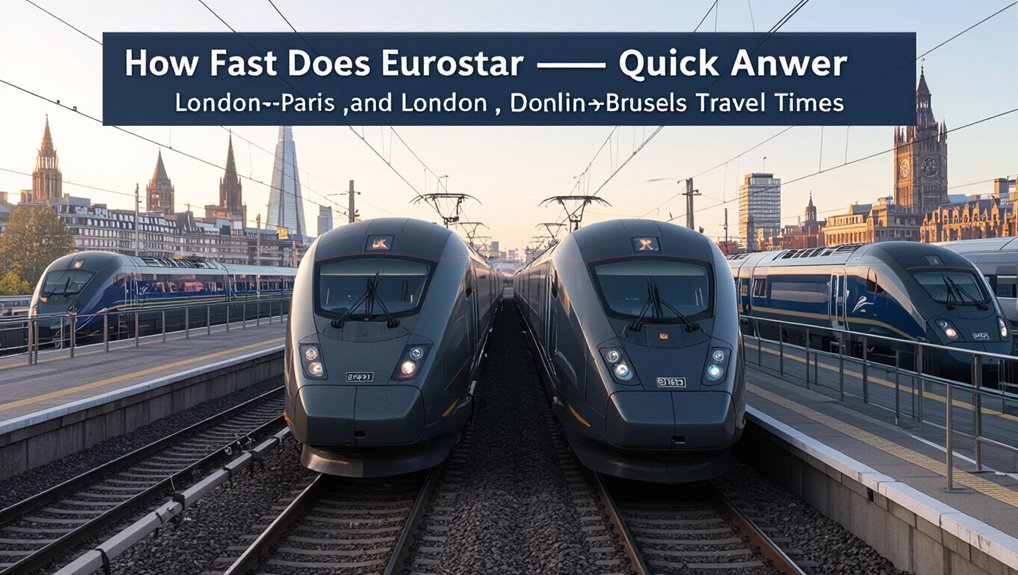
Eurostar typically runs from London St Pancras to Paris Gare du Nord in about 2 hours 15 minutes on the fastest services, and to Brussels Midi/Zuid in roughly 1 hour 50 minutes.
Average times can be a bit longer depending on the specific train and timetable.
You’ll find schedules vary by service, stops, and peak-season demand, so check specific departure times to plan accurately.
How to Use This Guide and What It Covers
This guide shows you how to read the times, averages, and factors that affect Eurostar speeds so you can find the info you need quickly.
You’ll see which routes and measures are included, plus any assumptions behind the estimates.
Use the headings and quick-reference table to jump to the sections that matter to you.
How To Read
Want to get the most from this guide? You’ll find clear sections, quick facts, and visuals so you can scan or dive deeper as needed.
- Speed comparisons (city icons)
- Journey timelines (clock graphics)
- Train specs (schematics)
- Ticket tips (wallet image)
- Safety notes (shield symbol)
Read headings, use bolded facts, and follow callouts to find exact details fast.
What’s Included
Now that you know how to read the guide, you’ll find this section outlines exactly what’s covered and how to use each part.
You’ll get quick facts on top speed, average service speed, route specifics, and comparisons.
Use the tips to interpret charts, spot peak-speed segments, and apply findings to trip planning.
Links point to sources and ticketing notes for practical decisions.
Eurostar Top Speeds by Route
Now you’ll look at how fast Eurostar runs on its main routes, focusing on London–Paris and London–Brussels.
You’ll see the typical top speeds on each line and how track conditions or train type affect them. This will help you understand why journey times differ between the two connections.
London–Paris Speeds
On the London–Paris route, Eurostar regularly hits top speeds of around 186 mph (300 km/h) on high-speed sections.
You’ll feel swift acceleration, smooth tracking, and brief tunnel hushes.
Visualize the run with:
- Rolling countryside blurring past
- River crossings flashing by
- Chalk cliffs appearing, disappearing
- Tunnels compressing light and sound
- Paris skyline approaching fast
London–Brussels Speeds
While London–Paris shows Eurostar at its top stretch, the London–Brussels run feels brisk in a different way: shorter overall distance means you’ll hit high speeds quickly and settle into a steady, fast cruise for most of the journey. You’ll feel momentum early, comfortable stability mid-trip, and a quick, efficient arrival that makes this route feel satisfyingly swift.
| Emotion | Moment |
|---|---|
| Anticipation | Departure |
| Calm | Cruise |
| Satisfaction | Arrival |
Average vs Peak Speeds on Journeys
Because train timetables list average speeds more often than peak figures, you should treat published speeds as indicative of overall journey performance rather than the highest velocity a Eurostar will reach.
Published speeds reflect average journey pace—smoothing stops, slow zones and coasts—not the train’s top speed.
You’ll notice averages smooth out stops, slow zones and coast stretches:
- whistle past pastoral fields
- ease through station approaches
- accelerate on clear high-speed track
- coast through tunnels
- slow for border protocols and signals
Why London–Paris Is Faster Than London–Brussels
Although both routes use high‑speed lines, London–Paris runs faster overall because it spends more of the journey on dedicated high‑speed track and stops less often, so you see higher sustained speeds and shorter total travel time.
You benefit from straighter alignment and better signaling continuity, so trains accelerate and maintain top speed longer, cutting journey time compared with the slightly slower, more interrupted London–Brussels run.
Which Track Features Limit Eurostar Speed
When you ride Eurostar, the track itself sets strict speed limits: alignment and geometry force slower speeds through curves and over uneven sections.
Signaling and train protection systems also cap how fast trains can run for safety and traffic control.
Finally, overhead line capacity and power delivery can restrict acceleration and top speed on long runs.
Track Alignment And Geometry
If you want to understand why Eurostar trains can’t always run flat-out, start with track alignment and geometry: curves, gradients, cant (superelevation), and change lengths all limit safe speeds because they govern lateral forces and ride comfort.
You’ll notice features that force speed reductions:
- Tight radius curve hugging a hillside
- Steep gradient climb/descent
- Rapid cant shift
- Narrowly spaced sleepers
- Tunnel portal approach
Signaling And Train Protection
Track geometry sets the stage, but signaling and train protection dictate how fast a Eurostar can actually run on that track. You rely on line-side signals, onboard ATP/ETCS, and interlocking to maintain safe spacing; restrictive systems or degraded modes force speed reductions for safety and headway.
| System | Role | Speed Impact |
|---|---|---|
| Line-side signals | Visual guidance | Moderate |
| ETCS | Continuous control | Low |
| ATP | Overspeed protection | High |
| Interlocking | Route safety | Variable |
Overhead Line And Power
Because trains draw huge currents from the overhead wires, the quality and layout of the catenary and power supply directly cap a Eurostar’s speed and acceleration: poor contact, limited feeder spacing, insufficient substation capacity, or lower voltage sections force drivers and automatic systems to reduce power and slow the train to protect the electrical infrastructure and keep pantographs stable.
- sagging wires
- worn contact strips
- feeder gaps
- low-voltage zones
- substation limits
How Signaling and Speed Restrictions Work
When you ride the Eurostar, signaling systems and posted speed restrictions work together to keep trains safe and on time: signals tell drivers what the route ahead allows, while speed limits—temporary or permanent—control how fast you can go through curves, work zones, or track changes.
You’ll see national and line-specific rules, in-cab signaling, and automatic enforcement that slow or stop trains to prevent overspeed incidents.
How Border Checks and Station Stops Add Time
You’ll notice border control procedures add predictable delays before departure and on arrival.
Station dwell times vary with how many passengers board and disembark, and with luggage and accessibility needs.
Make sure you have your passport or ID ready—passport and ID checks are a common cause of hold-ups.
Border Control Procedures
How do border checks and station stops affect your Eurostar journey time? You clear passport control and security before boarding; delays here add fixed minutes.
Staff verify documents, scans take seconds but queues grow. Customs checks are rare but possible.
Platform procedures and announcements pace boarding.
- passport queues
- ID checks
- security scanning
- document verification
- occasional customs inspections
Station Dwell Times
Although passport control and security take place before you board, station dwell times still add measurable minutes to a Eurostar trip: you’ll experience additional time for boarding, luggage loading, staff briefings, and platform clearance.
Trains wait for connecting passengers, manage wheelchair access, and allow last-minute ticket checks.
Multiple short stops in city centers accumulate, so scheduled speed rarely equals door-to-door travel time.
Passport And ID Checks
1 key delay many travelers underestimate is passport and ID control: even when checks happen before boarding, you’ll still face additional time for document verification, stamping, and occasional secondary inspections that can hold up boarding and platform clearance.
- queue snaking past kiosks
- officers comparing photos
- bags opened for review
- families pulled aside
- delayed platform departure
Eurostar Train Types: E320, E300 and Differences
Trains like the E320 and E300 power most Eurostar services, and knowing their differences helps you pick the right journey.
You’ll find E320s (Class 374) offer newer interiors, more luggage space and better onboard facilities, while E300s (Class 373) are older but reliable with slightly narrower seats.
Choice affects comfort and amenities, not drastically different speeds on main routes.
How Weather, Freight and Congestion Affect Eurostar
When bad weather, freight movements or congestion squeeze the network, Eurostar’s schedules can feel the impact: services may be delayed, rerouted or capped to keep safety and track capacity in balance.
You’ll notice adjustments like:
- Trains slowing for heavy rain or snow
- Freight slots causing peak-time limits
- Platform reshuffles at terminals
- Temporary speed restrictions
- Timetable padding to protect connections
Real Timetable Examples: London–Paris in Practice
Having seen how weather, freight and congestion force adjustments, let’s look at concrete London–Paris schedules to show how those factors play out on the clock.
You’ll find typical nonstop services listed at about 2h16–2h20, some slower off-peak runs near 2h30, and occasional extended times when speed limits or slotting cause 2h40+ journeys.
Departure windows matter more than advertised top speed.
Real Timetable Examples: London–Brussels in Practice
You’ll typically see London–Brussels Eurostar services timed between about 1h50 and 2h05 for nonstop runs, with off-peak or connection-affected trips stretching to roughly 2h20–2h35.
Delays for congestion, border procedures or engineering works can add further minutes, so timetable cushions matter as much as peak-speed capability.
- early morning departure, quiet platform
- peak-hour packed train
- high-speed tunnel section
- short engineering slow-down
- city-center arrival bustle
How Stops and Route Choices Change Effective Speed
Because each stop and route choice forces Eurostar to trade top speed for other priorities, your average journey speed can differ a lot from its maximum.
Each additional stop adds dwell time and acceleration/deceleration, while alternative lines may limit speeds or add congestion.
When you pick direct expresses versus multi‑stop services, or routed paths with engineering constraints, expect noticeable changes in effective travel speed.
Eurostar vs Short‑Haul Flights and Driving: Door‑to‑Door Time
When you compare Eurostar with short‑haul flights and driving, focus on door‑to‑door time rather than just in‑motion speed: check how long it takes to get to the station or airport, required check‑in or security buffers, transfer times, and last‑mile travel at the other end.
Compare door‑to‑door time—not just speed: include station/airport transfers, check‑in buffers, baggage and last‑mile travel.
- taxi to station at dawn
- queuing through airport security
- baggage claim delays
- city tram to hotel
- motorway congestion near exits
Tips to Minimise Door‑to‑Door Travel Time
A few simple habits can shave hours off your door‑to‑door time on Eurostar trips:
Pack light and use carry‑on only when possible, book central station hotels to cut transfers, check live departures and pick off‑peak trains to avoid crowds, arrive 30–45 minutes early, prebook onward transport, and use contactless or mobile tickets so you’ll move through check‑in and boarding swiftly.
Common Myths About Eurostar Top Speeds
Though Eurostar is often billed as a high‑speed miracle, several persistent myths about its top speeds keep circulating — and you should know what’s true.
- Trains don’t zoom nonstop at max velocity.
- Speed limits vary by tunnel, track, and country.
- Timetables prioritize punctuality over top speed.
- Weather and traffic affect peak speeds.
- Rolling stock age influences achievable velocity.
What Future Upgrades (HS2, Links) Could Change
If upgrades like HS2 and new cross‑channel links go ahead, you’ll see travel times drop considerably and service patterns shift as networks prioritize faster, more direct routes. You’ll benefit from quicker London‑to‑Europe trips, more frequency, and better connections. Expect new rolling stock, dedicated high‑speed paths, and revised timetables that cut layovers and boost reliability.
| Upgrade | Impact |
|---|---|
| HS2 | Faster London links |
| Cross‑channel links | Direct routes |
| New trains | Higher speeds |
| Timetable changes | More frequency |
Frequently Asked Questions
How Energy-Efficient Is Eurostar Compared With Other Transport Modes?
You’ll find Eurostar very energy-efficient: it uses far less energy and emits far fewer CO2 per passenger-kilometer than cars and planes, especially on electric routes, so you’ll cut emissions and energy use by choosing it.
What Safety Systems Prevent High-Speed Derailments?
You rely on automatic train protection, European Train Control System (ETCS), continuous cab signaling, trackside axle counters, four‑quadrant brakes, rigorous maintenance, and trained drivers who’ll intervene to prevent overspeed and derailments.
How Much Do Eurostar Tickets Vary With Train Speed or Class?
Ticket prices don’t directly track speed; they’re tied to class, flexibility, peak times and advance purchase. You’ll pay more for Premium/Business, refundable fares, weekend departures and last-minute bookings, while off-peak Standard seats cost least.
Can Bicycles Be Carried on Eurostar Services?
Yes — you can take bikes on Eurostar, but you’ll need to book a bike space or use a disassembled, boxed bike as luggage; rules, fees, and advance reservation requirements vary by route, so check before travel.
Are Pets Allowed on Eurostar and Under What Conditions?
Yes — you can take small pets (dogs, cats, household birds) in-carriage if they’re in secure carriers under 6kg including carrier; larger dogs need to travel in specific conditions or via pet transport services, and fees and documents apply.
Conclusion
You’ve seen how Eurostar’s top speeds, typical averages and route differences shape travel times — particularly the quicker London–Paris run versus London–Brussels — and how door‑to‑door comparisons often favour high‑speed rail for city‑centre trips. Use the tips to shave minutes off your journey, remember common myths about peak speeds, and watch infrastructure upgrades that could cut times further. Ultimately, Eurostar already beats flying for many short international city‑to‑city trips.