How Does Lighting Travel Simple Explanation You Can Understand
You see lightning when charge differences in a storm push electrons along ionized air paths, and that sudden rush heats the air so it glows and makes thunder. Inside clouds, collisions split positive and negative regions, sending faint branched leaders toward the ground while return strokes flood the channel with current and light. Lightning follows paths of least resistance, often to tall or sharp objects, and if you keep going you’ll learn how leaders, return strokes, and safety measures work.
Quick Answer: How Lightning Travels in One Sentence
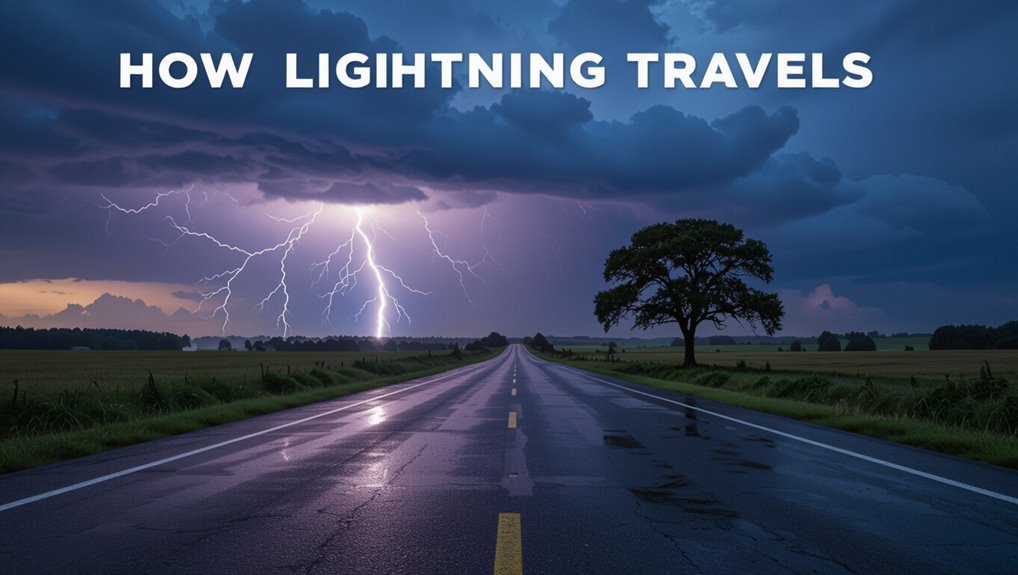
Though it looks instantaneous, lightning travels as a rapid discharge of electrical current along stepped ionized channels from cloud to ground (or within clouds), following paths of least resistance at speeds up to a third the speed of light.
You’ll see a bright return stroke when opposite charges connect, and you’ll hear thunder afterward; the visible flash marks a tiny fraction of a longer charge buildup process.
What This Article Covers About Lightning
This article outlines how lightning forms, the paths and speeds of its discharges, the physical processes behind stepped leaders and return strokes, and the risks and safety measures you should know to stay safe during thunderstorms.
You’ll also get clear explanations of different lightning types, how strikes affect structures and people, practical protection tips, and guidance on when to seek shelter or emergency help.
How Charges Build Up in Storm Clouds
Having covered how lightning moves and the roles of leaders and return strokes, we now look at how those powerful discharges start: charges building inside storm clouds.
You’ll see collisions between ice, water droplets, and hail transfer electrons, creating regions of positive and negative charge. Those separated pockets grow until the electric field’s strong enough to trigger a lightning leader toward a lower potential.
Why Charges Separate Inside Clouds
Because ice, water droplets, and hail particles collide and exchange charge as they move within updrafts and downdrafts, storm clouds naturally sort positive and negative charges into different regions.
You’ll see lighter, positively charged particles rise while heavier, negatively charged ones fall. This continual separation concentrates opposite charges in layers, setting up strong electric fields within the cloud until they discharge.
What Voltage Difference Means for Lightning
When the cloud’s separated charges create a strong electric field, you get a large voltage difference between regions — fundamentally a big push trying to move electrons from negative to positive areas.
That voltage difference tells you how much energy each electron could gain. If the difference becomes huge, electrons follow a path toward positive regions, releasing energy as light and heat along the way.
Why Air Usually Resists Electrical Flow
Although air looks empty, its molecules form a barrier that keeps free charges from moving easily; you need enough energy to knock electrons away from atoms and make a conductive path.
You feel that resistance as insulation: neutral atoms hold electrons tightly, collisions scatter carriers, and molecules absorb energy.
Only when the electric stress exceeds breakdown does air stop blocking current.
How a Conductive Path (Leader) Begins
As the storm builds, you’ll see the electric field intensify near sharp points and charged pockets in the cloud.
When the field gets strong enough, it triggers a stepped leader — a faint, branching channel that advances in short jumps toward the ground.
That leader lays out the first conductive path that a full lightning stroke will follow.
Electric Field Intensifies
Because charges on a cloud and the ground keep separating, the electric field between them grows stronger until it pulls electrons from air molecules and sets the stage for a conductive path called a leader.
You’ll notice localized ionization where the field is strongest; free electrons accelerate, ionize nearby atoms, and create a faint, charged channel that readies the atmosphere for rapid discharge.
Stepped Leader Forms
A faint, jagged channel called a stepped leader darts downward from the cloud in quick, discrete bursts, carving the initial conductive path for a lightning strike.
You watch as each step ionizes air, creating short, branching segments that seek oppositely charged regions.
When a leader nears ground or an upward streamer, you’ll see a connection form, enabling the main, powerful return stroke to follow.
Stepped Leaders: How They Advance
When you watch a storm, you won’t see a steady beam of electricity reaching the ground—instead, a stepped leader advances in sudden jumps, extending a branching, ionized path toward the surface.
You follow its pauses and leaps as charge seeks the easiest route, building conductive channels until contact triggers the return stroke.
- Jumps occur in microsecond bursts
- Ionization trails form briefly
- Each step bridges small gaps
- Progress repeats until connection
How Leaders Branch and Fork
As a stepped leader approaches, you’ll notice it makes branching decision paths that choose where energy will flow next.
Those splits act like forking leadership roles, assigning different channels to carry charge toward ground.
Watching those choices helps you understand how one leader becomes many in a single discharge.
Branching Decision Paths
Because leaders face forks at every turn, you’ll notice they treat decisions like a map: they identify likely branches, evaluate outcomes for each path, and prioritize which forks need immediate closure.
You’ll trace options, test assumptions, and commit to routes that preserve momentum while leaving room to pivot.
- List options quickly
- Weigh risks and rewards
- Set short checkpoints
- Decide, then adapt
Forking Leadership Roles
If you want decisions to scale, you’ve got to branch leaders as deliberately as you branch strategies: identify who can own each fork, define the authority and guardrails they’ll operate under, and set clear expectations for when to escalate or close a path.
You’ll assign ownership, align incentives, rotate exposure to different forks, and monitor outcomes so leaders learn, adapt, and keep forks productive without creating bottlenecks.
How Leaders Meet Upward Streamers
When leaders spot upward streamers, they move to intercept them quickly, matching pace and angle so the two flows meet cleanly rather than collide chaotically.
You watch as focused tips adjust charge, guiding connection paths. You note timing, alignment, and energy balance to favor a smooth link.
- Adjust approach angle
- Synchronize arrival timing
- Balance charge intensity
- Maintain clear path
Return Strokes: Why They’re So Bright
When the return stroke rushes down the channel, you see a huge jump in current that makes the stroke intensely bright.
That current heats and ionizes the air, and those excited atoms and molecules emit the visible light you notice.
Because several return strokes can follow the same path in quick succession, each one adds flashes and boosts the overall brightness you observe.
Brightness From Current Surge
Because a return stroke channels an enormous surge of current along a narrow channel, it heats the air to tens of thousands of degrees in milliseconds and makes the stroke blindingly bright.
You see intense light because the surge deposits huge energy fast, creating a compact, ultra-hot path that radiates strongly.
- Energy concentration
- Rapid heating
- Short duration
- Extreme brightness
Ionized Air Light Emission
As the return stroke rips through the channel, it strips electrons from air molecules and turns the path into a dense plasma that glows intensely; you’re seeing light emitted as those ions and free electrons recombine and relax, releasing photons across a broad spectrum.
You observe a rapid, bright flash because high particle densities and temperatures boost emission rates and broaden spectral lines, producing white‑hot appearance.
Multiple Return Stroke Effect
Although a single return stroke is already blinding, multiple return strokes racing down the same channel pile up energy and light so quickly that you perceive the flash as far brighter and longer-lasting than any one stroke alone; each successive stroke reheats the channel, re-ionizes residual gas, and adds new photons before the previous emission has fully faded.
- You see intensified brightness.
- You notice extended duration.
- The channel stays highly conductive.
- Photons from strokes overlap.
Why a Flash Often Flickers (Multiple Strokes)
A camera flash often fires in multiple quick bursts—called strokes—because the flash system adjusts output to get the exposure right and to recycle the capacitor.
Why Some Strikes Stay in Clouds (Intra-Cloud)
You’ll find intra-cloud strikes happen because clouds build multiple separated charge regions that can discharge without reaching the ground.
The lightning follows the pathways of least resistance between oppositely charged pockets, guided by ionized channels and sharp field gradients.
Turbulence and shifting currents inside the cloud keep those channels moving, so the flash stays aloft rather than seeking the surface.
Charge Regions Inside Clouds
When you look up at a storm cloud, don’t assume its interior is electrically uniform; distinct layers of positive and negative charge form as ice particles collide and separate, creating regions that guide lightning paths.
You’ll notice how these zones store energy and trigger intra-cloud flashes.
- Charged layers stack by altitude
- Collisions move charges apart
- Local imbalances spark within cloud
- Flashes jump between regions
Pathways Of Least Resistance
Those stacked charge layers set up clear routes inside the cloud, and lightning follows the path of least resistance between them.
You’ll see flashes jump horizontally or diagonally where opposite charges align nearby. The discharge finds conductive ionized channels, connects charge pockets, then stops when equilibrium’s reached.
You won’t always get ground strikes—many intra-cloud flashes neutralize charges internally before reaching earth.
Role Of Cloud Turbulence
Because turbulent updrafts and downdrafts churn charge pockets, they often trap discharges inside the cloud and keep lightning from reaching the ground. You’ll see flashes jumping between charged regions, not toward earth. Turbulence reroutes paths, sustaining intra-cloud strikes.
- Charges separate rapidly within cloud cells
- Local fields reorganize unpredictably
- Streamers connect nearby pockets
- Ground-directed leaders weaken
Why Some Strikes Reach the Ground (Cloud-to-Ground)
Although most lightning stays within clouds, a few discharges find a path to the ground because the storm charges and the local electric field line up to create a continuous conductive channel, and you can think of that channel forming in stages: stepped leaders propagate downward from the cloud, and when a strong upward streamer from the ground meets a leader, a high-current return stroke follows, allowing the strike to reach the surface.
| Stage | Direction | Effect |
|---|---|---|
| Leader | Downward | Ionizes air |
| Streamer | Upward | Connects to leader |
| Return | Upward | Delivers current |
How Ground Objects Influence Where Lightning Hits
You’ll notice lightning often targets the tallest objects because they shorten the path from cloud to ground.
You’ll also see strikes favor areas with conductive surfaces and higher ground, which change how charges concentrate.
Keep these factors in mind as you consider why some spots get hit more than others.
Tall Objects Attract
When a storm builds, tall objects on the ground change how the electric field concentrates and make it more likely that lightning will strike nearby; you’ll notice this around lone trees, towers, and skyscrapers because their height and sharp points enhance the local field and encourage the upward leaders that complete a lightning channel.
- You see taller targets more often hit.
- Sharp points intensify charge.
- Upward leaders form from peaks.
- Nearby ground gets less favored.
Surface Conductivity Matters
Because different surfaces let charge move more easily, the ground beneath a storm strongly steers where lightning will land. You’ll notice conductors like wet soil, metal, and seawater draw strikes more than dry sand or pavement. Avoid standing near conductive paths. Identify safer spots and move indoors when you see lightning.
| Surface | Conductivity | Likelihood |
|---|---|---|
| Seawater | High | High |
| Wet soil | High | High |
| Dry sand | Low | Low |
| Concrete | Medium | Medium |
Ground Elevation Effects
Although taller or sharply pointed objects attract lightning more often, it’s not just height that matters — shape, isolation, and surrounding terrain all influence where strikes land.
You should note how ground elevation directs currents and changes risk.
- Hills concentrate charge toward peaks
- Isolated structures stand out to leaders
- Wet soil improves conductivity
- Valleys can channel strikes away
How Tall Structures Change Strike Patterns
If you stand near a skyscraper during a storm, you’ll notice it changes where lightning strikes by altering the local electric field and providing a taller, more conductive target than surrounding terrain.
You observe more frequent strikes on tall objects because they concentrate charge, raise the breakdown threshold nearby, and offer preferred paths.
Lightning protection redirects currents safely into grounded systems, protecting people and equipment.
How Stepped Leaders Connect to Streamers
You’ll see a stepped leader form as a jagged, negatively charged channel that advances toward the ground in discrete jumps.
When it nears objects, upward positive streamers launch and, if one meets the leader, they connect to complete the conductive path.
That connection moment determines where the subsequent return stroke will travel and how intense the strike becomes.
Stepped Leader Formation
When a thundercloud’s electric field becomes strong enough, it launches a stepped leader: a jagged, branching channel of ionized air that advances toward the ground in short, discrete jumps.
You watch as it branches, weakening air resistance, creating paths of lower voltage. It primes the route so a return discharge can meet it.
- Branches form intermittently
- Ionization intensifies locally
- Steps span tens of meters
- Paths lower resistance
Streamer Connection Process
One or more upward streamers erupt from the ground or tall objects as the stepped leader nears, and they race to meet its tip by following the strongest local field lines.
You’ll see a final, rapid connection when a streamer and the leader join, creating a conductive path. That junction triggers the main lightning return stroke, flashing and equalizing charge along the channel.
Sheet Lightning: Why Strikes Spread Out
Although a lightning strike looks like a single jagged bolt, it often fans into a glowing sheet because the charge doesn’t follow one narrow path—multiple channels and branches distribute the return stroke across a wider cloud face.
You see diffuse light as many paths activate. You can picture the spread and why clouds glow:
- Several branches carry current
- Brightness sums across channels
- Cloud illumination masks individual strokes
- View angle broadens appearance
How Thunder Forms From Rapid Air Heating
When lightning rips through the air, you see it heat the surrounding gas so fast that it expands violently.
That rapid air expansion launches a pressure front that travels outward as a shock wave.
You’ll hear that shock wave as the thunderclap that follows the flash.
Rapid Air Expansion
Because lightning heats the air along its channel to tens of thousands of degrees in a fraction of a second, the surrounding air expands explosively and creates the shock waves you hear as thunder.
You feel the pressure change and hear the rumble as energy moves outward.
- Air jumps outward instantly
- Pressure spikes near the channel
- Temperature differences drive motion
- Sound radiates from heated air
Shock Wave Creation
1 sudden flash of lightning slams the air along its path into temperatures hotter than the surface of the sun.
That rapid heating drives an explosive outward push that produces a shock wave you perceive as thunder.
The shock starts as a sharp, supersonic pressure front; as it travels, it weakens into audible sound.
You hear rolling thunder from distance, timing lightning’s intensity and proximity.
Why Lightning Looks White, Blue, or Purple
Although lightning’s flash can seem starkly white, you’ll often notice hints of blue or purple because the air and particles along the bolt selectively scatter and emit different wavelengths of light.
- Hot ionized air emits broad-spectrum white light with blue bias.
- Shorter wavelengths scatter more, enhancing blue hues.
- Dust and moisture shift color toward purple or pink.
- Viewing distance and camera settings change perceived color.
Lightning vs. Light and Sound: Speed Comparison
You can spot lightning almost instantly because the light from the strike reaches your eyes at about 300,000 kilometers per second.
The thunder, however, crawls along at roughly 343 meters per second, so you’ll hear it seconds to minutes later depending on distance.
Comparing these speeds shows why light and sound give you very different impressions of the same storm.
Lightning Versus Light
When a storm rolls in you can often see lightning before you hear thunder, because light races from the strike at about 299,792 kilometers per second while sound crawls through air at roughly 343 meters per second—so the flash arrives almost instantly and the boom follows after a delay that tells you how far away the storm is.
- You spot the flash immediately.
- You count seconds to estimate distance.
- Light isn’t slowed by air the way sound is.
- Visual cues warn you sooner than sound does.
Light Versus Sound
Because light moves at about 299,792 kilometers per second while sound crawls at roughly 343 meters per second, you see flashes from a storm almost instantly but hear thunder only after a noticeable delay.
You can estimate distance: every three seconds between flash and thunder equals roughly one kilometer.
Light rarely slows in air; sound varies with temperature and humidity, so your timing gives a quick, practical gauge.
How Current, Voltage, and Energy Vary by Strike
Although every lightning strike follows the same basic physics, its current, voltage, and delivered energy can vary dramatically from one flash to the next. You can’t predict exact values; conditions like channel length and charge buildup matter.
Although lightning obeys the same physics, each strike’s current, voltage, and energy can differ dramatically.
Consider how variables change per strike:
- Peak current ranges widely, altering damage potential.
- Voltage can span millions of volts.
- Duration shifts energy delivered.
- Path complexity affects distribution.
What a Bolt’s Temperature Reveals About Power
You can start by noting that a bolt’s temperature reflects the extreme energy concentrated in a tiny channel of air.
Higher heat means more energy was released, and measuring that temperature gives clues about the strike’s power and duration.
Practical methods like spectroscopy and high-speed thermal imaging let you estimate and compare strike heat without touching the plasma.
Bolt Temperature Basics
When you measure a bolt’s temperature, you’re reading a direct clue about its energy and recent history—how hard it was fired, how quickly it cooled, and how much power was behind it.
You use that reading to infer intensity, timing, and source characteristics.
- Peak temperature hints at strike strength
- Cooling rate shows duration
- Spatial spread maps energy path
- Relative readings suggest source type
Heat Indicates Energy
Because temperature is a direct expression of energy, a bolt’s heat tells you how much power was released and how it behaved in the instant of strike.
You can infer intensity: higher heat means greater current and faster ionization, producing brighter, shorter-lived channels.
Cooler bolts suggest dispersed energy or longer paths.
Heat patterns also reveal energy distribution along the channel and interactions with surrounding air.
Measuring Strike Heat
Although it flashes and vanishes in a heartbeat, a lightning bolt’s temperature is a measurable fingerprint of the power driving it. Reading that temperature tells you how much energy was dumped, how fast it moved, and how the current behaved along the channel.
You can determine peak power, duration, channel conductivity, and energy distribution:
- Peak temperature estimates intensity
- Pulse duration shows energy delivery
- Conductivity reveals current path
- Thermal maps trace energy spread
How Lightning Alters Air Chemistry (Nitrogen Oxides)
If you’ve ever watched a storm, you’re seeing chemistry in action: lightning’s immense heat rips molecular nitrogen (N2) and oxygen (O2) apart, and those fragments quickly recombine into reactive nitrogen oxides (NO and NO2) that seed the atmosphere with compounds affecting ozone and air quality.
You’ll find these NOx alter local ozone levels, influence smog formation, and supply fixed nitrogen to ecosystems, especially after rain.
How Lightning Can Start Wildfires
When lightning strikes dry vegetation or cracks a tree, it can deposit enough heat and energy in a tiny spot to ignite a fire that then spreads with wind and fuel. Your local landscape, soil moisture and recent weather determine whether that spark grows into a wildfire or fizzles out.
A single lightning strike can ignite dry fuel; local terrain, moisture, and weather decide if it becomes a wildfire.
- You see smoldering leaves or a glowing branch.
- Wind pushes flames into new fuel.
- Dry fuels let fires escalate quickly.
- Lightning-caused starts can be remote and hard to detect.
Why Ball Lightning Is Unusual (Leading Theories)
Because it defies the usual rules of lightning—lasting seconds, moving independently, and appearing as a glowing sphere—ball lightning grabs scientists’ attention and fuels a range of competing explanations.
You’ll encounter plasma models, combustion of vaporized materials, microwave cavity theories, and nanoparticle combustion ideas. Each tries to match sightings, duration, and energy, but none fully explains formation, motion, or disappearance, so debate continues.
Upper-Atmosphere Discharges: Sprites, Jets, and Elves
Although they happen far above storm clouds, sprites, jets, and elves are driven by the same lightning processes you see below and can be just as dramatic.
You might glimpse brief red sprites, upward blue jets, or expanding elves after strong lightning; they trace electric bursts into the ionosphere and reveal how charge moves between atmosphere layers.
- Sprites: brief red tendrils
- Blue jets: narrow upward beams
- Elves: expanding disk glows
- Triggered by strong cloud-to-ground strikes
How Different Storm Types Affect Lightning Patterns
Seeing sprites and jets reach toward the ionosphere highlights how storm structure shapes electrical behavior.
At ground level, different storm types send lightning along very different paths. You’ll notice single-cell storms give brief, simple flashes; multicell and squall lines produce frequent, clustered strikes; supercells spawn intense, long-reaching bolts and more intra-cloud activity.
You can predict risk by storm appearance.
How Geography and Climate Change Lightning Frequency
Where storms form and how they move depend a lot on geography, so you’ll see different lightning patterns near mountains, coasts, and plains.
You’ll also notice climate change is boosting lightning activity by warming and moistening the atmosphere, increasing storm intensity.
Pay attention to regional and seasonal shifts, because timing and frequency of strikes change from place to place and month to month.
Geography Affects Storms
If you live near mountains, coasts, or large lakes, you’ll notice storms behave differently because geography steers airflows, moisture, and where convection can ignite—factors that directly influence lightning frequency.
- Mountains force air up, sparking thunderstorms.
- Coastlines mix sea and land breezes, fueling cells.
- Lakes add moisture and heat contrasts that trigger strikes.
- Valleys channel storm paths, concentrating lightning in corridors.
Climate Change Amplifies Lightning
Because a warmer atmosphere holds more energy and moisture, climate change is already boosting the conditions that spark lightning: greater instability, stronger updrafts, and more available water vapor. You’ll notice storms fire more electrical activity as heat and humidity rise, increasing strike frequency and intensity. Visualize changes:
| Warmer air | More moisture |
|---|---|
| Stronger updrafts | Higher lightning rates |
| Expanded storm energy | Increased strike intensity |
Regional Seasonal Variations
Beyond the broad increase in lightning from warming, the way strikes change depends a lot on geography and seasons.
You’ll notice patterns vary by region, altitude, and ocean influence, and timing shifts as climates warm.
Watch for these seasonal tendencies:
- Tropical wet seasons boost storm frequency.
- Mid-latitude summers lengthen thunderstorm windows.
- Mountains focus convective activity.
- Coastal shifts alter storm timing and intensity.
How Seasons Change Lightning Activity
Although the tilt of Earth and its orbit may seem abstract, they directly change when and where you see lightning by altering temperature contrasts and moisture patterns.
These shifts drive the storms that produce most lightning, so seasonal cycles lead to predictable peaks and lulls in lightning activity. You notice more strikes in warm, humid seasons when convection intensifies, and fewer during cool, stable periods.
How Scientists Measure Lightning With Sensors and Satellites
When you want to know where and when lightning strikes, scientists rely on networks of ground sensors and a fleet of satellites that detect the electromagnetic signals, flashes, and radio pulses lightning produces.
You interpret their data to track storms, estimate energy, and warn people quickly.
- Sensor arrays map timing and location
- Satellites monitor flashes globally
- Data fusion improves accuracy
- Alerts reach emergency services
How Radio and Optical Detectors Pinpoint Strikes
You use precise timing from multiple stations to triangulate a lightning strike’s location within meters.
Then you compare the signal strengths each detector records to map the strike’s energy and orientation.
Together, timing and signal-strength mapping give a clear, localizable picture of each flash.
Timing And Triangulation
Because lightning signals reach different sensors at different times, networks can pinpoint strikes by comparing arrival times and angles.
You rely on precise clocks and geometry to locate events. Sensors log timestamps and directions, then triangulation solves position.
- Record exact arrival times
- Measure signal arrival angles
- Cross-reference multiple sensors
- Compute intersection for location
Signal Strength Mapping
Although timing and angle give you a rough fix, signal strength mapping refines a strike’s location by comparing how radio and optical detectors register intensity across the network.
You analyze signal amplitudes, account for distance attenuation and sensor sensitivity, and overlay readings to create a heat map. Peaks converge where the strike likely occurred, improving accuracy when timings are ambiguous or sensors differ in response.
What Lightning Mapping Arrays Reveal
When scientists deploy Lightning Mapping Arrays (LMAs), they capture the three-dimensional paths of electrical discharges with millisecond precision, revealing how flashes initiate, branch, and connect within storm clouds.
You’ll see charge regions, leader progression, and timing that clarify strike origins. LMAs help you predict storm behavior and refine safety models.
Observe charge regions, leader progression, and precise timing to reveal strike origins and improve storm behavior prediction and safety models.
- Charge structure mapping
- Leader channel tracking
- Temporal sequencing
- Risk assessment
How High-Speed Cameras Changed Our View of Lightning
If you slow lightning down to thousands of frames per second, you stop seeing a single flash and start seeing a cascade of distinct steps, pulses, and leader behaviors that were invisible to the naked eye. You watch leader branches, return strokes, and dart leaders unfold, letting you quantify timing, speeds, and triggers.
| Feature | Insight |
|---|---|
| Steps | Discrete advances |
| Pulses | Energy bursts |
| Leaders | Branching paths |
| Timing | Millisecond detail |
| Speed | Measured meters/µs |
What Lab Experiments Recreate About Lightning Processes
You can recreate key lightning processes in the lab to study spark channel formation and watch how leaders and streamers evolve under controlled conditions.
By scaling down thunderstorm dynamics with model setups, researchers reproduce charge separation and discharge paths that mirror real storms.
Those experiments let you test theories about initiation, propagation, and branching without waiting for a natural strike.
Spark Channel Formation
Lab experiments recreate spark channel formation by forcing high electric fields through controlled gaps and watching conductive paths emerge.
You observe ionization, heating, and rapid gas expansion as channels form. Experiments show progression, branching, and conductivity changes that mimic lightning on small scales.
- You trigger ionized filaments
- You measure temperature and current
- You watch branching patterns
- You compare timings
Leader And Streamer
Having seen how spark channels form, experiments next reproduce the separate but linked processes of leaders and streamers to mirror lightning’s staged growth.
You watch a hot, conductive leader extend slowly while cold, branching streamers leap ahead, ionizing gaps.
In labs you trigger and image both: leaders guide charge flow, streamers seed new paths, together recreating natural stepped progression.
Scaled Thunderstorm Models
When researchers scale down storm conditions, they recreate the key electrical and fluid dynamics that drive lightning so you can see how discharge processes play out under controlled conditions.
You watch charge separation, leader initiation, and streamer propagation in tanks and chambers. Lab models let you test variables safely and quantify results.
- Charge separation mechanics
- Leader formation timing
- Streamer branching patterns
- Scaling and measurement methods
What Computer Models Reveal About Leader Behavior
Although you can’t watch a leader’s microscopic steps in real time, computer models let you recreate and probe those steps in detail, revealing how leader channels form, branch, and jump under different electric-field and ionization conditions.
You’ll adjust parameters, run simulations, and see how charge accumulation, local heating, and streamer interactions steer paths, helping predict discharge patterns and testing hypotheses you can’t observe directly.
How Air Conductivity Changes With Humidity and Temperature
You’ll see that humidity raises ion mobility by adding water molecules that help charge carriers move more freely.
You’ll also notice temperature changes air conductivity by affecting collision rates and carrier energies. Together, these factors shift how easily a leader can propagate through the air.
Humidity Raises Ion Mobility
Because water molecules cling to ions, increasing humidity boosts the number and mobility of charge carriers in air, so the air becomes more conductive.
You notice sparks travel easier and small charges dissipate faster.
Humid air changes ion sizes and lifetimes, altering conductivity you can feel.
- More ions form
- Ions move faster
- Charge paths widen
- Discharge is calmer
Temperature Alters Conductivity
Humidity changes how many and how fast ions move, and temperature adds another layer by changing air density and molecular energy.
You’ll notice warmer air increases molecular motion, boosting ion mobility and conductivity, while colder air slows particles and lowers conductivity.
When humidity and temperature combine, they set ion lifetime and pathways, so you can predict electrical discharge likelihood more accurately.
How Pollution and Aerosols Influence Lightning
When cities pump more aerosols into the atmosphere, they change how thunderstorms form and how often they produce lightning.
You’ll notice clouds hold more, smaller droplets, altering charge separation and strike frequency. Pollution can boost or suppress lightning depending on conditions.
- More particles = more cloud seeds
- Smaller droplets slow precipitation
- Enhanced charge separation sometimes follows
- Effects depend on humidity and storm dynamics
How Human Structures Alter Local Lightning Risk
Pollution-driven changes in cloud microphysics can alter where and how storms concentrate their charge, and human-built features further shape that risk at ground level.
You should know tall buildings, towers, and metal structures attract strikes by providing preferred discharge points.
Urban heat islands and conductive networks (roads, rail, pipelines) change local electric fields, so plan shielding, grounding, and avoidance measures accordingly.
How to Tell Cloud-to-Ground Lightning From a Distance
How can you tell if a distant flash is heading to the ground or staying aloft? You watch shape, duration, and context, then infer likely type.
- Forked, jagged channels often mean cloud-to-ground strikes.
- Bright, quick downward strokes suggest ground connection.
- Diffuse, sheet-like flashes usually stay aloft.
- Nearby thunder and falling leaders increase chance of ground strikes.
Estimating Distance: The Flash-to-Bang Method
If you see a flash and want to know how far away the storm is, start counting seconds until you hear the thunder: each five seconds of delay corresponds roughly to one mile (or three seconds per kilometer). Count the seconds, divide by five (or three) for distance, and seek shelter if close.
| Seconds | Miles | Kilometers |
|---|---|---|
| 5 | 1 | 1.6 |
| 10 | 2 | 3.2 |
How Long Lightning Risk Lasts After a Storm
Although the main thunderhead may have passed, lightning can still strike for up to 30 minutes (and sometimes longer) after the last thunder you hear.
So stay under cover until the danger truly clears. You should monitor skies and forecasts, avoid assuming safety, and wait for official all-clear before resuming activities.
- Watch the clock and clouds
- Listen for distant thunder
- Check weather alerts
- Wait at least 30 minutes
How to Stay Safe Outdoors During Lightning
When you’re caught outside during a storm, move quickly to a safe location—preferably a substantial building or an enclosed metal vehicle—and stay there until the all-clear; seek low ground only if no shelter’s available and avoid open fields, lone trees, hilltops, water, and metal objects that can conduct lightning.
Crouch low on the balls of your feet if stranded, keep feet together, minimize contact with ground, and spread out from others.
Why Buildings and Cars Protect You From Strikes
Because lightning seeks the easiest path to ground, buildings and cars protect you by offering a safer route for the strike to follow—solid structures with proper grounding or a metal shell redirect the current around occupants rather than through them.
Because lightning follows the easiest path, grounded buildings and metal cars channel strikes around occupants, keeping them safer.
- You stay insulated from direct current paths.
- Metal shells conduct strikes to the exterior.
- Grounded wiring sends energy safely away.
- Stay inside until the storm passes.
How Lightning Rods and Grounding Systems Work
If you install a lightning rod and proper grounding, they’ll give the bolt a predictable, low-resistance route to earth so the current bypasses people and sensitive equipment. The rod intercepts the strike, a heavy conductor carries the charge down, and a buried grounding electrode disperses it into the soil.
You inspect connections, bond metal parts, and size conductors to handle huge currents, reducing side-flash risk.
How to Protect Electronics From Lightning Surges
Although you can’t stop lightning, you can keep surges from wrecking your electronics by combining good grounding with targeted surge protection: install whole-house surge arresters at the service entrance, add point-of-use surge protectors for sensitive gear, and guarantee all protective devices are properly bonded and rated for lightning-level currents.
- Unplug nonessential devices during storms
- Use UPS for critical equipment
- Inspect and replace damaged protectors
- Verify grounding resistance regularly
How Airports and Wind Farms Manage Lightning Risk
Airports and wind farms face very different lightning challenges, so they use tailored strategies to keep people and equipment safe:
You’d see tall structures with lightning receptors, bonded grounding systems, and surge protection at terminals, while wind farms add blade lightning receptors, conductive paths inside turbines, and monitoring to schedule shutdowns.
Both use inspections, maintenance, and protocols so operations stay safe and downtime’s minimized.
Why Nearby Strikes Can Look Like Multiple Bolts
When you watch a storm roll in, a single lightning strike can seem to split into several flashes because the channel of ionized air branches and different parts light up at slightly different times; your eye and a camera often register those near-simultaneous illuminations as multiple bolts.
- You see branched channels
- Different segments flash sequentially
- Perception blends near-simultaneity
- Cameras can exaggerate separation
Common Lightning Myths Debunked
Because lightning is dramatic and rare to witness up close, you’ll hear a lot of confident-sounding but wrong claims about it—like that it never strikes the same place twice or that rubber soles will keep you safe.
You should know those are myths. Lightning can hit repeatedly, travel through plumbing and wiring, and injure without a direct strike.
Follow proven safety steps instead.
Further Resources to Learn About Lightning Science
If you want to dive deeper into how lightning forms and behaves, start with reputable sources like university research pages, government weather services, and peer-reviewed journals—these give clear explanations, safety guidance, and up-to-date findings.
- NOAA and national weather services for safety and forecasts
- University atmospheric science pages for research summaries
- Peer-reviewed journals for detailed studies
- Educational videos and museum exhibits for visuals and demonstrations
Frequently Asked Questions
Can Lightning Strike the Same Place Twice in Quick Succession?
Yes — lightning can strike the same place twice in quick succession; you’ll see rapid repeated strikes because tall conductive objects get targeted, and charge can rebuild or multiple stepped leaders hit the same point during a single storm.
Do Animals Sense Lightning Before Humans Do?
Yes — you’ll often notice animals sense lightning before you do; they detect subtle pressure changes, static electricity, and low-frequency sounds, so they react faster or behave oddly, giving you early warning signs of nearby storms.
Can Lightning Travel Through Underground Pipes or Plumbing?
Yes — lightning can travel through underground pipes or plumbing, especially metal or conductive systems. You shouldn’t touch faucets, showers, or connected appliances during storms, since current can follow pipes into buildings and cause shocks.
How Effective Are Surge Protectors Against a Direct Strike?
They’re not effective against a direct strike; surge protectors’ll be destroyed or bypassed by lightning’s immense energy, so you shouldn’t rely on them alone. Combine grounding, lightning rods, and disconnecting electronics for real protection.
Is It Safe to Use a Cellphone Indoors During a Storm?
Yes, it’s generally safe to use your cellphone indoors during a storm, but don’t use a wired headset or charge it from a wall outlet; unplug chargers and avoid contact with plumbing or metal that can conduct lightning.
Conclusion
Now you know that lightning’s a huge spark caused when charge builds and the voltage gets big enough to jump an air gap, and that storm processes, terrain and structures influence where it strikes. You can see why airports and wind farms take special precautions, and why one flash can look like many. Don’t buy myths — lightning follows physics. If you’re curious, dig into the resources and stay safe during storms.