Can I Carry 20000mAh Power Bank in Flight?
Yes — you can usually carry a 20,000mAh power bank on a plane, but you must keep it in your carry-on and not checked baggage. Convert capacity to watt‑hours (20,000mAh × 3.7V ÷ 1000 ≈ 74Wh) to confirm it’s under the common 100Wh limit; 100–160Wh needs airline approval and over 160Wh is generally banned. Expect security checks, protect terminals, and check your airline’s rules — keep going to learn practical packing and approval tips.
Can I Bring a 20,000mAh Power Bank on a Plane? Short Answer
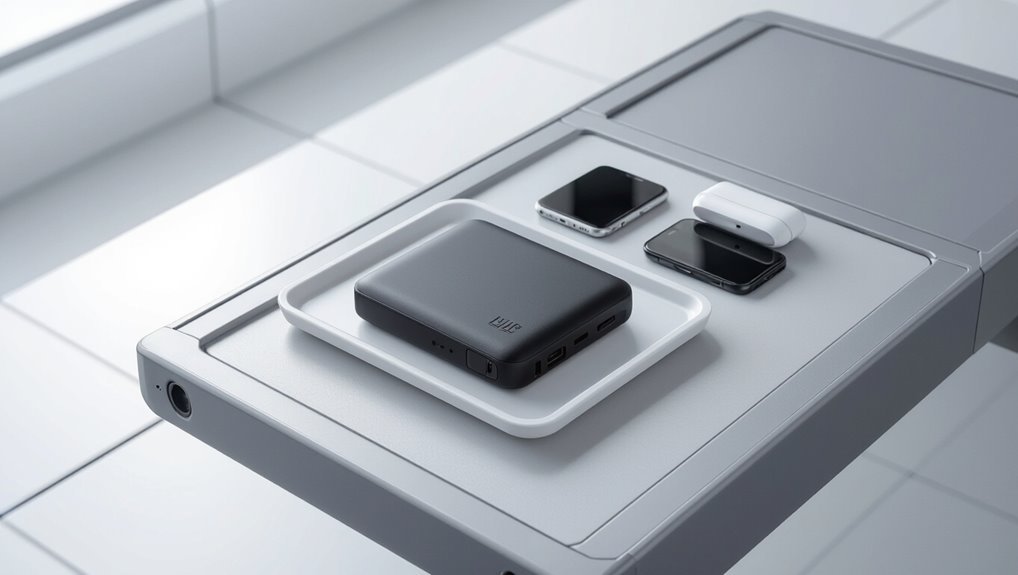
Wondering if you can bring a 20,000mAh power bank on a plane? You usually can, but airlines and regulators limit portable batteries.
You’ll need to carry it in your carry-on, not checked luggage, and follow airline-specific rules.
Check the battery’s watt-hour rating and airline policy before travel to avoid confiscation or delays.
Always declare if required.
Why Watt-Hours (Wh) Matter for Airline Rules
You need to convert mAh to watt‑hours to know if your 20,000mAh bank meets airline rules—use Wh = (mAh × V)/1000.
Most airlines cap carry‑on power banks at 100 Wh and require airline approval for 100–160 Wh.
Knowing this lets you determine if your device is allowed or needs paperwork before you fly.
Calculating Watt‑Hours Accurately
Because airlines regulate batteries by energy, not milliamp-hours, converting mAh to watt‑hours tells you whether a power bank meets cabin limits.
Use the formula Wh = (mAh/1000) × V; most power banks use 3.7V cells. Check the label or manufacturer specs for voltage.
Round carefully and include any device voltage conversions; accurate Wh avoids surprises and helps you comply with airline policies.
Airline Wh Limits
Airlines limit batteries by watt‑hours because Wh directly measures stored energy and the associated fire risk.
So knowing your power bank’s Wh determines whether you can carry it in the cabin, need airline approval, or are prohibited entirely.
Check limits: under 100 Wh is generally allowed; 100–160 Wh often requires airline approval; over 160 Wh is usually banned from passenger aircraft without special arrangements.
Convert 20,000mAh to Wh : Quick Formula
You’ll want to convert mAh to Wh because airlines set limits in watt-hours, not milliamp-hours.
Use the quick formula Wh = (mAh ÷ 1000) × V — typically 3.7V for lithium cells — to get the correct rating.
For example, a 20,000mAh bank at 3.7V is (20,000 ÷ 1000) × 3.7 = 74Wh, which helps you check airline rules.
Why Wh Matters
Think of watt-hours (Wh) as the universal currency airlines and regulators use to compare battery capacity: it tells you how much energy a power bank stores in a way that’s comparable across voltages.
You’ll rely on Wh to know if your 20,000mAh pack meets airline limits, affects carry-on rules, and determines whether you must declare or get approval before flying.
mAh To Wh Formula
Now that you know why Wh matters, let’s convert milliamp-hours to watt-hours so you can compare batteries properly.
Use Wh = (mAh × V) / 1000.
For typical USB power banks rated at 3.7V (cell voltage), multiply 20000mAh by 3.7 and divide by 1000 to get watt-hours.
This gives a direct, comparable energy value for airline rules.
Examples And Calculation
Start with the quick formula: Wh = (mAh × V) / 1000.
Use 3.7V (typical) so 20000 × 3.7 / 1000 = 74Wh.
That tells you if it fits airline limits.
- Visualize a slim 20,000mAh pack labeled 74Wh.
- Imagine a guard checking the 100Wh threshold.
- Picture your phone charged multiple times before landing.
International Limits: What IATA and ICAO Say About Spare Batteries
While airlines set the rules you’ll follow, IATA and ICAO provide the international framework that defines how spare lithium batteries are treated on flights.
This framework specifies watt-hour limits, quantity allowances, and packaging requirements that member carriers and national regulators adopt.
You must carry spares in carry-on, keep terminals protected, and comply with permitted Wh ranges (generally up to 100Wh freely, 100–160Wh with airline approval).
US Guidance: TSA and FAA Rules for Power Banks
In the United States, the TSA and FAA set the operational rules you’ll follow for carrying power banks on commercial flights: pack spare lithium batteries in your carry-on, protect or insulate terminals, and know that devices or batteries over certain watt-hour limits may need airline approval or can be prohibited.
- Small power bank in pocket
- 100–160 Wh needs airline OK
- Over 160 Wh usually banned
EU Rules: EASA and Major Carrier Policies
If you’re flying within or from the EU, EASA sets the baseline for lithium battery capacity limits that most carriers follow.
Check each airline’s carry-on rules because some require stricter limits, packing methods, or advance approval for batteries near 100 Wh (about 27000 mAh).
Always declare high-capacity power banks and pack them in your carry-on with terminals protected to avoid short circuits.
EASA Capacity Limits
European Aviation Safety Agency (EASA) rules set the baseline for what you can carry: batteries up to 100 Wh are generally allowed in carry-on, those between 100–160 Wh need airline approval, and anything above 160 Wh is typically banned from passenger aircraft.
- Small phone pack — imagine a pocketable 50 Wh cell.
- Mid-size power bank — about 120 Wh, needs ok.
- Large unit — 200+ Wh, denied.
Airline Carry-On Rules
While EASA provides the baseline for battery capacity, individual airlines set the practical carry-on rules you’ll follow, and those policies can vary on approval processes, packaging, and quantity limits.
Check your carrier’s website before travel: major EU airlines generally allow up to 100 Wh without approval and 100–160 Wh with airline approval.
Some carriers cap the number of spare power banks you can carry.
Declaration And Packing
When you pack a 20,000 mAh (about 74 Wh) power bank for travel within the EU, declare it at check-in if the airline’s rules require approval and keep it in your carry-on, not checked baggage.
Pack it so it’s:
- Cushioned in a small pouch,
- Easily accessible for inspection,
- Switched off and terminals protected.
Airline Policies: Delta, United, British Airways, Emirates
If you’re flying with Delta, United, British Airways, or Emirates, you’ll find they all let you bring lithium-ion power banks in carry-on luggage but not in checked baggage, though specific watt-hour limits and declaration rules vary by airline.
Check each carrier: Delta and United follow FAA limits, BA restricts higher-capacity units without approval, and Emirates may require declaration for batteries above certain thresholds.
Carry-On or Checked: Where Must My Power Bank Go?
Wondering where your 20,000mAh power bank has to go?
You must carry it in your carry-on—never checked baggage—so crew can manage any risk.
Pack it where you can access it, like a padded compartment or top bin.
Keep your power bank within reach—stow it in a padded sleeve, zippered pocket, or easy-access bin.
Visualize placement:
- In an inside laptop sleeve
- In a zippered carry-on pocket
- On your personal item under the seat
What Power Bank Capacity Requires Airline Approval or Is Banned?
You’ve already learned that your 20,000mAh pack must stay in the cabin, but airlines and regulators also set clear limits on how large a power bank can be before you need approval or it’s outright banned.
Typically, batteries under 100Wh (about 27,000mAh) are allowed in carry-on without approval; 100–160Wh needs airline approval; over 160Wh is generally prohibited.
How to Check Wh Labeling and Documentation on Your Power Bank
When you inspect your power bank, look for a watt-hour (Wh) rating printed on the body or in the manual so you can quickly determine whether it meets airline rules.
Check labeling and docs:
- Confirm Wh value and model number.
- Verify manufacturer name, safety certifications, and serial.
- Keep original manual or a photo of the Wh label for gate staff.
How to Pack and Protect a 20,000mAh Power Bank in Your Carry-On
When packing a 20,000mAh power bank, you’ll need to follow airline battery limits and keep it in your carry-on, not checked luggage.
Protect it with a padded case or wrap it in clothing and cover exposed ports to prevent short circuits.
At security, place it where officers can easily inspect it and be ready to remove it from your bag if asked.
Battery Packing Limits
Although airlines and regulators allow most 20,000mAh power banks in carry-on, you’ve got to pack them correctly to avoid delays or confiscation.
Follow packing limits and presentation rules so security sees a compliant device:
- Keep the power bank in your carry-on, not checked luggage.
- Cover exposed terminals or use original casing.
- Carry documentation if capacity isn’t clearly labeled.
Protective Carrying Methods
If you’re bringing a 20,000mAh power bank in your carry-on, pack it so it stays protected, accessible, and clearly identifiable for security checks.
Use a padded pouch or dedicated compartment to prevent impacts and shorting. Keep cables separate and wrap terminals with tape or in a case.
Place it near the top of your bag for quick removal and inspection when requested.
Airport Screening Tips
Now that you’ve packed the power bank securely, you’ll want to prepare it for airport screening to avoid delays or confiscation.
Keep it accessible in your carry-on, power it on if asked, and label capacity if possible.
Visualize placement:
- Top pocket: easy removal.
- Middle compartment: padded, stable.
- Clear pouch: paperwork and battery label.
What to Expect at Security and Gate Checks for Power Banks
Expect security officers to ask you to remove the power bank from your bag and place it in a separate bin for X-ray screening.
Be ready to show its capacity if they ask. You’ll likely be asked about battery type and watt-hours.
Gate agents may inspect it again; keep documentation or the label visible.
If denied, they’ll explain why and offer options.
Alternatives If a 20,000mAh Pack Isn’t Allowed (Rent, Buy, Charge Stations)
When a 20,000mAh pack isn’t allowed, don’t panic—you’ve still got practical options like renting a battery, buying an approved smaller pack at the airport, or using charging stations in terminals; each choice has trade-offs in cost, convenience, and charging speed, so pick what fits your schedule and device needs.
- Rent: quick, short-term power.
- Buy: yours to keep.
- Stations: free or paid charging.
Quick Pre-Flight Checklist to Avoid Gate Problems
1 simple checklist can keep you off the gate with your power bank: confirm its rated watt-hours (must be ≤100 Wh for carry-on without airline approval).
Check the pack’s label, carry documentation or receipt, pack it in carry-on only, disable charging while packed, and keep terminals protected.
Verify your airline’s rules and declare oversized units in advance to avoid delays.
Top Myths and Quick FAQs About Power Banks on Flights
Curious what’s true and what’s not about carrying power banks on planes? You can bring most power banks in carry-on only, but airlines vary limits.
Don’t pack them in checked baggage. Keep them powered off and protected.
- Visualize: carry-on pocket, protective case, no loose terminals.
- Remember: airline rules, capacity labels, staff checks.
- Ask: declare if unsure.
Frequently Asked Questions
Can Airline Crew Confiscate a Compliant Power Bank Mid-Flight?
Yes — they can confiscate a compliant power bank mid-flight if crew believe it poses a safety risk or violates airline policies; you’ll be asked to stop using it, store it safely, or surrender it if required for safety.
Do Power Banks With Pass-Through Charging Pose Extra Restrictions?
Yes — they can. You shouldn’t use pass-through charging during flight, and some airlines forbid it because it can overheat or mask faults. Check your airline and pack it in carry-on; don’t leave it charging unattended.
Are Power Banks Allowed in International Transit/Transfer Lounges?
Yes — you can usually carry power banks through international transit lounges in carry-on only, but you’ll need to follow airline and country-specific watt-hour limits, declare oversized units, and avoid checked baggage to prevent confiscation or delays.
Does Carrying Multiple Smaller Power Banks Change Rules?
Yes — carrying multiple smaller power banks can change rules: you’ll need to keep each under airline and battery limits, usually in carry-on only, total quantity may be limited, and you’ll have to declare larger-capacity units.
Will Tsa/Airlines Accept Manufacturer Emails as Wh Proof?
Generally, no — airlines and TSA typically won’t accept manufacturer emails as definitive proof; you’ll need the device’s rated Wh printed or documented on packaging or spec sheet, and you should check specific airline policies before flying.
Conclusion
Yes — you can usually bring a 20,000mAh power bank on a plane, but it depends on its watt-hour rating. Calculate Wh (mAh × V ÷ 1000) — most 20,000mAh packs at 3.7V are about 74Wh, under the common 100Wh airline limit, so carry it in your carry-on and keep it with you. If it’s over limits, you’ll need airline approval or you won’t be allowed. Check airline rules, pack it charged, and expect security to inspect it.