Whats the Max Weight for Luggage Airline Limits Explained
You’ll usually be allowed one carry‑on plus a personal item, with carry weight often limited to about 7–10 kg on strict carriers (U.S. airlines often check only dimensions). Checked bags typically range from 20–32 kg depending on carrier and fare class, with premium cabins getting higher limits. Oversize or overweight items incur per‑piece or bracketed fees, and online payment is cheaper than the desk—keep going to see how limits, fees and measuring tricks vary by airline.
Quick Answer: How Much Luggage Can You Bring?
Wondering how much luggage you can bring? You’re typically allowed one carry-on plus a personal item; carry-on weight often ranges 7–10 kg for strict carriers, while many U.S. airlines don’t enforce weight but limit dimensions.
For checked bags, limits vary by airline and ticket, usually 20–32 kg; excess incurs fees. Always confirm rules before packing to avoid surprises.
Checked Baggage Weight Limits (By Airline & Ticket Class)
You’ve seen how carry-on rules vary; now let’s look at checked baggage weight limits, which differ by airline and ticket class and affect fees and what you can pack.
Typically, economy allows 20–23 kg (44–50 lb), premium economy or business often 30 kg (66 lb), and first class may permit more.
Check your airline’s policy to avoid overweight charges and split heavy items if needed.
Carry‑On Weight and Size Allowances
Now let’s look at what you can bring on board and how big it can be.
Airlines set specific carry-on size limits for overhead bins and weight limits for handling or cabin space, and those rules vary by carrier.
Check your airline’s exact dimensions and weight allowances before you pack so you won’t be stopped at the gate.
Carry‑On Size Limits
Check each carrier’s length, width and height limits, including handles and wheels. Measure your bag and compare to airline rules and cabin bin capacity.
Oversized items may need gate-checking or carry fees—plan ahead.
Carry‑On Weight Limits
Anyone planning to bring a bag into the cabin should check weight limits before travel, because airlines set varying carry-on weight allowances that can affect whether your bag goes in the overhead bin or must be checked.
Verify your carrier’s specific limit, pack strategically, use a scale, and redistribute items into checked luggage or your personal item if needed to avoid fees and delays.
How Airlines Measure Bags: Weight vs. Dimensions
When you’re packing for a flight, airlines check both weight and dimensions because each affects safety and space differently: weight influences aircraft balance and cargo limits, while dimensions determine whether a bag fits in overhead bins or the cargo hold.
You should weigh checked and carry‑on bags and measure length, width, height including wheels and handles to meet carrier limits.
Overweight, Oversize, and Extra‑Bag Fees (How They’re Calculated)
Beyond checking size and weight, you’ll also face fees if a bag exceeds limits or you need extra pieces.
Fees depend on airline, route, and whether a bag is overweight, oversized, or an additional piece.
Typical charges:
- Overweight: charged by weight bracket (e.g., 23–32 kg higher fee)
- Oversize: charged by dimension band
- Extra bag: flat per-piece fee
- Payment: online cheaper than airport
Exceptions That Change Baggage Limits: Routes, Alliances, Status
Although airlines publish standard size and weight rules, exceptions tied to specific routes, airline alliances, and your frequent‑flyer status can greatly change what you’re allowed to bring.
Check route-specific allowances—long‑haul, regional, or partner flights may differ.
Alliance benefits can extend free or heavier bags across carriers.
Elite status often waives fees or raises weight limits; always verify during booking to avoid surprises.
International vs. Domestic Rules : Where Limits Differ Most
You’ll notice checked baggage allowances often change between domestic and international flights, with international routes typically permitting heavier or more pieces.
You’ll also see carry-on rules vary—some international carriers restrict size or quantity more tightly than their domestic counterparts.
Keep an eye on your itinerary so you don’t assume the same limits apply across borders.
Checked Baggage Weight Differences
When you fly internationally, baggage rules often change in ways that can catch you off guard: many carriers and countries set lower per-piece or kilogram limits, stricter size rules, and tougher fees than domestic flights.
You should compare checked weight rules so you don’t pay surprises.
Check:
- per-piece vs kilogram limits
- weight vs size enforcement
- excess fee tiers
- airline alliance differences
Carry-On Allowance Variances
Curious how carry-on rules change between domestic and international flights?
You’ll find domestic routes often allow one bag plus personal item with looser weight checks, while international carriers enforce stricter size and weight limits—especially long-haul and low-cost international airlines.
Always check your airline’s policy before packing: dimensions, weight caps, and gate-checking practices vary widely and can incur fees if you don’t comply.
Weigh Baggage Accurately: Home and Airport Methods
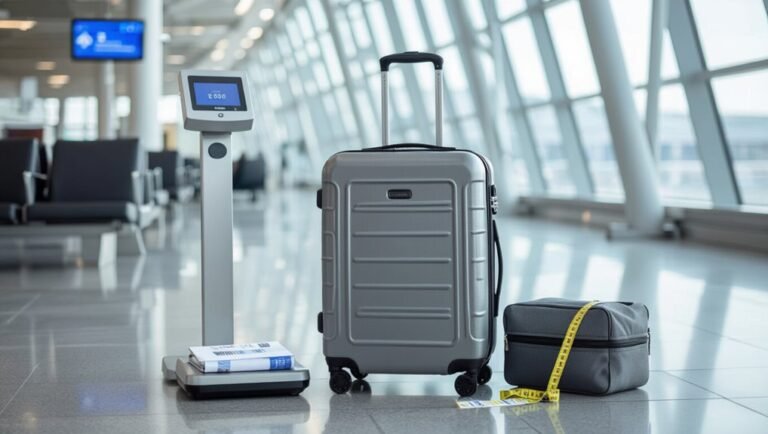
If you want to avoid overweight fees, start by weighing your bags at home with simple tools—bathroom scales, luggage scales, or a digital kitchen scale for small items—and double-check at the airport before you get to the counter.
- Place suitcase on scale center for accuracy
- Zero handheld scales before lifting
- Weigh packed carry-ons too
- Use airport scales as final check
Packing Tips to Avoid Overweight Charges
You should weigh your bag before you leave so you can adjust contents without stress.
Use smart packing techniques—roll clothes, use compression bags, and put heavy items near the wheels—to maximize space and balance.
That way you’ll avoid surprise fees and move through check-in faster.
Weigh Before Leaving
Before you head to the airport, weigh every bag—carry‑on and checked—so you know exactly what you’ll be charged and can adjust accordingly.
Use a reliable scale at home, shift items between bags, and remove extras before leaving. Quick checks save fees and stress.
- Keep a portable luggage scale
- Note airline weight limits
- Repack to balance loads
- Weigh after final packing
Smart Packing Techniques
Pack strategically to keep each bag under the airline limit: prioritize versatile, lightweight clothing, roll items to save space, wear your heaviest shoes and coat, and place dense items like shoes or toiletries near the wheelbase to balance weight.
Use packing cubes, limit duplicate items, stash liquids in checked or carry-on according to rules, and move items between bags if one’s nearing the limit.
If Your Bag Is Overweight at Check‑In: Fast Solutions
If your bag comes in over the airline’s weight limit at check‑in, act quickly to avoid hefty fees or delayed travel.
You can redistribute, remove, or pay—choose the fastest option. Consider:
- Move heavy items to carry‑on or personal bag.
- Remove nonessentials and consolidate.
- Ask gate or counter staff for a quick reweigh.
- Pay the overweight fee if time’s tight and it’s cheaper than delays.
Compare Baggage Policies Before You Book (Step‑By‑Step)
When you’re planning a trip, compare baggage policies across airlines so you won’t get surprised by extra fees or restrictions at the counter.
Check carry‑on and checked weight limits, size rules, and baggage count. Note fees for overweight, oversized, and additional bags.
Look for included allowances by fare class or loyalty status. Confirm rules for sports gear, batteries, and international connections.
Frequently Asked Questions
Can Frequent-Flier Miles Affect Free Baggage Weight Allowance?
Yes — often they do. If you’re elite or use miles to upgrade, airlines’ll usually grant extra baggage allowance or higher weight limits; check your carrier’s rules since benefits, qualifying tiers, and mileage-redemption perks vary by airline.
Do Airlines Count Weight of Detachable Wheels/Handles?
Yes — airlines count the weight of detachable wheels and handles as part of your checked baggage; they’ll weigh the whole bag as presented, so remove accessories only if you want them excluded and plan for possible security or damage issues.
Are Musical Instruments Treated as Checked or Carry-On Weight?
It depends on the airline and instrument size: you’ll usually carry small instruments as carry-on if they fit overhead or underseat, but larger ones often count as checked baggage or require an extra seat or special cargo arrangements—check policies.
How Do Liability Limits Apply if Overweight Bag Is Damaged?
If your overweight bag’s damaged, the airline’s liability’s usually capped by their contract of carriage and international conventions; you’ll file a claim, provide proof, and might get limited compensation, not necessarily full replacement value.
Can Pet Carriers’ Weight Combine With Human Luggage Allowance?
Generally no, you can’t combine your pet carrier’s weight with your personal luggage allowance; airlines treat pet carriers separately, and you’ll need to follow their specific pet fee, size, and weight rules, so check the carrier policy before travel.
Conclusion
Now you know the basics, so you can pack smarter and avoid surprise fees. Check your airline’s specific weight and size limits before you travel, weigh bags at home, and use packing techniques like rolling clothes and choosing lightweight luggage. If a bag’s overweight at check‑in, move items to your carry‑on or pay the fee—decide fast. Compare policies when booking to pick the fare that fits how much you actually need to bring.