Can You Check CPAP in Luggage for Flight
You can usually bring your CPAP as carry-on and you should, since cabin carriage protects fragile equipment and simplifies security. Only check it if the airline’s size limits, gate-checking, or full overhead bins force you to, and confirm battery rules first because lithium batteries often can’t go in checked bags. Pack documentation, drain humidifiers, and cushion components if you must check. Keep extras and a travel case handy — keep going to learn practical steps and precautions.
Can You Check a CPAP?
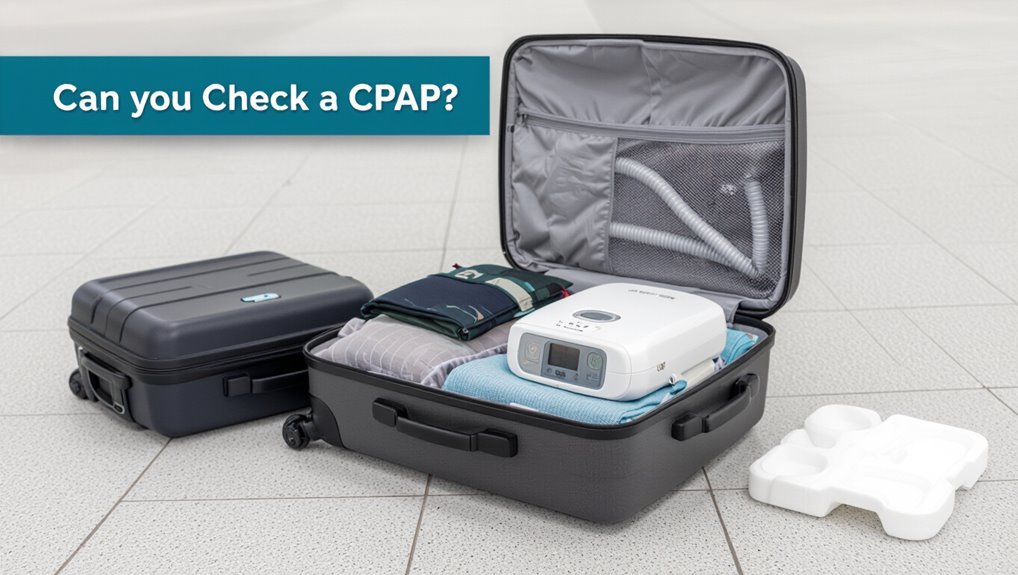
Airlines typically allow CPAPs in carry-on; if you must check it, pack in a hard case, remove batteries, and document serial numbers.
Inform the airline ahead, insure the device, and keep receipts. Prefer cabin carriage to protect fragile medical equipment.
Why Carry a CPAP Onboard?
Because your CPAP is both fragile and essential, you should carry it onboard whenever possible to avoid damage, loss, or delays that can happen in checked baggage.
You’ll have access during long delays, protect delicate parts, and keep batteries or chargers secure.
Keeping it with you also simplifies security screening and guarantees you can use it as needed for uninterrupted therapy during travel.
When You Must Check Your CPAP
Check your CPAP when airline policy, battery and power rules, or checked-baggage size limits force you to stow it instead of carrying it on.
You’ll need to confirm whether batteries are allowed in checked bags or must go in the cabin and whether the carrier considers your machine oversized.
Plan ahead so you’re not stuck without power or facing unexpected fees at the gate.
Airline Policy Requirements
When you fly, airlines set specific rules that can force you to check your CPAP rather than carry it on—especially on smaller regional flights, international routes with strict security protocols, or when overhead bin space is limited.
Check airline policies before you travel: size limits, stowage requirements, documentation for medical devices, and advance notice rules.
Confirm any carrier-specific forms to avoid surprises at boarding.
Battery And Power Rules
If your CPAP uses lithium batteries or external power packs, airlines and security rules can force you to stow it in checked luggage or refuse it entirely—so you need to know battery type, capacity (watt‑hours), and carrier limits before you fly.
Check airline and TSA/ICAO limits, declare nonspillable batteries, pack spare lithium batteries in carry‑on when allowed, and carry documentation showing watt‑hours and approval.
Checked Baggage Limitations
Having clarified battery rules and documentation, you also need to know circumstances that force a CPAP into checked baggage.
If your device is oversized, irreplaceable carry-on space is full, airline policy bans large medical batteries, gate-checking is required for bulky cases, or security insists, you’ll check it.
Pack padding, label fragile, and note serials.
- Oversized machine
- Full overhead bins
- Large battery restrictions
- Bulky travel case
- Security directive
Quick Decision: Carry-On or Checked?
Because you’ll rely on your CPAP to sleep and breathe comfortably, deciding whether to carry it on or check it matters. You’ll usually carry it on to protect fragile parts, keep battery access, and avoid loss. If space forces checking, pack in a hard case and note fragile.
| Carry-on | Checked | Notes |
|---|---|---|
| Protects | Space-saving | Battery access |
| Accessible | Risky | Hard case |
Airline Rules That Affect CPAPs
When you pack your CPAP, airline rules will shape whether it goes in carry-on or checked baggage, how it’s screened by security, and what you can do with spare batteries.
You’ll want to check specific carrier policies on portable medical devices and battery limits before you fly.
Preparing documentation and knowing screening procedures will help you avoid surprises at the gate.
Carry-On Versus Checked
Most travelers stash their CPAP in carry-on luggage because airlines generally treat medical devices more favorably in the cabin than in checked bags.
You’ll protect fragile parts, keep batteries accessible, and avoid loss.
Pack thoughtfully and notify staff if needed.
- CPAP machine in overhead bin
- Mask and tubing in pouch
- Battery at hand
- Foam padding around device
- Travel case snug
Security Screening Procedures
Airport security screens CPAPs differently than routine carry-on items, so know the rules and be ready to show the device separately at the checkpoint.
You’ll remove hoses and masks for X-ray inspection and may need to power the unit on if asked.
Declare it to officers, follow their guidance, and keep documentation handy to speed screening and avoid damage or delays.
Battery Transport Rules
Screening may have wrapped up, but you’ll still need to handle CPAP batteries according to airline and TSA rules.
You should carry lithium batteries in carry-on, limit watt-hours, tape terminals, declare oversized packs, and check airline policies ahead.
Pack chargers separately and keep documentation handy for inspection.
- small sealed battery
- taped terminals
- labeled watt-hour rating
- clear carry-on bag
- airline policy note
TSA Rules for CPAPs and Checked Bags
While you can check a CPAP, TSA strongly recommends carrying it in the cabin whenever possible because checked baggage faces rough handling and temperature changes that can damage the device.
You should remove batteries, pack accessories in carry-on, label medical equipment, and declare it at screening if asked.
Checked CPAPs may be inspected; document serial numbers and photos to prove condition if damage occurs.
International Carrier CPAP Rules to Watch
Because airlines and countries set their own rules, you should check each international carrier’s CPAP policies before you fly.
Because airlines and countries set their own rules, check each carrier’s CPAP policies before you fly.
Look for battery limits, documentation, carry-on versus checked bag allowance, adapter requirements, and local regulations.
Pack accordingly and note contact emails for clarification.
- sealed battery pack
- medical letter
- power adapter
- labeled device case
- declared at check-in
Confirming Airline CPAP Policy Before Booking
Before you book a ticket, check the airline’s CPAP policy so you won’t run into surprises at the airport; look for rules on battery types and capacity, whether CPAPs count as carry-on or checked baggage, required medical documentation, and any paperwork or stickers they want you to present at check-in.
Then contact the carrier directly to confirm limits, declaration procedures, and any advance notice they require.
Choosing Carry-On vs. Checked: Decision Factors
Which option makes your trip easier: carrying your CPAP onboard or checking it with luggage?
You’ll weigh reliability, size, battery needs, security checks, and gate-check convenience. Choose what reduces stress and guarantees therapy.
Weigh reliability, size, battery needs, and security — pick the option that minimizes stress and guarantees therapy.
- CPAP snug in overhead bin
- Bulky machine in checked suitcase
- Battery pack at hand
- TSA inspection open on counter
- Fragile parts padded and visible
Best Travel Cases for CPAP Protection
One good travel case will keep your CPAP safe, organized, and easy to grab at a moment’s notice.
Choose a hard-shell or padded neoprene case with customizable foam inserts or mesh pockets for cords, mask, and filters.
Look for water-resistant zippers, lockable compartments, and a comfortable handle or shoulder strap.
Make sure it fits airline size limits and your specific CPAP model.
How to Pack a CPAP to Avoid Damage
Now that you’ve picked the right travel case, pack the CPAP to minimize shocks, crushing, and stress during transit.
Cushion the machine, secure loose parts, and keep electronics dry. Handle the case gently and label it fragile so handlers notice.
- foam cradle around the device
- soft clothes as extra padding
- mask in a separate pouch
- cords coiled neatly
- hard-shell suitcase base placement
Packing Humidifiers, Water Chambers, and Tubing
Pack humidifiers, water chambers, and tubing so they’re protected from leaks, cracks, and crushing: drain and dry chambers completely, seal them in waterproof bags, and cushion with soft clothing or bubble wrap.
Coil tubing loosely to prevent kinks and place it in a padded pouch.
Label fragile items and pack them near the center of your checked bag away from heavy objects.
Managing Filters and Removable Parts
Treat filters and removable parts as small, delicate components: remove washable filters and let them dry completely, stash disposable filters in a sealed bag, and keep any caps, clips, or adapters together in a labeled pouch so nothing gets lost in transit.
Pack them in a cushioned case, zip them shut, and place near your CPAP for easy access.
- Tiny foam filter
- Spare disposable filter pack
- Mask clips and caps
- Hose adapter
- Small screwdriver
Rules for CPAP Batteries in Carry-On and Checked
Because batteries present safety and airline-regulatory concerns, you’ll need to follow specific rules about carrying CPAP batteries on board or in checked luggage.
You should pack spare batteries in carry-on only, protect terminals from shorting, and comply with airline watt-hour or capacity limits.
Installed batteries may be allowed in checked bags per airline policy, but you should verify rules and declare them if required.
FAA Guidance on Lithium and Non-Lithium Batteries
The FAA differentiates lithium and non‑lithium batteries and sets specific carriage rules you’ll need to follow: you must carry lithium batteries in the cabin when possible, protect terminals, and declare large-capacity cells; non‑lithium batteries usually face fewer restrictions but should be secured.
The FAA separates lithium and non‑lithium rules: carry lithium in-cabin, protect terminals, and declare large cells.
Consider these visuals:
- A sealed carry-on with batteries tucked inside
- Terminals taped over
- A labeled battery case
- A gate agent inspecting documentation
- A removed battery beside your CPAP
Packing External CPAP Battery Packs Safely
When you pack external CPAP battery packs, follow airline battery regulations to avoid surprises at security or the gate.
Protect cells from short circuits and physical damage by using original cases, insulating terminals, and cushioning them in your carry-on.
Keep documentation handy and place batteries where staff can access them if asked.
Airline Battery Regulations
If you’re bringing an external CPAP battery, know that airlines treat lithium batteries as potential hazards and set strict limits on capacity, labeling, and placement to keep flights safe.
You must follow capacity caps, carry-on rules, and airline notification requirements to avoid confiscation or delays.
- Carry-on only
- Capacity limits (Wh)
- Terminal protection
- Clear labeling
- Airline approval ahead of time
Packing And Protection
1 simple rule will keep your CPAP battery safe in transit: carry it in your hand luggage and protect its terminals and casing. Pack it in a padded pouch, tape or cap terminals, and cushion against impacts. Keep spare batteries separate and insulated.
| Item | Protection | Tip |
|---|---|---|
| Battery | Padded pouch | Tape terminals |
| Spares | Separate bag | Insulate |
| CPAP | Hard case | Cushion |
Documentation And Accessibility
While you’ll keep the battery in your carry-on for safety, also bring clear documentation and make it easy to access: pack a copy of your prescription, manufacturer labeling for the battery and CPAP, and any airline or TSA approval letters in a transparent pouch near the top of your bag.
- clear plastic pouch displaying papers
- labeled battery with specs visible
- prescription page with dates
- airline approval email printout
- quick-access top pocket for screening
Insuring Your CPAP Against Loss or Damage
Because your CPAP is both a medical necessity and a costly piece of equipment, you’ll want to confirm it’s covered before you travel.
Check your homeowner, renter, or travel insurance for coverage limits, deductibles, and whether checked baggage losses apply.
Consider purchasing supplemental travel insurance or a rider for high-value devices, keep receipts, and document serial numbers to support claims if loss or damage occurs.
Labeling and Documentation for Checked CPAPs
If you check your CPAP, make sure it’s clearly labeled and backed by documentation so airlines and baggage handlers can identify it and you can prove ownership quickly.
Attach a durable tag with your name and phone, include a copy of purchase receipt, label the case “Medical Device,” add a bright ribbon for visibility, and keep a photo of serial number and contents on your phone for quick verification.
Medical Letters, Prescriptions, and Proof to Carry
Before you travel, get a written letter from your doctor that states your medical need for a CPAP, along with a prescription that lists the machine make and model.
Carry copies of the device specifications or serial number in case airline or security staff ask.
Keep the originals and a digital copy easily accessible to speed inspections and avoid delays.
Doctor’s Letter Detailing Need
When you’re traveling with a CPAP, carry a concise, signed letter from your doctor that states your diagnosis, the prescribed device type and model, and that the machine is medically necessary for in-flight use and at your destination.
Keep it brief, dated, on letterhead, and with contact info. Include clear copies with your documents.
- Letterhead doctor signature
- Diagnosis statement
- Medical necessity declaration
- Contact phone and email
- Date and clinic address
Prescription And Device Specs
Because airport and airline staff may ask for more than a doctor’s note, carry the original prescription and a brief spec sheet for your CPAP showing model, serial number, power requirements, and approved battery or humidifier compatibility.
These documents prove the device is prescribed, safe for inflight use, and match what you’re transporting.
Also keep a copy on your phone, and present paperwork when requested to avoid delays.
What Happens If TSA Inspects Your Checked CPAP?
If TSA inspects your checked CPAP, agents will usually open the case to examine the device and may run it through X-ray or perform a visual inspection.
They’ll handle it carefully but you should expect some disturbance to packing and accessories. You can expect documentation notes and possible brief delays while they verify contents.
- scattered foam inserts
- displaced tubing
- loosened mask straps
- inspection tag stapled
- handwritten note on luggage
Preparing for a Security Inspection of a Checked CPAP
As you pack a CPAP for checked baggage, organize and label it so TSA can inspect it quickly without damaging components.
Place the machine in a hard case, remove water and batteries, and pack masks and tubing separately in clear bags.
Include a brief printed note with device details and your contact info.
Expect possible inspection and follow officer instructions calmly.
Filing an Airline Damage or Loss Claim
Even with careful packing and clear labeling, checked CPAPs can still get damaged or go missing, so you’ll want to know how to file a claim with the airline promptly.
Gather receipts, photos, serial numbers, and your boarding pass. Contact the airline’s baggage service within their deadline and keep records.
- cracked casing
- crushed carrying case
- displaced hose
- missing power supply
- scratched screen
Alternatives When You Can’t Bring Your CPAP
When you can’t bring your CPAP, plan ahead so your sleep therapy doesn’t suffer: check whether your airline or destination has rental units, ask your doctor for a travel prescription or alternative device, and look into battery-powered or mask-only options that meet local rules.
Also pack extra masks, filters, and distilled water if allowed, verify power adapters, and confirm device approvals before travel.
Renting or Borrowing a CPAP at Your Destination
If you can’t bring your CPAP, look into renting or borrowing one at your destination well before you travel: contact local medical supply companies, sleep clinics, or the hotel concierge to check availability, rental rates, and what paperwork they’ll need (prescription, ID, insurance).
You’ll confirm fit, mask type, and tubing needs, and arrange pickup or delivery.
- compact rental case
- disposable mask kit
- sanitized tubing bundle
- spare power adapter
- delivery receipt and agreement
Travel CPAP and Portable Models Suited to Flying
When you’re choosing a travel CPAP, focus on compact models with reliable pressure delivery and easy cleaning.
Look specifically for battery-powered portable units if you’ll be camping or facing long layovers without power.
We’ll compare top options, battery life, and airline-friendly features so you can pick what fits your trip.
Best Travel CPAP Options
Although you can bring a full-size CPAP on a plane, choosing a travel-specific or portable model makes flying easier and cuts hassles at security and in cramped cabins.
Pick lightweight, FAA-approved units with quiet motors, simple masks, and easy-clean components. Consider compact designs that fit carry-ons and slip into overhead bins.
- Small suitcase-ready device
- Slim travel mask
- Foldable tubing
- Minimalist power cord
- Carry-on storage pouch
Battery-Powered Portable Units
Packing a travel-ready CPAP is great, but you’ll get the most freedom from a battery-powered portable unit that keeps you covered on long flights, during layovers, or when power outlets aren’t available.
You can carry compact models that run on FAA-approved batteries, switch between battery and AC, and use simple masks.
Check airline rules, pack spare batteries in your carry-on, and keep manuals accessible.
Cleaning and Maintenance After Checked Travel
Inspect your CPAP as soon as you retrieve your luggage, and start by unplugging the unit and wiping the exterior with a damp cloth to remove dust or residue from transit.
Upon retrieving your luggage, unplug the CPAP and wipe the exterior with a damp cloth to remove transit dust.
Then dry, inspect filters, and sanitize detachable parts before use. Check seals and tubing for damage; replace if needed.
- damp cloth on casing
- disposable filter disposal
- soaked mask in mild soap
- coiled tubing drying
- fresh distilled water fill
Tips for Long Trips and Multi-Leg Itineraries
When you have multiple flights, pack your CPAP and essential accessories in carry-on so you can access them between legs and avoid lost luggage issues.
Bring extra filters, tubing, and a compact travel case to keep things organized across connections.
For battery and power, carry a charged backup battery and check airline rules for power banks and in-seat outlets so you’re never stuck without power.
Packing For Multiple Flights
Long trips with multiple legs demand a strategy that keeps your CPAP accessible, powered, and protected without bogging you down—so plan by prioritizing carry-on placement, power options, and a compact maintenance kit.
You’ll streamline transit, customs, and short layovers by packing smartly and keeping essentials reachable.
- Carry-on padded case
- Quick-clean wipes
- Compact tubing wrap
- Extra mask cushions
- Travel checklist
Managing Battery And Power
Because flights and layovers can stretch your CPAP runtime, you’ll want a clear plan for batteries, inverters, and charging windows so you never miss therapy, even across time zones.
Carry FAA-approved spare batteries in carry-on, pack a compatible inverter and charger, note airport charging options, and schedule charging during layovers.
Know airline battery limits and label gear to speed security checks.
Real Traveler Lessons: Checked CPAP Experiences
If you decide to check your CPAP, expect a mix of practical perks and avoidable hassles—your device can survive luggage handling, but only if you pack it smart, label it, and prepare for possible inspections.
You’ll learn to cushion, document, and split parts between bags. Expect extra screening and polite questions; stay calm and show paperwork.
- Foam-padded case bouncing
- TSA inspection tag
- Mask in a sealed bag
- Power cord tucked separately
- Damp cloth tucked nearby
Common Mistakes That Cause Damage or Loss
When you treat your CPAP like any other checked bag, mistakes pile up fast: poor padding, leaving detachable parts loose, skipping documentation, and stashing batteries or chargers where handlers won’t expect them all increase the odds of damage or loss. You should secure parts, label electronics, and notify staff.
| Mistake | Consequence | Fix |
|---|---|---|
| Poor padding | Cracks | Use foam |
| Loose parts | Loss | Zip bags |
| No docs | Confiscation | Carry letter |
| Hidden batteries | Delay | Pack access |
| No notification | Rough handling | Tell airline |
Step-by-Step Checklist If You Must Check Your CPAP
1 clear checklist will help you protect your CPAP when checking it: follow steps to prepare the device, secure accessories, document medical necessity, pack batteries and chargers accessibly, and notify airline staff so handlers know it’s fragile.
You should clean and dry parts, use a hard case, label it medical, remove batteries into carry-on, and photograph the device before handing it over.
- hard protective case
- wrapped hose
- sealed mask
- labeled paperwork
- photos and receipts
Final Guide: When to Carry, When to Check, and Why
You should usually carry your CPAP in carry-on to protect it from damage and keep supplies handy.
Checking may be OK for heavy or bulkier units, but you’ll risk rough handling, temperature changes, and potential loss.
Check TSA and your airline’s rules beforehand so you know size allowances, battery policies, and any documentation you’ll need.
Carry-On Advantages
Carrying your CPAP in the cabin gives you direct control over its safety, power access, and troubleshooting, so you’ll avoid delays or damage that can happen if it’s checked.
You’ll manage batteries, keep filters clean, and access paperwork quickly. Pack it in a padded carry-on and keep tubing detachable.
- Padded carry bag
- Visible paperwork
- Spare battery pack
- Clean filters
- Detachable tubing
Checked-Bag Considerations
If keeping your CPAP with you in the cabin isn’t possible, you’ll need to weigh the risks and protections for checked baggage.
Pack the device in a hard case, cushion hoses and mask, remove batteries or follow battery rules, and lock the case if desired.
Label contents for fragile handling and consider travel insurance or spare equipment in case of loss or damage.
TSA And Airline Rules
1 clear rule to follow: always prioritize carrying your CPAP in the cabin when possible, since TSA and most airlines allow medically necessary devices in carry-on luggage and you’ll avoid damage, loss, or battery restrictions that affect checked bags.
Check airline policies, bring documentation, pack batteries in carry-on, gate-check only if necessary, and inspect cases before boarding.
- buzzing motor
- foam-lined case
- tangled hose
- spare battery pack
- airport security table
Frequently Asked Questions
Can I Check My CPAP Inside a Hard-Shell Suitcase Without a Case?
You shouldn’t. You’ll risk damage from pressure, impacts, and crushing; airlines and TSA recommend carrying your CPAP in a protective case and as carry-on. Pack it in a padded case, or at least wrap it securely if checked.
Will Packing My CPAP Void Its Warranty if Damaged in Checked Baggage?
Generally, packing your CPAP in checked baggage won’t automatically void the warranty, but manufacturers might deny claims if damage results from misuse or improper packing, so check your warranty terms and use proper protective packaging or carry it on.
Are Rental CPAPS at My Destination Compatible With My Mask and Settings?
Usually yes — rental CPAPs often support common masks and can be adjusted to your prescribed settings, but you’ll want to confirm mask compatibility and required pressure/settings with the rental provider beforehand to guarantee a proper fit.
Can I Check Extra CPAP Supplies Like Masks and Prescription Tubing?
Yes — you can check extra CPAP supplies like masks and prescription tubing, but you shouldn’t. Keep essential items in carry-on to avoid damage or loss, and pack duplicates and receipts in checked baggage if necessary.
Do Airport Lost-And-Found Policies Cover Checked Medical Equipment Like CPAPS?
Yes — many airport lost-and-found offices accept checked medical equipment like CPAPs, but policies vary. You should contact the specific airport promptly, keep serial numbers and receipts, and be ready to provide proof of ownership and ID.
Conclusion
You can usually carry your CPAP onboard, and you should when possible — it’s safer, keeps it from damage, and guarantees you have therapy during delays. Check it only if the airline forbids carry-ons, you absolutely need the space, or your device’s battery or mask bulk forces your hand. Pack batteries and fragile parts in your carry-on, label and document the machine, and follow airline and TSA rules to avoid loss or problems.