Can You Pack a Swiss Army Knife in Your Luggage
You can’t bring a Swiss Army knife in your carry‑on, but you can pack it in checked luggage if you secure it properly and follow airline and local laws. Use a sheath or wrap to prevent accidental opening, cushion it in the center of your bag, and declare odd tools if required. Be aware some countries ban certain blades or locking mechanisms, so check each airport and transit rule — keep going and you’ll learn practical tips and legal nuances.
Who Should Bring a Swiss Army Knife? Use Cases and Risks
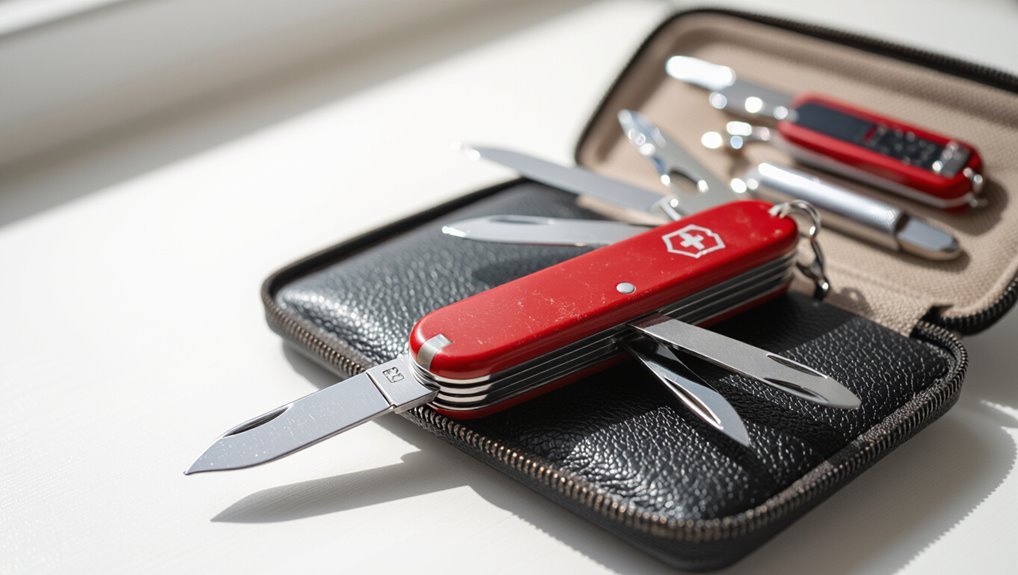
Who needs a Swiss Army Knife in their luggage? You who camp, hike, or fix gear will find it handy for cutting cord, opening cans, repairing straps, or minor first‑aid.
You should weigh benefits against airport rules and destination restrictions; some places ban blades. If you’re unsure, leave it at home or pack it in checked baggage where allowed to avoid confiscation.
Quick Answer: Can You Pack a Swiss Army Knife in Carry‑On or Checked Bags?
Wondering whether you can bring a Swiss Army Knife on your flight?
You can usually pack a Swiss Army Knife in checked luggage without issue, but carrying it in your carry‑on is often restricted.
Check airline and local rules before travel, secure the tool in your bag, and consider alternatives like buying one at your destination if regulations prohibit bringing it aboard.
TSA Rules for Pocket Knives and Multi‑Tools in Carry‑Ons
Although TSA allows some small tools in carry‑ons, pocket knives and multi‑tools with blades are generally prohibited from the cabin.
You’ll face screening rejection or confiscation if your tool has a fixed or folding blade.
Plastic, nylon, or purely non‑cutting multitools may pass.
Always check current TSA guidelines before travel, remove questionable items, and pack blade‑equipped tools in checked luggage instead.
TSA Rules for Knives in Checked Baggage
You can pack most knives, including Swiss Army knives, in checked baggage according to TSA rules, but there are size and blade-type considerations you’ll want to check before travel.
Secure the knife in a sheath or wrap it to prevent accidental opening and protect baggage handlers.
Also place it where it won’t shift or be mistaken for other items during screening.
Checked-Baggage Knife Rules
When flying with a Swiss Army knife, pack it in checked baggage—TSA allows knives in checked bags but forbids them in carry-ons, so make sure it’s not in your personal item or cabin pocket.
You should declare any unusual blades if asked, secure the knife so it won’t open, and follow airline or international rules, since some countries prohibit certain knife types in checked luggage.
Packing And Storage Tips
If you’re putting a Swiss Army knife in checked baggage, secure it so it can’t open, sheathe or wrap the blade, and place it where it won’t shift or get crushed during transit. Pack in the center, cushion with clothes, and declare if required. Follow airline rules.
| Item | Action | Tip |
|---|---|---|
| Knife | Sheath | Center pack |
| Cushion | Clothes | Prevent shift |
| Declare | Per airline | Check policy |
Which Swiss Army Knife Features Trigger Restrictions
Which parts of a Swiss Army Knife will raise flags at security checkpoints? You’ll trigger restrictions with folding blades, scissors, corkscrews, and any sharp or pointed tools.
Also avoid razors, multitool saws, and spring‑loaded or lockable implements.
Cosmetic items like toothpicks and tweezers are usually fine.
When in doubt, pack these tools in checked baggage or leave them at home to prevent delays.
Blade Length and Size Limits for Swiss Army Knives
You’ll want to check blade length restrictions before you pack a Swiss Army Knife, since many carriers and countries set strict limits on how long a blade can be.
Also watch the overall size and tool count—some multi-tools are treated like knives if they exceed certain dimensions.
Rules vary widely by country and airline, so confirm limits for both your origin and destination.
Blade Length Restrictions
Because blade laws vary widely by country, state, and even city, you’ll want to check local limits before packing a Swiss Army Knife; many places restrict blade length, type, or carry method. You should measure blades, favor non-locking small blades, and pack in checked luggage when unsure.
| Region | Max Length | Notes |
|---|---|---|
| EU | Varies | Often <3 cm |
| US | Varies | State laws differ |
Multi-Tool Size Limits
When deciding what Swiss Army Knife to pack, check both blade length and overall tool dimensions since authorities often regulate size as strictly as blade type; small, non-locking models are more likely to be allowed in carry-on luggage.
Measure closed length, blade cutting edge, and thickness.
Airlines and security may ban multitools exceeding specific lengths or with locking mechanisms, so choose compact, non-locking variants.
International Carry Variations
Although rules vary widely from country to country, you’ll usually find that blade length and whether the tool locks determine if a Swiss Army Knife is allowed in carry-on or even checked baggage.
You should check local laws and airline rules. Consider limits:
- Blade length caps
- Locking mechanism bans
- Multi-tool size allowances
- Checked baggage exceptions
- Airport security discretion
When Airline Policies Add Restrictions Beyond TSA Rules
If an airline’s rules go beyond TSA guidelines, you’ll need to check their specific baggage policies before you pack a Swiss Army knife.
Some carriers ban knives entirely, restrict blade length, or require checked storage.
Visit the airline website or contact customer service to confirm allowances, packing requirements, and potential fees.
Follow their directions to avoid confiscation, fines, or denied boarding.
How Security Officers Decide on Knives
Because security officers balance safety, regulations, and context, they’ll assess a Swiss Army knife by its visible features, declared purpose, and the situation at hand.
You should expect them to check legality, blade length, locking mechanisms, designated use, and carry location.
- legality
- blade length
- locking mechanism
- declared purpose
- carry location
International Overview: Common Differences by Region
When you travel, remember that knife rules change a lot by region—Europe often restricts folding knives with one-handed opening or locking blades.
North America tends to focus on blade length and intent, and many Asian and Middle Eastern countries enforce strict prohibitions regardless of size.
Always check local aviation and customs laws, pack multifunction tools in checked baggage when allowed, and declare items if required.
EU and UK Rules for Multi‑Tools in Luggage
Although rules vary across the EU and the UK, both generally treat multi‑tools differently for carry‑on versus checked baggage, so you should expect stricter limits in the cabin.
You can usually pack small tools in checked bags, but carry‑on rules ban blades.
Check airline and airport lists, lock blades if allowed, and declare unusual items.
- carry‑on blade ban
- checked baggage allowed
- size limits apply
- airline policies differ
- declare when unsure
Canada Rules for Knives on Planes
Canada treats knives and multi‑tools differently depending on whether they’re in carry‑on or checked baggage, and you’ll generally face stricter limits in the cabin: blades of any length are prohibited in carry‑ons, while most knives and tools can go in checked luggage if packed safely and declared when required.
Always lock or sheathe blades, pack them deep inside checked bags, and follow airline rules.
Australia Rules for Knives on Planes
If you’re flying within or to Australia, remember that blades and multi‑tools are generally banned from carry‑on luggage and must go in checked baggage; however, state and territory laws can still affect what you can bring, so check both airline and local rules before you travel.
- Pack knives in checked bags only
- Secure items in hard case
- Declare if required
- Know quarantine rules
- Verify airline limits
Asia and Middle East: What to Expect
When traveling through Asia and the Middle East, expect rules to vary widely by country and airline, so check both before packing a Swiss Army Knife; many carriers and airports forbid blades in carry‑on and require them in checked baggage, while a few jurisdictions also restrict the size or type of blade you can import.
Always verify local laws, airline policies, and airport security guidelines before you fly.
Countries That Ban Knives Entirely (Examples)
If you’re traveling to a country with a total knife ban, you’ll need to leave your Swiss Army Knife at home or ship it ahead.
These bans are usually meant to prevent violence or maintain strict security in public spaces and government areas.
Check official rules before you go so you don’t face fines, confiscation, or arrest.
Countries With Total Knife Bans
Although most countries regulate blade length and carry conditions, a few impose near-total bans on privately owned knives, meaning you can’t legally bring pocketknives or fixed blades into the country for everyday use.
You should check rules before travel.
Examples you might encounter:
- Singapore
- Japan
- United Kingdom (specific contexts)
- Norway (strict enforcement)
- UAE
Reasons For Complete Prohibitions
The countries that ban knives outright often do so because they’re prioritizing public safety and crime prevention over individual convenience.
In places with strict prohibitions, lawmakers and enforcement agencies have concluded that removing easy access to blades reduces assaults, gang activity, and illegal weapon circulation.
You’ll find bans motivated by recent spikes in knife crime, high urban violence rates, or political pressure to appear tough on weapons, so enforcement is strict.
How to Check Airline and Country Rules Before You Travel
Want to avoid hassles at the airport? Check rules before you travel so you won’t face confiscation or fines.
Verify policies with:
- Your airline’s baggage policy page
- The departure country’s aviation authority
- The destination country’s customs/transport agency
- Airport security notices and TSA-equivalents
- Contact airline customer service for clarification
Save screenshots and confirmations for your trip.
Packing Checklist for Checked Swiss Army Knives
Before you pack, check your airline and TSA rules so you know whether Swiss Army knives are allowed in checked baggage and what limits apply.
Follow a simple packing procedure—sheath the knife, place it in the center of your suitcase surrounded by clothing, and secure it so it won’t shift.
Keep copies of airline or TSA policy pages and any required documentation with your travel papers in case staff ask.
Checked Baggage Rules
When you pack a Swiss Army knife in checked baggage, follow airline and TSA rules closely to avoid delays or confiscation; you’ll need to confirm allowed tool types, size limits, and any airline-specific policies before travel.
- Check TSA and local aviation regulations
- Verify airline policy and weight limits
- Secure the knife in luggage
- Declare if required
- Avoid prohibited blade types
Packing Procedure Steps
Now that you’ve checked regulations and airline policies, follow a clear packing checklist to keep your Swiss Army knife compliant and easy to find if inspected. Wrap the knife in a protective pouch, place it in the center of checked luggage, and document its location. Stay calm and cooperative if inspected.
| Item | Action |
|---|---|
| Wrap | Pouch |
| Place | Center luggage |
| Note | Document location |
TSA And Airline Policies
Although checked knives are generally allowed, TSA and many airlines set specific rules you should follow to avoid delays or confiscation. You should pack and declare properly, check airline policies, and secure blades to prevent injury.
Follow this checklist:
- Lock blade closed and secure in sheath
- Place in checked baggage only
- Declare if required
- Check airline-specific limits
- Inspect upon arrival
Safe Storage Tips to Prevent Damage or Injury in Checked Luggage
If you pack a Swiss Army Knife in checked luggage, store it so blades and tools can’t open or rub against other items; use a rigid sheath, a dedicated hard-case, or wrap it tightly in several layers of clothing to lock everything in place.
Place the secured knife centrally among soft items, avoid external pockets, and label fragile bags.
Check fastenings before travel to prevent shifting.
Preparing a Swiss Army Knife for Carry‑On Screening (If Allowed)
- You’ll prepare your Swiss Army Knife for carry‑on screening only if allowed; follow clear steps to reduce delays.
- Close and lock blades if possible
- Remove loose attachments or keyrings
- Place in a clear pouch or small case
- Keep accessible in your carry‑on top pocket
- Inform the officer proactively if asked
When and How to Declare a Multi‑Tool at Security
If you’re carrying a multi-tool, tell the TSA officer or place it in the bin for screening as soon as you reach the checkpoint so it’s handled properly.
Say it’s a Swiss Army Knife or multi-tool and point to where it’s packed—officers may inspect it, test it in the X‑ray, or ask you to remove it.
Expect a brief inspection and either approval for carry‑on or direction to place it in checked baggage or surrender it, depending on the airline and local rules.
When To Declare
When you arrive at the security checkpoint with a multi‑tool in your bag, tell the agent immediately so they can assess it; declaring it up front prevents delays and potential confiscation.
You’ll know to declare when:
- you’re in carry‑on, not checked baggage
- the tool has a blade or scissors
- signage or officer asks
- international rules differ
- security requests inspection
How To Declare
Approach the security officer as soon as you reach the checkpoint and let them know you have a multi‑tool in your bag so they can direct inspection or advise whether it needs to go in checked luggage. Be calm, show the tool if asked, follow instructions, and pack receipts or documentation if available.
| Item | Action | Tip |
|---|---|---|
| Multi‑tool | Declare | Be upfront |
| Bag | Open for inspection | Stay nearby |
| Receipt | Present if asked | Helps verification |
| Checked? | Follow officer | Avoid arguments |
What To Expect
Although security procedures vary by airport and country, you’ll typically be asked to declare the multi‑tool at the checkpoint counter or to the officer who greets you at the X‑ray line; they’ll tell you whether to remove it, show it, or put it in checked luggage.
Expect clear instructions and brief inspection.
Tips:
- Be honest
- Keep it accessible
- Follow directions
- Show receipts if asked
- Pack blades properly
What Happens If Security Seizes Your Swiss Army Knife?
If security seizes your Swiss Army Knife, you’ll usually be given a receipt and an explanation of the options: surrender it for disposal, have it held for pick-up after your flight, or—less commonly—face a citation or fine depending on local laws and the knife’s features. You can choose surrender, storage, or contest later per instructions.
| Option | Timing | Likely outcome |
|---|---|---|
| Surrender | Immediate | Disposal |
| Hold | After flight | Return |
| Citation | Immediate | Fine |
How to Contest a Seizure or Appeal a Confiscation Decision
When agents seize your Swiss Army Knife and you believe the action was improper, you can challenge the decision by following the agency’s appeal process, gathering documentation, and asking for a written explanation of the grounds for confiscation.
Follow these steps and stay concise:
Follow these steps and stay concise: request documentation, document the item, gather contacts, file your appeal promptly.
- Request the written confiscation notice
- Take photos of the item and packing
- Collect witness/contact details
- File the agency appeal form promptly
- Keep copies of all correspondence
Legal Penalties and Fines for Boarding With a Prohibited Knife
If you try to board with a prohibited knife, you could face criminal charges that stick to your record and complicate future travel.
You may also be hit with monetary fines that range widely depending on the jurisdiction and circumstances.
Know that both penalties can apply together, so it’s not just a one-time cost.
Criminal Charges Risk
Because airport security treats prohibited knives as potential weapons, you can face serious criminal charges and fines for trying to board with a Swiss Army knife.
You should know consequences, act responsibly, and consult laws before travel.
- Arrest or detention
- Criminal record risk
- Court appearance requirement
- Possible travel restrictions
- Confiscation and evidence handling
Monetary Fines Amounts
Although penalties vary by country and airport, you can expect fines ranging from modest administrative fees to several hundred dollars (or more) if you’re caught trying to board with a prohibited Swiss Army knife, especially where laws treat blades as serious security risks.
You’ll also face confiscation, possible travel delays, and higher penalties if officers suspect intent to harm or repeated violations.
TSA‑Friendly Alternatives to Swiss Army Knives
Looking for a pocket tool you can bring on a plane? You’ll want non-bladed, TSA-allowed options that still handle everyday tasks.
Consider these carry-on friendly alternatives:
- Multi-tool without knife blade (pliers, screwdrivers)
- Plastic or ceramic letter opener
- Compact screwdriver set
- Keychain flashlight
- Mini pry bar (blunt tip)
Choose durable, clearly non‑cutting tools to avoid confiscation.
Battery and Electric Tool Rules for Travel
You’ll need to know which battery types are allowed on planes and which are restricted.
Check whether devices with batteries must go in carry-on or can be checked, since rules differ by airline and battery chemistry.
Also confirm power bank capacity limits to avoid having them confiscated at security.
Battery Type Restrictions
When packing a Swiss Army Knife that has batteries or built-in electric tools, check the type and watt-hour rating of each cell before you go: airlines and security screeners have strict rules for lithium-ion, lithium metal, alkaline, and rechargeable NiMH batteries, and those rules determine whether the item can travel in checked baggage, carry-on, or not at all.
- Lithium-ion: watch Wh limits
- Lithium metal: often restricted
- Alkaline: usually allowed
- NiMH: generally permitted
- Replaceables: remove if required
Carry-On vs Checked
After you verify the battery type and watt-hour rating, decide whether to pack the Swiss Army Knife with its electric components in carry-on or checked baggage — rules differ sharply between the two.
You should pack lithium batteries and powered tools in carry-on when allowed, secure terminals, and keep spare batteries in protective covers.
Checked baggage often prohibits installed or spare lithium cells; check airline rules.
Power Bank Limits
Because power banks combine high-capacity lithium cells with portable convenience, airlines and security agencies set strict limits you should know before packing one.
You should keep power banks in carry-on, check capacity, carry originals, avoid loose batteries, and declare large units.
- Carry-on only
- Under 100Wh usually allowed
- 100–160Wh needs approval
- Over 160Wh prohibited
- Tape terminals and pack safely
Shipping Tools: Using Checked Baggage Shipping or Couriers
If you need to move a Swiss Army knife without risking airport security headaches, consider checked-baggage shipping or a courier service as practical alternatives.
You’ll pack the knife securely, declare any required items, and follow carrier rules.
Check prohibitions, insurance options, and delivery timelines.
Couriers often offer tracking and liability coverage, giving you a compliant, reliable way to transport tools.
Handling Layovers and Connecting Flights With a Knife
When you have a layover, check security checkpoint rules at each airport you’ll pass through so you don’t get stopped for carrying a knife in a carry-on.
Remember that policies and whether you can pack the knife in carry-on vs checked baggage vary by airline and country, so plan accordingly.
For international transit, confirm restrictions for both the origin and connection countries to avoid confiscation or fines.
Security Checkpoint Rules
As you plan connections and layovers, know that carrying a Swiss Army Knife through security depends on where it’s stored and the rules of each airport and airline you’ll pass through.
You should check rules, declare if required, and prepare for inspection.
- Verify TSA or local authority policies
- Keep knife packed per rules
- Declare at checkpoints if needed
- Expect secondary screening
- Know transfer airport restrictions
Carry-On Vs Checked
Decide whether to pack your Swiss Army Knife in carry-on or checked luggage based on the laws at every airport on your route and the practical risks of each option.
Carry-on risks confiscation and missed transfers; checked luggage risks loss or delayed retrieval.
For tight layovers choose checked if allowed; for easy connections keep it secured in checked or mail it ahead to avoid complications.
International Transit Restrictions
If you’re transiting through multiple countries, check each country’s blade rules and airline policies before you pack—some airports ban knives entirely from transit zones while others allow them only in checked baggage, so a single layover can change what you can legally carry.
You’ll want to:
- Verify transit airport rules
- Check airline restrictions
- Use checked baggage when required
- Pack documentation of permissions
- Allow extra time for security checks
Commuting Through Multiple Countries: Practical Tips
When you’re traveling across several countries with a Swiss Army Knife in your bag, plan routes and checkpoints so you won’t be caught off guard by varying regulations; know which borders allow blades, which require them in checked luggage, and which ban them entirely.
Carry documentation of local laws, keep the knife secured in checked baggage when uncertain, and check airline and train rules before departure to avoid fines or confiscation.
What to Do If You Need a Tool but Left Your Knife Behind
Forgot your Swiss Army Knife? You can still handle small tasks smartly. Check nearby stores, ask hotel staff, or borrow from fellow travelers.
Forgot your Swiss Army Knife? No problem — check nearby shops, ask hotel staff, or borrow from fellow travelers.
If buying isn’t possible, improvise with common items and prioritize safety.
- Ask reception or concierge
- Visit a nearby hardware/shop
- Borrow from a fellow traveler
- Use scissors or keys carefully
- Delay nonessential repairs until home
Storing and Labeling Multi‑Tools to Speed Security Checks
You can make security checks smoother by storing and labeling your multi‑tools so they’re obvious and easy to inspect. Keep them in a clear pouch, attach a printed label with contents, and place near the top of your bag. Presenting them proactively speeds screening and avoids surprises.
| Item | Storage |
|---|---|
| Multi‑tool | Clear pouch |
| Label | Printed tag |
| Position | Top pocket |
| Note | Ready to show |
Frequently Disputed Scenarios Screeners See With Multi‑Tools
Although screeners try to follow clear rules, they still encounter repeat disputes over multi‑tools—items that look similar but differ by size, blade type, or local rules—so you should expect questions and be ready to explain or show details quickly.
- Locking vs non‑locking blades
- Small scissors vs shears
- Folded size vs extended length
- Nonmetal tools with metal bits
- Regional allowance differences
Real Traveler Examples: Mistakes and Best Practices
Ever wondered how a tiny oversight can derail your trip? You packed a knife in checked baggage once and still faced delays when handlers inspected it.
Learn from that: declare when asked, stow securely, and avoid blades on carry-ons.
Other travelers forgot to lock tools, causing damage.
Pack smart, follow airline rules, and you’ll skip hassles and lost time.
Final Pre‑Trip Checklist: Travel‑Ready Swiss Army Knife Steps
After learning from other travelers’ mishaps, take a moment to run through a compact checklist so your Swiss Army Knife won’t cause delays or damage on the trip.
- Confirm blade locks are secure and tools fold fully.
- Remove batteries or damp items to prevent corrosion.
- Pack in checked luggage if blade is sharp and allowed.
- Use a sheath or wrap to protect other items.
- Verify local rules before arrival.
Frequently Asked Questions
Can I Carry Replacement Knife Blades or Loose Blades in My Luggage?
You generally can’t carry loose or replacement knife blades in carry-on luggage; you’ll need to pack them in checked baggage and check airline and destination rules beforehand, since some countries may prohibit certain blade types or lengths.
Are Swiss Army Knives Allowed on Cruise Ships or Ferries?
Generally, no — cruise lines and ferries usually ban pocket knives like Swiss Army knives for passenger safety. You’ll need to check each carrier’s rules; some allow sealed luggage storage or shipboard surrender options upon boarding.
Do Rental Car Agencies Allow Stored Knives Inside Their Vehicles?
Generally, you can leave a stored knife inside a rental car, but policies and local laws vary, so you should check the rental agreement and contact the agency; they’ll tell you any restrictions or required storage procedures.
Can I Bring a Swiss Army Knife Through a Train or Bus Terminal Internationally?
Generally, you can’t bring a Swiss Army Knife through international train or bus terminals past security; rules vary by country, so check local transport and border regulations beforehand, and pack knives in checked luggage when possible.
Will Travel Insurance Cover Loss or Theft of My Swiss Army Knife?
Usually yes, but it depends on your policy and exclusions; you’ll need to check coverage for small valuables, declare item value, keep proof of ownership, and report theft promptly—some policies limit amounts or exclude pocketknives specifically.
Conclusion
If you’re weighing whether to bring a Swiss Army Knife, remember it’s usually allowed only in checked luggage — not in carry‑ons — and some blade lengths or features can still cause issues. Pack it securely in checked baggage, sheath or wrap sharp edges, and label or separate it to help screeners. Double‑check airline and international rules before travel. When in doubt, leave the knife at home or ship it ahead to avoid delays, fines, or confiscation.