Is CLEAR the Same as TSA PreCheck? Differences
No — they’re different services that speed different parts of airport security. CLEAR uses biometrics to verify your identity and escort you past ID checks, while TSA PreCheck shortens the physical screening steps like shoes, belts, and laptops. You’ll enroll and pay for each separately, and using both together gives the fastest, most reliable checkpoint experience. Keep going and you’ll find how each works, where they’re available, and which combo fits your travel style.
Quick Decision: Is CLEAR the Same as TSA PreCheck?
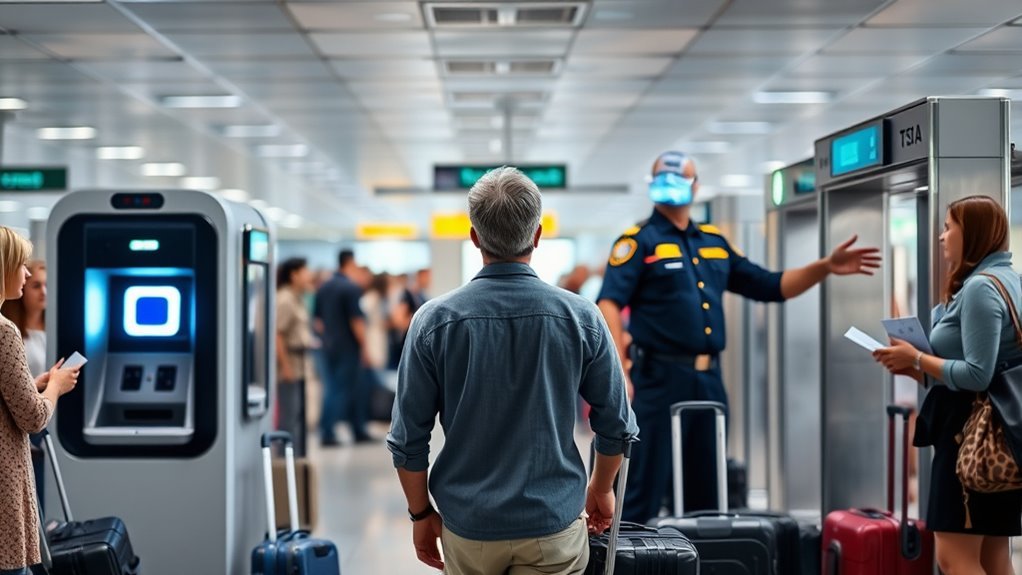
While both speed up airport security, CLEAR and TSA PreCheck aren’t the same: you’ll see different benefits. CLEAR uses your biometrics to verify identity and move you to the front of the ID line; it doesn’t change screening procedures.
TSA PreCheck alters the security process itself, letting you keep shoes, belts, and laptops in bags at designated lanes. You can use both together for the fastest experience, but each requires separate enrollment and fee.
Choose CLEAR if you value identity speed; pick PreCheck if you want reduced screening hassle. Combining them gives the most streamlined airport flow.
How Does TSA PreCheck Speed Security Screening?
With TSA PreCheck, you move through ID checks faster because agents verify your status ahead of time.
You’ll usually wait in shorter security lines reserved for trusted travelers.
And you won’t have to remove shoes or laptops, which keeps the screening walkthrough quicker and smoother.
Faster ID Verification
Because TSA PreCheck verifies your identity and screens you in advance, you move through identity checks much faster at the checkpoint. You present your boarding pass and ID less often because agents already see your vetted status, so you avoid repeated document comparisons. Your ID glance is quick, focused on confirming the match rather than detailed validation. That shaving of seconds adds up across travelers, keeping flow steady and predictable for you.
- Agent confirms PreCheck designation rather than full document inspection.
- Fewer ID scans or manual checks.
- Rapid visual ID match.
- Consistent, streamlined verification process.
Shorter Security Lines
The quicker ID checks feed directly into shorter security lines: since PreCheck members skip the bulk of document rechecks and join a dedicated lane, the screening queue moves faster and more predictably. You walk into a streamlined process where fewer steps per traveler reduce bottlenecks at the front of the checkpoint.
Because PreCheck lanes limit intensive secondary inspections, throughput rises and average wait times drop, especially during peak hours. You’ll likely clear screening more consistently than in standard lanes, letting you plan arrivals with less buffer time.
That reliable pacing keeps overall airport flow smoother and stress lower for frequent flyers.
Less Shoe And Laptop Removal
When you’re in a TSA PreCheck lane, you’ll usually leave your shoes and light outerwear on and keep laptops in their bags, which cuts several steps from the screening process. You move faster because you skip removing items that slow most travelers. That reduces fumbling, tray jams, and time at the conveyor.
You still follow officer instructions and avoid prohibited items, but the routine feels routine.
- Keep shoes on — no barefoot shuffle.
- Leave light jackets — one less layer to manage.
- Laptops stay packed — no tray lineup.
- Fewer trays means quicker throughput.
How Does CLEAR Use Biometrics to Skip the ID Line?
With CLEAR, you use your fingerprint or iris to verify your identity at dedicated kiosks, so you don’t have to show your ID to an agent.
That biometric check links your face to your boarding pass in seconds. It’s a quicker ID check-in that moves you past the line and straight toward screening.
Biometric Identity Verification
Although you still show a boarding pass, CLEAR uses quick biometric scans—usually fingerprints or an iris scan—to confirm your identity so you can skip the ID-check line and head straight to security.
You enroll once: a staffer captures your biometric templates and links them to your profile. At the kiosk, a live scan matches you to that template in seconds, then a CLEAR ambassador escorts you to screening.
Data is stored encrypted; CLEAR says templates can’t be reverse-engineered into images. You can update or revoke biometrics if needed, and enrollment requires ID verification to prevent fraud.
- Fast live scan
- Encrypted storage
- Ambassador escort
- Update/revoke options
Faster ID Check-In
You’ll skip the ID-check line because CLEAR replaces the paper-ID step with a quick biometric match at a kiosk: you scan your fingerprint or iris, the system verifies that live scan against your encrypted template captured at enrollment, and a CLEAR ambassador then escorts you past the ID queue straight to screening.
After verification, your boarding pass and traveler status determine whether you go to standard or expedited lanes like TSA PreCheck. CLEAR speeds identity confirmation to seconds, reduces human error from manual ID checks, and keeps your data encrypted on file.
You keep control—opt in to biometrics and decide when to use CLEAR.
How CLEAR vs TSA PreCheck Differ at the ID and Screening Lanes
Curious how CLEAR and TSA PreCheck actually play out when you get to the airport? You’ll notice CLEAR speeds ID verification using biometrics; an agent or kiosk confirms your identity, then escorts you to the front of the screening line.
TSA PreCheck doesn’t verify ID biometrically but gives you access to dedicated screening lanes where you keep shoes, belts, and laptops. Combined, they minimize both ID and security steps.
- CLEAR: biometric ID, skip ID line, escorted to security.
- TSA PreCheck: vetted status, expedited screening lane rules.
- CLEAR+PreCheck: fastest flow, minimal interaction.
- Regular line: standard ID check and full screening.
Where CLEAR and TSA PreCheck Are Available (Airports & Airlines)
If you travel through major U.S. airports, you’ll find CLEAR and TSA PreCheck at many—but not all—locations and airlines. You can use CLEAR at over 50 airports and select sports venues; it speeds ID verification, then routes you to the appropriate security lane.
TSA PreCheck operates at more than 200 airports and across most U.S. carriers, providing expedited screening without removing shoes, belts, or laptops from bags. Availability varies by terminal and airline participation, so check both services’ airport lists before travel.
If one isn’t available, the other might be, and some travelers use both for maximum convenience.
Price, Enrollment Time, and Renewal: CLEAR vs TSA PreCheck
Knowing where each service is available helps decide which one to pick, but cost and time commitments often sway that choice. You’ll weigh CLEAR’s higher annual fee against PreCheck’s lower government-backed price.
Enrollment for CLEAR is quick—minutes at the kiosk—while PreCheck needs an online form plus an in-person appointment that takes longer.
Renewal for CLEAR is simple via app; PreCheck requires reapplying or updating biennially.
Consider value if you travel often or with family; bundles and airline partnerships can change costs.
- CLEAR: higher price, faster enrollment, simple renewal.
- PreCheck: lower fee, longer enrollment, two-year term.
- Family impacts cost-effectiveness.
- Promotions can alter upfront choice.
CLEAR vs TSA PreCheck: Real-World Wait-Time Comparisons
When you’re rushing to a flight, average wait times at security lines can make a big difference in your day. Compare typical waits for CLEAR and TSA PreCheck during normal hours, then look at peak-time differences to see where each saves you the most time.
Real-world time savings often depend on the airport and how crowded it is, so you’ll want to weigh both everyday and busy-period performance.
Typical Airport Waits
Although both programs aim to speed you through security, their real-world wait times often differ in predictable ways. You’ll usually move fastest with CLEAR when biometric lanes are staffed and short; it eliminates ID checks.
TSA PreCheck cuts time at the x-ray and allows you to keep shoes and laptops, so lines flow quicker even without biometrics.
- CLEAR: near-instant ID verification, then join security screening.
- TSA PreCheck: expedited screening lane, simpler trays and procedures.
- Combined: fastest overall—CLEAR for ID, PreCheck for screening.
- Neither: expect standard security timing and full screening procedures.
Peak-Time Comparisons
Because airport crowds spike at predictable hours, you’ll see clear differences between CLEAR and TSA PreCheck during peak times:
CLEAR shaves minutes by skipping ID checks whenever biometric kiosks are staffed, while PreCheck speeds the screening line itself so it keeps moving even if CLEAR lanes are limited or offline.
You’ll find CLEAR most helpful when ID checkpoints bottleneck; biometric access gets you to screening faster.
PreCheck shines when scanners are backed up because fewer items and simpler procedures keep throughput high.
If both are available, using CLEAR to reach a PreCheck lane combines benefits, reducing overall delay during busy periods.
Real-World Time Savings
If you want a practical sense of how much time you’ll actually save, look at real-world wait data rather than promises: CLEAR often trims the ID-check stage to under a minute when kiosks are staffed, while TSA PreCheck typically cuts full-screening times by letting you keep shoes and laptops packed and move through dedicated lanes.
- Morning peak: CLEAR + PreCheck can shave 10–20 minutes off total time.
- Midday: CLEAR alone often saves 5–10 minutes versus regular lines.
- Evening: PreCheck limits screening steps, saving consistent 8–15 minutes.
- Irregular staffing or busy security can erase CLEAR gains, so plan buffer time.
When TSA PreCheck Alone Makes Sense
When you fly mainly on domestic routes with low-security lines at airports you frequent, TSA PreCheck alone often gives you the best balance of speed and cost. You’ll skip full shoe and belt removal, keep laptops and liquids stowed, and move through standard security lanes faster without extra membership fees beyond PreCheck’s annual or five-year cost.
If your trips are predictable, airports reliably offer PreCheck lanes, and you don’t need biometric ID verification or instant enrollment, PreCheck covers most convenience needs. Stick with it when savings and simplicity matter more than the absolute fastest possible checkpoint access.
When CLEAR Alone Makes Sense
Although CLEAR doesn’t speed you through the metal detector, it gets you to the front of the line fast by using biometric ID so you can bypass long ID-check queues that slow down everyone else. You’ll find CLEAR alone makes sense when speed to the checkpoint matters more than relaxed screening rules.
It’s useful if you travel sporadically, want a hands-free ID process, or often face long ID lines. Consider situations like tight connections, solo travelers who value time, or airports where CLEAR lanes are plentiful.
- Tight connection — avoid missed flights
- Sporadic travel — skip upfront hassle
- Hands-free ID — minimal interaction
- Busy airports — consistently shorter waits
Why Using CLEAR + TSA PreCheck Is Faster Than Either Alone
Because CLEAR gets you to the front of the ID line and TSA PreCheck lets you breeze through physical screening, using both cuts total checkpoint time dramatically—you skip ID waits and avoid shoewands, belts and laptop removals in one smooth flow.
You move from identity verification straight into the expedited PreCheck lane, eliminating the usual merge and requeue delays. That combination reduces interaction points, shortens queueing and minimizes handling of your carry-ons.
Fewer steps mean fewer bottlenecks and lower variance in wait times, so you’ll reliably reach the gate faster than relying on either service alone.
How to Enroll, Link, and Use Both Services
If you want both services, start by enrolling in each separately—apply online for CLEAR and book an in-person appointment for TSA PreCheck (or Global Entry, which includes PreCheck).
After approval, add your Known Traveler Number (KTN) from PreCheck to airline profiles and reservations; CLEAR uses your phone number and biometrics.
At the airport, use CLEAR lanes to skip ID checks, then keep an eye for the PreCheck lane at security for expedited screening.
- Enroll online for CLEAR, then verify biometrics at an enrollment center.
- Complete TSA PreCheck in-person appointment and receive your KTN.
- Add KTN to frequent flyer accounts and bookings.
- At airport, use CLEAR first, then PreCheck lane for screening.
Which Option Is Best for Different Traveler Types
Who benefits most from CLEAR, TSA PreCheck, or both depends on how and how often you travel.
If you fly frequently and value speed over cost, CLEAR speeds you to the front by verifying identity at kiosks — ideal for business travelers, families with kids, or tight connectors.
If you want cheaper recurring convenience and fewer security steps (keep shoes, laptops), TSA PreCheck fits leisure travelers and most frequent flyers.
Combine both if you want maximum time savings and smoother checkpoints.
If you rarely fly, neither may be worth it; pick PreCheck for occasional trips, CLEAR for high-volume travel.
Frequently Asked Questions
Can CLEAR or TSA Precheck Help With International Departures or Customs?
They can help a bit: TSA PreCheck speeds U.S. security screening for many international departures, while CLEAR speeds ID verification at participating airports; neither replaces customs processing, so you’ll still clear immigration and customs procedures.
Do TSA Precheck or CLEAR Cover Global Entry Benefits?
No — neither TSA PreCheck nor CLEAR automatically include Global Entry. You’ll need to apply and pay for Global Entry separately (or get it via Customs/CBP programs); Global Entry covers expedited immigration and customs when returning internationally.
Can Minors Use CLEAR or TSA Precheck Without Enrollment?
Minors can’t use CLEAR without their own enrollment; CLEAR requires individual biometric registration. TSA PreCheck can cover children 12 and under when traveling with an enrolled adult, but older minors need their own PreCheck enrollment.
Do Rideshare Drop-Off Lines Affect CLEAR or TSA Precheck Access?
They don’t directly affect CLEAR or TSA PreCheck access, but using rideshare drop-off lines can change your walking distance and timing; you’ll still use CLEAR lanes or PreCheck security as normal if those services are available at that terminal.
Are Refunds or Prorated Cancellations Available for Clear/Tsa Precheck?
Yes — you can get refunds or prorated cancellations, but policies vary: CLEAR offers pro-rated refunds if you cancel within certain windows, and TSA PreCheck refunds depend on enrollment center rules and timing, so check each program’s terms.
Conclusion
In short, CLEAR and TSA PreCheck aren’t the same: CLEAR uses biometrics to skip the ID check, while TSA PreCheck gives you a faster security screening lane. Alone, CLEAR helps when ID lines are long; PreCheck speeds up the actual screening. Together, they’re best—CLEAR gets you to the front, PreCheck gets you through quicker. If you travel often, combine them; if you fly rarely, pick the one that matches your airport and comfort with biometrics.