Is Shaving Cream a Liquid TSA? Carry On Rules Explained
Yes — TSA treats shaving cream as a liquid/aerosol, so you’ll need containers of 3.4 oz (100 mL) or less packed in a single clear quart-sized bag for carry-on. Solid soaps or puck sticks aren’t considered liquids and are fine outside the bag. Declare any medically necessary or oversized items for inspection, and pack aerosols carefully or check them. Keep containers accessible and follow airline rules for tighter limits if applicable to learn what to pack next.
What This Guide Covers and Who It’s For
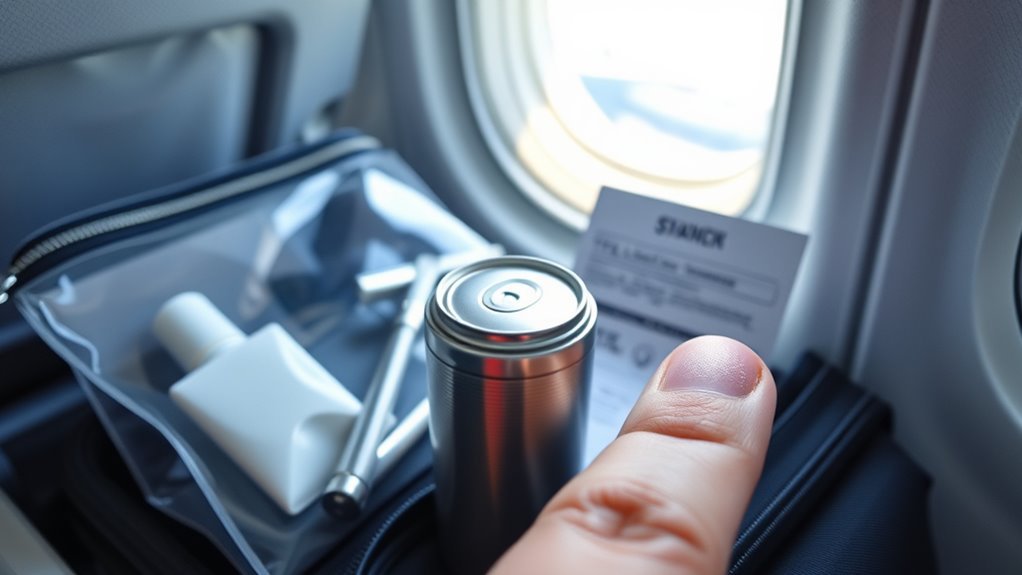
Wondering whether your shaving cream will make it through airport security? This guide tells you who needs it and what to expect, focusing on carry-on travelers, casual tourists, and business flyers who pack shaving cream or similar aerosols.
You’ll get clear, practical advice on preparing toiletries for screening, examples of common container sizes that typically comply, and tips for packing alternatives if restrictions apply.
You won’t get legal jargon or exhaustive regulatory history — just straightforward steps to speed you through checkpoints and avoid surprises.
Read this if you want concise, actionable help before you head to the airport.
Is Shaving Cream a Liquid Under TSA Rules?
Because TSA treats most shaving creams the same way it treats other toiletries, you’ll generally have to follow the 3-1-1 liquids rule when carrying them in your carry-on.
You should pack shaving cream in containers 3.4 ounces (100 milliliters) or less, and place them together in a single clear quart-sized bag.
Larger pressurized cans or noncompliant sizes belong in checked baggage.
Solid shaving soap or shaving sticks usually don’t count as liquids, so you can carry them without the 3-1-1 constraints.
Always check product labeling and current TSA guidance before travel to avoid surprises at the checkpoint.
How the TSA Defines Liquids, Gels, and Aerosols
When you pack for a flight, the TSA groups liquids, gels, and aerosols together because they behave similarly in security screening and pose comparable safety concerns. You should know they define these by state and packaging: liquids flow, gels hold shape but squish, and aerosols release mist or foam under pressure. That means substances like shampoo, toothpaste, and shaving foam fall under the same category if they’re not solid. Check labels and container type before security to avoid surprises.
| Type | Example |
|---|---|
| Liquid | Water |
| Gel/Aerosol | Shaving foam |
The 3‑1‑1 Rule Explained for Shaving Cream
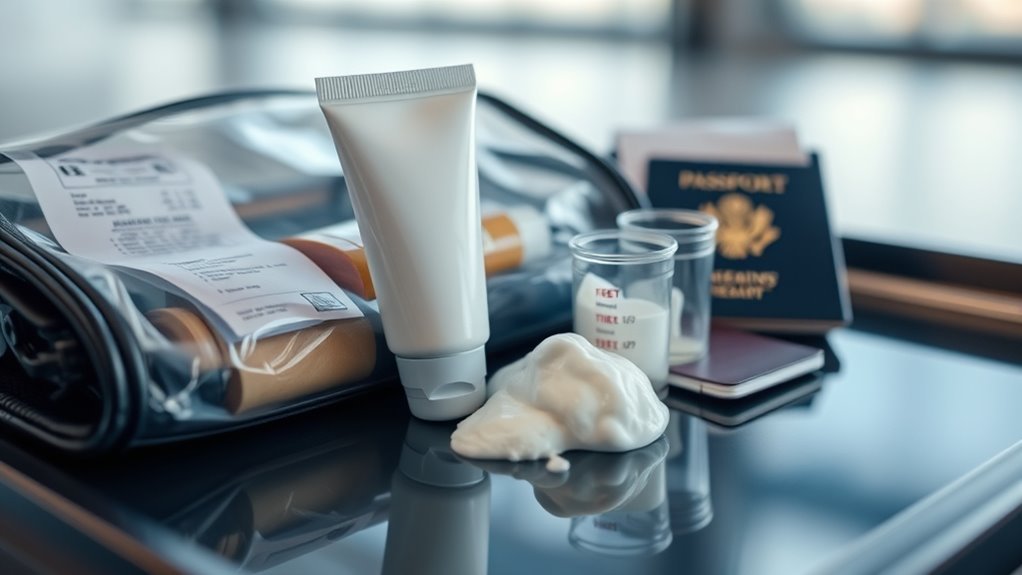
How much shaving cream can you bring through airport security? You follow the TSA’s 3-1-1 rule: containers must be 3.4 ounces (100 milliliters) or less, fit inside a single clear quart-sized bag, and you’re limited to one bag per passenger.
Treat shaving cream as a gel/foam—so each canister counts as a container. Place it in the bag before screening and remove the bag from your carry-on if required.
If a canister exceeds the size limit, you’ll need to check it or dispose of it. Remember, security officers may ask to inspect items, so stay cooperative and prepared.
Allowed Volume for Shaving Cream in Carry‑On
You can bring shaving cream in your carry‑on as long as each container fits the TSA 3.4‑ounce (100 mL) limit and all containers fit in a single quart‑size bag.
Small travel‑size cans or pump bottles that meet the container size rules are fine, but larger cans must go in checked baggage.
If you have a medically necessary foam or prescription aerosol, let TSA know — exceptions may apply with documentation.
TSA Carry‑On Limit
Although shaving cream is treated as an aerosol by the TSA, you can bring it in your carry-on only if each container holds 3.4 ounces (100 milliliters) or less and all containers fit inside one clear quart-size bag.
The TSA enforces a 3-1-1 rule: three total items, one quart bag, one passenger. You’ll need to present the bag separately during screening.
Larger pressurized cans must go in checked baggage.
If you carry multiple small containers, make certain they comfortably fit and close. Security officers may request removal for inspection, so keep the bag accessible to speed up the process.
Container Size Rules
Wondering about the exact size of shaving cream you can carry on? You must follow the TSA 3-1-1 rule: containers 3.4 ounces (100 milliliters) or less, all fitting inside one clear quart-sized bag. Each passenger gets one such bag.
If your shaving cream is aerosol or foam, it still counts as a liquid/gel and must meet that size limit. Multi-packs or travel sets are fine only if each individual container is within the limit.
Oversized cans need to go in checked baggage or be discarded. Check airline or international variations before packing to avoid surprises at security.
Exceptions And Medications
Because some passengers need larger toiletry supplies for medical or special-needs reasons, TSA allows exceptions to the 3-1-1 rule for medically necessary liquids and gels—this can include prescription topical medications, lubricants, or larger-volume personal care items if you can justify them.
You should declare these items at screening, keep documentation handy, and expect inspection. For shaving cream used as a medical necessity or skin-treatment carrier, be prepared to explain its purpose.
Think about how this affects your packing and peace of mind:
- Relief — you won’t be forced to discard essential products.
- Dignity — you can travel with necessary care.
- Confidence — screening becomes less stressful.
When Shaving Cream Must Go in Checked Baggage
If your shaving cream container exceeds the TSA’s 3.4-ounce (100 ml) limit for carry-ons, you’ll need to pack it in checked baggage or buy a compliant travel-size at the airport.
Larger pressurized cans are treated as aerosols and aren’t allowed in the cabin. When checked, place the can upright in a sealed plastic bag and cushion it to prevent punctures or leakage.
Declare any unusually large or commercial quantities if required by airline rules. Check airline and international regulations for specific weight or hazardous-material limits.
Keep receipts or documentation for specialty products to avoid delays at security or customs.
Packing Aerosol Shaving Cream for Carry‑On
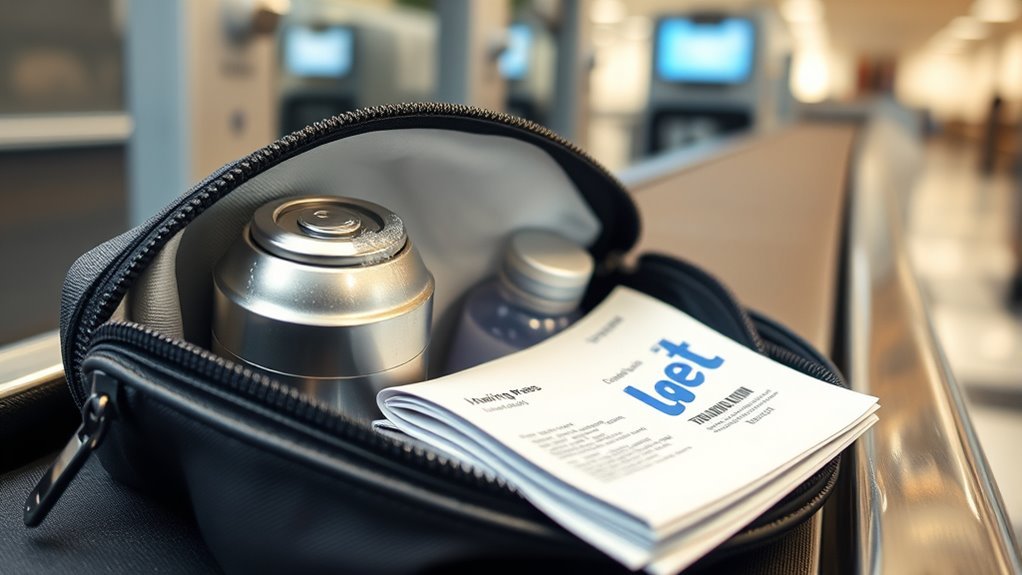
When you need to bring aerosol shaving cream in your carry‑on, know that TSA allows it only in containers 3.4 ounces (100 ml) or smaller and packed inside your single clear quart‑size bag with other liquids, gels, and aerosols.
You’ll want to check the can’s labeled volume, seal it against leaks, and place it where security can easily inspect your bag. Be mindful of airline or destination restrictions on aerosols.
Pack confidently by following these emotional checkpoints:
- Relief — you’ll have grooming comfort without stress.
- Confidence — you meet rules and feel prepared.
- Calm — screening goes smoothly and quickly.
Packing Non‑Aerosol Creams and Gels for Carry‑On
When you pack non‑aerosol creams and gels, keep each container to 3.4 ounces (100 ml) or less to meet TSA carry‑on rules.
You can bring things like shaving gels, creams, and styling pomades, but they all need to fit inside a single clear quart‑sized bag and be shown at security.
Make sure containers are sealed and easy to present so screening goes smoothly.
Container Size Limits
Because TSA treats non‑aerosol creams and gels like liquids for carry‑on screening, you’ll need to pack them in containers no larger than 3.4 ounces (100 milliliters) and place them in a single clear quart‑sized bag for each passenger. Stick to those limits to avoid hassles at security. Label or choose translucent bottles so agents can see contents.
If you need more, check baggage or buy travel‑size replacements after screening. Keep the quart bag accessible for removal at checkpoints.
- Relief: you’ll breeze through security.
- Frustration: overfull bags get tossed.
- Confidence: you’re ready to travel.
Allowed Product Types
Now that you’ve got container size rules down, know which non‑aerosol creams and gels are okay to pack so you don’t waste space or time at the checkpoint. You can bring shaving cream in non‑aerosol pump or cream form, hair styling cream, toothpaste, moisturizers, sunscreen, and gel deodorant in containers that meet TSA limits.
Solid bars (soap, shampoo) aren’t counted as liquids, so they’re a good space saver.
Medications and baby formula are allowed beyond limits with declaration.
Avoid aerosol foams and large tubs; they’ll be rejected. Stick to compliant types to breeze through security.
Packing And Presentation
If you’re packing non‑aerosol creams and gels for carry‑on, group them in a single clear, quart‑sized plastic bag so TSA agents can quickly scan and verify compliance. You’ll tidy tubes, jars, and travel containers, keep lids secure, and place the bag where it’s easy to remove. Labeling helps if volumes aren’t obvious. Prepare for inspection calmly and don’t cram liquids among electronics.
- You’ll feel prepared when everything’s visible.
- You’ll avoid delays with neat, accessible packing.
- You’ll reduce stress knowing you followed the rules.
This approach saves time and keeps your toiletries flight‑ready.
How to Pack Large Cans: Ship, Check, or Downsize
When you’ve got oversized cans of shaving cream, decide whether to ship them ahead, check them, or downsize before you go—each choice has trade-offs in cost, convenience, and risk.
If you ship, pack cans upright in sturdy boxes with cushioning and check carrier rules for aerosols; shipping avoids TSA limits but costs time and money.
If you check, place cans in checked baggage inside protective sleeves and follow airline limits for pressurized containers.
If you downsize, transfer product into compliant travel bottles or buy travel-size replacements to keep in carry-on.
Pick the option that matches your budget and tolerance for hassle.
Medically Necessary Shaving Products: TSA Exceptions
The TSA allows certain medically necessary shaving products beyond standard liquid limits, so tell your security officer and have documentation ready if you carry extra quantities or specialized formulations. You can bring prescription creams, medicated gels, or non-aerosol preparations that treat skin conditions or support healing. Pack them accessibly and label prescription containers clearly.
Expect inspection; cooperate calmly to speed screening.
- Relief: knowing treatment travels with you.
- Anxiety: inspections can feel invasive—prepare paperwork.
- Confidence: clear labeling avoids delays.
Carry only what you need, keep documentation handy, and arrive early to handle any questions.
What to Declare at TSA Checkpoints and How to Do It
If you’re carrying shaving cream or other liquids that exceed the 3.4-ounce limit, you need to declare them at the checkpoint.
When you reach the TSA agent, plainly say you have oversized liquids or medically necessary products and specify what they are.
Keep your items accessible for inspection and follow the agent’s instructions.
Declare Liquids Over Limit
Know what to declare and you’ll speed through security: anything over the TSA’s 3.4-ounce (100 ml) limit—or larger quantities of gels, creams, pastes, aerosols, and liquids—must be removed from your carry-on and placed in checked baggage or declared to an officer at the checkpoint.
You’ll avoid delays by organizing bottles, tubs, and cans before you reach the scanner. Pack oversized items in checked luggage when possible. If you must carry them, expect inspection. Keep receipts for medically necessary liquids.
Follow these steps to stay calm and compliant:
- Sort items by size and necessity.
- Secure containers and lids tightly.
- Expect brief inspection.
How To Verbally Notify
When you approach the checkpoint, politely tell the TSA officer about anything that exceeds the 3.4‑ounce rule or any medically necessary liquids, aerosols, gels, creams, or sharp items you’ve packed; do this before placing your bag on the X‑ray belt so the officer can guide the inspection.
Say clearly what the item is, why it’s over the limit (medication, infant needs), and whether it’s in carry‑on or a separate container.
Hold items up when asked, remove them promptly if directed, and answer questions concisely.
If you need a secondary screening, follow instructions and keep calm to speed the process.
What TSA Officers Look for During Toiletry Screening
Because officers have to screen dozens of bags quickly, they focus on a few key things when checking your toiletries: container size and labeling, consistency (liquid, gel, or solid), and whether items are properly packed in a clear quart‑sized bag.
You should present items clearly and cooperate if asked to remove or open containers. They’ll look for intact seals, readable volume markings, and anything that seems suspiciously dense or taped.
Expect politely firm questions if something’s unclear. Follow the rules to speed screening and avoid delays.
- Relief — when you’re prepared.
- Frustration — when you’re not.
- Confidence — when you comply.
Why Shaving Cream Shows Up on X‑Ray Screening
When you pass a can of shaving cream through X‑ray screening, the machine detects the foam’s density and the metal canister differently from other toiletries.
Because foam scatters X‑rays and creates varying contrasts, it can blur or obscure adjacent items on the image. That’s why officers may ask you to remove or open containers so they can get a clearer view.
How X‑Rays Detect Foam
Although X-ray machines don’t “see” foam the way your eyes do, they pick up differences in density and atomic composition, so shaving cream shows up as a distinct, often opaque area on the image.
You’ll notice foamy textures absorb and scatter X-rays differently than liquids or solids, creating contrast technicians interpret. That contrast comes from trapped air, propellants, and surfactants altering attenuation.
You can think of it this way:
- It changes density — air pockets lower average density.
- It alters composition — chemicals shift atomic interaction.
- It creates texture — scattering increases opacity.
You’ll see why foam stands out quickly.
Can Shaving Cream Obscure Images
If you’ve ever wondered whether shaving cream can hide items in your bag, the short answer is: not reliably—its foamy structure changes how X-rays pass through and can create areas of confusing contrast.
But modern scanners and trained operators usually detect anomalies behind or within that foam. You might think dense foam masks shapes, yet X-ray systems map material density and thickness; metal, batteries, and dense liquids still produce distinct signatures.
Technicians flag irregular shadows for inspection, and automated algorithms highlight suspect regions. Packing cream in opaque containers or burying objects won’t prevent secondary screening or removal requests.
Common Reasons TSA Will Confiscate Shaving Cream
Because TSA rules focus on safety and consistency, officers commonly confiscate shaving cream for a few clear reasons. You’re likely to lose it when:
- It’s over the 3.4-ounce limit, which feels frustrating when you packed it.
- It’s not in a clear quart-sized bag, causing delays and embarrassment.
- It appears suspicious during screening — foam can mimic prohibited substances, which makes you anxious.
To avoid confiscation, you’ll check sizes, pack transparently, and present items promptly. That reduces stress and keeps your routine items with you, letting you focus on travel instead of arguments at the checkpoint.
Are Solid Shaving Soaps and Sticks Exempt?
If you use solid shaving soaps or sticks, you’ll usually be fine carrying them on because they aren’t treated as liquids. Check that sticks aren’t in gel form and that soaps are solid bars—anything creamy or soft could still be considered a liquid.
Always pack them accessibly in case an officer wants to inspect them.
Solid Soap Carry-On
Wondering whether your solid shaving soap or stick counts as a liquid under TSA rules? You’ll be pleased: solid soaps and hard shaving sticks are generally treated as solids, not subject to the 3-1-1 liquid rule. Pack them in carry-on without volume limits, but be mindful they may be inspected.
- Relief — no tiny bottles, no measuring, just pack and go.
- Caution — if softened, gooey, or in a cream pot, TSA may call it a liquid.
- Confidence — label or keep originals to speed security checks.
Always follow officer instructions; policies can vary by airport.
Shaving Stick Rules
When you pack a solid shaving stick or hard soap, TSA usually treats it as a solid rather than a liquid, so you don’t have to worry about the 3-1-1 rule. You can carry solid sticks in your carry-on without packaging limits, but be ready for TSA to inspect them if uncertain. If your product is softer or in a tube, agents might consider it a gel. Labeling helps: keep original containers or clear indications it’s solid. Below’s a quick visual to compare common formats and likely TSA treatment.
| Product | TSA Treatment |
|---|---|
| Hard stick | Solid — allowed |
| Solid puck | Solid — allowed |
| Cream tube | Liquid/gel — 3-1-1 |
| Soft stick | Possibly gel — inspect |
| Aerosol foam | Liquids — 3-1-1 |
Shaving Cream Wipes and Sheets: Pros and TSA Status
While traditional aerosol and gel shaving creams often trigger TSA scrutiny, shaving cream wipes and sheets give you a compact, low-mess alternative that’s usually easier to pack. You’ll appreciate single-use convenience, no bulky cans, and less risk at security.
Most wipes are considered solids or impregnated sheets, so they typically bypass the 3.4 oz liquid rule, but always check packaging for moisture content. Bring them in carry-on; keep originals to show if asked.
Emotional perks:
- Relief — no more spilled cans in your luggage.
- Confidence — quick, tidy shaves on the go.
- Freedom — lighter, simpler travel.
Aerosol vs. Cream vs. Gel: Key Differences
Because they dispense product differently and create distinct textures, aerosols, creams, and gels perform and travel differently, so you should pick the one that matches your shave style and TSA needs.
Aerosols spray a foamy lather; they’re lightweight and convenient but count as pressurized containers under airline rules, so check size limits.
Traditional creams come in tubes or tubs, give rich, controllable lather, and usually fall under liquids/creams restrictions for carry-on.
Gels are clear, viscous, and often easier to squeeze into travel sizes, but they’re treated as gels/creams by TSA.
Choose by texture preference, packing ease, and permitted volume.
Temperature and Altitude Effects on Aerosol Cans in Checked Bags
If you pack aerosol shave cans in your checked luggage, remember that changes in temperature and cabin pressure can affect their pressure and safety; airlines and regulators restrict or forbid certain aerosol types for checked baggage to prevent leaks or ruptures.
You should stow cans upright, cushion them, and avoid full cans if possible. Cold at altitude can reduce internal pressure, then warming during handling can spike it — that cycle risks burst seams or leaked propellant.
Be aware of label warnings and limits on flammable contents. Consider non-aerosol alternatives to avoid hassle and potential damage.
- Fear of rupture
- Annoyance of leaks
- Relief using creams
Airline Rules That Can Be Stricter Than TSA
Even if TSA allows your shaving cream, your airline might’ve tighter rules you need to follow. You’ll want to check individual carrier policies, especially for international flights where limits can differ.
Also note some frequent flyer tiers or codeshare situations can impose exceptions or stricter handling.
Airline Policy Variations
While the TSA sets the baseline for what you can carry through security, individual airlines can — and often do — enforce stricter rules about items like shaving cream, aerosol cans, and oversized toiletries. You’ll need to check airline websites and confirmations because policies vary by carrier and aircraft.
Some airlines ban aerosols entirely in cabins; others limit container size below TSA’s 3.4 ounces. Fees, gate-checking, or refusal at boarding can happen. Prepare by packing travel-size products, storing them in clear bags, and calling ahead when unsure.
Consider these emotional prompts:
- Frustration — unexpected hassles.
- Relief — clear guidance.
- Confidence — smooth boarding.
International Carrier Limits
Domestic airline rules set expectations, but international carriers often apply different — and sometimes tighter — limits on aerosols, creams, and pressurized containers. You should check your airline’s website before packing: some limit can sizes, others ban certain propellants, and fines or gate-side disposal are possible. Know that connecting flights follow the strictest rule along your route. Pack travel-size or transfer to compliant containers, and place items in clear bags for inspection. Below is a quick visual to help you think about variation.
| Rule Type | Example |
|---|---|
| Size limit | 100 mL vs 50 mL |
| Prohibited | Flammable propellants |
Frequent Flyer Exceptions
Because some airlines impose stricter carry-on rules for elite members or specific routes, you should always confirm your carrier’s policy before you pack.
Frequent flyer exceptions can change allowances for liquids, gels, and aerosols like shaving cream. Don’t assume elite status grants leniency; sometimes it tightens rules on certain flights.
- Fear: you might be denied boarding if you rely on outdated perks.
- Frustration: unexpected fees or confiscated items ruin plans.
- Relief: checking policies ahead prevents surprises and keeps your routine intact.
Call or check the airline app for exact limits and documentation requirements.
International Security Rules: What to Check Before You Fly
Heading abroad? You’ll need to check destination and transit security rules before packing shaving cream. Different countries treat aerosols, pressurized cans, and foam differently. Confirm allowed volumes, carry-on versus checked allowances, and forbidden ingredients like flammables. Check airline policies and airport security pages for transit connections. Keep receipts and original packaging for inspections. Declare unusual items at screening. If unsure, pack in checked luggage or buy at your destination. Use the table below to quickly note sources and checks.
| Source | What to confirm |
|---|---|
| Airline | Aerosol rules, limits |
| Departure airport | Carry-on policies |
| Transit airport | Connection restrictions |
| Destination | Import bans, limits |
How to Read Product Labels for Aerosol vs. Non‑Aerosol Info
When you’re checking a shaving product, scan the label for key words like “aerosol,” “pressurized,” “foam,” or “gel” and look for pictograms (a spray nozzle or gas cylinder) that signal an aerosol canister.
Manufacturers usually list the physical form and any propellant warnings near the ingredients or caution section, so you’ll quickly tell whether it counts as an aerosol for TSA and airline rules.
Check the ingredients or caution section — manufacturers typically note physical form and propellant warnings to confirm aerosol status.
Read volume statements (mL/oz), hazard symbols, and “Contains gas under pressure.” If unclear, check manufacturer websites.
Notice expiry or storage warnings that imply pressurization.
React accordingly:
- Relief — identify safety marks.
- Frustration — spot vague labels.
- Confidence — verify capacity and propellant.
How to Choose TSA‑Friendly Shaving Products
Now that you can tell whether a shaving product is an aerosol or not, pick items that fit TSA liquid rules and still meet your grooming needs.
Choose non‑aerosol creams or gels in containers 3.4 ounces (100 ml) or smaller and place them in a clear quart‑size bag.
If you prefer foam, opt for solid stick soaps or shaving bars—they’re not liquids and won’t count toward your liquid allowance.
Check labels for “aerosol” or pump dispensers; pumps can still be liquids.
When in doubt, transfer product to a compliant travel bottle and label it so security checks go smoothly.
Travel‑Size Shaving Cream Alternatives That Comply With TSA
Looking for TSA‑friendly shaving options that won’t eat into your 3.4‑ounce allowance? You can still get a smooth shave with compact, compliant alternatives that reduce spills and stress. Consider solid and paste options that fit 3‑1‑1 rules and travel light.
- Solid shaving soap puck — lasts long, feels luxurious, and won’t leak.
- Shaving balm stick — mess‑free application, hydrates, and slips easily into a toiletry bag.
- Travel tube of shaving cream (≤3.4 oz) — familiar feel, transparent container, quick security pass.
Pick what matches your skin and routine so you stay calm and confident on the go.
Electric Razors, Disposable Razors, and Shaving Without Cream
If you prefer to skip creams and canned foams, electric razors and simple disposables are excellent TSA‑friendly options that keep your carry‑on light and hassle‑free.
You can pack battery or USB‑powered electric razors in carry‑ons without liquid restrictions, just remove batteries if required.
Disposable razors are allowed, though blades in cartridge razors are fine; straight razors with removable blades belong in checked baggage.
If you shave without cream, use gentle water, pre‑shave oil in approved travel size, or shave after showering to soften hair.
Choosing these options simplifies security checks and reduces spill risks on flights.
Packing Checklist for a TSA‑Friendly Shaving Kit
When you pack a TSA‑friendly shaving kit, focus on essentials that meet security rules and keep grooming simple on the go. Choose travel‑size or solid items to breeze through checkpoints and reduce stress. Pack thoughtfully so you feel tidy and confident during your trip.
- A compact razor (folding or disposable) and a blade guard — reliable, low‑risk, calming.
- Travel‑size shaving cream or solid shaving soap under 3.4 oz / 100 ml in a clear bag — so security won’t delay you.
- Small aftershave balm (sample or solid) and a mini comb — finish fresh, avoid surprises.
Family Travel: Packing Shaving Cream for Multiple People
Because you’re juggling multiple people’s needs and TSA limits, pack shaving cream strategically so everyone gets what they need without holding up security. Divide supplies: one compliant 3.4 oz bottle per person in a single quart bag, plus shared canned foam in checked luggage. Label each bottle, pre-fill travel tubes from larger jars, and bring razors in a separate pouch. At security, pull the quart bag out quickly. If someone needs more product mid‑trip, plan a purchase at your destination. Keep receipts if you buy after screening.
| Item | Tip |
|---|---|
| Bottles | 3.4 oz max |
| Bag | One quart, clear |
| Labeling | Name each |
| Checked | Bulk cans only |
Business Travelers: Grooming Tips for Same‑Day Travel
When you’re hopping off a red-eye and straight into meetings, pick quick‑drying shaving gels and sprays that meet TSA size limits so you can freshen up fast.
Bring compact grooming tools—a travel razor, foldable brush, and small mirror—that fit neatly in your carry‑on. These choices keep your routine efficient and compliant on same‑day travel.
Quick Drying Products
If you’ve got a tight schedule and a meeting right after you land, pick grooming products that dry fast and perform well under pressure. You want reliable results without wasting time or looking rushed. Choose formulas labeled quick‑dry or fast‑absorb, test them before travel, and pack travel‑size tubes to meet TSA liquid rules. Quick options cut prep time and boost confidence.
- Lightweight styling cream — shapes hair, dries fast, no flaking.
- Rapid‑dry deodorant — controls odor immediately, subtle scent.
- Instant‑dry aftershave balm — soothes skin, non‑sticky finish.
Compact Grooming Tools
Although your schedule’s tight, you can still look polished with a few compact grooming tools that fit in a briefcase or carry‑on. Pack a travel razor, small trimmer, and folding brush to freshen up between meetings. Choose battery‑powered or USB‑rechargeable devices to avoid spare fluid rules and keep noise low. Stash a microfiber towel and multipurpose balm for quick touchups. Store blades and tools where security can see them easily to speed screening. Be mindful of sharp-item rules for international flights and check airline policy when in doubt.
| Tool | Benefit |
|---|---|
| Travel razor | Clean shave |
| Mini trimmer | Detail work |
| Folding brush | Quick styling |
Mistakes Travelers Make With Shaving Cream at Security
Because TSA treats shaving cream like other aerosols and gels, you can trip up security with a few common mistakes that are easy to avoid. You’ll feel stressed if you pack improperly or assume rules don’t apply. Don’t let simple errors ruin your trip:
Don’t let simple shaving-cream packing mistakes trip you up—follow TSA rules to avoid delays and spills.
- Overstuffing carry-on pockets with full-size cans that exceed the 3.4 oz rule, causing delays and confiscation.
- Leaving unsealed or leaky containers that spill and damage electronics or clothes, creating mess and extra screening.
- Hiding cans in bulky luggage instead of declaring them in a clear quart bag, which draws attention and slows you down.
What to Do If TSA Confiscates Your Shaving Cream
If an officer takes your shaving cream, calmly ask why and whether you can retrieve it or have it mailed home.
If retrieval isn’t possible, replace it after security or buy an allowed foam or stick to finish your trip.
To avoid future confiscations, pack travel-sized containers in a clear quart bag and double-check TSA rules before you fly.
Ask The Officer
When an officer says your shaving cream has to go, stay calm and ask exactly why—knowing the reason helps you decide what to do next. You’ll want clear answers and polite tone. Request specifics: is it over the size limit, considered a gel, or flagged for another security concern? Note the officer’s explanation and any policy cited.
If you disagree, ask how to appeal or who supervises the checkpoint. Keep receipts and packaging visible. If you’re emotional, breathe and stay respectful; losing your temper won’t help. Document the interaction mentally or with notes once you’re past security.
- Listen
- Ask
- Record
Retrieve Or Replace
Although you can’t get every confiscated item back at the checkpoint, you do have options for retrieving or replacing your shaving cream—so stay proactive and calm. Ask the officer if the item was logged and where it’s stored; some airports keep confiscated goods for a limited time at lost-and-found or a security office.
If retrieval’s allowed, bring ID and claim within the posted window. If it’s permanently disposed of, check airport shops, terminals, or vendors for replacements, or buy travel-size or solid alternatives.
Keep receipts if you intend to file a complaint or request reimbursement from the airline.
Prevent Future Confiscations
To avoid future headaches after a confiscation, plan ahead and pack smart so your shaving cream complies with TSA rules. If TSA took your can, don’t argue—stay calm, ask where it went, and note any receipts if they offer disposal or replacement.
Learn from it: stick to travel-size foam or solid alternatives, declare liquids when unsure, and store items in clear quart bags. Keep proof of purchase for replacements and check airport shops for compliant options.
Follow these steps to prevent repeats:
- Buy travel-size or solid replacements before flying.
- Use clear quart bags every trip.
- Keep receipts and photos.
Security Screening Technology and Privacy Considerations
Because security screening uses increasingly advanced tech, you should know what gets scanned, how images are handled, and what privacy safeguards apply.
You’ll pass your bag through X‑ray machines and sometimes automated threat detection; officers may use millimeter‑wave scanners for passengers.
Images are typically processed by software before an operator views them; most systems display generic outlines or filtered views, not detailed photos.
Scanned images are usually software‑processed first, showing generic outlines or filtered views rather than detailed photos.
You can request a private screening if you’re uncomfortable.
Operators must follow privacy policies and data-retention limits, and they can’t save personal images for casual use.
Ask TSA or airport staff about specific procedures if concerned.
Recent TSA Policy Changes and Where to Check Updates
Security procedures and tech evolve, and so do the rules that govern what you can bring and how screenings work. You’ll want to track recent TSA policy changes so you’re not surprised at the checkpoint. Check official sources before travel: the TSA website, social feeds, and airport alerts. Changes can affect permitted container sizes, screening methods, or packing expectations.
- TSA website — definitive guidance, updated notices.
- @TSA on social — quick alerts and clarifications.
- Airport websites/apps — local variations and temporary restrictions.
Stay proactive: verify within 24–48 hours of departure to avoid delays or confiscations.
Quick Summary: Pack, Declare, and Pass Security
When you pack smartly, declare what’s required, and follow screening instructions, you’ll move through the checkpoint faster and with less stress.
Pack shaving cream in a clear quart-sized bag, keeping individual containers to 3.4 ounces (100 ml) or less for carry-on. If you need larger cans, put them in checked luggage.
Declare prohibited or unusual items to the officer and remove electronics and liquids from your bag when prompted. Place the clear bag on the belt separately.
Follow directions from TSA staff, respond promptly to requests, and don’t argue—cooperation keeps lines moving and reduces delays.
Frequently Asked Questions
Can I Bring Shaving Cream in My Checked Baggage During International Flights?
Yes — you can pack shaving cream in checked baggage for international flights, but don’t overfill cans, follow airline and country hazardous materials rules, and avoid damaged or leaking containers to prevent confiscation or safety issues.
Do Hotel-Provided Canned Shaving Creams Count Toward My 3-1-1 Liquids?
Yes — hotel-provided canned shaving creams count toward your 3-1-1 liquids if you carry them on. You’ll need containers 3.4 ounces (100 mL) or smaller, fitting all items into one clear quart-sized bag.
Will TSA Allow Compressed Gas Shaving Foams on Domestic Flights?
Yes — TSA allows compressed-gas shaving foams in carry-on bags only if each container is 3.4 ounces (100 milliliters) or less and fits inside your single clear quart bag; larger aerosols must go in checked luggage.
Are Novelty or Flammable-Scent Shaving Products Restricted Differently?
Yes — novelty or flammable-scent shaving products are treated like other aerosol/flammable items; you’ll face size, carry-on limits and potential bans for flammability, so check TSA and airline rules before packing them.
Can I Carry Shaving Cream in My Carry-On if My Flight Is Overnight?
Yes — you can carry shaving cream in your carry-on if your flight is overnight, as long as each container is 3.4 ounces (100 ml) or less and fits inside a single quart-sized clear bag; larger cans go in checked baggage.
Conclusion
You now know shaving cream counts as a liquid/gel under TSA rules, so pack it in a 3.4-ounce (100 mL) or smaller container inside your quart-sized clear bag for carry-on. If it’s larger, put it in checked luggage or buy travel size after security. Declare any oversized or unusual items if asked, and follow TSA officers’ instructions. Check TSA updates before travel to avoid surprises and speed you through screening.