What Happens if Your Luggage Is Over 50 Lbs
If your checked bag tops 50 lbs, an agent will weigh it, stop you, and offer options: pay an overweight fee, repack items into carry-on or another bag, or ship contents via cargo. Fees and rules vary by airline, route, and fare class, and elite status or business cabins may get higher allowances. Refuse and reweigh calmly, get receipts for disputes, and keep valuables with you — continue for tips on avoiding fees and smart packing.
Quick Answer: What Happens if Your Checked Bag Is Over 50 Lb?
If your checked bag tops 50 pounds, the airline will usually charge you an overweight baggage fee, may require you to repack or move items into another bag, and in rare cases can refuse the bag if limits are exceeded. Fees and procedures vary by carrier, so check your airline’s policy before you fly.
Expect a fee based on weight brackets and route. Staff will weigh your bag at check-in; you’ll be told options if it’s over limit.
You can pay the surcharge, shift items into a carry-on if allowed, or distribute contents among other checked bags to meet requirements.
Quick Checklist: What to Do at Check-In If Your Bag Is Heavy
If your bag looks heavy at check-in, ask the agent about overweight fees right away so you know the cost options.
Be ready to redistribute clothes or remove items into your carry-on to hit the weight limit.
If you can’t, consider paying the fee or repacking before the scale to avoid surprises.
Ask About Overweight Fees
When your bag tips the scales, ask the check-in agent about overweight fees right away so you know your options and costs before you commit to anything. Be direct, polite, and specific: confirm the fee per pound or the flat surcharge, whether it applies to carry-on, checked, or both, and if different tiers exist.
- Ask the exact charge and how it’s calculated.
- Confirm whether loyalty status or credit cards waive fees.
- Check if fees differ for international versus domestic flights.
- Request whether paying at kiosk, counter, or online changes the amount.
Record answers and compare before deciding.
Redistribute Or Remove Items
Because you’ve just learned the weight and need to act fast, start by opening the bag and sorting items into three piles: essentials to keep, nonessentials to move to another bag or leave behind, and heavy items you can shift into your carry-on or a travel companion’s luggage.
Weigh decisions: move dense items like shoes, books, and toiletries first, then bulky but light garments.
Ask companions if they’ll carry a few things or buy a cheap checked bag if splitting isn’t possible.
Redistribute evenly to avoid overweight tags later.
If you must remove items, tuck valuables into your personal item so they stay with you.
Which Airlines Use a 50 Lb Checked-Bag Threshold
You’ll find most major U.S. carriers stick to a 50 lb limit for standard checked bags, so you should check each airline’s specific policy before you pack.
Regional and many low-cost carriers often have stricter or different weight rules, so don’t assume the same allowance applies.
Compare fees and thresholds online or call the airline to avoid surprises at the counter.
Airlines With 50 Lb Limit
If your checked bag tips the scale over 50 pounds, several major carriers will charge an oversized-weight fee rather than refuse the bag outright. You’ll find the 50 lb threshold common among legacy U.S. airlines for standard checked items: they’ll let you check heavier bags for a fee, not ban them.
Before packing, check each airline’s policy and fee chart so you won’t get surprised at the counter.
Typical carriers include:
- American Airlines
- Delta Air Lines
- United Airlines
- Alaska Airlines
Pay attention to international flights and fare classes—rules and charges can still vary.
Regional And Low-Cost Carriers
Those major legacy carriers often accept bags over 50 lb for a fee, but regional and low-cost airlines usually enforce stricter limits or different fee structures.
You’ll find carriers like Southwest, Spirit, Frontier, and many regional partners set lower weight caps or charge steep oversize/overweight fees. Some budget airlines allow only 40–45 lb for checked bags on certain routes or aircraft.
If your bag exceeds the limit, you’ll pay per-pound fees, face repacking, or have to upgrade to cargo service.
Always check the specific carrier’s policy before flying so you can avoid surprises and extra costs.
How Overweight Fees Typically Scale by Airline and Route
Because airlines set overweight fees based on both their policies and the route you’re flying, the extra charges can vary a lot, often increasing with weight bands and longer or international itineraries. You’ll usually see predictable tiers and surcharges that depend on carrier and distance, so plan accordingly.
Airline overweight fees vary by carrier and route, rising in weight bands and on longer or international trips—plan ahead.
- Budget carriers often charge per kilogram or fixed bands, hitting you harder as weight rises.
- Legacy airlines use set weight brackets (e.g., 51–70 lbs, 71–100 lbs) with stepwise fees.
- Connecting routes or remote airports can add handling fees on top of overweight charges.
- Seasonal demand and route competition can influence fee levels, so check before packing.
Domestic vs. International 50 Lb Rules and Exceptions
When you fly domestically, most airlines stick to a 50 lb checked-bag limit with predictable overweight fees.
International carriers can set different weight thresholds and fee structures, so you’ll want to check each airline’s rules for your route.
Also note there are occasional exceptions or waivers—for things like elite status, military travel, or special items—that can let you bypass the standard limits.
Domestic Airline Limits
Although many carriers set a 50 lb (23 kg) checked-bag threshold, domestic airlines in the U.S. often handle over‑weight bags differently than international carriers do—charging steep fees, requiring advance notice, or refusing bags that exceed specific limits (commonly 70 lb/32 kg). You should check your airline’s rule before packing.
Expect per‑bag overage fees, potential need to prepay, or gate refusal if your bag’s too heavy.
- Weigh bags at home to avoid surprises.
- Consolidate or redistribute items to undercut limits.
- Consider shipping heavy items separately.
- Call customer service for exceptions or waivers.
International Carrier Differences
If you’re flying internationally, expect different weight rules and fee structures than domestic U.S. carriers use. You’ll find many international airlines set lower limits (often 23kg/50lb) or use piece-based rules instead of weight-based ones. Fees, surcharges, and size allowances vary by region and alliance, so check your carrier before packing.
| Region | Common Limit | Fee Notes |
|---|---|---|
| Europe | 23kg/32kg | Weight-based fees common |
| Asia | 23kg/32kg | Piece and weight mixes |
| Africa | Varies | Check carrier policies |
Confirm limits early to avoid surprises at check-in.
Exceptions And Waivers
Because airlines recognize special circumstances, carriers often grant exceptions or waivers to the 50 lb rule for things like sports equipment, medical needs, or military travel, and those allowances differ noticeably between domestic and international flights.
You should check policies early; domestic carriers often allow specific oversized items with a fee waiver, while international rules can be stricter or vary by country.
Consider these steps:
- Confirm your carrier’s published exception types and documentation needs.
- Request a waiver in advance via customer service or special services.
- Pack proof for medical or military exemptions.
- Get written confirmation to avoid surprises at check-in.
When Carriers Refuse 50 Lb+ Checked Bags
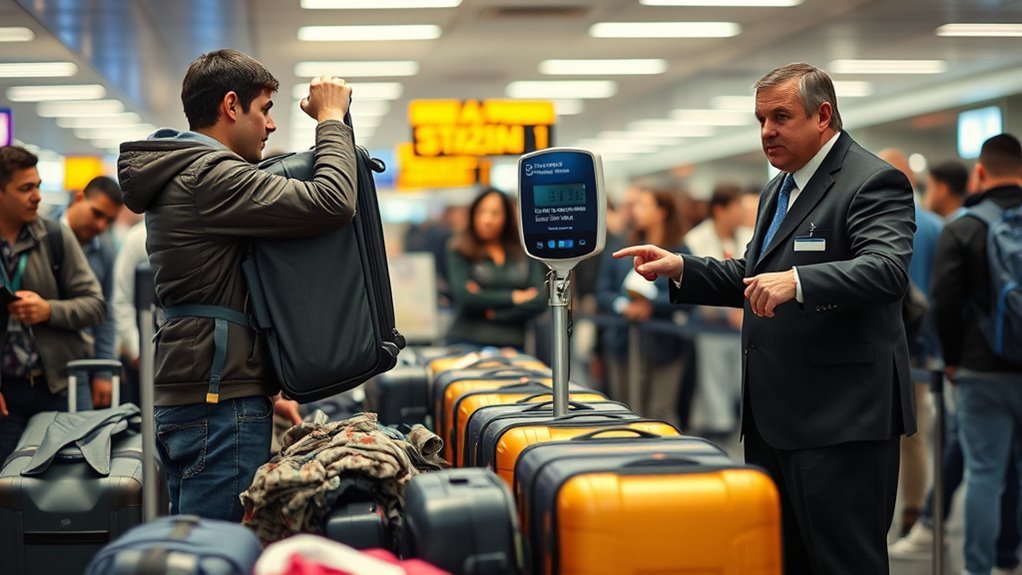
When an airline refuses your checked bag for exceeding the 50-pound limit, you’ll face a few immediate choices: pay an overweight fee, repack to meet the limit, or ship items separately.
If they deny check-in entirely, stay calm and ask for options and exact policy citations. Weigh items at the counter; request a supervisor if rules seem misapplied.
If repacking, move heavy items into carry-on or another bag (keep valuables with you).
For shipping, get rate estimates and receipts.
Document the interaction: names, times, and refusal reason. That record helps if you dispute charges or file a complaint.
How Size and Weight Limits Interact at the Counter
Although size and weight limits are listed separately, they work together at the counter and can affect whether your bag’s accepted, how much you pay, and which screening procedures apply. You’ll face combined rules: an oversized bag may also be overweight, forcing rebagging or extra fees. Agents won’t ignore one violation because the other passes; both matter for handling and liability. Know policies before you pack so you can avoid surprises.
- Check both linear dimensions and pound limits.
- Weigh and measure at home to prevent fees.
- Consolidate items to meet both rules.
- Ask agents about fee waivers or solutions.
What Counts Toward Your Checked-Bag Weight: Common Items
If you want to avoid surprise fees, know which everyday items count toward your checked-bag weight: clothing, shoes, toiletries (including liquids and aerosols), electronics and their chargers, books, and any packed gifts or duty-free purchases all add pounds.
Also include jackets, belts, hats, and extra pairs of shoes you don’t wear to the gate. Toiletry bottles, makeup kits, and full shaving kits add weight even if small.
Cameras, laptops, tablets, power banks, and spare batteries count. Souvenirs, wine, and packaged food increase totals.
Empty pockets don’t exempt items—pack jewelry, cash, and small tools in carry-ons or wear them.
Airline Liability for Heavy Bags and Damage Limits
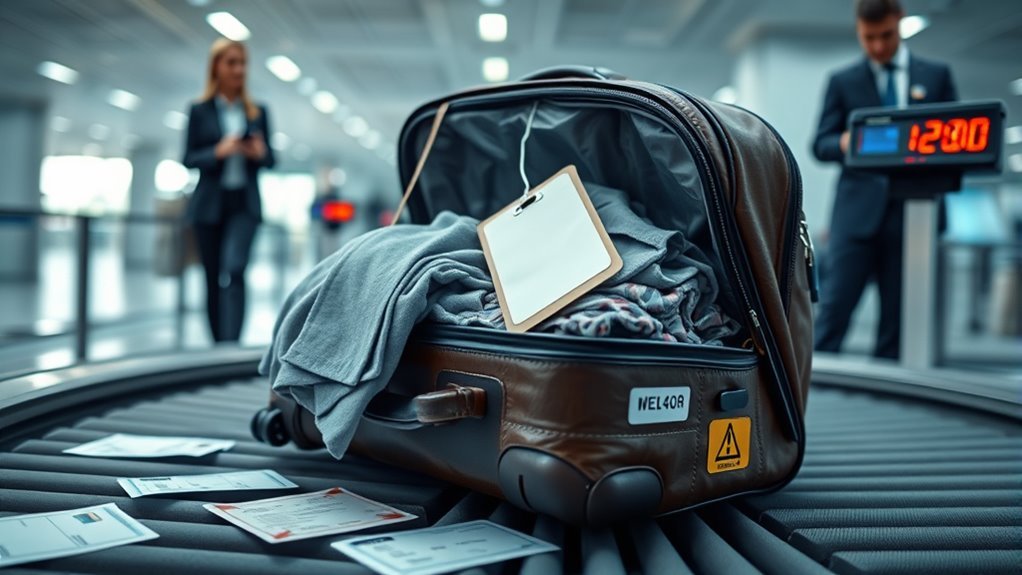
You’ll want to know the airline’s liability limits for overweight bags so you’re not surprised if items are lost or damaged.
Check whether you can declare a higher value for expensive contents and what fees or proofs that requires.
If something does happen, follow the carrier’s damage claim process promptly to maximize your chances of reimbursement.
Airline Liability Limits
How much responsibility does an airline actually take when a heavy bag is lost or damaged? You should know airlines set monetary caps under international and domestic rules, so compensation may be limited even if your 50+ lb bag is ruined. Check carrier terms and file claims quickly.
- Domestic limits: often fixed amounts per ticketed passenger.
- International rules: Montreal Convention caps damage and loss.
- Proof requirement: receipts, photos, and baggage tags strengthen claims.
- Timeframes: strict deadlines exist for reporting damage or loss.
You can pursue travel insurance or credit card coverage for amounts beyond airline liability.
Declared Value Options
Wondering whether declaring a higher value will protect your heavy bag? You can declare a value when checking certain carriers or purchasing airline-provided excess valuation. That increases the airline’s maximum payout if your overweight bag is lost or mishandled, but coverage varies by carrier and fare type.
You’ll usually pay a fee for higher declared value and should keep receipts for expensive items. Note limits often still exclude wear-and-tear or improper packing.
Check policy details before travel, confirm maximums for oversized or overweight items, and weigh declared-value costs against credit card or travel insurance alternatives for better protection.
Damage Claim Process
When your overweight or oversized bag arrives damaged, start the claim process immediately by reporting the damage to the airline’s baggage service office at the airport and getting a written Property Irregularity Report (PIR) or damage receipt—this step preserves your rights and timestamps the incident.
You’ll need to follow up in writing, submit photos, repair estimates, and proof of value. Know that liability may be capped and airlines often limit payouts for heavy bags.
- File PIR at airport
- Take dated photos of damage and contents
- Submit receipts, repair quotes, and ID
- Keep copies and note timelines
What Gate and Check-In Staff Can Legally Require
If your bag tips the scale over the airline’s weight limit, gate and check-in staff can legally require you to pay an overweight fee, move items into another bag or your carry-on, or have the bag shipped as cargo—actions they take to comply with safety and weight-and-balance rules.
You’ll also be asked to present ID and your ticket; staff can deny carriage if regulations or carrier policy forbid accepting the item. They can refuse oversized or hazardous items, and they can require you to sign forms for special handling.
Staff can enforce limits consistently; you must follow their lawful instructions to complete check-in.
Fixing an Overweight Bag at the Counter: Real Options
If your bag tips the scales over 50 lbs, you’ve got two practical choices at the counter: repack some items into your carry-on or another bag, or just pay the airline’s overweight fee.
Repacking can save you money but takes time and maybe a bit of creativity.
If you’re short on time or options, paying the fee gets you on your way quickly.
Repack At The Gate
Because airlines rarely waive fees for overweight luggage, you’ll need quick, practical options at the gate to avoid surprises. You can often avoid fees by repacking on the spot. Here’s a concise plan:
- Move heavy items into your carry-on or personal bag, balancing weight and security.
- Remove nonessentials and wear bulky clothing—shoes, jackets, or layers—onto your person.
- Ask a gate agent for a temporary tote or box; some counters offer free plastic bags.
- Redistribute items into another checked bag if traveling with someone or request a weight-efficient swap.
Act fast, stay polite, and prioritize airline rules and security checks.
Pay The Overweight Fee
When you can’t or don’t want to repack at the gate, pay the overweight fee to move on quickly and avoid holding up the line. You’ll hand your bag to the agent, pay the charge, and continue to your flight without juggling items. Fees vary by airline and route, so check rates beforehand. Keep valuables with you; airlines handle overweight bags like checked luggage. Paying is fastest when you’re short on time or can’t redistribute weight. Use this option when convenience outweighs cost.
| Option | Notes |
|---|---|
| Pay fee | Fastest |
| Repack | Free if possible |
| Ship | Expensive but effective |
| Leave items | Risky, inconvenient |
Repacking at the Airport: Step-by-Step Process
Although you’ve already checked your bag, repacking at the airport lets you fix overweight issues fast: quickly pull out nonessentials, shift dense items to carry-on, and redistribute weight toward wheels or the bag’s base so it balances. You’ll act efficiently: open pockets, remove items you can live without, and set aside things for hand luggage. Follow this stepwise approach to minimize delay.
Repack quickly at the airport: remove nonessentials, shift dense items to carry-on, and balance weight near the wheels.
- Empty outer compartments and weigh mentally what’s heaviest.
- Move shoes, books, and toiletries to your carry-on.
- Compress clothing and refill strategic spaces near wheels.
- Reseat fragile items and zip securely before reweighing.
Typical Overweight Surcharge Amounts and Billing
If your bag tips the scales over the airline’s weight limit, expect a tiered fee structure that rises with each weight bracket. You’ll typically see modest surcharges for slightly overweight bags (e.g., 50–62 lbs).
Larger fees are charged for heavier ranges (63–100 lbs), and steep penalties or refusal may occur beyond the airline’s maximum weight limits. Fees vary by carrier, route, and whether you’re checked at the gate or ticket counter.
Airlines charge per bag and may bill the card used for purchase or require payment at the counter. Keep receipts and check your credit card protections in case you dispute a charge.
When Buying an Extra Bag Beats Paying an Overweight Fee
Before you pay a hefty overweight fee, compare the cost of adding a second checked bag versus redistributing items between bags to stay under limits.
You can often split heavy items into a new bag or shift weight to a carry-on to avoid surcharges, but weigh the extra-bag fee against gate-check risks and convenience.
At the gate, know that gate-checking might save money but can mean less access and potential delays, so choose what fits your priorities.
Compare Extra Bag Costs
Wondering whether to pay an overweight fee or buy an extra bag? You’ll save when the extra-bag price is less than repeated overweight penalties.
Compare costs quickly: consider airport vs. advance purchase rates, round-trip charges, and carry-on limits.
- Check airline extra-bag fee online — advance buys are often cheaper.
- Multiply overweight fees by number of heavy bags and legs of travel.
- Factor in potential domestic vs. international differences and frequent-flier waivers.
- Include convenience: an extra bag avoids repacking stress and possible gate charges.
Do the math before check-in to pick the cheaper, less stressful option.
Weight Distribution Strategy
When the math shows an extra bag is the smarter buy, you’ll want a clear weight distribution strategy to keep each suitcase under limits and avoid new fees. Start by weighing everything and prioritizing dense items—shoes, toiletries, electronics—so they spread across bags instead of piling in one.
Put lighter, bulky items like sweaters where weight won’t tip scales. Use a handheld scale at each transfer and shift items in 1–2 pound increments until both bags sit just below limits.
Pack essentials and valuables in your carry-on. Label and lock bags, then reweigh at check-in to confirm compliance.
Gate-Check Versus Pay
If you’re facing an overweight charge at the counter, compare the cost and hassle of paying the fee to the price of buying an extra bag. You’ll want to decide fast: gate-checking can avoid fees but risks delays or fragile items getting handled roughly.
Buying another checked bag usually costs more upfront but gives predictable handling and no surprise fines. Consider these factors to choose smartly:
- Fee vs extra bag price comparison.
- Contents’ fragility and value.
- Connection times and potential delays.
- Airline policies on gate-check liability.
Pick the option that minimizes risk and cost.
How Frequent-Flyer Status, Cabin Class, and Alliances Change Fees
Frequent-flyer status, your cabin class, and the airline alliances you book through directly affect whether you pay overweight or extra-bag fees and how much they cost. If you have elite status, you often get higher free weight limits or waived fees; check each carrier’s tier benefits.
Flying business or first usually increases your checked-bag allowance and weight limit compared with economy.
Booking through an alliance partner may extend benefits, but policies vary—confirm with the operating carrier.
Miles-based upgrades or corporate contracts can also change rules.
Always verify allowances on your itinerary to avoid surprises at check-in.
Weighing Luggage at Home: Scales, Methods, and Accuracy Tips
Although you don’t need fancy gear, having a reliable scale at home makes avoiding overweight fees much easier. Simple hand-held luggage scales, bathroom scales used with a quick subtraction method, or digital hanging models all work if you follow a few accuracy tips. You’ll want consistency and confidence before you leave.
- Calibrate: zero your scale or test with a known weight.
- Use the same method: hang or platform, don’t switch.
- Distribute items evenly and zip fully before weighing.
- Allow battery-powered devices to warm up and replace weak batteries.
Weigh after packing final items to catch surprises.
Best Packing Strategies to Stay Under 50 Lb
While packing with weight limits in mind, focus on choices that cut pounds without cutting essentials. Prioritize versatile clothing you can layer and re-wear, and plan outfits so every item serves a purpose.
Use compression cubes to reduce bulk, not necessarily weight, and put heavier items near the wheels for balance. Wear your bulkiest shoes and jacket on the plane.
Distribute weight between carry-on and checked bags within airline rules. Pack travel-size toiletries and decant liquids into lightweight containers.
Weigh your bag regularly during packing and remove nonessential single-use items to stay confidently under 50 lbs.
Smart Item Swaps to Cut Checked-Bag Weight
If you swap a few heavy items for lighter alternatives, you can shave pounds without sacrificing comfort or function. Start by auditing bulk items and replacing them with efficient substitutes. Consider fabric, electronics, and toiletries first; small swaps add up quickly.
Swap a few heavy items for lighter alternatives—audit bulk gear and replace with efficient, travel-friendly substitutes to shave pounds.
- Replace heavy denim with a lightweight travel pant.
- Swap large shampoo bottles for solid shampoo bars.
- Trade hardcover books for a single e-reader.
- Exchange a bulky toiletry kit for multi-use, travel-sized items.
You’ll still have what you need, but your checked bag will weigh noticeably less, avoiding fees and hassle at the counter.
Using Carry-On and Personal-Item Allowances to Shift Weight
When you spread heavier items between your carry-on and personal bag, you can keep your checked luggage well under the limit and skip overweight fees. Check airline size and weight limits for both pieces, then prioritize dense, heavy items—chargers, shoes, toiletries—in your carry-on if allowed.
Use your personal item for flatter, compact things like tablets, documents, or a light sweater. Distribute weight so neither hand-luggage piece exceeds its allowance.
Pack strategically: roll clothes to save space, use packing cubes, and put fragile items in your personal bag for protection. At the gate, be ready to rearrange quickly if asked.
Special Rules for Sports Gear, Instruments, and Mobility Aids
Because sports equipment, musical instruments, and mobility aids often exceed standard size or weight limits, airlines treat them differently than regular checked bags and you should check policies ahead of time. You’ll usually face special handling, separate fees, or required advance notice.
Know categories and pack accordingly:
- Sports gear: skis, bikes, and surfboards may incur oversized charges or need hard cases.
- Instruments: airlines may let small instruments board as carry-ons or require reservations for cabin storage.
- Mobility aids: wheelchairs and scooters are typically free and get priority handling.
- Documentation: bring proof of medical necessity or rental agreements when applicable.
Insurance, Declared Value, and Protection for Heavy or Valuable Items
You’ve handled special rules for oversized sports gear, instruments, and mobility aids; now consider protection for heavy or valuable items to avoid costly losses. You should check airline liability limits and whether basic carriage covers weight-related damage.
Buy travel insurance or declare higher value when carriers allow declared-value coverage; that often raises compensation caps after damage or loss. Photograph items, keep receipts, and pack valuables in carry-on when possible.
For antiques, jewelry, or electronics, get specialized policies or add-on endorsements. File claims promptly and follow carrier timelines and documentation requirements to improve recovery chances and avoid denied claims.
State- and Country-Specific Overweight Baggage Variations to Check
If you’re traveling across borders, check local and national rules for overweight baggage before you pack — regulatory limits, carrier liabilities, and inspection procedures can vary widely by country and even by state or province. You’ll want to confirm limits, fees, and required declarations so you don’t face surprises at the counter.
Consider these checks:
- Verify national aviation authority weight limits and airline policies.
- Check state or provincial transportation rules for ground connections.
- Confirm customs declarations and potential penalties for overweight items.
- Review local carrier liability caps and required documentation for claims.
Plan ahead and document everything.
How to Dispute an Overweight Fee or Mishandled Heavy Bag
When an airline tags your bag as overweight or mishandles a heavy piece, act quickly and calmly to dispute the fee or file a claim—start by getting documentation at the counter, including a copy of the weight ticket, any incident report, and the agent’s name.
Then photograph the bag, damage, and weight ticket. Note flight, time, and staff interactions.
Contact the airline’s baggage or customer service promptly, submit forms and attachments, and keep copies.
If denied, escalate to a supervisor, use social media for visibility, and consider lodging a complaint with aviation authorities or your card issuer’s chargeback program.
Track responses and deadlines.
Tools and Gadgets to Monitor and Manage Luggage Weight
Because airlines enforce strict weight limits, having the right tools helps you avoid surprises and extra fees. You’ll want gadgets that’re accurate, portable, and simple so you can weigh and adjust on the fly. Consider compact devices and clever organizers that let you monitor weight before you reach the counter.
Because airlines cap luggage weight, bring accurate, portable tools to weigh and adjust on the go.
- Digital luggage scale — quick readings, tare function, lightweight.
- Smart suitcase with built-in scale — counts weight as you pack.
- Compression straps and packing cubes — redistribute and reduce bulk.
- Portable luggage scale hook — fits handles, stores easily, very durable.
Use these tools to stay under limits and travel confidently.
Final Packing Checklist: Avoid Surprises at the Ticket Counter
Before you head to the airport, run through a fast, focused checklist that keeps weight, dimensions, and essentials in check so you don’t get hit with surprises at the ticket counter.
Weigh each bag; shift items to bring checked luggage under limits. Measure dimensions if you’ll gate-check or use budget carriers. Zip external pockets and secure straps to avoid protrusions that trigger size fees.
Pack valuables and documents in carry-on. Rebalance heavy items close to wheels for easier lifting. Remove prohibited or heavy extras.
Keep a small scale and a spare foldable bag handy for quick redistribution.
Frequently Asked Questions
Can Overweight Baggage Affect Carry-On Allowance or Boarding Priority?
Yes — overweight checked bags can affect your carry-on allowance and boarding priority, since airlines may gate-check your bag, charge fees that influence elite benefits, and enforce stricter boarding for passengers with oversized or extra luggage.
Do Airlines Ever Weigh Carry-On Bags During Boarding?
Yes — airlines sometimes weigh carry-ons at gate or check-in if bags look oversized or flight’s full; you’ll be asked to gate-check items, pay fees, or repack, so travel prepared and know airline policies.
Can Contents Removed at Check-In Be Mailed to My Destination?
Yes — you can mail removed items to your destination, but you’ll handle packaging, postage, customs (if international), and tracking. Airlines rarely forward personal items; using a courier or postal service is usually faster and more reliable.
Are There Tax or Customs Implications for Heavy Checked Luggage Internationally?
Yes — you might face customs duties or taxes if your heavy checked luggage contains goods exceeding duty-free allowances or commercial quantities; you’ll need to declare items, and customs can assess, confiscate, or charge based on local rules.
Can Hotels or Rental Car Companies Be Liable for Damaged Overweight Luggage?
They can be, but it depends on contracts and negligence; you’ll need evidence of their handling, report damage promptly, keep receipts, and check their policies and local laws — liability isn’t automatic for overweight luggage.
Conclusion
If your checked bag tips over 50 lb, you’ll usually pay an overweight fee, have to repack items into another bag, or—rarely—be denied carriage. To avoid surprises, weigh and redistribute before check-in, know your airline’s limits, and use a compact scale and lightweight suitcase. Keep valuables and essentials in a carry-on in case you’re forced to part with items. If charged unfairly, calmly dispute with the airline and keep receipts and photos.