Which Is Better Polycarbonate or Polypropylene
You’ll pick polycarbonate when you need tough, impact‑resistant, optically clear parts that stand up to heat and fire, and you’ll pick polypropylene when you want low cost, light weight, chemical resistance, and flexible hinges. Polycarbonate excels for lenses, safety shields, and heat‑exposed components but costs more and needs careful processing; polypropylene suits containers, living hinges, and harsh chemical environments yet can soften and creep. Keep going to see practical selection tips and tests.
Quick Answer: Polycarbonate vs Polypropylene
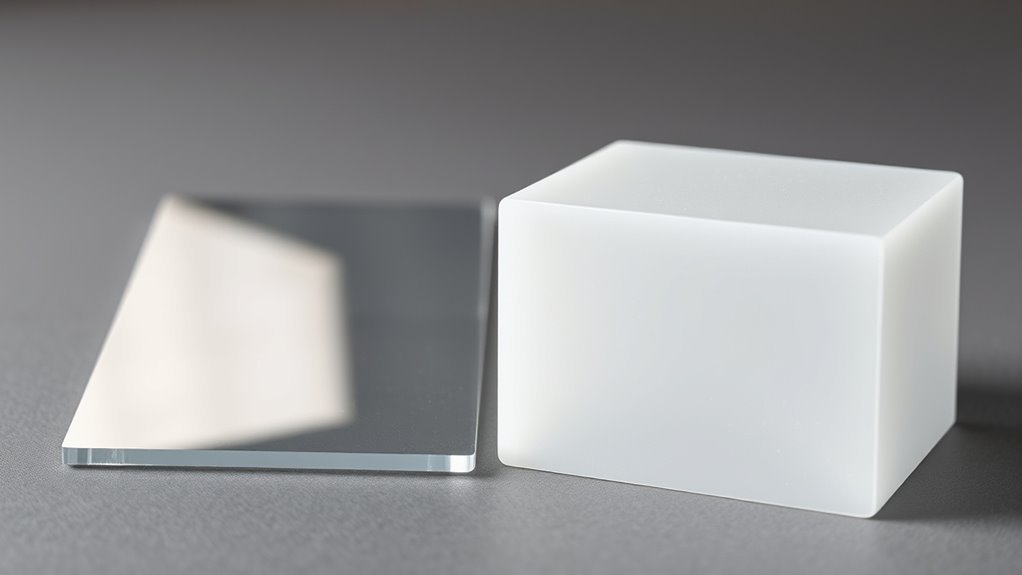
While both polycarbonate and polypropylene are versatile thermoplastics, they serve different needs: polycarbonate gives you high impact resistance, clarity, and heat tolerance, whereas polypropylene offers chemical resistance, flexibility, and lower cost.
While both are versatile thermoplastics, polycarbonate offers clarity and toughness; polypropylene brings chemical resistance, flexibility, and savings
You’ll pick polycarbonate when you need transparent, tough parts that withstand higher temperatures and repeated impact—think safety shields, lenses, or electronic housings.
Choose polypropylene for lightweight, flexible components that resist solvents and fatigue, like living hinges, chemical containers, or packaging.
Each material has trade-offs: polycarbonate costs more and can be sensitive to some chemicals, while polypropylene lacks optical clarity and high-temperature strength.
Decision Framework: Choosing the Right Polymer
To choose between polycarbonate and polypropylene, you’ll weigh mechanical properties like strength and impact resistance against chemical compatibility for your application.
You’ll also factor in cost and how each polymer behaves in processing and fabrication.
This framework helps you match material performance to product requirements quickly.
Mechanical Property Comparison
When you’re choosing between polycarbonate and polypropylene, focus first on the mechanical demands of your application: impact resistance, stiffness, fatigue life, and dimensional stability will usually determine which polymer performs better.
You’ll pick polycarbonate when you need high impact toughness, optical clarity, and dimensional stability under load; it’s stiffer and resists brittle failure.
Choose polypropylene for lighter, flexible parts where fatigue resistance, low density, and cost matter; it tolerates repeated flexing and chemical exposure better.
Consider part geometry, load type (static vs cyclic), temperature, and required tolerances—these factors will guide your final material choice.
Chemical Resistance Tradeoffs
Mechanical requirements are only part of the decision; chemical exposure will often dictate which polymer you pick. You’ll weigh PC’s sensitivity to strong bases and some solvents against PP’s resilience to acids, bases, and many organic chemicals.
Consider service temperature, contact duration, and concentration—those shift compatibility quickly. Use chemical charts and spot testing for borderline cases.
- Polycarbonate: good for diluted chemicals, poor with strong alkalis and aromatic solvents.
- Polypropylene: resists many solvents and acids, vulnerable to oxidative environments.
- Additives and grades change resistance; verify specifics.
- Long-term exposure demands conservative selection and testing.
Cost And Processing Considerations
Cost and processing realities often decide which polymer you pick more than properties on paper. You’ll find polypropylene is cheaper per kilogram and easier to mold, with lower melting point, faster cycle times, and less tooling stress—good for high-volume parts.
Polycarbonate costs more, needs higher processing temperatures, and demands careful moisture control and mold design, but it yields tough, transparent components.
Consider part geometry, production volume, and downstream finishing: polycarbonate may justify higher setup costs for performance, while polypropylene wins on unit cost and recyclability.
Run cost modeling, prototype with intended processes, and include yield and warranty in your decision.
Polycarbonate at a Glance: Properties & Strengths
When you need a material that takes knocks without cracking, polycarbonate’s high impact resistance makes it a strong contender. You’ll also appreciate its wide thermal stability range, which keeps performance consistent from cold conditions up to elevated temperatures.
Together, those properties explain why polycarbonate’s used in safety gear, glazing, and heat-exposed components.
High Impact Resistance
Because polycarbonate’s molecular structure lets its chains absorb and dissipate energy, it delivers exceptional impact resistance that outperforms polypropylene in many applications. You’ll pick polycarbonate when toughness matters: it resists shattering, survives drops, and keeps form under sudden stress.
That reliability makes it ideal for safety gear, clear barriers, and durable housings. You can also machine or thermoform it without losing strength, and additives boost UV or scratch resistance when needed.
- Survives high-velocity impacts without cracking
- Maintains clarity while resisting fractures
- Withstands repeated impact cycles
- Easier to retrofit for added protection
Thermal Stability Range
Alongside its impact toughness, polycarbonate also delivers a wide thermal stability range that makes it useful across varied temperatures. You’ll find it stays dimensionally stable from roughly -40°C to about 120°C in continuous use, resisting embrittlement in cold and softening or creep in moderate heat.
Short-term exposure can tolerate higher peaks, but you shouldn’t assume unlimited heat resistance. Compared to polypropylene, polycarbonate retains mechanical strength and optical clarity better at elevated temperatures, so you can use it for glazing, housings, and light fixtures where heat fluctuates.
Mind additives and annealing—they’ll influence performance and service limits.
Polypropylene at a Glance: Properties & Strengths
Curious what makes polypropylene so widely used? You’ll find it lightweight, chemically resistant, and easy to mold, so it suits many everyday and industrial applications. It resists fatigue, handles repeated flexing, and won’t absorb much moisture, keeping properties stable.
- Low density for lighter parts without sacrificing stiffness
- Excellent chemical and corrosion resistance for harsh environments
- High fatigue resistance, great for hinges and living joints
- Good electrical insulating properties for housings and components
You can process it via injection molding or extrusion, and it’s often cost-effective, recyclable, and performs reliably across diverse uses.
Key Selection Criteria for Your Project
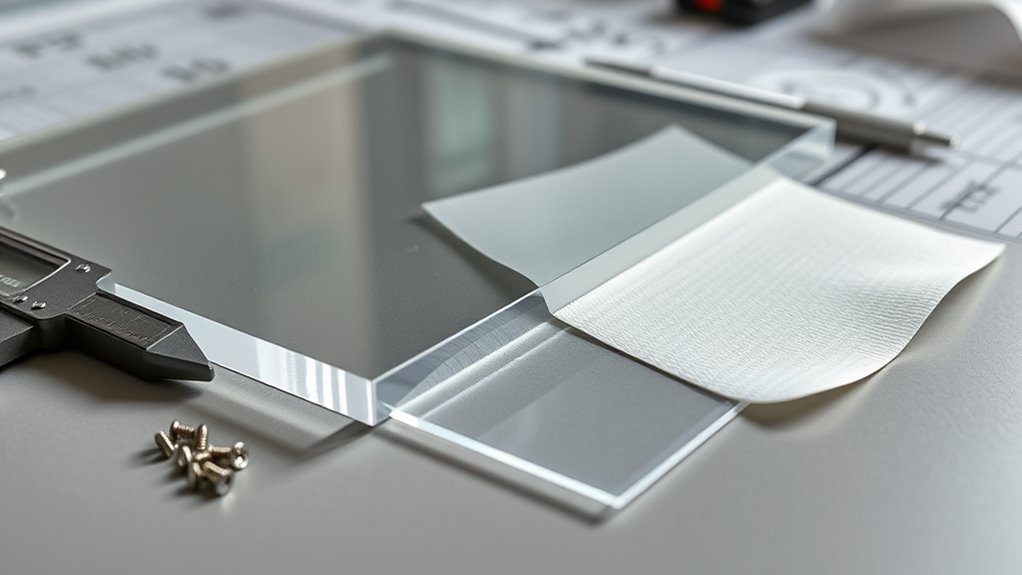
Now that you know polypropylene’s strengths, pick the right material by matching performance needs to key selection criteria: mechanical loads, temperature range, chemical exposure, UV and impact resistance, part geometry and wall thickness, processing method, cost targets, and end-of-life plans like recyclability.
Evaluate operating temperatures versus material limits, and chemical compatibility with solvents or acids. Consider UV stabilizers or coatings if outdoor use’s expected.
Match processing—injection molding, thermoforming, extrusion—to achievable tolerances and features. Factor unit cost, tooling, and yield against lifecycle value.
Finally, plan for disposal or recycling to meet sustainability goals and regulations.
Mechanical Strength: Impact & Toughness Compared
When you’re choosing between polycarbonate and polypropylene, impact strength and toughness are the first mechanical properties to compare because they determine how a part survives drops, hits, and repeated stress.
You’ll find polycarbonate markedly tougher and far more impact-resistant, so it protects delicate electronics and safety gear. Polypropylene offers decent toughness with greater ductility and fatigue resistance, making it better for living hinges and flexible components.
Consider applications, expected loads, and failure modes when choosing.
- Polycarbonate: high impact strength, rigid, brittle at extreme strain
- Polypropylene: lower impact strength, very ductile
Temperature affects toughness.
Cost and weight trade-offs.
Optical Performance: Clarity and Light Transmission
Now let’s look at optical performance, where you’ll see a clear difference between the two.
Polycarbonate offers superior optical clarity and higher light transmission rates than polypropylene. That makes it the better choice when visibility or light passage matters.
Superior Optical Clarity
1 key factor in choosing between polycarbonate and polypropylene is how clearly they transmit light: polycarbonate offers superior optical clarity, while polypropylene tends to be more translucent or opaque.
You’ll prefer polycarbonate when you need crisp visibility, optical precision, or a clear visual presentation. Polycarbonate resists yellowing better and maintains clarity under stress, so components like lenses, safety shields, and clear housings benefit.
Polypropylene fits when full transparency isn’t required and cost or chemical resistance matters more.
- Use polycarbonate for optical parts
- Choose polypropylene for opaque applications
- Prefer polycarbonate for durability and clarity
- Consider surface treatments to enhance clarity
Light Transmission Rates
How much light passes through a material matters when you need accurate illumination or true color rendering, and polycarbonate typically transmits far more light than polypropylene.
You’ll notice polycarbonate lets through around 88–92% of visible light when clear, offering near-glass clarity ideal for lenses, glazing, and displays.
Polypropylene, even when translucent, usually transmits far less—often 50% or lower—so colors appear muted and details lose sharpness.
Choose polycarbonate when optical fidelity, UV-stability, and minimal haze matter.
Use polypropylene for diffused light, cost-sensitive covers, or when impact resistance and chemical tolerance outweigh clarity needs.
Scratch Resistance and Coatings
Because you’ll often see both plastics in items that face daily wear, knowing how they handle scratches matters. You’ll find polycarbonate is tougher but more prone to surface marring; it accepts hard coatings that restore clarity and resist abrasion.
Polypropylene resists cracking and hides minor scuffs thanks to its flexibility, but it’s harder to coat for optical clarity. When choosing, consider expected abuse, aesthetic needs, and repairability.
- Polycarbonate: high impact, vulnerable to fine scratches without coating
- Hard coatings: improve abrasion resistance, add cost
- Polypropylene: forgives dents, shows matte wear
Maintenance: coated PC can be polished or recoated
Thermal Behavior: Heat Deflection & Operating Range
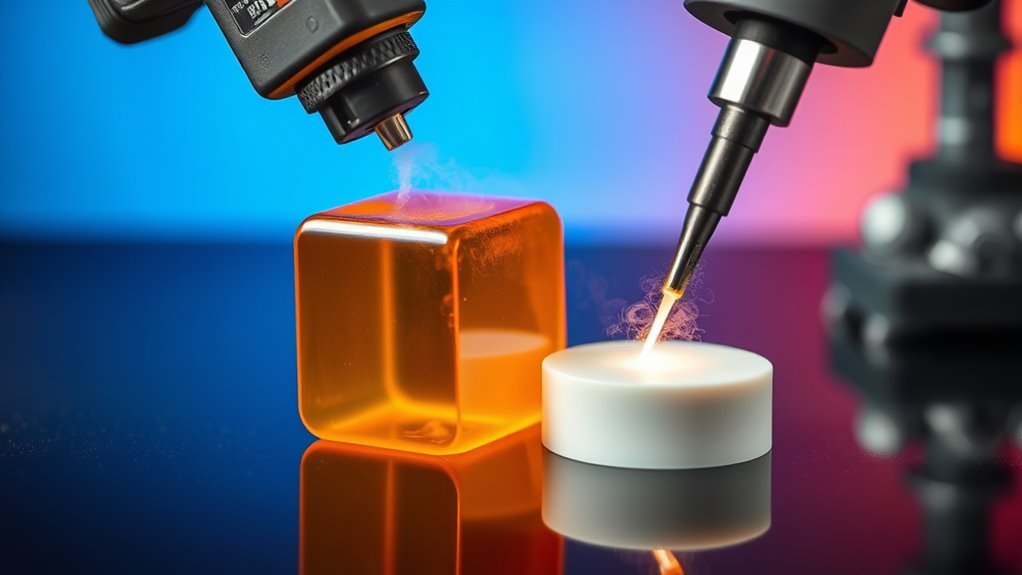
Next, you’ll compare how polycarbonate and polypropylene handle heat by looking at heat deflection temperature and their usable service ranges.
You’ll see that polycarbonate tolerates much higher heat before deforming, while polypropylene stays functional at lower temperatures and can be more cold-resistant.
This contrast determines which material will hold shape and performance in your application’s expected temperature extremes.
Heat Deflection Temperature
Curious which plastic will keep its shape under heat? You’ll find polycarbonate has a much higher heat deflection temperature than polypropylene, so it resists bending and warping under load at elevated temperatures. That makes it better for parts exposed to heat while under stress.
Polypropylene softens and deflects sooner, so you’ll avoid it where stiffness under heat matters.
- Polycarbonate: higher HDT, maintains rigidity under load.
- Polypropylene: lower HDT, more prone to creep and deformation.
- Design: choose PC for structural parts near heat sources.
- Testing: verify HDT with your expected loads, times, and environment.
Service Temperature Range
How hot or cold will your part need to perform reliably? You’ll choose polycarbonate when you need a broader usable range: it handles continuous service roughly -40°C to +115°C and resists deformation at higher short-term temperatures.
Polypropylene suits lower-cost, moderate-temperature uses, typically from about -20°C to +90°C, though reinforced grades extend that.
Consider thermal cycling, impact at low temperatures, and long-term creep near upper limits. If you expect sustained heat, pick materials with proven long-term stability or add heat-stabilizing additives.
Match resin choice to your application’s worst-case temperatures, not just average conditions.
Chemical Resistance: Solvents, Acids, Cleaners
When you expose polycarbonate and polypropylene to solvents, acids, or harsh cleaners, their different chemistries show clearly. You’ll find polypropylene resists many acids, alkalis, and alcohols, while polycarbonate is vulnerable to strong solvents and some alkaline cleaners. Choose based on exposure and concentration.
- Polypropylene: good against dilute acids, bases, and alcohols; resists stress cracking.
- Polycarbonate: sensitive to ketones, chlorinated solvents, and strong bases; may craze.
- Cleaning: use mild detergents for polycarbonate; stronger disinfectants suit polypropylene.
- Testing: always spot-test chemicals and concentrations on samples before large-scale use.
Moisture and Dimensional Stability
If you need parts that hold tight tolerances in humid environments, moisture uptake and dimensional stability matter a lot for choosing between polycarbonate and polypropylene.
You’ll find polycarbonate absorbs more water than polypropylene, causing slight swelling and potential shifts in tight tolerances over time.
Polypropylene resists moisture uptake, so it maintains dimensions better in wet or variable-humidity conditions.
If you need consistent fit, alignment, or optical clarity after exposure, polycarbonate can still work with proper drying and design allowances, but polypropylene gives you an easier path to stable dimensions without additional processing or strict moisture control.
Weight and Density: Which Is Lighter
Because density determines how heavy a part feels for a given size, you’ll usually find polypropylene is the lighter choice: PP has a density around 0.90–0.92 g/cm³, while polycarbonate sits near 1.20 g/cm³.
So, the same-volume PC part will weigh roughly 30–35% more than a PP equivalent. You’ll pick PP when weight matters—portable devices, shipping, or buoyant parts—while PC fits when strength-to-weight tradeoffs are acceptable.
Consider mechanical needs, cost, and finish before deciding.
- Choose PP for minimal mass and lower material cost.
- Choose PC for stiffness despite added weight.
- Compare part volume implications.
- Factor in end-use performance.
Moldability: Polycarbonate vs Polypropylene
Weight differences also affect how you approach molding: lighter PP parts often require different gate sizes, cooling times, and wall thickness strategies than denser PC components. You’ll find PP flows easily, tolerates thin sections, and resists warpage when molded with controlled cooling. PC needs higher temperatures, slower cooling, and attention to sink marks; it fills complex molds well but can stress crack if improperly cooled. Choose PP for cost-effective, flexible designs and PC for rigid, impact-resistant pieces. Consider shrinkage rates and weld line strength during mold design to avoid failures.
| Property | Impact |
|---|---|
| Flowability | PP > PC |
| Cooling time | PP < PC |
| Shrinkage | PP variable |
| Stress sensitivity | PC higher |
Fabrication: Thermoforming, CNC, 3D Printing
When you choose between polycarbonate (PC) and polypropylene (PP) for fabrication, remember each material responds differently to thermoforming, CNC machining, and 3D printing.
PP softens and stretches more readily for deep draws. PC, on the other hand, holds sharper detail in thermoforming but needs higher temperatures and slower cooling.
PP stretches easily for deep draws; PC captures sharper thermoformed detail but demands higher temps and slower cooling
CNC cuts PC cleanly with crisp edges, while PP can smear or tear without the right tooling.
PC prints well in filament and resin systems for strong, dimensionally stable parts, whereas PP is challenging to bond and print without specialized filaments or surface treatments.
You should consider tool speeds, cooling, and fixturing for each process.
- Thermoforming: PC for detail, PP for stretchable parts
- CNC: use sharp, high-speed cutters for PP; standard tooling suits PC
- 3D printing: PC tolerates FDM and SLA better than PP
- Surface prep: required more for PP to achieve adhesion and finish
Joining and Bonding: Adhesives, Welding, Fasteners
If you need a reliable joint, choose the method that matches each polymer’s chemistry and mechanical traits. You’ll find polycarbonate bonds well with cyanoacrylate and structural epoxies; solvent welding isn’t effective, but ultrasonic or hot-plate welding and mechanical fasteners work because it withstands heat and stress.
Polypropylene resists most adhesives; you’ll need surface treatments (flame, plasma, or primers) before using specialty polyolefin adhesives or hot-plate/ultrasonic welding. For both, design joints to distribute load, avoid stress concentrators, and account for differential thermal expansion.
Test prototypes for durability, environmental resistance, and cycling before final production or assembly.
Surface Finish: Gloss, Colorability, Textures
When you compare surface finishes, gloss and reflectivity tell you how shiny each material will look and how it interacts with light.
You’ll find polycarbonate usually offers higher gloss and clearer color saturation, while polypropylene is easier to texture or matte-finish for grip and reduced glare.
Consider how coloring and textures affect both aesthetics and function when choosing between them.
Gloss And Reflectivity
Although both polycarbonate and polypropylene can be finished to look sleek, they differ noticeably in gloss, colorability, and texture options. You’ll notice polycarbonate typically yields higher inherent gloss and mirror-like reflectivity, so it’s ideal when you want bright, glossy surfaces that highlight sharp details.
Polypropylene usually shows a softer sheen and diffuses light more, giving a muted look. You’ll pick based on desired visual effect and end-use durability.
- Polycarbonate: high gloss, strong specular reflection
- Polypropylene: lower gloss, more diffuse reflection
- PC: preserves clarity under light
- PP: hides minor surface flaws
Coloring And Textures
Having covered gloss and reflectivity, let’s look at how color and texture choices affect appearance and performance. You’ll find polycarbonate takes dyes and coatings well, giving vibrant hues and smooth or textured finishes. Polypropylene resists some pigments but accepts masterbatches, so colors can be durable though less vivid. Textures hide scratches; matte feels softer, glossy pops color. Consider UV stability, post-processing, and meant touch. Use pigments for longevity, coatings for gloss control, and molded textures for wear resistance.
| Property | Polycarbonate | Polypropylene |
|---|---|---|
| Color vividness | High | Moderate |
| Texture options | Wide | Good |
| UV resistance | Needs stabilizers | Better intrinsically |
UV Exposure and Weathering Durability
If you plan to use parts outdoors or in bright indoor light, UV exposure changes how polycarbonate and polypropylene perform over time. You’ll find polycarbonate resists impact well but yellows and becomes brittle without UV stabilizers. Polypropylene weathers by losing gloss and cracking, yet resists yellowing less.
Choose additives, coatings, or pigmented grades to extend life. Consider application needs: optical clarity, flexibility, or long-term appearance.
Choose additives, coatings, or pigments to enhance durability—balance optical clarity, flexibility, and long-term appearance needs.
- Polycarbonate: strong, needs UV inhibitors for clarity
- Polypropylene: chemically stable, needs pigments or coating for surface durability
- Additives: UV absorbers and HALS extend service life
- Testing: accelerated weathering predicts field performance
Flame Retardancy and Standards
How will your choice perform in a fire scenario? You’ll find polycarbonate is inherently more flame retardant than polypropylene: it has higher ignition temperatures, self-extinguishes more readily, and emits less flaming drip.
Polycarbonate grades often meet UL 94 V-0 or V-1 with additives.
Polypropylene is more flammable, melts and can drip, and typically needs flame-retardant additives or fillers to reach comparable UL ratings.
Check relevant standards — UL 94, ASTM E84, EN 45545 — for your application.
Verify tested formulations and certifications, since additives and processing alter performance.
Always match material grade to required fire-safety classification.
Longevity and Wear in Typical Environments
When you choose between polycarbonate and polypropylene, consider how each handles long-term exposure to sunlight, chemicals, temperature cycles, and mechanical wear—because those factors largely determine service life and maintenance needs.
You’ll find polycarbonate resists impact and retains clarity but can yellow under UV without coatings. Polypropylene resists many chemicals and repeated flexing but can creep under sustained load and embrittle in cold.
In humid or outdoor settings, additives and design choices matter as much as base resin. Pick for the dominant stressors, plan for protective treatments, and inspect periodically to catch wear before failure.
- UV exposure and coatings
- Chemical compatibility
- Thermal cycling resilience
- Mechanical fatigue and impact
Electrical Properties and Insulation Performance
When you compare polycarbonate and polypropylene for electrical uses, focus first on their dielectric strength and how that affects required thickness and spacing.
Consider their thermal insulation behavior too, since heat buildup alters performance over time.
Also check moisture and tracking resistance, because water ingress or surface tracking can quickly undermine an insulator.
Dielectric Strength Comparison
Although both polycarbonate and polypropylene serve as electrical insulators, their dielectric strengths differ enough that you’ll choose one over the other depending on voltage and environment.
You’ll find polycarbonate typically offers higher dielectric constant and good tracking resistance, making it suitable for compact, high-field components.
Polypropylene, meanwhile, provides excellent breakdown strength per thickness and lower loss at high frequencies, so you’ll favor it in capacitors and RF applications.
Consider moisture, additives, and thickness, since they shift performance.
- Polycarbonate: higher dielectric constant, good tracking
- Polypropylene: higher breakdown strength per mm
Moisture lowers both materials’ strength.
Additives and thickness alter values.
Thermal Insulation Behavior
Since you’ll often judge electrical insulation by how it handles both heat and current, thermal insulation behavior matters for polycarbonate and polypropylene in different ways.
You’ll find polycarbonate sustains structural integrity at higher temperatures, so it won’t deform or soften as quickly under heat stress; that helps maintain clearances and prevents shorting in warmer environments.
Polypropylene offers lower thermal conductivity and excellent insulating resistance at moderate temperatures, making it efficient where heat buildup is limited.
When you choose, weigh operating temperature, potential hot spots, and long-term thermal aging—PC for higher-heat resilience, PP for lower-conductivity, cost-effective insulation.
Moisture And Tracking Resistance
If you expose parts to humid environments or liquid contact, moisture and tracking resistance become critical for electrical performance. You’ll find polycarbonate absorbs more moisture, which can lower surface resistivity and promote tracking under high voltage.
Polypropylene resists water uptake, keeping insulation stable and reducing leakage pathways. Choose PP for wet or splash-prone applications; choose PC when mechanical strength or flame retardancy outweighs slight moisture sensitivity.
Consider coatings or sealants to improve PC performance. Evaluate dielectric strength after conditioning to simulate service.
- Polycarbonate: higher moisture absorption
- Polypropylene: low water uptake
- Coatings improve resistance
- Test after humidity conditioning
Food Contact & Medical Suitability
How do polycarbonate and polypropylene stack up when you need materials safe for food or medical use? You’ll find polypropylene often wins for direct food contact and many medical disposables because it’s chemically inert, autoclavable in thin sections, and widely certified. Polycarbonate offers clarity and toughness but can leach bisphenol-A unless certified BPA-free; it’s used for reusable medical devices with careful controls.
| Property | Polycarbonate (PC) | Polypropylene (PP) |
|---|---|---|
| Common approvals | Selective, BPA-free needed | FDA, EU food contact often |
| Typical uses | Reusable devices, lenses | Containers, syringes, trays |
Cost Analysis: Material, Processing, Lifecycle
Now let’s look at costs so you can compare polycarbonate and polypropylene on price, processing, and long-term ownership.
You’ll see material cost differences upfront, then how molding, machining, or finishing change your per-part expense.
Finally, weigh lifecycle costs like durability, maintenance, and recycling to determine total value.
Material Cost Comparison
When comparing polycarbonate and polypropylene costs, you’ll want to look beyond raw resin prices to processing and lifecycle expenses that affect total cost per part.
You’ll find polypropylene’s lower resin cost often wins for high-volume, low-tolerance parts, while polycarbonate’s higher price can be justified by strength, clarity, and longevity in demanding uses.
Consider end-of-life, replacement frequency, and any required additives or coatings.
- Resin price per kilogram and typical yield
- Expected service life and replacement intervals
- Additives, colorants, and UV or flame treatments
- Recycling value and disposal costs
Processing Expense Differences
Although resin price matters, you’ll also pay differently for processing: polycarbonate typically demands higher molding temperatures, slower cycle times, and stricter moisture control, which raises energy and throughput costs.
While polypropylene runs cooler, cycles faster, and tolerates wider processing windows, lowering per-part production expense.
You’ll face higher tooling wear, tighter machine maintenance, and occasional drying equipment for PC, increasing fixed and variable costs.
PP lets you use simpler molds, reduced energy, and higher output per hour.
When estimating costs, factor machine time, reject rates from sensitivity to processing, and any additional capital for temperature and humidity control.
Lifecycle Cost Evaluation
Start by tallying three main cost buckets you’ll incur over a part’s life: upfront material, processing and tooling, and downstream lifecycle costs like maintenance, replacement frequency, and end-of-life handling.
You’ll compare polycarbonate and polypropylene by quantifying each bucket: PC costs more initially but lasts longer in harsh conditions; PP is cheaper upfront and lighter, lowering shipping and some processing costs.
Factor recyclability, repairability, and expected failure mode. Run a total cost of ownership over your intended service life and unit volumes to see which material yields lower per-part lifecycle cost.
- Initial material and resin pricing
- Processing and tooling amortization
- Maintenance and replacement cadence
- End-of-life disposal or recycling
Recycling and Disposal: End-of-Life Options
How can you responsibly dispose of polycarbonate and polypropylene products at the end of their life? You should check local recycling streams: PP (♳5) is widely accepted; PC is less common and may need specialized facilities. Reuse, repair, or donate durable items to extend life. If recycling isn’t available, separate materials to avoid contamination. For hazardous polycarbonate blends (with BPA or fire retardants), follow hazardous-waste guidance. Composting isn’t an option. When disposal’s unavoidable, choose waste-to-energy where permitted to recover energy and reduce landfill volume.
| Material | End-of-life option |
|---|---|
| Polypropylene (PP) | Curbside recycling |
| Polycarbonate (PC) | Specialized recycling |
| Mixed/Contaminated | Hazardous disposal or energy recovery |
| Durable items | Reuse/donate |
Carbon Footprint and Production Energy Use
After you sort end-of-life options, it’s worth looking upstream at the carbon footprint and energy required to make polycarbonate and polypropylene. You’ll find polypropylene generally uses less energy and emits fewer greenhouse gases because it’s derived directly from propylene with simpler processing.
After end-of-life choices, check upstream: polypropylene usually requires less energy and emits fewer greenhouse gases than polycarbonate.
Polycarbonate needs more intensive synthesis, higher temperatures, and often uses bisphenol-A, raising emissions and energy demand.
Consider these practical points as you choose materials:
- Polypropylene: lower energy per kg, fewer CO2e emissions.
- Polycarbonate: higher process energy, greater carbon footprint.
- Recycling rates affect overall lifecycle emissions.
- Material performance can justify higher upfront energy.
Supply Chain: Lead Times and Sourcing
Think about how raw material availability affects whether polycarbonate or polypropylene will be easier to source for your project.
You’ll want to compare typical production lead times for each resin and factor in potential delays.
Also consider supplier diversification so you’re not stuck if one feedstock or plant has interruptions.
Raw Material Availability
Because supply chains for polycarbonate (PC) and polypropylene (PP) hinge on different feedstocks and global demand patterns, you’ll see distinct lead-time and sourcing challenges when choosing between them. You should evaluate availability risks tied to petrochemical feedstocks, regional production hubs, and specialty grades. Consider inventory buffers, alternate suppliers, and recyclate content options to mitigate supply disruption.
- PC often depends on bisphenol A and phosgene-derived chemistry, concentrated in specific regions.
- PP is tied to propylene from steam crackers and olefin plants, with broader global capacity.
- Specialty PC grades may face scarcity.
- Recycled PP offers more flexible sourcing.
Production Lead Times
Lead times for producing parts from polycarbonate (PC) versus polypropylene (PP) can differ markedly, so you should factor turnaround speed into material selection.
PC often requires tighter mold tolerances, controlled cooling, and post-processing like annealing or UV coatings, which can extend cycle times and queue lengths.
PP molds faster, cool quickly, and typically needs less finishing, yielding quicker cycles and higher daily output.
Tool changes, resin drying, and quality inspections affect both; plan for longer lead times when complex geometries or high optical clarity in PC are required.
Communicate timelines with your manufacturer and build contingency into project schedules.
Supplier Diversification
When you diversify suppliers for polycarbonate and polypropylene, you reduce risk from single-source disruptions and gain flexibility to balance lead times, costs, and quality. You can shift volumes, compare performance, and negotiate better terms.
You should map trusted domestic and international vendors, qualify secondary sources, and set contingency agreements so production keeps moving during shortages or delays.
- Establish minimum dual-sourcing for critical grades
- Audit suppliers for lead-time reliability and quality controls
- Use staggered contracts to avoid simultaneous shortages
- Maintain safety stock tied to supplier performance metrics
Diversification lowers downtime and preserves product timelines.
When to Use Blends, Copolymers, or Additives
If your project demands a mix of properties that neither pure polycarbonate nor pure polypropylene can deliver, consider blends, copolymers, or targeted additives to tune stiffness, impact resistance, chemical resistance, or processing behavior.
You’ll choose blends when you want intermediate mechanical or thermal balance without reinventing resin chemistry. Copolymers suit applications needing inherent compatibility and consistent phase behavior.
Use additives—UV stabilizers, flame retardants, plasticizers, nucleating agents—when targeted property shifts or regulatory compliance are required.
Test formulations for processing window, long-term stability, and recyclability. Work with suppliers to screen grades quickly, then validate via application-specific aging, impact, and chemical exposure tests.
Design Tips for Switching PC → PP
Having settled on a blend, copolymer, or additive strategy, you may find yourself swapping polycarbonate for polypropylene to cut cost, improve chemical resistance, or simplify molding.
If you choose a blend or copolymer, switching polycarbonate to polypropylene can cut cost and simplify molding
You’ll need to rethink wall thickness, draft, and rib design because PP flows differently and shrinks more. Adjust gate location and cooling to avoid sink and warpage.
Expect lower stiffness—compensate with geometry, gussets, or localized fillers. Test for stress cracking and surface finish early. Validate material compatibility with paints, adhesives, and overmolding.
- Increase draft angles and uniform wall sections
- Use ribs and gussets for stiffness
- Optimize gating and cooling
- Prototype for surface and bonding
Common Failure Modes and Prevention
Because PP and PC behave very differently under stress and heat, you’ll see distinct failure modes when you swap materials and need targeted prevention strategies.
You’ll encounter brittle cracking and crazing with PC under impact or cold, so add fillets, avoid sharp notches, and use impact-modified grades.
With PP, expect cold flow, stress relaxation, and environmental stress cracking; control wall thickness, add ribs cautiously, and design for retained clearance.
Both can suffer fatigue and chemical attack—select compatible additives, seal joints, and avoid incompatible solvents.
Specify appropriate surface finishes and assembly methods to reduce stress concentrators and extend service life.
Testing and Specs to Validate Material Choice
Recognizing the different failure modes you just reviewed, you should validate material choice with targeted tests and clear specifications that map to real-world stresses.
You’ll define pass/fail criteria tied to performance: impact energy, elongation, UV retention, and chemical resistance.
Run comparative lab tests and field trials to confirm assumptions under expected temperatures and load cycles.
Document test methods (ASTM/ISO references), sample prep, and acceptance thresholds so suppliers and QA align.
- Impact resistance (notched/unnotched)
- Thermal cycling and HDT/Vicat measurements
- UV/weathering and color/strength retention
- Chemical exposure and swelling/softening
Affordable Alternatives: Blends, Hybrids, Composites
When you need the strength of polycarbonate but must hit a tight cost target, consider engineered blends and hybrid constructions that trade some performance for price without sacrificing key properties.
You can specify PC/ABS blends to retain impact resistance and improve processability while lowering material cost.
Polycarbonate filled with mineral or glass reduces price and raises stiffness; watch weight and surface finish.
Polypropylene alloys enhance chemical resistance and reduce density for lighter parts.
Co-injection and overmolding let you combine rigid and flexible zones efficiently.
Test candidates for thermal, UV, and long-term stress to ensure the hybrid meets your application needs.
Quick Decision Checklist: Choose Polycarbonate or Polypropylene
If you need to pick quickly, start by matching your top three priorities—impact resistance, chemical exposure, and cost—and eliminate the polymer that can’t meet at least two.
You’ll then check temperature range, transparency, weight, and recyclability to confirm.
Use simple tests or supplier notes to verify claims before ordering.
Run quick lab checks or ask suppliers for verification before you place an order.
- Choose polycarbonate if you need high impact strength and optical clarity.
- Choose polypropylene for chemical resistance, low cost, and lighter parts.
- Prioritize operating temperature and UV exposure; they often decide the winner.
- When in doubt, prototype both in small batches to compare performance.
Further Resources: Standards, Datasheets, Sample Sources
Although standards, datasheets, and sample sources serve different purposes, you’ll want all three when choosing between polycarbonate and polypropylene. Use standards (ISO, ASTM, UL) to confirm mechanical, thermal, and flammability requirements for your application.
Pull manufacturer datasheets to compare tensile strength, impact resistance, thermal limits, and chemical compatibility—check test conditions and tolerances.
Order physical samples or request molded parts to validate processing, finish, and real-world performance.
Keep a short checklist: applicable standards, critical datasheet values, supplier lead times, and sample test results. That systematic approach cuts risk and speeds confident material selection.
Frequently Asked Questions
Can Either Polymer Be Safely Used in Direct Contact With Alcohol-Based Sanitizers?
Yes — you can use polypropylene safely with alcohol sanitizers; it resists alcohol well. Polycarbonate can degrade or craze over time with frequent alcohol exposure, so you shouldn’t rely on it for prolonged direct contact with alcohol-based sanitizers.
How Do Polycarbonate and Polypropylene Compare for Acoustic or Sound-Damping Use?
Polycarbonate’s rigidity transmits sound more, while polypropylene’s flexibility and lower density absorb vibrations better, so you’ll prefer polypropylene for damping; polycarbonate suits structural panels where stiffness and impact resistance matter more than noise control.
Which Polymer Is Better for Applications Requiring Microwave Oven Safety?
You’ll prefer polypropylene for microwave-safe use because it withstands heat, resists warping, and rarely leaches; polycarbonate can release BPA and deform at higher temperatures, so avoid it unless explicitly rated microwave-safe by the manufacturer.
Are There Notable Differences in Static Charge Buildup and ESD Behavior?
Yes — you’ll see differences: polycarbonate tends to hold more static than polypropylene, so you’ll need antistatic additives or grounding for PC, while PP is naturally less prone to ESD but still can charge.
Can Either Material Be Sterilized With Gamma or Electron Beam Irradiation?
Yes—you can sterilize both with gamma or e-beam, but polypropylene tolerates doses better while polycarbonate tends to yellow, embrittle, or lose impact strength; you’ll need dose control, testing, and possible additives or post‑irradiation annealing.
Conclusion
You’ll pick the better polymer by matching material strengths to your real needs: go with polycarbonate when you need high impact resistance, optical clarity, heat resistance, and rigidity; choose polypropylene for chemical resistance, low cost, fatigue resistance, and lightweight parts. Use the decision framework and test specs to validate choices, and consider blends or composites if neither alone fits. Run prototypes and check datasheets to confirm performance before scaling production.