Do Airlines Measure the Wheels on Luggage
Yes — airlines measure your bag’s external dimensions, and that usually includes wheels, handles and any protrusions, so don’t expect wheels to be ignored. Carriers and gate agents check the assembled, farthest-point size (often “including wheels” or “measured assembled”) when deciding carry-on or checked status. Most staff focus on total fit and weight rather than wheel specs, but visible damage or overhang can trigger inspection. Keep this in mind if you want to avoid surprises and learn practical tips.
Quick Answer: Do Airlines Measure Luggage Wheels?

Most airlines don’t separately measure your luggage wheels; they check the bag’s overall dimensions (length + width + height) and weight, so wheels only matter insofar as they affect those totals.
You should measure from edge to edge including wheels and handles to verify compliance with size limits. If your wheels add bulk and push dimensions over the airline’s allowance, you’ll face fees or required repacking.
For carry-on, confirm the airline’s stated maximum and test fit in overhead sizers when possible.
For checked bags, focus on overall linear inches and weight rather than worrying that wheels alone will trigger penalties.
Why Luggage Wheels Matter to Airlines and Handlers
If your bag meets the airline’s stated dimensions on paper, the wheels can still matter in practice because they change how handlers and stowage systems interact with your suitcase.
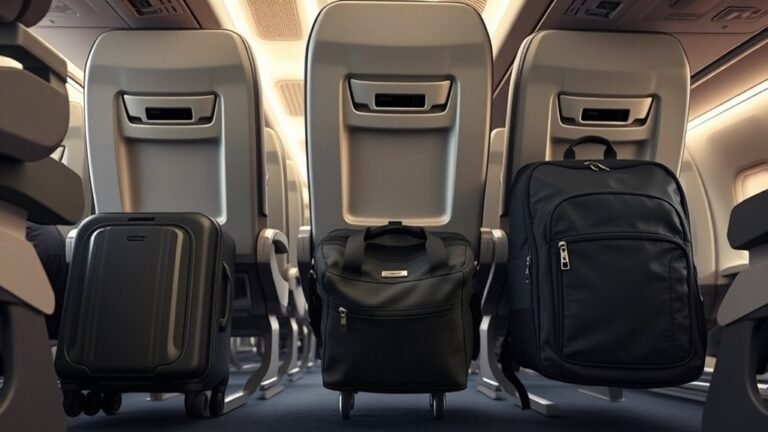
You should care because wheel size, placement, and protrusion affect how bags fit in overhead bins, carts, and conveyor guides. Bulky or misaligned wheels can catch on doors, jam roller tracks, or force handlers to rotate bags, slowing loading and increasing damage risk.
Smooth-rolling, recessed wheels ease handling and let staff maximize space. Choosing suitcase wheels thoughtfully reduces delays, lowers mishandling chances, and helps your luggage survive transit intact.
How Airlines Define Carry-On and Checked Size Limits
When you check an airline’s baggage policy, they define carry-on and checked size limits by total external dimensions—length plus width plus height—including wheels, handles, and any protrusions—so the bag must fit their stated envelope rather than just the fabric compartment.
You should measure your luggage that way, laying it flat to include wheels and extended parts.
Airlines list specific dimension caps and sometimes weight limits; regional carriers can differ.
Airlines set exact size—and sometimes weight—limits for luggage; regional carriers often have different rules.
Gate-check rules may vary.
If your bag exceeds published limits, you’ll pay fees or be required to check it.
Confirm limits for your carrier and fare class before travel.
Where Wheels Count: Handles, Protrusions, and Overhang
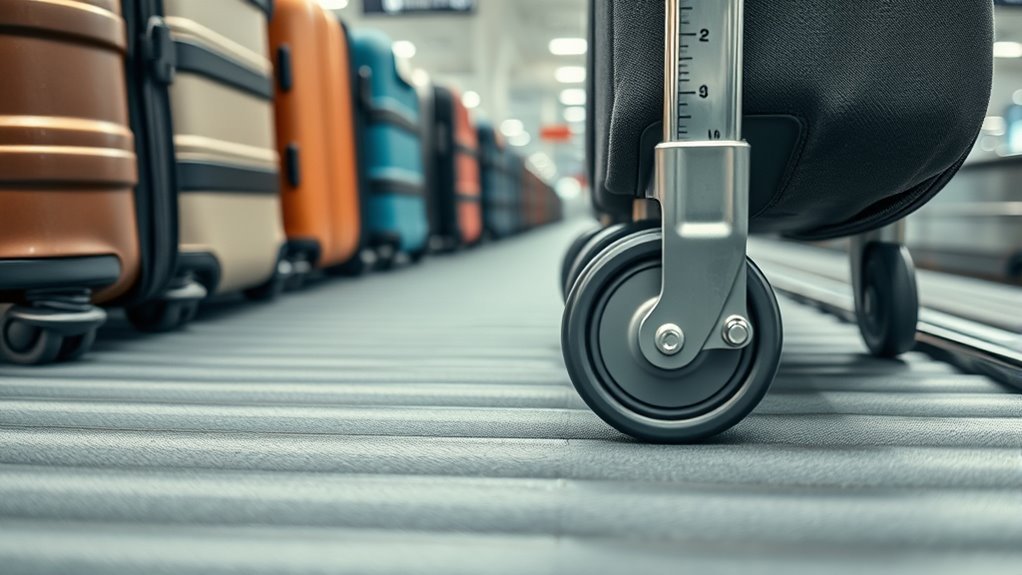
Because wheels, handles, and any sticking-out parts change a bag’s external envelope, you should measure luggage including them and treat overhang as part of the size limit.
You’ll include wheel housings, fixed or retractable handles, side pockets, and any rigid trim when measuring height, width, and depth. Soft fabric or compressible bits might be judged differently, but rigid protrusions rarely compress.
Measure with handles extended if they stick beyond the main body. When in doubt, check dimensions with a tape measure and compare to airline limits—overhang can push you over size caps and trigger gate checks or fees.
Which Airlines Explicitly Mention Wheels in Policy
Having covered how wheels and other protrusions affect a bag’s measured size, let’s look at which carriers actually call out wheels in their rules. You’ll find that some airlines explicitly mention wheels, others suggest them under dimensions, and a few ignore them entirely. Check each carrier’s baggage page before you fly.
Common explicit mentions include:
- Delta: notes wheels and handles as part of total dimensions.
- American Airlines: includes wheels in size limits for checked bags.
- United: specifies measuring to the outside of wheels.
- Southwest: refers to overall dimensions, effectively covering wheels.
- JetBlue: explicitly counts wheels in their measurement guidance.
Common Policy Language About Luggage Wheels
If you’re checking an airline’s baggage rules, you’ll often see phrasing that treats wheels, handles, and other protrusions as part of the “overall” or “total” dimensions, meaning carriers expect you to measure to the farthest points of the bag. You should read terms like “including wheels and handles,” “maximum external dimensions,” or “measured fully assembled.” That language signals enforcement of size limits rather than just interior capacity. Here’s a quick comparison:
| Phrase | Meaning | Action |
|---|---|---|
| “Including wheels” | Measured externally | Measure outward |
| “Measured assembled” | Count protrusions | Check full size |
| “External dims” | No exceptions | Pack accordingly |
When Gate Staff or Baggage Handlers Inspect Wheels

When you arrive at the gate or the baggage counter, staff will often give your carry-on a quick visual and sometimes a hands-on check to see whether wheels or handles push the bag past the allowed dimensions.
You’ll usually see brief, practical checks rather than formal measuring unless size is borderline. Staff judge protrusions, stability, and whether the bag fits overhead or in a sizer.
They’ll expect cooperation and may ask you to compress or adjust items.
- Wheels that stick out visibly
- Extended handles left up
- Attachment straps or pockets
- Nonstandard wheel housings
- Signs of damage affecting shape
If asked, comply promptly.
Real Scenarios That Trigger a Wheel Inspection
Because airlines need to keep boarding smooth and bins safe, certain situations make staff take a closer look at your bag’s wheels: oversized carry-ons being forced into sizers, bags that barely fit overhead bins, visible protruding wheels or damaged housings, repeated gate-checking of the same item, and reports from ground crews about snagging or instability. You’ll face inspection when staff notice obstruction, wobbling during handling, or when policy flags a pattern. Quick checks aim to confirm stowability and avoid in-flight issues.
| Trigger | What staff check |
|---|---|
| Oversize | Wheel clearance |
| Snagging reports | Structural integrity |
| Repeated gate-checks | Consistency |
| Visible damage | Attachment security |
How Damaged Wheels Cause Delays or Denied Boarding
Although a single broken wheel might seem minor, airlines treat damaged rolling gear as a real safety and operational risk. You can be delayed or denied boarding if staff judge your bag unsafe to stow or handle.
You’ll face extra inspection, possible rebagging, or refusal to accept the luggage if wheels snag, detach, or leak debris. Staff prioritize cabin safety and efficient loading, so damaged wheels that threaten conveyors or other bags trigger action.
Common consequences include:
- Extra screening time at check-in
- Gate-side rebagging or repacking
- Baggage refusal for aircraft hold
- Missed connections from delays
- Required repair before acceptance
Wheel-Related Fees: Who Charges and When
Who pays for wheel repairs or extra handling can depend on where and how the damage occurs. If an airline mishandles your checked bag, you can usually file a claim and the carrier may reimburse repairs or compensation under its liability rules.
If damage happens after you reclaim luggage or from normal wear, you’ll likely cover costs. Third-party handlers or airport contractors might be responsible if their negligence is proven, but pursuing them can be complex.
For carry-on or gate-checked items, policies vary; you should check ticket terms and incident procedures immediately and document damage with photos and receipts.
Airport Ground-Handling Standards for Wheels
You should know that ground crews follow strict wheel maintenance protocols to keep baggage carts and conveyor systems rolling safely. They’ll inspect wheels at set intervals and after any abnormal wear to meet inspection frequency standards.
Airlines and airports also use approved wheel specifications to guarantee replacement parts meet load and durability requirements.
Wheel Maintenance Protocols
When ground crews service luggage, they follow strict wheel maintenance protocols to keep bags moving smoothly and prevent delays. These standards cover inspection frequency, acceptable wear limits, and approved repair or replacement procedures.
You’ll learn how crews act when damage appears, which tools they use, and when they must remove a wheel from service. Key actions include:
- Visual and tactile checks for cracks, flat spots, and missing components.
- Lubrication and axle torque verification with calibrated tools.
- Temporary fixes allowed and documented under protocol.
- Mandatory replacement criteria based on safety thresholds.
- Recordkeeping and chain-of-custody for repaired parts.
Inspection Frequency Standards
Because luggage wheels face constant stress and varying conditions, ground-handling teams set specific inspection intervals so you can rely on consistent performance. You’ll see daily visual checks for obvious damage and weekly functional tests that assess swivel, rolling smoothness, and axle security.
Monthly detailed inspections include bearing play measurements, tread wear assessment, and lubrication checks. After heavy-duty duties or reported issues, crews perform immediate additional inspections.
Records note findings, corrective actions, and follow-up dates so you can track trends and anticipate replacements. These standards help you avoid failures during handling and maintain predictable operational safety and efficiency.
Approved Wheel Specifications
Although standards vary by operator and airport, approved wheel specifications set clear limits on dimensions, materials, load ratings, and performance so ground crews can choose parts that withstand repeated handling and environmental exposure. You’ll rely on those specs when approving replacements, ordering spares, or evaluating damage reports.
They tell you what’s safe for conveyor belts, carts, and aircraft bulk areas, and they reduce downtime by standardizing repairs. Key aspects include:
- Diameter and width tolerances for clearance and stability
- Material composition for wear and weather resistance
- Static and dynamic load ratings for weight-bearing safety
- Bearing types and sealing standards for contamination resistance
- Performance tests and certification requirements
Conveyors, Loaders, and Wheel Interaction
When you watch baggage move through the system, pay attention to how wheel materials and tread patterns affect conveyor belt wear.
You’ll notice loaders press wheels against rollers and ramps in ways that concentrate abrasion and stress. That interaction influences maintenance schedules and can determine whether a bag’s wheels meet ground-handling standards.
Conveyor Belt Wear
If you handle baggage operations, you know conveyor belts take constant punishment from suitcase wheels, rollers, and loader mechanisms, and that interaction governs how quickly belts wear and fail. You see abrasion, edge fraying, and delamination accelerate when loads, debris, or misaligned rollers concentrate stress.
Regular inspection, cleaning, and proper tension extend service life. Track wear patterns to predict replacement and prioritize repairs.
- Inspect belt surface for cuts, glazing, and frays.
- Monitor tracking to prevent edge damage.
- Remove grit and foreign objects routinely.
- Measure thickness and splice integrity periodically.
- Log load cycles and peak loads to forecast wear.
Loader Wheel Contact
Belt wear patterns often point to how baggage meets moving equipment, so let’s look specifically at loader wheel contact and how it affects conveyors and loaders. You’ll notice how wheel diameter, hardness, and tread shape change pressure points on belts, creating focused abrasion or smearing.
When wheels ride slightly off-center or oscillate, they induce lateral tracking issues and edge fraying. Soft wheels absorb shock but can leave sticky residue; hard wheels resist deformation yet concentrate stress.
Regularly inspect wheel alignment, replace flattened or glazed wheels, and monitor belt texture. Small wheel faults multiply, so timely maintenance preserves conveyor life and reduces baggage damage.
Manufacturer and Industry Standards for Wheels
Although luggage wheels might seem trivial, manufacturers and industry bodies treat them as precision components with specific performance and testing standards. You’ll find ASTM, ISO, and industry consortiums set criteria for durability, materials, load, and environmental resistance.
Manufacturers certify wheels through lab and field testing so you get predictable performance.
- Durability cycles: simulated rolling over varied surfaces
- Load ratings: maximum static and dynamic weights per wheel
- Material specs: polymers, bearings, and wear-resistant treads
- Environmental tests: temperature, UV, salt spray resistance
- Dimensional tolerances: fit, alignment, and rotation smoothness
You’ll rely on these standards for reliable travel gear.
Spinner vs Inline Wheels: Fit and Stability Differences
When you compare spinner and inline wheels, look at how their footprints and contact points affect rolling resistance and balance.
Check axle alignment and rigidity, because a wobbling axle will make even a light bag feel unstable.
Pay attention to cornering: spinners turn easily but can feel tippy, while inlines track straighter and resist tipping during sharp maneuvers.
Wheel Footprint And Contact
Because the area where wheels meet the ground determines how a bag rides, you’ll notice clear differences between spinner and inline designs. You’ll feel stability from inline wheels because their longer contact patch spreads weight front-to-back, while spinners concentrate load on smaller, multiple points, improving maneuverability but sometimes reducing steadiness.
Consider how terrain and packing affect contact pressure.
- Inline wheels: larger footprint along rolling axis
- Spinner wheels: smaller, multiple contact points
- Surface adaptability: inline grips uneven ground better
- Turning: spinners pivot with less lateral skid
- Load distribution: inline reduces wobble under weight
Choose based on routes and handling preference.
Axle Alignment And Rigidity
If you push a suitcase, its axle alignment and wheel rigidity tell you immediately how it’ll track and feel under load.
You’ll notice spinners have individual stub axles that let wheels swivel independently; that gives maneuverability but can introduce slight play if fittings are loose.
Inline wheels share a fixed axle, so they resist deflection and keep a straighter, predictable roll.
Stiffer axles reduce wobble when the bag’s heavy, while flexible mounts absorb shocks at the cost of precision.
Inspect fittings, tightening screws or replacing worn bushings to restore alignment.
Proper firmness ensures consistent tracking and less user effort.
Cornering Stability Differences
Axle alignment and wheel rigidity set the stage for how your suitcase handles turns, but cornering behavior really separates spinners from inline wheels. You’ll feel spinners pivot smoothly; they let you steer with minimal wrist torque.
Inline wheels track straight, resisting lateral drift but needing you to tilt the bag. Fit, wheel width, and mounting depth change bite and slip during maneuvers.
- Spinner: four corners contact, easy rotation
- Inline: two-wheel tracking, stable at speed
- Wide wheels increase grip on turns
- Deep-mounted axles reduce wobble
- Softer compounds absorb small bumps
Choose based on control you want.
Measuring Luggage With Wheels: Step-By-Step
When measuring wheeled luggage, start by placing the bag upright on a flat surface so it stands as it would during travel; this guarantees you measure the dimensions airlines actually consider.
Measure height from base (including wheels) to top, keeping tape straight.
Measure width at the widest point side-to-side.
Measure depth front-to-back at the fullest point, pressing fabric flat if soft-sided.
Record measurements in inches or centimeters as required.
Check handles: extend telescoping handles to ensure compliance, then retract for storage dimensions.
Note any loose straps or protrusions and include them if they affect overall size.
Measuring Expandable Bags and Wheel Overhang
When you measure an expandable bag, always do so with it fully zipped to its expanded size so you don’t get surprised at the gate.
Don’t forget to include wheel overhang in your width and depth measurements, since protruding wheels can push you over the limit.
To reduce overhang, consider tucking in the wheels if possible, using a bag with recessed wheels, or choosing a slightly smaller packed volume.
Measuring Bag When Expanded
If your suitcase has an expansion zipper, measure it both compressed and fully expanded so you know the maximum size you’ll present at check-in; include any added depth the zipper creates and measure from the outermost points of the shell. You’ll avoid surprises by noting the largest dimensions and comparing them to airline limits.
Measure height, width, and depth with a rigid tape, holding the bag upright and filled to typical capacity. Record both states and label them.
- Measure while packed to account for bulging
- Use a hard ruler for depth accuracy
- Note handle and pocket protrusions
- Photograph measurements for proof
- Recheck before travel
Accounting For Wheel Overhang
You’ve already measured your bag both compressed and fully expanded; now account for wheel overhang so the airline won’t count extra inches against you. Measure length and width including the wheels’ furthest points while the bag sits upright and on a flat surface. Note if wheels retract or sit proud; airlines differ on counting protrusions. Record both measurements and photograph the profile next to a ruler for proof at check-in. Use the table below to log quick comparisons.
| State | Measured Dimension |
|---|---|
| Compressed (incl. wheels) | |
| Expanded (incl. wheels) | |
Tips To Reduce Overhang
Because airlines often judge size by the bag’s outermost points, trim wheel overhang before you pack. You’ll measure with expandable sections collapsed, then add any extended depth. Check wheels, handles, and bumpers; a few millimeters can trigger fees. Use protective tape or a temporary wheel cover to avoid damage while reducing protrusion. If possible, swap to low-profile wheels or remove detachable wheels when permitted.
- Collapse expandable zippers before measuring
- Measure from wheel tip to opposite edge
- Use packing cubes to avoid bulging
- Choose soft-sided bags for compressibility
- Keep receipts for modifications and replacements
Carry-On Sizing Hacks to Avoid Wheel Problems
When sizing a carry-on to dodge wheel damage, think in regards to clearance and weight distribution rather than just inches.
Choose wheels that tuck under the frame or sit flush so they won’t catch during gate handling.
Prefer lighter shells with reinforced wheel housings; that reduces stress on axles.
Measure depth including wheels and handles to guarantee true fit in overhead bins and sizers.
Balance heavy items over the bag’s center, not on the wheel end, to prevent tipping and undue axle load.
If you swap bags, test rolling and lifting fully packed to confirm stability and clearance.
Packing Tips to Protect Wheels in Transit
If you want your suitcase wheels to survive the trip, pack with their protection in mind by cushioning and stabilizing what sits near the wheel housings. Place fragile items away from corners, use soft layers around wheel wells, and keep heavy objects centralized to prevent pressure on casters. You’ll want to limit shifting during handling.
- Wrap delicate things in clothing near wheels
- Fill gaps with socks or bubble wrap
- Place dense items in the suitcase center
- Strap internal compartments to reduce movement
- Use a hard-shell case or wheel guards when possible
These steps cut stress on wheels and reduce damage risk.
On-the-Spot Fixes for Broken Wheels at the Airport
If a wheel gives out before you board, a roll of strong tape can buy you time—wrap it tightly around the axle and wheel housing to hold things together for the walk to the gate.
If you packed or can grab a spare wheel, swapping it out at a quiet corner is faster and more reliable than a tape fix.
Keep basic tools like a screwdriver in your carry-on so you can make either repair quickly.
Quick Wheel Tape Repair
Although a cracked or detached spinner wheel can ruin your timing, a quick tape repair can get you rolling to the gate in minutes. You’ll want strong tape, scissors or a pocketknife, and a calm pace.
Clean the area, align the wheel, and wrap firmly so it spins enough to steer to your gate. Use airport staff if available.
- Use heavy-duty duct tape for strength
- Wrap in multiple tight layers around axle
- Avoid covering brake or wheel bearings
- Test stability by rolling slowly first
- Replace tape at the next opportunity or check bag repair options
On-the-Spot Wheel Swap
Need a wheel swap now? You can often get a quick fix at airports. Look for airline service desks, baggage offices, or airport repair kiosks — some offer replacement wheels or temporary rigs. Ask staff politely; they’ll assess whether a swap is feasible without delaying your flight.
Keep receipts and photos if damage occurred during handling. If an immediate replacement isn’t available, request a sturdy protective bag or gate-check options to avoid further breakage. You’ll usually pay for parts or service, but it’s worth preserving mobility.
Plan a backup: compact rollers or a collapsible carry option for future trips.
Best Wheel Designs for Frequent Flyers
When you travel frequently, wheel design matters more than you might think: durable bearings, oversized polyurethane treads, and multi-directional spinner hubs cut down drag, absorb shocks, and keep rolling smooth over pavements, airport tiles, and curb edges.
You want wheels that resist wear, minimize noise, and reduce wrist strain. Consider these designs to improve reliability and comfort on long trips:
- Polyurethane spinners with sealed ball bearings for quiet, smooth rotation
- Oversized wheels for better handling on uneven surfaces
- Dual-wheel setups for stability and weight distribution
- Shock-absorbing suspension mounts to protect contents
- Replaceable wheel cartridges for easy repairs
What to Look For When Buying Luggage for Airline Limits
When you shop for luggage, check carry-on size limits first so the wheel housings won’t make your bag too tall or wide for overhead bins.
Also pay attention to the bag’s weight and how it’s built—lighter bags help you stay under airline weight caps, but you don’t want flimsy construction.
Aim for a balance of low weight and solid durability so your suitcase meets limits without falling apart.
Carry-On Size Limits
Curious how airlines actually measure carry-ons? You’ll want a bag that fits their length, width, and height rules — often including wheels and handles. Measure fully packed dimensions, since airlines check external size.
When buying, focus on these practical points:
- Confirm airline maximums (cm/in) for your common carriers
- Measure with wheels and extended handle retracted
- Choose a slightly smaller external size to avoid surprises
- Check cabin bin compatibility for typical overheads
- Prefer rigid edges over bulging fabric that adds bulk
Buy based on measured external dimensions so your carry-on meets limits and avoids gate checks.
Weight And Durability
Because airlines often enforce strict weight limits, you should pick luggage that balances low tare weight with rugged construction so you can pack more without risking fees or damage.
Choose materials like polycarbonate or high-denier ballistic nylon for a strong-but-light shell.
Check wheel and handle quality: dual-spinner wheels and reinforced telescoping handles reduce stress and wear.
Inspect seams, zippers, and corner guards for durability.
Prioritize weight savings where it won’t compromise protection—thin shells are lighter but need internal padding or hard-sided frames for fragile items.
Weigh your bag empty to make sure you’re under limits before packing.
Soft-Sided vs Hard-Shell: Wheel Compliance Tradeoffs
Although both soft-sided and hard-shell suitcases look similar from afar, their wheel designs force different compliance tradeoffs you’ll want to take into account.
Though they may appear alike, wheel design makes hard-shells and soft-sided cases behave very differently at airline size checks.
You’ll notice hard-shells often have recessed, fixed wheels that protect against damage but can add width and rigidity, affecting airline size limits.
Soft-sided bags let you compress fabric around wheels, sometimes squeezing under limits, yet exposed wheels risk snagging and breaking.
- Hard-shell: protected wheels, less give in tight spaces
- Soft-sided: compressible, potentially slimmer profile
- Spinner vs inline impacts protrusion
- Wheel housing materials affect durability
- Check airline rules before buying
International Differences in How Carriers Treat Wheels
When you travel internationally, be aware that carry-on wheel rules can differ widely between airlines and countries.
Checked-bag standards for wheel size, placement, and protection also vary, and you might find a bag accepted on one carrier but flagged on another.
Check regional policies ahead of time so you know who’s liable if wheels get damaged.
Varying Carry-On Wheel Rules
If you travel internationally, you’ll quickly notice that airlines don’t agree on how to treat wheels on carry-on bags: some count them toward overall dimensions, others ignore them, and a few have specific rules for retractable or oversized wheels. You should check carrier policies before packing, since enforcement varies at gates.
Consider wheel type, orientation, and removable options to avoid surprises.
Quick checklist:
- Confirm whether wheels are included in stated length/width/height
- Measure with wheels extended and retracted if possible
- Look for max linear dimensions and weight limits
- Note regional carriers often have stricter size enforcement
- Keep receipts for detachable parts
Checked-Bag Wheel Standards
Across airlines and countries you’ll find little agreement on whether wheels count toward checked-bag dimensions, so you should check each carrier’s policy before you fly.
In some regions carriers include wheels and handles in linear measurements, while others ignore protruding hardware unless it exceeds size or weight limits.
Low-cost carriers tend to enforce strict, explicit rules; legacy airlines may be more varied or lenient.
International rules can differ even within alliances, so review both departure and arrival airline policies for interline trips.
If in doubt, measure your suitcase including wheels, or choose a compliant soft-sided bag to avoid surprises.
Regional Damage Liability
Because liability rules vary by region, you should expect different outcomes if an airline damages your suitcase wheels abroad. You’ll face national laws, carrier contracts, and varying limits on compensation.
Act quickly: document damage, keep receipts, and file claims per the carrier’s timeline.
- Know regional liability caps (e.g., Montreal Convention vs. local rules)
- Read the airline’s Contract of Carriage before flying
- Photograph damage and retain boarding pass and bag tag
- File claims promptly and keep copies of all correspondence
- Consider travel insurance to cover gaps not handled by carriers
Special Cases: Strollers, Sports Gear, and Wheeled Items
Airlines often treat strollers, sports gear, and other wheeled items differently from standard checked bags, so you’ll want to check specific carrier policies before you travel.
You should note size, weight, and packaging rules: some carriers allow strollers gate-checked free, others count them as checked baggage.
Sports equipment like skis, bikes, and golf bags often have dimensional or fee exceptions but may require special packing or disassembly.
Wheels and frames can be treated as fragile; you’ll want protective covers or padding.
Always declare oversized items at check-in, verify fees, and confirm liability limits to avoid surprises.
Documenting Wheel Damage and Disputing Fees
When you find wheel damage after a flight, document it immediately so you can make a clear claim. Take photos, note flight details, and report to the airline baggage desk before leaving the airport.
If they won’t acknowledge it, file a written report online within the carrier’s deadline. Keep receipts for repairs and any replaced parts.
- Photograph damage from multiple angles and include a timestamp.
- Record flight number, date, and baggage tag information.
- Get a written incident report number from staff.
- Save repair estimates and invoices.
- Follow the airline’s claim process and appeal if denied.
Practical Pre-Trip Checklist to Avoid Wheel Surprises
Before you head to the airport, run a quick wheel check so you’re not surprised by wobbling, stuck rollers, or loose axles mid-trip. Inspect each wheel for cracks, debris, and uneven wear. Spin wheels to confirm smooth rotation and listen for grinding. Tighten visible screws and test axle play; replace missing fasteners. Lubricate bearings sparingly with silicone spray if they stick.
Verify telescoping handle clears wheels and locks firmly. Pack a small repair kit: screwdriver, zip ties, replacement screws, and a portable luggage strap. Weigh and measure after the check to avoid surprises at the counter.
Quick FAQ: Top Luggage-Wheel Questions Answered
Now that you’ve run through a quick pre-trip wheel check, you’ll probably have a few common questions—this FAQ answers the ones travelers ask most. You’ll get short, practical answers so you can travel confident.
- Do airlines measure wheels? Mostly no; they check overall bag size and weight, not wheel diameter.
- Will damaged wheels get flagged? Yes, if they affect handling or safety.
- Can you fix wheels at the airport? Often you can improvise, but professional repair’s better.
- Do wheel types affect fees? Only if they change checked vs. carry-on status.
- Should you document damage? Always photograph before travel.
Action Plan If Your Bag Fails a Wheel Check
If your bag fails a wheel check, stay calm and start documenting the issue—take photos from several angles and note any noises or wobble you observed.
Next, report the problem immediately to gate or check-in staff and show your photos; ask for written confirmation or an incident/card.
If staff offer to tag the bag for inspection or to remove it from service, accept and get details on next steps.
Request options: repair, replacement, or gate-checking for the flight.
Keep receipts for any out-of-pocket fixes and note personnel names.
Follow up with the airline’s baggage office within their stated timelines.
Further Resources: Policy Links and Manufacturer Guides
After you document and report a wheel issue, consult official resources so you know your rights and repair options. You’ll find clear steps, warranty details, and carrier-specific procedures.
Use manufacturer guides for model-specific repairs and parts, and check airline policies for compensation or denied-boarding handling.
- Airline baggage policy pages (claims, size/weight rules)
- Manufacturer manuals and online troubleshooting guides
- Warranty registration and service center contacts
- Consumer protection sites and aviation authority rules
- Travel forums and reputable repair tutorials
Bookmark links, save screenshots, and follow official instructions to streamline repairs or claims without unnecessary delays.
Frequently Asked Questions
Can Luggage Wheels Affect Carry-On Weight Limits?
Yes — luggage wheels count toward carry-on weight limits, so you’ll often hit the airline’s allowance faster if your bag has heavy wheels. You’ll want to weigh your packed bag to avoid surprises at the gate.
Do Airlines Measure Spinner Swivel Clearance Separately?
No, they usually don’t measure spinner swivel clearance separately; you’ll be judged on overall dimensions including wheels and handles, so you should check airline size limits and test-fit your bag in their sizer before boarding to avoid surprises.
Are Detachable Wheels Allowed as Carry-On Components?
Yes — you can usually carry detachable wheels as carry-on components, but you’ll need to stow them inside your cabin bag or meet airline security and size rules; check your carrier’s policy to avoid surprises at the gate.
Can Repaired Aftermarket Wheels Violate Airline Rules?
Yes — repaired aftermarket wheels can violate airline rules if they change your bag’s dimensions, fail security inspection, or look unsafe. You’ll risk denied boarding, checked baggage fees, or confiscation if carriers or TSA deem them noncompliant.
Do Ride-On Suitcase Wheels Change Class of Service Requirements?
No, ride-on suitcase wheels usually don’t change class of service requirements; you’ll still follow size, weight, and carry-on rules, but airlines might restrict motorized or oversized models, so check specific carrier policies before travel.
Conclusion
You’ll usually be fine—airlines measure total bag dimensions, not wheels separately, but wheels count as part of length/width/height and can push a bag over limits. Carriers and gate agents may note protrusions like wheels or handles, and low-cost airlines often enforce strict size checks. Before you travel, measure with wheels attached, confirm airline limits, and use a compact case or soft-sided bag to avoid surprises at check-in or the gate.