What Is the Largest Suitcase You Can Check on a Plane
You’ll usually be able to check a suitcase up to about 62 linear inches (length + width + height), wheels and handles included, though some carriers or routes allow slightly larger or smaller sizes. Weight limits commonly sit around 50 lb (23 kg) for economy and up to 70 lb (32 kg) for premium cabins, with steep fees for oversize or overweight bags. Measure externally and check your airline’s rules, and keep going for tips on measuring, packing, and fees.
Quick Decision: Check, Ship, or Leave Items Behind
When you’re deciding whether to check a large suitcase, ship items ahead, or leave things behind, weigh cost, convenience, and risk. You’ll compare airline baggage fees, size limits, and potential overweight charges against shipping rates and delivery time.
Consider fragile or valuable items—shipping with insurance might be safer than airline handling, but tracking and pickup add hassle.
For fragile or valuable items, insured shipping can outpace airline handling—though tracking and pickups add extra hassle.
Think about timing: overnight shipping solves last-minute excess, while downsizing saves time at the airport.
Also factor layovers, connections, and liability for delays or loss.
Make a practical choice: minimize stress, avoid surprises, and assure essential items stay with you.
Quick Answer: Largest Suitcase Airlines Normally Accept
Although airlines vary, you can generally expect most domestic carriers to accept checked suitcases up to about 62 linear inches (length + width + height) and 50–70 pounds before overweight fees apply. That’s the practical maximum without paying extra.
Some international or low-cost airlines set lower size or weight limits, while premium tickets sometimes include heavier allowances.
Oversized or overweight bags typically incur steep charges and may need special handling. To avoid surprises, check your carrier’s specific limits and fee schedule before packing.
If your bag exceeds limits, consider redistributing items, shipping, or paying applicable oversize/overweight fees.
How Checked Luggage Size Is Measured (Linear Dimensions)
If your suitcase approaches the common 62-linear-inch guideline, you’ll want to know exactly how airlines measure those dimensions so you don’t get slapped with oversize fees.
You measure length, width, and height, including wheels and handles, then add them together for the linear total.
Be precise and use a tape measure along the suitcase’s longest points.
Use a tape measure and record the suitcase’s longest points for an accurate size total.
- Measure the longest height from top (including handle) to bottom (including wheels).
- Measure the widest point across the body.
- Measure the deepest point from front to back.
- Add all three measurements for the linear inch total.
Typical Maximum Checked-Luggage Dimensions Worldwide
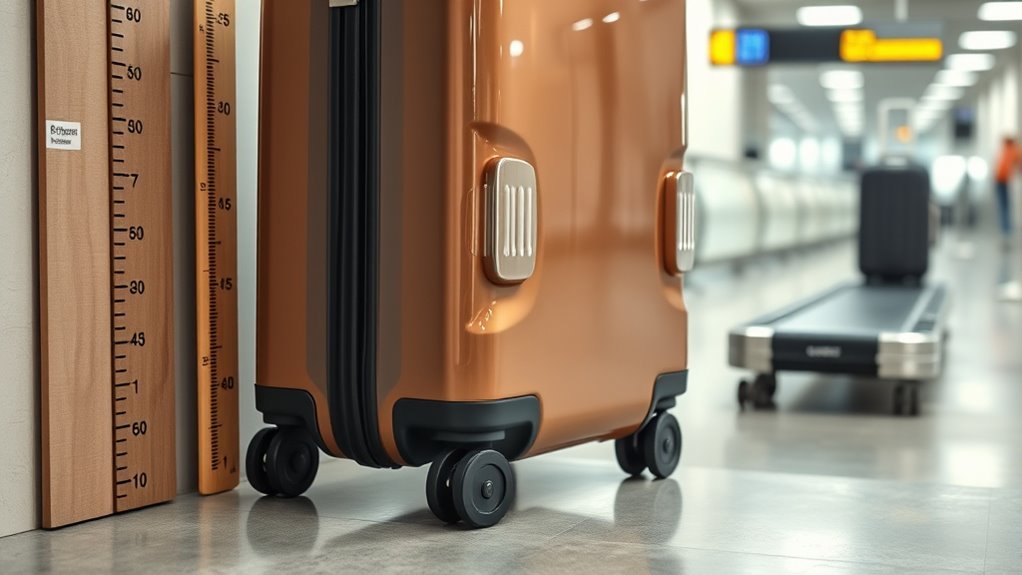
Airlines usually cap checked-bag size by linear dimensions (length + width + height), so you should know the common limits before you pack.
Most carriers set a maximum around 62 inches (158 cm), but some regional or low-cost airlines use smaller limits or different rules.
Measure your suitcase correctly—including wheels and handles—to avoid surprises at check-in.
Airline Size Limits
When you’re planning to check a suitcase internationally or on a long-haul flight, most carriers set a practical size cap—usually around 62 linear inches (158 cm) measured as length + width + height—to keep baggage handling consistent and avoid oversize fees.
Though some regional or budget airlines may allow slightly larger or enforce smaller limits, you should check your airline’s published limits and fee chart before packing.
- Major international carriers: commonly 62 linear inches, 50 lb (23 kg) standard.
- U.S. domestic airlines: similar size, variable weight allowances.
- Low-cost carriers: smaller limits, strict fees.
- Cargo/charter: flexible but costly.
Measuring Luggage Correctly
Because carriers charge or reject bags based on combined length, width and height, measure your suitcase along its three longest external points (including wheels and handles) to get the correct linear inches or centimeters.
Use a tape measure, extend telescoping handles fully, and press any expandable sections flat.
Record length + width + height and compare with common limits: 62 linear inches (158 cm) for many international and premium domestic checked allowances, and often 45–64 inches (114–163 cm) for oversized or sports gear policies.
If your total exceeds the airline’s limit, expect oversized fees or refusal; repack or choose a smaller bag.
Standard Checked-Luggage Weight Limits by Route and Class
Although rules vary by carrier and ticket type, you’ll usually see standard checked-bag weight limits set at 23 kg (50 lb) for economy and 32 kg (70 lb) for business or first-class on most international and long-haul routes. You should check specifics per airline and route, since regional, domestic, and low-cost carriers often use different limits.
Checked-bag limits vary, but expect about 23 kg (economy) and 32 kg (business/first) on long-haul routes.
Typical patterns include:
- Domestic short-haul: often 20–23 kg (44–50 lb).
- International economy: commonly 23 kg (50 lb).
- Premium cabins: typically 32 kg (70 lb).
- Special allowances: frequent flyer status or premium fares can raise limits.
Why Some Airlines Refuse Very Large Suitcases
If you try to check an oversized suitcase, airlines will often refuse it because it creates safety, handling, and cost problems that go beyond simple weight limits. You’ll face issues with cargo hold balance, obstructed loading equipment, and damaged conveyor systems.
Bigger bags can exceed bin dimensions or require special handling that disrupts schedules and raises labor costs. You might be asked to pay oversize fees, ship items separately, or remove contents to meet limits.
Carriers also limit size to safeguard staff from injury and ensure rapid boarding. Check policies before travel to avoid surprises and extra expense.
Major U.S. Carriers: Checked-Luggage Size and Weight Limits
You’ll want to check each major U.S. carrier’s maximum linear dimensions before you pick a suitcase, since size limits can vary by airline.
Also note weight restrictions and overweight fees, which often kick in well below what a larger bag can physically hold.
Knowing both size and weight rules helps you choose a case that avoids extra charges.
Airline Size Limits
When you’re packing for a flight, knowing each major U.S. carrier’s checked-luggage size and weight limits helps you avoid fees and delays. You’ll usually see a maximum linear dimension (length + width + height) and a per-piece weight cap.
Most carriers accept up to 62 linear inches for standard checked bags. Check specifics before you go, since oversized or specialty items trigger extra charges. Compare policies for these major carriers:
- Delta: 62 linear inches standard.
- American: 62 linear inches standard.
- United: 62 linear inches standard.
- Southwest: 62 linear inches standard.
Always verify airline rules for exceptions.
Weight Restrictions Overview
Because airlines balance safety and fuel costs, they set strict weight limits for checked bags that you need to follow to avoid fees or having luggage refused. Major U.S. carriers typically cap standard checked bags at 50 pounds (23 kg) for economy and 70 pounds (32 kg) for premium cabins or elite members.
Oversized or overweight items trigger steep charges or require freight handling. You should weigh packed luggage before leaving, redistribute items into carry-ons if needed, and check each carrier’s policy since limits, fees, and exceptions (sports equipment, musical instruments, military moves) vary by airline and fare class.
Major International Carriers: Checked-Luggage Rules Compared
Although rules vary by carrier, the biggest factors you’ll face are maximum linear dimensions, weight limits, and oversize fees — and knowing each airline’s specific thresholds helps you avoid surprises at the check-in counter. You should compare carriers before booking so you can pack strategically and avoid hefty charges.
Know each airline’s size, weight, and oversize rules so you can compare carriers and avoid surprise fees.
Key differences include allowance per cabin class, how weight is measured, and whether oversize counts as an extra piece.
- Look up each airline’s maximum linear size (length+width+height).
- Note standard weight caps (usually 23kg/32kg thresholds).
- Check oversize and overweight fee schedules.
- Verify exceptions for elite status or premium cabins.
Low-Cost Carriers: Stricter Size Rules and Extra Fees
If you’re flying with a low-cost carrier, expect tighter size limits and extra fees for anything that pushes their rules—these airlines design fares around lean baggage allowances and enforce them strictly at check-in. You’ll often see lower free-checked-bag weight and linear-dimension caps compared with legacy carriers.
Oversized or overweight items trigger hefty surcharges, and some carriers refuse noncompliant bags entirely. Prepaying online usually cuts costs versus airport payments, so measure and weigh before arrival.
Consider compact packing, compressible luggage, or shipping bulky items. Read the carrier’s exact dimensions and fee schedule to avoid surprises and extra charges.
Short-Haul vs Long-Haul: Checked-Bag Rule Differences
When you fly short-haul you’ll often see stricter size limits and lower weight allowances than on long-haul routes.
Airlines also set different rules for domestic versus international flights, so the same suitcase might be fine one way but overweight or oversized the other.
Check the specific carrier’s route-based policies before you pack to avoid surprises.
Size Limits Vary
Because flight routes and aircraft types differ, airlines split rules between short-haul and long-haul flights, and that affects how big a checked bag you can bring. You’ll notice limits change by route type, aircraft cargo space, and fare class. Check specifics before packing.
- Short-haul: carriers often set stricter linear dimensions to fit smaller cargo holds.
- Long-haul: you’ll usually find larger maximum linear sizes allowed for intercontinental jets.
- Regional jets: expect tighter, variable limits based on plane model and route demand.
- Airline policies: each carrier publishes size charts—use them to avoid surprises at check-in.
Weight Restrictions Matter
Size limits are only part of the picture—you also need to watch weight caps, which differ sharply between short-haul and long-haul flights.
On short-haul routes, carriers often impose lower per-bag weight limits—commonly 15–23 kg (33–50 lb)—because quick turnarounds and smaller aircraft constrain handling.
Long-haul flights generally allow heavier checked bags, frequently up to 23–32 kg (50–70 lb) per piece, especially in higher fare classes.
You should check your ticket or airline site before packing: fees for overweight items climb steeply, and excess-weight rules, not dimensions, will often determine whether you pay, repack, or gate-check.
International Vs Domestic
If you’re flying domestically on a short-haul route, expect stricter per-bag weight and sometimes tighter dimension limits than on international or long-haul services, which often allow heavier, larger pieces—especially in higher fare classes or checked as part of an allowance.
You should compare routes and fares before packing. Know that airlines set different max sizes, fees, and oversize rules by market.
- Short-haul: lower weight (often 20–23 kg) and tighter linear dimensions.
- Long-haul: higher allowances, more leniency for size/weight.
- International: checked pieces may be free within allowance.
- Always verify carrier policy for your specific itinerary.
Find an Airline’s Exact Checked-Luggage Limits
Start by checking the airline’s official website or mobile app for its checked-baggage policy—airlines post exact weight, linear-dimension, and fee rules there and update them frequently.
Next, locate the specific route type (domestic, international, partner) and fare class since limits often vary.
Note maximum linear inches or centimeters, weight caps per bag, and oversized/overweight surcharges.
Look for exceptions—elite status, credit-card benefits, or special items like sporting gear.
Save or screenshot the page and record the URL and date.
When in doubt, call the airline; an agent can confirm limits for your exact itinerary.
Measuring Your Suitcase Correctly at Home
Before you head to the airport, measure your suitcase’s total linear dimensions (length + width + height) so you know if it meets the airline’s size limits.
Weigh the bag after it’s packed to avoid surprise overweight fees.
Compare those measurements and weight against your carrier’s checked-luggage policy to confirm compliance.
Measure Total Linear Dimensions
When you’re checking whether a suitcase meets airline size limits, measure its total linear dimensions — length plus width plus height — including wheels, handles, and any external pockets; airlines count everything that contributes to the bag’s overall footprint.
You’ll need a tape measure and a flat surface. Measure the longest points and add them.
- Lay the suitcase flat and measure height from base to top, including wheels.
- Measure width across the widest external points, including pockets.
- Measure depth from front to back, accounting for bumps.
Add the three measurements; compare to airline limits before you pack.
Weigh Your Packed Bag
Because airlines enforce strict weight limits, you should weigh your packed bag at home so you’re not hit with surprise fees at the airport. Use a reliable luggage scale or a bathroom scale and record the weight after zipping.
If using a bathroom scale, lift the bag onto it or weigh yourself holding the bag and subtract your body weight. Include any straps, packing cubes, and souvenirs you’ll carry.
Redistribute items between bags to avoid overweight charges, and aim a few pounds under the limit to account for scale variance. Reweigh after adjustments so you depart confident and fee-free.
Check Airline Size Limits
How big is too big for your airline? Measure length, width, and height including wheels and handles so you won’t guess. Compare totals to carrier limits before you pack.
- Measure: lay the suitcase flat, tape measure from end to end.
- Add: include protruding parts—handles, wheels, straps—into the total.
- Check: visit the airline website for linear size limits and exceptions.
- Trim: if you exceed limits, consider a smaller bag or remove attachments.
Do this at home to avoid fees, gate check surprises, or repacking under time pressure.
Measuring Soft-Sided and Oddly Shaped Luggage
If your suitcase isn’t a rigid rectangle, you’ll need to measure it a bit differently: press any compressible areas to their typical packed shape, then measure height, width, and depth at the widest points including wheels and external pockets.
Lay the bag on a flat surface and use a tape measure, ensuring straps or handles lie as they’ll when checked.
For duffels and soft totes, account for bulges from packed items and any exterior compartments.
Note manufacturer-stated dimensions but verify yourself.
Record the largest three measurements and add them per airline rules; that gives you the true checked size.
When a Bag Is “Standard” vs “Oversized
You’ll want to know the airline’s standard size dimensions so your bag meets the normal checked-baggage allowance.
If your suitcase exceeds those linear dimensions or weight limits, it’ll be tagged oversized and you’ll likely pay extra fees.
Check each carrier’s oversize fees and maximum limits before you pack to avoid surprises.
Standard Size Dimensions
When airlines talk about a “standard” checked bag, they mean one that fits within the carrier’s published linear dimensions—usually the sum of length + width + height—and stays under the weight limit so you won’t face oversize or overweight fees.
You should measure your suitcase including wheels and handles, then compare to your airline’s rule. Typical standards hover around 62 linear inches (158 cm), but always check specifics.
Consider these quick checks:
- Measure length, width, height including protrusions.
- Add the three numbers for linear inches.
- Weigh the loaded bag on a scale.
- Confirm airline limits before travel.
Oversize Fees & Limits
Having checked your bag’s dimensions and weight, you’ll now need to know how airlines treat items that exceed their “standard” limits: oversized bags usually trigger extra fees and stricter handling rules.
You’ll find most carriers define “standard” by linear dimensions (length + width + height) and weight; anything beyond—commonly over 62 linear inches or 50–70 pounds—counts as oversized or overweight.
Fees vary: flat surcharges, tiered pricing, or refusal to accept very large items without prior notice.
Check your airline’s policy before you pack, consider splitting items or shipping bulky goods, and factor fees into trip costs.
Typical Oversize Checked-Luggage Fees and Examples
Most major airlines charge an oversize fee for checked bags that exceed the airline’s linear dimension limit (typically 62 inches/157 cm), and those fees usually range from about $75 to $200 each way depending on carrier and route.
You’ll pay more for international or transpacific flights and sometimes less on discount domestic routes.
Typical examples illustrate what to expect:
- Domestic legacy carrier: $100–$150.
- Low-cost carrier: $75–$125.
- International long-haul: $150–$200.
- Regional or niche carriers: variable, often $85–$160.
Check your airline’s website before you travel to avoid surprises.
Overweight Fees: Weight Bands and Cost Examples
Airlines set overweight fees in clear weight bands, so you’ll pay progressively more as your checked bag gets heavier rather than a single flat penalty. Typically bands run like 23kg/50lb, 32kg/70lb, and sometimes a higher bracket before refusal; fees climb at each step.
For example, many carriers charge $30–$50 for the first overweight band, $100–$200 for the next, and $200+ or special handling for the heaviest accepted bags.
Low-cost and international airlines vary, so check your carrier’s chart. Weigh your suitcase at home to avoid surprise charges at the airport counter.
Maximum Weight Limits Where Bags Are Refused
How heavy can you take before a carrier simply refuses your bag? You’ll hit absolute cutoffs rather than gradual fees: airlines set limits for safety and handling. Know the common thresholds and act accordingly.
How heavy is too heavy? Airlines enforce hard limits—know common cutoffs so your bag isn’t refused at check-in.
- 50 lb (23 kg) — standard economy cap; over this triggers fees or reclassification.
- 70 lb (32 kg) — many carriers’ hard refusal point for checked luggage.
- 100 lb (45 kg) — mostly cargo-only; passenger check-in usually denied.
- Exceptional items — musical instruments or sporting gear may have special weight rules; call ahead.
If your bag exceeds a carrier’s limit, you’ll need alternatives before boarding.
Who’s Responsible If an Oversized Bag Is Damaged or Lost?
If your oversized bag gets damaged or lost, responsibility can fall on several parties depending on where and how the item was handled—you, the airline, or a ground-handling contractor.
You should report damage or loss immediately at the airline’s baggage desk and keep your boarding pass and baggage tags.
Airlines typically limit liability for checked baggage and may pay a capped amount unless you declared and paid for excess value.
Ground handlers can be liable if proven negligent.
File a written claim, meet deadlines, and keep receipts for repairs or replacement.
Consider travel insurance for valuable items beyond carrier limits.
Packing Strategies to Meet Size and Weight Limits
Knowing who’s responsible for a damaged or lost oversized bag helps after the fact, but when you’re packing you’ll want to prevent problems before they happen. You’ll aim to stay within airlines’ linear and weight limits while keeping essentials accessible. Follow focused steps:
- Weigh and measure baggage before you pack; adjust contents to meet limits.
- Prioritize versatile clothing and roll items to save space.
- Use compression bags for soft items and distribute weight evenly.
- Place heavy items near wheels and keep valuables in carry-on.
Check airline rules again before travel to avoid surprises.
Best Lightweight Suitcases That Maximize Capacity
When you need maximum space without exceeding airline weight limits, choose a lightweight suitcase that pares down shell weight while preserving interior volume and smart organization. Look for durable polycarbonate or ballistic nylon shells with thin, reinforced frames; they resist dents without adding bulk.
Prioritize models with high internal-to-external-volume ratios, like spinner designs that expand minimally but use depth efficiently. Removable compartments, zippered compression panels, and external pockets help you organize without extra baggage.
Check smooth, lightweight wheels and ergonomic handles to reduce strain. Finally, validate the empty weight against airline limits so you start your trip under the cap.
Ways to Compress Clothes Without Violating Rules
You can fit more without breaking airline rules by rolling clothes instead of folding them to save space and reduce wrinkles.
Use compression bags to squeeze out air and compact bulkier items, just watch weight limits and any fragile items inside.
Also pick lighter fabrics like nylon or merino that compress well so you don’t sacrifice outfits for space.
Roll Not Fold
If you want to fit more into the suitcase size airlines allow, roll your clothes instead of folding them. You’ll save space, reduce wrinkles, and spot gaps to tuck socks or belts.
Follow these simple steps to maximize capacity without changing your bag.
- Lay garments flat and smooth.
- Fold sleeves or tuck corners to create a neat cylinder.
- Roll tightly from one end, compressing air as you go.
- Arrange rolls snugly in rows, filling edges and corners.
You’ll check a fuller suitcase within dimensional limits while keeping items organized and accessible.
Use Compression Bags
Although they compress your clothes dramatically, compression bags don’t have to violate airline rules if you use them correctly: you’ll pack more, protect garments from moisture, and keep things organized by removing excess air with a hand pump or rolling method rather than a vacuum.
You should choose reusable, durable bags sized to fit your suitcase without bulging zippers. Place heavier items at the bottom, seal carefully, and avoid overstuffing to prevent pressure damage.
Keep one outfit accessible in case bags get held for inspection. Remember airline weight limits; compressing volume won’t reduce weight, so weigh luggage before heading to the airport.
Choose Lightweight Fabrics
Pick lightweight fabrics to shrink bulk without changing airline rules: they let you pack more by volume while keeping weight down, so you won’t hit checked-bag limits. You’ll choose materials that compress easily and resist wrinkles, letting you fit extra outfits without extra fees. Think layering rather than heavy pieces, and favor breathable synthetics or fine wool.
- Pick travel-weight shirts that fold flat.
- Swap bulky denim for stretch chinos or leggings.
- Use thin, warm layers like merino or fleece.
- Pack dresses and blouses in light synthetics that won’t crush.
What to Remove From Checked Luggage to Save Weight
Because airlines charge by weight and many fees kick in once you exceed limits, removing just a few heavy or dense items from checked luggage can keep you under the limit and save money. Start by taking out duplicate shoes, bulky sweaters, and extra jeans—wear the bulkiest on the plane.
Move heavy toiletries, full shampoo bottles, and canned goods to travel-size containers or carry-on. Leave nonessential electronics like extra chargers or spare batteries at home or consolidate into a single device.
Swap hardcover books for e-readers, and ditch excess packaging. Pack only what you’ll actually use to avoid surprise overweight charges.
When to Split Heavy Items Into Multiple Bags
If one bag’s weight is flirting with your airline’s limit, split heavy items into a second bag to avoid surprise fees.
You’ll also cut the risk of damage from overstuffed zippers or crushed contents by spreading weight more evenly.
Consider the extra checked-bag fee versus potential overweight charges and choose the cheaper, safer option.
Weight vs Airline Limits
Airlines set both per-bag weight limits and overall checked-bag allowances, so you’ll need to weigh what you pack before you get to the airport. You don’t want surprises at the counter. Compare your airline’s per-piece and cumulative limits, then decide whether to redistribute items.
Consider practical steps:
- Weigh each potential suitcase at home.
- Move dense or heavy items between bags to balance totals.
- Use your airline’s allowance to avoid excess fees by splitting strategically.
- Prioritize fragile or valuable items in carry-on to control weight distribution.
Plan early so you won’t face last-minute repacking.
Damage And Fee Risks
Balancing weight limits is only part of the equation—you also need to think about damage and extra fees when a single bag gets too heavy. If your suitcase exceeds handling comfort, fragile items risk crushing and seams can split. Splitting heavy items reduces strain, avoids overweight surcharges, and makes retrieval easier if a bag is lost.
| Situation | Risk | Action |
|---|---|---|
| Single heavy bag | Tears, broken items | Split contents |
| Overweight fee likely | Extra charge | Redistribute weight |
| Fragile articles | Damage | Use padding, separate bag |
| Multiple transfers | Handling stress | Use compact cases |
Check airline policies and weigh bags before leaving.
Sports Equipment: Golf, Skis, and Bike Checked Rules
When you’re planning to check bulky sports gear like golf bags, skis, or bikes, know that each item has its own size, weight, and packaging rules that can affect fees and acceptance. You’ll need to pack, protect, and declare properly to avoid surprises.
Consider these concise guidelines:
- Golf: soft or hard travel cases, club headcovers, often charged as oversized if over length/weight limits.
- Skis: use a padded ski bag, combine poles and boots, declare length—airlines set specific maxs.
- Bikes: disassemble, protect frame, pedals, and wheels; use a bike box or bag.
- Fees: vary by carrier and can be hefty—check ahead.
Musical Instruments and Oversized-Item Policies
You’ll want to check each airline’s instrument policy before you book, since some treat guitars, cellos, and other instruments as carry-on while others require checking.
Watch for oversize fee thresholds—if your case exceeds linear or weight limits you’ll owe extra charges.
Always use a sturdy, protective case and confirm any case requirements with the carrier to avoid damage or refusal.
Airline Instrument Policies
Airlines treat musical instruments differently than standard luggage, so you’ll want to check each carrier’s rules before you travel. You’ll face choices about cabin vs. checked carriage, case type, and required declarations. Follow these key points:
- Confirm carry-on size and gate-check policies; some instruments qualify as personal items.
- Use hard cases and secure padding; airlines stress protection for fragile items.
- Declare oversized or fragile instruments at check-in to document condition and request special handling.
- Consider buying a seat for valuable instruments if airline policies or size make gate carry impossible.
Plan ahead to avoid surprises and damage.
Oversize Fee Thresholds
If an instrument exceeds an airline’s checked-size limits, expect an oversize charge and possibly special handling requirements. You’ll find most carriers set a linear dimension threshold—often 62 inches (length + width + height)—above which fees rise sharply or baggage is refused.
Some airlines use separate length limits for guitars, cellos, or wind instruments. Fees vary by carrier and route; international flights often impose higher charges.
Special-item rules may require advance notice, reservations, or transport as cargo. Always check your specific airline’s size and weight charts before travel to avoid surprises and additional costs.
Protective Case Requirements
When transporting a musical instrument or other oversized item, pack it in a sturdy, purpose-built case that meets the carrier’s requirements to reduce the risk of damage and extra handling fees. You’ll avoid denied carriage, surcharges, and claims disputes by choosing a case airlines accept and by securing padding and latches.
Inspect airline policies for size, weight, and case construction rules before travel. Follow carrier rules at check-in to speed handling and reduce inspections.
- Verify approved case types and materials.
- Use rigid, lockable cases with internal padding.
- Label and insure valuables.
- Arrive early for oversize processing.
Fragile or Valuable Items: Checked-Bag Tips
Because checked bags travel rougher than you might expect, pack anything fragile or valuable with extra care and consideration. Use padding, rigid cases, and place items near the suitcase center. Remove batteries from electronics, secure lids, and document contents with photos. Keep small valuables in carry-on when possible. Label the exterior with your contact info and use tamper-evident tape.
| Item type | Packing tip | Priority |
|---|---|---|
| Glassware | Bubble wrap, double-box | High |
| Electronics | Hard case, remove battery | High |
| Jewelry | Padded pouch, photo inventory | Medium |
| Souvenirs | Cushioning, fill voids | Medium |
Check airline size and weight limits before you go.
Insurance Options for Oversized or High-Value Bags
You’ve taken steps to protect fragile and valuable items inside your checked bag, but damage or loss can still happen — and oversized or high-value pieces pose special risks and claims challenges.
- Check your airline’s limited liability and whether it covers oversize fees or requires declared value.
- Review homeowner or renter insurance for personal property off-premises; confirm coverage limits and sublimits for jewelry or electronics.
- Consider dedicated travel insurance or special buy-up policies that explicitly cover oversized items and higher valuation.
- Document contents with photos, receipts, and serial numbers, and keep copies of baggage tags and claim forms for faster reimbursement.
How International Flights Treat Oversize and Overweight Bags
How do international carriers handle oversize and overweight bags, and what should you expect at the check‑in counter? You’ll face strict rules: airlines set maximum linear dimensions and weight limits per fare class.
If your bag exceeds dimensions, they may tag it as oversized and place it on a cargo manifest; overweight items usually incur per-kilogram or flat fees. Some carriers cap liability or refuse extremely heavy pieces.
You’ll be asked to repack, pay, or ship via cargo. Check your airline’s international baggage policy before travel, weigh and measure luggage at home, and arrive early to resolve issues without delaying your trip.
Customs Considerations for Items in Oversized Luggage
When you check an oversized suitcase, remember to declare high-value items like electronics, jewelry, or large collections to avoid fines or seizure.
You’ll also need to know which goods are prohibited or restricted by the destination country—think weapons, certain foods, and large amounts of cash.
Check customs rules before you pack so you’re not caught off guard at inspection.
Declaring High-Value Items
Wondering whether to declare pricey items packed in oversized luggage? You should. Customs rules often require declaration of valuables, and oversized bags can attract extra scrutiny. Be proactive: list high-value electronics, jewelry, art, and cash when required.
Follow these steps:
- Check destination and transit country declaration thresholds.
- Keep receipts, serial numbers, and photos accessible.
- Note items on your customs form and carry copies.
- Consider separate insurance and notify your carrier of declared valuables.
Declaring protects you from fines, delays, or confiscation, and helps with claims if items are lost or damaged.
Prohibited And Restricted Goods
Because oversized luggage draws more inspection, you should be especially careful about prohibited and restricted items packed inside it.
Customs and airline rules vary: weapons, explosives, certain batteries, large quantities of alcohol or tobacco, fresh food, and restricted medications can trigger fines, seizure, or denial of entry.
Check both departure and destination regulations before packing.
Declare anything required on forms to avoid penalties.
If an item’s status is unclear, call the airline or customs authority.
Pack documentation for prescriptions and receipts for high-value goods.
When in doubt, leave questionable items at home or ship them via approved channels.
Connecting Flights and Mixed-Carrier Baggage Rules
If your trip involves connecting flights on different airlines, know that the most restrictive carrier’s size or weight limits usually govern checked luggage, so plan accordingly. You’ll want to confirm rules before booking and again before travel.
Consider these steps:
- Check each airline’s max dimensions and weight limits for checked bags.
- Use the strictest allowance to pick your suitcase size and avoid surprises.
- Note interline agreements—some carriers honor partner rules, easing limits.
- Prepare for transfer inspections and potential recheck procedures at connection airports.
Confirm policies early, pack smart, and weigh bags to prevent fees or delays.
Airport Check-In Tips to Avoid Surprise Fees
Before you head to the airport, check your airline’s baggage allowance limits so you know size and weight caps.
Weigh and measure your suitcase at home to avoid overweight and oversize fees at the counter.
If you’re close to limits, consider redistributing items or paying for an extra checked bag online—it’s usually cheaper than at the airport.
Baggage Allowance Limits
When you check a bag, airlines expect you to follow size, weight, and piece limits that vary by carrier, route, and fare class, so know the rules before you get to the counter. You’ll avoid surprises by checking policies online, noting dimensions, and confirming how many free checked items your ticket includes. Pay attention to alliance and codeshare differences.
- Confirm permitted piece count for your fare.
- Measure total dimensions (length+width+height).
- Weigh packed luggage at home on a reliable scale.
- Check specific airline rules for international versus domestic flights.
Follow these limits to streamline check-in.
Overweight And Oversize Fees
Knowing your airline’s size and weight rules helps you avoid last-minute fees, but you also need to prepare for overweight and oversize charges at the check-in counter. You’ll face fees if your bag exceeds weight or linear dimensions; carriers often charge incrementally more for each extra pound or inch. Weigh and measure at home, redistribute items into carry-ons, or ship bulky items ahead. Ask about fee caps, sports equipment policies, and soft vs. hard case tolerances. The right preparation saves money and stress.
| Scenario | Likely fee |
|---|---|
| 1–10 lbs over | Moderate |
| Oversize (large) | High |
Using Curbside or Home Check-In for Heavy Suitcases
If lugging a heavy suitcase through the terminal sounds awful, curbside or home check-in lets you hand it off before you ever step inside the airport. You’ll save time and strain, but you should prepare: label, weigh, and secure your bag, and have ID and booking ready. Consider these steps:
Skip hauling heavy bags—use curbside or home check-in. Label, weigh, and secure luggage; keep ID and essentials handy.
- Confirm curbside or home check-in availability with your airline.
- Prepay any baggage fees online to speed processing.
- Position your suitcase for easy transfer and note weight limits.
- Keep essentials and valuables in your carry-on; checked bags aren’t immediately accessible.
These options make heavy travel easier and more efficient.
When Gate Agents May Refuse an Oversized Suitcase
Because gate agents have to keep flights safe and on time, they’ll refuse an oversized suitcase if it can’t be stowed safely, exceeds airline or aircraft size limits, or poses a handling risk. If your bag won’t fit in overhead bins or cargo holds allocated for that flight, they’ll stop you.
Damaged, unstable, or wet luggage that could harm others or equipment gets rejected. Excessively heavy pieces that ground crew can’t lift without special gear may be refused too.
Also expect refusal when size or weight rules differ by aircraft type or destination, or when loading would delay boarding or departure.
Solutions If Your Suitcase Is Refused at Check-In
If an agent says your suitcase is too big, check the airline size limits immediately so you know your options.
You can re-pack items into a smaller bag, remove excess gear, or pay for oversized baggage if the airline allows it.
If none of those work, ask about shipping the excess or leaving items with a trusted person.
Airline Size Limits
When an airline agent tells you your suitcase is too big, stay calm and act quickly: you’ve got several practical options to get your luggage accepted or salvage your trip. Airlines set combined linear size and weight caps; regional carriers often limit 62 linear inches and 50 lbs, while some international or premium tickets allow more. Check posted limits, but if yours triggers refusal, consider these steps:
- Measure and verify dimensions against the carrier’s published limits.
- Ask about oversize fees or gate-check alternatives.
- Redistribute items into another bag within allowed size.
- Request supervisor review or rebook to a flight with looser limits.
Packing And Alternatives
Ever wondered how to salvage a trip when an agent refuses your suitcase at check-in? Act quickly: ask why—size, weight, or damage—and request measurement or weighing to confirm.
If it’s oversized, redistribute items into carry-ons or a smaller bag you can purchase or borrow.
For overweight fees, move heavy items to your personal item or wear layers to reduce weight.
Consider shipping bulky items ahead or to your destination via courier.
If refusal persists, request supervisor assistance or ask about gate check options.
Stay calm, document interactions, and prioritize essential items to keep your travel plans intact.
Shipping Alternatives for Very Large or Heavy Luggage
Sometimes checking a suitcase just won’t work—oversize dimensions or excess weight can push you to contemplate shipping instead, and several reliable options can save time, money, and stress. You can choose services that match urgency, budget,, and handling needs. Consider packing securely, documenting contents, and buying insurance.
Compare door-to-door convenience versus drop-off points, and check transit times.
- Courier services for fast, tracked door-to-door delivery.
- Freight carriers for very heavy or multiple items requiring palletizing.
- Luggage-specific shippers that handle travel timelines and hotel delivery.
- Postal service options for slower, often cheaper shipments.
Cost Comparison: Extra Bag Fees vs Shipping Services
Compare the out-the-door cost of checking extra bags to shipping before you decide—airlines pile on fees for additional or oversized pieces, but shipping companies can offer flat rates, weight-based pricing, or discounts for slower transit.
You should total ticket surcharges, overweight charges, and potential gate-check penalties, then contrast that with carrier quotes including pickup, packaging, and insurance.
For bulky but non-urgent items, ground freight or consolidated shippers often win on price.
For delicate or time-sensitive gear, expedited courier services may cost more but reduce risk.
Run real quotes for your exact dimensions and dates to pick the cheapest reliable option.
Exceptions: Military, Medical Gear, and Elite Status
While most travelers stick to published size and fee rules, a few groups get special treatment: active-duty military, passengers carrying medical equipment, and airline elite members. You’ll still need documentation and coordination, but exceptions can ease limits.
While most follow size and fee rules, military, medical travelers, and elites can often get documented exceptions—call ahead.
- Military: You can often check oversized or extra bags under orders; verify with your airline and bring ID.
- Medical gear: Mobility aids and essential devices are usually accepted free and outside size caps with medical letters.
- Elite status: Top-tier flyers get higher allowances and occasional oversize waivers.
- Always call ahead to confirm policies and note possible handling restrictions.
Environmental and Cost Trade-Offs of Large Suitcases
Because bigger suitcases let you carry more, they can cut the number of trips you need—but they also increase aircraft weight and fuel burn, which raises emissions and often means higher checked-bag fees or oversize surcharges.
You’ll balance convenience against environmental and monetary costs: fewer trips reduce your total travel emissions, but a heavier single flight marginally increases that flight’s footprint.
Airlines may charge more for weight or dimensions, and oversized bags can trigger handling fees.
Pack strategically, weigh luggage before leaving, and consider shipping items or renting locally to minimize both costs and environmental impact without sacrificing essentials.
Real Traveler Examples: Oversized-Bag Fee Scenarios
If you’ve ever walked up to a check‑in counter with a suitcase that looks like it could be a small car, you know how quickly an oversized fee can wipe out the savings from packing more.
So these real traveler examples show how rules and charges actually play out. You’ll see common outcomes and quick takeaways:
- A 32″ bag hit a $150 oversized fee on an international carrier; repack or pay.
- A 28″ bag stayed free when within 62 linear inches even at overweight limits.
- A 35″ hard case required cargo handling and a higher surcharge.
- A soft duffel squeezed under dimensions, avoiding extra cost.
Suitcase-Acceptance Checklist Before You Leave Home
Those traveler examples show how fees can surprise you at the counter, so check your bag against a short preflight checklist before you leave home.
Measure length, width and height including wheels and handles; compare totals to your airline’s maximum.
Measure length, width, and height — wheels and handles included — then compare to your airline’s maximum.
Weigh the packed suitcase on a home scale to avoid surprises.
Remove prohibited items and secure fragile belongings with padding.
Note airline weight limits and redistribute heavy items into carry-ons if needed.
Label your bag inside and out with contact info.
Lock with an airline-compliant lock.
Photograph the suitcase and contents for claims.
Confirm baggage allowance online before heading to the airport.
Quick Glossary: Common Checked-Luggage Terms
Before you head to the airport, get familiar with a few common checked-luggage terms so you can read airline rules and avoid surprises. You’ll want clear definitions so you can pack, measure, and avoid fees.
- Linear size — the sum of length + width + height; airlines set maximums.
- Weight allowance — the permitted pounds/kilograms per bag before overweight fees apply.
- Oversize/overweight fee — charges for bags exceeding size or weight limits.
- Checked baggage tag — the receipt and tracking label you keep until arrival.
Learn these terms, compare them to your suitcase, and pack accordingly.
Resources to Verify Current Airline Baggage Policies
When you need up-to-date baggage rules, go straight to authoritative sources: visit the airline’s official website baggage page, check the carrier’s mobile app, or call customer service for clarifications you can’t find online.
Also consult the Transportation Security Administration (TSA) site for security restrictions and country-specific aviation authorities for international travel.
Use fare-type and route-specific baggage calculators on airline sites to estimate size and fees. Save screenshots or confirmation emails showing allowances for your booking.
If policies seem inconsistent, ask an agent to email a written policy reference. That documentation helps resolve disputes at check-in or gate.
Frequently Asked Questions
Can I Check a Suitcase Larger Than the Airline’s Listed Linear Dimensions in Rare Cases?
Yes, sometimes you can, but airlines rarely allow oversized bags without prior approval; you’ll need to call ahead, pay hefty oversize fees, and present a valid reason—otherwise they’ll refuse, gate-check, or charge you.
Do Budget Airlines Allow Oversized Sports Equipment Without Counting It as a Bag?
Usually they don’t; you’ll pay fees or need to prebook oversized sports gear. Some budget carriers let specific items (bikes, skis) be handled as special items with charges. Check the airline’s sports equipment policy.
Will a Suitcase With Non-Removable Wheels/Telescoping Handle Be Measured Differently?
Yes — you’ll usually be measured including non-removable wheels and handles, since carriers measure overall dimensions. Check your airline’s size limits and weight rules, and contact them if you’re close to avoid unexpected oversize fees.
Are Airlines Obliged to Notify Me in Advance About Impending Size-Limit Changes?
Generally, no — airlines aren’t legally obliged to notify you personally about impending size-limit changes; they’ll usually update terms, website, or email subscribers, so you should monitor airline communications and check policies before flying.
Can Loyalty Status Override Oversized or Overweight Baggage Refusal?
Usually you can’t expect loyalty status to override oversized or overweight baggage refusal; airlines may grant leniency to elite members, but policies vary and agents still can enforce fees or deny carriage for safety or size limits.
Conclusion
Before you head to the airport, decide whether to check, ship, or pare down items—oversized fees and refusals are real. Most airlines accept up to about 62 linear inches (158 cm) and 50 lb (23 kg) on economy routes, but limits vary by carrier and class. Measure your suitcase, weigh it, and check your airline’s policy online. If your bag exceeds dimensions or weight, expect extra charges or gate-checking; plan accordingly to avoid surprises.