What Is the Largest Power Bank You Can Take on a Plane
You can bring power banks up to 100 Wh in your carry‑on without airline approval; units between 100–160 Wh need airline permission and are limited in number, while anything over 160 Wh is generally banned on passenger planes. Always keep power banks in carry‑on, protect terminals, and show labels or calculate Wh from mAh if needed. Check your airline’s rules before you go, and keep going to see conversion tips, packing tricks, and carrier variations.
Quick Answer: Power Banks Allowed on Planes
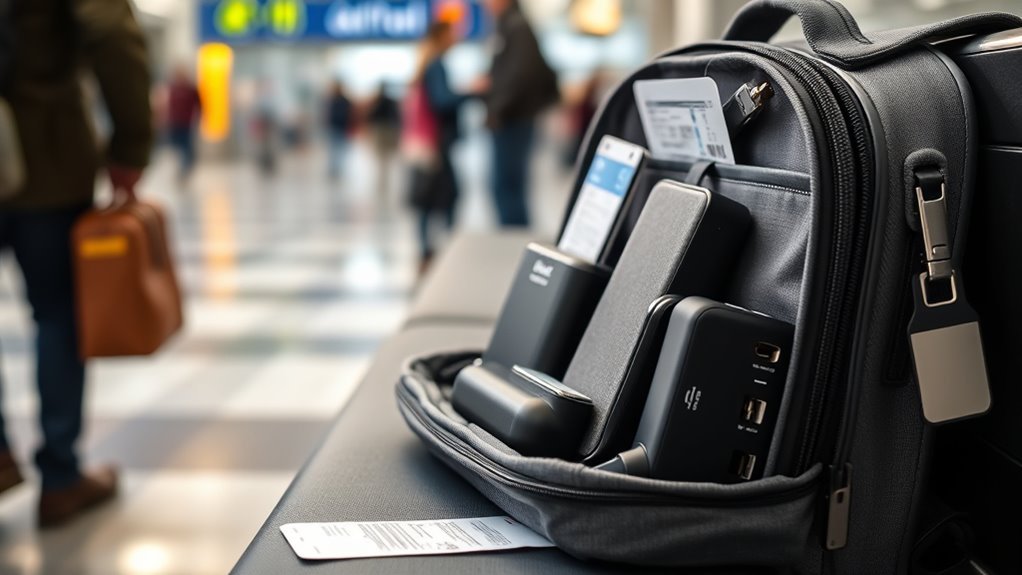
If you’re wondering whether you can bring a power bank on a plane, the short answer is yes—with limits: airlines and aviation authorities generally allow portable chargers in carry‑on baggage but restrict those over certain capacities (measured in watt‑hours, Wh).
They forbid them in checked luggage. You should carry yours in the cabin, keep it accessible for inspection, and verify any built‑in batteries aren’t damaged. Labeling helps if capacity isn’t obvious.
If you’re connecting devices, don’t use the bank during security checks. Always check your airline’s policy before flying to avoid surprises at the gate.
Maximum Power Bank Sizes at a Glance
When you’re packing a power bank for a flight, remember regulators set clear watt‑hour thresholds that determine what you can carry and whether you need airline approval.
You can generally bring power banks up to 100 Wh in carry‑on without approval. Devices between 100 Wh and 160 Wh usually require airline permission and are limited in number. Anything above 160 Wh is typically forbidden in passenger aircraft.
Check your power bank’s rating on the label or calculate it if needed. Always keep power banks in carry‑on, not checked baggage, and confirm airline-specific rules before you travel.
Why Wh Matters More Than mAh for Flights
You should think in watt-hours (Wh) because airlines set limits by energy, not milliamp-hours (mAh).
I’ll explain the Wh formula, show typical airline caps, and walk you through converting mAh so you can pick a travel-friendly capacity.
That way you’ll avoid surprises at security and keep your devices charged.
Watt-Hour Basics
Think of watt-hours (Wh) as the true size label for a power bank on flights—they tell you how much energy the battery actually stores, while mAh only reflects capacity at a specific voltage and can mislead when comparing devices.
You convert mAh to Wh by multiplying mAh by voltage (V) and dividing by 1000. Manufacturers often list Wh directly; if not, check the device voltage—most power banks use around 3.7V for cells.
Knowing Wh lets you compare batteries fairly and check airline or regulator limits readily. Keep focused on Wh when evaluating what you can carry.
Airline Limits Explained
Although mAh describes a battery’s cell capacity, airlines and regulators set rules based on watt-hours because Wh measures actual energy and fire risk more reliably—so you’ll need to focus on Wh when checking limits.
Airlines classify portable batteries by Wh tiers: typically under 100 Wh is allowed in carry-on without airline approval; 100–160 Wh may require airline approval and limits on quantity; over 160 Wh is generally prohibited.
You must carry power banks in carry-on baggage, not checked.
Always check your airline’s policy before flying, declare batteries if required, and keep devices powered off during inspection if asked.
Calculating Travel-Friendly Capacity
Why does watt-hour matter more than milliamp-hour when you’re sizing a power bank for travel? You should convert mAh to Wh because airlines set limits in Wh. Wh reflects actual energy, independent of voltage, so two banks with equal mAh can differ in allowed status. Use this quick table to visualize common sizes:
| mAh | Voltage (V) | Wh (approx) |
|---|---|---|
| 10,000 | 3.7 | 37 |
| 20,000 | 3.7 | 74 |
Keep banks under 100 Wh to avoid airline approval. If unclear, check manufacturer Wh or calculate: (mAh ÷ 1000) × V = Wh.
Convert mAh to Wh in Two Steps
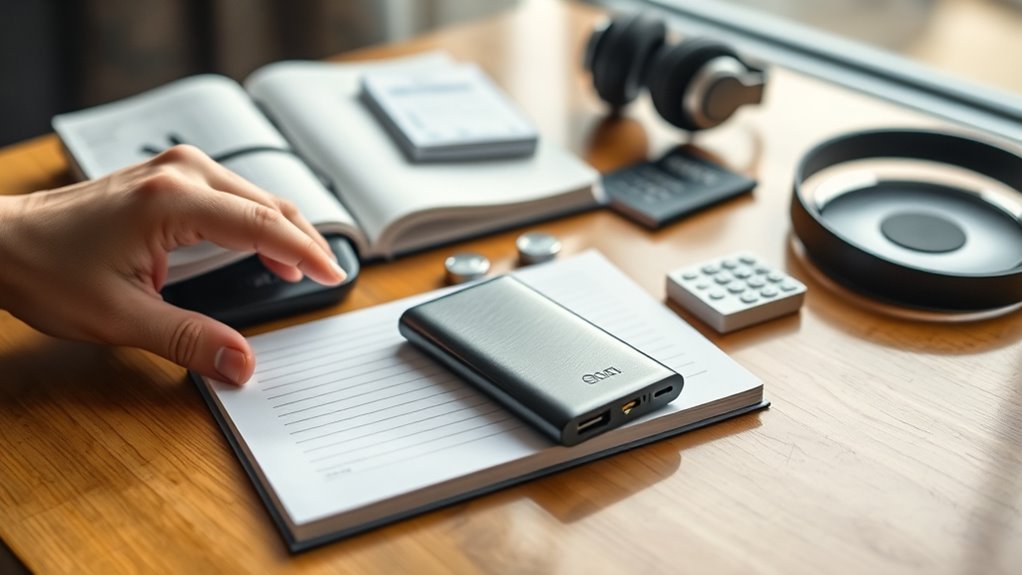
When you’re figuring out if a power bank meets airline rules, convert its mAh rating to watt-hours (Wh) in two quick steps so you’ve got the right number for regulators.
First, take the mAh value and divide by 1000 to get Ah (for example, 20,000 mAh → 20 Ah).
Second, multiply that Ah by the battery’s nominal voltage—usually 3.7V for lithium cells—to get Wh (20 Ah × 3.7V = 74 Wh).
Round moderately, note the device’s labeled voltage if provided, and use that Wh value when checking airline limits and allowed carry-on policies.
Conversion Examples and Quick Calculator
Now that you know how to convert mAh to Wh, let’s put it into practice with a few clear examples and a quick, reusable calculator you can use before every trip.
Take a 10,000 mAh bank at 3.7V: 10,000 ÷ 1000 × 3.7 = 37 Wh. A 20,000 mAh bank is 74 Wh.
If your label lists Wh, you’re done.
For a rough handheld calculator, divide mAh by 1000 and multiply by 3.7.
Keep these examples in mind when packing.
- 10,000 mAh in your pocket
- 20,000 mAh in your carry-on
- Label showing Wh
- Phone charging twice
- Airport security check
IATA Rules for Power Banks (Lithium Batteries)
Because airlines follow strict safety guidelines, the International Air Transport Association (IATA) sets the rules you’ll need to follow for carrying power banks with lithium batteries. You must carry power banks in carry-on baggage only. Cells under 100 Wh are typically allowed without airline approval; 100–160 Wh need airline approval and usually limit quantity; over 160 Wh are prohibited.
| Wh range | Approval | Typical allowance |
|---|---|---|
| <100 Wh | No | Common |
| 100–160 Wh | Yes | Limited |
| >160 Wh | No | Prohibited |
| Quantity | Varies | Check airline |
Always label capacity and check airline specifics before travel.
Why Airlines Usually Follow IATA : And When They Don’t
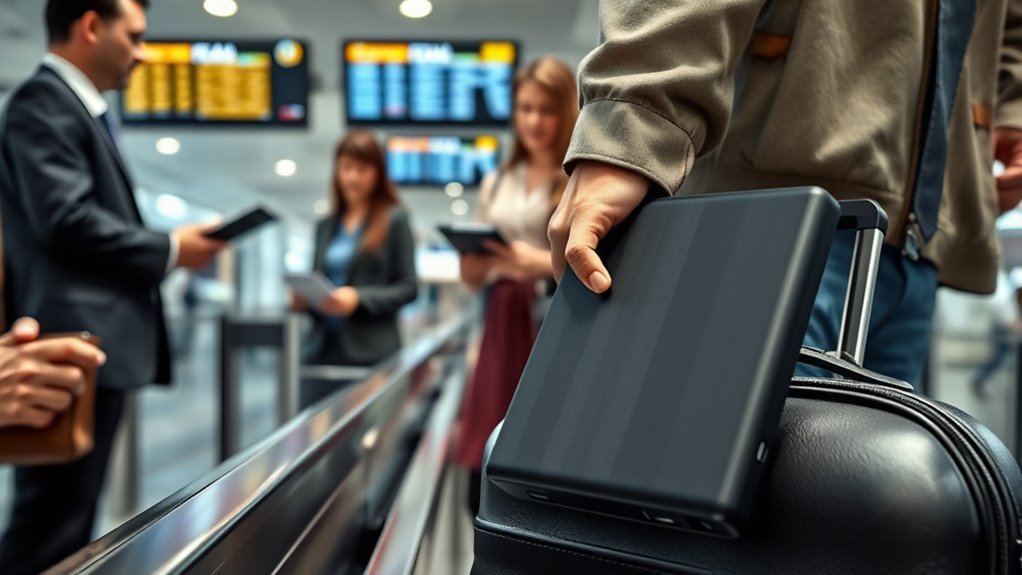
You’ll notice most airlines follow IATA because it creates a consistent, safety-focused baseline for carrying lithium batteries. Still, national regulators or local operational constraints can force stricter limits or different paperwork.
Let’s look at when safety, airport rules, or operational needs make an airline tighten or bend those IATA guidelines.
Why Airlines Follow IATA
Most carriers follow IATA rules because doing so keeps operations consistent, simplifies compliance across jurisdictions, and reduces safety and liability risks for you and the airline. You benefit from clear limits on battery sizes, streamlined staff training, and predictable check-in processes.
When carriers align with IATA, screens, forms, and gate checks match across routes, so you won’t face surprise refusals. Carriers may diverge for legal, operational, or security reasons, but alignment is the default because it minimizes delays and incidents.
Visualize these practical benefits:
- A uniform sticker on your power bank
- A calm gate agent scanning documents
- A single checklist at security
- Smooth connections without rechecks
- Clear signage at boarding
Exceptions And National Rules
While airlines generally follow IATA, national aviation authorities can—and sometimes do—set stricter rules that change what you can bring onboard. You’ll find countries that limit watt-hours, ban certain lithium chemistries, or require specific labeling and certification beyond IATA’s baseline.
Airlines operating under those jurisdictions must enforce local law, so your allowed capacity can vary by route. Check the departure and arrival authority guidance, plus airline pages, before you fly.
For international trips, comply with the stricter rule between origin, destination, and any transit points. Keep documentation handy to avoid delays or confiscation at security.
Operational And Safety Concerns
Local or airline rules matter because they reflect safety calculations and operational realities that go beyond IATA’s baseline. You’ll find airlines follow IATA mostly to standardize fire risk, battery abuse, and crew procedures, but they’ll tighten limits when routes, aircraft type, or local regs increase risk.
You should expect stricter carry-on rules, required inspections, or outright bans in certain airports. If you carry high-capacity packs, declare them and pack them in cabin baggage so crew can access them during an incident.
- A smoking battery in a laminated bag
- Crew isolating a device mid-flight
- Overheating near oxygen systems
- Emergency checklist on a tablet
- Ground crew refusing boarding
Carry‑On vs Checked: Where You Must Keep Power Banks
Because lithium batteries can pose a fire risk in the cargo hold, airlines and regulators require you to keep power banks in your carry‑on baggage rather than checked luggage. You should always pack power banks in your cabin bag, accessible for inspection and to allow crew to respond quickly if a fault occurs. Check airline-specific limits and declare very large units if asked. Keep terminals protected and avoid loose placement near metal objects. Security may remove items that look damaged. Use the table to remind you of basic handling rules.
| Action | Reason |
|---|---|
| Carry on | Crew access |
| Protect terminals | Prevent short |
Power Banks Under 100 Wh: What’s Allowed
Now that you know to keep power banks in your carry-on, you should also understand the size rules for the most common units. If your bank is under 100 Wh, you can usually bring it without airline approval.
Keep power banks in carry‑on; under 100 Wh usually allowed without airline approval—carry labeled and ready for inspection.
You should carry it in its original packaging or clearly labeled with capacity, and keep it on your person or in cabin baggage. Airlines may inspect batteries, so be ready to power them on.
- A slim 5,000 mAh phone pack
- A chunky 20,000 mAh tablet charger
- A camera battery pack
- A backup for noise‑canceling headphones
- A USB‑C laptop starter
100–160 Wh: Airline Approval and Limits
If your power bank falls between 100 Wh and 160 Wh, you can usually bring it on board but you’ll need the airline’s approval first; carry it in your cabin baggage and be prepared to show its capacity label or documentation.
Contact the airline before travel to confirm any carrier-specific limits and required paperwork. Expect staff to inspect the device and verify Wh rating; some airlines cap the number of such batteries per passenger.
Pack terminals to prevent short circuits and avoid checked luggage. If approval’s denied, you’ll have to leave the power bank behind or ship it following dangerous-goods rules.
Above 160 Wh: Why Large Power Banks Are Banned
If your power bank exceeds 160 Wh, airlines ban it because of the increased fire and thermal-runaway risk from large lithium batteries.
Regulators worldwide prohibit these devices in both carry-on and checked baggage, and you’ll need special permits or cargo arrangements to move them.
Instead, consider shipping through approved cargo services or using multiple smaller, airline-compliant batteries.
Safety And Fire Risk
Because lithium batteries can ignite and burn fiercely when damaged or shorted, airlines prohibit power banks above 160 Wh to prevent catastrophic onboard fires. You should understand why: large capacity stores more energy, creates hotter, longer-lasting fires, and can overwhelm crew firefighting tools.
You’ll be held responsible for unsafe devices, and insurers may deny claims.
- A pocket-sized charger erupting in smoke mid-flight
- Melting plastic and acrid, blinding fumes filling a cabin
- Crew racing with fire extinguishers and oxygen masks
- Passengers coughing, alarms blaring, emergency descent
- Evacuation slides deploying amid charred debris
Regulatory Prohibitions Explained
Those fire dangers are exactly why regulators draw a hard line at 160 Wh: they limit how much energy you can carry in a single, unchecked portable battery. You can’t bring power banks above that threshold onto passenger aircraft because regulators classify large lithium cells as significant fire and thermal runaway risks.
Airlines and civil aviation authorities hence ban or strictly control them to protect passengers and crew. You’ll find clear rules in ICAO, IATA, and national regulations: above 160 Wh requires airline approval or cargo-only transport under special handling.
Follow labeling and declaration rules, or your device will be refused.
Alternatives And Transport Options
Why can’t you just pack a giant power bank in your carry-on? Because batteries over 160 Wh are treated as fire risks, so airlines prohibit them.
You can, however, choose safer options and compliant transport methods. Ship large batteries via specialized cargo services, borrow local chargers, buy a smaller approved pack, or rent power stations at your destination.
Always declare batteries to carriers and check airline rules before travel.
- A bulky power bank tucked into checked luggage, forbidden and risky
- A courier van labeled “hazardous cargo”
- A compact 100 Wh bank clipped to your backpack
- A rental battery locker at the airport
- A friend lending a charger
Typical US Carrier Policies (United, Delta, American)
When you fly with major U.S. carriers like United, Delta, or American, each airline follows FAA rules but has slightly different wording and limits in their policies, so you’ll want to check the specific carrier before packing a high-capacity power bank.
Generally, you can carry power banks up to 100 Wh in carry-on without airline approval.
Power banks in the 100–160 Wh range usually require airline approval and are limited to two units per passenger.
Over 160 Wh is prohibited.
All three airlines require you to keep power banks in carry-on, not checked baggage, and to protect terminals from short circuits.
European Carrier Rules and Nuances
US carriers follow the FAA framework, but European airlines and aviation authorities apply the ICAO and EASA standards with their own wording and local restrictions, so you’ll want to check both the airline and the country rules before you pack a large power bank.
You can usually carry up to 100Wh without approval; 100–160Wh often needs airline permission and must go in carry-on; over 160Wh is typically forbidden. Some countries add stricter limits or require battery terminals to be insulated. Always declare when asked and carry documentation if capacity isn’t printed.
- Gate check bins with labels
- Overhead locker with small device
- Security tray inspection
- Cabin crew query at boarding
- Airline approval email in your inbox
Asian and Middle Eastern Carrier Rules
Although many Asian and Middle Eastern carriers follow ICAO/EASA guidance, you’ll find important local differences: airlines often cap allowed watt-hours, impose stricter carry-on rules, or require prior approval for higher-capacity batteries.
Check carrier websites before travel; some carriers in the Gulf and East Asia limit power banks to 100Wh without approval and 160Wh only with airline consent.
You’ll usually have to carry batteries in hand luggage, keep terminals protected, and avoid spare lithium batteries in checked baggage.
Customs or security at certain airports may enforce additional paperwork or refuse unusually large batteries, so confirm rules for both airline and departure/arrival airports.
Low‑Cost and Charter Carriers: Extra Restrictions
Low-cost and charter carriers often enforce tighter limits on power banks than full‑service airlines, so you’ll usually face stricter watt‑hour caps, mandatory carry‑on only rules, and tougher requirements for advance approval. You should check rules before booking; some operators ban anything over 100Wh, others permit up to 160Wh with paperwork.
Pack batteries in original packaging, carry them on, and be ready to show specs. Staff may refuse oversized units at boarding. Consider renting or shipping high-capacity packs instead.
- A slim power bank in your hand luggage
- A stickered battery label showing Wh
- A gate agent inspecting your device
- A denied oversized pack beside your bag
- A taped, clearly marked backup battery
How Airports and Gates Enforce Power Bank Rules
When you pass through security and approach the gate, airport staff actively screen for power banks by checking baggage, scanning labels, and asking passengers about spare batteries. You’ll face clear rules: keep power banks in carry‑on, present them when asked, and accept staff directions to stow or remove items. Gate agents may refuse boarding for unlabeled or damaged units, and airport security can seize noncompliant batteries. Know the signs inspectors use and comply quickly to avoid delays. Follow airline instructions for declared high‑capacity units and carry documentation if you’ve obtained prior approval.
| Action required | Typical outcome |
|---|---|
| Show power bank | Inspection |
| Label check | Accepted or seized |
| Remove from bag | Hand inspection |
| Damage observed | Confiscation |
| Prior approval | Boarding allowed |
What TSA and Equivalents Look for at Security
When you go through security, agents are checking that your power bank stays within allowed battery capacity limits, usually expressed in watt-hours.
They’ll ask you to remove it from your bag and may inspect it visually or with X-ray to confirm labels and condition.
If anything looks noncompliant or damaged, they’ll ask questions and could deny it or require additional screening.
Battery Capacity Limits
Because airlines and security screeners measure batteries by watt-hours (Wh) rather than milliamp-hours (mAh), you’ll want to know how Wh translates and where the cutoffs lie: most regulators allow power banks up to 100 Wh in carry-on without approval, permit 100–160 Wh with airline approval, and restrict anything above 160 Wh entirely.
You should check the Wh rating printed on the device or calculate it (Wh = mAh × V / 1000). Carry only approved units in your cabin; checked baggage is usually forbidden.
Know airline policies, keep documentation, and pack power banks where staff can see them.
- Small pocket charger
- Tablet-sized battery
- DSLR power pack
- Laptop spare battery
- Oversized industrial unit
TSA Inspection Procedures
If you bring a power bank through security, TSA officers and their international counterparts will look for clear labeling, damage, and whether the unit exceeds allowed watt-hour limits.
You’ll need to remove it from carry-on for X-ray screening if requested, and officers may ask you to power it on to confirm it’s a battery, not a replica device.
They’ll inspect for swelling, corrosion, or loose components that indicate danger.
If labeling is missing, expect questions or confiscation.
Knowing your power bank’s Wh rating and keeping it in your carry-on reduces delays and increases the chance you’ll be allowed to fly with it.
Finding Your Power Bank’s Official Wh Label
To confirm how big a power bank you can bring, start by locating its watt-hour (Wh) rating — that number determines airline rules. Check the label on the device, the packaging, or the spec sheet. If you spot “Wh,” that’s official; if you see only mAh and voltage, you’ll need the Wh later (not covered here).
Note manufacturer stamps that list maximum output and safety certifications. Keep the label visible when packing; security may ask to verify it.
- A tiny printed sticker near the USB ports
- A molded imprint on the case
- The original box flap
- A spec sheet inside packaging
- A glossy product label
If No Wh Label: Calculate and Mark It Correctly
If your power bank doesn’t show Wh, you’ll need to calculate it manually by converting mAh to Wh using Wh = (mAh × V)/1000.
Then mark the device clearly with the calculated Wh and follow airline labeling steps—include the Wh value and, if required, the voltage and battery chemistry.
Doing this upfront keeps you compliant and avoids surprises at the gate.
Calculate Watt-Hours Manually
When a power bank doesn’t show its watt-hour (Wh) rating, you’ll need to calculate it yourself so airlines can see it’s within allowed limits.
Find the battery’s voltage (V) and capacity in milliamp-hours (mAh) from the label.
Convert mAh to Ah by dividing by 1000, then multiply Ah × V to get Wh.
Round to one decimal place and write the Wh on the device or its packaging.
Keep the math clear and legible for security checks.
- A tiny sticker reading “3.7V, 5000mAh”
- A calculator screen showing 18.5Wh
- A felt-tip pen marking the case
- A passport-style inspection table
- A clear plastic bag holding the bank
Labeling Steps For Airlines
Because airlines and security staff rely on clear watt-hour info, you should calculate the Wh and mark it visibly on the power bank or its packaging if the manufacturer didn’t print it. Write the Wh value in permanent marker or a printed label, include your name and contact, and place it where staff can read it without opening the device. Carry a copy of your calculation and the battery specs. If questioned, show your math and the device. Use this quick reference table for labeling placement:
| Item | Label Location | Notes |
|---|---|---|
| Power bank | Front or side | Visible without opening |
| Packaging | Outer box | Secure label |
| Document | Printed calc | Keep accessible |
Convert mAh To Wh
To calculate watt‑hours (Wh) from milliamp‑hours (mAh), multiply the mAh by the battery voltage (V) and divide by 1,000:
Wh = (mAh × V) / 1000
So you’ll convert the common 3.7V cell value by plugging in the numbers and then mark that Wh clearly on the power bank or its packaging.
You’ll avoid airline confusion and possible confiscation by showing Wh. If your pack only lists mAh, compute Wh, write it legibly, and keep a note with the math. Carry documentation or a photo of the calculation when you travel.
- A tiny sticker with “74Wh”
- A pen writing numbers
- A neat label on the case
- A printed receipt with specs
- A phone photo of the math
Documentation for 100–160 Wh Units
If you’re carrying a power bank rated between 100 and 160 Wh, airlines and security agencies require specific documentation and airline approval before you board. You’ll need the manufacturer’s specification sheet or a label showing the Wh rating, model number, and battery chemistry.
Carry proof of purchase or a product manual if the label is unclear. Keep a copy of any airline authorization and contact details for the manufacturer handy.
Present documents during check-in and security screening when requested. Missing or unclear documentation can lead to denial of carriage, so organize and have originals or clear digital copies ready.
How to Request Airline Approval for 100–160 Wh
When you’re planning to bring a 100–160 Wh power bank, contact the airline well before your flight to request written approval and confirm any carrier-specific procedures. Explain model, capacity, serial number, and designated carriage in carry-on only. Attach manufacturer specs or your purchase receipt.
If carrying a 100–160 Wh power bank, get written airline approval, provide specs and serial, and pack in carry-on only.
Ask about labeling, packaging, and whether pre-approval emails suffice at security. Note response timeframes and save correspondence.
- A neat photo of the power bank label in your hand
- An email thread with airline approval on-screen
- The power bank tucked into a clear zip pouch
- A boarding pass beside the packed device
- A security officer inspecting documentation
What Happens If Your Power Bank Is Refused?
What happens if an airline refuses your power bank? You’ll be told at the checkpoint or gate and asked to remove it from carry-on. If refusal is due to capacity or missing approval, you can’t bring it onboard.
Options typically are: return it to your car, send it via cargo (check airline policy), or surrender it—some airports will dispose of noncompliant packs. Don’t attempt to hide it; that creates bigger problems.
Ask staff for written reason and guidance. If you disagree, request a supervisor. Keep purchase proof and specs for appeals or future approval requests with the airline.
Packing Best Practices to Prevent Short Circuits
After you resolve any refusal at the gate, you should focus on safely packing allowed power banks to prevent short circuits. You’ll insulate terminals, keep devices separate, and stow battery packs in carry-on where crew can inspect if needed. Use original boxes or hard cases, tape exposed connectors, and avoid loose metal objects. Label capacity if asked, and check airline rules before boarding.
- Wrap terminals with electrical tape
- Place each pack in a protective pouch
- Put packs inside your carry-on pocket, not checked luggage
- Keep cables and coins away from contacts
- Use rigid cases for extra protection
How to Travel With Multiple Power Banks Legally
Wondering how many power banks you can carry? You can bring multiple units in carry-on if each is under limits and you follow airline rules. Declare any over 100Wh but under 160Wh and get approval. Keep banks in your carry-on, protect terminals, and pack chargers separately. Know each battery’s Wh rating and count total units for airline staff.
| Item | Limit | Action |
|---|---|---|
| <100Wh | Usually allowed | No approval |
| 100–160Wh | Restricted | Airline approval |
| >160Wh | Prohibited | Don’t pack |
| Quantity | Varies | Check airline |
Why You Shouldn’t Pack Power Banks in Checked Bags
Because power banks contain lithium batteries that can short-circuit or overheat, you shouldn’t pack them in checked baggage where fires are harder to detect and respond to. Keep them in your carry-on so crew can access them quickly, terminals stay protected, and any required inspections or declarations are straightforward.
You’ll reduce fire risk, follow airline rules, and avoid lost or damaged devices. Carry-on storage lets you switch them off, cover exposed ports, and present them for inspection.
Think about smoke in a cargo hold, melted plastics, delayed flights, emergency landings, and having a usable charger when you land.
- smoke in a dark cargo hold
- singed luggage fabric
- a molten plastic puddle
- frantic baggage handlers
- you retrieving a working charger
How Much Capacity Do You Really Need for Travel?
How much power you need depends on what devices you use and how long you’ll be away: do you just want a top-up for your phone, or must you keep a laptop, tablet, camera, and headphone battery topped off all day? Estimate total watt-hours: phone ~10–15Wh, tablet ~25–40Wh, laptop ~50–100Wh. Choose a power bank that covers combined needs plus 20–30% loss from conversion.
| Device | Typical Wh | Suggested запас |
|---|---|---|
| Phone | 10–15 | 15–20 |
| Laptop | 50–100 | 75–130 |
Aim for realistic margins; don’t overspec.
Top Use Cases: Commute, Long Haul, Remote Work, Emergency
For a daily commute you’ll want a compact power bank that slips into your bag and tops up your phone without extra weight.
For long-haul flights, choose a high-capacity model that can recharge multiple devices and last the trip.
Later we’ll compare options for remote work and emergency readiness so you can pick the right balance of size and power.
Commute: Compact Capacity Choices
When you’re commuting, a compact power bank gives you just enough juice to get through the day without weighing down your bag, so focus on models between 5,000–10,000 mAh that balance size, weight, and quick charging.
You want reliable top-ups for phone calls, transit apps, and short work sessions. Pick a slim model with USB-C PD or fast USB-A, a textured grip, and enough capacity to revive a smartphone once or twice.
Keep it in an easy pocket and charge nightly so it’s ready when you rush out.
- Slim pocket-sized unit
- USB-C PD port
- Single full phone charge
- Textured grip
- Nightly bedside charging
Long Haul: High-Capacity Essentials
Because long flights and multi-day trips leave you with limited outlets, you’ll want a high-capacity power bank that delivers multiple full charges and fast recharges so your devices stay powered from takeoff to arrival.
Choose a model under airline limits—generally 100Wh allowed in carry-on without approval; 100–160Wh needs airline approval.
Prioritize capacity for phones, tablets, and laptops, plus USB-C PD for quick top-ups.
Look for multiple ports, pass-through charging, reliable build quality, and clear Wh/Whr labeling.
Pack it in your carry-on, protect it from impact, and check airline rules before flying internationally to avoid surprises.
Choosing a Compliant Power Bank for International Travel
If you’re traveling internationally, pick a power bank that meets both airline and country rules so you don’t get stopped at security or stuck without juice abroad. Check watt-hours (Wh) limits, usually 100Wh allowed in carry-on; 100–160Wh need airline approval; over 160Wh is banned. Keep it in carry-on, not checked baggage. Register approvals if required, and verify local regulations at arrival and transit airports. Bring printed or digital proof of capacity.
Choose a reputable brand with clear markings and avoid custom or modified batteries that invite inspection.
- A slim 100Wh unit tucked in a padded pocket
- Airline staff inspecting labels
- A gate agent asking to see approval
- A traveler showing a specs page on their phone
- A power bank safely stowed in a carry-on compartment
Battery Features That Ease Security Checks (Labels, Cables)
Picking a clearly marked, well-equipped power bank makes passing through security much smoother, so look beyond capacity limits to the small features that inspectors and gate agents scan for.
Choose units with visible capacity labels in Wh and mAh, manufacturer name, and model number — they answer officer questions fast. Keep documentation or original packaging if you’ve got it.
Use built-in or detachable USB cables stored neatly; loose wires can slow screening. A clear on/off switch and LED indicators show the device is nondefective.
Avoid homemade packs or obscured batteries; straightforward labeling and tidy cables reduce hold-ups.
Integrated Batteries vs Separate Power Banks on Flights
If your device has an integrated battery, you’re usually limited to the battery capacity built into the device and must follow airline rules for lithium-ion cells.
Separate power banks are treated as spare batteries and typically need to be carried in cabin luggage, with capacity limits (usually 100–160 Wh) and airline approval for higher capacities.
Check both your device’s battery rating and the airline’s policy before you pack to avoid surprises.
Integrated Battery Limits
Airlines and regulators treat built-in batteries—like those in laptops, e-bikes, or scooters—differently from removable power banks, so you’ll need to know those distinctions before you travel. You must check watt-hour (Wh) ratings, because many airlines cap integrated batteries (often up to 100 Wh without airline approval).
Larger installed batteries may be restricted entirely or require special packaging, declaration, and airline consent. You’ll also face limitations for devices with non-removable packs, like certain drones or mobility aids.
Inspect device labels, carry documentation, and contact your carrier ahead of time to avoid confiscation or delays.
- Laptop with sticker reading 56 Wh
- Folded e-bike frame
- Mobility scooter labeled 150 Wh
- Drone sealed battery inside
- Packed carry-on with device documentation
Separate Power Bank Rules
Now that you know how built-in batteries are handled, let’s look at separate power banks and how rules differ for them. You’ll carry most power banks in carry-on, not checked baggage, because airlines and regulators restrict lithium-ion devices.
Check the watt-hour (Wh) rating: under 100 Wh you can bring them without airline approval; 100–160 Wh usually needs airline approval and limits you to two units; over 160 Wh is generally prohibited.
Labeling should show Wh or convert from mAh (Wh = mAh × V / 1000). Keep terminals insulated, follow airline policies, and declare units when required to avoid delays.
Handling Power Banks During International Connections
When you’re connecting through international airports, think ahead about differing rules and how they affect the power banks you carry. You should check each carrier’s and country’s watt-hour limits, keep power banks in carry-on, and be ready to show specs at security.
Pack chargers and cables neatly, and avoid stashing battery packs in checked luggage. If a connection requires an overnight stay, secure devices in a hotel safe.
Be mindful that some airports ban certain battery capacities.
- A crowded security line with open laptop trays
- A small carry-on zipped tight
- A passport and boarding pass ready
- A clear battery label in hand
- A briefcase with cables organized
Avoid Counterfeit or Unsafe Power Banks Before Flying
Before you pack a power bank, check labels for misspellings, inconsistent logos, or missing certification marks that signal a fake.
Inspect the casing and terminals for bulges, corrosion, or loose parts that suggest poor battery integrity.
If anything looks off, don’t risk it—replace the unit or buy from a reputable seller before your flight.
Spot Fake Labels
Although a real-looking sticker might make a power bank seem legit, you should inspect labels closely to spot counterfeits and unsafe units before you fly. Check for misspellings, inconsistent fonts, or blurry logos that scream low-quality copying. Verify model numbers and certification marks like UL, CE, or FCC against manufacturer info. Look for proper input/output ratings and a clear capacity listing in mAh and Wh.
If serials are missing or glued-on labels peel, treat the unit with suspicion and don’t risk bringing it onboard.
- Blurry logo on a shiny sticker
- Missing UL/CE/FCC stamp
- Handwritten capacity
- Peeling serial number
- Inconsistent font styles
Check Battery Integrity
Because a damaged or counterfeit power bank can ignite or fail unexpectedly, you should inspect its physical and electrical condition before you pack it for a flight.
Check the casing for cracks, bulges, dents, or melted plastic; any deformation can signal internal damage.
Verify the capacity and model printed on the device match the manufacturer’s specs and avoid units with misspellings or off logos.
Test charging and discharging briefly—watch for excessive heat, strange smells, or unstable indicator lights.
If the battery gets hot, leaks, or shows inconsistencies, don’t fly with it; replace it with a certified unit.
Alternatives to Large Power Banks for Travel
If you want to avoid hauling a bulky, high-capacity power bank through airport security, there are several lighter, travel-friendly options that still keep your devices charged. You can choose solutions that fit carry-on limits, reduce weight, and simplify screening.
Pack items that suit your itinerary and charging habits, and prioritize certified batteries and reliable brands. Consider swapping raw capacity for convenience when flying.
- slim 10,000mAh power bank tucked in a pocket
- USB-C wall charger with foldable prongs
- multiport charging hub for hotel desks
- solar charger clipped to a backpack
- phone battery case for all-day use
Checklist to Follow Before You Fly With a Power Bank
Before you pack a power bank, run through a quick checklist so you don’t hit delays or get it confiscated at security. Check its capacity in Wh (or convert from mAh), and confirm it’s within airline limits. Make sure it’s carried in your carry-on, not checked luggage.
Verify the power bank is labeled with its capacity and in good condition—no swelling, damage, or exposed wiring. Bring charging cables separately and protect terminals with tape or a case.
Know the airline’s per-passenger device limit and declare high-capacity units if required. Pack proof of purchase or specs when possible.
Official Resources and Links (IATA, TSA, Major Airlines)
Now that you’ve run through the checklist, you’ll want to confirm rules with the authoritative sources that set and enforce them. Check IATA’s Dangerous Goods Regulations for international guidance, TSA for U.S. domestic rules and permitted watt-hours, and each airline’s policy pages for variations. Bookmark official pages, download PDF summaries, and note contact channels for quick clarification.
When in doubt, call the airline or airport.
Visualize where to find info:
- IATA Dangerous Goods Regulations landing page
- TSA batteries and power banks guidance
- Airline carry-on policy web page
- PDF download of watt-hour limits
- Airline customer service contact info
Frequently Asked Questions
Can I Carry Power Banks in My Personal Item Instead of the Carry‑On Bag?
Yes — you can carry power banks in your personal item instead of the carry-on bag, but airlines and security require them in cabin baggage, within watt-hour limits, and you’ll need airline approval for larger or multiple batteries.
Do Power Banks Require Special Labeling for Noncommercial (Private) Flights?
Yes — for noncommercial private flights you still need battery labeling and watt‑hour info if asked; you should carry original packaging or a clear label showing the Wh rating, and declare large batteries to the operator.
Are Power Banks With Integrated Solar Panels Treated Differently by Airlines?
No, airlines generally treat solar-panel power banks the same as regular ones; you’ll need to carry them in your cabin baggage, observe the same watt-hour and quantity limits, and follow airline-specific rules or safety instructions.
Can I Use a Power Bank to Charge Other Passengers’ Devices Inflight?
Yes — you can usually use your power bank to charge other passengers’ devices inflight, but you’ll need crew permission and must follow airline rules about capacity, connectors, and safe placement to avoid blocking aisles or creating hazards.
What Documentation Is Needed for Power Banks Owned by Businesses or Borrowed?
You’ll need proof of ownership or a borrower’s note plus the power bank’s specifications (Wh or mAh and voltage) and, if requested, a company letter authorizing travel. Keep receipts and manufacturer labels accessible.
Conclusion
Quick answer: you can bring power banks up to 100 Wh in carry-on without airline approval, and 100–160 Wh with airline consent; nothing over 160 Wh is allowed. Remember that airlines care about watt-hours, not mAh—convert mAh to Wh by multiplying voltage (usually 3.7V) and dividing by 1000. Pack power banks in your carry-on, avoid damaged or counterfeit units, and check your airline’s rules before flying to guarantee a smooth trip.