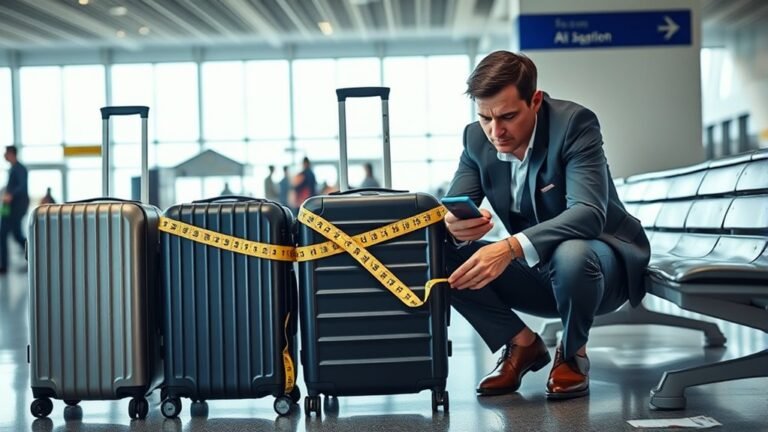
What Is an Underseat Luggage
An underseat luggage is the compact bag you tuck fully beneath the seat in front of you so it stays accessible and out of the aisle. You’ll want a soft-sided tote, small roller, compact backpack, or structured briefcase that fits airline limits—commonly about 18 x 14 x 8 inches but check each carrier. Pack tech in padded sleeves, keep documents handy, and compress clothes with cubes. Keep going to learn airline rules, packing tricks, and troubleshooting tips.
What Counts As Underseat Luggage?
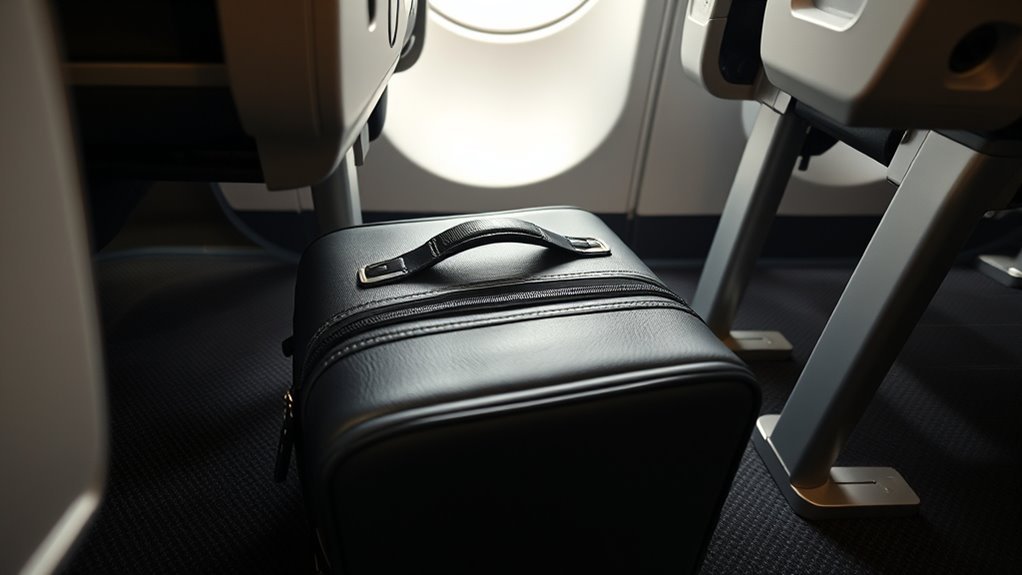
What exactly counts as underseat luggage? You’re looking at items that fit beneath the seat in front of you and stay contained without spilling into aisles. Think small roller bags, compact backpacks, structured tote bags, camera bags, or soft duffels you can squash slightly.
Electronics cases, briefcases, and diaper bags also qualify if they nestle underfoot. Airline rules focus on size and shape rather than name: anything you can stow securely, reach during flight, and that won’t block egress is acceptable.
Avoid oversized hard-shell suitcases or loose items that require gate-checking or overhead bin storage.
Typical Underseat Dimensions to Memorize
You should know common airline limits—many carriers cap underseat bags around 18 x 14 x 8 inches, though some are slightly smaller or larger.
Memorizing a few typical size examples (and the strictest limits you fly) will save you time and fees.
Always measure your bag’s length, width, and height before you go so you’re not surprised at the gate.
Common Airline Limits
Wondering how big your underseat bag can be? Airlines set limits to fit beneath seats: typically around 18 x 14 x 8 inches, but sizes vary. Low-cost carriers often have stricter dimensions; legacy airlines may allow slightly larger personal items.
Weight limits are rare for underseat bags, yet some international carriers enforce them. Always check your carrier’s website before packing.
Measure depth, height, and width including wheels and handles. If your bag exceeds limits, gate agents may gate-check it or charge fees.
Memorize your usual airline’s maximums to avoid surprises and streamline boarding.
Typical Size Examples
While exact limits vary by carrier, memorizing a few common underseat dimensions makes packing quicker and prevents surprises at the gate. Think in ranges: many U.S. carriers accept about 18 x 14 x 8 inches (46 x 36 x 20 cm).
Budget and international airlines often trim that to roughly 16 x 12 x 8 inches (41 x 30 x 20 cm). Some generous carriers allow up to 19 x 15 x 9 inches (48 x 38 x 23 cm).
For backpacks, aim for 17 x 13 x 9 inches (43 x 33 x 23 cm) to fit most aisles and underseats reliably.
Measuring Your Bag
How big is your bag compared to common underseat limits? Measure length, width, and height including wheels and handles; airlines verify total external size. Typical domestic limits hover around 18 x 14 x 8 inches (46 x 36 x 20 cm).
While international carriers may allow slightly smaller or larger dimensions, use a tape measure or ruler, note centimeters for precision, and compare to airline specs before you pack.
Remember weight limits too. If your bag exceeds limits, transfer essentials to a personal item or choose a compliant bag.
Regularly measuring prevents gate surprises and ensures a smoother trip.
How Airlines Define Underseat Bags
You’ll want to know the exact size and dimensions airlines consider acceptable for an underseat bag so your item fits without trouble.
Pay attention to placement rules too—some carriers require the bag to slide fully under the seat in front, others allow it beside your feet.
Check each airline’s policy before you pack to avoid gate-checking or repacking.
Size And Dimensions
Wondering what counts as an underseat bag? Airlines set size limits so your item fits under the seat in front of you. Typical maximums hover around 18 x 14 x 8 inches (46 x 36 x 20 cm), but some carriers use slightly different measurements or total linear dimensions (length + width + height).
Soft-sided bags compress better than hard-shell cases, letting you maximize allowed space. Weigh limits are rare for underseat items, but dimensions matter most. Always check your airline’s published specs before travel, since exceeding their stated size can force you to gate-check or pay fees.
Placement Rules
Because airlines want aisles and exits clear, they define underseat bags by where and how the item must fit—typically tucked fully beneath the seat in front of you with no part protruding into legroom or the aisle.
You should place the bag flat and forward so it doesn’t block recline or access. Use straps or compartments to keep contents compact and prevent shifting.
If gate agents or crew ask, you’ll need to demonstrate it fits under the seat during boarding.
Remember some airlines specify orientation, electronics out, or weight limits, so check your carrier’s rules before you arrive at the gate.
Airline-Specific Size Examples (Delta, American, United, JetBlue)
Want to know how different U.S. carriers treat underseat bags? Delta lets you bring a personal item that fits under the seat—typically about 18 x 14 x 8 inches works.
American Airlines accepts items roughly 18 x 14 x 8 inches as well; stowable under the seat is key.
United’s guideline is similar, with a common practical maximum near 17 x 14 x 8 inches to guarantee fit.
JetBlue advertises a personal item that fits under the seat in front of you—around 17 x 13 x 8 inches is a safe target.
Check each carrier’s site before travel for exact limits.
Low-Cost and International Underseat Rules to Watch
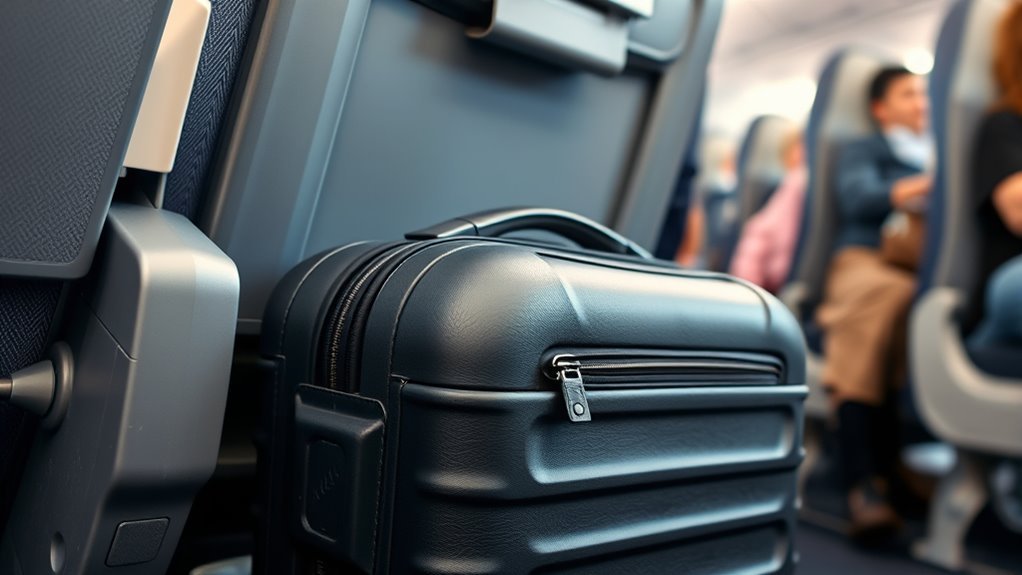
Watch for stricter size limits on budget carriers, since they often enforce smaller underseat allowances and charge for larger personal items. When flying internationally, you’ll find variations in what’s allowed under the seat, so check your carrier and route before you pack.
Also note some airlines prefer you stow certain items overhead rather than under the seat, which can affect what you bring on board.
Budget Carrier Size Limits
Many low-cost and international carriers set stricter underseat size limits than legacy airlines, so you’ll want to verify dimensions before you pack. Check both linear dimensions and allowable weight: some budget lines limit height to slide under sloped seats, others cap weight tightly.
Measure your bag including wheels and handles; airlines count exterior size. If you fly connections, confirm each carrier’s rule to avoid gate checks or fees.
Use soft-sided, compressible bags to squeeze into tighter spaces. Keep essentials in a slim personal item in case your underseat bag gets stowed in the cabin hold.
International Airline Variations
If you’ve been checking size and weight limits for budget carriers, remember that international airlines add another layer of variation that can catch travelers off guard.
You’ll find regional standards, differing carry-on allowances, and country-specific security rules that affect what fits under the seat. Some carriers let a personal item plus a small bag; others count both as carry-ons and enforce stricter dimensions.
Weight limits may apply where you least expect them. Check the airline’s official policy for your route, and confirm at booking and again before departure to avoid gate fees or forced gate-checked items.
Overhead vs Underseat Rules
Because airlines treat underseat and overhead storage differently, you’ll need to decide which bag you’ll rely on and where it can go—especially with low-cost and international carriers. You should check size limits, carry-on allowances, and whether personal items count separately.
Low-cost carriers often force larger bags into the hold or charge for overhead space, while international rules vary by carrier and class. Keep essentials under the seat: valuables, medications, and devices. If overhead is guaranteed, you can pack bulkier items.
Before you fly, confirm dimensions and fees to avoid gate-checking or surprises.
- Measure and compare.
- Prioritize essentials underseat.
- Confirm fees and policies.
Underseat vs Overhead: Which Should You Pick?
When deciding whether to stash your bag under the seat or in the overhead bin, think about access, space, and convenience during the flight.
Choose underseat if you want immediate access to essentials—meds, electronics, a book—and prefer a smaller bag that fits snugly without blocking footroom.
Opt for overhead when you carry larger items or want legroom beneath you; it keeps the cabin tidy but requires gate retrieval.
Consider boarding time, turbulence, and how often you’ll need items midflight.
Pick the option that matches your carry size and in-flight needs, balancing reachability against storage capacity.
Who Benefits Most From an Underseat Bag?
If you travel for work a lot, an underseat bag keeps your laptop, documents, and essentials reachable during tight schedules and gate changes.
If you’re traveling with small kids, you can stow snacks, toys, and a change of clothes within arm’s reach to handle hiccups quickly.
Both groups save time and stress by keeping must-have items out of the overhead bin.
Frequent Business Travelers
What makes underseat bags ideal for frequent business travelers? You value speed, organization, and access. An underseat bag keeps essentials—laptop, documents, chargers—at hand so you can work or exit quickly.
It fits tight overhead restrictions and reduces boarding delays. Durable, professional designs complement your appearance while protecting gear. Choose one with compartments and a trolley sleeve to streamline airport passage.
Consider:
- Fast access: grab documents or devices without opening overhead bins.
- Efficient organization: dedicated pockets for tech and paperwork.
- Mobility: compact size fits under seats and slides onto luggage handles.
Families With Small Children
Who needs quick access to snacks, wipes, and a favorite toy? You do when you’re juggling a toddler and carry-ons. An underseat bag keeps essentials within arm’s reach, so you can calm meltdowns, change diapers, and offer snacks without blocking the aisle.
You’ll appreciate pockets for bottles, a wipe dispenser, and an insulated compartment for milk. Compact size fits under seats, leaving stroller or larger luggage stored.
Choose a durable, easy-clean material and a bag that slides out smoothly. With strategic packing, you reduce stress and stay ready for surprises during travel with small children.
Top Underseat Styles and When to Use Them
When you pick an underseat bag, think about how you’ll use it: soft-sided totes slide into tight spaces, structured carry-ons keep electronics safe, and rolling underseat cases save energy during long connections.
Choose a soft tote if you need flexibility for irregular items and quick grab access.
Opt for a structured carry-on when you want protection and a polished look.
Pick a rolling underseat case if you value wheeled convenience and heavier loads.
- Soft-sided tote — flexible, lightweight, squeezes under seats.
- Structured carry-on — protective, professional, stacks well.
- Rolling case — ergonomic, stable, reduces arm strain.
Essential Compartments and Organization Features
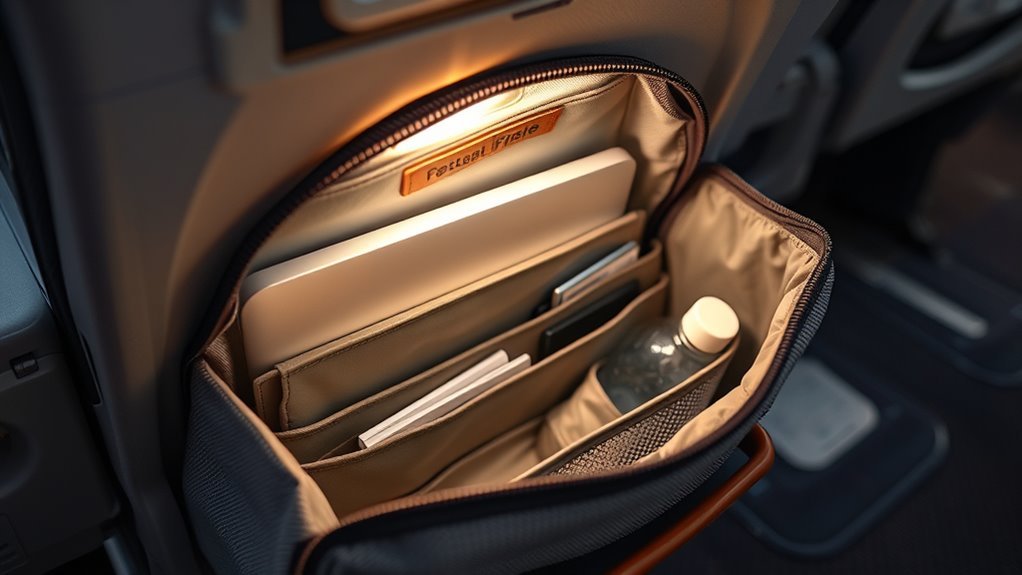
Because you’ll be grabbing items mid-flight and moving through tight spaces, underseat bags should give you clear, accessible organization: a padded laptop sleeve, quick-access phone/wallet pocket, and a zippered main compartment with internal dividers let you stash electronics, documents, and cords without digging.
You’ll want dedicated cable loops, mesh pouches for chargers, and a small pen slot.
Exterior pockets should sit flat to slide under seats yet open easily.
Consider a RFID-blocking pocket for cards and a soft-lined sunglasses pocket.
Removable organizers or compression straps help shift bulk.
Efficient layouts save time and reduce in-flight fumbling.
Material, Weight, and Durability: What to Choose
When you’re choosing underseat luggage, weigh lightweight fabric options like ripstop nylon or polyester against sturdier materials to match how often you travel.
Think about frame materials too—aluminum or reinforced plastic can add protection without too much extra weight.
We’ll compare fabric weight, tear resistance, and frame durability so you can pick the best balance for your needs.
Lightweight Fabric Choices
Although size limits you, choosing the right fabric lets you maximize durability without adding bulk or weight. You’ll favor materials that resist abrasion, repel moisture, and stay light so your bag holds essentials without becoming cumbersome. Consider denier ratings, coatings, and weave tightness when comparing options.
Balance weight with expected wear and maintenance—some fabrics need reproofing, others clean easily.
- Cordura or ballistic nylon: high abrasion resistance, moderate weight.
- Polyester with PU coating: lighter, water-resistant, budget-friendly.
- Ripstop nylon: ultra-light, tear-resistant, needs careful finishing to last.
Durable Frame Materials
If you want a bag that keeps its shape and protects gear under daily use, choose frame materials that balance stiffness, weight, and impact resistance.
You’ll often see aluminum for strong, lightweight frames that resist dents; it’s pricier but lasts.
ABS or polycarbonate blends give rigid support at lower cost and handle knocks well, though they can scuff.
Composite frames—carbon fiber or reinforced polymers—offer top strength and minimal weight, ideal if you carry fragile items frequently.
Consider frame attachment points and reinforcements too; weak joints ruin a good material choice.
Match material to your travel habits and budget.
Measure Your Bag to Avoid Gate Check
Since airlines vary on exact dimensions, measure your bag before you head to the airport so it fits under the seat and avoids a gate check. Use a tape measure to record length, width, and height including pockets and wheels.
Compare those numbers to the carrier’s underseat allowance online. If it’s borderline, remove items or compress clothing to reduce thickness.
- Measure at widest points (including handles tucked in).
- Note airline-specific limits for both carry-on and personal item.
- Re-measure after packing to confirm fit and prevent surprises at the gate.
Wheels, Handles, and Mobility for Underseat Bags
When you pick an underseat bag, pay close attention to wheel size, handle length, and overall maneuverability so you can stow and retrieve it without fuss.
Choose smooth-rolling wheels—larger wheels handle uneven floors and cabin carpet better, while recessed or spinner wheels reduce snagging.
Opt for a telescoping handle that locks at a comfortable height and collapses fully to fit under seats.
Consider weight distribution and grip placement so the bag pivots easily when you tilt it.
Test turning radius in tight spaces; narrow, responsive bags beat bulky, awkward designs.
Prioritize reliable hardware for stress-free travel.
What You Can Legally and Practically Keep Under the Seat
Although airlines set sizes and safety rules, you can typically keep essentials like a laptop, small backpack, duty-free items, medication, and a briefcase under the seat in front of you. Just check your carrier’s exact dimensions and any restrictions for lithium batteries, sharp objects, or liquids over 100 mL.
Bring essentials—laptop, small bag, meds—under the seat, but verify airline size limits and lithium/liquid rules.
You should also consider accessibility, security, and cabin crew instructions. Avoid oversized bags that block egress or aisles. Store fragile items padded and keep important paperwork reachable.
If in doubt, gate agents can advise.
- Keep accessible items within reach.
- Pack hazardous or liquid limits appropriately.
- Prioritize safety and crew directions.
Packing Order: What Goes in an Underseat Bag First
Wonder what to stow first? Start with essentials you’ll need mid-flight: a small toiletry kit, medications, and a light sweater.
Next, place items you’ll access frequently—snacks, a book, and travel-size tissues—so they’re reachable without unpacking.
Then add bulkier soft items like a compact travel pillow or scarf to cushion fragile contents.
Put heavier, flat things toward the bottom and against the back of the bag to stabilize weight.
Reserve a quick-access pocket for boarding passes, ID, and a pen.
Finish by zipping compartments to compress and keep everything organized and easy to retrieve.
Tech Protection and Document Organization Tips
After you’ve packed items by access and weight, think about protecting your tech and organizing documents so you won’t fumble at security or midflight. Keep electronics in padded sleeves and place them near the top for quick removal.
Use a slim, zippered pouch for passports, boarding passes, and receipts so they’re together and visible.
Consider cable organizers to prevent tangles and a portable charger in an external pocket.
- Keep fragile tech padded and accessible.
- Store travel documents in one visible pouch.
- Organize cables and power banks for easy reach.
Layering and Compressing Clothes for Underseat Bags
When packing clothes for an underseat bag, think in layers and compress as you go so you can fit more without wrinkling or rummaging midflight. You’ll roll delicate items, fold heavier layers flat, and place bulky pieces nearest the bag’s base. Use packing cubes or compression bags to squeeze air out and separate outfits. Keep a versatile outfit accessible on top. Reassess and remove duplicates before zipping. The goal’s efficient access plus minimal creasing.
| Layer | Item example | Compression tip |
|---|---|---|
| Base | Jacket | Fold flat |
| Middle | Sweater | Roll tightly |
| Top | Shirt | Use cube |
How to Choose the Right Underseat Bag for Your Budget
Although budget limits shape your options, you can still find an underseat bag that balances size, durability, and features without overspending. Start by measuring airline underseat dimensions and match capacity to your trip length.
Prioritize durable materials and reinforced seams for longevity; cheap zippers or fabric cost more over time. Choose a style with organized pockets so you don’t waste space.
Compare warranties and reviews to avoid buyer’s remorse. Finally, pick a trusted brand or local maker if repairs matter.
- Measure fit first
- Prioritize durability
- Compare reviews and warranty
Common Gate Issues and Quick Troubleshooting Tips
If your bag won’t slide under the seat or the gate area gets crowded, stay calm and troubleshoot quickly to avoid missed connections or damaged luggage.
First, assess size: remove items or compress the bag, then try angling it diagonally. If the carrier enforces stricter sizing, ask staff to check overflow options.
First check fit—compress or remove items, angle the bag diagonally, and ask staff about overflow options.
When gates are packed, claim a small space near your seat or use overhead temporarily, keeping essentials accessible.
Zip and strap everything to prevent spills. Keep receipts and photos if damage occurs, and report issues immediately to airline agents to resolve fees or repairs before boarding.
Frequently Asked Questions
Are Underseat Bags Allowed on International Connecting Flights With Different Carriers?
Usually yes, but it depends on each carrier’s policy, fare class, and connecting airport rules; you’ll need to check both airlines’ size/weight limits, confirm transfer baggage rules, and follow any international security or customs requirements.
Can Pets Fit in Underseat Carriers and What Are the Rules?
Yes — you can fit small pets in approved underseat carriers, but you’ll follow airline size, weight, booking, and health-vaccine rules, keep the carrier under the seat during taxi/takeoff/landing, and verify international transfer policies.
Do Underseat Bags Count Toward Frequent Flyer Carry-On Allowances?
Usually yes — underseat bags count as your personal item or carry-on depending on the airline. Check your carrier’s rules and dimensions; if you already have a carry-on, the underseat item might still qualify as your personal item.
How Do Security Screening Requirements Affect Packed Electronics in Underseat Bags?
Security screening means you’ll remove larger electronics and place them in bins for X-ray; smaller devices can stay in your underseat bag but may be inspected, so keep batteries accessible and avoid overpacking for quick checks.
Can Underseat Luggage Be Stored Under Bulkhead Seats With Fixed Armrests?
Yes — you can usually store underseat luggage beneath bulkhead seats with fixed armrests if the bag fits height and width restrictions; check airline rules and gate agent instructions, since some carriers or tight spaces might prohibit it.
Conclusion
Now that you know what counts as underseat luggage, you can pick a bag that fits airline rules and your travel needs. Choose something protective for gadgets, easy to organize for documents, and compressible for clothes. Remember common size limits and watch low-cost carriers’ stricter rules. At the gate, stay calm, be ready to shift items into your personal bag, and you’ll avoid delays and keep essentials within reach throughout your trip.