What Does Hand Luggage Mean Simple Explanation
Hand luggage means the bag you bring into the airplane cabin and keep with you during the flight — usually a larger carry-on that fits in the overhead bin plus a smaller personal item that slides under the seat. You’ll need to follow airline size, weight and liquid rules, pack meds and electronics in your cabin bag, and be ready for security checks. Keep it organized and light, and if you keep going you’ll find tips on limits, packing and common mistakes.
Hand Luggage Explained: Rules, Rights, Quick Checklist
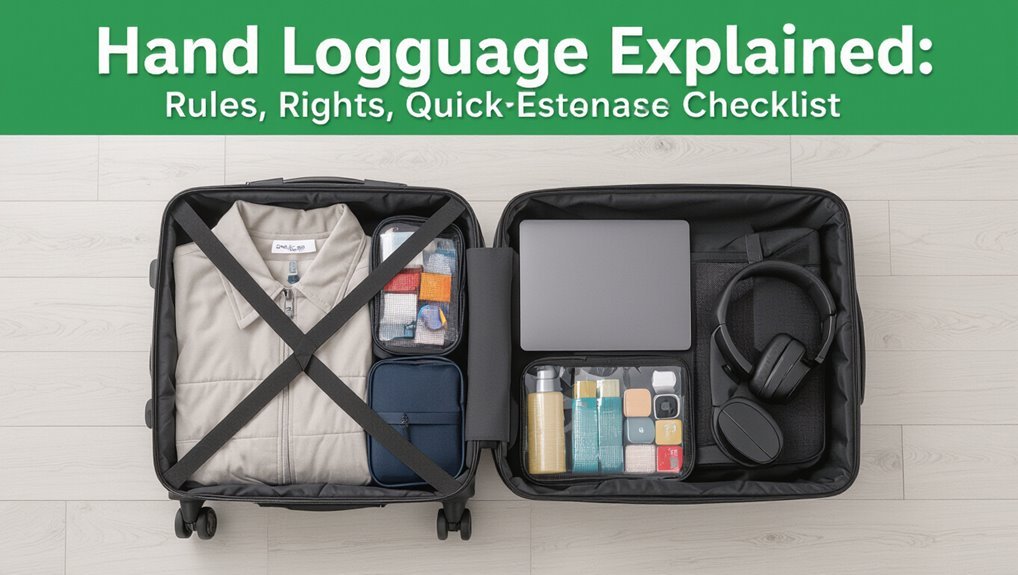
When you’re packing for a flight, knowing hand luggage rules and your rights saves time and stress: airlines set size, weight, and contents limits, but you also have rights if staff ask you to check a bag or remove items.
Check allowances, prohibited items, and liquid rules. Keep documents accessible, weigh bags beforehand, and ask staff politely if clarification’s needed to avoid delays or surprises.
What Counts as Carry-On (And What Doesn’t)
Carry-on means the bags and personal items you’re allowed to bring into the cabin—typically a main cabin bag plus a smaller personal item like a purse, laptop case, or briefcase—and anything larger or heavier than the airline’s limits, sports equipment, or checked-only items won’t count as carry-on. You should pack essentials, follow size/weight rules, and gate-check oversized items.
| Allowed | Not Allowed |
|---|---|
| Small suitcase | Surfboard |
| Purse/laptop | Golf clubs |
| Duty-free bag | Large instruments |
Carry-On vs Personal Item: Key Differences
When you pack, remember carry-ons and personal items aren’t the same: they differ in size and allowed dimensions.
You also need to follow different rules about what you can bring inside each and how those items must be packed.
Finally, airlines have specific stowage rules—carry-ons go in the overhead bin, personal items fit under the seat.
Size And Dimensions
Most airlines set clear size limits, so you should know the exact dimensions allowed for a carry-on versus a personal item before packing. Measure luggage including handles and wheels. Generally, carry-ons are larger and fit overhead; personal items go under the seat. Check airline policies to avoid gate-checking.
| Type | Typical Size (inches) | Typical Use |
|---|---|---|
| Carry-on | 22×14×9 | Overhead bin |
| Personal item | 18×14×8 | Under seat |
| Small bag | 17×13×6 | Essentials only |
Allowed Contents
Although both items travel with you, their allowed contents differ because airlines and security treat carry-ons and personal items for distinct purposes: carry-ons can hold larger, non-essential items and bulkier electronics, while personal items should contain essentials you’ll need during the flight, like documents, medications, and smaller electronics.
You’ll pack toiletries, extra clothes, and chargers in the carry-on, keeping passports, wallets, and meds in the personal item.
Stowage Rules
Every airline sets clear stowage rules, so you should know where your carry-on and personal item belong during boarding and flight: carry-ons go in the overhead bins while personal items fit under the seat in front of you.
| Item | Size | Location |
|---|---|---|
| Carry-on | Larger | Overhead |
| Personal | Smaller | Underseat |
| Tips | Secure | Cabinside |
Airport vs Airline Carry-On Rules: Who Decides?
When you check carry-on limits, remember that airports set security and size constraints for safety and space, while airlines set what you can bring on board and often enforce fees and precise dimensions—so you’ll need to satisfy both.
You should verify airport rules for prohibited items and airline policies for weight, dimensions, and fees before packing, and expect gate agents to enforce the carrier’s limits.
Typical Carry-On Size Limits by Airline
Most major airlines let you bring one carry-on plus a personal item, but size and weight limits vary enough that you should check your carrier’s exact dimensions before packing.
Typical limits range around 22 x 14 x 9 inches (56 x 36 x 23 cm) for the carry-on, while regional or low-cost carriers often require smaller bags.
Measure before travel to avoid gate checks.
Common Carry-On Weight Limits and Variations
Although airlines generally let you bring a carry-on and a personal item, weight limits for that main bag can vary widely—from no limit at all to strict caps of 7–10 kg (15–22 lb) on many international and low-cost carriers—so check your carrier’s policy before you pack.
You should weigh luggage at home, prioritize essentials, distribute items between bags, and expect fees or gate checks if you exceed limits.
How to Measure Your Bag to Avoid Gate Issues
Start by measuring your bag’s dimensions—length, width and depth—because airlines gate-check on size as strictly as on weight.
Use a tape measure including handles and wheels. Record numbers and compare them to your airline’s maximums.
If it’s borderline, compress contents or choose a smaller bag. Re-measure after packing to prevent surprises at the gate.
How to Weigh Your Carry-On Before Travel
Once you’ve checked dimensions, weigh your packed carry-on to avoid surprises at the gate: airlines enforce weight limits as strictly as size.
Use a reliable luggage scale or a bathroom scale (lift the bag then subtract your weight). Redistribute items, swap heavy for lighter alternatives, or move extras to checked baggage.
Reweigh until it meets the airline’s limit to prevent fees or forced gate checks.
Liquids and Gels in Carry-On: The Rules
Most airlines follow the “3-1-1” rule for carry-on liquids: containers must be 3.4 ounces (100 milliliters) or less, fit in a single clear quart-size (1 liter) resealable bag, and you’re limited to one bag per passenger—so pack intentionally and consolidate travel-size items to speed your security screening.
| Item | Limit |
|---|---|
| Shampoo | 100 ml |
| Lotion | 100 ml |
| Perfume | 100 ml |
| Gel | 100 ml |
| Total | 1 bag |
How to Pack Liquids Step-by-Step
Start by choosing travel-size, TSA-approved containers so your liquids meet airport limits.
Put them in a clear, resealable plastic bag to keep spills contained and screening quick.
Arrange the bag near the top of your carry-on for easy access at security.
Choose Approved Containers
Think of approved containers as your liquids’ travel ID: they tell security what’s allowed and keep spills contained.
Choose clear, leakproof bottles or travel-size jars labeled with capacity. Stick to limits—usually 100 ml or 3.4 oz—and verify caps seal tightly.
Use sturdy materials that won’t crush in your bag. Pack upright, check for damage, and replace questionable containers before travel.
Use Clear Plastic Bags
Once you’ve got approved containers, pack them inside a clear, resealable plastic bag so security can inspect them without unpacking your items.
Keep bags under size limits, seal tightly, and remove air. Show the bag separately when required. Store upright to avoid leaks.
- Single bag per passenger
- Visible labels help
- Avoid overfilling
- Use sturdy plastic
- Replace if damaged
Arrange For Easy Access
When packing liquids, organize them so you can pull the clear bag out without emptying your carry-on: place the resealable pouch near the top or in an outer pocket, keep heavier containers at the bottom, and face labels outward for quick ID.
Pack lids tight, double-bag leaky items, and group cosmetics together. That way security checks and in-flight needs stay fast and hassle-free.
Packing Medications and Medical Devices in Carry-On
Carrying medications and medical devices in your carry-on keeps them accessible and reduces the risk of loss or temperature damage, so pack them where you can reach them quickly.
Pack medications and medical devices in your carry-on for easy access and to prevent loss or temperature damage.
- Keep prescriptions in original containers with labels.
- Pack a copy of your prescription and doctor’s note.
- Use insulated pouches for temperature-sensitive meds.
- Bring spare batteries and chargers for devices.
- Store emergency meds in an easy-to-reach pocket.
Documenting Special Cabin Items (Instruments, Medical Gear)
If you plan to bring musical instruments or medical gear into the cabin, document them clearly before you arrive at the airport to avoid delays and confusion.
Contact the airline and provide item descriptions, dimensions, and any supporting medical letters. Confirm seat or storage arrangements for fragile instruments.
Keep prescriptions and device manuals accessible. Arrive early to allow security staff to inspect items without stress.
Electronics and Batteries Allowed in Cabin
You can bring most electronics in your carry-on, but check airline limits for items like laptops and cameras.
Batteries are generally allowed if they’re the approved types (alkaline, NiMH, and lithium within watt-hour limits), so verify capacity and any spare battery rules.
Pack devices and loose batteries securely—protect terminals, use original packaging or battery cases, and keep them accessible for screening.
Electronics In Carry-On
Electronics and their batteries are generally allowed in your carry-on, but airlines and regulators set rules to keep devices safe during flight.
You should pack thoughtfully, follow gate agent instructions, and declare unusual items. Keep devices accessible for screening and protect them from damage.
- Turn off or disable flight-affecting features
- Carry spare batteries in carry-on
- Use protective cases
- Follow size limits
- Declare damaged devices
Battery Types Allowed
After packing devices and spare cells in your carry-on, check which battery chemistries and formats are allowed in the cabin.
Airlines usually permit AA, AAA, lithium-ion and nickel-metal hydride in devices; spare lithium batteries often need terminal protection and capacity limits (Wh).
Button cells are generally fine. Restricted or damaged batteries can be prohibited.
Always verify your airline’s battery policies before travel.
Secure Packing Tips
Start by organizing devices and spare batteries so they’re easy to access and won’t short or get crushed in transit.
Pack batteries in original packaging or separate cases, keep devices powered off, and place electronics in padded compartments. Carry fragile items on top and follow airline limits.
- Use battery cases
- Turn devices off
- Cushion with padding
- Keep accessible
- Follow airline rules
Fragile and Valuable Items: Carry-On Best Practices
When you pack fragile or valuable items in your carry-on, prioritize protection and accessibility so they stay safe and you can reach them quickly if needed.
Wrap electronics and glass in soft clothing or padded sleeves, place them toward the center, and use compartments to prevent shifting.
Keep receipts, jewelry, and essential documents in an easily reachable pocket for quick checks or security.
Allowed Sharp Objects and Prohibited Items in Carry-On
Although some small tools and personal items are allowed, airlines and security agencies strictly limit sharp objects in carry-on bags, so you should know what’s permitted and what’ll be confiscated at the checkpoint.
Although small personal tools are allowed, strict limits on sharp carry-ons mean know what’s permitted or will be confiscated.
Follow rules, pack smart, and declare anything doubtful.
- Small scissors (blunt tip)
- Disposable razors
- Nail clippers
- Tweezers
- Pocket knives (usually prohibited)
Security Screening: What to Expect With Carry-On
When you go through security screening, you’ll follow a few standard steps like placing your carry-on on the conveyor, removing electronics and liquids, and walking through the scanner.
Keep a clear, up-to-date list of allowed items so you can pull out anything that needs separate inspection. Being prepared speeds the process and reduces the chance your bag gets opened for a manual check.
Security Check Steps
Move through the security checkpoint efficiently by having your carry-on ready for inspection: remove electronics larger than a phone, place liquids in a clear quart-sized bag, empty pockets, and be prepared to step out of your shoes or remove outer layers if required.
Keep calm, follow staff directions, and collect items promptly.
- Place carry-on on the belt
- Spread items neatly
- Follow scanner instructions
- Answer staff questions briefly
- Repack quickly and orderly
Allowed Items List
After you’ve cleared the scanner and repacked, check what you can actually bring on board: airlines and security have specific lists for carry-on items that affect how you pack and what you’ll be asked to remove at screening. You’ll find allowed, restricted, and prohibited items vary; follow rules to avoid delays.
| Category | Examples | Notes |
|---|---|---|
| Liquids | Toiletries <100ml | Bag separately |
| Electronics | Laptop, phone | Remove at scan |
| Sharp items | Scissors (<4") | Often banned |
| Prohibited | Firearms, explosives | Never allowed |
Connecting Flights: Carry-On Rules to Know
Because connecting flights involve different airlines or airports, you’ll want to double-check each carrier’s carry-on rules before you pack.
When booking connections, check each airline’s carry-on rules—sizes, transfers, and fees—before you pack.
You should confirm size limits, transfer policies, baggage fees, cabin access, and security procedures to avoid surprises.
- Size and weight limits
- Transfer and through-check rules
- Fee differences
- Cabin storage priority
- Security and liquids limits
What Happens If Your Carry-On Is Too Big at the Gate?
If your carry-on looks oversized at the gate, staff will usually perform a quick size check with a sizer frame.
You can be asked to gate-check the bag, pay an oversized carry-on fee, or rearrange items into a compliant personal item.
Know that refusing may lead to enforced check-in and possible delays, so have a backup plan ready.
Gate Size Check
1 common moment of travel stress comes at the gate when an agent asks you to try your bag in the sizer; if your carry-on’s too big, they’ll usually ask you to check it—either at the gate for a fee or by tagging it to go into the hold—so be prepared for delays, charges, or having to reorganize items you wanted to keep with you.
- Measure bag before travel
- Know airline limits
- Expect a gate fee
- Move valuables to personal item
- Pack essentials separately
Options At Gate
Confronted with a too-large carry-on at the gate, you’ve got a handful of clear options: gate agents may ask you to check it, you can transfer items into a smaller bag or personal item, ask to gate-check the bag for pickup at arrival, or decide to return it to the counter for formal checked baggage.
Choose the quickest, least disruptive solution.
Fees And Consequences
When your carry-on is too big at the gate, airlines typically enforce their rules immediately: you may be charged a fee to check it, asked to gate-check it for collection at baggage claim, or required to return it to the ticket counter as checked baggage.
You’ll face delays, extra cost, or lost access to items in the bag.
- Pay a gate-check fee
- Move essentials to personal item
- Accept checked tagging
- Miss overhead space priority
- Risk delayed arrival at claim
How to Avoid Extra Fees for Oversized Carry-On
Although you might think a slightly larger bag is harmless, airlines charge extra for carry-ons that exceed their size limits, so it’s smarter to plan ahead.
Measure your bag, weigh it with packed items, and compare dimensions to your carrier’s rules.
Use soft-sided bags that compress, remove nonessentials, and gate-check oversized items proactively to avoid surprise fees.
How Low-Cost Carriers Enforce Stricter Carry-On Rules
Many low-cost carriers enforce strict carry-on rules by limiting bag size, weight, and even the number of allowed personal items. They’ll charge or gate-check anything that doesn’t comply.
You should check policies, pack efficiently, and be ready to pay for extras at the gate.
- Measure your bag
- Weigh it beforehand
- Use compact packing cubes
- Know allowed items
- Arrive early to avoid surprises
How Loyalty Status Affects Your Carry-On Allowance
If you’re an elite member, you’ll often get extra or larger carry-on allowances and priority boarding that makes stowing your bag easier.
If you’re a basic member, you’ll usually face stricter size limits and may have to gate-check bags more often.
Know your status before you pack to avoid surprises at the gate.
Elite Status Perks
When you reach elite status with an airline, your carry-on allowance often improves — you may get an extra bag, a heavier weight limit, or priority boarding that keeps overhead space available for your items.
- You’ll often bring an extra personal item.
- You’ll enjoy priority overhead access.
- You may get relaxed weight rules.
- You’ll board early, reducing stress.
- You’ll have clearer gate handling for disputes.
Basic Member Limits
Although you haven’t earned elite perks yet, basic members still get a defined carry-on allowance that you should know before packing: you’re typically allowed one cabin bag plus a personal item, with size and weight limits set by the airline.
Don’t assume flexibility—check your carrier’s rules, as fees or restrictions can apply.
Pack efficiently and weigh items to avoid surprises at the gate.
International Differences in Carry-On Regulations
Because aviation rules are set by countries and carriers rather than by a single global body, you’ll find carry-on allowances vary widely across regions and airlines.
You should check limits, fees, and security rules before travel.
- Size and weight caps differ
- Some airlines allow two items
- Low-cost carriers charge for larger bags
- Security liquids limits vary by region
- Regional rules affect mobility aids and duty-free items
Choosing the Right Carry-On Size for Your Trip
If you’re packing for a short trip, pick a carry-on that fits the airline’s overhead bin and your packing style so you won’t be juggling fees or gate-checking at the last minute.
Measure dimensions, consider weight limits, and choose soft or hard-shell based on space needs.
Match size to trip length and activities so you carry only what’s necessary and stay mobile.
When to Use a Personal Item Instead of a Second Bag
When your carry-on is full or bulky, pick a personal item instead of bringing a second bag so you avoid extra fees and airport hassle.
Use a personal item when you need quick access, stricter size limits apply, you want weight relief, gate-checking is likely, or security lines demand speed.
- Quick access to essentials
- Airline size restrictions
- Reduce total weight
- Avoid gate-check
- Faster security
Maximize Carry-On Space: Packing Strategies
Pack smart, and you’ll fit more into your carry-on without stress.
Roll clothes to save space, prioritize versatile pieces, and wear bulky items on the plane.
Roll garments to maximize space, choose versatile pieces, and wear bulky items during travel.
Fill shoes with socks or chargers, use zip-lock bags for toiletries, and distribute weight evenly.
Keep essentials accessible in pockets or a small personal item.
Stick to a minimalist checklist to avoid overpacking.
Best Packing Cubes and Organizers for Carry-On
Suitcases and backpacks can stay tidy and you’ll find things faster with the right packing cubes and organizers; choose lightweight, durable cubes that match your carry-on’s dimensions, plus a few slim pouches for toiletries, electronics, and dirty laundry.
- Small cube for underwear and socks
- Medium cube for shirts
- Compression cube for bulkier items
- Padded pouch for chargers
- Mesh pouch for quick access
What to Wear to Reduce Carry-On Bulk
Choose clothes that do double duty so you can wear the bulkiest items instead of stuffing them in your carry-on: layer a lightweight merino or synthetic base, add a thin insulating layer you can compress, and top it with a packable, weatherproof shell that stows into its own pocket.
| Item | Purpose |
|---|---|
| Merino base | Odor control, warmth |
| Thin insulating layer | Compressible warmth |
| Packable shell | Weather protection |
| Multi-use pants | Day/night use |
| Slip-on shoes | Save space, easy security |
Pack a Compact Change-of-Clothes Kit for Delays
Wearing versatile layers helps, but you should also carry a tiny change-of-clothes kit for delays or mishaps.
Pack compact, quick-dry pieces that fit a small pouch so you can freshen up after spills or long waits.
Pack a tiny pouch of quick-dry essentials to freshen up after spills or long delays.
- Lightweight shirt
- Foldable underwear
- A thin pair of socks
- Compact scarf or wrap
- Small zip pouch for wet items
Family Travel: Carry-On Tips for Parents and Kids
Traveling with kids means thinking like a short human: pack essentials where you can reach them, keep snacks and entertainment within arm’s reach, and plan for quick changes or meltdowns so everyone stays calmer at security and on the plane. Use a small backpack per child, stick to easy snacks, and sanitize wipes handy.
| Item | Purpose |
|---|---|
| Snacks | Prevent hunger tantrums |
| Wipes | Quick cleanups |
| Change clothes | Accidents |
| Small toy | Distraction |
| Documents | IDs, boarding passes |
Business Travel: Prioritize These Carry-On Items
Because your time’s limited and meetings don’t wait, pack carry-on items that keep you productive, polished, and prepared: a fully charged laptop and charger, a portable battery, noise-cancelling earbuds, a slim toiletry kit for quick touch-ups, a spare dress shirt or blouse, travel-size lint remover, important documents (passport, boarding pass, itinerary, business cards) and a small healthy snack to bridge delays.
- Laptop charger
- Portable battery
- Earbuds
- Spare shirt
- Documents
Long-Haul Flights: What to Keep in Your Cabin Bag
If you’re facing a 10‑hour flight (or longer), pack a cabin bag that keeps you comfortable, rested, and organized without weighing you down: noise‑canceling headphones, an inflatable neck pillow, a lightweight blanket or large scarf, compression socks, a toiletry kit with toothbrush and deodorant, hand sanitizer and lotion, prescription meds plus copies of prescriptions, and an easily accessible set of travel documents and chargers.
| Essentials | Extras |
|---|---|
| Headphones | Snacks |
| Meds & docs | Eye mask |
| Toiletries | Chargers |
Quick Pre-Flight Carry-On Checklist
Before you leave for the airport, check your carry-on against the airline’s weight and size limits so you don’t face last-minute fees.
Make sure essentials and travel documents — passport, boarding pass, medications, and chargers — are packed where you can grab them quickly.
Also confirm that liquids follow security rules and that items you’ll need during screening are easy to access.
Weight And Size Limits
When you’re packing your carry-on, start by checking the airline’s specific weight and size limits so your bag meets gate requirements and avoids surprise fees.
- Weigh your packed bag at home.
- Measure length, width, height including wheels.
- Know cabin vs. personal item allowances.
- Redistribute items if overweight.
- Review international carrier variations before you fly.
Essentials And Documents
Also pack a copy of reservations, emergency contacts, credit cards, some local currency, prescribed medications with prescriptions, a pen for forms, and a charged phone with charger or power bank.
Security And Accessibility
You’ve packed your documents and meds; now make sure the rest of your carry-on keeps security checks smooth and items reachable during the flight.
Organize liquids, electronics, and essentials for quick access, lock valuables, and keep a clear pocket for boarding passes.
- Place liquids in a clear bag
- Pack electronics on top
- Keep chargers reachable
- Lock valuables
- Stash a pen and wipes
Common Carry-On Mistakes and How to Avoid Them
Pack smart to skip the stress of common carry-on mistakes that can slow you down or get your bag gate-checked.
Don’t overpack; weigh and measure to meet airline limits. Keep liquids in a clear, compliant bag and place electronics on top for easy screening.
Pack essentials and a change of clothes, label valuables, and know prohibited items to avoid delays or confiscation.
Frequently Asked Questions
Can Carry-On Rules Apply to Transit Lounges Before Immigration?
Yes — you can be subject to carry-on rules in transit lounges before immigration, since airport security or airline policies often apply pre-immigration. You’ll need to follow size, weight, and security restrictions while waiting in those areas.
Can Duty-Free Purchases Exceed Carry-On Limits at Boarding?
Yes — you can exceed carry-on limits with duty-free items at boarding only if the airline and security allow sealed bags and total weight/size remain acceptable; otherwise you’ll need to check purchases or remove items before departure.
Are Service Animals Counted as Carry-On Items?
Yes — service animals aren’t counted as carry-on items. You’ll keep them with you in the cabin, follow airline and documentation rules, and they don’t consume your carry-on allowance, though handlers must manage their animal during boarding and flight.
Do Family Strollers Count Toward Each Passenger’s Allowance?
Yes—you’ll usually get stroller allowance per child or passenger, but rules vary by airline; you should confirm with your carrier because some count one stroller per family, gate-check policies and size limits can affect allowances.
Can Oversized Souvenirs Be Gate-Checked for Free?
You usually can’t gate-check oversized souvenirs for free; airlines often charge for oversized or excess items. Check your carrier’s policy—sometimes staff waive fees or item qualifies as checked baggage included with your fare, but don’t count on it.
Conclusion
Now you’re set to pack smarter: hand luggage means the bag you take into the cabin, usually one carry-on plus a personal item, sized and packed to airline rules. Check both airport and airline limits before you go, prioritize essentials—documents, meds, valuables—and keep liquids, chargers, and a change of clothes accessible. Follow the quick checklist, avoid common mistakes like overpacking or banned items, and you’ll breeze through security and enjoy a smoother trip.