
What Does Checked Luggage Mean Simple Explanation
Checked luggage is the bag you hand to the airline at check-in so they store and transport it in the plane’s cargo hold, not in the cabin with you. You’ll tag it, it’ll go through security screening, and ground crews will load it for you. Checked bags have size, weight, and content rules and may incur fees or special handling. If you keep going, you’ll find tips on limits, fees, tracking, and smarter alternatives.
What “Checked Luggage” Means
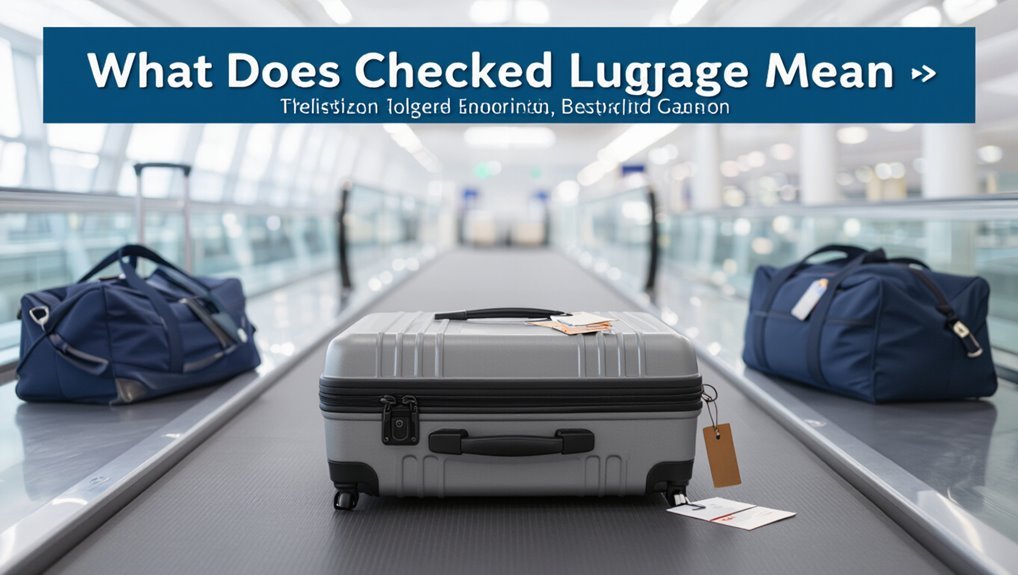
Checked luggage is the bag you hand over to the airline at check-in to be stored in the plane’s cargo hold, not the one you keep with you in the cabin.
You’ll tag it, drop it at the counter or kiosk, and accept that the airline controls it until arrival.
You shouldn’t expect access during flight and must follow size, weight, and content rules.
Carry-On vs. Checked Bag: Quick Comparison
Now that you know what checked luggage is, let’s compare it quickly with carry-on bags so you can pick the right option for your trip.
Carry-ons stay with you, suit smaller essentials, and avoid claim waits, but they’re limited by strict size/weight rules.
Checked bags hold more, let you pack bulky items, and free you from lugging, though you’ll wait at baggage claim and risk delays or fees.
When to Check a Bag (Decision Guide)
If you’re packing for a week or longer, you’ll probably need to check a bag to carry extra clothing and toiletries.
Check a bag when your carry-on exceeds airline size or weight limits to avoid gate-check hassles.
Also check items that aren’t allowed in the cabin—sports gear, large liquids, or bulky equipment—so they travel safely.
Trip Length Matters
Because how long you’re traveling directly shapes what you need to pack, trip length is the single biggest factor in deciding whether to check a bag.
For short trips, you’ll likely fit essentials in a carry-on. For longer stays, checked luggage lets you bring more clothes, toiletries, and gear without cramming.
Balance duration, laundry access, and convenience when choosing.
Carry-On Limits Reached
Hit your carry-on limits—weight, size, or item count—and it’s time to check a bag.
You’ll avoid gate delays, extra fees, and stressed shuffling when you plan ahead. Decide based on:
- Overweight or oversized bags.
- Excess items beyond airline allowances.
- Risk of gate check or lost space.
Check one bag to stay compliant and relaxed.
Special Items Require Checking
1 clear rule: when an item is fragile, oversized, hazardous, or unusually valuable, you should check it rather than try to carry it on. You’ll protect fragile gear, avoid security issues with batteries or chemicals, and safeguard valuables from theft. Choose checking for peace of mind and claim ease.
| Item type | Why check it |
|---|---|
| Fragile | Prevent breakage |
| Hazardous | Meet rules |
What Changes Once a Bag Is Checked
Once you hand over your bag, it goes through a different security screening process than carry-ons and may be x-rayed or inspected separately.
Your suitcase gets tagged and routed by the airline’s handling systems, which affects where and how it’s loaded onto the aircraft.
At your destination, you’ll follow the baggage claim procedure to retrieve it rather than taking it off the plane yourself.
Security Screening Process
After you hand your bag to the airline, its screening shifts from passenger-facing checkpoints to centralized, automated systems and vetted handlers; this means the contents are inspected by X-ray, explosive trace detection, and sometimes manual searches behind the scenes rather than at the ticket counter.
You’ll experience:
- Remote X-ray analysis.
- Explosive trace and chemical screening.
- Selective manual inspection when alarms trigger.
Handling And Tagging
With screening completed, your bag moves into the airline’s handling system where it’s tagged, logged, and routed for loading. Staff and automated conveyors take over responsibility for its movement.
You won’t control it anymore: handlers verify tags, inspect for damage, and place it on correct flights. Tags include destination codes and priority markers so ground crews load and transfer luggage efficiently and accurately.
Baggage Claim Procedure
When you drop a checked bag, the airport takes over responsibility and a different set of rules applies:
- Track: you get a tag and can track status; delays happen.
- Claim: go to the correct carousel; present ID and claim tag.
- Liability: airlines handle loss/damage under limits; file reports promptly.
You won’t control handling until you reclaim the bag, so keep documentation handy.
Typical Checked Luggage Weight and Size Limits
Airlines generally set checked baggage limits you should know before packing: most carriers cap weight per bag at 50 lb (23 kg) in economy, with 70 lb (32 kg) for premium tickets or special fares.
Linear size (length+width+height) usually mustn’t exceed about 62 inches (158 cm).
Oversized or overweight bags may be refused or rerouted; always verify your airline’s exact limits.
Common Checked-Bag Fees and How They’re Charged
You’ll usually pay a fee for your first checked bag on many domestic flights, so check the airline’s base price before you book.
If your bag exceeds the airline’s weight or linear size limits you’ll face additional charges, which often increase with the amount over the limit.
Expect steeper excess and oversize penalties for very heavy or oversized items and for bags that require special handling.
First Bag Fees
Most U.S. carriers charge a fee for your first checked bag on domestic economy flights, typically ranging from $25 to $35 and collected per passenger at check-in or online.
You can often avoid or reduce it by qualifying for waivers or using a credit card benefit.
- Loyalty status
- Fare class upgrades
- Co-branded credit cards
Weight And Size Charges
Checked-bag fees often rise sharply if your luggage goes over the carrier’s size or weight limits, and you’ll be charged a per-bag surcharge that grows with each extra pound or inch.
Check your airline’s specific weight/linear size thresholds and fee tables before packing. Weigh and measure bags at home, redistribute items to avoid surcharges, and consider prepaid or bundled options that may lower per-bag costs.
Excess And Oversize Penalties
Fees for excess weight and oversize luggage can add up fast, and airlines charge them in predictable ways: a flat surcharge for bags that exceed standard limits, steep per-pound or per-inch rates for progressively heavier or larger items, and sometimes an additional penalty for items that need special handling.
- Flat over-limit fee for size/weight
- Per-pound or per-inch incremental charges
- Special-handling or irregular-item surcharges
How to Avoid Overweight and Oversize Charges
When you pack, aim for efficient layering and careful weighing so your suitcase stays within airline limits; small adjustments at home can prevent costly overweight or oversize charges at the airport.
Use a reliable scale, roll clothes, wear bulky items, distribute weight across bags, and swap heavy items into carry-on.
Know your airline’s size and weight rules and pack only essentials to avoid fees.
Checking a Bag at the Airport: Counters, Kiosks, Curbside
Once your bag’s packed within the airline limits, the next step is getting it onto the plane—usually at a ticket counter, a self-service kiosk, or curbside check-in.
You’ll choose the fastest option, hand ID and confirmation, and pay any fees.
Steps to follow:
- Queue at counter for agent assistance.
- Use kiosk for quick tag printing.
- Drop bag curbside for convenience.
How Checked Bags Are Tagged and Tracked at the Airport
When you check a bag, an agent or kiosk prints a barcode tag that’s attached to your luggage and linked to your flight and destination.
That barcode is scanned at key points and fed into the airline’s baggage tracking system so you can know where your bag is during travel.
Knowing how tagging and tracking work helps you spot issues quickly and provide accurate info if a bag goes missing.
Bag Tagging Process
A brightly colored adhesive tag is the first thing you’ll see attached to your suitcase at the check-in counter, and it’s what lets airlines identify and route your bag through the airport’s tracking system.
Agents scan the tag’s barcode and enter destination and flight data, then a matching tag is printed and secured to your bag so automated conveyors and scanners can read it at each transfer point.
- Scan barcode
- Print tag
- Attach securely
Baggage Tracking Systems
Track your suitcase from check-in to carousel through a layered baggage tracking system that combines barcode tags, RFID chips, conveyor sensors, and centralized software to follow each bag’s journey.
You’ll get status updates via airline apps or airport displays as scanners log location, sorters route bags, and handlers scan transfers.
If delays occur, tracking helps locate and reroute your luggage quickly.
What Happens to Checked Luggage During a Flight
Although you never see most of the process, your checked luggage moves through a coordinated chain: it’s tagged at check-in, screened for security, loaded onto the aircraft in cargo holds, and transferred between conveyors and carts by ground crews until it’s placed on the correct flight.
- Ground crews handle loading and transfers.
- Bags ride in pressurized, temperature-controlled holds.
- Crew manifests and scanners track each bag’s location.
What to Do When Your Checked Bag Doesn’t Arrive
If your checked bag doesn’t show up on the carousel, stay calm and act quickly: go straight to the airline’s baggage service office in the arrivals area to file a report, because airlines need immediate notification to start searching and arranging delivery.
Give your flight details, bag description, and contact info, keep the report number, ask about delivery timeline, and confirm where to track updates.
Delayed, Damaged, and Lost-Luggage Claims: Step-by-Step
If your checked bag is delayed, damaged, or lost, start by filing an official report with the airline before you leave the airport or as soon as you notice the issue.
Photograph and itemize any damage or missing contents so you have clear evidence to support your claim.
Then monitor the airline’s claim portal or contact their customer service to track compensation progress and follow up as needed.
File A Report
Start by reporting the problem to the airline as soon as you notice your bag is delayed, damaged, or missing—don’t wait.
You’ll file a report at the airport or online, get a reference number, and follow up.
Steps:
- Provide ID and flight details.
- Describe the issue clearly.
- Record the report number and contact info for follow-up.
Document Your Damage
After you file the report, begin documenting the damage right away so your claim won’t stall. Photograph all angles, list broken items, keep receipts, and note timestamps. Send copies to the airline promptly. Use clear, dated evidence to support your claim.
| Photo angle | Item list |
|---|---|
| Exterior | Broken zipper |
| Interior | Torn lining |
| Close-up | Scratched suitcase |
| Receipt | Replaced item |
Track Compensation Progress
While you wait for the airline to respond, keep a clear timeline of every interaction—record dates, names, claim numbers, and what was said—so you can track progress and push follow-ups efficiently.
Track compensation progress by checking status, escalating when stalled, and keeping receipts.
- Check claim portal daily.
- Escalate after set deadlines.
- Save all communications and receipts.
Liability and Compensation for Lost or Damaged Bags
Because airlines are responsible for the bags you check in, they also bear legal liability when those bags are lost, delayed, or damaged—and you have specific rights to compensation.
You should file a property irregularity report immediately, keep receipts for contents, and follow airline claim procedures within required time limits.
Reimbursement limits vary; you’ll need proof of value and expenses to pursue full recovery.
When and Why to Buy Baggage Insurance
You should consider baggage insurance when your checked items are valuable, you’re on a trip with multiple connections, or you’ll be traveling through high-risk routes.
It typically covers loss, theft, and damage beyond the airline’s liability limits, and sometimes includes delayed baggage expenses.
Weigh the policy cost against the value of your items and the likelihood of a claim to decide if it’s worth buying.
When To Consider
Wondering when it’s worth buying baggage insurance? You should consider it if you’re traveling with valuable items, on a long multi-stop trip, or heading to places with higher loss risk.
- Expensive gear or irreplaceable items
- Complex itineraries or tight connections
- Destinations with known baggage issues
Buy based on value at risk and your tolerance for inconvenience.
What It Covers
If those risk factors make you think insurance’s worth it, next look at exactly what policies cover so you can match protection to need. You’ll see coverage varies: loss, theft, delay, and damage. Choose limits, deductibles, and claim processes that suit your trip and valuables. Compare airline protection to travel policies before buying.
| Coverage Type | Typical Examples |
|---|---|
| Loss/Theft | Missing bags |
| Delay | Overnight essentials |
| Damage | Broken items |
Cost Versus Risk
Because buying baggage insurance costs money up front, weigh that against the likely loss and how you’d handle it — think replacement value of your items, trip length, destinations, and how much disruption you’d tolerate.
Consider buying if you’re traveling with valuables, long trips, or risky destinations.
- Valuables
- Trip duration
- Destination risk
Packing Checked Luggage: Protecting Fragile Items
Fragile items need thoughtful packing when you put them in checked luggage, since baggage handlers and conveyor systems can be rough.
Wrap breakables in bubble wrap or clothing, place them in the center of the suitcase, and use hard-sided cases when possible.
Fill gaps with soft items to prevent shifting, label the bag as fragile, and consider insurance for valuable breakables.
What Not to Pack in Checked Luggage (Valuables & Prohibited Items)
When you’re packing, keep valuables and prohibited items out of checked luggage to prevent loss, damage, or legal trouble.
Pack these elsewhere and follow airline rules:
Pack valuables and prohibited items separately, and always follow airline and TSA rules when deciding what to check.
- Jewelry, cash, passports — keep them in carry-on.
- Medications and essential documents — never checked.
- Prohibited items (firearms, explosives, many aerosols) — check airline and TSA lists before travel.
Smart Luggage Rules: Batteries, Trackers, and Check-In
Think about how smart luggage changes packing: batteries, GPS trackers, and built-in electronics can make travel more convenient but also trigger airline rules and safety checks.
You should remove or disable non-removable lithium batteries if required, declare devices at check-in, and follow airline limits for spare batteries.
Keep trackers’ power low and check carrier policies to avoid confiscation or delays.
Best Locks and Security Practices for Checked Bags
Smart luggage features can affect more than batteries and trackers — they also change how you should lock and protect checked bags.
Use TSA-approved locks so agents can inspect without damage. Store valuables in carry-on when possible. Consider tamper-evident straps and hard-shell cases.
- Choose TSA-approved locks.
- Keep valuables with you.
- Add tamper-evident straps or seals.
Choosing the Right Suitcase for Checked Travel
Picking the right suitcase for checked travel makes a big difference in durability, convenience, and airline fees.
Choose a hard-shell case for impact protection or a lightweight soft-shell for flexibility. Verify size and weight limits to avoid excess charges.
Look for smooth wheels, reinforced corners, and a reliable lock. Prioritize warranties and easy repair options for long-term value.
Packing List Essentials to Keep in Your Carry-On
After you’ve chosen the right checked suitcase, you’ll want a well-packed carry-on that keeps valuables, documents, and immediate needs within reach.
Pack essentials so you stay comfortable and prepared:
- Passport, wallet, boarding pass, and phone charger.
- Medications, glasses, travel-size toiletries.
- One change of clothes, snacks, and a compact entertainment device.
Family Strategies for Distributing Checked Luggage
When you’re traveling as a family, divide checked luggage by role and need so everyone knows what they’re responsible for:
| Person | Primary Items | Notes |
|---|---|---|
| Adults | Clothes, toiletries | Pack shared meds |
| Kids | Toys, extra clothes | Put essentials on top |
| Shared | Snacks, stroller | Label for easy ID |
| Backup | Emergency kit | Keep accessible |
International Checked-Baggage Rules and Customs Tips
Because international rules vary by airline and country, you should check both before you pack to avoid surprises at the airport.
You’ll also need to declare valuables, follow weight/size limits, and respect import restrictions. Pack receipts and prescriptions. Check customs forms and duty allowances.
Consider:
- Prohibited items
- Duty-free limits
- Documentation for electronics and meds
Airline Exceptions and Waived Fees (Status, Cards, Codeshares)
Rules at customs and baggage limits set the baseline, but airlines often make exceptions that can save you fees or let you carry extra items. Check status, credit cards, or partner codeshares before booking; they can waive charges or add allowance. Confirm rules at check-in to avoid surprises.
| Benefit | Source |
|---|---|
| Free bag | Elite status |
| Extra weight | Co-branded card |
| Waived fee | Codeshare |
| Priority | Loyalty |
| Clarify | Airline desk |
Alternatives to Checking: Shipping, Delivery, and Storage
If you don’t want to check bags, consider shipping items ahead, using delivery services at your destination, or leaving excess luggage in short‑term storage — each option can save time, avoid airline fees, and give you more mobility on travel days.
- Ship bulky items to your hotel or a courier locker.
- Use local delivery apps for purchases or baggage transfer.
- Drop bags in airport or city short‑term storage.
Quick Checklist Before Handing Your Bag to the Airline
Before you hand your bag to the airline, run a quick checklist to save time and avoid surprises: check weight, secure locks, remove valuables, note damage, and confirm tags.
| Item | Action | Done |
|---|---|---|
| Weight | Weigh bag | ☐ |
| Locks | Secure/lock | ☐ |
| Valuables | Keep with you | ☐ |
| Damage | Inspect | ☐ |
| Tags | Confirm tag info | ☐ |
Frequently Asked Questions
Can Checked Luggage Contain Medication Refrigerators or Medical Devices?
Yes — you can pack medication refrigerators and many medical devices in checked luggage, but you’ll need to declare them, secure batteries or coolants, follow airline and TSA rules, and confirm fragile or temperature‑sensitive items’ handling beforehand.
Do Pet Travel Crates Count as Checked Baggage or a Separate Fee?
Pet travel crates can be either checked baggage or incur a separate fee depending on the airline and size; you’ll need to check specific carrier rules, crate dimensions, and whether the pet travels in cabin, as fees and policies vary.
How Are Checked Bags Handled During Tight Connection Times?
If your connection’s tight, the airline usually transfers checked bags for you, but they might not make the next flight; you should notify gate agents, ask for priority tagging, and be prepared to recheck luggage or retrieve it at baggage claim.
Can I Request My Checked Bag Be Placed on a Specific Flight?
Yes — you can request it, but airlines don’t guarantee routing. Tell the agent at check-in or the transfer desk, they’ll note preferences and try to accommodate, yet final placement depends on schedules and baggage systems.
Are Cultural or Religious Items Treated Differently in Checked Baggage?
Yes — you can pack cultural or religious items in checked baggage, but airlines and security may inspect them; you should declare valuable or fragile pieces, cushion them well, and contact the carrier if you need special handling or documentation.
Conclusion
When you check a bag, you hand it to the airline so they store it in the plane’s cargo hold instead of keeping it with you in the cabin. You’ll drop it at the ticket counter or curbside, get a baggage tag, and pick it up at baggage claim. Checked bags can be heavier and bigger but face weight limits, fees, and security checks—so choose checking when you need extra items, bulky gear, or want hands-free travel.
