What Does 80 Linear Inches Mean for Luggage
“80 linear inches” means you must add your bag’s length, width, and height — including wheels, handles, and external pockets — and keep the total at 80 inches or less to avoid oversize fees or refusal. Lay the bag flat, measure fully extended handles and any bulging pockets, and record the sum before check-in. Carriers enforce this differently and also apply weight limits and surcharges, so check your airline for specifics and keep reading for practical measuring and packing tips.
What “80 Linear Inches” Means : Quick Definition
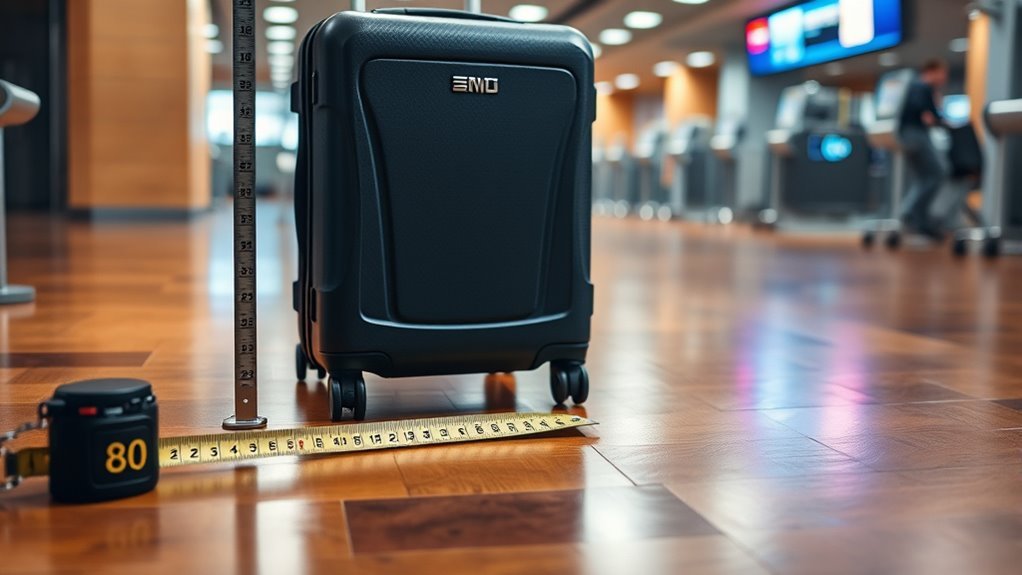
“80 linear inches” is a luggage size limit that adds together the length, width, and height of your bag; if those three dimensions total 80 inches or less, the bag meets the rule.
You use this measure to confirm oversized baggage policies for airlines and some shipping services. It simplifies enforcement, since carriers compare a single total instead of multiple limits.
If your bag exceeds 80 inches, it’s usually treated as oversized and may incur fees or special handling. You’ll want to check airline-specific thresholds and fees before travel, because allowances and penalties can vary considerably.
How to Measure Your Bag (Wheels, Handles, Pockets)
When you measure your bag for the 80 linear inch rule, include wheels and extended handles so the total reflects its true size.
Lay the bag flat and measure length + width + depth, making sure any external pockets are counted in the depth.
If handles retract, measure them in their fully extended position since carriers may check that dimension.
Include Wheels And Handles
Because airlines measure luggage by its total linear inches, you need to include wheels, handles, and any external pockets when you measure your bag.
Lay the suitcase flat and measure height from wheel base to top-most handle end when extended, or to the highest fixed handle if retractable stays hidden.
Measure width across the widest points, including wheel housings, then depth from front to back including bumpers.
Add those three numbers for total linear inches.
If handles collapse, measure both extended and stowed to guarantee compliance with carrier rules.
Record measurements so you can quickly check limits before travel.
Measure External Pockets
How do external pockets affect your bag’s linear inches? You’ll measure pockets that add bulk: press them flat, then include their depth in the bag’s width or thickness when totaling length + width + height. If a pocket’s removable, take it off and measure both configurations. Soft pockets compress; hard shells don’t—use the uncompressed size carriers will see. Don’t forget side mesh or zippered front pockets that protrude.
| Pocket Type | How to Measure |
|---|---|
| Flat zippered | Press flat, measure thickness |
| Bulky side | Measure protrusion and include in width |
| Removable | Measure on/off and use larger value |
How Airlines Enforce 80 Linear Inches : Carrier Variations
When you check a bag, airlines each have their own 80-linear-inch limits and fee structures, so you’ll want to read the carrier’s checked baggage policy before you pack.
For carry-ons, some airlines enforce size at the gate with sizers, while others only weigh or eyeball bags at check-in.
Knowing both checked and carry-on enforcement rules for your airline helps you avoid surprises and extra charges.
Checked Baggage Policies
Airlines enforce the 80 linear inch rule in different ways, so you’ll want to check each carrier’s specifics before you pack.
For checked baggage, carriers set size limits, fees, and sometimes carry strict measurement protocols at check-in. You’ll see flat fees for oversized bags, tiered surcharges based on how much you exceed 80 linear inches, or outright refusal if a bag’s too large.
Frequent flyer status or class of service can affect allowances.
Always measure length + width + height, include wheels and handles, and weigh your bag.
Prepaying oversize fees online often saves money and reduces surprises.
Carry-On Enforcement
Curious about how carriers actually check carry-ons against the 80 linear inch guideline? You’ll find variation: some airlines measure at the gate with a plastic sizer, others use overhead-bin fit or visual inspection.
Low-cost carriers often enforce strictly, gate-checking bags that don’t fit their sizer; legacy airlines may be more lenient until bins are full. If staff ask you to gate-check, comply quickly to avoid delays.
To avoid surprises, check your airline’s website before packing, measure length+width+height, and choose a bag that comfortably fits published dimensions rather than pushing the limit.
Size Limits vs. Weight Limits: Fees and Oversize Rules
Although 80 linear inches tells you the maximum combined length, width and height for oversized baggage, most carriers also enforce separate weight limits that trigger different fees and handling rules.
You’ll face penalties for exceeding either dimension or mass: oversized pieces often incur flat oversize charges, while overweight bags carry weight-based fees that rise with excess pounds.
Rules vary by airline, fare class and route, and special items (sports equipment, instruments) may have distinct policies.
Always check carrier limits before packing, redistribute contents if needed, and be prepared to pay or repack at the airport to avoid surprises.
Choosing Bags That Fit 80 Linear Inches
Now that you know how oversize and overweight rules can hit your wallet, pick luggage that stays within 80 linear inches to avoid those fees. Measure length + width + height including wheels and handles.
Choose hard-shell or soft-sided suitcases with dimensions under 62 linear inches for carry-on alternatives or up to 80 for checked bags.
Look for compact spinner models that maximize interior volume without bulging. Verify manufacturer specs and remeasure after adding any attachments.
If you travel often, invest in a lightweight case to keep contents under weight limits.
Finally, test-fit your bag in airline sizers before you fly.
Packing and Gate Tips to Avoid Oversize Charges
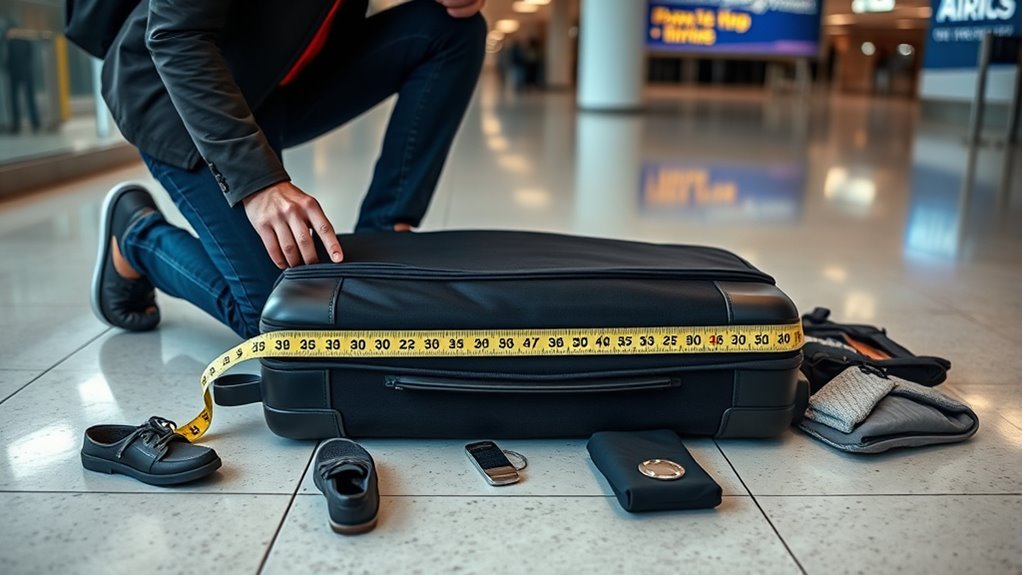
When you pack strategically and check dimensions before you leave, you can avoid last-minute oversize fees at the gate. Measure your packed bag—including wheels and handles—and compare to the airline’s 80 linear inches limit.
Use soft-sided luggage or compressible packing cubes to fit awkward items. Shift heavy or bulky things into a carry-on or personal item you’ll keep with you.
If you expect souvenirs, leave room or ship ahead. At check-in, have your measuring tape ready and be prepared to rearrange contents to meet rules.
Staying proactive saves time and unexpected charges.
Frequently Asked Questions
Can an Airline Waive 80-Inch Rules for Frequent Flyers?
Yes — you can sometimes get an airline to waive the 80-inch rule if you’re a top-tier frequent flyer; call reservations, ask politely, highlight status and purpose, and be ready to pay fees or accept a gate-check if needed.
Do Cruise Lines Use the 80 Linear Inches Standard?
No, cruise lines usually don’t use the 80 linear inches airline standard; they’ll set their own baggage size and weight limits. You should check your specific cruise line’s policy before packing to avoid surprises.
Are Checked Musical Instruments Measured by Linear Inches?
Yes — checked musical instruments are typically measured by linear inches (length + width + height) for airline and cruise baggage rules, and you’ll need to follow each carrier’s specific limits, fees, and packing requirements.
Does 80 Linear Inches Include Removable Compartments or Straps?
Yes — it usually does. Carriers count everything that contributes to overall length, width, and height, so removable compartments, external pockets, and straps typically count unless the airline explicitly exempts them in its baggage rules.
Can Oversized Luggage Be Shipped Instead of Checked?
Yes — you can usually ship oversized luggage instead of checking it, but you’ll need to arrange courier or freight service, pack securely, compare costs and delivery times, and confirm airline or destination restrictions beforehand.
Conclusion
Now you know that “80 linear inches” means adding length + width + height of your bag (including wheels and handles). Measure before you go, because carriers vary and oversized fees can be steep. Pick luggage designed to meet the limit, pack smart to avoid bulging, and weigh checked bags to dodge weight surcharges. At the gate, be ready to reorganize or pay; a quick measurement and smart choices save time, money, and stress.