
Is the TSA a Federal Agency? Full Explanation
Yes — the Transportation Security Administration is a federal agency inside the Department of Homeland Security, created after 9/11 to centralize and strengthen aviation security. You’ll deal with TSA screening rules, federal procedures, and oversight by DHS and Congress; officers enforce security standards but don’t have general police powers. Funding, audits, and legal limits shape what TSA can do. Keep going and you’ll get a clear view of its authority, limits, hiring, and traveler impacts.
Quick Answer: Is the TSA a Federal Agency – and Why It Matters?
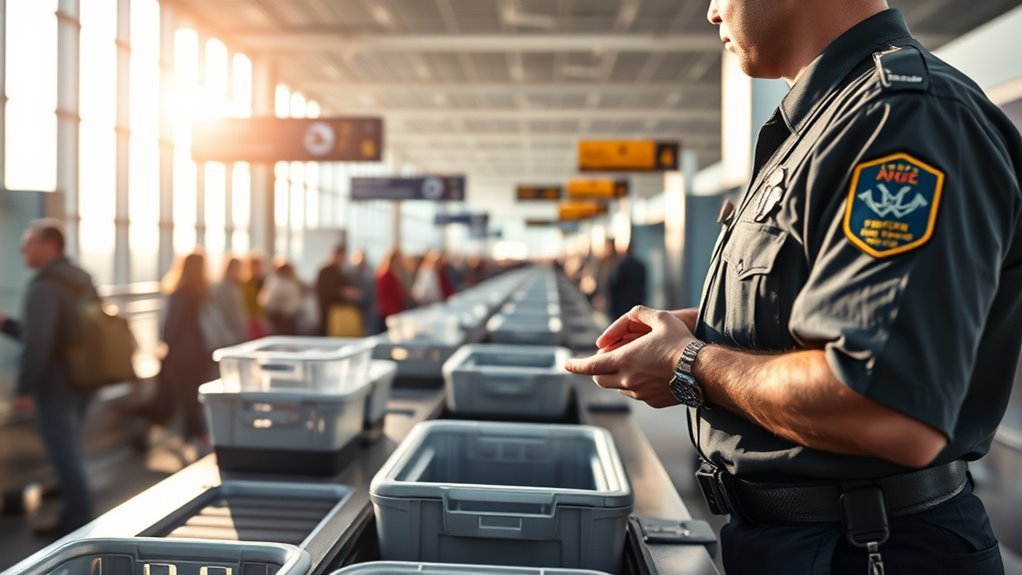
Wondering whether the TSA is a federal agency? You should know it is: the Transportation Security Administration is a U.S. federal agency within the Department of Homeland Security.
That status means you’re subject to federal rules, oversight, and policies when passing through airport security. It matters because federal authority defines officer powers, complaint procedures, and legal standards that apply to screenings, searches, and interactions.
Knowing this helps you understand which laws protect you, where to file grievances, and why protocols are standardized nationwide. Being aware of TSA’s federal role lets you better assert rights and follow required security procedures with confidence.
Why the TSA Was Created After 9/11
After the 9/11 attacks exposed major gaps in aviation security, Congress created the Transportation Security Administration to centralize and strengthen how the nation protects its airports and passengers. You needed a single, accountable body to set consistent standards, implement advanced screening technologies, and deploy trained personnel nationwide.
The aim was to reduce vulnerabilities revealed by fragmented, inconsistent airport security practices. You now see uniform checkpoint procedures, passenger and baggage screening protocols, and intelligence-sharing with law enforcement.
Where the TSA Sits in the Federal Government
Creating the TSA answered immediate security gaps, but you might wonder how that new agency fits into the federal structure that governs homeland security and transportation.
You’ll find the TSA housed within the Department of Homeland Security, reporting to DHS leadership while operating nationwide. It coordinates with the Department of Transportation on aviation policy and with federal law enforcement when security incidents arise.
You’ll also see regional TSA offices that implement national directives locally, and the agency works with state and local partners.
This placement balances centralized authority for standards with collaboration across agencies and jurisdictions to secure transportation systems.
What Federal Powers Does the TSA Have?
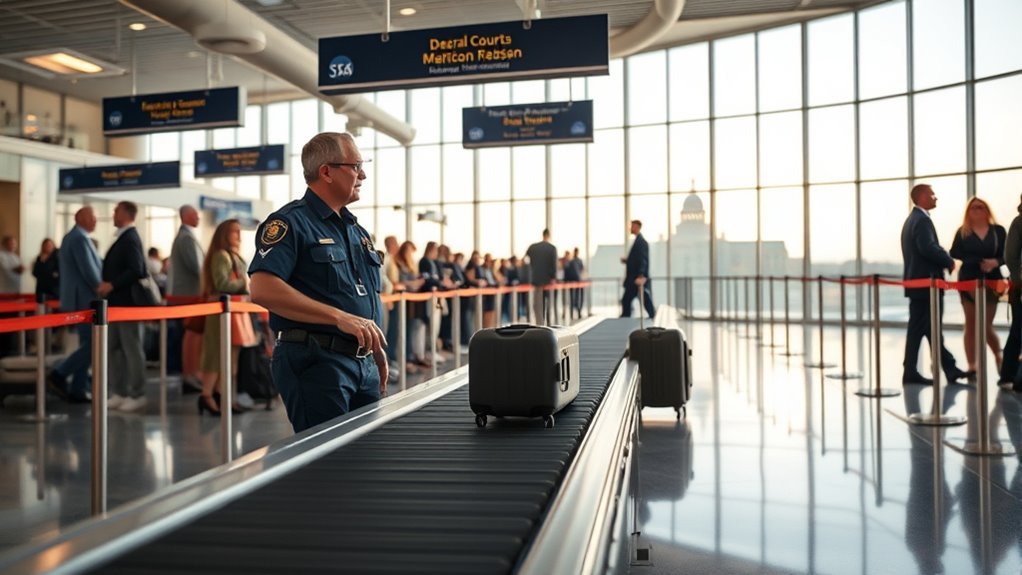
You’ll see the TSA exercises federal regulatory authority over aviation security rules, screening procedures, and access to secure airport areas. It also has limited law enforcement powers, like checking IDs, enforcing security rules, and coordinating with federal, state, and local police.
Below, we’ll outline what those authorities allow the agency to do and where its powers are constrained.
Federal Regulatory Authority
When you fly or work in transportation sectors, the TSA exercises a range of federal regulatory powers that let it set security standards, inspect compliance, and enforce rules across airports, airlines, and certain surface transportation modes. You’ll see this in its screening protocols, baggage and cargo rules, and credentialing for access to secure areas.
The agency issues directives, approves security programs, and mandates training and equipment standards. You must follow its regulations to operate or access facilities; carriers and operators face fines, civil penalties, and operational restrictions for noncompliance.
Its regulatory scope focuses on risk reduction and consistent security measures.
Law Enforcement Powers
Because TSA’s primary mission is transportation security, it’s been given specific federal law enforcement authorities to prevent and respond to threats in the aviation and certain surface transportation environments.
You’ll encounter Transportation Security Officers, Federal Air Marshals, and special agents who can screen, detain, and refer individuals for criminal prosecution when laws are violated.
You can expect authority to enforce aviation security regulations, conduct risk-based screening, use screening technologies, and carry firearms in some roles.
TSA can also issue civil penalties, coordinate with federal, state, and local law enforcement, and participate in intelligence-sharing to detect and disrupt threats before they reach transportation systems.
What TSA Authority Does Not Cover
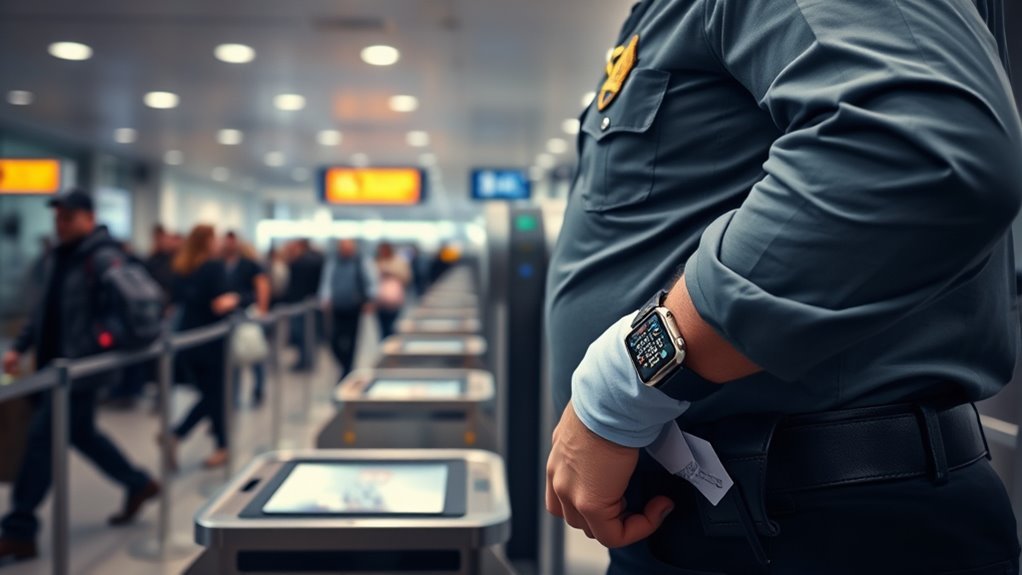
While TSA officers can enforce security rules and refer violations, you shouldn’t expect them to act as full law enforcement. They don’t have broad arrest powers like federal or local police, and their authority is limited to aviation security-related matters.
If a criminal issue arises, you’ll see law enforcement agencies take the lead.
No Law Enforcement Powers
Although the TSA has broad responsibilities for transportation security, it doesn’t have general law enforcement powers—agents can’t make arrests for crimes unrelated to aviation security, carry out arbitrary searches without legal justification, or enforce immigration and criminal statutes beyond their specific scope.
You should know TSA officers mainly perform screening, credential checks, and security inspections tied to transportation safety. If they encounter criminal activity outside their jurisdiction, they alert local, state, or federal law enforcement with proper authority.
You can’t expect TSA to investigate general crimes, execute warrants, or manage broader public-safety enforcement roles beyond federally defined transportation duties.
No Broad Arrest Authority
Building on what TSA officers can and can’t do, it’s essential to recognize they don’t have broad arrest authority beyond narrow transportation-related offenses.
You shouldn’t assume TSA can arrest for general crimes like assault, theft, or drug possession unless those acts directly threaten airport security or occur in conjunction with federal transportation statutes.
If a serious crime happens, local or federal law enforcement with full arrest powers usually handles it.
TSA can detain someone briefly to maintain safety and hand them to police, but they lack the unilateral, wide-ranging arrest authority officers in police departments or federal investigative agencies possess.
Major Legal Challenges and Key Court Rulings About the TSA
When travelers and civil-rights groups challenged TSA practices, courts across the country had to weigh security needs against constitutional protections; these cases have shaped what the agency can and can’t do, from screening procedures to data collection.
You’ll see rulings limiting intrusive searches, requiring reasonable suspicion for some actions, and scrutinizing data retention.
Key decisions clarified officer authority and passenger rights, creating precedent you’ll rely on if contesting a policy.
- Limits on full-body scanner use and notice requirements.
- Standards for pat-downs and reasonable suspicion.
- Constraints on warrantless searches of electronic devices.
- Review of passenger-screening databases.
How the TSA Is Funded and Held Accountable
You’ll see that the TSA’s budget comes from a mix of congressional appropriations, passenger fees, and other federal sources. Congress keeps oversight through hearings and budget controls that shape priorities and operations.
Meanwhile, the Department of Homeland Security’s Inspector General conducts audits and investigations to hold the agency accountable.
Funding Sources Mix
How is the Transportation Security Administration funded, and who keeps it accountable? You’ll see a mix of revenue streams: federal appropriations, passenger security fees, reimbursable agreements, and grants. Each stream ties to specific programs and reporting requirements so you can track spending.
- Federal appropriations: Congress provides baseline funding for operations and staffing.
- Passenger security fees: Collected via ticketing, these fund screening and related services.
- Reimbursable agreements: Airlines and airports may reimburse TSA for special services.
- Grants and cooperative funding: States and local partners sometimes share costs for infrastructure and training.
Congressional Oversight Role
Although Congress provides TSA’s funding through appropriations and fee-authority, it also exercises ongoing oversight to guarantee those dollars are spent effectively and lawfully. You’ll see committees like Homeland Security and Transportation hold hearings, subpoena documents, and question officials about budgets, programs, and performance.
Congress shapes policy through statutes, earmarks, and reporting requirements, and it can restrict spending or require corrective action. You rely on that process to verify accountability: lawmakers demand transparency, require regular reports, and use appropriations riders to influence operations.
Ultimately, congressional oversight ties funding to legal, fiscal, and operational responsibilities for the TSA.
Inspector General Audits
Congressional oversight sets expectations, but the Department of Homeland Security’s Office of Inspector General (OIG) provides independent, detailed audits and investigations that hold the TSA directly accountable for how it spends federal funds and implements programs. You’ll see OIG reports assess cost efficiency, program effectiveness, and compliance with law.
Those findings prompt corrective actions, congressional inquiries, or policy changes. You can track recommendations and agency responses online, ensuring transparency and follow-through.
- Audit financial management and procurement practices
- Evaluate operational programs like screening and workforce deployment
- Investigate waste, fraud, or misuse of funds
- Monitor recommendation implementation and results
TSA Hiring, Federal Classification, Pay, and Unions
When you’re looking into TSA hiring, you’ll find the agency blends federal classification rules with special hiring flexibilities to staff airport security roles quickly while maintaining civil-service standards. You’ll see GS and excepted service positions, screening personnel pay tied to locality and grade, and pathways for veterans and seasonal hires. Bargaining units exist for many screeners and federal employees, so you can expect collective bargaining on pay and conditions where allowed.
| Category | Notes |
|---|---|
| Classification | GS, excepted service |
| Pay | Locality, grade-based |
| Unions | Collective bargaining possible |
TSA Relationships With Airlines and Airport Operators
The TSA coordinates closely with airlines and airport operators to balance security requirements with efficient passenger flow, sharing threat information, setting screening standards, and aligning on checkpoint design and staffing needs. You’ll see collaboration on procedures, pilot programs, and traveler communications so security doesn’t become a bottleneck.
TSA, airlines, and airports work together—sharing threats, aligning standards, and designing checkpoints to keep security smooth and efficient.
You can expect joint planning for peak travel, special events, and equipment placement. Contracts and memoranda define roles, while performance metrics guide adjustments.
- Shared threat briefings and operational alerts
- Screening standard agreements and training coordination
- Checkpoint layout and passenger flow planning
- Resource and staffing alignment through MOUs
TSA Coordination With Local and State Police
How do local and state police fit into airport security? You’ll see them working alongside TSA to handle law enforcement tasks airports can’t delegate — criminal investigations, traffic control, perimeter patrols, and response to incidents.
TSA shares threat intelligence and coordinates exercises so local forces know procedures and access points.
Jurisdictional authority stays with state or local agencies for crimes under their laws, while TSA focuses on transportation security.
You’ll notice joint command during major events or emergencies; unified communication channels and memoranda of understanding clarify roles, ensuring prompt arrests, evidence collection, and community-focused policing without duplicating federal security duties.
Common Criticisms and Proposed Reforms : What Would Change for Travelers?
If you’ve ever missed a flight because of long security lines or felt uncomfortable with intrusive screening, you’re hearing common criticisms that drive reform proposals: faster, smarter screening technologies; clearer, consistent procedures across airports; strengthened privacy protections; and better training to reduce profiling and errors.
You’d notice shorter waits, fewer pat-downs, and more predictable rules. Funding and oversight shifts could standardize experience, while audits and transparency would boost accountability.
You’d also benefit from improved traveler communication and appeals for screening disputes.
- Faster, tech-driven screening
- Uniform procedures nationwide
- Stronger privacy safeguards
- Enhanced staff training
Frequently Asked Questions
Can Travelers Sue the TSA for Invasive Searches?
Yes — you can sometimes sue the TSA, but your options’re limited by federal immunity, administrative remedies, and qualified immunity; successful claims usually allege constitutional violations, intentional misconduct, or statutory waivers like the FTCA after exhausting administrative claims.
Are TSA Security Procedures Consistent Internationally?
Mostly, yes — you’ll see similar basic goals worldwide, but procedures and strictness vary by country, technology, and threat level, so you’ll encounter different screening types, rules for liquids, and privacy or pat-down practices.
How Does TSA Handle Lost or Damaged Property?
TSA handles lost or damaged property by directing you to local airport authorities or airline lost-and-found; they’ll document incidents, investigate security screening mishaps, and you can file claims—expect coordination but limited direct compensation from TSA.
Can TSA Employees Refuse Assignments on Religious Grounds?
Yes — you can request religious accommodation for assignments, and TSA must consider it; however, they can deny requests if it causes undue hardship to operations or security, so be prepared to provide documentation and alternatives.
What Privacy Protections Exist for Passenger Data Collected by TSA?
You have privacy protections via federal statutes (Privacy Act, FOIA exemptions), agency policies, and TSA’s data minimization, access controls, and retention limits; you can request records, challenge inaccuracies, and pursue redress through agency privacy offices or courts.
Conclusion
Yes — the Transportation Security Administration (TSA) is a federal agency created after 9/11 to secure the nation’s transportation systems. It sits within the Department of Homeland Security, giving it federal law enforcement and regulatory authority over passenger and baggage screening, access to secure airport areas, and certain civil penalties. It doesn’t handle criminal investigations like the FBI, and some duties remain with airlines or local police. TSA employees are federal workers with specific pay scales and limited collective bargaining, and the agency coordinates with airports and local authorities while facing ongoing criticisms and reform proposals.
