Is ChapStick a Liquid TSA? TSA Liquid Rule Guide
You can usually bring stick ChapStick in your carry-on because TSA treats solid lip balms as solids, so they don’t count toward the 3-1-1 liquid limit; however, glossy, liquid, squeeze-tube, or balm that softens and spreads may be treated as a liquid and must fit in your quart-sized bag or go in checked luggage. When unsure, pack it checked or put a small sample in a compliant container — keep going and you’ll learn how to tell which type applies to you.
Quick Answer: Will Your ChapStick Pass TSA-What to Do Now?
If you’re wondering whether your ChapStick will fly with you, the quick answer is usually yes: lip balm in a stick or solid tube is allowed in both carry-on and checked bags.
While liquid or gel forms must follow the 3-1-1 liquid rule. Check your balm: solid sticks are fine; glossy or squeezable tubes that squeeze out jelly might be treated as liquids.
If you’re unsure, put questionable items in your checked bag or transfer to a compliant travel-size container labeled under 3.4 ounces (100 milliliters).
Declare anything flagged by TSA and cooperate with screening to avoid delays.
How the TSA Liquid Rule Works in Plain Language
You’ll want to know exactly what counts as a liquid, the size limits for carry-on containers, and which items are exceptions so you don’t get stopped at security.
The TSA treats gels, creams, aerosols, pastes, and lotions the same as liquids, but some solid sticks can be different.
I’ll explain the typical 3-1-1 rule, common exemptions, and how chapstick usually fits.
What Counts As Liquids
Curious what the TSA considers a “liquid”? You should know the rule covers liquids, gels, aerosols, creams, pastes, lotions, and substances with similar consistency.
If it flows, spreads, squeezes, or can be poured, the TSA treats it like a liquid.
Solid bars, powders, and most medications are usually excluded unless they melt or become pliable.
Food items like yogurt, peanut butter, and sauces count as liquids.
Electronics with liquid components or sealed containers of liquid are included too.
When in doubt, assume a product that changes shape or spreads under pressure is a liquid for screening.
Size Limits And Exceptions
Now that you know what counts as a liquid, let’s look at how much you can bring. You’re allowed carry-ons with travel-sized containers: each container must be 3.4 ounces (100 milliliters) or less, all fitting in one clear quart-sized bag.
Checked bags don’t have that limit, but follow airline and country rules. Exceptions include medications, baby formula, and breast milk—declare them at security.
Solid sticks like most ChapStick normally aren’t restricted, but gels or liquid lip balms are. If unsure, pack questionable items in checked luggage or declare them to the TSA agent.
- 3.4 oz rule
- Quart bag limit
- Medical/baby exceptions
Solid vs. Semi-Solid: How TSA Defines Consistency?
Although the TSA doesn’t use “solid” and “semi-solid” as strict legal categories, it treats products by their consistency and how they behave under pressure and temperature—so you should think about whether a product holds its shape, spreads, or flows.
If it stays solid at room and body temperature, like a stick deodorant or lip balm in a twist tube, agents usually treat it as a solid.
If it softens, melts, or can be smeared—balms that puddle, gels, creams—they behave like liquids for screening.
Test by pressing or warming; if it deforms and spreads, pack it following liquid rules.
The 3-1-1 Rule Explained for Carry-On Items
You’ll learn the 3-1-1 rule—one quart-sized bag, one clear plastic bag, and containers of 3.4 ounces (100 ml) or less—and what that actually means for your carry-on.
I’ll point out which items count as liquids, gels, or aerosols (including lip balms and ointments) and which are treated as solids.
Then you’ll get quick packing tips to stay compliant and breeze through security.
What The 3-1-1 Rule Means
Because airport security limits how much liquid you can bring in a carry-on, the TSA’s “3-1-1” rule gives a simple way to pack. You must follow size and containment limits so screening goes smoothly and you avoid confiscations. Think compact, transparent, and accessible when organizing toiletries.
- Three: One quart-sized, clear plastic bag per passenger.
- One: Each bag holds containers of 3.4 ounces (100 milliliters) or less.
- One: Place the single bag outside your carry-on for screening.
Stick to these limits, and you’ll speed through checkpoints while keeping necessary items like lip balm or small creams.
Which Items Count
Now that you know how the 3-1-1 bag works, let’s look at what actually counts toward those limits.
You’ll include liquids, gels, aerosols, creams, pastes, lotions, and items that behave like liquids—think shampoo, sunscreen, perfume, mascara, and toothpaste.
Solid bar soap, most dry powders, and solid cosmetics usually don’t count.
Medications, baby formula, and breast milk get special allowances but must be declared.
Single-use items in sealed containers count if over 3.4 ounces.
ChapStick in stick form is solid and exempt; lip gloss or balm in a tube counts as a liquid.
Packing Tips For Compliance
When packing your carry-on, organize liquids, gels, and creams so they’re easy to access and clearly visible in a single quart-sized, resealable bag; doing this speeds security checks and helps you stay within the 3-1-1 limits.
You should sort items by size and frequency of use, keep travel-size containers under 3.4 ounces (100 ml), and place chapstick, makeup, and lotions together to avoid digging.
Seal the bag fully and set it atop loose items for quick removal at screening.
Follow these quick steps:
- Use clear quart bag.
- Limit containers to 3.4 oz.
- Keep bag accessible.
How to Tell If Your ChapStick Counts Toward 3-1-1
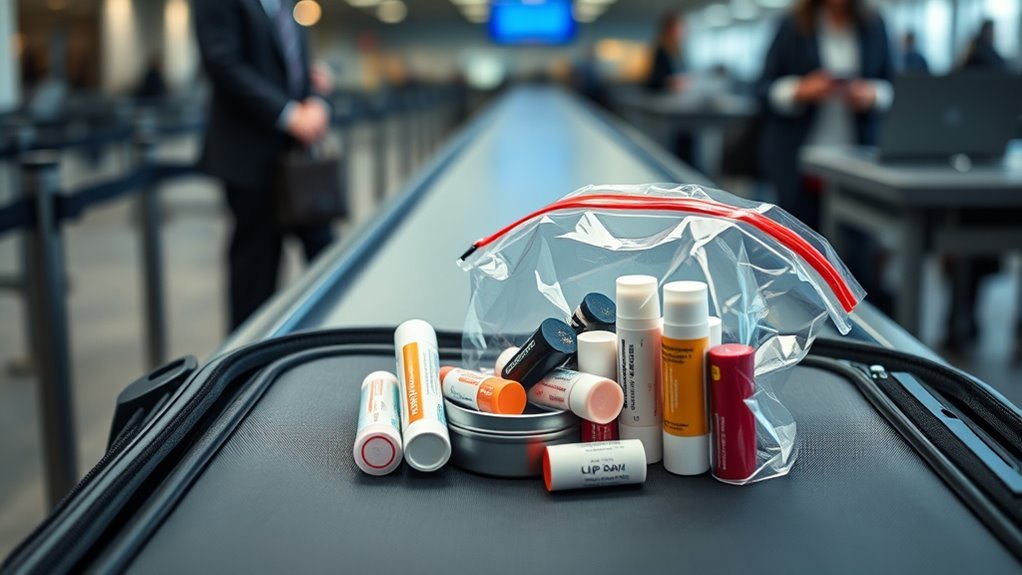
Want to know if your ChapStick counts toward the TSA 3-1-1 rule? Check the label: if it’s classified as a liquid, gel, cream, paste, or aerosol, it falls under 3-1-1.
Solid waxy sticks that don’t smear when pressed generally don’t count. If the product’s consistency or packaging is ambiguous, treat it as a liquid and place it in your quart-sized clear bag to avoid delays.
Lip balms in containers larger than 3.4 ounces (100 ml) must go in checked baggage regardless.
When in doubt, show the item to TSA at the checkpoint for final determination.
ChapStick Formats: Stick, Tube, Pot, and Packet – Overview
You’ll notice chapstick comes in several formats that affect how TSA treats it: solid sticks and twist-up tubes are usually firmer.
While pots and single-use packets hold softer, spreadable balm.
Check the consistency and container size—soft or liquidy balms in pots or packets are more likely to fall under the 3-1-1 liquid rule.
Knowing which format you have helps you pack smarter and avoid surprises at security.
Solid Stick vs Tube
Although both formats aim to tame dry lips, the solid stick and the tube differ in how they dispense product and how you use them. You’ll notice tactile differences and packing implications that matter for travel and daily use.
- Stick: You twist up a solid balm; it’s mess-free, easy to apply directly, and rarely leaks.
- Tube: You squeeze a semi-solid or cream from a small nozzle; it gives controlled amounts and can be better for lip treatments.
- Travel: Sticks usually meet TSA carry-on rules as solids; tubes may be judged by consistency—keep them sealed and accessible for inspection.
Pots And Packet Forms
How do pots and packets differ from sticks and tubes when you’re choosing a lip balm format?
Pots let you scoop balm with a fingertip, giving you control over amount and easy mixing with other products. But they expose balm to contaminants and can be messy in transit.
Packets are single-use, compact, and TSA-friendly, perfect for one-off needs or samples. Yet they create waste and offer limited product.
Both pots and packets are treated as solids by TSA if not melted; however, semi-liquid or glossy formulations might be scrutinized.
Choose based on hygiene, convenience, and the balm’s consistency.
Are Stick-Format Lip Balms Allowed Through Security?
If you’re wondering whether stick-format lip balms count as liquids for TSA screening, the short answer is no: solid stick balms aren’t subject to the 3.4-ounce (100 ml) carry-on liquid limit and can go through security loose or in your bag.
You should still follow basic packing common sense: keep them accessible for inspection, avoid melted or semi-soft sticks, and know that flavored or medicated sticks don’t change classification.
Quick tips:
- Carry multiple sticks in your carry-on or pockets.
- Store them upright to prevent damage.
- Present them if asked during screening.
Are Tube or Squeeze Lip Balms Treated as Liquids?
If your lip balm comes in a tube or squeeze bottle, you’ll need to treat it like a liquid under TSA rules. That means checking size limits—containers over 3.4 ounces (100 mL) usually aren’t allowed in carry-on.
And packing it in your quart-sized clear bag is necessary. Also note that some balm formulas are solid enough to be treated like sticks, so check consistency before you fly.
Tube Balm Rules
When you’re packing lip care, remember that tube or squeeze balms usually count as liquids for TSA purposes because they can be dispensed through a small opening and fit the definition of a gel or liquid. You should treat them like other toiletries at security. Keep them accessible, declare if asked, and follow carry-on rules to avoid delays.
- Measure: check volume so you know if it qualifies for carry-on liquid limits.
- Pack: place the tube in your clear quart bag with other liquids.
- Inspect: verify the cap seals to prevent leaks during screening and transit.
Squeeze Balm Limits
You already know tube or squeeze balms usually count as liquids for TSA screening, so now let’s focus on how that affects what you can carry.
You’ll need to measure volume: containers must be 3.4 ounces (100 milliliters) or less to fit in your quart-size bag. If your squeeze balm exceeds that, transfer a small amount into a compliant travel container or leave it behind.
Keep all liquid-format lip products together and easily accessible for inspection.
Solid bars or stick balms may differ, but here you’re treating squeezable formulations as liquids and following the 3-1-1 rule.
Solid Versus Liquid
Although both types protect your lips, the TSA treats tube or squeeze lip balms differently from solid stick balms: squeeze or tube formulations are handled as liquids or gels, so they must follow the 3-1-1 rule and fit in your quart-size bag.
While solid stick balms usually count as solids and can go in either carry-on or checked luggage without the same volume restrictions. You should:
- Check packaging: tubes/squeezes usually fall under liquids/gels.
- Pack squeeze balms in your quart bag and keep sticks accessible.
- Consider solid sticks to avoid scrutiny and speed security.
When uncertain, declare the item to the officer.
Are Pot or Jar Lip Balms Considered Gels or Solids?
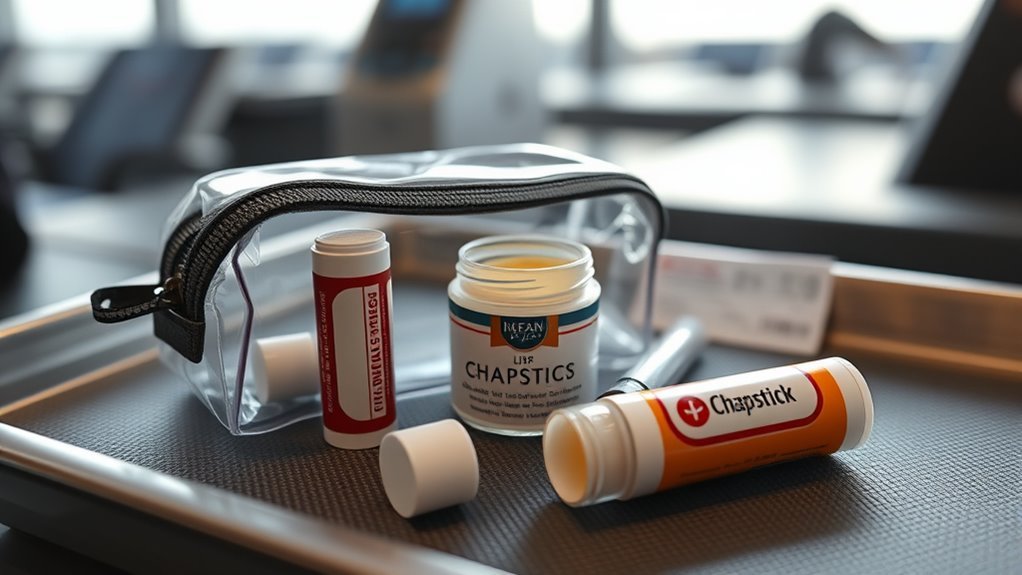
Because pot and jar lip balms don’t flow like liquids, TSA generally treats them as solids or creams rather than pure liquids, but there are important limits you should know. You can usually carry small pots in carry-on, but TSA may classify soft balms as gels if they’re scoopable. Pack them in your quart-size bag if they’re soft or over 3.4 ounces (100 ml). Hard, stick-like balms are fine outside that bag. Declare unusual products if asked.
| Balm Type | Typical State | Carry-On Rule |
|---|---|---|
| Solid balm | Firm | Outside bag |
| Soft pot | Scoopable | In bag |
| Large jar | >3.4 oz | Checked or dispose |
Are Aerosol Lip Balms and Sprays Allowed?
Wondering about aerosol lip balms and sprays? You can bring them in carry-ons only if they meet TSA aerosol and liquid limits. Aerosols count toward your 3.4 oz (100 ml) containers and must fit in a single quart-sized bag. Check these points before packing:
Aerosol lip balms and sprays are allowed in carry-ons only if they’re 3.4 oz (100 ml) or smaller and fit in your quart bag.
- Confirm the spray is 3.4 oz (100 ml) or smaller.
- Verify it’s labeled as personal care aerosol, not hazardous.
- Place it inside your quart bag with other liquids for screening.
If it’s larger, put it in checked baggage. Always declare any item officers ask about to avoid delays.
What the TSA Liquid Rule Says About Medicated Balms
If your balm contains active ingredients like menthol or analgesics, the TSA may classify it as a medication rather than a cosmetic. That usually means you can carry it on, but you should be ready to show it and explain what it’s at security.
Also check quantity limits—medicated balms in small containers typically follow the same 3.4-ounce/100-milliliter rule unless declared as a prescribed medication.
Medicated Balm Classification
When you’re packing a medicated balm like mentholated lip treatment or a prescription ointment, the TSA treats it based on consistency and volume: semi-solids and balms generally fall under the 3-1-1 liquids rule if they can be squeezed, scooped, or spread, so containers larger than 3.4 ounces (100 mL) must go in checked baggage or be removed at security.
You should assess form, packaging, and need. Consider these points:
- Texture: solid sticks vs. soft tubs—soft tubs are treated as liquids.
- Container size: over 100 mL triggers checked-bag rules.
- Medical need: declare prescriptions to TSA.
Carry-On Quantity Limits
Although medicated balms often look harmless, the TSA treats many of them as liquids for carry-on purposes, so you’ll need to follow the 3-1-1 rule: each container must be 3.4 ounces (100 mL) or less and all containers must fit in a single quart-sized, clear plastic bag.
If your medicated balm is packaged in a stick under that size, you’re fine. Larger tubs or prescription ointments may be considered gels and must go in checked baggage or meet exceptions.
Keep prescriptions in original labeled containers and declare them if asked. When in doubt, carry documentation or pack extras in checked luggage.
Are Lip Balms With SPF Treated Differently?
Lip balms that contain SPF are generally treated the same as regular solid lip balms by TSA screening: as long as they’re in a solid stick or compact form, you can carry them in either your carry-on or checked bag without worrying about the 3.4-ounce liquid limit.
Solid SPF lip balms travel like regular sticks—carry in carry-on or checked bags without 3.4-ounce concerns.
You should still be aware of a few points:
- If your SPF product is a balm stick, it’s allowed like cosmetics.
- Gel, paste, or pot formats might be considered liquids and fall under the 3.4-ounce rule.
- Always declare or remove questionable items if asked during screening.
Passenger Examples: Common ChapStick Scenarios
If you’re packing ChapStick in your carry‑on, you’ll want to know how it fits the TSA’s 3‑1‑1 rules and whether tubes count as solids or liquids.
For checked baggage, you’ll learn what limits (if any) apply and when it’s safer to stow extras there.
You’ll also see how many lip balms you can reasonably bring if you carry multiple sticks or tubs.
ChapStick In Carry‑On
1 common question travelers ask is whether you can bring ChapStick in your carry‑on and how different situations affect that answer. You can carry standard solid sticks without issue.
If your balm’s in a tube or pot under 3.4 ounces (100 ml), it fits the liquid rule and must go inside your quart‑size bag.
Abrasive flavors or medicated formulas don’t change TSA treatment, but clear labeling helps.
At security, present your quart bag separately when asked.
- Solid ChapStick: carry freely.
- Small tubs/tubes ≤3.4oz: pack in quart bag.
- Larger containers: avoid in carry‑on.
ChapStick In Checked
When you pack ChapStick in checked luggage, you can stow both solid sticks and larger tubs without worrying about the 3.4‑ounce carry‑on limit, but you should still secure lids and place soft or melted products in a sealed bag to prevent leaks. You’ll label tubs if concerned and cushion items to avoid punctures. If a stick melts, clean residue promptly. Expect routine baggage screening; ChapStick rarely causes issues. Below are quick examples to guide choices.
| Item | Packed | Tip |
|---|---|---|
| Stick | Checked | No size limit |
| Tub | Checked | Seal in bag |
| Tube | Checked | Cushion against heat |
| Multiple | Checked | Separate in bag |
Multiple Lip Balms
Packing several lip balms is common, and knowing how to handle them keeps your carry-on routine smooth. You can carry multiple sticks or tins; TSA treats solid balms as non-liquids. Keep them accessible in case an officer asks.
- Consolidate: Put small pots together to avoid spills and speed screening.
- Declare if unsure: Tell the officer you have multiple balms, especially unusual packaging.
- Check sizes: Tubes and sticks are fine; gels or liquids over 3.4 oz must go in checked luggage.
Follow these tips and you’ll avoid delays while keeping your lips comfortable.
What Happens If a ChapStick Is Flagged at Security?
Curious what happens if a ChapStick gets flagged at security? You’ll be asked to remove it from your bag and place it in a separate bin for X-ray screening.
An officer may inspect it visually and, if needed, open or swab it for explosive residue testing. If it’s compliant with size rules and harmless, you’ll get it back and proceed.
Officers may visually inspect or swab ChapStick for explosive residue; compliant, harmless items are returned so you can proceed.
If it appears suspicious, prohibited, or fails a test, they’ll confiscate it. You can request clarification politely; officers can’t return items once seized.
Keep receipts or packaging handy to speed verification if you travel frequently.
How TSA Handles Weird ChapStick Packaging
If a ChapStick comes in unusual packaging—think metal tins, novelty containers, or multi-piece kits—expect TSA officers to inspect it more closely. They’ll separate any non-transparent or oddly shaped items for X-ray and may open them to verify contents.
You should be ready to explain what the item is and show the balm if asked. Pack weird containers where they’re easy to access and avoid hiding components in dense electronics or clothing.
- Label items clearly to speed inspection.
- Use simple, transparent packaging when possible.
- Be cooperative—quick answers save time.
When to Remove ChapStick From Your Bag for Inspection?
When you go through security, keep your ChapStick handy and be ready to take it out if an officer asks—small, opaque tubes and weird containers can trigger manual checks, so presenting it proactively speeds things up.
Remove it when an officer or signage instructs you to empty pockets or place items in bins, or if your bag is selected for additional screening.
If asked to empty pockets or place items in bins, remove your ChapStick for screening.
Take it out with other small personal items rather than buried inside packed clothing.
If your ChapStick is in a clear quart bag with other liquids and under size limits, you can usually leave it packed unless asked.
What the TSA Screening Machines Look for in X-Rays
When your bag goes through X-ray, the machine flags dense shapes like metal casings or batteries that stand out from softer items. It also recognizes the silhouettes of liquid containers, so a tube of chapstick can catch attention if it resembles other liquid vessels.
You’ll see organic materials show up with different densities too, which helps agents tell food or cosmetics apart from electronics.
Detecting Dense Shapes
Because dense objects block X-rays more than surrounding materials, TSA screening systems flag compact, high-opacity shapes for closer inspection. You’ll notice technicians focus on size, edges, and uniformity when reviewing scans.
Dense items can hide other threats, so operators verify composition and intent quickly.
- Size: larger dense cores trigger priority checks.
- Edges: sharp, well-defined outlines suggest solid components.
- Uniformity: consistent opacity across an object implies metal or dense plastic.
You should separate suspicious dense items from carry-on clutter and be ready to explain or remove them for a manual check.
Recognizing Liquid Containers
Although liquids don’t block X-rays the way dense solids do, TSA screening systems still flag and analyze containers because shape, volume, and contents produce distinctive signatures on scans.
You should know machines detect uniform fills, meniscus lines, caps, and layered densities that suggest liquids or gels. Cylindrical bottles, squeezable tubes, and pouches show predictable outlines; irregular blobs raise questions.
Operators compare size to allowed limits and check for multiple compartments or hidden pockets. You can reduce scrutiny by packing clear, single-compartment containers in a quart bag and keeping volumes visibly below permitted thresholds to speed screening.
Identifying Organic Materials
X-ray screening systems spot organic materials by their lower density and characteristic color tones on the display, so you’ll see softer, often orange or brown hues that contrast with metals and inorganic solids.
You’ll learn to recognize chapstick and similar organics by shape, color tone, and packing context. Watch for these cues when your bag passes through:
- Size and shape: cylindrical or stick-like items with uniform interior tone.
- Color signature: warm orange/brown hues indicating organic composition.
- Context: grouped with clothes or toiletries, not dense electronics.
If uncertain, expect secondary inspection; declare liquids or gels to speed screening.
TSA PreCheck and Faster ChapStick Screening
If you enroll in TSA PreCheck, you’ll usually move through security faster and keep small personal items like ChapStick in your carry-on without extra scrutiny.
With PreCheck, you often don’t remove shoes, belts, laptops, or compliant liquids from bags, so a single stick of lip balm generally passes without being placed in a quart-sized bag. Still, pack it where it’s easily accessible in case an officer asks to inspect it.
Remember officers can request additional screening for any item, so follow instructions calmly. PreCheck speeds the process and reduces hassle, but it doesn’t guarantee zero checks.
Medical Exemptions: When More Lip Balm Is Allowed
If you need more lip balm for medical reasons, bring a doctor’s note and any prescription packaging to make screening smoother.
You’ll usually be permitted prescription lip balm in larger amounts, but you should tell TSA officers about it when you reach the checkpoint.
Clear communication with airport security helps avoid delays and guarantees your medication is handled properly.
Doctor’s Note Required
When you need more than the TSA’s standard allowance because of a medical condition, bring a doctor’s note that clearly states the medical necessity and the type or amount of lip balm required; this documentation helps Transportation Security Officers make an informed exception and speeds up screening.
You should:
- Ask your clinician to specify condition, product, and quantity.
- Carry the original or a clear photocopy with contact info.
- Present it confidently at security and answer questions calmly.
Keep the note concise, dated, and signed. TSA officers usually accommodate verified medical needs, but clear documentation prevents delays.
Prescription Lip Balm
Need more than the 3.4-ounce carry-on limit for lip care? If you have a prescription lip balm for a medical condition, you can carry larger quantities. Bring the prescription bottle or pharmacy label showing your name and medication; a doctor’s note helps but isn’t always required.
Pack it separately for screening and tell the officer it’s a medically necessary topical. Security may inspect or test the item. Keep receipts or documentation accessible in case officers ask questions.
Following these steps guarantees delays are minimized and you can access needed lip treatment without violating TSA liquid rules.
Airport Security Communication
You should tell TSA officers about your prescription lip balm as you approach the checkpoint and place it in a separate bin for inspection; clear communication speeds screening and reduces hold-ups. Explain briefly that you have a medical exemption and show documentation if asked. Keep containers labeled and accessible.
- Say what the item is and why you need more than 3.4 ounces.
- Present a doctor’s note or prescription when requested; originals help.
- Cooperate with additional screening like swabbing or opening tubes.
You’ll move through faster by being proactive, calm, and organized, minimizing delays for everyone.
Carrying ChapStick on International Flights: Best Practices
Traveling internationally with ChapStick is usually simple, but knowing the rules will save you time at security and prevent surprises at your destination.
Pack stick balms in carry-on; solid sticks are generally allowed without counting toward liquid limits. If your balm is in a tube with visible liquid or glossy gel, place it in a clear quart-sized bag and make sure each container is 100ml/3.4oz or smaller.
Pack solid stick balms in your carry-on; liquid or glossy gel tubes must go in a clear quart-sized bag (≤100ml/3.4oz).
Label medicated lip treatments if possible. Keep chapstick accessible for screening and declare if asked.
Check your airline and destination rules ahead of travel, since specific countries or carriers may impose different restrictions.
European Union vs. US Rules for Lip Balm
When you’re packing lip balm for a trip, know that the EU enforces strict carry-on liquid limits (typically 100 ml per container in a clear bag) that can affect gel or liquid-style balms.
The US TSA generally allows small lip balms but treats gels and liquids according to the 3-1-1 rule, so check format and size before you fly.
To avoid problems, stick to solid sticks or travel-size compliant tubes and keep them accessible at security.
EU Carry-On Limits
In the EU, liquid rules for carry-on are stricter than many travelers expect, and that includes lip balm: if it’s in a tube or pot larger than 100 ml (3.4 oz) you’ll need to pack it in checked luggage or buy a travel-sized version that fits inside a single, transparent 1-liter resealable bag.
You should:
- Check the container size — anything over 100 ml goes in hold baggage.
- Put all small liquid items, including balms and glosses, in one clear 1‑liter bag.
- Present the bag separately at security for inspection.
Follow these steps to avoid delays.
US TSA Allowances
Although the EU’s 100 ml rule is stricter, the US TSA treats lip balms more leniently: solid sticks and balms in tubes are generally allowed in carry-on without fitting the 3.4 oz/100 ml liquid limit, while anything in a squeezable or liquid form (like glosses or gels) must follow the 3.4 oz/100 ml rule and fit in your single quart‑sized clear bag. You should separate squeezable balms for inspection and label them if needed. Below’s a quick comparison to help you decide what to pack.
| Type | TSA Rule |
|---|---|
| Solid stick | Allowed in carry-on |
| Squeezable gel | Must be ≤3.4 oz and in quart bag |
Travel Tips For Lip Balm
Most travelers carry at least one lip balm, but rules you need to follow differ between the EU and the US — pack solid sticks in your carry-on to avoid the EU’s liquid restrictions, and keep squeezable or gloss-type balms under 100 ml (3.4 oz) and in your single clear quart-sized bag for US and EU screening.
You’ll want practical choices and quick checks at security. Follow these tips:
- Choose solid stick balms for carry-on to skip liquid limits.
- Place any tube or jar ≤100 ml inside your clear bag.
- Keep larger or specialty balms in checked luggage to avoid hassles.
Traveling To/From Canada or Mexico: What to Expect
When you travel to or from Canada or Mexico, expect slightly different border processes than domestic flights—customs checks, passport reviews, and sometimes extra questions about your trip, items you’re bringing, or agricultural goods.
Traveling to or from Canada or Mexico means passport checks, customs questions, and possible extra inspections—allow extra time.
You’ll still follow TSA carry-on rules for liquids, gels, and aerosols, so pack chapstick in your quart-sized bag if it’s a tube over pocket size or if agents consider it a gel.
Declare food, plants, and large quantities of personal items when asked.
Be polite, answer questions directly, and allow extra time for inspections or secondary screening at arrival or departure points.
Allowed Quantities for ChapStick in Checked Baggage
Checked baggage gives you more leeway with chapstick: you can pack as many tubes, sticks, or pots as you like in checked luggage without worrying about the 3.4-ounce (100 mL) carry-on liquid limit. You still must follow general checked baggage rules and airline restrictions.
Pack items securely to avoid leaks or damage; soft containers can be crushed. If you’re carrying large tubs or multiple products, consider sealing them in a plastic bag to catch any residue. Remember prohibited items like combustible aerosols remain restricted.
Quick tips:
- Wrap or bag chapstick.
- Place in the center of your suitcase.
- Avoid pressurized aerosol forms.
Storing ChapStick in a Carry-On Pocket vs. Checked Bag
If you want quick access to chapstick during a flight, keeping it in a carry-on pocket makes sense — you’ll be able to reapply without digging through a suitcase at the carousel. You’ll also avoid checked-bag temperature swings that can soften or melt balm.
Keep tubes accessible for security: solid sticks generally don’t need removal, but put anything gel-like in your quart-size bag.
If you’d rather stash backups, the checked bag works for extras you won’t need mid-flight.
Balance convenience and risk: carry what you’ll use onboard, and reserve bulk or spare items for checked luggage.
Preventing Leaks and Mess From ChapStick in Luggage
Pack your chapstick in a sealed bag or hard case so it won’t rub against clothes or leak.
If you’re flying to a hot destination or storing it in checked baggage, keep it insulated or carry it onboard to prevent melting.
Tuck it away from fabric and electronics to protect your luggage interiors if a spill does occur.
Storing ChapStick Properly
Want to avoid greasy surprises when you open your luggage? Pack chapstick smartly to keep tubes from leaking and staining clothes. Place each stick upright in a small resealable plastic bag and squeeze out extra air.
Use hard-sided travel cases or sunglasses-style cases to prevent crushing. Keep chapstick away from toiletries that might puncture tubes.
- Store upright in sealed bags.
- Use rigid cases for protection.
- Separate from sharp or heavy items.
Label bags if you carry medicated balms. When you follow these steps, you’ll minimize mess and retrieve usable lip care when you arrive.
Preventing Temperature Meltdown
Because temperature swings can turn a solid stick into a greasy mess, you should plan where and how you store ChapStick in your luggage to prevent leaks. Pack it in a hard case or metal tin, keep it away from heat sources, and place it near the center of your bag where temperatures stay steadier. For extra safety, seal the tube in a zip-top bag and wrap it with a small cloth. Check lids before travel. Consider solid balms over soft formulas for hot trips.
| Strategy | Benefit |
|---|---|
| Hard case | Physical protection |
| Zip-top bag | Containment of leaks |
| Center placement | Stable temperature |
| Cloth wrap | Cushioning |
| Solid balm | Less likely to melt |
Protecting Luggage Interiors
While you can’t always control temperature changes, you can keep ChapStick from turning your suitcase into a greasy mess by isolating and cushioning it before you close your bag.
Wrap sticks in a small resealable plastic bag, squeeze out air, and seal tightly.
For tubes, place them upright in a hard case or a padded sunglasses sleeve.
If you carry multiple, group them in a dedicated toiletry pouch to limit contact with clothes.
- Pack each item in a sealed bag.
- Use rigid containers for tubes.
- Place pouches near the center of your luggage.
Temperature and Pressure: Will ChapStick Melt Midflight?
If you’ve ever worried about your ChapStick turning into a gooey mess on a flight, you can relax—it’s unlikely to melt midair. Cabin temperatures stay controlled, and pressure changes don’t directly raise temperatures enough to liquefy typical lip balm formulations.
However, extreme heat before boarding—like a car trunk on a hot day—can soften or melt sticks, so keep them in your carry-on, not checked luggage. Solid balms with higher melting points resist softening better than natural-oil-heavy ones.
If you notice softening, pop the tube in a cooler spot or refrigerator when possible to re-solidify before use.
Packing Multiple Small Balms: Do They Add Up?
When you toss several small ChapSticks into your bag, they generally don’t combine into a single liquid volume for TSA purposes—you’re judged by individual container size and, for carry-on liquids, the total of liquid-like items in your quart bag.
You should:
- Count each balm as its own item for carry-on assessment.
- Keep all gels, creams, and soft solid balms together in the quart-sized bag if they behave like liquids.
- Check sizes: anything over the allowed container limit needs to go in checked baggage.
If in doubt, present them separately at screening and follow the officer’s direction.
What Counts as a “Single Container” Under TSA Rules?
Because the TSA treats each sealed product as its own container, you should count the actual packaging—not the product type—when deciding what fits in your quart bag.
Treat each sealed item as its own container — count packaging, not product type, for your quart bag.
That means a single chapstick tube, a twist-up balm stick, or a small squeeze tube each counts as one container.
Multi-pack blister cards still count per individual sealed unit if inspectors can’t separate them.
Solid bars in reusable tins count as their tin.
If you transfer balm into a travel-sized jar, that jar becomes the container and must meet size limits.
Labeling doesn’t change this—packaging does.
Combining ChapStick With Other Toiletries in Your 3-1-1 Bag
When you pack lip balm, tuck it into a clear 3-1-1 bag with other small items to save space and keep it accessible.
Combine toiletries smartly by grouping creams, sticks, and liquids separately so you can spot potential leaks.
Use sealed pouches or caps facing down to prevent mess and protect clothes if something opens.
Packing Lip Balm Efficiently
Looking for a simple way to fit your ChapStick into the TSA 3-1-1 bag without wasting space? Pack smart: choose slim tubes, cap them tightly, and place them upright in a clear pouch. Keep essentials accessible so you won’t rummage at security.
- Swap bulky sticks for travel-size tubes to save room.
- Use small zip pouches to group lip balm, hand cream, and sunscreen.
- Label or color-code items for quick identification.
You’ll breeze through checkpoints when your lip balm’s organized, visible, and stays within the 3-1-1 limits, reducing stress and potential confiscation.
Combining Toiletries Smartly
If you want to streamline your 3-1-1 bag, group ChapStick with other small, frequently used toiletries—like travel toothpaste, sunscreen sticks, and solid deodorant—so you can grab one clear pouch and go.
Place items by frequency: daily essentials at the top, backups beneath. Use small compartments or elastic bands to keep tubes upright and accessible.
Label or color-code pouches for quick swaps between carry-on and checked luggage.
Keep medications and lip balm together for easy reach during flights.
Regularly audit contents to remove empty containers and expired products, keeping your pouch compact and travel-ready.
Preventing Leaks And Mess
Along with sorting items by frequency, take simple steps to prevent leaks and sticky messes in your 3-1-1 pouch. You’ll keep chapstick and other toiletries tidy by sealing, cushioning, and isolating items before travel. Use small clear bags, wipe containers, and check lids.
- Screw caps tightly and tape seams.
- Wrap tubes in a microfiber square or travel cloth.
- Store creams and liquids upright inside a secondary ziplock.
When packing, place chapstick away from color-transfer items and inspect pressure-sensitive products after altitude changes.
Quick checks save you from sticky surprises at security and on arrival.
How to Pack ChapStick to Avoid Delays at the Checkpoint
When you’re packing for travel, stow your ChapStick where TSA agents can easily see it to speed screening and avoid questions. Put small sticks in an outer pocket or the top of your carry-on so officers don’t have to dig. Remove any bulky holders that hide labels or look like electronic accessories.
If you carry multiple balms, group them together rather than scattering them across bags. For checked bags, secure caps to prevent loss and leaking.
Keep a travel-ready spare in your personal item for easy access after screening. Clear presentation minimizes inspection and keeps you moving.
Using Clear Quart Bags: Best Zipper Bag Tips
Pick a clear quart bag so TSA agents can quickly see your lip balms without you having to rummage.
Stand chapsticks upright to save space and keep labels readable, then press the zipper fully closed and run a finger along the seal to be sure it’s airtight.
Those small habits speed screening and help you avoid opening or repacking at the checkpoint.
Choose Clear Quart Bags
Why not grab clear quart bags for your carry-on so security checks go faster and you’re less likely to ditch essentials? Choose sturdy, resealable quart bags that fit TSA dimensions and keep items visible. You’ll speed screening, protect against leaks, and organize small toiletries like chapstick, creams, and gels.
- Pick transparent, durable material to resist tears and show contents.
- Use one bag per passenger to comply with the 3-1-1 rule and avoid disputes.
- Seal bags completely and flatten them to maximize space and let agents glance quickly.
Keep one accessible so security goes smoothly.
Packing Lip Balms Upright
Although it takes just a moment, packing your lip balms upright in a clear quart bag keeps them from rolling around and makes them easy to spot at security.
Stand tubes base-down so labels face up; that orientation prevents caps from loosening and shows contents quickly.
Use a small divider or slip a business card between items to keep them separated and upright.
Place heavier items at the bag’s back to avoid toppling.
Keep only what you need to stay within space limits, and arrange frequently used balms near the opening for quick access.
This simple setup streamlines screening and reduces spills.
Seal Bag Zipper Tips
When you’re sealing a clear quart bag for TSA, press the zipper slowly along the entire length to guarantee a complete closure and avoid air pockets that can cause leaks or accidental openings. Then double-check visually and run your fingers once more to feel for gaps.
Fold the bag at the top if allowed by airline staff to reduce strain on the seal. Keep contents organized so pressure doesn’t shift items.
- Press slowly and evenly.
- Squeeze out excess air before sealing.
- Inspect seal under light.
These steps help you avoid spills and speed security checks.
Tips for Parents Traveling With ChapStick for Kids
If your child needs chapstick during a flight, pack a small, TSA-compliant tube in your carry-on and keep it accessible in a front pocket or clear pouch so you can reach it quickly without digging through luggage. Bring a backup in checked baggage, label it with your child’s name, and explain rules calmly so they don’t worry. Offer it before dryness starts, and use kid-friendly flavors to encourage use. Keep wipes handy for sticky hands. If asked, show the pouch proactively to speed screening.
| Item | Location | Purpose |
|---|---|---|
| Chapstick | Carry-on | Immediate use |
| Backup | Checked bag | Replace if lost |
| Wipes | Side pocket | Clean hands |
| Label | Tube | Identification |
| Note | Front pouch | Quick access |
How to Declare Lip Balm at Security If Unsure?
Because security rules can vary and agents may ask questions, tell the TSA officer you’re carrying lip balm as you place your carry-on or clear pouch on the screening belt. Be brief and specific so screening moves quickly.
Follow these steps:
- Show the lip balm separately if asked and state its form (stick, balm, or tube).
- If it’s in a clear quart bag, point that out; if not, offer to remove it for inspection.
- Answer questions directly and accept inspection—cooperating reduces delays.
If an item’s denied, you’ll be told; keep calm and comply to avoid complications.
How to Appeal or Ask for Clarification at the Checkpoint
Although security officers make most decisions on the spot, you can politely ask for clarification or request a supervisor if you think an item was misclassified. Explain calmly that your lip balm is solid or in a travel-size container and show packaging or a photo if helpful.
Stay cooperative, avoid arguing, and listen to the officer’s explanation. If you still disagree, request a TSA supervisor for a secondary review — they’ll re-evaluate and explain options like surrendering, placing the item in checked baggage, or using a rule exemption.
Keep receipts or product info handy for faster resolution and move through the line efficiently.
What Airline Staff and Gate Agents Can Actually Enforce
While TSA controls security screening and federal rules, airline staff and gate agents enforce airline policies and boarding procedures and can deny boarding for things like improper documentation, unpaid fees, or behavior that jeopardizes safety. You’ll deal with them for seat assignments, gate changes, carry-on size rules, and conduct issues.
Airline staff enforce carrier rules—boarding, baggage, IDs, and conduct—so stay calm, ask for a supervisor, and note names.
They won’t reinterpret federal law, but they’ll apply airline-specific rules and make final boarding calls. If you disagree, stay calm, ask to speak with a supervisor, and document names.
Typical enforceable items include:
- Carry-on dimensions and weight limits.
- Ticketing, boarding passes, and ID requirements.
- Passenger behavior and compliance.
Why Some ChapSticks Are Mistakenly Removed From Carry-Ons
When agents pull ChapSticks from carry-ons, it’s usually due to confusion over the TSA’s liquids rule and product labeling. Small balm tubes can look like prohibited gels or aerosols on X-ray or in hurried inspections. If you can’t clearly show they’re solid sticks, officers may remove them to avoid delays.
You should expect mistaken removals when packaging is ambiguous, brand labeling implies “gel” or “aerosol,” or the balm is in a squeezable tube. To prevent hassles, keep sticks accessible, show solid form when asked, or place them in a clear bag with other accepted items so screening goes smoothly.
Common Misconceptions About ChapStick and TSA : Top 5 Myths
Don’t let rumors make you overpack or toss your lip balm—many travelers believe incorrect things about ChapStick and TSA rules. You’ll hear myths that cause confusion; here are the top five clarified so you pack smart.
- You must treat all ChapStick as a liquid.
- Tube size over 3.4 oz automatically means confiscation.
- Solid balms are never allowed.
You should know: most standard ChapSticks count as solids or gels under 3.4 oz and fit in your quart bag.
If yours looks liquidy or exceeds limits, place it in checked luggage or be ready to discard it.
Real Traveler Stories: ChapStick Flagged at Security
After hearing the myths, you might think ChapSticks hardly ever cause a scene—but travelers report otherwise. You’ll read quick anecdotes where agents pause to inspect tubes, ask for removal, or flag multiple sticks in a carry-on. These moments slowed trips, but most ended with simple explanations.
| Situation | Outcome | Tip |
|---|---|---|
| Clear tube flagged | Brief inspection | Keep accessible |
| Multiple sticks | Secondary screening | Separate liquids bag |
| Unlabeled balm | Asked to remove | Carry original packaging |
| Solid vs. gel debate | Often allowed | Know ingredients |
Stay calm, explain, and follow instructions to move on.
Brands & Features That Simplify TSA Screening
Because TSA officers focus on clarity and labeling, choose brands and packaging that make screening straightforward. You’ll want products that clearly show ingredients, volume, and solid or stick format.
Pick recognizable brands with rigid tubes, twist-up mechanisms, and minimal liquid gel content.
- Choose rigid, labeled sticks with volume under carry-on limits.
- Favor brands that display “solid” or “stick” and list grams/oz on the tube.
- Use clear, tamper-evident caps and simple, readable fonts for quick inspection.
These choices reduce questions, speed screening, and cut the chance you’ll be asked to open or discard your chapstick.
How to Read Product Labels for TSA Compliance
When you check a lip balm or lotion before packing, focus on three label elements: format (look for “stick” or “solid”), net quantity (grams or fluid ounces), and ingredient list or texture clues that indicate gel content.
Read net quantity to confirm it’s under TSA’s 3.4-ounce (100 mL) limit for carry-ons if the product isn’t a solid.
Read the net quantity to ensure it’s under TSA’s 3.4-ounce (100 mL) carry-on limit if not a solid.
Check for words like “gel,” “ointment,” “balm,” or “stick”; “stick” or “solid” usually means allowed.
Scan ingredients: waxes and butters signal solids, whereas water, glycerin, or silica often mean liquid or gel.
When unsure, transfer solids to a labeled container or pack in checked luggage.
Best Travel-Sized ChapSticks That Meet TSA Rules
Choose travel-sized ChapSticks that clearly read “stick” or list solid ingredients so you won’t waste time at security. Sticks under 3.4 oz (100 mL) and those labeled as solid are allowed in carry-ons, while tubes that list water, glycerin, or silicone could be treated as gels.
Pick compact, solid formulas with durable tubes and minimal branding to speed checks. Look for metal or hard-plastic casings that won’t squish. Store them in your quart bag if unsure.
Recommended types:
- Beeswax-based solid stick
- Petrolatum/hard-ointment stick
- Solid balm in twist tube
These meet TSA expectations and travel easily.
Alternatives to ChapStick for Long Flights
If you’re facing dry cabin air on a long flight, consider lip options beyond classic ChapStick that offer longer-lasting moisture and less need for reapplication. You can pick a wax-based balm stick, a thin-layer ointment, or a medicated patch depending on comfort and duration. Choose fragrance-free, hypoallergenic formulas to avoid irritation at altitude. Store in your 3-1-1 bag if in liquid or ointment form; sticks usually fit carry-on rules. Compare texture, longevity, and packaging to match your routine and TSA limits.
| Option | Benefit |
|---|---|
| Wax stick | Solid, travel-friendly |
| Ointment | Intense, long-lasting |
| Patch | Targeted, low reapply frequency |
DIY Travel Lip Balm Recipes That Comply With TSA
You can make TSA-friendly lip balms at home that mimic wax sticks or thin ointments so they’ll pass carry-on rules and keep your lips hydrated on long flights. Use simple ingredients, measure precisely, and store in compliant containers.
Try these quick recipes:
- Beeswax stick: melt 1 tbsp beeswax, 1 tbsp coconut oil, 1 tsp shea butter; pour into a small twist tube.
- Oil balm: mix 2 tbsp almond oil, 1 tbsp cocoa butter, a drop of vitamin E; fill a 3.4 oz (100 ml) or smaller jar.
- Tinted balm: add a pinch of beetroot powder to recipe 1 for color.
When to Buy ChapStick After Security Instead of Before
If you’re worried about passing ChapStick through the security checkpoint, consider buying it after security instead of before. You can grab a tube at airport shops or vending machines near your gate, which saves you time and hassle at the TSA line.
Buying at the gate also lets you pick up travel-sized or higher-end options without risking confiscation.
When To Buy After
Because airport security restricts liquids, buy ChapStick after security when you want hassle-free travel and guaranteed compliance with TSA rules. You’ll avoid removing it from your bag, wondering if it fits the 3.4-ounce limit, or facing delays at the checkpoint.
Pick up lip balm in the terminal if you:
- Realize you forgot a compliant size in your carry-on.
- Prefer not to unpack toiletries during screening.
- Want a fresh, sealed product after checked-bag handling.
Buying after security saves time and stress, and guarantees your ChapStick won’t cause a final-minute security question.
Gate Purchase Option
Picking up ChapStick at the gate can be the quickest fix when you want to skip worrying about size limits or screening hassles. If you forgot yours or packed a full-size tube, buy one after security from a newsstand or convenience shop. That ChapStick is already screened and allowed past the checkpoint, so you won’t risk confiscation.
Prices can be higher, so weigh convenience against cost. If you prefer a brand or medicated formula not sold airside, bring a travel-size in your carry-on or place the item in checked luggage. Gate purchases solve last-minute needs efficiently.
One-Day Packing Plan: Carry-On ChapStick Strategy
When you’re planning a one-day trip, pack only the essentials and keep your ChapStick within easy reach so you don’t waste time digging through your bag at security or mid-flight.
Stash it in an exterior pocket or a clear toiletries pouch so agents can see it quickly if asked.
Tuck your ChapStick in an exterior pocket or clear toiletries pouch for fast, hassle-free visibility at security.
Choose a solid stick under TSA size limits to avoid questions.
- Put ChapStick in a small, accessible pocket.
- Keep a backup in your coat or carry-on bin.
- Use a clear pouch for quick visibility at checkpoints.
This keeps you prepared, compliant, and hassle-free.
Quick Checklist: Pack ChapStick Without Stress
If you’re packing ChapStick without stress, follow a simple checklist so you don’t forget it or slow down at security. Grab your preferred stick, confirm it’s solid (no gel/oil formula), and place it in an accessible pocket of your carry-on or personal item.
If it’s part of a liquids bag, keep it with other gels under 3.4 ounces and reseal the clear quart bag. Label or group lip care items together so you can remove them quickly if asked.
Keep one spare in checked luggage. Double-check before you leave and you’ll breeze through screening.
Final Checklist: Avoid ChapStick Delays at TSA
Because small delays add up, use this final checklist so you won’t get slowed by ChapStick at TSA: confirm your lip balm is a solid stick (not a gel or liquid), stash it in an easy-to-access pocket of your carry-on or personal item, keep any gel-like lip products inside your quart-sized liquids bag, and have a spare in checked luggage.
Avoid TSA delays: carry a solid stick lip balm within easy reach, quart-bag gels, and a checked spare.
- Remove the stick quickly when asked and place it on the bin belt.
- Keep gels, balms in tubes, and glosses sealed inside the clear bag and labeled if homemade.
- Replace ambiguous products with clearly solid sticks before travel.
FAQ: Short Answers to Common ChapStick & TSA Questions
Here are quick, direct answers to the ChapStick-and-TSA questions travelers ask most—what counts as a solid stick, how to pack gel or tinted balms, and what to do at the checkpoint so you can move through without a fuss.
Is ChapStick allowed? Yes, solid sticks are treated as solids.
Gel or liquid balms? Those fall under liquids and must fit your quart bag and 3.4 oz/100 ml limit.
Tinted or glossy balms? If they’re liquid-like, pack them in the bag.
How to present at security? Place liquids in the quart bag and remove it when requested.
Lost or confiscated? Replace with a compliant version before flying.
Sources and TSA References for Further Reading
Want the official word? You can check primary sources to confirm ChapStick’s status and packing rules. Use these reputable references to stay accurate and prepared:
- https://www.tsa.gov — Search “liquids” and “personal lubricants/chapstick” for current guidance.
- FAA and CBP sites — Look for overlapping regulations and international travel notes.
- Airline policies — Review your carrier’s carry-on limits and any country-specific exceptions.
You should bookmark these links, print key excerpts if you travel often, and verify before each trip. These sources update regularly, so relying on them prevents surprises at security checkpoints.
Appendix: Sample Declaration Scripts for Security Officers
If you’re approaching a checkpoint with ChapStick or similar items, use a clear, brief declaration so officers know what you’re carrying and why. Say, “I have a tube of lip balm in my carry-on; it’s under 3.4 ounces,” or “This is a solid stick of chapstick, not a gel.”
For multiple items, state quantity: “Two lip balms, both solid sticks.” If asked about liquids, explain packaging: “This is in a travel-size tube inside my quart bag.”
Keep tone polite, hands visible, and answer follow-up questions directly to speed screening and avoid confusion.
Frequently Asked Questions
Can Flavored Lip Balms Trigger Additional Screening Due to Scent?
Yes, flavored lip balms can trigger additional screening if a scent raises security concerns; you’ll likely be asked to open or remove the item for inspection, and officers might swab it for explosive residue before letting you proceed.
Can Solid Balm Samples in Promo Tins Be Carried in Hand Luggage?
Yes — you can carry solid balm samples in promo tins in your hand luggage; they’re treated as solids, so they don’t count toward the 100ml liquid limit, though security may inspect them if needed.
Do Foreign-Brand Ingredient Names Affect TSA Screening Decisions?
No — foreign-brand ingredient names won’t affect TSA screening decisions; agents focus on item type, volume, and packaging, not language. You’ll be screened based on whether it’s a liquid/gel and complies with security rules.
Will TSA Confiscate Unlabeled Homemade Chapstick in Carry-On?
Probably not, but TSA can confiscate unlabeled homemade chapstick if screeners suspect it’s a prohibited substance or it causes screening alarm. You should label it, keep it small, and be ready to explain ingredients and purpose.
Can I Bring Lip Balm Past TSA if It’s Leaking Inside Packaging?
Yes — you can usually bring leaking lip balm past TSA, but you’ll need to secure it in a sealed plastic bag, declare it if asked, and expect officers to inspect or confiscate it if it creates a mess or concern.
Conclusion
Quick answer: most stick chapsticks are fine in carry-on because they’re solid, but gels or tubes can count as liquids. Keep anything creamy or gel-like in a quart-sized 3-1-1 bag and verify containers are 3.4 oz (100 ml) or less. Place solid sticks loose or in your bag’s top for easy screening. If unsure, put it in checked luggage. Stay calm, declare when asked, and you’ll get through security smoothly.