Is a Weekender Bag Considered a Carry On? Airline Rules
You can usually use a weekender as a carry-on or personal item depending on its packed size and your airline’s rules. Measure length, width and depth including handles and wheels—if it fits under the seat it’s a personal item; if it matches overhead-bin limits it’s a carry-on. Expect stricter checks on low-cost carriers, full flights, or basic-economy fares, and gate-checking if bins fill. Keep essentials accessible and keep going to learn practical sizing and packing tips.
Quick Answer: Will My Weekender Count as a Carry-On?
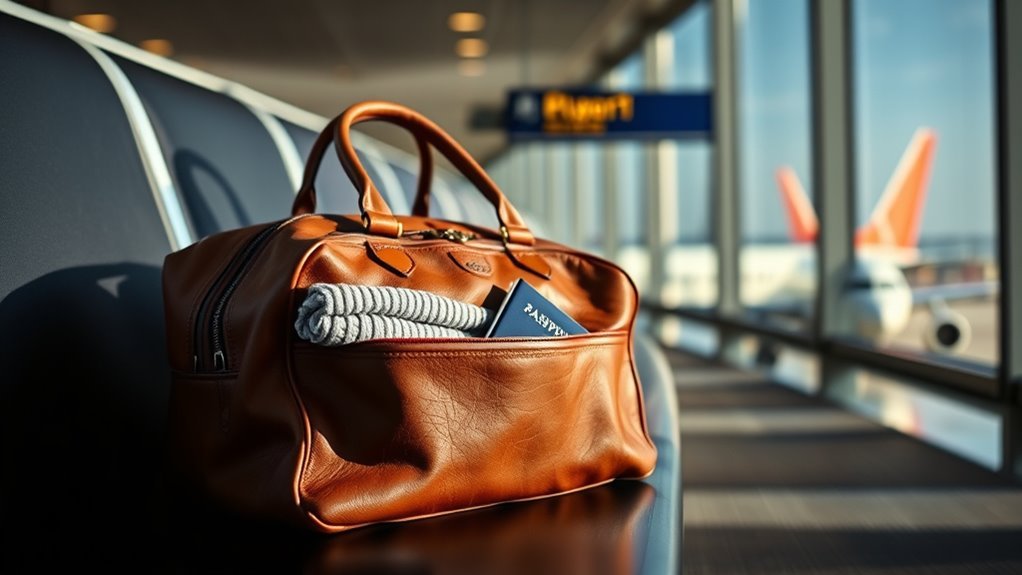
Wondering if your weekender will count as a carry-on? Generally, yes—most airlines treat a weekender as a personal item or carry-on depending on size and how you pack.
Check your airline’s exact dimensions; if the bag fits under the seat, it’s a personal item, freeing your carry-on allowance. If it matches overhead bin limits, it becomes your carry-on.
Hard-shell or overstuffed bags may get gate-checked even if within dimensions. Loyalty status, fare class, and full flights can affect enforcement.
Always measure your packed bag and consult the airline before flying to avoid unexpected fees or gate checks.
What Is a Weekender Bag? Size, Style, Uses
A weekender bag is a mid-sized duffel or tote that usually fits within typical carry-on dimensions, so you’ll want to check measurements before you pack.
You’ll find styles from soft-sided canvas and leather to structured rollaboards, each affecting how much you can squeeze inside.
People use them for short trips, gym sessions, or as an oversized personal item when they need easy access to essentials.
Size And Dimensions
Because you’ll often grab a weekender for short trips, it’s useful to know what defines one: compact rectangular or duffel-style bags roughly 18–22 inches long, 10–12 inches high, and 8–10 inches deep that hold enough for a 1–3 day getaway.
You’ll find variations slightly larger or smaller, but staying within those dimensions helps it qualify as cabin luggage on many airlines. Measure including handles and wheels if present, since carriers check total external size.
Pay attention to depth when packing bulky items. Choosing a bag that fits overhead bins and under seats saves time and avoids gate checks.
Typical Styles
When you pick up a weekender bag, you’re choosing a compact, grab-and-go piece that blends the structure of a small duffel with the organization of a tote—usually sized to hold 1–3 days’ worth of clothes and essentials. You’ll find several common styles that suit different tastes and trips.
Hard-shell weekender bags protect fragile items, while canvas editions feel casual and lightweight. Leather options look polished for business or city breaks, and convertible backpacks free your hands when you need mobility.
- Hard-shell for protection
- Canvas for relaxed travel
- Leather for a refined look
- Convertible for hands-free carry
Common Uses
If you need a compact bag for a short trip or overnight stay, a weekender fits the bill: it’s roomy enough for 1–3 days of clothes, toiletries, and a few extras while staying small enough to carry onboard most airlines. You’ll grab it for weekend getaways, business overnight trips, gym escapes, or as stylish carry-on backup. Pack shoes, a spare outfit, chargers, and a toiletry kit. Use compression cubes to maximize space. Choose leather or canvas based on purpose.
| Use case | Typical contents |
|---|---|
| Weekend | Clothes, shoes |
| Business | Laptop, documents |
Carry-On vs. Personal Item vs. Checked: Key Differences
You’ll want to compare size and dimensions first, since carry-ons, personal items, and checked bags each have different limits.
Check allowed contents next—what you can pack in a weekender may be fine as a personal item but restricted in checked luggage.
Finally, remember boarding placement rules: personal items go under the seat, carry-ons go in overhead bins, and checked bags are gate-checked or sent to the hold.
Size And Dimensions
Curious how airlines decide whether your weekender counts as a carry-on, a personal item, or needs to be checked? You should measure length, width, and height including handles and wheels. Airlines set strict maximums—if your bag exceeds them, it’s checked.
Personal items must fit under the seat; carry-ons go in the overhead bin. Weight limits matter on some carriers, but dimensions are the main gatekeepers.
- Measure your packed weekender before you fly
- Compare dimensions to your airline’s posted limits
- Remember compression doesn’t change external size
- If in doubt, choose a smaller bag to avoid fees
Allowed Contents
While size decides whether your weekender fits overhead or under the seat, what you pack determines where it’s allowed and how it’s screened. You’ll treat carry-on, personal item, and checked baggage differently.
Carry-ons can hold larger liquids in a quart bag, electronics, medications, and valuables you’ll want accessible.
Personal items should be smaller: documents, a tablet, snacks, and small toiletries.
Checked bags accept prohibited carry-on items like large liquids, sharp tools, and bulk sports equipment, but they’re riskier for valuables.
Always follow airline and TSA lists: remove electronics and liquids for screening, and declare restricted items before flying.
Boarding Placement Rules
Knowing what you pack helps, but where that bag goes during boarding is a separate matter. You’ll usually gate-check oversized carry-ons, stow true carry-ons in the overhead, and slide personal items under the seat. Rules vary by airline and fare class, so confirm dimensions and fees before you pack.
- Overhead bin: standard carry-on, larger items like structured weekender bags.
- Under-seat: personal items—soft weekender bags might fit here.
- Gate check: if bins are full or bag exceeds size limits.
- Checked: choose this if weight or space rules force you to surrender the bag.
Carry-On Dimensions That Matter Most
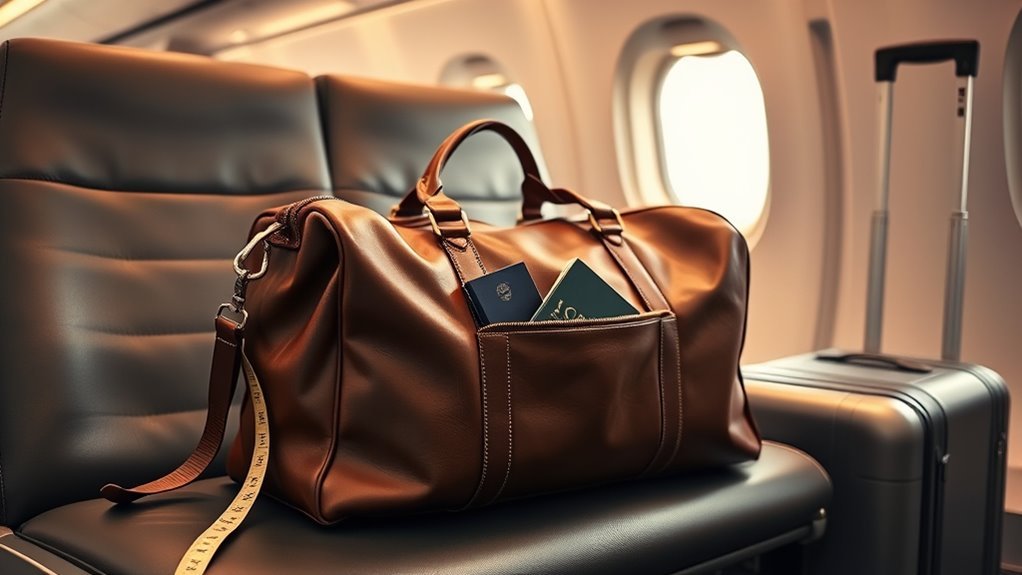
Because airlines measure different parts of your bag, the three dimensions that matter most are length, width, and depth — and how they’re measured (including handles and wheels) determines whether your weekender qualifies as a carry-on.
Measure your packed weekender — length, width, depth (handles and wheels included) — to avoid surprise gate checks.
You’ll need to measure the bag fully packed, including external pockets, telescoping handles extended or stowed per airline guidance, and wheels that add depth.
Some carriers use linear dimensions (L+W+D) while others set strict height and width limits. Check the airline’s official policy and compare your bag’s measurements.
If it exceeds limits, you’ll risk gate check fees or having to check the bag.
Typical Carry-On and Checked Bag Weight Limits
You’ll want to know typical weight limits for carry-ons and checked bags, since they often determine whether your weekender qualifies as cabin luggage.
Domestic flights usually allow heavier carry-ons and higher checked-bag weight thresholds than many international carriers, which can be stricter.
If you exceed those limits, expect overweight bag fees that can be steep and vary by airline and route.
Typical Weight Limits
Most airlines let carry-ons weigh between 7–10 kg (15–22 lb), while checked bags commonly top out at 23 kg (50 lb) for economy fares; exceed those limits and you’ll face fees or forced rebooking. You should weigh your weekender pre-trip and pack strategically to avoid surprises.
Smaller carriers and premium cabins often allow heavier carry-ons, but policies vary. Weighing scales or luggage with built-in scales help. If you’re unsure, check your airline’s site before packing.
- Use a compact scale to confirm limits.
- Shift heavy items to checked luggage if needed.
- Wear bulky clothes to save weight.
- Know fees for overage.
International Vs. Domestic
When you fly domestically, carriers often set carry-on weight limits more generously or don’t enforce them strictly.
However, international flights usually impose stricter, clearly stated limits for both carry-on and checked bags—so check both routes before you pack.
You’ll find domestic airlines often focus on size rather than weight, letting you board with a dense weekender bag if it fits the sizer.
International carriers and many alliances publish explicit kilogram or pound limits for cabin and checked luggage; exceeding them can force repacking or denial.
Always verify your specific carrier’s policy for each sector of your itinerary.
Overweight Bag Fees
After checking whether your flight is domestic or international, you should also watch weight limits—airlines spell out different kilogram or pound caps for carry-ons and checked bags, and exceeding them can trigger overweight fees. You’ll want to weigh your weekender before you leave; typical carry-on limits sit around 7–10 kg (15–22 lb), while checked bags often max near 23 kg (50 lb) for economy.
Fees climb by weight bands, so a small excess can cost considerably. Pack smart, move heavy items to checked luggage if allowed, and consider weighing at the airport scale.
- Weigh your packed bag at home
- Check airline-specific caps
- Redistribute items between bags
- Pay online to reduce airport fees
When Airlines Treat a Weekender as a Personal Item
If your weekender fits under the seat and meets the airline’s size and weight limits, they’ll often count it as your personal item rather than a carry-on. You should check dimensions, weight, and whether a jacket or laptop qualifies separately. Gate agents can be stricter when cabins are full, so pack strategically and be ready to stow larger items.
| Situation | Tip |
|---|---|
| Tight cabin | Compress or gate-check heavier bag |
| Laptop + bag | Use a slim sleeve for laptop |
| Busy flight | Keep essential items accessible |
Knowing rules saves hassle and might avoid unexpected fees.
Major U.S. Carriers: Delta, American, United Rules
While rules vary by carrier, Delta, American and United each let a compact weekender count as either a personal item or a carry-on depending on size and how strict agents are; check each airline’s exact dimensions and weight limits before you pack.
You’ll usually get one free carry-on plus a personal item, but interpretations differ at boarding. Measure your bag, know gate agents enforce overhead space limits, and be ready to gate-check if needed.
- Measure external dimensions to match each airline’s policy
- Pack compressible items to fit stricter limits
- Keep essentials accessible as a personal item
- Have a backup plan for gate check
Low-Cost U.S. Carriers: Spirit, Frontier, Allegiant Rules
Those big carriers tend to be more flexible, but low-cost airlines like Spirit, Frontier and Allegiant take a stricter approach: they charge for most carry-ons and enforce tight size rules.
So a weekender bag that flies as a personal item on Delta or United may cost you extra here. You’ll need to check each carrier’s dimensions: Spirit’s personal item allowance is very small, Frontier and Allegiant vary by fare and membership.
If your weekender exceeds limits you’ll pay carry-on fees at gate rates. Pack compactly, measure your bag, and consider checked baggage or a smaller bag to avoid surprise charges.
International Carry-On Rules That Affect Weekenders
Because international carriers and airports follow varied rules, you’ll want to check both airline policies and departure/arrival country regulations before assuming your weekender qualifies as carry-on. You should verify size and weight limits, allowed contents, and whether gate-checking or fees apply.
Note differing rules for regional jets and long-haul aircraft, plus security restrictions that vary by country.
- Measure your weekender against the airline’s dimensional limits.
- Confirm liquids, batteries, and restricted items per destination.
- Look for free personal item vs. carry-on distinctions.
- Check transfer/connection rules that might impose stricter standards.
How Fare Class and Seat Affect Free Carry-Ons
If you book a higher fare or sit in premium cabins, you’ll usually get more generous carry-on allowances than basic-economy passengers. Your seat location can also matter because some airlines reserve overhead space for certain ticket types or frequent flyers.
You should check fare rules: main cabin, premium economy, business, and first often include larger or additional carry-ons. Basic-economy might limit you to a personal item only.
Window, aisle, or bulkhead seats don’t change the allowance, but frequent flyer status or cabin boarding groups can affect bin access.
Always verify your ticket and airline policy before packing.
Gate Checks and Overhead Bin Realities
When overhead bins fill up or gate agents call for lighter cabins, you’ll often be asked to gate-check your weekender bag — a quick way to free space but one that can mean extra handling and delayed retrieval at your destination. You’ll hand the bag to staff at the jet bridge, get a claim tag, and trust the airline to load it in the hold.
Expect it back at the jet bridge on arrival or on the baggage carousel, depending on the carrier and airport. Protect valuables and fragile items since checked handling is rougher.
You’ll get it back at the jet bridge or carousel—keep valuables and fragile items out of gate-checked bags.
- Pack essentials in a small personal item
- Remove electronics and documents
- Use a durable tag and lock
- Note the gate-check receipt number
Soft-Sided vs. Hard-Sided Weekenders: What Airlines Prefer
When you pick between a soft-sided and hard-sided weekender, think about durability versus flexibility: hardshells resist impacts while soft bags squish into tight overhead spaces.
You’ll find soft-sided bags let you pack a bit more and conform to airline size preferences, though they offer less crush protection.
Check your carrier’s size limits and packing needs to choose what’ll save you gate checks and fit best.
Soft-Vs-Hard Durability
Although airlines don’t explicitly ban soft- or hard-sided weekender bags, carriers usually favor designs that fit overhead bins easily and hold up to handling. So you’ll want to pick the one that matches your travel style and the carrier’s space constraints.
You’ll weigh durability: hard shells resist impacts and moisture, while soft-sided bags absorb crushes and can squeeze into tight spaces. Consider repairability, weight trade-offs, and exterior abrasion.
Match materials to trip risks—rain, rough handlers, or crowded bins—and choose a bag that keeps contents protected without exceeding carrier size limits.
- Hard shell: superior impact resistance
- Soft shell: squeezes into gaps
- Zippers vs. latches: repair notes
- Surface wear: expected differences
Flexibility And Packing
Because airlines judge carry-on suitability by how easily a bag stows and how efficiently you can pack it, your choice between a soft- and hard-sided weekender should hinge on how you plan to use space. You’ll prefer soft-sided if you need squeezability into overhead bins and flexible pockets for odd items. Choose hard-sided when organized compartments and protection for fragile gear matter more than compressibility. Consider weight trade-offs and how often you expand capacity. Use this quick comparison to decide.
| Feature | Soft-Sided | Hard-Sided |
|---|---|---|
| Compressibility | High | Low |
| Protection | Moderate | High |
| Packing organization | Flexible | Structured |
Airline Size Preferences
If you want airlines to accept your weekender as a carry-on, focus first on dimensions and shape—soft-sided bags can squeeze into tight overhead spaces, while hard-sided ones must meet strict size limits without any give.
You’ll typically find soft-sided weekender bags let you compress or mold contents, helping meet varying airline limits. Hard shells protect fragile items but force you to size-check precisely.
Consider airline policies, overhead bin depth, and boarding group priorities when choosing. Balance protection versus flexibility to maximize acceptance across carriers.
- Compressibility helps fit odd spaces
- Hard shells offer better protection
- Check each airline’s dimensions
- Prefer slimmer profiles for boarding endpoints
How to Measure Your Weekender the Right Way
To measure your weekender the right way, lay it flat and include handles and wheels in your dimensions so you don’t get surprised at the gate.
Lay your weekender flat — measure from handles to wheels so gate surprises don’t derail your trip.
Next, use a soft tape measure and record length, width, and height from the longest points.
Measure external pockets and any protrusions you’ll carry onboard.
If the bag compresses, measure both relaxed and compressed heights to compare with airline limits.
Note zipper pulls, straps, and telescoping handles in your total.
Write down measurements and compare with your carrier’s published carry-on allowances before packing.
Recheck after stuffing to avoid last-minute gate dilemmas.
When Your Weekender Becomes Oversized
When your weekender exceeds an airline’s carry-on dimensions, you’ll face choices: gate-check it, pay for checked baggage, or quickly redistribute items into a compliant personal item. Decide fast—boarding lines move. Measure and repack; prioritize essentials like documents, medications, and electronics.
If you gate-check, secure valuables and note retrieval procedures. Paying to check adds cost but reduces stress. Redistributing can save fees but requires strategy.
- Reposition heavy items toward your checked bag to meet size limits
- Use compression cubes to shrink volume immediately
- Keep passports and phones in an accessible smaller bag
- Remove nonessentials before boarding
How Airlines Enforce Size and Weight at Check-In and Boarding
After you’ve repacked or gate-checked an oversized weekender, airlines still enforce size and weight through concrete steps at check-in and the gate.
At check-in, agents measure bags with molded frames or tape measures and place them on scales. If your bag exceeds limits, they’ll charge fees or tag it for checked baggage.
At the gate, staff may re-measure carry-ons using sizers and weigh them if overhead space is tight.
During boarding, attendants monitor overhead bins and may request gate-checking for bulky items.
Knowing these procedures lets you avoid surprises and act quickly if staff intervene.
What to Do If Staff Say Your Bag Isn’t a Carry-On
If staff tell you your weekender isn’t a carry-on, stay calm and keep your tone polite.
Check the bag against the airline’s published size rules and show them measurements or the airline policy on your phone.
If they still refuse, ask to speak with a supervisor to resolve it.
Stay Calm And Composed
Though it’s frustrating to be told your weekender isn’t a carry-on, stay calm and polite—admitting stress rarely helps. You’ll handle staff questions better if you breathe, listen, and respond clearly.
Ask concise, respectful questions about options and next steps. Offer to check the bag at the gate if space allows, or ask about priority overhead space. Keep documents handy and avoid arguing.
- Ask what specific rule it violates
- Request alternative solutions calmly
- Offer to gate-check or pay for carry-on allowance
- Keep receipts and notes for later follow-up
Staying composed speeds resolution and preserves goodwill.
Know Size And Rules
When gate staff say your weekender isn’t a carry-on, don’t guess—measure and check the airline’s size and weight limits right away so you know where you stand. Use a tape to measure length, height, and depth including pockets and wheels, then weigh the bag on a scale.
Compare numbers to the carrier’s published limits online or on your boarding pass. If it exceeds dimensions, ask about gate-checking options, fees, or whether items can move to a personal item to comply.
Keep documentation of the policy and measurements on your phone in case you need to reference them quickly.
Ask For Supervisor Help
Since front-line agents can be overwhelmed or working from strict checklists, ask politely to speak with a supervisor when you think your weekender meets the rules but staff insist it doesn’t.
Explain calmly, show measurements, and cite the airline’s published dimensions or carry-on policy on your phone.
If the supervisor still denies it, request a written reason or fee receipt. Stay firm but courteous to avoid escalation.
- Have your bag measured and photograph dimensions
- Keep policy screenshot or PDF ready
- Ask for supervisor name and department
- Note outcome and get documentation for appeals
Cost: Carry-On Fees vs. Checking a Bag
If you want to save money, weigh the total cost of bringing a weekender as a carry-on against checking a bag. Calculate airline carry-on fees (some carriers charge for main cabin bags), potential gate checking, and baggage size violations that trigger overweight or oversized charges.
Consider connection rules that might force checked luggage. Remember checked-bag fees are per direction and per bag; weigh convenience losses like wait time and lost-bag risk against fees.
Compare totals for your trip length and itinerary. Pack to meet carry-on dimensions to avoid surprises, and re-evaluate per airline since prices and policies change often.
How Elite Status and Credit Cards Waive Restrictions
If you fly often or hold an airline credit card, you’ll find those perks can override strict carry-on rules.
Elite status often lets you board early and bring an extra bag, while premium cards frequently include a free carry-on or checked bag perk.
Let’s look at how those benefits actually work and what to watch for.
Elite Status Perks
When you fly frequently or hold the right co-branded card, airlines will often bend their carry-on rules for you: elite status and premium credit cards can exempt a weekender bag from size or fee restrictions, let you bring an extra personal item, or grant priority boarding that avoids gate-checking.
You’ll get formal allowances tied to status tiers: higher tiers usually allow larger or additional bags, preferred boarding reduces carry-on loss risk, and frontline staff typically enforce rules more leniently for recognized elites.
Verify each airline’s published perks and confirm at check-in to avoid surprises.
- Bigger size allowance
- Extra personal item
- Priority boarding
- Gate agent flexibility
Credit Card Benefits
Although elite status gets you noticed, premium co-branded credit cards are often the easiest way to loosen carry-on rules for a weekender bag. If you hold a qualifying card, you’ll get free checked bag(s), priority boarding, or an extra carry-on allowance depending on the airline’s cardholder perks.
Bring your card and matching ID to the gate or check-in counter and ask politely — agents typically honor cardholder benefits even when cabins are full.
Compare cards: some waive size restrictions, others grant companion benefits or fee credits. Use benefits strategically to avoid gate-checking and travel lighter with confidence.
Practical Boarding Tips to Avoid a Gate Check
Because gate checks often come down to space and timing, you can take simple steps at boarding to keep your weekender with you. Move quickly to your seat when boarding starts, stow the bag above your row if possible, and stay alert for overhead capacity warnings. If attendants ask you to gate check, politely point out your compact bag and ask about fitting it in the cabin.
Move quickly, stow your compact weekender above your row, and politely offer to lift it—beat gate checks with timing and space.
- Board early when allowed to secure overhead space
- Compress or rearrange items to fit stricter bins
- Offer to lift the bag into higher bins yourself
- Keep essentials in a slim personal item
Using a Weekender as Your Only Bag for Weekend Trips
If you’ve managed to keep your weekender with you at the gate, you’re already well positioned to use it as your only bag for a short trip. Pack deliberately: choose versatile clothing, limit shoes to two pairs, and use packing cubes to compress items and separate outfits.
Stash toiletries in a clear, TSA-compliant pouch and wear bulkier layers on the plane. Keep chargers and documents in an accessible pocket.
Weigh your bag at home to avoid surprises and leave room for souvenirs. Traveling light lets you move faster through security and arrivals, and reduces stress when connections are tight.
When to Choose a Compact Rollaboard Instead
When should you trade your weekender for a compact rollaboard? Choose a rollaboard when mobility, organization, or gate-check risk matters. You’ll roll through airports without shouldering weight, and structured shells protect fragile items better.
- You’ve got heavier gear or tech that strains your shoulders.
- Long connections or lots of walking make wheels worth it.
- You need clearer internal organization for business or multiple outfits.
- Your airline often enforces strict overhead rules or risks gate-checking soft bags.
A compact rollaboard keeps you within carry-on limits while easing transit; pick one when comfort and protection outweigh weekend-style flexibility.
Best Weekender Features to Meet Airline Size Rules
Although airlines vary, the smartest weekender choices focus on dimensions, weight, and practical design so you avoid surprises at the gate. Choose a bag that fits airline max linear dimensions, stays under cabin weight limits, and has sturdy handles and comfortable straps for quick maneuvering. Look for compressible fabrics, external pockets for easy access to travel documents, and a structured base so it slides into overhead bins.
| Feature | Benefit | Look for |
|---|---|---|
| Compact size | Fits bin | Measured dimensions |
| Light weight | Avoids fees | Nylon shell |
| Organization | Quick access | Zippers & pockets |
| Structure | Easy stow | Reinforced base |
How Connecting Flights Change Carry-On Rules
Because each carrier sets its own size and weight limits, connecting flights can change what you’re allowed to carry onboard, especially if you switch to a different airline, cabin class, or international leg. You should check each carrier’s policy before packing.
If an initial short-haul allows a larger weekender but a later segment restricts bags, you may be forced to gate-check or pay.
Carry-on entitlement can also change with code-shares, upgrade/downgrade, or regional partners. Plan for the strictest rule on your itinerary and know transfer desk procedures to avoid surprises.
- Verify each airline’s dimensions
- Note cabin class differences
- Watch code-share fine print
- Allow time for re-checking
International Transfer Tips: Customs, Security, and Limits
When you transfer internationally, check the customs declaration rules for your destination and any transit countries so you know what needs to be declared.
Keep liquids, electronics, and medications easily accessible for additional security screening, and pack receipts for high-value items.
If you’re unsure about limits or procedures, ask airport staff before you go through the checkpoint.
Customs Declaration Requirements
Curious what you must declare after an international transfer? You’ll need to report goods, currency, and items subject to restrictions when entering a country. Be honest: undeclared valuables can lead to fines or confiscation.
Keep receipts and declare gifts, purchases over the duty-free allowance, and any food or plant products.
- High-value electronics and jewelry
- Cash or monetary instruments above the limit
- Purchased goods exceeding duty-free thresholds
- Agricultural items, meat, or plants
Fill forms truthfully, use electronic kiosks where available, and ask customs officers if unsure to avoid delays or penalties.
Security Screening Tips
Before you reach the gate, streamlining security checks will save time and stress: pack liquids in a clear quart-sized bag, keep electronics and laptops accessible for quick removal, and have your boarding pass and ID ready.
When transferring internationally, allow extra time for secondary screening and possible passport checks.
Remove belts, watches, and shoes if required, and empty pockets to speed X-ray passage.
Know local rules for prohibited items and duty-free limits to avoid surprises.
If you carry medicines or special equipment, bring prescriptions and declare them.
Stay calm, follow instructions, and ask staff if unsure to prevent delays.
Realistic Packing Examples for a Weekender
If you’re packing a weekender for a short trip, think in outfits and purpose rather than stuffing in every possibility; that makes realistic lists quick to build and easier to fit into a single bag. You’ll pick versatile pieces that mix and match, prioritize toiletries in travel sizes, and plan shoes for activities.
Lay items out before packing to avoid duplicates. Roll or fold what you prefer for neatness, and keep essentials accessible.
- One neutral pair of pants, two tops, lightweight sweater
- One pair of shoes (casual/dress), sandals
- Travel-size toiletries, compact brush
- Charger, documents, small first-aid kit
How to Compress and Max Space in a Weekender
When you want to fit more into a weekender without bulking it up, prioritize compression and smart layering. Roll clothes tightly to reduce air and use packing cubes—assign one cube per outfit type to stack neatly.
Use compression bags for bulky items like sweaters and squeeze air out before sealing. Nest shoes with socks and store fragile or shape-sensitive items inside them.
Compress sweaters in vacuum bags, squeeze out air, nest shoes with socks, and stow fragile items inside.
Fill gaps with belts, underwear, and chargers (not valuables). Wear your bulkiest layers on travel days.
Keep a slim toiletry bag and foldable laundry bag to separate dirty items and reclaim space on return.
Packing Electronics and Valuables Safely in a Weekender
Now that you’ve squeezed every inch out of your weekender, it’s time to protect the items that matter most: electronics and valuables. Pack gadgets in padded sleeves, place chargers together, and keep fragile items centered away from zippers.
Use small lockable pouches for jewelry and passport copies, and consider a slim anti-theft pouch you can stash inside. Keep cables organized to avoid damage and label devices for quick ID.
Always carry irreplaceables on your person when possible. Below are quick reminders to keep things secure and accessible:
- Padded sleeves for tablets and laptops
- Lockable pouch for jewelry and cash
- Cable organizer and labeled chargers
- Anti-theft inner pouch for passport and phone
Quick Pre-Flight Checklist to Ensure Compliance
Before you head to the airport, run through a short, focused checklist to make sure your weekender meets carry-on rules and protects your essentials.
Measure dimensions and compare them to your airline’s limits; if it’s slightly over, swap items to a personal item.
Measure your bag against airline limits — if it’s marginally oversized, move items into a personal item.
Weigh the bag to avoid fees.
Confirm fragile items are padded and electronics are accessible for security screening.
Remove prohibited items and relocate liquids into a clear quart-size bag under limits.
Secure zippers and locks, note external pockets for quick access, and tuck sharp objects into checked luggage or protective cases.
Double-check flight-specific policies online.
How Airport Crowding and Aircraft Type Affect Carry-On Success
That quick checklist helps you meet size and security rules, but actual success getting a weekender into the overhead bin often depends on airport crowding and the aircraft type. You’ll find policies matter less than timing and plane layout.
Gate agents may gate-check bags when flights board full, and narrow-body jets have smaller bins. Choose early boarding if possible, pick a slim weekender, and be ready to gate-check without protest.
- Arrive early to board with priority or early groups
- Prefer wide-body or newer aircraft with deeper bins
- Watch gate announcements for boarding changes
- Have a compact backup bag ready
Weekender Packing Checklist You Can Copy
If you want a stress-free weekend trip, pack only what you’ll actually wear and use: versatile layers, a small toiletry kit, chargers and adapters, and one pair of shoes that suits day and night.
Make a simple checklist: two tops, one lightweight sweater, one pair of pants, one pair of shorts or skirt, underwear for each day plus one spare, socks, pajamas.
Add compact toiletry essentials in travel sizes, a toothbrush, any medications, and sunscreen.
Include phone charger, portable battery, ID, cards, and a reusable water bottle.
Finish with a small laundry bag and a foldable tote for extras.
Frequently Asked Questions
Can I Bring Liquids in My Weekender Without Using a Clear Bag?
No, you usually can’t—TSA requires liquids in carry-on bags to be in a clear quart-sized bag, each container 3.4 ounces (100 ml) or less, and you’ll need to present it separately at security checkpoints.
Are Weekender Bags Allowed in Overhead Bins on Small Regional Planes?
Yes — you can usually stow a weekender in overhead bins on small regional planes, but airlines and aircraft vary, so check size limits and gate staff instructions; if it’s oversized, you’ll likely need to gate-check it.
Do Airline Staff Ever Measure Bags Inside Overhead Bins After Boarding?
Yes — airline staff sometimes measure bags inside overhead bins after boarding if space’s tight or a gate agent flagged you; they’ll open bins or use a sizer, and you’ll be asked to gate-check oversized items.
Can I Gate-Check a Weekender With Fragile Items Inside?
Yes — you can gate-check a weekender with fragile items, but you’ll want to cushion them well, label the bag fragile, and request careful handling; airlines might place it in cargo where bumps and stacking can occur.
Will a Packed Weekender Count as a Carry-On if It Contains a Stroller?
Yes, it usually will: airlines often count a packed weekender as your carry-on even with a stroller inside, so you should check the carrier’s policy, gate-check if allowed, and be ready to gate-check if they require.
Conclusion
Yes—your weekender can count as a carry-on, but it depends on its size and the airline. Measure it: if it fits the carrier’s carry-on dimensions, bring it aboard; if it’s smaller, it might be a personal item. Weigh it to meet limits, stow valuables and electronics properly, and be ready to gate-check if the flight’s full or the plane’s small. Use the checklist to pack smart and avoid surprises at boarding.