Is a Backpack a Personal Item or Carry On? Airline Rules
A backpack can be either a personal item or a carry-on depending on size, how you pack it, and the airline’s rules. If it fits under the seat in front of you it’s usually a personal item; if it needs the overhead bin it’s a carry-on and may incur limits or fees. Airlines may reclassify oversized bags at the gate, so measure and pack compactly. Keep essentials accessible and check specific airline limits to learn more.
Is a Backpack a Personal Item or a Carry-On?
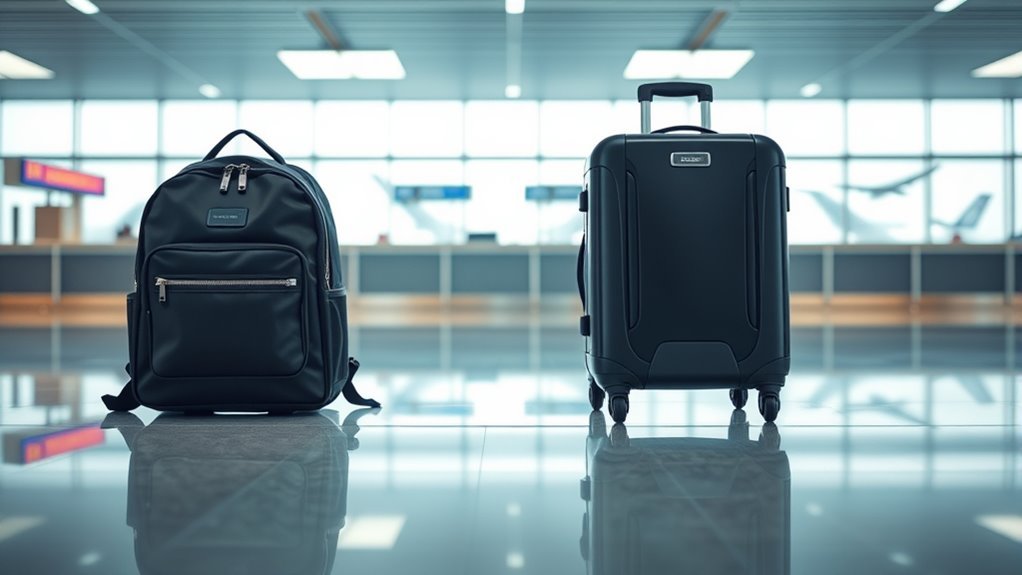
Whether your backpack counts as a personal item or a carry-on depends on its size and the airline’s rules, so always check limits before you pack. You judge by dimensions and what else you carry. If it fits under the seat in front, you’ll usually treat it as a personal item; if it needs the overhead bin, it’s a carry-on.
Airlines vary, so you adapt: compress clothing, use slim organizers, or choose a smaller pack to avoid fees.
At the gate, staff may reclassify oversized packs, so keep essentials accessible and be ready to gate-check if needed.
Official Airline Criteria for Personal Items vs. Carry-Ons
When you check an airline’s policy, you’ll usually find two clear factors that determine if a bag is a personal item or a carry-on: size (dimensions and sometimes weight) and where the carrier expects it to be stowed (under the seat or in the overhead bin).
You should read rules before packing, since airlines enforce limits and may charge for oversized items. Look for specific measurements, permitted contents, and any class or fare exceptions.
If you know expectations, you can avoid gate fees and forced gate-checking.
- Check published dimensions and weight limits
- Note stowage location rules
- Review fare-class exceptions
- Confirm enforcement practices
Carry-On vs. Personal-Item Sizes for Backpacks
Now that you know how airlines classify bags by size and stowage, let’s look specifically at backpacks: carriers usually set two separate size envelopes—one for personal items that must fit under the seat and a larger one for carry-ons that go in the overhead bin.
You should treat slim daypacks or laptop sleeves as personal items if they comfortably slide under seats; bulkier travel backpacks usually qualify only as carry-ons.
Check your airline’s published dimensions and compare them to your pack’s typical packed shape. When in doubt, use a smaller bag or be prepared to gate-check a larger backpack.
How to Measure Your Backpack (At Home or the Airport)
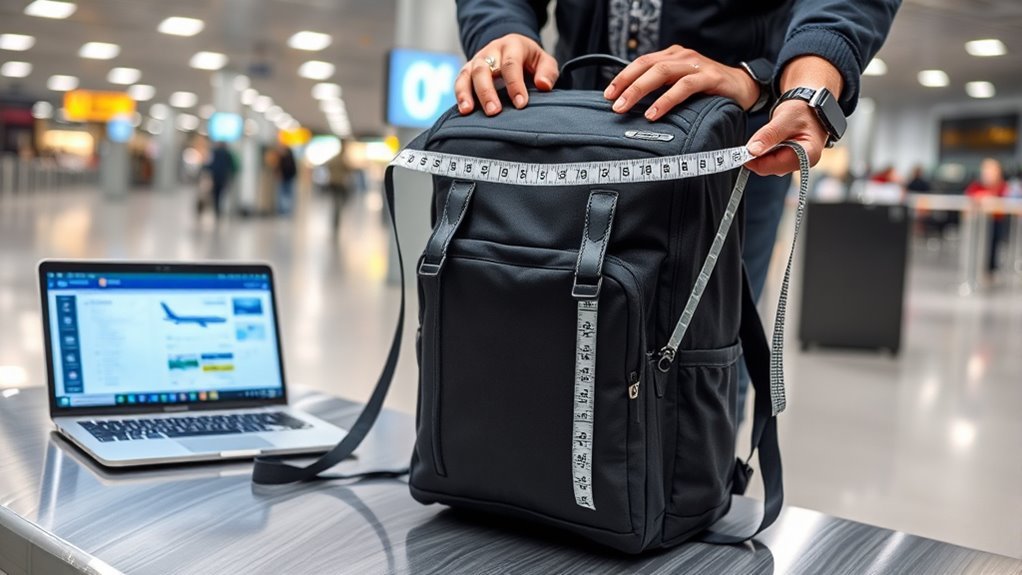
Start by measuring the external dimensions of your backpack—height, width, and depth—so you can compare it to airline size limits.
Then check the interior capacity by filling it with the items you usually carry to see if it fits as a personal item or full carry-on.
If it’s close to the limit, remeasure at the airport while packed to be sure.
Measure External Dimensions
Before you head to the gate, measure your backpack’s external dimensions so you know whether it fits as a personal item or carry-on. Lay the bag flat and measure height, width, and depth at the widest points, including wheels, straps, and any external pockets. Use a rigid tape measure for accuracy and record numbers in centimeters and inches.
If at the airport, try fitting the backpack into airline sizers without compressing it. Compare your measurements to the airline’s published limits before boarding to avoid fees or gate checks.
- Measure with straps extended and folded
- Include protruding pockets
- Round up small fractions
- Recheck after packing
Check Interior Capacity
Want to know whether that backpack will hold everything you need and still meet airline rules? Open all compartments, empty pockets, and lay items out. Use a tape measure or ruler to note internal height, width, and depth—measure along seams for usable space.
For flexible packs, stuff it with pillows or clothes to mimic packed shape, then compress to simulate airline handling.
Calculate liters by multiplying H×W×D (cm) and dividing by 1,000, or use a luggage scale for filled weight.
Compare capacity to airline size/volume limits and your essentials list. Adjust packing or choose another bag if needed.
How Wearing and Packing Affect Classification
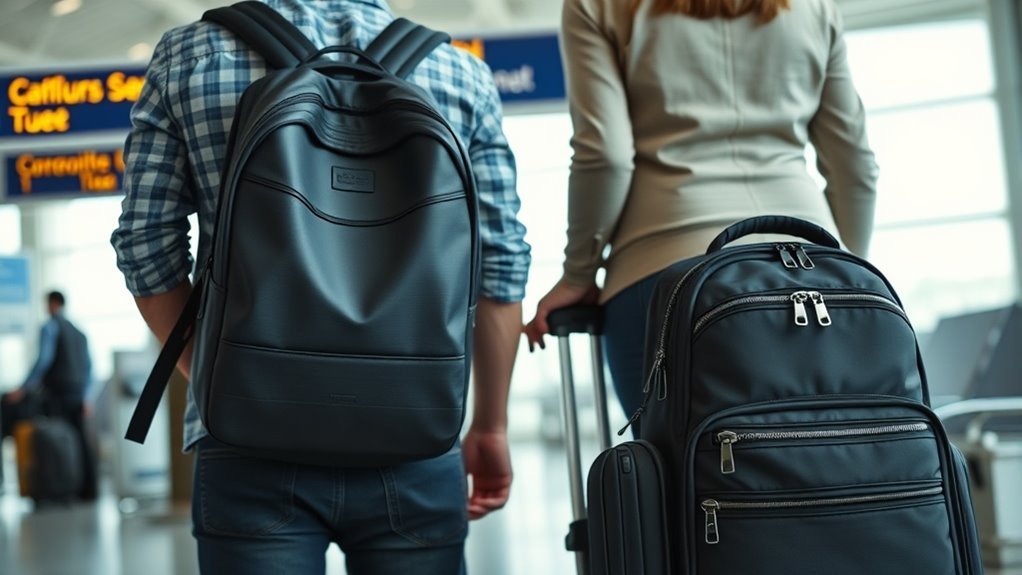
Whether you wear your backpack on your back or carry it by the straps can change how gate agents classify it, so don’t assume wearing it always makes it a personal item.
How you pack matters too: if it’s bulging or exceeds airline packed-size rules, it’ll likely be counted as a carry-on regardless of how you carry it.
Keep it compact and test its packed dimensions to avoid surprises.
Wearing vs. Carrying
Although it might seem like a small detail, whether you wear your backpack or carry it can change how an airline classifies it. You should know that wearing it on your back often reads as a personal item, while holding it by the handle or stowing it externally can look like a carry-on. Gate agents and flight crews judge by visibility and intent, so act deliberately.
- Wear it to keep it compact and perceived as personal.
- Carry it to signal a larger, stowable bag.
- Sling it when boarding to avoid gate-checking.
- Ask staff if unsure to prevent surprises.
Packed Size Rules
How tightly you pack your backpack can change whether an airline treats it as a personal item or a carry-on, because agents look at both visible dimensions and how the bag behaves when you move it.
You should compress soft items to keep the pack within allowed measurements; a bulging bag often ends up classified as a carry-on. Wear it on your back to show compactness, or keep it under the seat to prove it fits.
Expandable pockets, water bottles, and trip souvenirs can push you over limits, so pack strategically. If in doubt, weigh and measure after loading to avoid surprises.
Smart Packing: Keep Your Backpack a Personal Item
If you pack strategically, you can keep your backpack classified as a personal item and avoid gate-check hassles. Choose a slim, soft-sided pack that fits under the seat, prioritize lightweight essentials, and compress bulky items. Place valuables and documents where you can access them quickly. Don’t overload pockets or add rigid frames that increase dimensions.
Pack smart: choose a slim soft pack, compress bulk, keep essentials accessible, and avoid rigid frames.
- Use packing cubes to flatten clothes and save space.
- Limit liquids to a single clear toiletry bag under size limits.
- Wear heavier items like jackets or boots to reduce bulk.
- Weigh your bag at home to confirm it stays light.
Major Airlines’ Backpack Rules (U.S. & International)
When you’re preparing to travel, know that airlines vary widely on what they’ll accept as a personal item, so check rules before you get to the gate.
US carriers like Delta, United, and American typically allow a small backpack as a personal item if it fits under the seat; dimensions differ by airline. Southwest and JetBlue are more lenient but still have limits.
International carriers vary more: European and Asian airlines often enforce stricter size rules and may require carry-on payment.
Low-cost airlines commonly treat backpacks as carry-ons unless they meet strict under-seat size limits.
Always verify dimensions and policies.
What to Do If Your Backpack Is Flagged or Gate‑Checked
Worried your backpack’s been flagged or handed off at the gate? Stay calm and act promptly: ask the gate agent why, confirm retrieval procedures, and keep essentials with you. If gate-checked, tag your bag and remove valuables. Get a claim stub and verify the destination carousel or curbside pickup.
- Ask politely for the reason and whether it’s refundable or avoidable next time.
- Remove electronics, medications, and documents before handing it over.
- Keep the claim ticket safe and take a photo of the bag and tag.
- Follow up with airline baggage service immediately if it’s delayed or damaged.
Avoid Fees and Hassles: Priority, Approved Travel Backpacks
Because airlines prioritize size and compliance, choosing a travel backpack that meets carry-on or personal-item rules can save you time and money. Pick backpacks labeled carry-on-approved or personal-item-sized and check dimensions against your carrier’s limits before you pack.
Look for structured frames, compression straps, and external pockets that keep essentials accessible for security and boarding. Consider lightweight, durable materials and lockable zippers to avoid gate-checks and theft.
If you travel frequently, invest in a model that fits overhead bins comfortably; that priority will reduce fees, speed boarding, and give you reliable carry privileges every trip.
Frequently Asked Questions
Can I Bring a Backpack as Carry-On Plus a Personal Item on the Same Flight?
Yes — you can usually bring a backpack as your carry-on and also a separate personal item, but rules vary by airline and fare. Check size limits and gate policies so you won’t be charged or asked to gate-check your bag.
Can School Backpacks With Laptops Count as Personal Items?
Yes — you can often count a school backpack with a laptop as a personal item if it fits under the seat and meets airline dimensions, but policies vary, so check your carrier’s rules before boarding to avoid surprises.
Do Backpack Straps or External Pockets Affect Classification?
Yes — airlines often judge by size, not straps, but bulky external pockets or very long straps can make a backpack look oversized, so you’ll want a compact, streamlined pack to increase chances it’s accepted as a personal item.
Are Inflatable or Compressible Backpacks Measured Differently?
Yes — airlines may treat inflatable or compressible backpacks differently: you’ll often get them measured when expanded, but gate agents can compress them into your personal item or carry‑on allowance, so pack accordingly and stay flexible.
Can Gate Agents Require Me to Check a Backpack Purchased Onboard?
Yes — gate agents can require you to check a backpack purchased onboard if it violates size, weight, or stowage rules, safety concerns exist, or the flight’s overhead bin space is full; you’ll then retrieve it at baggage claim.
Conclusion
So, is your backpack a personal item or a carry-on? It depends on airline rules and size: keep it small and slim, measure it, and pack smart—electronics and essentials only—to qualify as a personal item. Wear it on boarding or stash it under the seat to avoid gate-checking. Know major carriers’ limits, use approved travel backpacks, and consider priority boarding to skip overhead space fights. Be ready to pay or gate-check if it exceeds limits.