
Is 32 Inch Luggage Oversized? Airline Size Rules
Yes — a 32‑inch suitcase is often treated as oversized because airlines add height, width and depth to calculate linear inches (commonly limited to 62″). Carriers measure external dimensions including wheels and handles, and many 32″ tall cases combined with typical widths/depths exceed that cap, triggering oversize fees or gate checks. Policies and weight limits vary by airline and fare, so measure and check rules before travel — keep going to see measurement tips, fee workarounds and packing options.
Will a 32-Inch Suitcase Be Oversized?
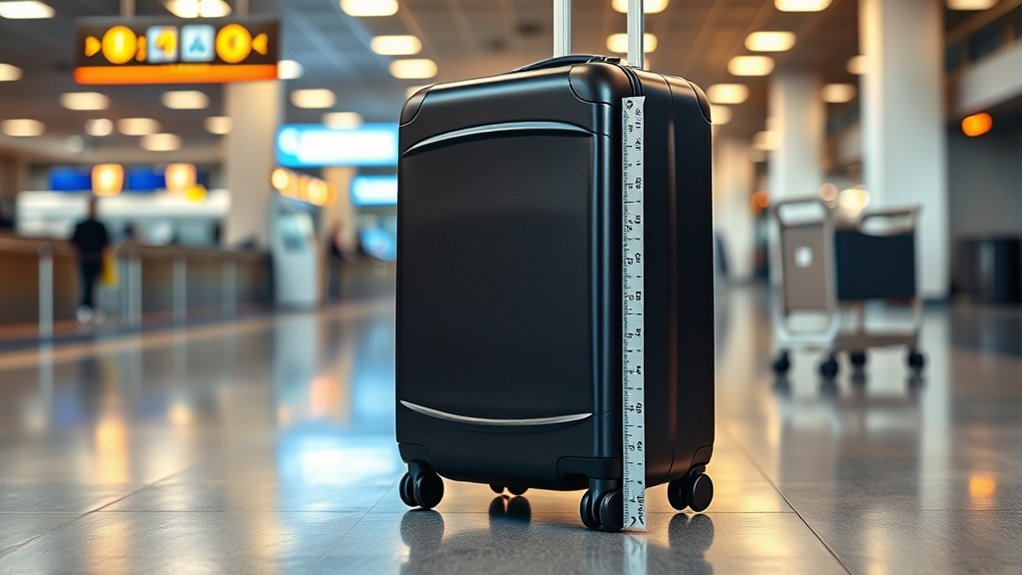
Wondering whether a 32-inch suitcase counts as oversized? You’ll likely find it exceeds many airlines’ standard checked-size limits, which often cap at 62 linear inches (length + width + height).
A 32-inch case usually pushes total dimensions and can trigger oversized fees on major carriers. You should check your airline’s specific size and weight policies before you travel.
If you’re near an airline’s limit, consider packing lighter, using a smaller bag, or paying the extra fee.
Remember fees and allowances vary by carrier and fare class, so verify rules for your particular flight to avoid surprises.
How Airlines Measure Luggage Size
When you check a bag, airlines measure the outside dimensions only — wheels and handles included. They use the linear size calculation, adding length + width + height to compare against limits.
Knowing that simple sum lets you quickly tell if a 32-inch case will be oversized.
External Measurements Only
Because airlines assess luggage by its external dimensions, you’ll want to measure the widest, tallest, and deepest points of your 32-inch suitcase — including wheels, handles, and any protrusions — to see if it exceeds the carrier’s stated limits.
Use a tape measure from edge to edge, capturing bulges from pockets or straps. Measure with handles retracted and extended, if the airline specifies how they evaluate telescoping pulls.
Record each dimension in inches or centimeters and compare to the airline’s posted maximums. If any single external measurement exceeds limits, the bag will be considered oversized regardless of internal capacity.
Linear Size Calculation
If you want to know whether a 32-inch suitcase counts as oversized, start by calculating its linear size: add the height, width, and depth (including wheels, handles, and any protrusions) and compare that total to the airline’s maximum linear dimension.
Measure at the suitcase’s fullest points with a tape measure, standing it upright for height, then width across the front, and depth from front to back.
Round up to the nearest whole inch if your airline requires it.
If the sum exceeds the allowed limit, it’s oversized and may incur fees or require gate-checking—plan accordingly to avoid surprises.
The 62 Linear-Inch International Rule
You’ll learn that linear inches add length + width + height (including handles and wheels) to get a suitcase’s total.
The 62-inch limit exists as a global safety and storage standard for checked bags, but some airlines set their own stricter limits or charge oversize fees.
I’ll also point out common exceptions and where carriers often vary so you can check before you fly.
What Counts As Linear-Inches
When planning international travel, airlines measure checked baggage by linear inches—the sum of your bag’s length, width, and height—to enforce the common 62-inch rule. You’ll include wheels, handles, and any external pockets when you measure; manufacturers sometimes list measurements without protrusions, so verify.
Lay the bag flat, measure at its largest points, and round up fractions per the carrier’s guidance. If you pack add-ons or straps, those count too. Use a tape measure for accuracy to avoid surprises at check-in.
- Measure length, width, height at the bag’s fullest points.
- Include wheels and fixed handles.
- Count external pockets and straps.
- Round per airline policy.
Why 62-Inch Rule Exists
Having measured your bag and confirmed what counts toward linear inches, it helps to know why airlines stick with the 62-inch cap. You’ll find that the rule balances passenger safety, cargo handling, and aircraft space.
Larger bags can block aisles, overload conveyor systems, and exceed compartment limits. It also simplifies international standards so ground crews and ticket agents share one clear threshold.
Exceptions And Airline Variations
Although 62 linear inches serves as the common international benchmark, airlines and countries still set their own exceptions and variations you should know before booking. You’ll find differences in checked baggage limits, oversized fees, and whether measurements include wheels and handles.
Low-cost carriers often enforce stricter size caps; some international routes adopt looser policies for specific markets. Always check your carrier’s published rules and any country-specific regulations before packing.
- Regional carriers may apply smaller size limits.
- Premium cabins sometimes allow larger bags.
- Special items (sports gear, medical equipment) get separate rules.
- Enforcement varies at check-in and gate.
How 32 Compares to 62 Linear Inches
How do 32 inches stack up against the 62 linear-inch limit airlines use? You measure linear inches by adding length + width + height. A single 32-inch dimension is usually the height; your bag’s other two dimensions matter.
For typical 32″ suitcases, combined width and depth often push total linear inches past 62, making them oversized. If your 32″ case is slender, it might stay under 62, but that’s uncommon.
Always measure the full exterior dimensions and add them. If the sum exceeds 62, expect oversize fees or restrictions; if not, you’ll meet that common airline threshold.
Typical U.S. Checked Bag Size Rules
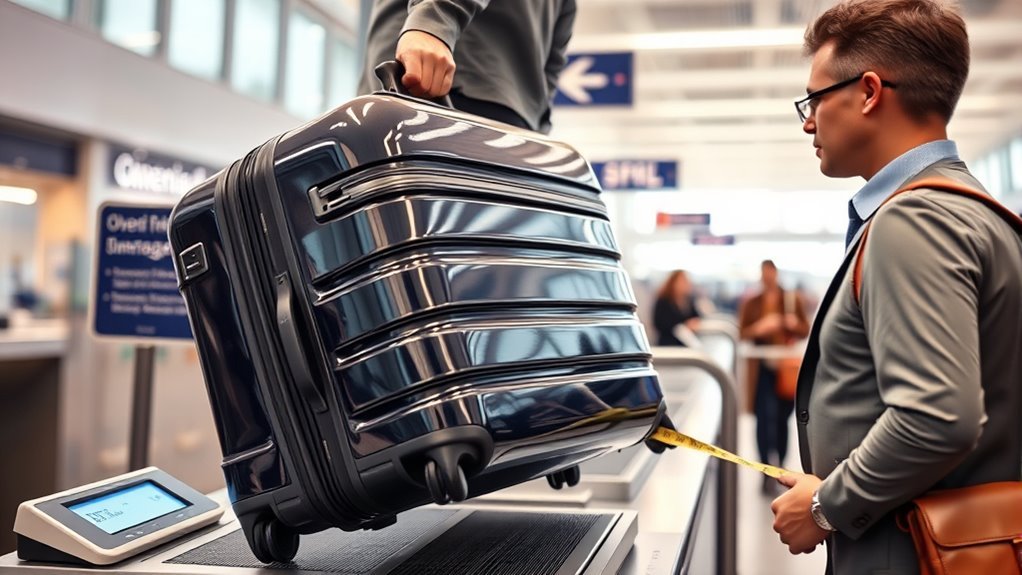
When you check a bag on most U.S. airlines, they expect the exterior dimensions to stay within about 62 linear inches (length + width + height) and the weight to be no more than 50 pounds for standard economy fares. Exceeding either usually triggers oversize or overweight fees and sometimes handling restrictions.
You should measure your 32-inch suitcase including wheels and handles, verify the carrier’s published limits, and weigh it at home to avoid surprises.
Common practices include:
- Allowing limited oversize fees for bags slightly over 62 inches
- Charging higher fees for weights above 50 pounds
- Imposing strict caps in premium classes
- Requiring special handling for very large items
Low-Cost Carriers’ Stricter Checked Limits
With low-cost carriers you’ll find strict size enforcement, so your 32-inch bag could be flagged even if it isn’t heavy. Some airlines only check weight, but many still charge or reject bags that exceed exact linear dimensions.
Expect extra fees and tighter limits, so measure and weigh your suitcase before you head to the airport.
Strict Size Enforcement
Wondering why your 32-inch suitcase might get dinged at the gate? You’ll face strict size enforcement on many low-cost carriers that measure and reject bags exceeding their limits. They want fast turnarounds and consistent loads, so gate agents won’t negotiate.
- Carriers use rigid templates or sizers to check length, width, and depth.
- Even small protrusions—wheels, handles—can push a bag over the limit.
- If it fails, you’ll pay oversized fees or be forced to check differently.
- Policies vary by airline; check the specific dimensions and tolerance before travel.
Plan ahead to avoid surprises.
Weight-Only Exceptions
If you fly a low-cost carrier, don’t assume only size matters—many budget airlines enforce weight-only rules that cap checked baggage by mass rather than dimensions, and that can catch travelers off guard.
You’ll find rules like 15–23 kg per bag regardless of a 32-inch case fitting the sizer. Weigh your packed suitcase before heading to the airport, because agents may refuse or charge penalties if it exceeds the limit even when it fits dimensionally.
Consider redistributing items, using a lighter case, or shipping heavy items separately.
Always check the carrier’s exact kilogram limit and how strictly they enforce it.
Extra Fees And Limits
Because low-cost carriers price every kilogram and inch, you’ll often face stricter checked-bag limits and extra fees that make a 32-inch suitcase costly to bring, even when it’s technically allowed. You’ll pay for oversized dimensions, weight overages, and sometimes a separate “large” bag charge; online prepayment can lower costs, but gate-checks are punitive.
Check the carrier’s published linear inch/centimeter limits and weight caps, and weigh your packed case before arrival. Plan alternatives—ship, split, or downgrade—to avoid surprise charges.
- oversized dimension fees
- per-kilogram weight surcharges
- bulk/large-piece premiums
- gate-check penalties
International Carrier Policy Variations to Expect
Although many airlines follow similar size-and-weight frameworks, international carriers vary widely on what they call “oversized” and how they’ll charge or handle a 32-inch suitcase.
You’ll find some carriers strictly enforce linear dimensions (length+width+height), others set max linear totals that your 32-inch case may exceed.
Weight rules differ too: airlines might accept larger dimensions if under a weight threshold, or reject heavy 32-inch bags outright.
Fees range from a modest surcharge to steep overweight/oversize penalties, or mandatory cargo transfer.
Always check the specific carrier’s policy before booking to avoid surprises at check-in.
Airlines That Usually Accept 32-Inch Bags
You’ll find that many major international carriers will usually accept 32-inch bags, though weight limits and excess fees can apply.
U.S. legacy airlines often allow them too, especially in checked baggage for premium or frequent flyers.
Low-cost carriers are the main exceptions, so you’ll want to check their specific size and weight rules before you fly.
Major International Carriers
When flying internationally, many major carriers let you check a 32-inch suitcase without extra fuss, though rules vary by airline and route. You’ll usually be fine if total linear dimensions and weight meet the carrier’s checked-bag allowance, but you should confirm specifics before packing.
Some carriers include large bags in the fare; others charge oversize fees or enforce strict weight limits.
- Emirates and Qatar often accept 32″ within weight-based allowances.
- Lufthansa and Air France allow 32″ on many fares, watch weight caps.
- Singapore Airlines accepts larger checked pieces on most international tickets.
- Thai Airways and ANA permit 32″ with standard checked allowances.
U.S. Legacy Airlines
If you’re flying domestically in the U.S., many legacy carriers are generally more forgiving about 32-inch checked bags than low-cost rivals, provided the bag meets their weight and linear-dimension rules.
You’ll find airlines like American, Delta, and United typically allow 62 linear inches (length + width + height) as standard; a 32-inch roller usually fits that limit unless it’s oversized by depth or exceeds weight limits (often 50 lbs for economy).
Check your ticket’s allowance and elite or credit-card benefits, since free checked pieces, overweight fees, and waivers vary.
Always confirm current policy before you pack.
Low-Cost Carrier Exceptions
Although low-cost carriers usually enforce stricter size and weight rules, a few make exceptions for 32-inch checked bags when they meet linear-dimension and weight limits. You can travel with a 32-inch case if you confirm the carrier’s max linear inches (length+width+height) and pay any oversize fee. Some LCCs accept 62–80 linear inches on certain fare types or with add-ons.
- Check the airline’s online baggage chart before booking.
- Weigh and measure your packed bag at home.
- Expect higher oversize fees than legacy airlines.
- Consider prepaying baggage to reduce surprise charges.
Airlines That Often Tag 32-Inch as Oversized
Because airlines set their own size rules, a 32-inch suitcase can be treated differently depending on the carrier, and you’ll often find it flagged as oversized by U.S. legacy carriers and many international airlines with strict checked-bag limits.
A 32-inch suitcase may be flagged oversized by many legacy and international carriers due to strict linear-inch limits
You’ll commonly see Atlanta-based and major transcontinental airlines enforce 62 linear-inch (length+width+height) limits that make a 32-inch case borderline or over.
European flag carriers and many Asian carriers also stick to similar linear measurements and may charge oversize fees or require gate checks.
Low-cost carriers sometimes allow larger bags for a fee, but the biggest carriers are likeliest to tag 32-inch pieces.
Weight Limits and 32-Inch Luggage
When you pick a 32-inch suitcase, weight limits become as important as dimensions because many airlines cap checked-bag weight at 50–70 pounds and will charge hefty fees for anything heavier. You should weigh your packed bag at home, distribute dense items across bags, and choose lighter materials to stay under limits.
Know airline-specific variances and loyalty exemptions that might raise your allowance.
- Use a luggage scale before leaving.
- Pack clothing compressibly and fill gaps with soft items.
- Place heavy items near wheels for balance.
- Consider paying for an extra checked bag instead of overpacking.
Oversize Fees You Should Expect
If your 32-inch bag exceeds an airline’s size or weight limits, you’ll usually face an oversize charge that can be steep.
Know whether airlines charge by linear dimensions or by weight, because a heavy but compact bag might hit a different fee than a large but light one.
You can avoid or reduce fees by checking specific carrier rules, redistributing items, or shipping bulky items ahead.
Common Oversize Charges
Airlines charge oversize fees for luggage that exceeds their size limits, and you should expect these charges to vary widely by carrier and route. You’ll usually see a flat fee for checked bags beyond linear dimension limits, higher rates for international flights, and possible denial if a bag’s too large.
Know the carrier’s published fee, whether it’s charged per direction, and if online purchase reduces the price.
- Domestic short-haul oversize flat fees
- International or interline premium surcharges
- Gate-checked or oversized handling charges
- Per-bag vs per-direction billing differences
Weight Versus Dimension Limits
Although size matters, weight often dictates whether you pay an extra fee: carriers set both linear-dimension limits (usually around 62 inches/157 cm) and separate weight caps (commonly 50 lbs/23 kg), and exceeding either can trigger different charges or handling rules.
You’ll see overweight fees that differ from oversize surcharges; some airlines charge per pound/kilogram, others use flat rates for ranges. International carriers may have lower weight limits.
Excess weight can also require gate-checking or cargo placement, affecting liability and delivery time. Always check your specific airline’s published fee chart so you know what to expect.
Ways To Avoid Fees
When you want to dodge oversize fees, plan proactively: measure and weigh your bag before you leave, choose luggage that fits standard linear limits (around 62 inches/157 cm), and consider packing strategies that keep dimensions down—like using soft-sided bags, compression cubes, or splitting bulky items into checked and carry-on pieces.
You’ll also check airline size rules and fee charts, gate-check only when necessary, and use travel-sized essentials. Inspect zippers and handles to prevent bulging. Carry critical items onboard to reduce checked volume.
- Use compression packing systems
- Choose expandable but compressible bags
- Ship bulky items ahead
- Monitor airline policies closely
What Happens When Baggage Is Flagged Oversized
Wondering what happens if your suitcase is flagged oversized? You’ll be stopped at check-in or the gate. Staff will measure and weigh it, then tell you the airline’s specific options.
You can pay an oversized baggage fee, which is often higher than a standard checked-bag charge. Some carriers require you to repack items into compliant bags or remove excess before flying.
If neither works, you might need to ship the item separately or decline travel with that bag. Expect additional documentation and receipts for oversized charges.
Always ask staff for exact costs and next steps to avoid surprises.
Damage Risks for Large, Overfilled Suitcases
If your bag gets flagged for size, don’t forget that large, overfilled suitcases also raise the risk of damage in transit and handling. You expose zippers, wheels, and shell seams to extra stress; stuffing soft items against rigid frames can crack plastics or burst seams.
Overfilled suitcases not only get flagged—they stress zippers, wheels and shells, increasing risk of cracks and bursts.
Handers may sling or stack your case into tight holds, increasing impact points. You can’t control every bump, but you can mitigate loss by packing strategically and choosing sturdy luggage.
- Overstuffed zippers split under pressure
- Protruding wheels and handles snap when crushed
- Hard-shell cracks from concentrated force
- Contents shift and break inside
Measure Your Suitcase Correctly at Home
Because airlines count length, width, and height (including wheels and handles), measure your suitcase the way they’ll see it: stand it upright, extend the handle fully, and use a tape measure from the top of the handle down to the base, then across the widest points for width and depth.
Check wheels and corner bumpers for protrusions, and press any removable exterior pockets flat.
Record measurements in inches and round up to the nearest whole number.
Compare those figures to your airline’s maximums before packing.
Re-measure after adding any straps or external gear to avoid surprises at check-in.
Calculating Linear Inches for a Packed Bag
When you’ve packed your bag and zipped it closed, measure its height, width, and depth—including wheels, handles, and any bulging pockets—and add those three numbers together to get the linear inches. You’ll use that total to compare against airline limits; carry-on, checked, and oversized thresholds differ.
Measure with the bag as you’ll carry it, including extended handles and exterior pockets. Record the number before you leave to avoid surprises at check-in.
- Use a rigid tape or ruler for accuracy
- Measure from the longest points
- Round up to the nearest whole inch
- Note airline-specific linear inch limits
Packing Strategies to Avoid Oversize Fees
Although you’ll want to bring everything, smart packing trims size and avoids oversize fees. Prioritize versatile clothing and plan outfits to limit bulk.
Wear your heaviest shoes and jacket on the plane to reduce packed volume. Use compression bags or packing cubes to flatten garments and organize layers so you don’t overpack.
Shift dense items into your personal item — laptop bag or backpack — keeping within airline rules. Weigh and measure your packed bag before heading to the airport; adjust items to meet linear-inch limits.
Finally, pack toiletries in travel sizes and replace hard cases with soft pouches to save space.
When to Downsize: 28 Vs 30 Vs 32
If you’ve trimmed your packing to dodge oversize fees, the next step is choosing the right case size for your habits and trips. You’ll pick 28 if you want lighter lifting and faster handling, 30 for a balance of capacity and maneuverability, or 32 only if you habitually pack bulky items and accept possible airline surcharges.
Consider typical trip length, your tendency to bring gifts or gear, and whether you’ll check bags on multiple carriers.
- Short trips and carry-on-first travelers: favor 28
- Frequent two-weekers: consider 30
- Gear or bulky clothing: 32
- Multi-carrier itineraries: prefer smaller sizes
Best 32-Inch Designs for Durability
When you’re choosing a 32-inch bag, prioritize hard-shell construction for impact resistance and shape retention.
Look for reinforced zippers and corner protectors to keep seams and edges from splitting during rough handling.
These features together give you the best shot at a durable, long-lasting suitcase.
Hard-Shell Construction
Because you’re investing in a 32‑inch suitcase for longer trips, a hard‑shell construction is often the best choice for durability and protection. You’ll appreciate impact resistance and weather shedding when wheels and handles take most abuse.
Choose shells that balance weight and toughness so you’re not overpacking due to heavy luggage. Look for smooth finishes that resist scuffs and materials like polycarbonate or ABS that flex without cracking.
Maintenance is simple—wipe clean and avoid drops—but be mindful of internal organization to protect fragile items.
- Polycarbonate: lightweight, flexible impact resistance
- ABS: affordable, rigid protection
- Composite blends: balance weight and strength
- Textured finish: hides scratches and scuffs
Reinforced Zippers And Corners
Although the shell absorbs most impacts, reinforced zippers and corners keep a 32‑inch suitcase functioning trip after trip. You’ll want heavy‑duty, double‑stitch zipper tapes, oversized metal sliders with locking-compatible pulls, and molded corner guards or internal frame reinforcement to prevent splits and seam failures.
You’ll notice smoother handling when zippers glide without snagging, and corners take knocks instead of seams. Check for bonded or taped seams, replaceable corner caps, and dual-zipper designs that distribute stress.
Prioritize tested closures and corner protection over cosmetic details; they extend service life, reduce repair bills, and keep oversized luggage reliable through frequent airline handling.
Soft vs Hard Shell: Oversize Trade-Offs
If you’re deciding between soft and hard-shell 32-inch luggage, consider how each handles oversize rules and real-world packing needs.
You’ll find hard shells keep shape, protecting contents and sometimes meeting strict linear limits, but they’re rigid and can push you into oversize fees if dimensions exceed limits.
Soft shells flex, letting you squeeze into tight compartments and avoid marginal oversize charges, though they offer less impact protection and can bulge.
Soft-shell bags flex to squeeze into tight spaces and dodge borderline oversize fees, though they sacrifice some protection.
Choose based on routes and handling risk.
- Hard shell: better protection, fixed dimensions
- Soft shell: flexible fit, compressible edges
- Hard shell: less forgiving under pressure
- Soft shell: lighter, more external pockets
Use Compression and Packing Cubes With 32
With a 32-inch bag, you can squeeze extra mileage out of the interior by using compression bags to reduce bulk and fit more.
Use packing cubes to keep clothing sorted and to make it easy to find outfits without unpacking the whole case.
Tuck fragile items between cubes or in a padded cube to shield them from knocks.
Maximize Volume With Compression
When you want to squeeze the most into a 32-inch suitcase, compression and packing cubes are your best tools; they let you organize, flatten, and layer items so you get far more usable volume without overstuffing. Use a mix of flat compression bags for bulkier clothes and smaller cubes for accessories so every inch counts.
Roll lightweight garments into cubes to reduce air pockets. Place dense items at the base, softer items above, and vacuum or zip down bulky sweaters. Check weight distribution as you compress to avoid awkward handling at check-in.
- flat compression bags
- rolling in cubes
- dense-base, soft-top packing
- weigh as you pack
Organize Efficiently Using Cubes
Although packing cubes won’t increase your suitcase’s external size, they’ll let you organize a 32-inch case so every inch works harder. Use a mix of cube sizes: large for bulk clothing, medium for shirts and pants, small for underwear and socks.
Compressible cubes squeeze out air while keeping layers separate, so you won’t dig through a messy pile. Label or color-code cubes for outfits, laundry, and toiletries (spill-proof pouches only).
Place heavier cubes near wheels to stabilize rolling, lighter ones on top. Cubes speed packing, simplify security checks, and let you extract items without upsetting the whole case.
Protect Fragile Items Strategically
Now that your cubes have turned chaos into order, think about protecting anything breakable inside that neat system. You’ll want to combine compression and padding so glass, electronics, and souvenirs survive handling.
Compress soft items around fragile pieces, then nest those inside a small cube to limit movement. Label the cube “FRAGILE” and place it near the suitcase center, away from wheels and seams.
At security, expect a quick inspection—pack items so they’re easy to remove and repack.
- Wrap each item in clothing or bubble wrap
- Use a dedicated, cushioned packing cube
- Fill gaps with socks or scarves
- Position cube centrally and upright
Split Packing: Avoiding Oversized Charges
If your 32-inch suitcase risks an oversized fee, split your items into two smaller bags to maintain within airline limits and save money. Choose one carry-on and one checked bag or two checked pieces that meet linear dimensions.
Prioritize heavy, dense items in the smaller bag you’ll check to balance weight charges, and keep essentials, valuables, and a change of clothes in your carry-on.
Pack heavy, dense items into your smaller checked bag; keep essentials, valuables, and a spare outfit in your carry-on.
Use compression cubes to distribute volume evenly and avoid bulging. Weigh each bag at home to verify compliance.
Splitting reduces the chance of surprises at the gate and often costs less than paying oversized penalties.
Check Airline Rules Before You Book
Splitting your belongings can save you from oversized fees, but before you finalize plans, check the specific airline rules for dimensions, weight limits, and fees so you know what’ll actually fly. You’ll avoid surprises by confirming carry-on and checked-size maxima, fee schedules, and any size-based boarding or gate-check policies.
Don’t rely on baggage tags alone; airlines and fare classes can differ. Measure your packed 32-inch case and compare it to the carrier’s published limits. If you need to adjust, do it before booking to pick a fare that treats your luggage the way you expect.
- Compare dimension limits across carriers
- Note per-piece weight caps
- Check oversize and overlimit fees
- Verify rules for codeshares and connections
At the Airport: If Your Bag Is Flagged
When an agent flags your 32-inch bag at check-in, stay calm and ask exactly why—dimensions, weight, or policy differences can all trigger a flag—and have your measurements or receipts ready to speed the process.
Listen carefully, comply with reasonable requests, and avoid arguing at the counter. If they ask to re-measure or weigh it, step aside politely while they do.
You can offer to transfer items to another bag if available, or to check the item as oversized if you accept the fee.
Keep documentation handy and note the agent’s name and time for reference if needed later.
How to Contest an Oversized Fee or Error
Although contesting an oversized fee can feel intimidating, you’ve got clear steps to challenge mistakes and reduce charges. Start calm: ask for the measurement and policy citation, take photos of the tag and dimensions, and note agent names.
If denied, collect receipts and boarding documents, then escalate.
- Request an on-the-spot supervisor and record their response.
- Photograph your packed bag and the airline’s posted size chart.
- File a written complaint through the airline’s website within 7–14 days.
- If unresolved, dispute the charge with your card issuer and keep all correspondence.
Be persistent and factual to improve your chances.
When a 32 Bag Makes Sense (Use Cases)
If you’ve gone through the dispute steps and still need a larger bag, a 32-inch suitcase can make sense for specific trips and travelers.
You’ll benefit if you’re relocating long-term, moving bulky gear (like sports equipment or musical instruments that fit airline dimensions), or packing formal wardrobes that crease easily.
It’s useful for family trips when you consolidate everyone’s items into one checked piece to avoid multiple fees, or for road-to-air travel where ground transport handles size.
If you prioritize minimizing multiple cases and can accept potential airline handling limits, a 32-inch bag is practical.
Cost–Benefit Checklist for Buying 32 Luggage
Because a 32-inch suitcase changes how you pack, travel, and pay, weigh the real trade-offs before you buy. You’ll get more capacity for long trips, but you’ll face heftier fees, tighter airline acceptance, and storage hassles at home.
Consider your typical trip length, transport modes, and strength to lift and maneuver heavy bags. Factor in durable construction versus replacement cost, and whether oversized luggage reduces the number of trips or services you need.
- Trip frequency and typical duration
- Airline size/weight rules and likely fees
- Storage space and handling practicality
- Build quality, warranty, resale value
Quick Flow: Buy or Skip a 32-Inch Bag?
Now that you’ve weighed fees, packing capacity, and storage, here’s a quick flow to help you decide whether a 32-inch bag makes sense.
Ask: will you check it every trip? If yes and you travel long-term or need bulky gear, buy it.
If you mostly fly short trips, use carry-on or 26–28 inch checked options.
Check airlines you use: if oversized fees or tight connections are common, skip it.
Consider storage at home—do you have space?
Finally, if weight limits force you to leave essentials behind, choose a smaller suitcase and pack smarter.
Frequently Asked Questions
Can I Bring a 32-Inch Suitcase as Carry-On on Any Airline?
No, you can’t bring a 32-inch suitcase as carry-on on any airline; most carriers limit carry-ons to about 22–24 inches, so you’ll need to check a 32-inch bag, pay fees, and follow airline-specific requirements.
Do Cruise Lines Follow the Same Sizing Rules as Airlines?
No, cruise lines don’t follow airline size rules exactly; you’ll usually be fine with larger checked bags, but you’ll want to check each line’s limits, doorway/stowage constraints, and port tender rules before packing a 32-inch suitcase.
Will Oversized Luggage Affect Travel Insurance Claims?
Yes — oversized luggage can affect your travel insurance claims. Many policies exclude or limit cover for denied boarding, checked-item fees, or damage from noncompliant bags, so you’ll want to check terms, document issues, and keep receipts.
Can Hotels Charge for Oversized Bags Stored at Their Property?
Yes — hotels can charge for storing oversized bags, though policies vary by property and jurisdiction. You’ll usually see fees if storage requires extra space, security, or liability; always check the hotel’s terms beforehand.
Are There TSA or Security Restrictions Specific to Large Suitcases?
Yes — TSA doesn’t ban large suitcases, but you’ll still face security rules: you’ll need to remove electronics and liquids, allow X-ray screening, and follow airline or checkpoint size and carry restrictions, or they may inspect or deny carriage.
Conclusion
A 32-inch suitcase will often be oversized for many airlines, especially international carriers using the 62 linear-inch rule, but it can still work for some checked-bag allowances or when you need max capacity and aren’t flying low-cost carriers. Consider your typical routes, fees, and storage needs before buying. If you travel infrequently or want durability for long trips, a 32-inch may be worth it; otherwise, stick to 28–30 inches to avoid hassles and extra charges.
