How to Find Luggage at Airport Quickly and Easily
You can get your checked bags fast by preparing: confirm carousel and allowance in the airline app, tag bags inside and out, and photograph them. Pick bright luggage or add a neon strap, ribbon, or custom plate for instant spotting. Stand near the carousel’s feed or return gap, monitor tracker and airline updates, and report issues immediately at the desk. Keep documents handy for customs. Follow these tips and you’ll pick up bags much quicker — keep going to learn practical gear and step‑by‑step tactics.
How This Guide Helps You Find Luggage Fast
Because you want to get out of the airport quickly, this guide gives clear, actionable steps to locate your luggage with minimal wait. You’ll get prioritized tips for tracking bags, spotting the right carousel, and confirming claims so you don’t wander terminals.
You’ll learn what info to note from tags and apps, how to read flight and baggage displays, and when to approach staff for help. The guide highlights time-saving behaviors—positioning, timing, and simple questions—that reduce confusion.
Follow these concise instructions and you’ll retrieve your luggage faster, avoid common delays, and leave the airport with confidence.
Quick Checklist: 24 Hours Before Landing
If you want to cut waiting time at baggage claim, start preparing 24 hours before landing. Check your airline’s app for updated arrival time and carousel info; save screenshots.
Confirm baggage allowance and any transfer requirements so you’re not delayed at pickup. Pack a small day bag with essentials in case luggage is rerouted.
Charge your phone and download the airline’s boarding pass and bag receipts for quick access.
Set an alert to remind you to leave the plane promptly and head to baggage claim.
Review the airport map so you know the shortest route from your gate to the carousel.
Tag and Label Luggage for Instant ID
Once you’ve scoped the airport map and set reminders, make your bags instantly identifiable by tagging and labeling them clearly.
Attach a sturdy external tag with your name and a phone number you’ll answer; include an email if you’re comfortable. Add a unique, small ribbon or luggage strap for quick visual cues without relying on color choices.
Put a duplicate identification card inside a zipped compartment in case the external tag detaches. Use waterproof labels or laminate paper tags to survive handling.
Finally, photograph each tagged bag before checking it so you can show carriers a clear reference if needed.
Choose Luggage With Easy‑to‑Spot Colors
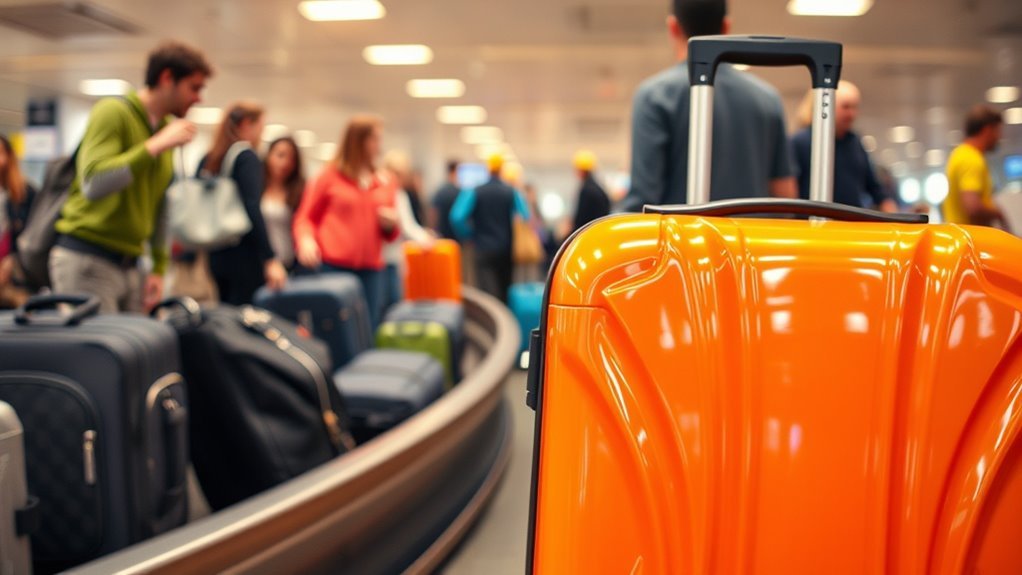
Want to spot your bag in a crowd without circling the carousel? Choose luggage with bold, contrasting colors so you can pick it out fast. Bright hues reduce confusion and save time. Look for solid tones or high‑contrast patterns rather than muted neutrals. Consider durable fabrics in red, teal, lime, or orange that stay vivid after wear. Below are quick visual prompts to imagine standout options:
| Color | Impression |
|---|---|
| Bright red | Instant pop |
| Teal | Rare, eye‑catching |
| Lime green | Hard to miss |
| Orange | High visibility |
| Deep purple | Uncommon, distinctive |
Add a Bright, Unique Bag Identifier
Pick a bold, distinct color or pattern for your bag so it stands out on the carousel.
Add a creative, durable tag—think bright ribbon, leather tag, or hard plastic ID with a fun design. Those simple identifiers make spotting and grabbing your luggage faster and stress-free.
Choose Bold, Distinct Colors
If you want to spot your bag in a crowd, choose bold, distinct colors and add a bright, unique identifier—think neon straps, patterned luggage covers, or a colorful ribbon—so it stands out on the carousel and saves you time and stress. Pick hues that contrast common black or navy bags, like lime, fuchsia, or teal. You’ll reduce mistakes and speed retrieval. Keep identifiers simple, visible from a distance, and washable. Use consistent color choices across trips so you recognize your luggage instantly.
| Color Idea | Visibility | Note |
|---|---|---|
| Neon Lime | High | Rare |
| Fuchsia | High | Bold |
| Teal | Medium | Stylish |
| Patterned Cover | High | Covers wear |
Use Creative, Durable Tags
While bold colors grab the eye, adding a creative, durable tag gives your bag a clear, lasting identifier that you can spot from across the carousel.
Pick a tag that’s sturdy—metal, thick leather, or heavy-duty plastic—so it survives rough handling and won’t fray or fade.
Choose a bright shape or unique design: a patterned tassel, custom luggage plate, or quirky charm.
Add your initials or a discreet contact method.
Secure it with a strong loop or cable tie.
When you arrive, glance for that distinctive marker first; it’ll save time and prevent grabbing the wrong bag.
Use Tracking Devices and Airline Apps to Find Luggage
Because you can track a bag in real time, using dedicated tracking devices and airline apps makes finding luggage faster and less stressful. Attach a small Bluetooth or LTE tracker inside your suitcase and register it in the maker’s app before you travel. Enable location sharing so you can see last-known positions and get notifications if your bag moves away from you.
Use the airline’s app to monitor checked-bag status, carousel numbers, and delay alerts. If something’s missing, combine tracker location with the airline’s info when you report the issue—this speeds up searches and improves the chances of a quick recovery.
Set Up GPS Trackers: Battery and Privacy Tips
Before you toss a GPS tracker in your bag, check how long its battery will last and whether it has power-saving modes so it won’t die mid-trip.
You’ll also want to review the tracker’s privacy settings and the company’s data practices to control who can see your location.
These simple steps help you keep your luggage locatable without sacrificing security.
Battery Life Management
When you set up a GPS tracker for your luggage, plan its power use so it lasts through travel and waits without draining unexpectedly. Check battery specs and choose mode settings—real-time for short trips, periodic pings for longer waits.
Turn off extra features like Bluetooth or rapid updates when not needed. Charge fully before departure and carry a compact power bank if allowed. Test runtime by simulating trip conditions.
Replace disposable batteries before long journeys. Monitor battery status via the app and set low-battery alerts. Conserving power keeps your tracker reliable, so you’ll find luggage when it matters.
Privacy And Data Security
If you’re using a GPS tracker, make privacy and data security a priority to keep your location and personal info safe. Lock down accounts, use strong passwords, and enable two-factor authentication to prevent unauthorized access. Review app permissions and disable unnecessary location sharing. Keep firmware updated to patch vulnerabilities.
- Use encrypted apps and trusted brands to limit data exposure.
- Turn trackers off or remove batteries when not traveling to avoid constant tracking.
- Check the tracker’s privacy policy and opt out of data selling if possible.
Treat your tracker like any sensitive device: protect credentials and localize sharing.
Check Baggage Status Before Landing
So you can skip the scramble at the baggage claim, check your bag’s status before landing using the airline’s app or website; open the app, enter your confirmation or bag tag number, and refresh for updates.
You’ll see whether your bag was loaded, routed to a different flight, or delayed. If the app shows loading issues or an unexpected transfer, notify gate staff or customer service immediately so they can flag your bag.
Save screenshots and note timestamps for follow-up. Doing this ahead of arrival saves time, reduces stress, and gives you clear steps if your baggage needs tracing or recovery.
Where Airport Bags Usually Unload (Ask Staff)
When you land, ask staff where bags are usually unloaded so you know which baggage handling areas to watch. They can point you to the nearest staff communication points or give updates on alternate unloading zones.
That quick check can save you time and walking.
Baggage Handling Areas
Although the sight of conveyor belts and carts can seem confusing, baggage handling areas are where most checked bags are sorted and loaded before reaching the carousel. You can speed retrieval by knowing where staff stage luggage.
Walk to visible loading docks near arrivals or follow signs to “Baggage Service” and ask staff politely. Look for secured cages and belt systems; those are key spots.
When checking the area, note:
- Nearby tugs and carts—they often move bags to carousels.
- Loading doors—bags come through here first.
- Staff stations—workers coordinate transfers and can help.
Staff Communication Points
If you want your bag found fast, head to staff communication points—these are where ground crews coordinate unloading and redirect luggage before it hits the carousel. Go to the ramp control window, baggage office, or airline service desk near the gates and ask which lot or holding area your flight’s luggage was sent to.
Give them your tag number, flight number, and description; they’ll radio or check the system and tell you the exact spot. Stay nearby so staff can bring it out quickly. If needed, request a supervisor for faster retrieval and confirm any forms or ID you’ll need.
Choose the Best Carousel Spot
Want the quickest grab on your bag? Positioning matters. Pick a spot where you can see incoming pieces and move smoothly when yours appears. Consider these simple choices:
- Stand near the middle of the carousel: you’ll catch items that slide from either direction.
- Choose a corner with a clear view of the feed: fewer people cluster there, so you’ll spot your bag fast.
- Stay close to the return gap: staff may let smaller items through first, giving you an early chance.
Keep your path clear, avoid blocking others, and be ready to step forward confidently when your luggage arrives.
Best Places to Wait Near the Carousel
After you pick a good carousel spot, think about where to wait so you can grab your bag with minimal fuss. Stand a few steps back from the belt’s edge to avoid crowding; that gives you room to move when your bag appears.
Position near a gap between passengers so you can step forward quickly. If possible, stay close to a carousel end where items pause longer.
Avoid blocking traffic paths or family groups with strollers. Keep your carry-on handy and your hands free.
Watch for staff opening doors or sorting bags; being alert beats rushing at the last second.
Read Baggage Displays and Flight Numbers Fast
When you step into baggage claim, scan the overhead displays for carousel numbers so you know exactly where to go.
Match the flight number and airline code on the screen with your boarding pass to confirm it’s yours.
Moving quickly between carousels is easy once you trust those brief checks.
Scan Carousel Numbers
If you’re tired of circling carousels, train your eyes to scan the baggage display quickly: focus on the flight number column first, then move right to the carousel number, so you can head straight to the correct belt without hesitation. You’ll save time and avoid crowds by reading only necessary info.
Scan for the arrival time, confirm the flight number, then lock onto the carousel digit(s). Move decisively and position yourself a few spots down the belt to claim bags early.
- Spot flight number
- Read carousel number
- Move to most suitable pickup spot
Match Airline Codes
Once you’ve locked onto the carousel number, shift your attention to airline codes so you can confirm that the displayed flight actually matches yours. Airline codes are the two- or three-letter abbreviations next to flight numbers; knowing yours prevents grabbing someone else’s bag.
Check the departure city, flight number, and code together—e.g., AA123 or BA045—to verify a full match. If codes look similar, verify the scheduled time and gate to avoid mistakes.
Watch for code-shares where one flight lists multiple airlines; the operating carrier’s code determines where your luggage appears.
When in doubt, ask staff; they’ll confirm quickly.
Scan Airline Carrier Tags to Confirm Your Bag
Before you grab bags off the belt, scan the airline carrier tags to confirm yours—those small barcodes and labels hold the key details like flight number, destination code, and routing.
Before grabbing luggage, scan carrier tags—barcodes and codes reveal your flight, destination, and routing to avoid mistakes.
You’ll save time by checking tags instead of guessing by color or size. Use your phone camera or a penlight to read faint printing.
Look for the three-letter airport code and flight number, then match routing coupons if present.
- Verify three-letter destination code.
- Confirm flight number and date.
- Check routing or transfer airport codes to avoid similar bags.
Spot Common Luggage Shapes and Brands Quickly
While scanning tags tells you which bag is yours, spotting common luggage shapes and popular brand silhouettes helps you zero in even faster; look for hard-shell suitcases, spinner wheels, and signature handle shapes.
Train your eyes for distinct profiles—tall duffels, cuboid checked bags, and rolling backpacks stand out. Note brand trademarks like ridged shells, colored zippers, or logo plates so you can pick them out across a carousel.
Move to a clear vantage point, watch how items rotate, and mentally group similar shapes. Combining shape recognition with color and small brand cues speeds retrieval and cuts wait time.
Use Camera Tricks to Scan Crowded Carousels
If the carousel’s packed, pull out your phone and use it like a scanning tool: pan slowly along the belt, record a short video, or take a burst of photos so you can pause and zoom without losing sight of moving bags. Use these simple camera tricks to spot your luggage faster:
- Record a 10–20 second clip, then scrub frame-by-frame to catch fast-moving tags or colors.
- Snap burst shots while focusing on your suitcase’s distinctive mark, then review and zoom.
- Use the zoom sparingly to avoid blur; steady your phone against the barrier for clearer images.
What to Do If Bags Are Delayed or Misrouted
When your bag doesn’t appear after scanning the carousel or your video shows it heading a different way, act quickly to report the problem to the airline’s baggage office at the airport. Stay calm, keep your boarding pass and baggage claim tag handy, and note flight number, carousel, and descriptions.
Ask for an immediate status check and an estimated arrival time. If the bag’s delayed or misrouted, confirm contact details and preferred delivery address. Request written confirmation of the report reference number.
Track updates via the airline app or text alerts, and keep receipts for any essential purchases you make while waiting.
How to File a Baggage Report With the Airline
Because you need a record and a quick resolution, file a baggage report with the airline at the airport counter or online as soon as you notice your bag is missing. Give a clear description, tag number, contact info, and travel itinerary. Get a reference number and estimated delivery details.
File a baggage report immediately—give a clear description, tag number, contact details, and get a reference and delivery estimate.
- Note: describe color, brand, stickers, and unique marks.
- Ask: confirm contact method, delivery window, and interim reimbursements.
- Keep: photos, boarding pass, claim tag, and the report receipt.
Follow up via the airline’s tracking link or phone, and stay polite but persistent until your bag’s located.
When to Contact Airport Security
After you’ve checked with the airline and retraced the baggage area, contact airport security immediately if you suspect theft, see unattended luggage, or notice suspicious activity near the carousel.
Tell them where you were, describe the item and any people involved, and give exact times.
If your bag’s missing and someone else claims it, don’t confront them—let security handle it.
Stay near a staff member or the information desk so you can be reached.
Follow security instructions promptly; they may need footage or statements.
Keep your phone charged and ready to share photos, boarding passes, and ID to speed the process.
Fast Customs and Exit Tips After You Find Your Bag
Once you’ve resolved any security issues and retrieved your bag, focus on clearing customs and exiting the airport quickly. Move confidently toward the customs area, have your passport, declaration form, and any receipts ready, and follow signs for nothing to declare if applicable.
- Fill forms and scan documents before queues build, using mobile e-declarations when available.
- Keep liquids, electronics, and items that may be inspected accessible in an outer bag or bin to speed screening.
- Know your exit: check arrivals maps, follow express lanes, and confirm ground transport pick-up points to leave without delays.
Avoid Mistakes That Slow You Down
While it’s easy to rush, slowing down for a few simple checks will save you time overall: confirm your baggage claim number, double-check tags and straps, and scan the carousel for bags that look similar to yours before grabbing one. Mistakes like grabbing the wrong bag, forgetting small items, or ignoring announcements force you back to the carousel. Stay near the belt, watch for paused loading, and keep your phone ready for updates. Use a simple checklist to avoid errors and move confidently to the exit.
| Check | Action | Time saved |
|---|---|---|
| Claim # | Confirm tag | 30s |
| Appearance | Compare features | 1m |
| Announcements | Listen | 10s |
How Class and Status Affect Baggage Priority
If you’ve got elite status or higher cabin class, your bag will often hit the carousel sooner than others. Airlines and loyalty tiers give priority tags and dedicated handling that speed up delivery.
Know your program’s perks and where your booking sits so you can expect faster baggage access.
Elite Status Perks
Because airlines prioritize premium cabins and frequent flyers, your class and status can dramatically speed up how quickly your luggage appears, from priority tagging at check-in to earlier loading and first access at the carousel. You’ll notice faster handling if you earn or hold elite tiers, but perks vary by carrier and alliance.
Use status proactively: confirm priority baggage tags, check dedicated carousels, and ask staff about expedited delivery. Track benefits online so you know what to expect.
Typical elite advantages include:
- Priority baggage tags and expedited handling
- Earlier loading and offloading order
- Access to priority carousels or dedicated staffing
Cabin Class Priority
How quickly your bag appears often comes down to the cabin you booked and the status you hold—premium cabins and higher tiers get priority tagging, earlier loading, and first access at the carousel.
If you fly business or first, expect priority labels and a separate delivery group; that means your suitcase often arrives on the first rotations.
Premium economy may get some advantage over standard economy, depending on the airline.
At busy airports, gate agents load premium sections first to clear space.
When you check in, confirm priority tagging and note any printed claim indicators to improve your odds of swift retrieval.
Loyalty Program Tiers
Beyond cabin class, your frequent-flier status plays a big role in where your bag lands in the loading order and when it hits the carousel. Elite tiers often get expedited handling, meaning your checked bag is one of the first off the plane.
Use your status proactively: tag bags, check receipts, and mention elite benefits at drop-off if needed.
Typical impacts include:
- Priority loading for top-tier members.
- Early carousel placement or separate priority belt.
- Faster recovery assistance and waived fees for mishandled bags.
Knowing your tier’s perks helps you predict wait times and request staff assistance confidently.
Handle Tight Connections and Layovers
If you’ve got a tight connection or a layover, act fast and prioritize what matters: confirm your arrival and departure gates, check whether your bags are through-checked, and plan the quickest route between terminals.
Move with purpose: follow airport signage, use shuttles or skytrains, and ask staff for the fastest path.
If your bags aren’t through-checked, head straight to baggage claim and request priority handling.
Keep carry-on essentials handy in case you need to rebook or retrieve items.
Notify your airline immediately if you’ll miss a connection so they can assist with baggage and transfer options.
What International Travelers Should Expect at Claims
When you arrive on an international flight, expect a few extra steps at baggage claim: clear customs, present your declaration if required, and wait a bit longer as your luggage goes through additional inspections.
You’ll move slower through the hall, so stay patient and organized. Keep documents handy, follow signage, and watch for announcements.
Expect occasional secondary inspections and possible delays if inspections flag items.
- Check signs for the correct carousel and customs lane.
- Keep passports and declarations accessible to speed processing.
- Report missing bags at the airline desk immediately and get a reference.
Reusable Gear to Speed Future Pickups
To speed up future pickups, pick a few reusable items that make identification and handling effortless: a brightly colored luggage tag, a durable strap with a unique pattern, and a compact bag tracker you can sync to your phone. You’ll spot your bag faster, hand it off smoothly, and reduce stress. Keep tags and straps in place between trips, charge the tracker, and test its app before you fly. Use rugged, washable materials so they last. Below is a quick reference for choosing gear:
| Item | Benefit |
|---|---|
| Tag | Visibility |
| Strap | Grip |
| Tracker | Location |
| Care | Longevity |
When to Request Baggage Delivery as Backup
After you’ve equipped your bag with visible tags, a sturdy strap, and a charged tracker, consider arranging baggage delivery as a backup for situations where grabbing your luggage quickly might still fail. You’ll want delivery when delays, missed connections, or heavy crowds make waiting impractical. Also request it if your itinerary’s tight, or if you’re arriving late and don’t want to navigate transit without essentials.
- When flights are delayed or rerouted and you risk missing the carousel entirely.
- When you have onward transport booked and can’t afford to linger.
- When you’re carrying fragile or urgent items that must arrive promptly.
Final Quick Checklist Before You Leave the Airport
Before you walk out, do a quick sweep of essentials so you don’t end up back at lost and found: check pockets and seat-back compartments for phones, wallets, chargers, and boarding passes.
Before leaving, do a quick sweep—check pockets and seat-back compartments for phones, wallets, chargers, and boarding passes.
Now confirm baggage tags match your claim checks and inspect zippers, straps, and locks for damage. Photograph luggage and tag numbers in case you need to report issues.
Reconfirm any delivery or delayed-baggage instructions with the airline desk, note the reference number, and save contact details.
If you used a porter or service, collect receipts.
Finally, scan the area once more before leaving the carousel zone.
Frequently Asked Questions
Can I Retrieve Luggage From the Sorting Area Before It Reaches the Carousel?
Usually no, you can’t retrieve luggage from the sorting area; it’s secure and staffed. If you need it urgently, contact airline staff or baggage claim, explain the situation, and they’ll guide you or request retrieval on your behalf.
How Do I Prove Ownership of a Damaged Bag at Pickup?
Show your baggage claim tag, matching ID (passport/drivers license), and photos of the bag before travel; point out unique marks or contents, sign inspection forms, and keep receipts — you’ll document ownership and expedite the claim.
Are There Airline Fees for Retrieving Carry-On From Gate Checks?
Usually no — you won’t pay extra to retrieve a gate-checked carry-on at the jetbridge or baggage claim. Check your airline’s policy since some might assess fees for gate-checking itself or oversized items.
Can Lost Luggage Be Held for Me at a Satellite Terminal?
Yes — airlines can hold lost luggage at a satellite terminal, but policies vary. Contact the airline or baggage service office immediately, provide your claim tags, and they’ll confirm location, hold duration, and pickup procedures for you.
What Documentation Speeds up International Baggage Reunification?
You’ll need your passport, boarding pass, baggage claim tags, police or incident report (if applicable), proof of ownership like photos/receipts, and a signed authorization if someone else collects the luggage on your behalf.
Conclusion
You’re set to sail through baggage claim with these simple steps—prepare 24 hours ahead, tag and color-code your bag, add a bright identifier, and keep reusable tools handy. Know what to expect at international claims and when to ask for delivery backup. Stick to the final quick checklist before leaving the airport, and you’ll avoid long searches, missed connections, and stress. Travel smarter, and you’ll grab your luggage fast every time.