How Many Ounces TSA Allows in Carry On Liquids
You can bring liquids in carry-on bags only in containers of 3.4 ounces (100 mL) or less each, and all must fit together in one clear, quart-sized, resealable plastic bag that closes flat without bulging. Medications, baby formula, breast milk, and duty‑free purchases have special rules and may be exempt if declared. Use slim, labeled bottles and cushion fragile items. Keep the bag accessible at screening—keep going to learn packing tips, exemptions, and international variations.
Who This Guide Is For And What You’ll Learn
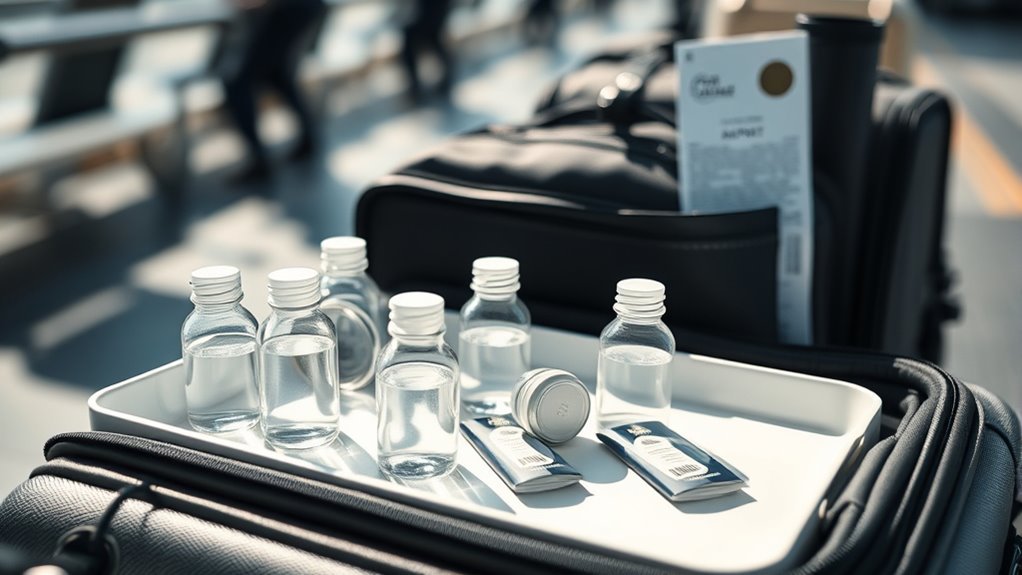
Who should read this guide and what’ll you get from it? You’re a traveler wanting clear, practical rules about carry-on liquids to avoid delays and confiscations. You’ll learn who’s affected—passengers on domestic and many international flights—what qualifies as a liquid, and how to pack liquids, gels, creams, and aerosols to meet TSA requirements.
You’ll get step-by-step packing tips, what containers work, and quick strategies for security lines and connecting flights. This guide keeps legalese minimal, focuses on actionable steps, and helps you prepare efficiently so security interactions go smoothly and you keep your essentials.
Quick Answer: How Many Ounces TSA Allows In Carry-On Liquids?
Wondering how much you can bring through TSA security? You can carry liquids, gels, and aerosols in containers of 3.4 ounces (100 milliliters) or less each. Those small containers must fit comfortably inside a single quart-sized, clear, resealable plastic bag per passenger. You’re allowed one such bag in your carry-on.
Medications, baby formula, and breast milk are exceptions—declare them at screening. Larger amounts should go in checked baggage.
If you follow these limits, you’ll move through security faster and avoid having items confiscated. Always check your airline and TSA updates before traveling.
Why TSA Uses The 3-1-1 Rule
You follow the 3-1-1 rule because it cuts down the volume of liquids that could be used to make a weapon, which lowers security risks on flights.
It also gives TSA officers a clear, consistent standard for screening carry-ons.
Plus, the rule matches international practices so your trip has fewer surprises at foreign checkpoints.
Security Risk Reduction
Because liquids can be used to make explosives, the TSA limits carry-on containers to the 3-1-1 rule to reduce the risk of coordinated attacks and make screening quicker and more reliable.
You benefit because smaller, uniform containers make it harder for someone to bring enough liquid components to create a device onboard. Screening staff can spot anomalies faster when bags present predictable contents, lowering false negatives.
You also face fewer delays since simpler rules speed inspections. By following 3-1-1, you help maintain a balance between convenience and safety, reducing overall security risk for everyone.
International Standardization
While the TSA’s 3-1-1 rule grew from specific security concerns, it also reflects a push toward international standardization that makes travel smoother for you and safer for airlines worldwide. Adopting similar limits across countries helps you pack predictably, reduces delays at security checkpoints, and minimizes disputes over allowed items.
When airports follow comparable rules, screeners can apply consistent procedures, improving detection and allowing quicker throughput. Standardization also aids airlines and manufacturers in designing compliant containers and travel kits, so you spend less time worrying about restrictions and more time focusing on your trip.
What Counts As Liquids, Aerosols, Gels, Creams, And Pastes?
You’ll want to know which items count as liquids for the TSA’s 3-1-1 rule, from water and shampoo to gels like hair gel and liquid makeup.
Remember aerosols and sprays—such as deodorant and sunscreen—are treated similarly, and creams or pastes like toothpaste and lotion also fall under the same limits.
Knowing these examples helps you pack compliant containers and avoid surprises at security.
Liquids, Gels Defined
What exactly counts as a “liquid” under TSA rules? You’ll treat liquids, gels, creams, pastes, and lotions the same for carry-on limits: anything that flows or can be squeezed, spread, or poured. Solid bars aren’t liquids. Toothpaste, shampoo, sunscreen, and makeup creams qualify. Pack travel-size bottles (3.4 oz/100 mL) in a clear quart bag and keep them accessible.
| Example | Texture | Pack as |
|---|---|---|
| Shampoo | Liquid | Yes |
| Toothpaste | Paste/gel | Yes |
| Lotion | Cream | Yes |
| Solid soap | Solid | No |
Follow limits and you’ll breeze through security.
Aerosols And Sprays
Now that you know which toiletries count as liquids, let’s look at aerosols and sprays.
You can bring aerosol cans and spray bottles in carry-on bags if each container is 3.4 ounces (100 milliliters) or less and fits inside a single quart-sized, clear plastic bag. Pressurized items like deodorant, hairspray, and sunscreen fall under this rule.
Larger aerosol cans must go in checked luggage, subject to airline limits and hazardous materials rules.
Remember empty spray bottles still count if they held liquid recently.
Always check airline and TSA updates before travel to avoid surprises.
Creams, Pastes Examples
Because TSA groups creams and pastes with liquids and gels, you’ll need to treat items like toothpaste, moisturizers, lip balm sticks in tubes, and certain makeup (cream blush, concealer, and foundation) as part of the 3.4-ounce/100 ml limit for carry-ons.
You should pack travel-size tubes, depot bulky jars into smaller containers, and keep the quart bag accessible for screening. Know that lotions, sunscreen, hair pomade, and paste deodorants count too. Below is a simple table to evoke urgency and care:
| Item | Type | Emotion |
|---|---|---|
| Toothpaste | Paste | Relief |
| Moisturizer | Cream | Comfort |
| Foundation | Cream | Confidence |
| Sunscreen | Lotion | Safety |
How To Measure 3.4 Ounces (100 Milliliters) Accurately
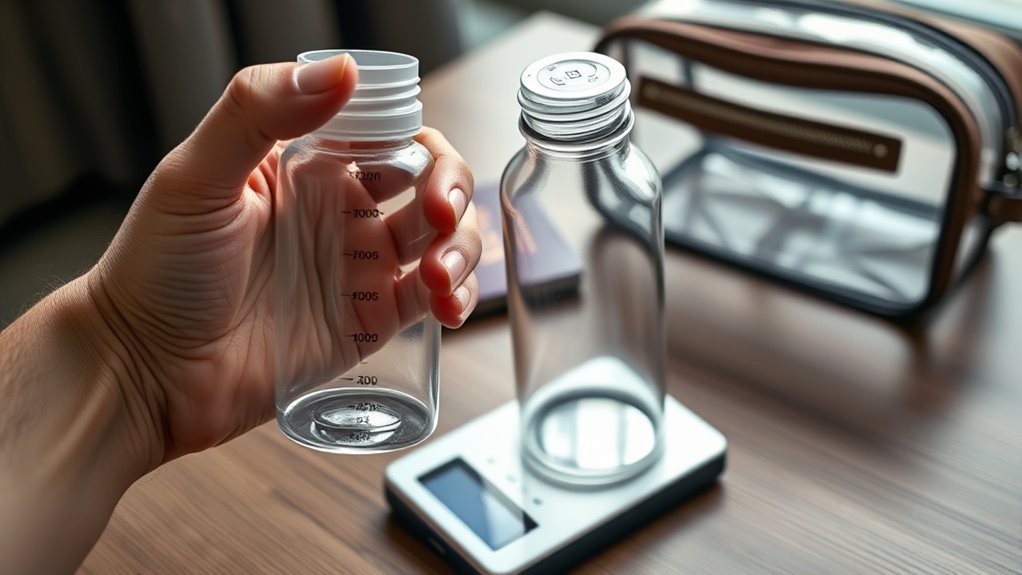
If you want to make sure your travel-sized liquids meet the TSA’s 3.4-ounce (100-milliliter) limit, use a clear, graduated measuring cup or a marked travel bottle and fill it to the indicated line—don’t guess by eye.
Pour slowly on a flat surface and read at eye level to avoid parallax error.
For creams or viscous products, scrape excess from the transfer tool back into the container and use a scale set to grams (100 g ≈ 100 ml for water-like fluids) for precision.
Label bottles and reseal tightly.
Double-check before packing to prevent surprises at security.
How Many 3.4 Oz Containers Fit In A Quart Bag?
After you’ve measured each 3.4-ounce bottle to meet the TSA limit, the next practical question is how many of those bottles will actually fit in a single quart-sized, clear plastic bag.
You can usually fit four to seven standard 3.4-ounce (100 ml) travel bottles depending on shape and cap size. Slim, flexible bottles pack tighter; rigid, wide ones take more space.
Lay items flat, remove excess air, and position caps opposite bases to maximize room. Don’t overstuff or seal poorly; the bag must close comfortably without bulging.
Test packing at home to confirm fit before heading to the airport.
What Qualifies As A Compliant Clear Quart-Sized Bag?
You’ll need a clear, quart-sized bag that measures about 7 x 8 inches to meet TSA requirements.
It must be transparent and made of flexible plastic or resealable zip-top material so agents can quickly inspect your liquids.
Hard-sided or opaque pouches usually won’t qualify, so stick with a flexible, clear plastic bag.
Clear Quart Bag Size
A compliant clear quart-sized bag is a transparent, resealable plastic pouch that holds no more than one quart (about 0.95 liters) and fits comfortably within the TSA’s carry-on screening process. You should pick a bag roughly 7×8 inches (varies slightly) so your toiletries lie flat and zip closed. Fit only travel-size containers (3.4 oz/100 ml) and avoid overstuffing to speed screening. Foldable, labeled, and clearly visible items help. If asked, remove the bag for separate screening. Below is a quick visual guide.
| Feature | Typical Size | Tip |
|---|---|---|
| Capacity | ~1 quart | Don’t overfill |
| Dimensions | ~7×8 in | Lay items flat |
| Closure | Resealable zip | Fully seal |
| Visibility | Clear | Keep items visible |
| Use | 1 bag per traveler | Remove at checkpoint |
Acceptable Bag Materials
When choosing a compliant quart-sized bag, pick clear, flexible plastic like polyethylene or PVC that’s strong enough to zip closed without tearing and totally transparent so TSA agents can easily inspect contents.
You’ll want seams that hold up to repeated handling and a secure, single-track zipper or press-seal closure that stays shut under light pressure.
Avoid colored, frosted, or mesh materials and opaque fabric pouches — they slow inspections and may be rejected.
Reusable travel-grade bags often meet standards; disposable sandwich bags usually do too if clear and leak-free.
Check for visible defects before packing to prevent delays.
How To Pack Multiple 3.4 Oz Bottles Efficiently
Packing multiple 3.4 oz bottles efficiently starts with grouping them by use and size so you can maximize space and meet the 3-1-1 rule. You’ll want a clear, flat quart bag and arrange bottles to prevent leaks and wasted room.
Pack 3.4 oz bottles by use and size in a clear quart bag to save space and prevent leaks.
Lay larger ones along the bag’s edges and nest smaller ones between them. Roll soft items around fragile bottles for cushioning. Seal the bag fully and place it atop carry-on contents for easy inspection.
- Lay out bottles and remove caps.
- Group by height and diameter.
- Position big bottles at edges.
- Fill gaps with cotton or socks.
Which Liquids Are Exempt From 3-1-1?
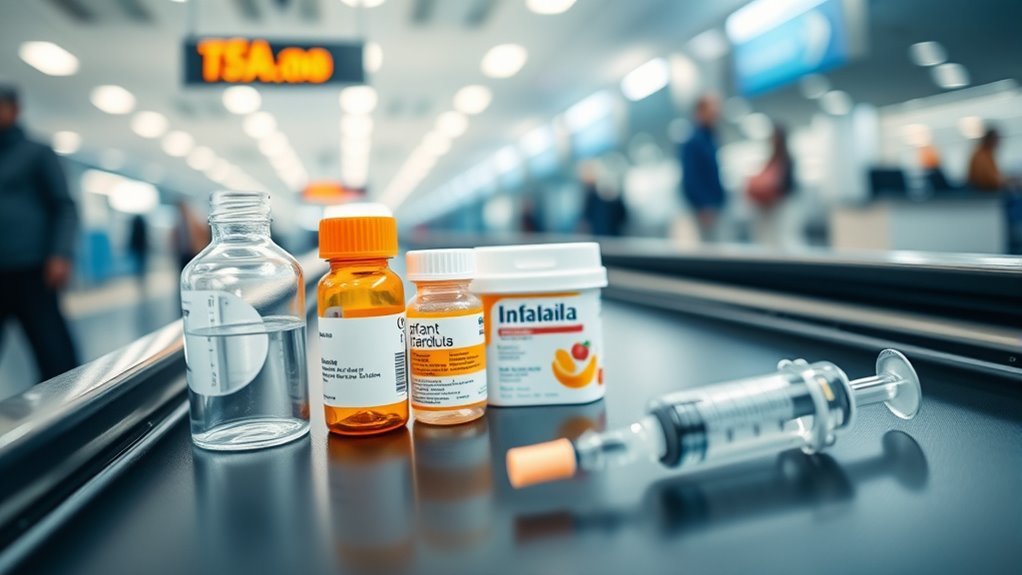
You can bring certain liquids through security without fitting them into the 3-1-1 bag, but you should know which ones qualify.
Items like baby formula, breast milk, and medically necessary liquids (including prescription meds) are allowed in reasonable amounts and may need to be declared for screening.
Also remember duty-free or liquids purchased after security often have separate rules and documentation requirements.
Medical And Baby Liquids
Certain medical and baby liquids don’t count toward the 3-1-1 carry-on limits, so you can bring necessary items like prescription medications, breast milk, formula, and baby food in reasonable quantities beyond the usual one-quart bag.
You should declare these items at screening and separate them for inspection. Pack them accessibly, label when possible, and expect additional screening.
Examples include:
- Breast milk in bottles or storage bags.
- Infant formula and prepared baby food.
- Liquids for medical devices (e.g., saline for CPAP).
- Over-the-counter liquid medicines for immediate use.
Follow TSA guidance and allow extra time at the checkpoint.
Prescription Medications Allowed
What counts as a medically necessary liquid exempt from the 3-1-1 rule? Prescription medications in liquid, gel, or aerosol form are allowed beyond the 3.4-ounce limit when you declare them at screening.
Bring them in reasonable quantities for your trip; there’s no specific ounce cap, but TSA may request testing. Keep medications separate from your carry-on bag for inspection, and carry labels or a prescription to expedite screening.
Ice packs, lotions, or other cooling elements used to preserve medication are also permitted. Always inform the officer before screening begins to avoid delays and guarantee compliance with security procedures.
Duty-Free And Purchased Items
Wondering whether duty‑free purchases can bypass the 3‑1‑1 rule? You can bring duty‑free liquids bought after clearing security in your carry‑on, but they must stay in a secure, tamper‑evident bag with the receipt visible.
Items purchased before security or outside the secure area still follow 3‑1‑1 limits.
Remember exceptions and procedures when connecting flights or entering countries with stricter rules. Consider these scenarios:
- Duty‑free bottle bought in terminal, sealed with receipt — allowed.
- Duty‑free bought before security — subject to 3‑1‑1.
- Liquids from onboard purchases — allowed if sealed.
- International connections may impose limits.
Traveling With Medications: Allowed Quantities And Proof
When you’re flying with medications, TSA lets you bring prescription and over-the-counter meds in amounts greater than the usual 3.4-ounce liquid limit.
However, you should separate them for inspection and be prepared to show proof like labels or a doctor’s note if asked. Pack meds in original containers when possible, and keep a copy of prescriptions or a physician’s note for controlled drugs or special formulations.
Inform the officer during screening if you have refrigerated or injectable meds. Declare liquid medications at the checkpoint.
Carry essential meds in your carry-on, and consider a concise list of drug names and dosages for quick reference.
Traveling With Baby Formula And Breast Milk: Rules And Tips
If you’re flying with breast milk or baby formula, TSA lets you bring them in quantities greater than the 3.4-ounce limit, but you should separate them from your other carry-on items for inspection and declare them at the checkpoint. You’ll want clear containers, ice packs, and a plan for feeding during delays. Keep bottles accessible and label expressed milk if possible.
- Pack formula, milk, and supplies in an easy-to-open bag.
- Tell the agent you have baby food and liquids for inspection.
- Expect additional screening; allow extra time.
- Carry documentation for medical needs if available.
Duty-Free Liquids: What’s Allowed After Purchase?
You can also bring duty-free liquids you buy at the airport, but they come with rules you should know before you board. If the item’s sealed in a secure tamper-evident bag with the receipt visible and you stay on an international itinerary, TSA usually lets it through. Keep the bag sealed until final destination, and be ready to show proof of purchase. If you transfer liquids to other containers, they’ll be treated as carry-on liquids.
| Item | Bagged? | Proof needed? |
|---|---|---|
| Perfume | Yes | Receipt |
| Alcohol | Yes | Receipt |
| Cosmetics | Yes | Receipt |
What Happens If Your Liquids Exceed The Limit At Security?
Should your liquids exceed the 3.4-ounce (100 ml) limit at security, TSA officers will ask you to either discard the items, place them in checked baggage, or return them to your vehicle if time allows.
You’ll face simple, standard choices and should act quickly. Expect polite, firm direction and possible secondary screening if needed.
To help, consider these options:
- Dispose of the liquid in provided bins immediately.
- Move the container to checked baggage at the airline counter.
- Return it to your car if you have time and access.
- Gift or hand it off to a traveling companion when allowed.
How TSA Decides Whether Your Container Is Allowed
You’ll need to meet TSA’s container size limits—typically 3.4 ounces (100 ml) or less per item—to bring liquids through security.
TSA officers will also look for clear, resealable bags or transparent containers so they can quickly inspect contents.
Knowing both size and visibility rules helps you pack faster and avoid delays.
Container Size Limits
Wondering how TSA decides whether your container is allowed? You’ll be judged by size, not content. Carry-on liquids must fit standard limits so agents can screen quickly. Follow these quick rules to avoid delays:
- Measure the container’s actual volume; it must be 3.4 ounces (100 milliliters) or less.
- Check printed capacity; if it says more, it’s not allowed even if partly full.
- Remember cumulative rules: each container must individually meet the limit and go in your quart‑size bag.
- If uncertain, transfer to a compliant container or pack larger quantities in checked luggage.
Container Transparency
Size limits matter, but TSA agents also judge containers by how easily they can see what’s inside. You should use clear, labeled containers so officers can identify liquids without opening them. Opaque bottles or unlabeled jars slow screening and risk removal.
| Container Type | TSA View |
|---|---|
| Clear plastic bag | Preferred — contents visible |
| Transparent bottle | Acceptable if labeled |
| Opaque jar | Problematic — may be inspected |
Pack liquids in visible, leak-proof containers, label them, and keep them accessible. That minimizes delays and reduces the chance your items get confiscated.
Packing Strategies To Avoid 3-1-1 Delays At TSA Checkpoints
Because going through security can be stressful, quick packing habits make a big difference at the checkpoint. You’ll streamline screening by preparing your liquids bag and carry-on before you leave home. Arrange items so officers can see them without rummaging.
- Put all liquids in a clear quart bag and seal it separately.
- Place the quart bag atop other carry-ons for easy removal.
- Group electronics and shoes in accessible spots to avoid delays.
- Keep small toiletries visible and consolidated to speed inspection.
Follow these steps, and you’ll move through 3-1-1 checks faster and with less hassle.
How To Combine Small Bottles And Refillable Travel Containers
Start by sorting what you actually need for your trip and transferring only those amounts into labeled refillable bottles so you don’t bring duplicates or excess.
Choose leakproof, clear containers that meet TSA’s 3.4 oz limit, and use a funnel or pipette to avoid spills.
Consolidate similar items—combine shampoo portions into one bottle, conditioner into another—to save space.
Label each with contents and date for easy security checks and hotel refills.
Pack them in a single, transparent quart-sized bag and seal it.
Keep receipts or original packaging for medical liquids to prevent questions.
Which Travel-Size Products Are Truly 3.4 Oz Or Less?
You’ll want to pick bottles that are truly labeled 3.4 oz (100 mL) so they fit TSA rules without surprises. Consider concentrated versions of shampoo or detergent that let you pack less liquid.
Plus, solid or powder alternatives like bar soap, shampoo bars, and powdered cleansers can help cut down on fluids. These options help you stay under the limit while keeping your routine.
True 3.4 Oz Bottles
When you’re packing essentials, knowing which bottles are truly 3.4 ounces saves time and prevents surprises at security. Many products marketed as “travel-size” actually hold more liquid than the TSA allows.
You’ll want clear labeling and rigid plastic or glass bottles marked 100 mL/3.4 oz. Look for leakproof caps, flat sides that fit in quart bags, and durable brands sold as “airline-compliant.”
Examples you can trust include prefilled toiletry bottles, sample-size cosmetics, and certain travel misters. Check volume stamps before buying.
- 3.4 oz rigid shampoo bottle
- 3.4 oz lotion pump
- 3.4 oz perfume vial
- 3.4 oz contact solution
Concentrated Product Options
If you’ve checked your rigid 3.4 oz bottles, the next smart move is choosing concentrated alternatives that give you more use without exceeding TSA limits.
Look for travel serums, solid conditioner paste in small screw jars, and concentrated shampoo bars packaged as liquid-free emulsions that list ≤100 ml. Liquid concentrates and glycol-based refills often come in 1–3 oz dropper bottles; they’re potent, so a little goes a long way.
Multipurpose items—leave-in treatments that double as styling or cleansing boosts—save space and remain compliant. Always check the labeled fluid ounces and keep them under the 3.4 oz rule.
Solid And Powder Alternatives
Because solids and powders don’t count as liquids under TSA rules, you can often carry full-size bars or jars without worrying about the 3.4 oz limit—just check labels and packaging to confirm weight rather than fluid volume.
You’ll save space by choosing solid shampoo, conditioner bars, powdered detergent, or dry shampoo. Pick items labeled in ounces or grams and keep them accessible for screening.
If a powder exceeds one kilogram, be prepared for extra inspection. Consider travel tins or resealable bags to contain residue and avoid leaks.
- Solid shampoo bar
- Powdered detergent sachet
- Dry shampoo powder
- Soap or lotion bar
How To Downsize Full-Size Cosmetics Legally For Carry-On
Packing your favorite full-size cosmetics for carry-on doesn’t have to mean tossing them or risking a TSA reject; you can legally downsize them with simple swaps and compliant containers.
Transfer liquids, gels, and creams into clear 3.4-ounce (100ml) travel bottles or jars, labeling contents. Use pre-approved sample sizes or solidiform versions—solid cleanser bars, powder blushes, and stick deodorants—to avoid liquid limits.
Transfer liquids into clear 3.4 oz travel bottles, label them, or choose solid and sample versions to skip liquid limits.
Keep everything inside a single quart-sized, resealable clear bag for quick screening.
For liquids that need refrigeration later, pack them at room temperature and buy ice packs after security.
Check product consistency to guarantee TSA compliance.
Tips For Packing Toiletries For Multi-Day Trips In Carry-On Only
When you’re flying carry-on only for several days, streamline toiletries by selecting multitaskers and consolidating liquids into the required quart-sized clear bag so you stay within TSA rules and move through security faster.
Pack smart: choose solid shampoo bars, travel-size sunscreen, and a dual-purpose moisturizer with SPF. Stash small refillable bottles labeled clearly. Arrange items so you can pull the bag out quickly.
- Solid shampoo and soap to save liquid ounces.
- 3-ounce bottles for shampoo, conditioner, face wash—only what you’ll use.
- Minimal makeup: multipurpose balm, tinted moisturizer.
- Compact dental kit and medication bottle.
Best Clear Bags And Organizers For TSA Compliance
Now that you’ve minimized liquids and picked multitaskers, the next step is choosing the right clear bag and organizers to keep everything TSA-compliant and easy to access. Pick a durable, resealable quart-size clear bag that lies flat for screening. Use smaller clear pouches for daily essentials and a padded case for fragile bottles. Label sections and arrange by frequency of use so security checks and in-flight needs are fast.
| Item | Purpose |
|---|---|
| Quart clear bag | Primary screening |
| Small zipper pouches | Organize categories |
| Padded bottle case | Protect fragile items |
| Silicone travel bottles | Refillable, leakproof |
How To Document Medically Necessary Liquids For Faster Screening
If you travel with medically necessary liquids, bring documentation like a doctor’s note or prescription label to speed up screening.
You’ll also want to separate those items and declare them at the checkpoint so TSA officers can verify them quickly.
Knowing a few screening tips—like informing officers before inspection and packing liquids accessibly—helps keep lines moving.
Medical Liquids Documentation
Wondering how to speed up security screening with medically necessary liquids? You’ll want clear, accessible documentation to avoid delays. Carry written notes and prescriptions showing dosage, frequency, and medical need. Label containers and keep them separate for inspection. Present documents proactively at the checkpoint.
- Doctor’s note with diagnosis and liquid names
- Original prescription or pharmacy label showing patient name
- Manufacturer labels or packaging for specialized solutions
- Simple inventory list of containers and volumes
Keep copies on your phone and printouts ready. Organized, concise documentation helps agents verify needs quickly and keeps you moving.
TSA Medical Screening Tips
With your paperwork organized, you can speed screening by presenting documentation proactively and knowing what agents will ask for. Pack prescriptions, physician notes, and manufacturer labels where they’re easy to access and separate the containers for inspection so you can hand them over quickly.
Keep originals and photocopies in a clear folder, and store injectable supplies and pumps in labeled cases.
Notify TSA officers before screening begins, state any mobility or medical needs, and ask for a private screening if preferred.
Declare all liquids, even if exempt, and show supporting documents when requested.
Stay calm, cooperative, and concise to minimize delays.
Traveling Internationally: How Other Countries’ Limits Compare
Across borders, liquid rules can change a lot, so you’ll want to check each country’s allowances before packing. You’ll find similar 100ml/3.4oz limits in the EU and UK, stricter bans on larger aerosols in some Asian airports, and leniency for duty-free purchases sealed at departure.
Across borders, liquid rules vary—check local allowances; many follow 100ml/3.4oz, with duty-free exceptions.
Consider these quick comparisons:
- EU/UK: 100ml per container, quart-sized bag required.
- Canada/US: 3.4oz (100ml) standard, similar enforcement.
- Japan/South Korea: generally 100ml, occasional stricter screening.
- Middle East: varies—some allow larger sealed duty-free items.
Always verify local rules before travel.
Connecting Flights: Carrying Liquids Through Multiple Airports
If you’re passing through multiple airports, rules that seemed straightforward at your departure point can change mid-journey, so plan how you’ll carry liquids between connections. Check each airport’s security rules and layover country regulations ahead of time; some require re-screening and may enforce different container sizes or packaging.
Pack liquids in clear, resealable quart-sized bags to simplify inspections, and keep receipts for duty-free purchases separate. If you have tight connections, prioritize compliant containers to avoid delays.
When in doubt, consolidate essentials into travel-size bottles and stow extras in checked luggage before departure.
How To Handle Purchased Liquids During Layovers And Transfers
When you buy liquids in an airport duty-free shop or at a terminal kiosk, keep the receipt and the sealed purchase bag handy, because some connections or countries require the original packaging to prove the item was bought post-security.
You’ll want a clear plan for layovers and transfers:
- Keep the sealed bag visible and the receipt accessible for security checks.
- Confirm transfer rules with the airline or transit airport before you board.
- If you must open the bag, reseal it and carry proof of purchase to avoid confiscation.
- For international transfers, check destination country rules to prevent surprises.
How Airline Storage Rules Affect Carrying Liquids
When you pack liquids, remember some airlines have stricter carry-on size and quantity limits than TSA does.
You’ll want to think about where items fit in the cabin—easy-to-reach pockets matter for security checks and in-flight use.
If a bottle’s too big or you need more, checking a bag is often the simplest alternative.
Airline Carry-On Limits
Wondering how airline carry-on rules change what you can bring through security? You’ll need to balance TSA liquid limits with each airline’s carry-on size and weight rules. Pack smart to avoid surprises.
- Check your airline’s carry-on dimensions and weight—oversized bags can be gate-checked.
- Fit all liquids in a single quart-sized, clear bag that meets TSA’s 3-1-1 rule.
- Know exceptions (medications, baby formula) and carry documentation when possible.
- Combine multiple small containers into one approved bottle to save space and simplify screening.
Confirm airline policies before travel to prevent delays.
Stowage And Accessibility
After you’ve packed liquids to meet TSA’s 3-1-1 rule and your airline’s size limits, think about where and how you’ll store them on the plane. You’ll want easy access for security or sudden needs, but secure placement to prevent spills. Keep fragile bottles upright, use seat-back pockets for quick reach, and overhead bins for bulkier toiletry kits. Consider turbulence and cabin announcements when choosing placement.
| Location | Accessibility | Risk |
|---|---|---|
| Seat pocket | High | Moderate |
| Overhead bin | Low | Low/Moderate |
| Under seat | Moderate | Low |
| Aisle carry | High | High |
Checked Bag Alternatives
Because airlines set different size and storage rules, you’ll often weigh the trade-offs between checking a bag and carrying liquids onboard. You want to keep essentials accessible but avoid fees or lost items. Consider airline rules, flight length, and whether duty-free or baby supplies will complicate your plan.
- Pack full-size toiletries in checked luggage to bypass 3-1-1 limits.
- Keep medications, contact solutions, and baby formula in your carry-on.
- Use airline-approved toiletry bags and seal duty-free purchases.
- Split liquids: small travel bottles for the cabin, larger ones checked.
Security Exceptions And Special Screening Procedures Explained
Although most travelers can follow the standard 3-1-1 rule, TSA provides specific exceptions and special screening procedures for medically necessary liquids, breast milk, and duty-free purchases that exceed the usual ounce limits. You should declare these items at the checkpoint and separate them from your carry-on for inspection.
Declare medically necessary liquids, breast milk, and duty‑free items at security; separate them for inspection and expect extra screening.
Medications, insulin, and breast milk aren’t subject to the 3.4-ounce limit but may be tested or opened.
Duty-free liquids in secure bags must remain sealed with receipts visible.
Cooperate with officers, allow additional screening like explosive trace testing, and plan extra time to avoid delays while ensuring compliance with TSA requirements.
How To Transport Frozen Or Solidified Liquids Under TSA Rules
Wondering how frozen or solidified liquids are treated at the checkpoint? You’ll follow similar 3-1-1 rules: if the item’s solid and won’t melt, treat it like a solid; if it could melt, it’s a liquid. Pack smart to speed screening.
- Label frozen gels (ice packs) and be ready to separate them.
- Keep partially frozen items that might thaw in your quart bag.
- Present frozen food or gels separately for inspection if asked.
- Bring documentation for medically necessary frozen liquids or breast milk.
Expect TSA to inspect; be cooperative and concise.
When To Check A Bag Instead Of Carrying Liquids On Board
If your liquids exceed the TSA quart-size limit or you’ve got more containers than the 3-1-1 rule allows, you should check a bag instead of trying to squeeze them into your carry-on.
Also consider checking items that are fragile or subject to airline or TSA restrictions, since they’re safer and less likely to be confiscated in checked luggage.
Making this choice ahead of time keeps security screening faster and your belongings more secure.
Liquids Over Quart Size
When you’ve got liquids that won’t fit the TSA 3-1-1 quart bag—like full-size toiletries, large sunscreen bottles, or duty-free spirits over the allowed volume—you’ll need to check them in your hold rather than try to carry them through security. Decide before packing so you avoid delays or discarded items.
Consider these scenarios:
- A 16-ounce shampoo bottle you use daily.
- A full-size lotion or cosmetic kit that exceeds 3.4 ounces.
- Duty-free alcohol purchased after security that’s larger than allowed carry-on volume.
- Medical fluids or baby formula in quantities beyond the quart bag limits.
Pack carefully and label fragile containers.
Too Many Containers
How do you decide whether to check a bag because of too many liquid containers? Count containers: TSA lets one quart-size bag of travel-size liquids (containers 3.4 ounces/100 milliliters or less) per passenger.
If you’ve got multiple quart bags, oversized bottles, or liquids that won’t fit without overflowing your carry-on, checking makes sense. Also check if security lines are tight and removing items would slow you.
Checking avoids confiscation and keeps your toiletries intact. Pack heavier or bulkier liquids in checked luggage, consolidate products into permitted travel sizes, and keep one accessible quart bag for screening to streamline your trip.
Fragile Or Restricted Items
You’ve already figured out how to handle excess containers, but some items shouldn’t ride in the cabin even if they fit the liquid rules. You’ll want to check certain fragile or restricted liquids to protect them and avoid delays.
Consider these situations:
- Large perfume bottles that could break and spill.
- Aerosol cans or pressurized toiletry refills prone to rupture.
- High-value skincare serums or luxury fragrances that you’d hate to lose.
- Flammable or reactive solutions that may be restricted by airline policy.
When in doubt, pack fragile or restricted liquids in checked luggage with proper padding and declarations.
What Counts As A Single Passenger’s Allowance At Security?
Although items you bring in a single bag may seem like one allowance, the TSA counts allowances per passenger, not per bag, so each traveler can carry permitted quantities regardless of how many bags they have. You’re allowed liquids, gels, and aerosols in 3.4-ounce (100 ml) containers in a single quart-size bag. Medication, baby formula, and breast milk get exceptions but stay reasonable. At security, present your quart bag separately; officers may inspect items. Know that combined volumes and clarity matter: officers judge size and purpose. Below is a quick comparison table for common carry-on items.
| Item | Typical Limit | Notes |
|---|---|---|
| Toiletries | 3.4 oz each | In quart bag |
| Medication | Varies | Declare if >3.4 oz |
| Baby supplies | Reasonable amounts | Subject to inspection |
| Liquids total | Per passenger | Not per bag |
How To Declare Larger Medicinal Liquids And Documentation Needed
If you need more than the 3.4-ounce limit for medical liquids, tell the TSA officer at the checkpoint before screening.
You’ll be allowed larger quantities for medical reasons, but you should have supporting documentation like a prescription, doctor’s note, or pharmacy label ready.
Keep the liquids separate from your quart-size bag and expect them to be inspected.
Medical Liquid Limits
When you need to bring medically necessary liquids that exceed the usual 3.4-ounce (100 mL) limit, declare them to TSA at the checkpoint and have your supporting documentation ready. You’ll get screened separately; agents may test or open containers. Stay calm, cooperative, and clear about why you need the larger amount.
Follow these steps:
- Tell the TSA officer about each medical liquid before screening.
- Keep medications accessible in carry-on baggage.
- Pack extra supplies in case of delays.
- Expect additional inspection but not automatic confiscation if need is verified.
Required Documentation For Meds
To declare medicinal liquids that exceed the 3.4-ounce limit, tell the TSA officer at the start of the checkpoint screening and have documentation ready to show why you need the amount.
Bring a copy of your prescription, a dated physician’s note, or pharmacy label identifying the medication and dosage.
If you use insulin or injectable meds, pack supplies in labeled containers and carry a glucometer or sharps case if applicable.
Keep originals and digital scans accessible on your phone.
Be ready to separate items for inspection; notify officers about privacy concerns.
Honest, clear documentation speeds screening and reduces hassles.
How To Pack Cosmetics And Perfumes To Prevent Leaks And Spills
Want to keep your cosmetics and perfumes intact during travel? You can prevent leaks and spills with a few simple steps. Seal bottles tightly, wipe threads, and add tape over caps. Use sturdy, clear quart-sized bags for the 3-1-1 rule, and place fragile items upright in the center of your carry-on surrounded by soft clothing. Consider travel-size containers and solid alternatives to cut risk.
- Empty excess air from bags before sealing.
- Double-bag liquids prone to leaking.
- Protect glass with bubble wrap or neoprene sleeves.
- Keep perfumes in insulated pouches to avoid pressure changes.
Common Items Travelers Mistakenly Think Are Liquids
Curious what items TSA flags as liquids even though they aren’t? You might assume anything wet or creamy counts, but many solid or gel-like items aren’t regulated as liquids.
Solid makeup sticks, deodorant solids, and bar soap are fine in carry-ons without liquid limits.
Solid makeup sticks, deodorant solids, and bar soap are allowed in carry-ons without liquid restrictions.
Powders generally aren’t treated as liquids, though large amounts can prompt extra screening.
Ice packs that are completely frozen are allowed; once slushy, they’re considered liquids.
Battery-powered toothbrushes, solid perfumes, and most compact solid cleaners don’t fall under the 3.4-ounce rule.
Still, packables should be accessible for inspection to avoid delays.
How To Handle Snacks, Condiments, And Food-Based Liquids
If you’re bringing snacks, remember solid items like chips or sandwiches aren’t subject to the 3.4-ounce rule.
But sauces, dressings, and soups are treated as liquids. Pack condiments in leak-proof containers and place them in a clear quart-sized bag with your other liquids.
Always declare any food-based liquids at security if an officer asks to avoid delays.
Solid Snacks Versus Liquids
Wondering what counts as a liquid at TSA checkpoints? You’ll treat most solid snacks as fine to carry; think chips, granola bars, and whole fruit.
Soft or creamy foods and anything that can pour or spread may be treated as a liquid or gel. Follow these quick rules:
- Solid snacks (chips, cookies) — allowed without limits.
- Semi-solid items (peanut butter, yogurt) — subject to 3-1-1 rules.
- Sauces and dressings — considered liquids if pourable.
- Baby food/medicals — exceptions exist; declare at screening.
When in doubt, pack soft items in checked baggage or declare them.
Pack Condiments Properly
Now that you know which snacks are treated as solids versus liquids, let’s cover condiments and food-based liquids so they don’t slow you down at the checkpoint.
Pack sauces, dressings, and oils in travel-size containers of 3.4 ounces (100 ml) or less and place them inside a single clear quart-size bag.
Solid toppings—like cheese, peanut butter in a sealed container labeled as solid, or hard candy—can usually ride loose. Seal jars tightly and double-bag anything that might leak.
If you carry larger amounts, ship them or check your bag. Keep receipts or labels handy to show contents if asked.
Declaring Food-Based Liquids
When you go through security, declare food-based liquids like soups, sauces, and oils up front so agents can screen them quickly; tell the officer if items exceed your quart bag or seem dense. You’ll speed processing and avoid surprises. Follow these tips:
- Pack jars and pouches upright and pad with clothing.
- Move sauces and dressings into clear, labeled containers under 3.4 oz when possible.
- Separate unusual items (homemade soups, nut butters) and notify agents before X-ray.
- Keep receipts or ingredient notes for commercial foods to show origin and content.
Be cooperative and concise to ease inspection.
How To Prepare For TSA PreCheck And Liquid Screening Differences
If you’re enrolled in TSA PreCheck, you’ll still want to review how liquid screening differs so you don’t slow your line or risk discarded items. You’ll generally keep shoes and belts on, but liquids rules still apply: 3.4-ounce (100 ml) containers in a clear quart-sized bag unless an exception applies.
Prep by packing compliant containers, placing the bag where an agent can easily see it, and separating any oversized medically necessary or infant-formula liquids with documentation ready. Don’t assume automatic exemptions—officers may ask to inspect items.
Arrive early and know the rules to speed your screening.
Using Travel-Size Appliances (Electric Shavers, Toothbrushes) And Liquids
Although small electric shavers and toothbrushes usually sail through TSA checkpoints, you should pack them where agents can easily spot them and be prepared to remove any larger devices from your carry-on for inspection.
You’ll also need to manage associated liquids and gels properly. Keep chargers accessible and stow batteries per airline rules.
Follow these simple steps:
- Place appliances in a clear pouch near the top of your bag.
- Put travel-size toothpaste and gels in the 3-1-1 quart bag.
- Remove devices if asked and place them in a bin.
- Keep spare batteries separate and protected.
Items Not Covered By The 3-1-1 Rule
Wondering what falls outside the 3-1-1 rule? You’ll find several exceptions: medications (including liquid prescriptions and liquid-filled medical devices), baby formula, breast milk, and items needed for special dietary or medical needs.
Some liquids—like prescriptions, medical devices, baby formula, breast milk, and dietary necessities—are exempt from 3-1-1.
Duty-free liquids purchased internationally in secure, tamper-evident bags are allowed if you keep the receipt and bag sealed.
Solid cosmetics—like stick deodorant or bar soap—aren’t counted as liquids.
Be aware that gels, pastes, and aerosols still fall under scrutiny unless specifically exempted.
Always declare medically necessary liquids at security to speed screening and avoid confiscation.
How To Dispose Of Or Donate Confiscated Liquids At The Airport
Need to get rid of a confiscated bottle before your flight? You can usually choose disposal or donation nearby. Ask TSA or airport staff for directions to a trash or recycling bin if it’s not permitted past security. Many airports offer donation bins or partner charity booths; staff can point them out.
If you prefer donation, confirm the item is unopened and allowed by the charity. Otherwise, dispose of liquids in designated drains or waste receptacles—don’t pour on walkways. Follow signage and staff instructions to avoid delays.
- Ask TSA for options
- Locate donation bins
- Use proper trash/recycle
- Follow staff directions
Real Traveler Scenarios: Packing Examples By Trip Length
When you’re planning a trip, packing smart for the length of your stay makes getting through security and staying comfortable much easier.
For a day trip, bring a 3-ounce hand sanitizer, travel sunscreen, and a lip balm in a quart-sized clear bag.
For a weekend, add a 3-ounce shampoo and conditioner, a small lotion, and a travel toothpaste.
For a week, carry refillable 3-ounce bottles of core toiletries and one multi-use product to save space.
For longer stays, pack minimal carry-on liquids and plan to launder or buy replacements after arrival.
Cost-Effective Ways To Buy Liquids After Security Or At Your Destination
If you’re planning to travel light and only bring a few 3-ounce bottles, you’ll likely need to pick up extras after security or at your destination—doing that smartly saves money and hassle. You can avoid inflated airport prices and wasted product by planning ahead.
Consider these approaches when you land or pass security:
Consider these smart options for toiletries once you’ve cleared security or reached your destination.
- Buy refillable travel-sized bottles and fill them at water stations.
- Purchase essentials at airport pharmacies or convenience shops with price checks.
- Shop local supermarkets for larger, cheaper sizes and decant into small bottles.
- Use hotel amenities or request complimentary toiletries before buying.
How To Appeal Or Ask For Clarification After A Confiscation
Although losing an item at security can be frustrating, you can get clear answers and sometimes recover property by promptly asking for an explanation and filing an appeal with the appropriate TSA office.
Start by calmly asking the officer on duty for the reason and any reference number. If that’s insufficient, request the supervisor’s name and contact info.
Collect your documentation: boarding pass, ID, and photos of the item.
File a complaint or appeal through TSA’s website or email within the stated timeframe, describing events and evidence succinctly. Keep copies, follow up politely, and escalate to TSA’s redress or FOIA processes if needed.
Updated Resources And Where To Check Current TSA Rules
Because TSA rules can change, you should check official sources regularly to get the latest guidance on liquids, prohibited items, and screening procedures. Use reliable channels so you won’t be surprised at the checkpoint.
- Visit TSA.gov for official limits, recent alerts, and policy explanations.
- Follow @TSA on Twitter and TSA on Facebook for real-time updates and travel advisories.
- Use the “What Can I Bring?” tool on TSA’s site or mobile apps to search specific items.
- Check your airline’s website and airport notices for local screening variations or temporary restrictions.
Bookmark and verify before each trip to stay compliant.
Quick Packing Checklist To Meet TSA Carry-On Liquid Limits
Want to breeze through security? Use this quick packing checklist to meet TSA carry-on liquid limits.
Gather toiletries in travel-size containers (3.4 ounces/100 milliliters or less). Place all containers inside a single clear, quart-sized resealable bag. Limit one bag per passenger and remove it from your carry-on at screening.
Keep medications, baby formula, and essential liquids separate and declare them to the officer.
Double-check perfumes, aerosols, and gels for size compliance. Seal or cap items to prevent leaks.
Pack the quart bag near the top of your carry-on for easy access at security checkpoints.
Frequently Asked Questions
Can I Bring Powdered Supplements or Dry Mixes in Carry-On Luggage?
Yes — you can bring powdered supplements and dry mixes in your carry-on, but TSA may screen them; keep them in original or clear labeled bags, declare if asked, and expect additional inspection if powders exceed about 12 ounces.
Are Liquid-Filled Souvenir Items (Snow Globes) Allowed in Carry-On?
You can bring most liquid-filled souvenirs like snow globes in carry-on, but they must meet the TSA’s liquid limits and security screening, so pack accordingly and be prepared to remove them for inspection during screening.
Do Airport Lounges Permit Larger Liquids Purchased Inside Before Boarding?
Yes — you can usually bring larger liquids bought in the secure area into lounges; you’ll need to keep receipts and the items in sealed tamper-evident bags, and individual lounge policies might still restrict consumption or storage.
How Are Aerosols in Pressurized Cans Screened Differently Than Liquids?
Aerosols in pressurized cans get inspected like other carry-on liquids, but you’ll face stricter limits for flammability and pressure; security may swab, X-ray, or ask you to remove them, and some aerosols are outright prohibited.
Can I Bring Refrigerated Insulin or Biologics Without a Doctor’s Note?
Yes — you can bring refrigerated insulin or biologics without a doctor’s note; you’ll need to declare them at security, keep them properly labeled and packed, and expect possible additional screening, but documentation can help if available.
Conclusion
You now know TSA’s 3-1-1 rule: one quart-sized bag, one bag per traveler, and containers no larger than 3.4 ounces (100 mL). When packing, measure bottles, consolidate products, and buy replacements after security if needed. If an item’s confiscated, politely ask for clarification and appeal through TSA’s channels. Check TSA.gov before travel for updates. Use the quick checklist to save time and avoid surprises at the checkpoint. Safe travels!