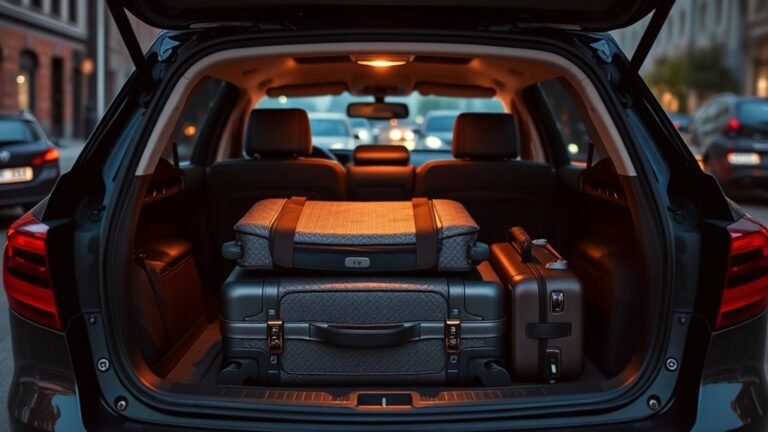
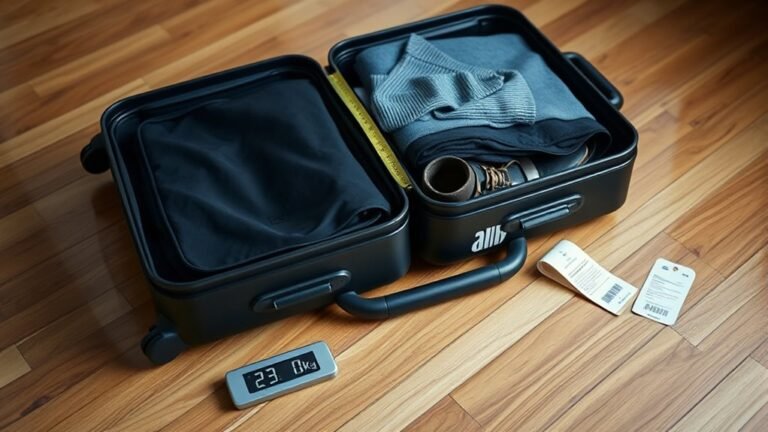
How Do Luggage Scales Work Simple Explanation
You can quickly weigh a suitcase by hanging it from a handheld luggage scale that senses the bag’s pull and converts that force into weight. Mechanical models use a spring that stretches and moves a pointer; digital ones use tiny strain gauges (load cells) that change resistance, get amplified, and show a number on a screen. Tare and unit buttons adjust readings, and proper handling gives accurate results — keep going to learn tips, care, and buying checks.
Who This Guide Is For and What You’ll Learn
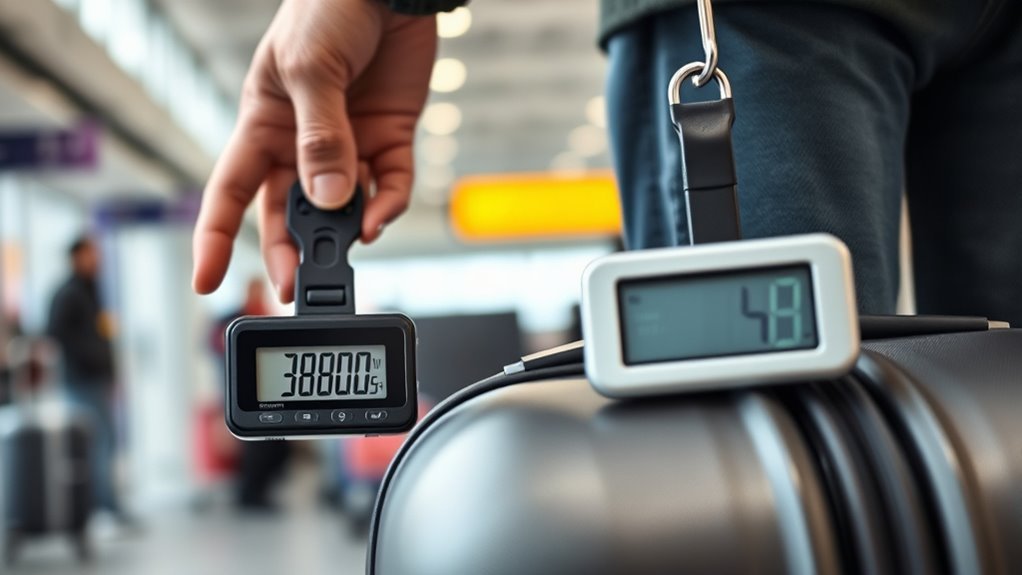
Whether you’re a frequent flyer, an occasional traveler, or someone shipping parcels, this guide helps you pick and use luggage scales so you avoid overweight fees and damaged bags. You’ll learn which scale types suit your needs—digital handhelds, hanging balances, or built-in options—and what features matter: max capacity, accuracy, battery life, and tare functions.
You’ll get practical tips for weighing packed bags, accounting for carry-on limits, and comparing airline rules. If you buy, maintain, or travel with a scale, you’ll know how to read measurements, troubleshoot common errors, and choose models that save time and money.
Quick Answer: How Luggage Scales Work
If you hang or hook your bag from a luggage scale, the device measures the force of gravity on the loaded bag and converts that force into a weight reading you can read on a display or dial.
You get a direct readout because the scale senses tension (mechanical spring or load cell) and translates it into units like pounds or kilograms.
You’ll see a quick, stable number that reflects total mass under gravity.
Portable scales are calibrated for accuracy and often include tare and unit functions so you can confirm compliance with airline limits.
How to Use a Luggage Scale Step-by-Step
Start by preparing your luggage—zip it up, secure loose items, and pack it as you’ll travel.
Attach the scale’s hook or strap to the handle and lift steadily until the display stabilizes.
Read the weight on the screen and record it to compare with airline limits.
Prepare Your Luggage
Before you weigh your bag, make sure it’s packed the way you’ll actually travel so the reading reflects your real load. Check pockets, attachables, and any liquids or electronics you’ll carry on. You want an accurate baseline before using the scale.
- Empty external pockets and zip compartments you won’t use, then reseal what you’ll keep.
- Place heavier items near the center and wheels to mimic rolling balance, not just weight.
- Add travel documents, chargers, and toiletry bags you intend to bring so the measured weight matches your final setup.
Now the bag’s ready for an accurate measurement.
Attach The Scale
Once your bag’s packed and zipped, clip or loop the scale’s strap or hook onto a sturdy handle or the luggage’s top strap so it won’t slip when lifted. Make sure the connection is secure and centred to keep the bag balanced.
If the scale has a buckle, fasten it fully; if it uses a carabiner-style hook, close any safety latch.
Hold the scale itself — not the bag —by its grip or frame, keeping your arm straight to avoid added force from movement. Keep the luggage off the ground and still until you’re ready to check the weight reading.
Read And Record Weight
With the scale secure and your arm steady, lift the luggage until it’s fully off the ground and hold it still; the display will settle to the correct value after a moment. Read the number carefully, note units (kg or lb), and watch for stability or taring icons. If it blinks or fluctuates, lower and retry, keeping the load steady.
Record the weight immediately—use your phone or a small notebook—so you don’t forget. Compare with airline limits and redistribute or remove items if needed. Follow this checklist:
- Verify stable display and units.
- Record weight promptly and clearly.
- Reweigh after adjustments.
Mechanical vs Digital Luggage Scales: Key Differences
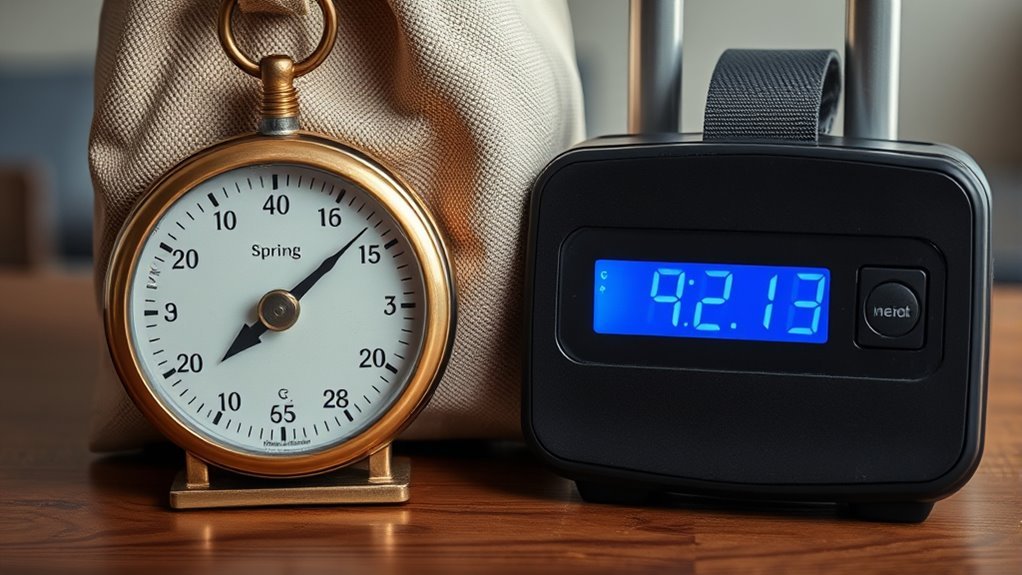
When you’re choosing a luggage scale, the biggest decision is whether you want a simple mechanical model or a digital one—each has clear trade-offs in accuracy, features, and durability.
Mechanical scales are rugged, don’t need batteries, and give quick, intuitive readings, but they’re less precise and can drift over time.
Mechanical scales are tough, battery-free, and immediate to read, though less precise and prone to occasional drift.
Digital scales offer precise readings, tare functions, unit switching, and memory, yet rely on batteries and can be fragile or affected by moisture.
You’ll prefer mechanical for rough, low-maintenance use and digital when you need exact weights and extra functions; pick based on how often and precisely you weigh.
How Spring (Analog) Scales Measure Weight
Although spring scales look simple, they measure weight by translating the force of gravity into spring stretch: you hang your luggage, the load pulls on a spring, and the spring’s extension moves a pointer against a calibrated scale. You read mass by noting pointer position; calibration converts spring displacement to weight units.
Springs obey Hooke’s Law within limits, so accuracy drops if you overload or the spring warms, fatigues, or bends. You should zero the scale before weighing and avoid jerks that cause oscillation. Maintenance and proper use keep readings reliable.
- Material fatigue affects linearity.
- Temperature shifts spring constant.
- Mechanical friction causes hysteresis.
How Load-Cell (Digital) Scales Measure Weight
Now you’ll see how digital luggage scales use tiny strain gauges bonded to a metal element to sense the slightest flex when weight is applied.
The gauges change resistance with that strain, and an onboard circuit converts those changes into a voltage signal.
That signal’s amplified, digitized, and processed so the display shows a stable weight reading.
Strain Gauge Basics
If you hold a digital luggage scale, tiny foil patterns inside—called strain gauges—bend as weight presses on the load cell, and those bends change the gauges’ electrical resistance. Your scale’s electronics measure that change and convert it into the weight you see.
You rely on that resistance shift: gauges are bonded to a deforming metal element so strain maps precisely to resistance. You calibrate and zero the system so small changes matter. Focus on sensor placement and gauge orientation to maximize sensitivity and reduce error.
- Wheatstone bridge balances outputs.
- Gauge material affects linearity.
- Adhesive and bonding control repeatability.
Signal To Display
With the strain gauges producing tiny resistance changes as the load cell bends, your scale’s electronics have to turn those minute signals into a readable weight. The gauges sit in a Wheatstone bridge that outputs a tiny voltage proportional to strain.
An instrumentation amplifier boosts that voltage, preserving accuracy and rejecting noise. An analog-to-digital converter samples the amplified signal and converts it to digital counts.
The microcontroller applies calibration coefficients, temperature compensation, and tare subtraction to translate counts into mass units. Finally, the processed value appears on the display.
You get a stable, accurate weight readout from those converted electrical signals.
How Force Becomes a Weight Reading
Although you don’t see it, every luggage scale is really measuring force and converting that measurement into the familiar weight number you read; it senses the pull of gravity on the bag and translates that pull into units like pounds or kilograms.
Every luggage scale measures force — sensing gravity’s pull on your bag and converting it into pounds or kilograms.
You hang the bag, the sensor deforms slightly, and that deformation creates an electrical signal proportional to force.
The scale’s electronics condition and calibrate that signal, compensating for offset and temperature, then compute a stable reading.
You rely on calibration constants and the display conversion to get a usable number.
- Sensor deformation translated to voltage
- Signal conditioning and filtering
- Calibration to produce the display
Pounds vs Kilograms: Why Units Switch
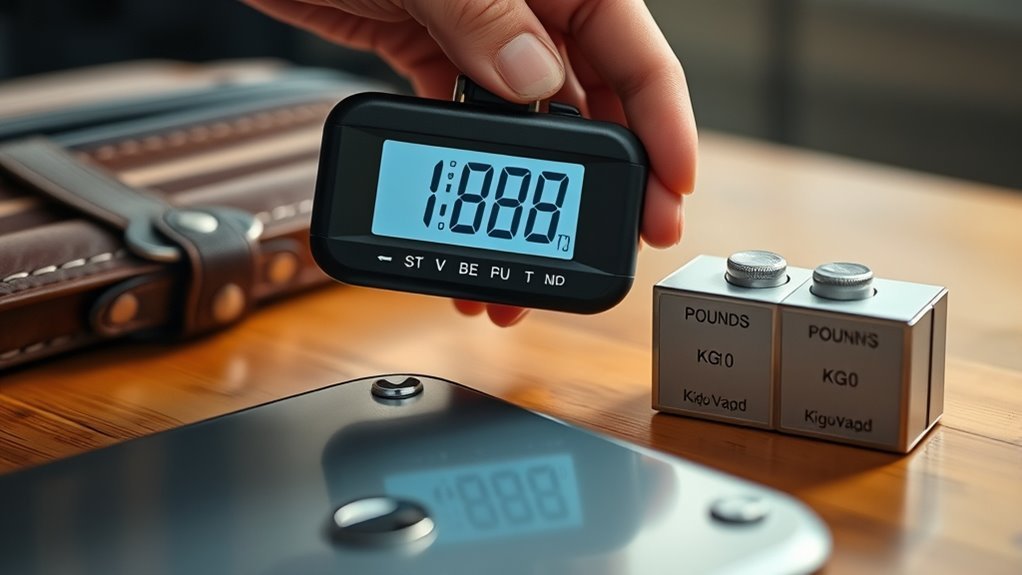
Because scales convert a measured force into a number, they can present that number in different units, and you switch between pounds and kilograms by changing the conversion factor the electronics use. You pick units in settings; the microcontroller multiplies sensor output by a factor (N for kg, N×2.20462 for lb). The display then shows the converted value and unit label. Switching doesn’t alter the raw measurement, only the math and label. Here’s a simple comparison:
| Concept | Example |
|---|---|
| Raw signal | Voltage from load cell |
| Conversion | ×1 for kg, ×2.20462 for lb |
| Display | “5 kg” vs “11.02 lb” |
Typical Accuracy and Precision to Expect
When you check a luggage scale’s specs, you’ll usually see accuracy quoted as a percentage of the reading (often ±0.5% to ±1%) or as a fixed increment (like 0.1 lb or 50 g); that tells you how close the displayed value is likely to be to the true weight under ideal conditions.
You should expect small, consistent deviations and occasional rounding to the nearest increment. Battery level, temperature, and how you hold the scale can shift results slightly, but good consumer scales keep errors predictable so you can plan for airline limits.
- Resolution: smallest step shown (e.g., 0.1 lb).
- Repeatability: same load gives same readout.
- Linearity: error stays proportionate across range.
What Tare and Zero Do to Readings
You’ll want to understand the tare function and how it differs from zero so your readings actually reflect just the bag’s weight.
Tare lets you subtract containers or straps, while zero simply resets the scale to ignore small offsets.
Always reset appropriately before weighing to keep accuracy tight.
Tare Function Explained
If you’ve ever weighed a suitcase with internal compartments or travel accessories inside, the tare and zero functions let you get the true luggage weight without doing extra math.
The tare function subtracts container or accessory weight so the scale shows only what you packed. You’ll place the empty insert or pouch on the scale, press tare, then add items; the display updates to reflect net weight.
Use tare when you want the weight of contents alone, and repeat tare if you swap containers. Remember to clear tare before a new measurement to avoid misleading results.
- Steps to tare
- Common mistakes
- Practical tips
Zero Vs. Tare
Although both zero and tare adjust a scale’s display, they do different jobs. You use zero to set the scale to a true baseline with nothing on it, so readings start from actual zero. You use tare when you place a container or hook and want the scale to ignore that weight, so it shows only the luggage. Zero affects the baseline; tare subtracts a specific present weight. Choose zero when nothing’s on the scale, choose tare when something’s on but shouldn’t count.
| Action | Use when | Result |
|---|---|---|
| Zero | Empty scale | Baseline = 0 |
| Tare | With container | Display ignores container weight |
Resetting For Accuracy
How do zero and tare actually change the numbers you see on a luggage scale? You use zero to clear small offsets so the scale reads true when nothing’s hanging. Tare removes weight of containers or straps so you only see bag mass. Resetting for accuracy means checking zero before each use and taring whenever you add carriers.
- Check zero: power on, ensure display reads 0.0; recalibrate if it doesn’t.
- Apply tare: hang an empty container or hook, press tare to subtract its weight.
- Verify: hang suitcase, confirm reading matches a known reference or repeat measurement.
How Strap or Hook Placement Changes Results
When you change where the scale’s strap or hook grabs your bag, the reading can shift because weight distribution and leverage change slightly; hooking near a corner or an off-center handle often tilts the bag and makes part of the load bear more of the force, so the scale may show a higher or lower value than when the bag hangs evenly from its center. You can test this by moving the hook and noting differences. Visualize balance points:
| Hook position | Likely effect |
|---|---|
| Center | Stable, accurate |
| Corner | Tilted, variable |
| Side handle | Uneven, higher or lower |
Check consistency before travel.
How Bag Shape and Packing Affect Measurements
Shifts in where you hang a bag can change readings, and the bag’s shape and how you pack it do the same by altering how weight distributes and where the scale takes its pull. You’ll notice bulging sides, unevenly packed items, or rigid frames shift the center of mass, making the scale register slightly higher or lower depending on contact points and leverage.
Soft duffels conform and concentrate load near the strap; hard-shell cases transfer load more directly. Small positional changes of dense items matter more than overall volume.
- Dense items at the bottom lower the center of mass.
- Side pockets shift lateral balance.
- Frame rigidity gives consistent readings.
Why Swinging a Bag Gives Wrong Readings
Because a hanging scale measures vertical force, swinging your bag adds horizontal motion and variable tension that confuse the reading. You’ll see spikes and drops as inertia and pendulum effects change the pull on the hook. To get accurate weight, stop motion, let the bag hang steady, and read when the display stabilizes. Avoid twisting or pushing, which shifts load distribution and momentarily reduces vertical force. A calm, vertical hang gives the true reading; any lateral movement produces dynamic forces the scale can’t separate from gravity.
| Cause | Effect |
|---|---|
| Swinging | Fluctuating tension |
| Inertia | Spikes on display |
| Twisting | Uneven load |
| Pushing | Underreported weight |
Battery, Power, and Display Issues in Digital Scales
If your digital luggage scale acts erratically or won’t turn on, start by checking the batteries and power connections since weak cells, corroded contacts, or a loose compartment can cause flickering displays, intermittent readings, or total failure.
You should replace batteries with fresh, correct-size cells, clean contacts with isopropyl alcohol, and make certain the compartment closes firmly.
Also inspect the display for cracks or moisture and reset the unit per the manual to clear glitches.
If problems persist, the internal power board or solder joints may be faulty and need repair or replacement by a technician.
- Replace batteries
- Clean contacts
- Inspect display and reset
Common Causes of Measurement Drift
After you’ve ruled out power and display faults, look at factors that make readings wander over time: sensor wear, temperature changes, mechanical strain from hanging or bumping, and loose or stretched straps can all cause gradual drift.
Inspect the load cell or strain gauge for corrosion, solder cracks, or bent mounts—these alter sensitivity.
Check attachment points and hooks for deformation that shifts forces.
Examine the strap and buckle for fraying or elastic creep that changes how load transfers.
Frequent drops or heavy overloads can fatigue internal components.
Regular calibration and gentle handling help minimize drift and keep readings reliable.
How Temperature and Humidity Affect Readings
When you use a luggage scale in different climates, temperature and humidity change how its sensors behave and can shift readings noticeably. You’ll notice small drifts when moving between hot, cold, dry, or humid environments because materials expand, electronics’ reference voltages shift, and moisture affects contacts.
Watch for inconsistent readings after exposure to extreme conditions and allow the device to stabilize to room conditions before weighing.
- Temperature: metals and strain gauges expand or contract, altering sensor output.
- Humidity: moisture can cause corrosion or change insulation, affecting circuits.
- Condensation: sudden cooling creates water that disrupts electrical contacts.
Calibrating a Digital Luggage Scale at Home
Because even small sensor shifts and environmental changes can skew readings, you’ll want to calibrate your digital luggage scale before important trips to guarantee accuracy.
First, place the scale on a flat, stable surface and power it on, letting it warm up per the manual.
Zero or tare the display with no load.
Use a known weight (a dumbbell, sealed bag of flour) near the scale’s capacity, hang or place it as you normally would, and confirm the reading.
If the value’s off, follow the manufacturer’s calibration mode steps to adjust.
Recheck with the known weight and neutralize any drift.
Checking Calibration on an Analog Scale
Start by making sure the needle rests exactly at zero with nothing on the hook. If it doesn’t, you’ll need to use the zeroing knob or screw.
Next, test the scale with a few known weights or household items to see if readings are consistent across the range.
If measurements are off, adjust the calibration mechanism incrementally and re-test until the readings match the known weights.
Zeroing The Scale
If your analog luggage scale doesn’t read exactly zero before you weigh a bag, you won’t get an accurate measurement, so you should check and adjust the zero setting every time you use it.
Hold the scale empty and level, then look at the needle or dial. Use the built-in adjustment wheel or screw to align the pointer to the zero mark.
If there’s no adjuster, note the offset and compensate mentally when reading weights.
Regularly inspect for dirt or bent parts that shift the pointer.
Calibrate in a stable environment to avoid drafts or uneven surfaces.
- Verify empty, level position.
- Turn adjuster to zero.
- Inspect mechanism for damage.
Test With Known Weights
When you’ve zeroed the scale, check its accuracy by hanging or placing items whose weights you already know; common objects like a 1 kg dumbbell, a full 1-liter water bottle (about 1 kg), or pre-calibrated weights work well. Use multiple weights to spot nonlinear errors and repeat each test three times, noting readings. If readings are within the tolerance you accept, the scale’s fine for travel. If not, mark the discrepancy and avoid heavy luggage until you can adjust or service it.
| Known Weight | Observed Reading |
|---|---|
| 1.0 kg | 1.02 kg |
| 2.0 kg | 1.98 kg |
Adjusting Calibration Mechanism
Now that you’ve compared the scale against known weights and noted any discrepancies, check the analog scale’s calibration mechanism to correct small errors.
You’ll usually find an adjustment screw or dial near the face; use a small screwdriver or the built-in knurled knob. Turn slowly, clockwise to decrease indicated weight, counterclockwise to increase it, and re-test with a known mass until the reading matches.
- Center the needle at zero without load before adjusting.
- Make quarter-turns, then reweigh to avoid overshooting.
- Repeat until consistent across multiple known weights for reliable calibration.
Weighing Irregular or Oversized Luggage Reliably
Because oversized and oddly shaped bags don’t sit neatly on a scale, you’ll need a few alternative techniques to get a reliable weight.
Use a flat board or rigid tray: place the bag on it, then weigh the board-plus-bag and subtract the board’s tare weight.
If the bag is too big for handheld scales, use a bathroom scale by weighing yourself, then weigh yourself while holding the bag and subtract.
For delicate items, distribute weight evenly on the tray to avoid tipping.
Repeat measurements and average them for accuracy.
Note balance, avoid placing the board off-center, and verify the surface beneath the scale is level.
Preventing Damage to the Scale’s Hook or Strap
If you want your scale to last, treat the hook or strap as the weakest link and avoid overloading or rough handling. You’ll protect it by using gentle, centered lifts, avoiding sideways pulls that twist or fray material. Don’t try to lift oversized items that strain connectors; use two hands or a luggage trolley instead.
Store the strap coiled without kinks and keep the metal hook dry to prevent corrosion.
- Inspect before each trip for frays, bends, or loose rivets.
- Lift smoothly, support heavy bags from below when possible.
- Replace damaged hooks/straps immediately to prevent failure.
Signs Your Luggage Scale Is Failing
When your readings start jumping around, lagging, or giving different weights for the same bag, your luggage scale is trying to tell you something. You’ll notice inconsistent zeroing, flickering display segments, or numbers that don’t stabilize.
The hook or strap might slip during weighing, and the scale may shut off unexpectedly. Batteries draining fast or swelling, unexplained corrosion near connectors, and a loose or wobbly housing are warning signs.
Calibration attempts that fail or repeatable offsets indicate internal sensor damage. If multiple symptoms appear, stop relying on it for accurate limits and repair or replace the unit promptly.
Choosing the Right Luggage Scale: Capacity, Accuracy, Size
Noticing those failure signs means it’s time to pick a reliable replacement, and you’ll want a scale that matches how you travel. Choose capacity above your heaviest bag, aiming for margin so you won’t max out the device.
Favor accuracy within 0.1–0.2 kg (0.2–0.5 lb) for predictable airline compliance. Consider size and weight: compact units fit carry-ons and won’t add noticeable bulk.
- Capacity: pick 40–50 kg if you check heavy bags; 25–30 kg suffices for light packers.
- Accuracy: tighter tolerance reduces surprise fees.
- Size: handheld vs pocketable depends on storage needs.
Budget vs Premium Scale Features to Consider
When comparing budget and premium luggage scales, you’ll want to focus on accuracy and precision since a small error can cost you at the airport.
Check build quality differences too—materials, strap strength, and display durability affect long-term reliability.
Finally, decide which extra features are worth paying for, like tare functions, backlit screens, or Bluetooth tracking.
Accuracy And Precision
Because your luggage weight determines fees and hassle at the airport, accuracy and precision should be top priorities when choosing a scale. You want repeatable readings and minimal error so you can pack confidently.
Compare stated accuracy (e.g., ±0.1–0.5 lb) and resolution (smallest increment shown). Check calibration options and whether the display stabilizes before you record a value.
- Verify resolution: finer increments let you hit airline limits more reliably.
- Look for consistency: test multiple lifts to confirm repeatability.
- Confirm calibration: easy recalibration keeps measurements trustworthy over time.
Build Quality Differences
Although budget scales can get you through a trip, premium models offer sturdier construction, clearer displays, and more reliable hardware that reduce wear and measurement drift over time.
You’ll notice thicker straps, reinforced hooks, and metal components on higher-end units that resist stretching, corrosion, and deformation. Premium casings seal better against dust and moisture, protecting load cells and electronics.
Buttons feel firmer and screens stay legible longer, lowering the chance of unreadable readings at the airport.
Choose based on expected frequency and rough handling: invest if you travel often or with heavy bags; pick budget for occasional, careful use.
Extra Features Worthpaying
If you travel often or just like gadgets that save time, some extra features on luggage scales are worth paying for. You’ll choose based on frequency, budget, and how much convenience matters. Basic models give accurate weight; premium ones add useful extras that justify higher cost if you use them.
- Backlit digital display and tare function — read numbers in low light and zero for containers.
- Bluetooth app sync — track multiple bags, history, and get alerts before limits.
- Built‑in tape measure and luggage handle comfort — small conveniences that speed packing and reduce strain.
Airline Weight Rules and Why Accuracy Matters
When you check your bag, the airline’s weight limits determine whether you pay extra, have to repack, or risk denied boarding. You’ll face different allowances for carry-on and checked pieces, and international routes often vary. Accuracy matters because scales at counters can differ from yours; small errors mean big fees. You’ll want reliable measurements to plan packing and avoid surprises. Below is a simple visual to imagine limits versus consequences:
| Limit type | Typical outcome |
|---|---|
| Under limit | Smooth boarding |
| Slightly over | Fee or repack |
| Far over | Denied check-in |
| Carry-on vs checked | Different rules |
Use a Scale to Avoid Overweight Fees
Weigh your bags at home before you leave so you don’t get surprised at the airport. Check your airline’s weight limits and allowed tolerances so you know where to aim.
If a bag’s too heavy, redistribute items or remove nonessentials to avoid fees.
Weigh Before Leaving
Before you head to the airport, grab a portable luggage scale and check your bags so you won’t get hit with surprise overweight fees at the counter. You’ll weigh each piece at home, adjust contents, and redistribute items between bags to stay under limits. Do a final check after packing changes and before locking zippers.
- Weigh: get a stable reading, repeat if needed.
- Adjust: move heavy items, swap to carry-on when possible.
- Reweigh: confirm changes kept you under the target and note the weight for peace of mind.
Know Airline Limits
Now that you’ve knocked your bags into the correct range at home, check each airline’s baggage rules so you know the exact size and weight limits to target. Airlines vary: checked bags often max at 23 kg (50 lb) or 32 kg (70 lb).
Carry-ons have stricter size and weight caps, and low-cost carriers may charge for even slight overages. Use your scale to measure each bag after packing, note the limit for your fare class, and factor in attachments like wheels or straps that add weight.
Accurate preflight weighing saves money and stress at the counter.
Redistribute Or Remove
How can you avoid surprise fees when your luggage tips the scale? Use a handheld scale to check weight, then act: redistribute items between bags, remove nonessentials, or shift to carry-on within limits. You’ll save money and stress by adjusting before check-in.
- Weigh each bag, move dense items (shoes, toiletries) to underweight luggage to balance totals.
- Pull out extras (souvenirs, heavy clothes) and decide what to wear, mail, or leave behind.
- Repack strategically: place heavy items near wheels for stability, compress clothing, and verify final weight with the scale.
Luggage Scales vs Bathroom and Postal Scales
Although bathroom and postal scales can tell you a weight, luggage scales are built for the specific needs of travel: they’re compact, have hooks or straps for single-handed use, and are calibrated for the typical weight range and handling of suitcases.
You’ll find luggage scales give quicker, more convenient readings when you lift a bag, avoiding awkward balancing on a bathroom scale or trying to center uneven items on a postal unit.
They’re designed for portability, battery life, and readability with one hand. For travel you’ll prefer a dedicated luggage scale for speed, simplicity, and consistent results.
Certifications and Specs Worth Checking
When you’re comparing luggage scales, check for accurate certifications and key specs so you don’t get surprised at the airport. You’ll want clear proof the scale meets legal-for-trade or aviation tolerance standards, plus readable specs so you can match capacity to your travel needs.
Look for stable calibration, max capacity, and resolution to guarantee consistent, useful readings.
Check stable calibration, sufficient max capacity, and fine resolution to ensure consistent, reliable luggage readings.
- Certification: legal-for-trade, ISO, or regional approvals that confirm accuracy limits.
- Capacity: maximum weight and margin beyond typical airline limits.
- Resolution & tolerance: smallest increment and stated error range for reliable results.
How Manufacturers Test Scale Accuracy
Having checked certifications and specs, you’ll want to understand how manufacturers actually verify those accuracy claims. They use calibrated test weights and controlled procedures: placing known masses across the scale’s measuring range to spot nonlinearity, repeatability, and hysteresis.
Engineers run multiple trials, average results, and record deviations versus traceable standards. They also test environmental factors like temperature and vibration in chambers to see how readings drift.
If a digital scale, firmware and ADC performance get inspected. Final products pass only if errors stay within declared tolerances; otherwise they’re adjusted, rejected, or recalibrated before shipment.
Lifespan and Maintenance Tips
You’ll want to know how long the batteries typically last and when to replace them to keep your scale reliable.
Check calibration periodically to maintain accuracy and spot any drift before it affects your baggage decisions.
Keep the unit clean and stored dry to prevent damage and extend its usable life.
Battery Life Expectancy
Curious how long your luggage scale’s battery will last? You’ll typically get months to years depending on use and battery type.
Store scales powered by coin cells often last longer between trips, while LCD backlights and Bluetooth drain faster.
To maximize lifespan, follow simple habits:
- Remove batteries if you won’t use the scale for months to prevent leakage and corrosion.
- Turn the scale off after each use and avoid leaving it on display mode or with lights active.
- Use quality batteries and replace all cells at once to maintain consistent voltage and reliable performance.
Calibration And Accuracy
Battery care affects more than just runtime—how you maintain power and storage also impacts your scale’s long-term accuracy and calibration needs. You should recalibrate after battery swaps, long idle periods, or noticeable reading drift.
Many digital scales offer a simple zero or calibration mode; follow the manual and use known weights or luggage with certified mass for checks. Mechanical scales may need tension adjustments or professional service if they lose accuracy.
Track calibration dates and any deviations so you spot trends before they worsen. Regular checks prolong useful life and make certain you avoid overweight surprises at the airport.
Cleaning And Storage Tips
Because dirt, moisture, and rough handling quietly shorten a scale’s life, regular cleaning and smart storage keep accuracy steady and problems away. You’ll wipe the body with a soft, slightly damp cloth—never soak it—then dry immediately.
Remove batteries before long storage to prevent leaks. Store the scale in a padded pouch or original box, away from extreme temperatures and humidity.
Check for corrosion or loose parts before each trip and recalibrate if readings drift. Follow manufacturer instructions for cleaning agents and battery types to avoid damage.
- Clean gently and dry thoroughly.
- Remove batteries during long storage.
- Store padded, temperature-stable, dry.
How to Store and Carry Your Luggage Scale Safely
When you’re not weighing bags, store your luggage scale where it won’t get crushed or exposed to moisture—think a padded pocket in your carry-on or a small hard case—and keep the strap neatly coiled to prevent fraying.
Pack it away from heavy items and sharp edges to avoid dents or scratches.
Remove batteries if you won’t use the scale for months to prevent leaks, and secure the display to avoid accidental button presses.
When carrying it on trips, clip it inside your bag or keep it in an accessible pocket so you can weigh luggage quickly and safely.
Eco and Sustainability Considerations for Scales
When you shop for a luggage scale, check for energy-efficient features like low-power sleep modes and long battery life to cut waste and costs.
Prefer models made from recyclable or recycled materials and look for clear manufacturer recycling guidance.
These choices help reduce the environmental footprint of a small but ubiquitous travel accessory.
Energy Efficiency Standards
While shopping for a luggage scale, you should weigh energy efficiency just as seriously as accuracy and build quality; efficient scales use less power, run longer on a single battery, and cut down on waste over the product’s lifetime. You’ll want models meeting low-power design principles and offering auto-off, LED efficiency, or e-ink displays to conserve charge. Look for certifications or clear power specs so you can compare.
- Choose scales with auto-shutoff timers and low quiescent current.
- Prefer e-ink or low-power LCDs over bright LED matrices.
- Check battery type and expected run-hours per charge or cell.
Recyclable Materials Use
Because materials determine a product’s end-of-life impact, you should favor luggage scales built from easily recyclable components—aluminum, stainless steel, and marked plastics—so recycling streams can reclaim value instead of sending parts to landfill.
Choose scales with modular designs that let you replace batteries, displays, or load cells without discarding the whole unit.
Check for clear recycling codes and minimal mixed-material bonding, which complicates separation.
Prefer manufacturers offering take-back programs or spare parts.
Durable finishes and corrosion-resistant metals extend life, reducing waste.
Quick Troubleshooting Fixes
If your luggage scale won’t turn on, give the battery contacts a quick wipe and try a fresh battery first—most issues are power-related and fixable in seconds.
Next, check the strap or hook for twists or fraying; a misaligned load point skews readings.
Check the strap or hook for twists or fraying — a misaligned load point will skew readings.
Reset the unit if it shows odd numbers: hold the power/tare button for several seconds, then test with a known weight like a water bottle.
Keep the sensor area dry and avoid bumps.
- Inspect batteries and contacts.
- Verify strap alignment and condition.
- Perform a tare/reset and retest.
Real-World Tips From Frequent Travelers
When you travel often, seasoned packers learn quick habits that keep their luggage scales reliable and readings consistent. You’ll stash the scale in an easy pocket so you remember it, check batteries before leaving, and zero it on flat surfaces.
You’ll weigh packed bags multiple times during packing to spot heavy items early, spread weight evenly, and tighten loose straps that catch air. You’ll note airport allowances and weigh again after last-minute purchases.
If readings jump, you’ll retest with a known weight. These small routines cut surprises at check-in and save you time, fees, and stress.
Buying Checklist: What to Verify Before Purchase
Before you buy, check the weight accuracy specs to make sure the scale measures in the increments and range you need.
You’ll also want to inspect build quality—materials, seam strength, and the hook or strap—so it won’t fail after a few uses.
Those two checks will save you money and hassle at the airport.
Weight Accuracy Specs
Since accurate readings are the whole point of a luggage scale, check the stated accuracy tolerance—usually ±0.1 to ±0.2 lb (±0.05–0.1 kg)—and confirm it’s suitable for your needs; manufacturers sometimes quote ideal conditions, so verify real-world performance in reviews.
Also note resolution (smallest increment) and whether the unit auto-calibrates.
- Resolution: finer increments (0.1 lb/0.05 kg) give more precise feedback for tight airline limits.
- Consistency: look for repeatable readings across multiple weighs.
- Certification: check for tested standards or third-party verification when exactness matters.
Durability And Build
Although durability might not be the flashiest feature, you’ll want a build that survives frequent travel and rough handling; check materials, joint strength, and seam reinforcement so the scale won’t fail after a few trips. You’ll inspect casing (metal vs plastic), strap and hook quality, and button resilience. Look for water resistance, shock-absorbing design, and replaceable straps. Test folding parts and battery access for wear points. Warranty and user reviews reveal real-world longevity. Use the quick checklist below to compare models before buying.
| Feature | What to check |
|---|---|
| Casing | Metal, thick ABS |
| Straps | Reinforced, replaceable |
| Joints | Tight, no wobble |
| Warranty | At least 1 year |
Frequently Asked Questions
Can a Luggage Scale Measure Liquids or Pressurized Containers Accurately?
Yes — you can weigh liquids or pressurized containers with a luggage scale, but it only measures total weight, not volume or pressure. You’ll get accurate mass readings if the item’s stable and fully supported during weighing.
How Does Airport Staff Verify Passenger-Claimed Baggage Weights?
They’ll weigh your bag on calibrated scales at check‑in or the gate and compare it to the allowance; if it’s over, they’ll charge, require repacking, or gate‑check. You’ll be asked to show ID for verification.
Can Luggage Scales Detect Hidden Items or Tampering Inside Bags?
No, luggage scales can’t detect hidden items or tampering inside bags; they only measure overall weight, so you’ll need inspections, X‑rays, or sniffer dogs to reveal concealed contents or signs of interference beyond weight discrepancies.
Do Luggage Scales Work for Checked Musical Instruments or Fragile Items?
Yes — you can use luggage scales for checked musical instruments or fragile items, but you’ll need to weigh the case and instrument together, handle them gently, and rely on proper packing and airline handling to protect fragility.
Is There a Legal Requirement for Consumer Luggage Scale Calibration?
No, there isn’t a universal legal requirement for consumer luggage scale calibration; you should check local regulations and manufacturer recommendations, and you can verify accuracy yourself using known weights or a certified scale if precise compliance matters.
Conclusion
Now you know how luggage scales work and how to use them, so you can avoid surprise fees and travel stress. Whether you pick a simple spring scale or a precise digital model, you’ll weigh bags quickly and confidently by following the steps and troubleshooting tips. Check battery life, tare, and accuracy before you travel. With these habits, you’ll pack smarter, stay within limits, and enjoy smoother trips without last-minute repacking.