How Big Is a 10kg Cabin Bag Airline Size Guide
A 10kg cabin bag means your carry-on must weigh no more than ten kilograms; size still depends on the airline, so you’ll need to follow their length, width and depth limits too. Airlines enforce weight at check-in and boarding, and oversized luggage can be rejected even if it’s under 10kg. Pack light, prioritize essentials, and use compact luggage to stay within limits. Scroll on to learn how sizes, weighing methods and smart packing tips work together.
What “10kg Cabin Bag” Actually Means
When an airline says “10kg cabin bag,” it means the carrier limits the weight of the bag you can bring into the cabin to 10 kilograms, not the bag’s external size or number of items inside.
You’re responsible for the total weighed load: luggage, contents, and any detachable pockets. Carriers check at the gate or desk and may weigh odd-looking items.
Dimensions and item counts are separate rules—size limits and personal item policies vary.
If you pack heavy, you’ll need to redistribute or check baggage.
Weigh your bag at home, use travel scales, and prioritize essentials to stay compliant.
Quick Answer: Will a 10kg Cabin Bag Be Allowed?
If your bag weighs 10kg or less and meets the airline’s size and item rules, you’ll usually be allowed to bring it into the cabin; however, approval depends on the carrier’s specific weight, dimension, and personal-item policies and how strictly staff enforce them at check-in or the gate.
To know for sure, check the airline’s website before you travel and compare your bag’s dimensions and contents to their limits.
Check the airline’s website before travel and compare your bag’s size and contents to their limits.
Frequent flyers use approved baggage lists or weigh bags at home.
If in doubt, contact the airline—preemptive clarification beats surprises and potential fees at the airport.
How Airlines Weigh Cabin Bags at the Gate
How do airlines actually check cabin bag weight at the gate? You’ll usually see staff ask you to place your bag on a portable scale or into a weigh-sizer (a small platform with a built-in scale). They might also use a handheld scale if space is tight.
Staff check weight quickly, note excess kilos, and decide on allowance or fees. If your bag’s overweight, you’ll be asked to move items to hold luggage, a personal item, or pay for checked baggage.
Be ready with essentials in your carry-on and know your airline’s limit to avoid delays and extra charges.
When Size Rules Override the 10kg Limit
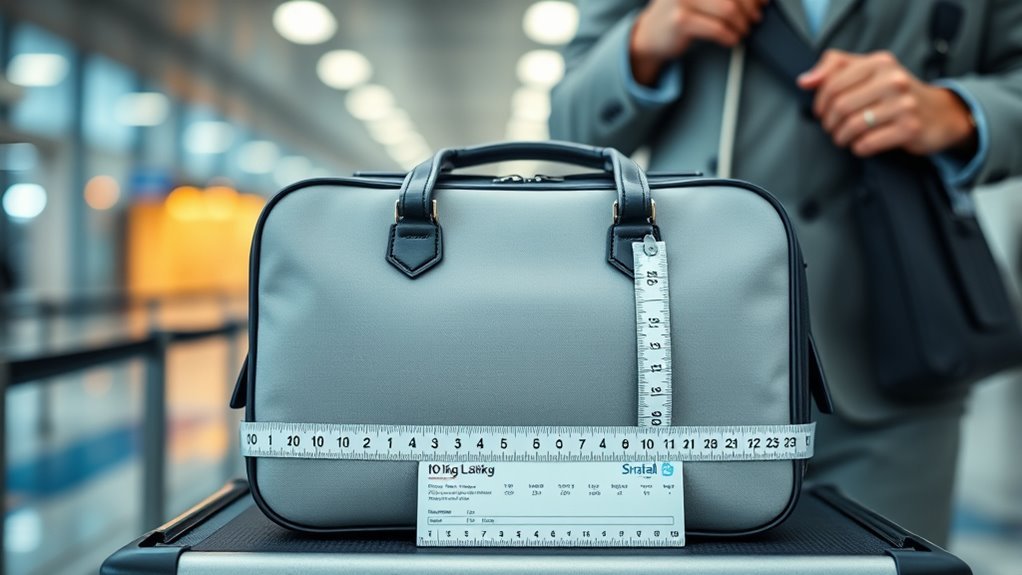
Gate staff may enforce weight, but size often carries more authority: airlines will refuse a cabin bag that doesn’t meet their length, width, and depth limits even if it’s under 10kg. You’ll need to check dimensions before you pack; oversized bags can be gate-checked, incur fees, or be denied boarding for carry-on. Measure bulging pockets and wheels, and consider collapsible options. Know specific carrier rules and priority policies; sometimes soft bags squeeze into overheads where hard cases won’t.
| Issue | Consequence | Tip |
|---|---|---|
| Oversize | Gate-check/fee | Measure fully |
| Bulging pockets | Rejection | Compress items |
| Wheels/protrusions | Non-compliant | Remove extras |
Standard Cabin Bag Dimensions Vs 10KG Rules
Want to know why dimensions matter as much as the 10kg limit? You’ll face two gatekeepers: weight and size.
Even if your bag is under 10kg, airlines often enforce strict length, width, and depth limits to fit overhead bins or under seats. If your suitcase exceeds those dimensions you may be charged or forced to check it regardless of weight.
Even under 10kg, oversized bags can be charged or forced into checked luggage—size rules matter as much as weight.
Conversely, a compact but dense bag can meet size rules yet hit the 10kg cap. Always check both sets of rules before packing.
Measure your bag and weigh it packed to avoid surprises at boarding.
Common 10kg Policy Types Explained
You’ll want to check whether your airline enforces a strict 10kg carry-on weight limit or a combined size-and-weight rule that lets slightly larger bags fly if they’re light.
Some carriers focus only on dimensions and let weight be flexible, while others will weigh every bag at the gate. Knowing which policy applies helps you pack smarter and avoid surprise fees.
Carry-On Weight Limits
Although 10kg limits look simple on paper, airlines enforce them in a few different ways, so you should check the exact policy before you pack.
Some carriers set a strict single-bag 10kg limit and weigh carry-ons at the gate; others allow a 10kg personal item plus a smaller underseat bag.
Low-cost airlines often impose tighter checks and charge for overweight items, while full-service carriers may be more flexible but still enforce limits for safety.
You should weigh your bag at home, distribute heavier items near the frame, and be prepared to move things to checked baggage if staff ask.
Size vs Weight Rules
When airlines set a 10kg carry-on rule, they’re usually balancing two different concerns: physical size (what fits in overhead bins or under the seat) and weight (what cabin crew consider safe to lift and stow). You’ll encounter three common policy types: strict weight-only, size-first with weight cap, and flexible combined rules. Know your carrier’s approach so you pack smart, placing dense items in checked luggage if needed. Weigh bag before travel and measure dimensions. Here’s a quick comparison to help you pick packing strategies.
| Policy Type | Focus | Tip |
|---|---|---|
| Weight-only | 10kg limit | Use scale |
| Size-first | Dimension priority | Compress items |
| Combined | Both enforced | Balance load |
Low-Cost Carriers That Enforce 10kg Strictly
Because low-cost carriers aim to cut costs and speed up boarding, many enforce a strict 10kg cabin bag limit and will weigh bags at the gate, so you should expect little flexibility and possible fees if your bag’s over the limit.
You’ll need to pack strategically, choose lightweight carry-ons, and know each airline’s stated dimensions. At check-in or boarding you’ll seldom get a break, so prepare to transfer items to your personal item or pay to check the bag.
Familiarize yourself with allowed liquids and tech rules to avoid surprises.
- Pack essentials first
- Use a digital luggage scale
- Wear heavier items
- Know liquid limits
- Check airline policy
Legacy Carriers That Are More Flexible With 10kg
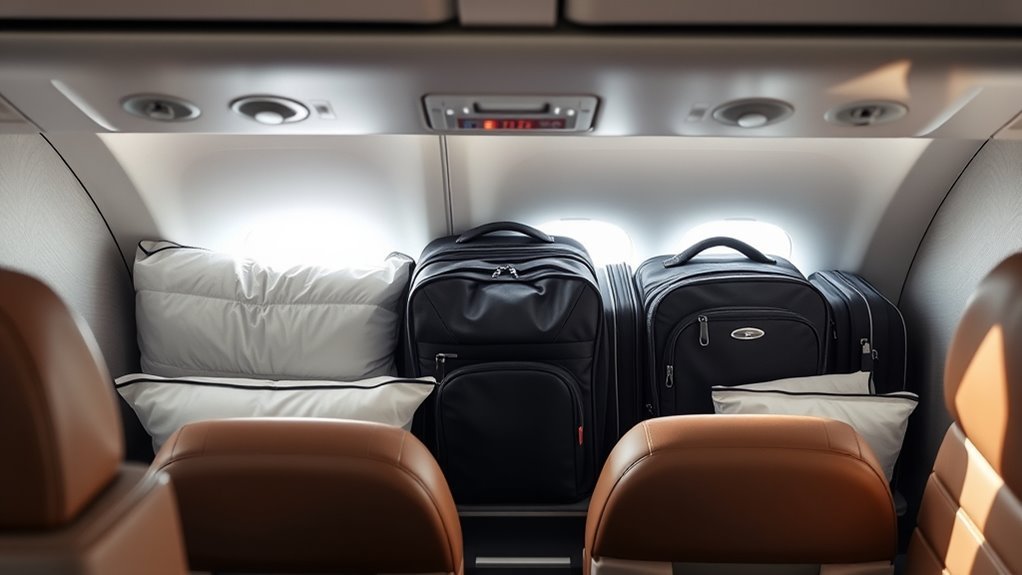
On legacy carriers you’ll find more wiggle room around the 10kg rule thanks to airline policy exceptions and onboard allowances.
If you have elite status you’ll often get larger or additional cabin items as a perk.
Also note that long‑haul flights typically allow bulkier cabin bags or different weight rules compared with short regional services.
Airline Policy Exceptions
Although most airlines stick to strict weight rules, several legacy carriers offer more flexibility with 10kg cabin bags, letting you carry slightly heavier or additional items without extra fees. You should check exceptions: carry-on combos, musical instruments, medical supplies, and duty-free purchases often get leniency.
Know that allowances vary by route and fare class; gate agents still have final say.
- Carry-on plus personal item treated as one combined weight
- Medical equipment and medication exemptions
- Small musical instruments allowed as cabin items
- Duty-free bags accepted beyond weight limits
- Infant bags or stroller exceptions apply
Elite Status Perks
If you frequently fly with legacy carriers, earning elite status can make that 10kg cabin limit much easier to handle. As a status holder, you’ll often get generous carry-on allowances, priority boarding, and gate agent discretion when your bag’s weight edges over limits.
Some airlines allow an extra personal item or higher weight threshold for elites, and agents usually favor members during busy flights. Use lounge access to repack or leave nonessentials before boarding.
Always confirm benefits per airline and carry proof of status; perks vary by program and route, so check rules before you pack or travel.
Long‑Haul Cabin Rules
When you fly long‑haul with legacy carriers, you’ll usually find more flexible cabin rules around that 10kg limit—airlines like British Airways, Lufthansa and Air France often allow higher weight thresholds, an extra personal item, or gate-agent discretion on international routes.
You should still check specific allowances before packing: permitted combinations, carry‑on dimensions, and whether your fare includes a cabin bag. Even with leniency, staff may enforce balance, security or safety constraints.
Know how elite status, route and aircraft type affect treatment so you can rely on flexibility rather than assume it.
- Check fare class limits
- Verify dimensions
- Ask gate agents
- Note elite benefits
- Pack smartly
Codeshare, Alliances and Multi-Leg Allowance Changes
Because airlines often sell seats through partners, your cabin allowance can change mid-journey when you book a codeshare or fly with alliance partners, so you need to check the rules for every carrier on your itinerary.
You’ll often be subject to the operating carrier’s policy, not the marketing airline’s, so verify size and weight limits for each flight segment.
When routes mix low-cost and full-service carriers, stricter limits usually apply.
Review your booking confirmation, check both airlines’ baggage pages, and call customer service if policies conflict.
Pack to the tightest allowed dimensions to avoid surprises and fees.
Frequent-Flyer Perks That Increase Cabin Allowance
If you fly often, your loyalty tier upgrades can let you bring larger or additional cabin bags.
You’ll also find many airline-branded credit cards add extra allowance or priority boarding that effectively increases what you can carry.
Check specific airline status perks to see the exact weight and size boosts they offer.
Loyalty Tier Upgrades
Want to squeeze more into your cabin allowance? Loyalty tier upgrades often raise your permitted bag weight or allow an extra piece, so you’ll pack smarter and travel lighter.
Higher tiers usually bring priority boarding and relaxed carry-on rules; check your airline’s chart. Don’t assume universality—benefits vary by carrier and route.
Keep confirmations and digital cards handy at check-in to avoid disputes.
- Complimentary extra carry-on or heavier allowance
- Priority boarding for earlier overhead space
- Flexible gate agent discretion
- Tier-specific baggage policies in T&Cs
- Upgrades via miles or status match
Confirm limits before packing.
Credit Card Benefits
When you pair the right travel credit card with your frequent-flyer account, you can often get extra or heavier cabin allowance as a cardholder perk. You’ll see this as an advertised benefit or via enrollment offers tied to co-branded cards.
Check card terms: some grant additional baggage allowance, expanded carry-on dimensions, or an extra piece per passenger when booked on the airline. Activate any required benefit before travel and add your frequent-flyer number to bookings.
Keep evidence—policy pages or confirmation emails—to show gate agents. Benefits vary by card level and issuing bank, so verify details before relying on them.
Airline Status Perks
Because airlines reward loyalty, achieving elite status can directly expand your cabin allowance and make boarding simpler. You’ll get clearer privileges: extra carry-on weight, a second bag, priority boarding, complimentary seat upgrades, and lounge access that eases connections.
Use status to avoid gate-checking and to carry essential gear without stress.
- Extra carry-on or higher weight limit
- Second personal item allowance
- Priority boarding and dedicated overhead space
- Complimentary or discounted upgrades
- Lounge access for smoother transfers
Check the airline’s terms: perks vary by level and carrier, so confirm allowances before travel.
What Airlines Count Toward the 10kg Limit
If you’re wondering which carriers apply a 10kg cabin bag limit, note that it’s not universal—some low-cost and regional airlines enforce a strict 10kg cap for carry-ons or personal items, while many full-service carriers set higher limits or use size-only rules. Always check the specific airline’s cabin baggage policy before you fly.
You’ll commonly see 10kg rules with budget airlines in Europe, Asia, and Australia, and with small regional operators. Legacy carriers and long-haul airlines often allow heavier or unweighted carry-ons.
Look at fare class, route, and add-on baggage options since those affect whether your bag counts toward 10kg.
Personal Item vs Main Cabin Bag: Exact Differences
You should check size and dimensions first, since personal items are usually smaller and must fit under the seat while main cabin bags go in the overhead.
Also compare allowed weight limits because some airlines combine weights while others set separate caps for each piece.
Finally, know the storage location rules so you’re ready to stow the main bag overhead and keep your personal item accessible under the seat.
Size And Dimensions
How different are a personal item and a main cabin bag when it comes to size and fit? You’ll notice the personal item is compact—meant under-seat—while the main cabin bag fits overhead.
Measure length × width × depth: airlines often cap each dimension. Think about shape, pockets, and rigidity; soft bags can compress, hard shells can’t. Pick what suits your carry strategy.
- Personal item: typically laptop bag, small backpack, or tote
- Main cabin bag: larger roller or cabin suitcase
Check airline dimension limits before packing.
Consider expandable panels and external pockets.
Verify handle and wheel allowances.
Allowed Weight Limits
Size and dimensions set the stage, but allowed weight limits will determine how much you can actually bring in each piece. Airlines usually treat a personal item and a main cabin bag differently.
A personal item often has a tight weight cap—sometimes 7–8 kg or unspecified but expected to be light.
A main cabin bag commonly allows up to 10 kg for budget carriers or higher for full-service ones.
You should check your carrier’s policy: exceeding the personal item limit can force you to gate-check or pay fees, and overloading the main bag may incur charges.
Weigh bags before travel to avoid surprises.
Storage Location Rules
While both items travel with you in the cabin, airlines treat a personal item and a main cabin bag very differently: a personal item must fit under the seat in front of you, and a main cabin bag goes in the overhead bin. You’ll need to choose what stays within reach versus what’s stowed.
A personal item holds essentials—documents, electronics, medication—while the main cabin bag carries bulkier clothing and purchases. At gate checks, staff may insist on moving overweight or oversized bags to the hold.
Know dimensions, monitor boarding priority, and pack strategically to avoid delays and fees.
- Under-seat vs overhead placement
- Size limits differ
- Accessibility needs
- Gate-check risk
- Weight and fee implications
Carry-On Size Limits and How They Interact With Weight
Because airlines set both dimensional and weight limits, you’ll need to check both before packing to avoid surprises at the gate.
You’ll find size limits dictate whether your bag goes in the overhead or under the seat; weight limits often apply regardless.
A slightly oversized but light bag can be rejected if it won’t fit the compartment, while a correctly sized but heavy bag can trigger fees or require gate checking.
Measure your packed bag, compare dimensions with airline rules, and weigh it on a scale.
Adjust contents or redistribute weight to stay within both limits and avoid extra charges.
Typical Weight of Everyday Travel Items (Quick Chart)
You’ll want to know typical weights so you can pack smarter and stay within a 10kg cabin limit. Toiletries and cosmetics, electronics and accessories, and clothing and footwear each add predictable kilos you can plan around.
Below is a quick chart to help you estimate how much those categories usually weigh.
Toiletries And Cosmetics
When you pack toiletries and cosmetics, aim for practical choices that fit both cabin limits and your routine; small savings in weight add up quickly. Prioritize essentials, use travel-size containers, and consolidate products to shave grams.
Choose solid bars over liquids where possible, and stash liquids in a single clear pouch to comply with security while keeping weight visible. Weigh items if you’re tight on allowance and replace bulky packaging with lightweight alternatives.
Here’s a quick reference of typical item weights to guide selection:
- 30ml liquid cleanser ~ 40g
- Toothpaste travel tube ~ 25g
- Solid shampoo bar ~ 50g
- Deodorant stick ~ 60g
- Small makeup kit ~ 80g
Electronics And Accessories
Although you might think chargers and earbuds hardly add up, electronics can quickly eat into a 10kg allowance, so pick items strategically and weigh them where possible. You’ll prioritize essentials: phone, power bank, laptop or tablet, headphones, and adapters. Choose lightweight versions, consolidate cables, and carry multifunction devices. Stash fragile items in padded compartments and keep batteries accessible for security checks. Below is a quick reference to typical item weights so you can decide what to bring.
| Item | Typical Weight | Notes |
|---|---|---|
| Smartphone | 150g | With case |
| Power bank | 200–300g | 10,000mAh |
| Laptop | 900–1,400g | Ultrabook vs standard |
| Headphones | 150–300g | ANC adds weight |
| Chargers/cables | 50–150g | Multiport chargers |
Clothing And Footwear
Because clothes and shoes make up the bulk of your cabin-bag weight, packing smart pays off—pick versatile pieces, pack lightweight fabrics, and wear your heaviest items on the plane.
You’ll want a quick chart in mind: items vary, but typical weights guide choices so you don’t exceed 10kg.
Roll clothes to save space, choose breathable synthetics, and limit bulky footwear to one pair.
Layering replaces extra jackets.
Use compression bags for seasonal gear and weigh items when possible to avoid surprises at the gate.
- T-shirt: 150–250g
- Jeans: 600–800g
- Lightweight jacket: 300–500g
- Sneakers: 700–900g
- Underwear/socks (pair): 50–100g
Quick Ways to Estimate Your Packed Bag Weight
If you need a fast, reliable sense of how much your 10kg cabin bag will weigh, use a few simple methods you can do at home or in the airport.
First, lift the packed bag: judge by feel against bags you know the weight of, or lift it onto a chair and compare to a similarly loaded suitcase.
Second, weigh yourself holding the bag on a bathroom scale: weigh yourself, then weigh yourself holding the bag; subtract to get bag weight.
Third, fill a backpack with typical items and compare.
Finally, remove heavy items and recheck; trimming a kilo or two is usually enough.
Best Portable Luggage Scales for 10kg Checks
When you’re aiming to stay under a 10kg cabin limit, a reliable portable luggage scale becomes essential, not optional. You want accuracy, compactness, and a clear display so surprises at the gate don’t ruin your trip.
Look for scales with a 10–50kg range, tare function, and sturdy strap or hook. Battery life and an easy-to-read backlight help in dim hotel rooms.
Below are five top features and model suggestions to guide purchases:
- Compact digital scales (50kg range)
- Hook/strap durability
- Backlit LCD for low light
- Auto-off and long battery life
- Calibration accuracy and warranty
How Soft-Sided Bags Save Weight and Fit More
Although soft-sided bags lack rigid shells, they give you more usable space and shave kilos off your carry, so you can pack smarter for a 10kg limit.
You’ll benefit from flexible fabric that compresses against clothing, squeezes into overhead bins, and permits small bulges without breaching airline measurements.
Soft-sided designs drop weight by avoiding heavy polycarbonate panels and bulky frames, leaving room for extra essentials.
External pockets help organize chargers, documents, and toiletries without packing duplicates.
Choose durable, lightweight materials and quality zippers; you’ll gain a lighter bag that fits tighter spaces and keeps you under that strict 10kg rule.
When a Hard-Shell Bag Is Worth the Extra Kilos
Soft-sided luggage has clear advantages for shaving kilos, but there are times a hard-shell bag is worth the trade-off. You’ll accept extra weight when protection, weather resistance, or rigid structure prevents damage to fragile gear or important documents.
Hard-shell luggage sacrifices kilos for protection, weather resistance, and structure—ideal for fragile gear or vital documents.
If you pack valuables, electronics, or a shape-sensitive outfit, the shell can save you replacement headaches and fees later. Choose one with a thin but tough polycarbonate wall, balanced weight, and reliable locks.
Consider how often you’ll need that protection versus the kilos it costs.
- Protects fragile items reliably
- Resists rain and spills
- Maintains shape for clothes
- Easier to clean
- Often offers better security
Wheels, Handles and Extras: Hidden Usable-Weight Costs
Don’t forget that wheels can add several hundred grams to your cabin bag, especially on spinner models. The telescopic handle and its locking mechanism also contribute measurable weight that eats into your 10 kg allowance.
Built-in pockets, zips and extras like USB ports or straps add up too, so factor them in when packing.
Wheels Add Extra Grams
When you’re packing to hit a strict 10kg cabin limit, remember that wheels, handles and other extras quietly shave off your usable weight. Wheels alone can add several hundred grams, so choose carefully.
You’ll lose packing capacity to sturdier wheels and dual-wheel setups versus minimalist designs. Hard-shell bags with recessed wheels often weigh more than soft-sided alternatives.
Consider wheel size, material and assembly when comparing models, and weigh the empty bag before you buy or pack. Small changes add up fast, so prioritize what matters for your trip.
- single vs dual wheels
- wheel material (plastic, rubber)
- wheel housing strength
- recessed vs exposed
- total empty bag weight
Handle Mechanism Weight
Because the handle system sits at the top of the bag and often includes telescoping poles, locks, and mounting hardware, it can quietly eat into your 10kg allowance. Lighter telescoping handles and minimalist top grips save grams, while reinforced multi-stage poles, metal lock housings, and integrated USB or TSA components add weight.
You should check materials and construction: aluminum or composite poles cut weight versus steel; single-stage pulls weigh less than multi-stage; plastic housings are lighter than metal.
Test feel and sturdiness—the lightest isn’t always durable. Prioritize a balance between weight savings and reliable operation to maximize usable capacity.
Pockets And Accessories
While pockets, wheels, and extra attachments might seem trivial, they quietly shave off usable weight from your 10kg allowance and change how you pack. You’ll want to account for fabric panels, zippered compartments, and sewn-in organizers that all add grams.
Stiffer shells, reinforced corners, and integrated chargers increase base weight, too. Choose features that actually help your packing strategy and skip decorative extras.
- Removable pockets: weigh less when detached
- Wheels: dual vs single affects grams
- Telescopic handles: heavier with metal shafts
- Built-in batteries: check airline rules and weight
- Internal dividers: useful but add bulk
Capsule Wardrobe: Build a 10kg-Friendly Outfit Plan
If you want to travel light without sacrificing style, build a compact capsule wardrobe that mixes versatile basics with a few statement pieces you can layer and reconfigure; this approach helps you stick to a 10kg cabin limit while covering different activities and climates. Choose neutral tops, one pair of trousers, a skirt or shorts, a lightweight jacket, and two shoes (wear the heavier). Pack items that mix for day, night, and active use. Rotate colors and textures. Use accessories sparingly to change looks.
| Item | Purpose | Pack Qty |
|---|---|---|
| Top | Base layer | 3 |
| Jacket | Layering | 1 |
| Bottoms | Day/night | 2 |
| Shoes | Casual/formal | 2 |
| Accessories | Accent | 3 |
Toiletries, Liquids and Other Hidden-Weight Culprits
Though they seem small, toiletries and liquids can quietly push your cabin bag over a 10kg limit, so you’ll want to be deliberate about what you bring. Prioritize multipurpose items, decant into travel-size containers, and pack only what you’ll actually use. Remember airport liquid rules and weigh your items if you often travel light.
Hard cases and leakproof pouches save clothes from spills and let you spot-check weight quickly. Consider solid alternatives for creams and shampoos to cut grams without sacrificing routine.
- travel-sized cleanser
- solid shampoo bar
- mini sunscreen stick
- refillable 100ml bottle
- leakproof toiletry bag
Electronics, Chargers and Lightweight Swaps
Because gadgets add real weight fast, choose essentials and lighter alternatives when you pack a 10kg cabin bag.
Limit yourself to one phone, one tablet or e-reader, and one compact camera only if you’ll use it.
Swap heavy laptop for a lightweight laptop or tablet hybrid, or rely on cloud apps and airport business centers.
Bring one multiport charger and a short, durable cable per device; use a small power bank within airline limits.
Turn off unused devices and delete bulky files before you go.
Pack earphones instead of bulky headphones and consider travel-size Bluetooth trackers.
Shoes: Pick 1–2 Pairs That Keep You Under 10kg
When you’re packing a 10kg cabin bag, limit yourself to one go-to pair plus a lightweight backup so your shoes don’t eat your weight allowance. Choose versatile shoes you can wear most days and a second pair that’s compact or foldable.
Pack one versatile pair and a lightweight backup—wear your bulkiest shoes and keep space for essentials.
Wear your bulkiest pair on the plane to save weight. Pack shoes in breathable bags to keep smells contained and use the space inside them for socks or chargers to maximize efficiency.
Prioritize comfort, weather-appropriateness, and weight when deciding which pair stays.
- Lightweight sneakers
- Foldable flats
- Sandals with straps
- Low-profile trainers
- Compact slip-ons
Layering Clothes to Reduce What You Carry
You can shave kilograms off your cabin bag by mastering smart layering instead of packing extra bulky items. Choose lightweight base layers that wick moisture, a mid layer for warmth, and a compressible outer shell that blocks wind and rain.
Wear your heaviest pieces on the plane — boots, jacket, thick sweater — to save weight inside the bag. Pick versatile fabrics and neutral colors so pieces mix and match, reducing outfit count.
Roll thinner items between layers to save space and keep wrinkles down. Plan outfits by day and activity to avoid unnecessary extras and stay under 10kg.
Compression Packing to Maximize Space Within 10kg
If you’re serious about staying under a 10kg cabin limit, compression packing will be your best ally. You’ll squeeze more into your bag without adding weight by removing air and organizing smartly. Use compression bags or cubes for bulky items, press out excess volume, and keep denser pieces at the bottom to stabilize weight.
Compress selectively—leave fragile items uncompressed. Check seals before travel to avoid leaks.
- Use vacuum or roll-down compression bags for sweaters and jackets
- Group similar items in cubes for quick access
- Fill gaps with socks and underwear
- Protect electronics in separate padded sleeve
- Weigh bag after packing
Rolling vs Folding: What Actually Saves Space?
You’ll find rolling usually trims bulk and squeezes more into tight corners, while folding stacks layers neatly and helps keep shirts and trousers less wrinkled.
Choose rolling for casual clothes and soft items, and folding for structured garments or anything you want to keep crisp.
Ultimately, the best method depends on the garment type and how you plan to organize the rest of your 10kg cabin bag.
Rolling Saves Bulk Space
When space matters most, rolling your clothes usually saves bulk compared with folding because it compresses layers and uses gaps more efficiently. You’ll fit more into tight cabin limits by eliminating air pockets and shaping rolls to corners.
Rolling also makes packing faster and helps prevent large creases. Use firm, even rolls for best results and prioritize compressible fabrics near the center.
- Roll shirts and lightweight trousers tightly
- Nest socks and underwear inside garment cores
- Place flexible items around shoes and gadgets
- Use compression cubes selectively
- Fill small gaps with belts or accessories
Folding Maximizes Layers
Although rolling often wins for small soft items, folding can actually maximize layers and stable stacking inside a 10kg cabin bag—especially for structured pieces like blazers, jeans, and dress shirts. You’ll layer folded items flat, using predictable thickness to build a neat block that resists shifting. Place heavier folded pieces at the base, medium next, light on top, then tuck soft rolls into gaps. This method helps you monitor weight distribution and prevents overstuffing. Use packing folders or cardboard to keep shapes.
| Base | Middle | Top |
|---|---|---|
| Jeans | Sweaters | Shirts |
| Blazer | Pants | T‑shirt |
Garment Type Matters
Because garment construction changes how fabric compresses and creases, you should pick rolling or folding based on the item itself rather than habit. You’ll save space and protect shape by matching technique to garment: structured pieces need careful folding, soft knits compress well rolled, and bulky items may be better flattened. Consider seams, embellishments, and how often you’ll wear each piece.
- Tailored jackets: fold with tissue to preserve shoulders
- T-shirts and knits: roll tightly to save volume
- Dresses with layers: fold to avoid distortion
- Jeans and trousers: fold along seams for neat stacks
- Delicates: roll in protective cloth
Packing Order: Distribute Weight to Pass Staff Checks
If you want your 10kg cabin bag to pass staff checks, pack with balance and visibility in mind. Place heavier items—shoes, electronics, toiletry bottles—near the bag’s base and centered over the wheels to keep weight stable and compact.
Layer lighter clothing on top and use compression packing cubes to reduce bulk and reveal contents quickly. Keep liquids and medication in an easy-access, transparent pouch at the top for inspection.
Distribute similar-weight items between compartments so the bag doesn’t tip when handled. Close external pockets lightly; leave nothing bulging that might trigger a manual check.
Gate Tricks: Quick Weight Reduction Tactics
If your bag tips the scales at the gate, quickly pull out nonessentials like books, chargers, or bulky toiletries and stash them in your personal item.
Put your heaviest jacket or shoes on to shave kilos off the bag without unpacking.
These quick moves often keep you under the limit and get you through without extra fees.
Remove Nonessentials Quickly
Want to shave kilos off your carry-on in minutes? You can — fast, decisive moves at the gate make the difference. Scan your bag, pull anything nonessential, and re-evaluate weighty choices before boarding. Be practical: prioritize documents, devices you’ll use, and medications; let go of backups and bulky extras.
- Extra chargers and cables
- Full toiletry bottles
- Heavy books or magazines
- Duplicate clothing items
- Souvenirs or impulse buys
Move items to checked luggage or discard packaging. Stay calm, act quickly, and you’ll meet limits without panic — just efficient, smart trimming that keeps essentials within reach.
Wear Bulkiest Items
You’ve just stripped out nonessentials—now use what you’re wearing to cut weight fast. Slip on your bulkiest jacket, boots, and any layered sweaters. Stash heavy shoes or a coat you planned to pack; pockets hold chargers, passports, and small liquids.
Don’t overload one side—balance weight so you can move and pass security comfortably. If you bought souvenirs, wear them: scarves, hats, even a wrapped sweater. Announce nothing to staff; just board lighter.
At the gate, keep a compact bag for items you’ll shed mid-flight. These quick swaps trim kilos without repacking.
What Happens If Your 10kg Bag Is Overweight at Boarding?
When your 10kg cabin bag tips the scales beyond the airline’s limit at boarding, staff will usually step in to resolve it quickly — common actions include asking you to repack, gate-check the bag, pay an overweight fee, or in rare cases refuse carriage.
If your 10kg cabin bag exceeds the limit at boarding, staff will quickly offer repacking, gate-checking, fees, or refusal.
You’ll be told options clearly and given little time, so stay calm and decide fast. If you choose to repack, move items to your personal item or hand luggage; if gate-checking, you’ll receive a tag and reclaim instructions.
- follow attendant instructions promptly
- prioritize essentials in carry-on
- expect quick weighing
- accept documentation for checked items
- ask clarifying questions
Fees, Re-Checks and Last-Minute Bag Solutions
If your 10kg bag’s over the limit, you’ll often face extra carry-on charges at the gate, so know the fees for your airline beforehand.
You can sometimes ask for a gate re-check to move items to hold luggage, but availability and cost vary.
For last-minute fixes, try shifting weight into your coat or smaller personal item, using compression bags, or leaving nonessentials behind.
Extra Carry-On Charges
Because airlines often tighten carry-on allowances, you should expect extra charges when your 10kg bag or personal item exceeds their limits — fees can apply at booking, check-in, or at the gate, and may include a re-check cost if staff make you send the bag to hold.
You’ll want to weigh and measure before arrival, know fare rules, and carry proof of dimensions. If charged, ask for a breakdown and dispute mistakes politely.
Consider prepaying larger allowance online to save money and stress.
- Pay attention to fare class limits
- Prepay baggage online when possible
- Keep receipts for disputes
- Use a compact scale
- Know airline policies before travel
Gate Re-Check Options
Although airlines sometimes sell gate re-check as a quick fix, you’ll want to know your options, costs, and timing before you get to the jetway. You can ask gate staff to check an oversized cabin bag, pay a fee, or accept free re-check when the flight is full. Decide quickly: fees vary, availability is limited, and checked claims may add delay. Keep valuables with you and tag bags. If you’re unsure, request confirmation of the fee and retrieval method.
| Option | Typical outcome |
|---|---|
| Paid gate check | Fee, priority tagging |
| Free gate check | No fee, limited spots |
| Oversize policy | Possible refusal |
| Retrieval time | Baggage hall delay |
Last-Minute Packing Fixes
When you’re running late at the gate, quick decisions on fees, re-checks, and last-minute bag swaps can save your trip—so know the likely costs, timing, and what you’ll keep with you. You’ll face pay-to-check fees, potential delays for re-screening, and limits on what stays with you.
Choose essentials: meds, documents, electronics, a change of clothes, and valuables. Ask staff about discounted gate-check options or combining items into a personal bag.
If you must pay, prioritize carry-on contents that prevent baggage hold risks. Move fast, stay polite, and confirm retrieval rules.
- Prioritize essentials
- Ask about gate-check fees
- Consolidate items
- Keep valuables with you
- Confirm baggage retrieval
How to Contest Inconsistent Weigh-Ins With Staff
If a staff member’s weigh-in doesn’t match the scale at the gate, stay calm and ask for a reweigh on the airline’s device or an approved scale. Explain you want a clear measurement.
Politely request to see the weight readout and note the time and staff member’s name if possible.
If disagreement persists, ask to speak with a supervisor and request the airline’s written policy on cabin limits.
Take photos of displays and your packed bag if permitted.
Keep records of receipts for checked items or excess charges.
If unresolved, file a formal complaint with the airline afterwards using your documentation.
How Multi-Leg Itineraries Affect Your 10kg Allowance
Because carriers and routes often differ, your 10kg cabin allowance can change across legs of a trip, so you should check each airline’s policy before you fly. You’ll need to plan for the strictest allowance if carriers treat connecting flights separately. Pack strategically, weigh your bag before departure, and know when checked transfer rules apply. If codeshares or different terminals are involved, allowances may not merge.
Check each carrier’s cabin allowance for every leg—plan for the strictest limit, weigh your bag, and pack strategically.
- Verify allowance per flight segment
- Confirm transfer baggage rules for connections
- Weigh bag with typical cabin items
- Prioritize essentials for stricter legs
- Keep documentation of purchase/allowance
Family Travel: 10kg Rules for Kids and Shared Items
How do 10kg cabin limits apply when you’re traveling with children and sharing gear? You’ll usually get one cabin allowance per ticket, so pack strategically: distribute essentials across your family’s bags to avoid one overloaded piece.
Put heavy shared items—diapers, wipes, medications—into the adult bag checked or allocated among adults’ cabin allowances. Use compact carriers, collapsible strollers, and wearable baby carriers; many airlines allow small collapsible strollers or one personal item per child beyond the 10kg bag.
Always confirm airline policy beforehand, weigh bags at home, and prioritize what you genuinely need in-cabin to prevent surprises at boarding.
Business Travel Tips for Keeping a 10kg Work Bag
Shifting focus from packing for kids, you’ll find a different set of priorities when keeping a 10kg work bag for business travel. You’ll prioritize essentials, streamline tech, and dress for meetings while staying airline-compliant. Pack dual-purpose items, choose lightweight fabrics, and consolidate toiletries. Keep documents accessible and use a slim laptop sleeve. Plan outfits around one neutral palette to minimize shoes and accessories.
- Prioritize portable chargers and a compact adapter
- Use a tablet instead of a bulky laptop when possible
- Pack a wrinkle-resistant blazer that rolls well
- Store important papers in a slim folder
- Weigh your bag before leaving home
Special-Item Rules: Instruments, Camera Gear, Meds
If you’re bringing instruments, check airline carry-on size and weight limits and whether a case counts as your hand luggage or an extra item.
Expect camera gear to get extra screening at security, so keep batteries and memory cards accessible and packed safely.
For meds, carry prescriptions and use original packaging or clear, labeled containers so staff won’t question them.
Instruments: Carry-On Restrictions
When you travel with instruments, airlines treat them differently than standard cabin bags, so you’ll want to know each carrier’s rules before you arrive at the gate.
You’ll usually be allowed to bring small instruments as carry-on if they fit in the overhead or under the seat, but larger instruments may require a purchased seat or gate-checked handling. Always call ahead, measure carefully, and have a hard case.
Prepare documentation for valuable or fragile items and arrive early to negotiate space.
- Check size and weight limits per airline
- Consider buying an extra seat
- Use a sturdy hard case
- Carry proof of value/ownership
- Arrive early to secure space
Camera Gear: Security Screening
Because camera equipment can trigger extra screening, plan how you’ll present lenses, batteries, and memory cards at checkpoints so security checks go smoothly.
Remove batteries and memory cards into clear bags or an easily accessible pocket; expect to power on cameras if asked.
Keep lenses in padded dividers but slide them into a top compartment for quick inspection.
Carry spare lithium batteries in your carry-on, terminals covered or taped, never in checked baggage.
Label small items to speed explanations.
Be cooperative and concise with officers—demonstrating an understanding of restrictions often shortens checks and gets you on your way faster.
Meds: Documentation & Storage
Camera gear can prompt extra checks, and medications will often get the same close look—so plan how you’ll present them at security. Carry prescriptions in original containers, plus a doctor’s note for injectables or controlled drugs. Pack daily doses in a clear, labeled pouch for easy inspection.
Keep liquids within allowance, but declare oversized medical liquids before screening. If you need refrigeration, use a compact insulated bag and ice packs approved for travel.
- Bring printed prescriptions and a physician letter
- Use original pharmacy labels when possible
- Separate meds for quick access
- Declare medical liquids
- Pack emergency meds in carry-on
Buying Duty-Free: Fitting Purchases Into 10kg
Buying duty-free can feel like a bonus until you realize those bottles and souvenirs need to fit inside your 10kg cabin allowance, so plan purchases with weight and space in mind.
Choose compact, lightweight items: perfume samples, chocolates in slim tins, or collapsible souvenirs.
Ask staff for sealed, tamper-evident bags for liquids — they save space and comply with rules.
Weigh heavier buys against essentials; a single bottle can push you over the limit.
Use soft packing techniques: nestle purchases into clothing gaps, compress garments, and prioritize flat items.
Keep receipts to verify exemption if gate checks arise.
Security-Screening Tips to Avoid Extra Repacking
If you want to breeze through security without unpacking, pack with screening in mind: place liquids in a clear 1‑litre bag, keep laptops and tablets in an easy‑access compartment, and avoid opaque or overstuffed pouches that hide items from X‑ray operators. You’ll move faster and avoid last‑minute repacking if you organize intentionally.
Keep small electronics, chargers, and travel documents visible. Don’t wrap items in layers that conceal contents.
Keep small electronics, chargers, and travel documents visible; avoid wrapping items in layers that hide their contents.
- Put liquids together and seal them.
- Use a thin laptop sleeve, not a bulky case.
- Keep belts and jewelry accessible.
- Pack shoes where they’re easy to remove.
- Know local liquid limits.
Seasonal Clothing and How It Shifts Your 10kg Choices
When seasons change, your 10kg cabin bag needs a different strategy: you’ll trade bulky layers for lighter options or add compact insulating pieces depending on weather.
Prioritize versatile garments—thin merino tops, convertible pants, and a packable down jacket—that layer without wasting weight.
Roll or compress items to save space; wear heaviest shoes and coat on board.
Swap swimwear and breathable fabrics for thermal base layers and moisture-wicking socks when heading to cold climates.
Limit outfits by planning activities and laundering options.
Use accessories—light scarf, gloves, hat—to extend outfit utility without adding heavy items or extra pairs.
Choosing the Right 10kg Cabin Bag for Your Needs
Choosing the right 10kg cabin bag means matching size, weight allowance, and organization to how you travel—think compact carry-on dimensions that meet your airline’s rules, a lightweight shell to stay under limits, and smart compartments for electronics and toiletries.
You want durability, easy access, and a shape that fits overhead bins or under seats. Consider how often you travel, whether you need expandable space, and if you’ll carry fragile gear.
Prioritize balance between protection and weight so you don’t sacrifice essentials.
- Lightweight, durable materials
- Organized compartments for tech
- Comfortable carry handles and straps
- Expandability without bulk
- Secure locks and zippers
How to Read Airline Policy Pages for Exact Limits
Because airline pages vary in layout and terminology, you’ll want to scan for specific headings like “carry‑on,” “hand baggage,” or “cabin allowance.” Look for exact dimensions, weight limits, and permitted item counts rather than relying on summaries or FAQs.
Check the effective date and route-specific notes (some limits differ by region or aircraft). Use the site’s search to find “size” or “weight” if navigation is unclear.
Note measurement units (cm/in) and whether dimensions include wheels and handles. Confirm whether a personal item is separate.
Save or screenshot the page and reference the airline’s contact details for discrepancies.
1–3 Day 10kg Packing List (Sample)
For a day trip with a 10kg cabin bag, pack a few versatile clothing pieces you can layer and rewear. Include compact toiletries and a couple of small accessories, plus your tech essentials and important documents in an easy-to-reach pocket.
I’ll show a tight sample list so you can see exactly what fits and what to skip.
Essential Clothing Pieces
Though you’ll be limited by weight, pack versatile pieces that layer, mix, and handle daily wear; think a neutral jacket, two tops, one pair of trousers, a casual dress or shorts (depending on climate), underwear for a week, and a pair of shoes that suit most activities.
Choose fabrics that dry quickly and resist wrinkles so you can wash and reuse.
Stick to a simple color palette so everything pairs.
Roll items to save space and use packing cubes to compress and organize.
Prioritize comfort for long travel days and select one smart outfit for dinners or meetings.
- Neutral jacket
- Two versatile tops
- One trousers
- Casual dress or shorts
- Pair of shoes
Toiletries And Accessories
After you’ve chosen outfits that mix and match, shift focus to toiletries and small accessories that keep you comfortable and polished without blowing your 10kg limit. Pack travel-sized essentials: toothpaste, deodorant, sunscreen, multipurpose balm, and a tiny perfume. Use resealable pouches to prevent leaks and keep liquids under limits. Choose one versatile pair of earrings, a compact hairbrush, and a lightweight belt. Prioritize items you’ll actually use and skip duplicates.
| Item | Why |
|---|---|
| Toothpaste (travel) | Saves space, meets rules |
| Multipurpose balm | Face, lips, cuticles |
| Compact brush | Tames hair fast |
| Light jewelry | Polish without weight |
Tech And Important Documents
When you’re packing light, your tech and documents should be compact, essential, and easy to access; choose multifunctional gadgets, slim chargers, and only the papers you’ll actually need. You’ll prioritize space and security: stash a phone, compact power bank, and a minimalist adapter.
Keep digital copies of passports and itineraries, and carry just one printed boarding pass if required. Use a slim organizer or pouch so you can pull items through security without dumping the bag.
- Phone with offline maps and e-tickets
- Lightweight power bank (10,000mAh)
- Multiport USB-C charger
- Passport and ID (paper backups)
- Slim zip document pouch
4–7 Day 10kg Packing List (Sample)
If you’re packing a 10kg cabin bag for a day trip, focus on essentials that keep you comfortable, organized, and under the limit. Pack a lightweight jacket, one change of underwear, and a compact toiletry kit (toothbrush, travel toothpaste, moisturizer, travel-size deodorant).
Add a reusable water bottle, snacks, and any medications. Bring your phone, charger, earbuds, and a slim power bank.
Include photocopies of ID and travel reservations in a small document sleeve. Use packing cubes or a fabric pouch to compress items and keep the bag tidy.
Weigh the packed bag to confirm you stay within 10kg.
Keep a Ready 10kg Carry-On Kit for Stress-Free Travel
Because last-minute packing adds stress, keep a ready 10kg carry-on kit so you can grab and go with confidence. You’ll save time, avoid overweight fees, and stay organized for short trips.
Store essentials in a lightweight bag you can lift easily; rotate items after each trip so nothing expires. Keep liquids in a clear pouch and pack versatile clothing that mixes and matches.
Have chargers and documents accessible to speed security checks and boarding.
- Lightweight foldable bag
- Clear liquids pouch (100ml compliant)
- Multi-use clothing pieces
- Compact charger and power bank
- Essential documents and wallet
Frequently Asked Questions
Can I Wear Heavy Items to Bypass the 10KG Limit?
No, you shouldn’t try wearing heavy items to bypass the 10kg limit. Airlines may weigh you and your clothing, and staff can refuse excess items. Pack smartly, distribute weight legally, and check airline rules to avoid penalties.
Do Gate Agents Weigh Bags Differently Between Morning and Evening Flights?
Generally no, gate agents won’t weigh bags differently based on time; they’ll follow airline policy consistently, though staffing, busy periods, or stricter checks on crowded flights can make you feel weighed more heavily at certain times.
Are Duty-Free Liquids Added to the 10KG Limit After Security?
Yes—you’re expected to include duty-free liquids in your 10kg cabin allowance after security, unless the airline explicitly exempts them; keep receipts and sealed bags handy, and check your carrier’s specific policy before boarding.
Can I Carry Extra Batteries or Power Banks Without Counting Them?
No, you can’t carry extra batteries or power banks without counting them; most airlines require them in carry-on, limit watt-hours, and may count weight toward your allowance, so check specific airline rules before packing spares.
Will Airport Staff Allow Redistributing Items Between Passengers to Meet 10KG?
Yes, you can redistribute items between passengers to meet a 10kg limit, but staff may inspect bags, enforce per-passenger allowances, or refuse transfers if safety or security concerns arise, so be cooperative and follow their instructions.
Conclusion
In short, a “10kg cabin bag” means your carry-on can’t exceed that weight even if it fits the size rules, so check your airline’s exact limits before you pack. You’ll usually be fine if you pack smart—prioritize versatile clothing, travel-size toiletries, and lightweight tech—and weigh your bag at home to avoid gate surprises. Keep a ready 10kg kit for quick trips, and you’ll breeze through security and boarding with less stress.