Does TSA Accept Temporary ID? ID Rules for Flights
Yes — you can often fly with a temporary paper ID if it clearly shows your name and photo, but you should expect extra checks. Tell your airline, bring supporting documents (passport, birth certificate, or government mail), and arrive early so TSA can verify your identity. Temporary licenses or interim printouts are usually accepted when details match your reservation, though acceptance varies by officer and airport. Keep backups handy and continue for practical tips and steps.
Quick Answer: Can You Fly With a Temporary ID?
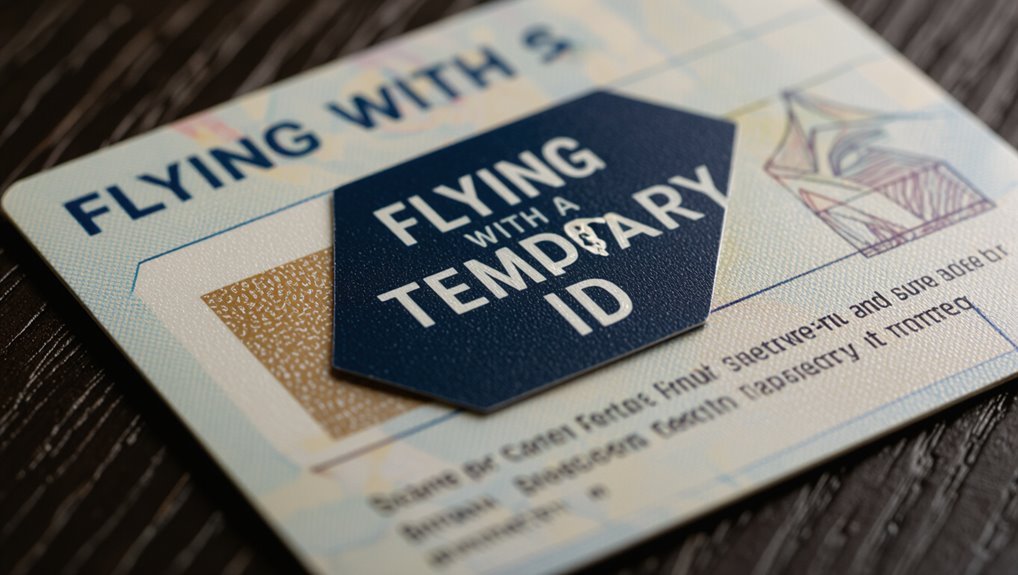
Can you fly with a temporary ID? Yes — in many cases TSA will accept a temporary or receipt-based ID if it shows your name and photo and additional documentation supports your identity.
You’ll need alternate proof like a passport, birth certificate, or government correspondence; carry anything that matches reservation details. Expect extra screening and arrive earlier to allow time for identity verification.
Policies can vary by airport and officer discretion, so be ready to explain the situation calmly and provide supplementary documents or digital records.
Temporary IDs aren’t guaranteed to work, but preparedness increases your chances of boarding.
3 Immediate Steps If Your ID Is Temporary or Missing
If your ID is temporary or missing, act quickly and calmly: notify your airline, gather any supporting documents (passport, birth certificate, social security card, or government mail), and arrive at the airport earlier than usual to allow time for secondary screening and identity verification.
At the airport, tell the ticket agent and security staff immediately so they can start verification procedures. Keep originals and photocopies ready, bring recent utility bills or electronic statements with your name and address, and have boarding confirmation handy.
Stay patient, answer security questions clearly, and follow staff instructions to speed up the process and reduce stress.
What TSA Officially Accepts as ID
When you go through TSA screening, they accept a range of government-issued photo IDs—like a U.S. passport, passport card, state-issued driver’s license or ID, and certain military IDs—as primary proof of identity; if you don’t have one, TSA can consider other documents such as a foreign passport or federally recognized tribal ID, and in some cases will verify identity using a combination of non-photo documents and records.
You’ll usually present a current, unexpired ID with your photo and name.
Realize certain IDs issued under REAL ID standards may be required for domestic flights after federal deadlines.
Ask the checkpoint officer if unsure.
Temporary Paper License vs. New Plastic License
Though your temporary paper license is issued to bridge the gap after you renew or apply for a new plastic license, you should know it isn’t always treated the same at TSA checkpoints.
You’ll often be allowed to fly with a valid temporary paper license if the name, birthdate, and photo match your boarding pass.
Still, TSA officers can request extra verification—like supplementary documents or ID corroboration—if the paper seems altered or information is unclear.
Once you receive the new plastic license, use it; it’s more durable, standardized, and less likely to trigger secondary screening than a temporary paper version.
Digital Photos of IDs and TSA’s Policy
Because TSA accepts a range of identity documents, you might wonder whether a clear digital photo of your driver’s license or passport will suffice at the checkpoint.
Generally, TSA requires original, physical ID; a phone image usually won’t replace that. If you’ve lost your wallet, bring any supplementary documents and explain the situation to officers—they have discretion.
Don’t rely solely on images stored in apps unless an airline specifically accepts them for boarding.
To picture scenarios, consider:
- A crisp phone photo in your wallet pocket.
- A screenshot open on your home screen.
- A printed photo clipped to paperwork.
How TSA Verifies Your Identity at Checkpoints
If you approach the checkpoint without your usual ID, TSA officers will still try to confirm who you are by checking any available documents, asking targeted questions about your personal history, and comparing your appearance to the name on the boarding pass.
You’ll be asked for secondary evidence like a temporary ID, printed boarding pass, credit cards, or mail. Officers may verify details such as your recent travel, address, or phone number.
You should answer clearly and provide supporting documents promptly. Stay patient and cooperative; clear, consistent information speeds processing and reduces the chance you’ll face additional delays.
What Happens During ID Matching and Secondary Screening
Once TSA accepts your temporary ID or other documents, officers begin ID matching by comparing the name and photo on your paperwork to the boarding pass and the person in front of them.
They then cross-check details against available watchlists and reservation data. You’ll be asked simple questions, perhaps to confirm your itinerary or recent travel.
If something’s unclear, you might be directed to secondary screening where officers inspect documents, ask more questions, and conduct additional bag or pat-down checks.
You should stay calm, answer directly, and follow instructions to speed resolution.
- Hands steady while you show documents.
- Close-up photo comparison.
- Secondary room, focused questioning.
When an Expired ID Might Still Pass TSA
You might still get through with an expired ID in limited acceptable exceptions, like documented medical or military circumstances.
Bring any proof you have and a secondary ID to support your identity, since agents will rely on corroborating documents and questions.
Be prepared for additional screening while they verify your situation.
Limited Acceptable Exceptions
Although expired IDs will usually get flagged, TSA does allow limited exceptions when other documentation or circumstances verify your identity; knowing these cases can save time at the checkpoint.
You’ll qualify sometimes if the situation is clear and verifiable. Examples include:
- A recently expired driver’s license paired with matching reservation and airline records showing consistent name and DOB.
- An expired passport from your country when flight records, boarding pass, and airline verification confirm identity.
- Temporary government paperwork issued within a short window (like recent name-change documents) accompanied by airline staff confirmation.
Always arrive early and be ready to explain the circumstance calmly.
Proof And Secondary IDs
If your primary ID is expired, TSA may accept it when you can quickly provide strong proof of identity and a reliable secondary ID; bring documents that clearly match your name and birthdate, like a current passport card, a government-issued birth certificate paired with a recent photo ID, or airline records showing consistent information.
You should present secondary items such as a temporary driver’s license, a government agency letter, a Federal or state employment ID, or a trusted credit card with your name.
TSA officers will verify details, ask questions, and may use credential databases; cooperate, stay calm, and arrive early to resolve issues.
When a Pending Driver’s License Renewal Counts
When your driver’s license renewal is pending, TSA will often accept a temporary or interim license as valid identification for travel, provided it shows your name, date of birth, and a clear photo.
If your driver’s license renewal is pending, TSA will usually accept a temporary interim license showing name, birthdate, and photo.
You’ll want the interim to be government‑issued, unexpired, and preferably laminated or printed on official letterhead.
Bring a second ID if you can, and be ready to explain the situation to TSA officers calmly.
If additional verification’s needed, expect extra screening time.
- a plastic interim license with photo
- a paper receipt with official seal (as backup)
- a passport or secondary photo ID
Is a Receipt for ID Renewal Enough to Fly?
Can a receipt for an ID renewal get you through TSA? You might, but it’s not guaranteed. TSA accepts alternative ID evidence in limited cases; a renewal receipt can help if it shows your name, birthdate, and application date. Expect extra screening and bring backup (passport, passport card, or other government ID) if possible. Inform the agent early and remain patient. Below is a simple comparison to clarify likelihoods and actions.
| Document | Likelihood TSA Acceptance | Recommended Action |
|---|---|---|
| Renewal receipt | Low–moderate | Present plus backup |
| Passport | High | Primary ID |
| State ID card | High | Primary ID |
| No ID | Very low | Expect denial or delay |
State Rules That Affect Temporary Licenses and TSA
You should know that states issue temporary licenses differently, and that affects what TSA will accept.
Check how long your temporary document is valid and whether it includes required details like a photo and DOB.
Also verify if your state’s temporary ID meets Real ID standards, since that can change boarding rules.
State Issuance Variations
Although federal ID standards guide TSA policy, states set the rules for issuing temporary driver’s licenses and IDs. Those differences directly affect whether TSA will accept your document at airport checkpoints. You should check your state’s layout, security features, and issuance notes before travel.
Some states print clear “temporary” wording, others issue paper receipts or interim cards, and expiration policies vary. Those visible cues and security elements shape an officer’s confidence.
- A glossy interim card with holograms signals permanence.
- A plain paper receipt raises questions at the gate.
- Short expiration dates prompt extra ID checks.
Temporary Document Validity
When a state issues a temporary license or ID, its specific validity rules — printed expiration, electronic records, and whether the document is considered a lawful temporary credential — determine how TSA officers will treat it at checkpoints.
You should check the temporary document for a clear expiration date, state seal, issuing agency contact, and any notation that it replaces a permanent card.
Some states also link records electronically; carry proof of application or renewal receipts if available.
If the temporary credential matches state-defined lawful-ID criteria, TSA typically accepts it.
If not, be prepared with alternate federally acceptable ID or secondary identification.
Real ID Compliance Effects
Because Real ID sets baseline standards for what counts as a state-issued identity credential, your temporary license’s acceptability at TSA checkpoints often hinges on whether the issuing state applied Real ID rules to its temporary documents.
States that mark temporary credentials as Real ID-compliant (with the star, electronic verification, or conforming data elements) make it far more likely TSA will accept them, while states that treat temporaries as noncompliant or lack electronic record linkage can leave you needing an alternate federally acceptable ID or additional proof of identity.
You should check your state’s policy before travel. Practical signs matter:
- Star marking indicating Real ID.
- Electronic DMV record linked to the temporary.
- Explicit state guidance labeling temporaries as compliant.
Real Examples: Successful and Denied Cases
To give you a realistic sense of what to expect, here are concrete TSA temporary ID outcomes drawn from passenger experiences—some travelers sailed through security with alternate documents, while others were turned away for common mistakes like incomplete paperwork or arriving too late.
Real TSA temporary ID experiences vary: some pass with alternate documents, others get turned away for paperwork or timing.
You might use a passport photocopy plus signed affidavit and board when officers verify identity quickly. Another traveler showed a state-issued temporary license with expiry notice and flew after secondary screening.
Conversely, people have been denied when forms lacked signatures, clerks hadn’t attached required receipts, or when they arrived after the cutoff for identity verification.
Plan documents and time carefully.
Other Government IDs TSA Accepts (Non‑Driver)
If you don’t have a driver’s license, TSA will often accept other government IDs like military ID cards and certain passport alternatives.
You’ll want to know which military IDs qualify and when a passport card or expired passport can be used under special circumstances.
Let’s look at the specific options and any documentation requirements so you’re prepared at the checkpoint.
Military ID Options
Military IDs are among the non‑driver government credentials TSA accepts for identity verification, and you’ll find several options depending on your service status and affiliation.
You can use common military IDs at checkpoints, but the card should be current and show your name and photo. If you’re a dependent or retired member, specific CAC, Geneva Convention, or retiree cards work.
Reserve and National Guard IDs are valid when they include standard identifying details.
- Common Access Card (active duty, clear photo)
- Retiree ID (blue/gray, veteran status)
- Dependent/Reserve ID (shows sponsor link)
Passport Alternatives
While a passport is the gold standard for ID at TSA checkpoints, several other government-issued, non-driver cards will also get you through security when you don’t have one.
You can use a state-issued identification card, federal government ID, or Trusted Traveler card (Global Entry, NEXUS, SENTRI).
U.S. citizenship certificates with photo, permanent resident cards, and Border Crossing Cards also qualify.
If you’re a Native American, tribal photo IDs are accepted.
Confirm any alternative is unexpired and has a clear photo and name matching your boarding pass.
Bring supporting documents if an agent requests additional identity verification.
Passports, Passport Cards, and Trusted Traveler IDs for TSA
When you travel internationally or need a federally recognized ID at TSA checkpoints, your passport, passport card, or Trusted Traveler ID (like Global Entry or NEXUS) will get you through screening and identity verification. Each document has specific uses, validity periods, and presentation requirements you should know before heading to the airport.
You’ll present your passport for international flights; passport cards work only for land/sea travel to nearby countries. Trusted Traveler cards or Known Traveler Numbers speed processing and may let you use dedicated lanes.
Always carry the physical card, verify it’s unexpired, and match the name on your boarding pass.
- Passport: photo, bio page, stamp-ready
- Passport card: compact, land/sea only
- Trusted Traveler ID: lane access, KTN visible
When TSA Might Accept Non‑Government IDs
If you arrive at a checkpoint without a federally issued photo ID, TSA agents can still accept certain non‑government documents and other forms of identity to verify who you are, but you should expect extra screening and additional identity checks.
You can present things like employee IDs, student IDs, utility bills, bank statements, or credit cards combined with your name and travel reservation.
TSA may ask questions, cross‑check names, or use secondary IDs and records to confirm identity. Acceptance isn’t guaranteed; officers use discretion and procedures to determine whether to let you proceed through security.
TSA may verify identity through questions and records; acceptance isn’t guaranteed and officers use discretion.
Bring whatever supports your identity.
Traveling With Minors: ID Rules and Exceptions
Traveling with children changes the ID rules you’ll need to follow, so know what’s required before you arrive at the airport.
You’ll usually need ID for adults, while minors under 18 often don’t need identification for domestic flights; carriers may ask for proof of age or relationship.
If a child has no ID, bring birth certificates, custody papers, or a pediatrician letter.
Expect extra screening and questions for unaccompanied minors or adults traveling with children not their own.
- Parent holding a toddler with a stroller.
- Family showing a birth certificate at check‑in.
- Solo teen meeting airline staff.
International Travelers: Temporary and Expired Documents
Because international trips demand valid travel documents, you should confirm whether temporary or recently expired IDs will be accepted long before you reach the airport or border. Check airlines, destination entry rules, and consulates; some countries and carriers reject temporary IDs or expired passports even with renewal receipts. Carry supporting evidence like renewal confirmation and a second photo ID if possible. Notify the airline ahead of travel to avoid denied boarding. At immigration, officers have final say; be prepared for secondary inspection or refusal.
| Document type | Typical acceptance |
|---|---|
| Temporary passport | Rarely accepted |
| Recently expired passport | Often rejected |
Backup Documents That Help Prove Your Identity
If your primary ID’s temporary, bring alternate photo IDs like a passport card or state ID so TSA can match your face to a photo.
You should also carry supporting documents—birth certificate, Social Security card, or immigration papers—to back up your identity claim.
Having both types ready speeds screening and reduces the chance of extra checks.
Alternate Photo IDs
When your primary ID is missing or gets questioned, alternate photo IDs can bridge the gap and help TSA confirm who you are. These backup documents—like a passport card, military ID, enhanced driver’s license, or a state ID from another household member—aren’t guaranteed to replace a REAL ID but can speed up resolution and reduce hassle at the checkpoint.
You should present any clear, government-issued photo ID you have, and stay calm while officers verify your identity.
Visual examples help you remember what to bring:
- Passport card tucked with boarding pass.
- Military ID in a wallet slot.
- Enhanced license visible and accessible.
Supporting Documentation
Along with a photo ID, bring supporting documents that help TSA verify your identity—things like a current utility bill, bank statement, Social Security card, birth certificate, or a court or medical record that shows your name and address.
If your primary ID is temporary, these backups prove who you’re and where you live. Carry originals or certified copies when possible; digital prints may help but aren’t guaranteed.
Organize documents so you can present them quickly at the checkpoint. If you lack certain papers, explain your situation calmly and ask the officer which alternative documents or secondary checks are acceptable.
How to Prepare Before the Airport With a Temporary ID
Wondering what to do before you get to the airport with a temporary ID? Plan calmly: confirm your temporary ID details match your reservation, scan or photograph documents, and notify the airline if you expect questions.
Arrive earlier than usual to allow time for verification.
- Picture yourself organizing a clear folder with the temporary ID, backup photos, and any linking paperwork.
- Visualize checking the airline website or calling customer service to note their guidance and any required arrival time.
- Imagine setting phone reminders and placing documents in an easy-to-reach pocket so you stay relaxed and efficient.
Checklist: What to Bring If You Expect Extra Screening
Bring a small, organized kit so you can move through extra screening smoothly: include your temporary ID, a photocopy or photo of the original government ID if you have it, boarding pass (printed or digital), any supporting paperwork that links your name to the reservation (e.g., ticket receipt, confirmation email), a secondary photo ID (like a student or company card), and contact info for the airline or TSA in case agents need to verify details.
| Item | Purpose |
|---|---|
| Temporary ID | Primary proof |
| Boarding pass | Flight verification |
| Supporting docs | Link name to reservation |
Also pack phone charger, photocopies, and a clear explanation note for quick answers.
TSA PreCheck and Temporary ID: What Changes?
How will TSA PreCheck work if you only have a temporary ID? If your PreCheck status is in TSA’s system, you’ll usually keep expedited screening even with temporary paperwork, but you must present the temporary ID matching your reservation.
If PreCheck isn’t linked or agents can’t verify you, expect standard screening.
- Picture showing your boarding pass and temporary ID together at the checkpoint.
- Imagine an officer scanning your name into the TSA system and confirming PreCheck status.
- Visualize being directed to the regular lane if verification fails, then clearing security normally.
Always carry supporting documentation and check your reservation details.
Airline Policies vs. TSA Rules: Who Controls Boarding?
You need to know that TSA sets ID standards for checkpoint entry while airlines set boarding policies for their flights, and those rules don’t always match.
If TSA accepts your temporary ID at screening, an airline can still refuse boarding if its policy is stricter.
We’ll cover how to spot conflicts and what steps to take to resolve ID discrepancies before you reach the gate.
TSA Identification Requirements
While the TSA sets the baseline for acceptable identification at security checkpoints, airlines often enforce their own boarding policies that can be stricter, and that difference can affect whether you get on the plane.
You must present a valid TSA-accepted ID (real or temporary documents with supporting proof) to clear Transportation Security Administration screening.
TSA focuses on identity and passenger vetting; you should carry secondary documents if primary ID is missing.
At checkpoints, officers verify name, photo, and travel eligibility, and may require additional screening.
Picture the process:
- ID check under bright lights.
- Officer comparing photo to your face.
- Bag placement for inspection.
Airline Boarding Policies
Because TSA sets the minimum ID standards for checkpoint screening, airlines still get to decide who boards their flights and can impose stricter rules than the agency.
So you can be denied boarding even if TSA would accept your documents. Before travel, check your airline’s ID policy—some require original government IDs, others accept temporary or digital copies.
Gate agents verify identity and the carrier’s contract of carriage governs enforcement. If an airline rejects your ID, you’ll need to follow its procedures, which may include manager review or denied boarding.
Confirm requirements when booking and carry any supplementary paperwork to avoid surprises.
Resolving ID Discrepancies
Although TSA sets the baseline for acceptable IDs at checkpoints, airlines have the final say on who boards their planes and can enforce stricter requirements—so if your temporary or digital ID meets TSA standards it still mightn’t satisfy a carrier.
You should confirm your airline’s policy before travel, carry supporting documents (receipt for replacement ID, birth certificate, police report), and arrive earlier to resolve issues.
At the gate, staff can deny boarding despite TSA allowing screening. If denied, escalate politely to a supervisor and request a written explanation for denial and options for appeal or rebooking.
- Ticket agent hesitates, you show documents.
- Gate supervisor reviews policy.
- You accept written denial or boarding.
What to Do If an Airline Refuses to Board You
If an airline refuses to board you despite having a TSA temporary ID, stay calm and act quickly:
Ask the gate agent for a clear explanation and which policy or document they’re citing.
Ask the gate agent to explain clearly and cite the exact policy or document they’re relying on.
Request to speak with a supervisor and document names, times, and what they say.
Show any supporting paperwork, boarding pass, and contact info for anyone who can verify your identity.
If denial continues, ask about rebooking options, refunds, or standby on the next flight.
Take photos of the agent’s ID badge and any written notes.
File a written complaint with the airline and, if needed, contact the TSA or DOT after you leave.
How to Speed Up ID Verification at Security
After you’ve handled a gate dispute, the next step is making security screening as quick and stress-free as possible — especially when you’re using a TSA temporary ID.
Arrive early, keep documents accessible, and stay calm to help officers verify you fast. Present your temporary ID and boarding pass together, and answer questions clearly.
- Pull out your temporary ID, boarding pass, and a secondary contact card so hands stay visible.
- Wear shoes and clothing that are easy to remove and pockets empty to speed belt and bag checks.
- Position carry-ons for quick inspection and label electronics for rapid removal.
When to Contact TSA or Your Airline Before a Flight
If you have a special circumstance—like a lost ID close to travel—you should contact TSA to ask about exceptions and what documentation they’ll accept.
For questions about boarding rules, rebooking, or whether your temporary ID meets the airline’s policy, call your carrier directly.
Don’t wait until you get to the airport—confirm ahead to avoid surprises.
Contact TSA For Exceptions
When you’re uncertain whether your temporary ID will get you through security, contact TSA or your airline before you go to the airport so you don’t face delays or denied boarding.
Explain your situation clearly, give travel dates, and ask whether your specific temporary document is acceptable.
If TSA recommends additional screening, note what to expect and arrive early.
Keep records of any guidance (names, reference numbers).
- Describe your temporary ID and when it was issued.
- Ask if alternative documents or forms are acceptable.
- Request written confirmation or a reference number for your case.
Call Airline For Policies
Need to confirm whether your temporary ID will let you board? Call your airline well before travel.
Policies vary by carrier and route, and agents can tell you what documents suffice, whether additional verification is required at the gate, and if online check-in will accept your temporary ID.
Ask about partner or connecting flights, domestic versus international rules, and any documentation you should bring to avoid delays.
If an airline recommends contacting TSA, they’ll tell you how.
Note names and confirmation numbers from calls, and request email confirmation when possible so you have proof if questions arise at the airport.
Fast Replacement Options for Lost or Expired IDs
Although a lost or expired ID can feel urgent, you’ve got several fast replacement options to get you back on the road or through security quickly.
First, contact your DMV for expedited in-person replacement; many offices issue temporary paper IDs same day.
Contact your DMV for expedited in-person replacement—many offices provide a temporary paper ID the same day.
Second, check if your state offers online renewal with printable temporary credentials you can show at TSA.
Third, if you’re traveling soon, visit your airline’s ticket counter — they can note your situation and guide TSA verification options.
Keep backup documents (passport, birth certificate, digital copies) and receipts to speed verification and reduce stress.
Common Myths About TSA and Temporary IDs, Debunked
Because travel stresses plenty of myths about TSA and temporary IDs, it helps to separate fact from fiction so you’re not caught off guard at the checkpoint.
You might hear that temporary IDs never work, but TSA may accept them with supporting documents and identity verification.
You may think airline staff decide ID rules; they follow TSA guidance, though airlines can enforce boarding policies.
Some say you’ll always be denied if your photo is different — TSA evaluates identity, not perfection.
Don’t assume automatic denial; bring backups, arrive early, and be ready to answer questions calmly and clearly.
Frequently Asked Questions
Can a Temporary ID Affect International Customs or Immigration Processing?
Yes — a temporary ID can slow or complicate international customs and immigration processing; you’ll face extra questioning, document checks, or delays, and you might be denied entry if officials doubt your identity or paperwork isn’t acceptable.
Will TSA Allow Boarding With a Court‑Ordered Name Change Document?
Yes — you can usually board if you show a court‑ordered name change plus an acceptable photo ID; TSA may also use additional documents or identity verification, so carry originals and extra proof to avoid delays.
Are Student or University IDS Ever Acceptable for TSA?
No, you generally can’t use student or university IDs as primary identification for TSA; you’ll need a REAL ID-compliant license, passport, or other accepted federal ID, though secondary school IDs might help with verification in rare cases.
Can a Temporary ID Impact Global Entry or SENTRI Enrollment Status?
Yes — a temporary ID can delay or complicate Global Entry or SENTRI enrollment if it doesn’t match your application or prove identity; you’ll need acceptable documentation or recheck appointments, and enrollment may be postponed until resolved.
Do TSA Agents Record or Report Passengers Flagged for Temporary IDS?
TSA agents generally don’t publicly record or report passengers solely for using temporary IDs, but they’ll screen you and may refer issues to supervisors or law enforcement if identity can’t be confirmed or other concerns arise during checkpoint processing.
Conclusion
Yes — you can often fly with a temporary ID, but you’ll need to be prepared. If yours is temporary or missing, stay calm, bring any supporting documents (like a police report, passport, or birth certificate), and arrive early. TSA accepts various IDs and may use extra screening to verify identity. Contact TSA or your airline if unsure, and consider expedited replacement options. Don’t rely on digital photos alone; follow guidelines to avoid delays.