Do the Wheels Count When Measuring Luggage Size?
Yes — you should count wheels, handles and any protruding parts when measuring luggage because airlines use total exterior dimensions to enforce size limits. Lay your bag flat with pockets and zippers closed, measure length, width and depth at the widest points, and include wheels, bumpers and extended handles. For soft or oddly shaped bags, press them into a typical packed shape and measure the maximum outline. Keep measurements and weight handy so you can follow steps to avoid fees and learn practical tips.
Do Wheels and Handles Count Toward Luggage Size? (Short Answer)
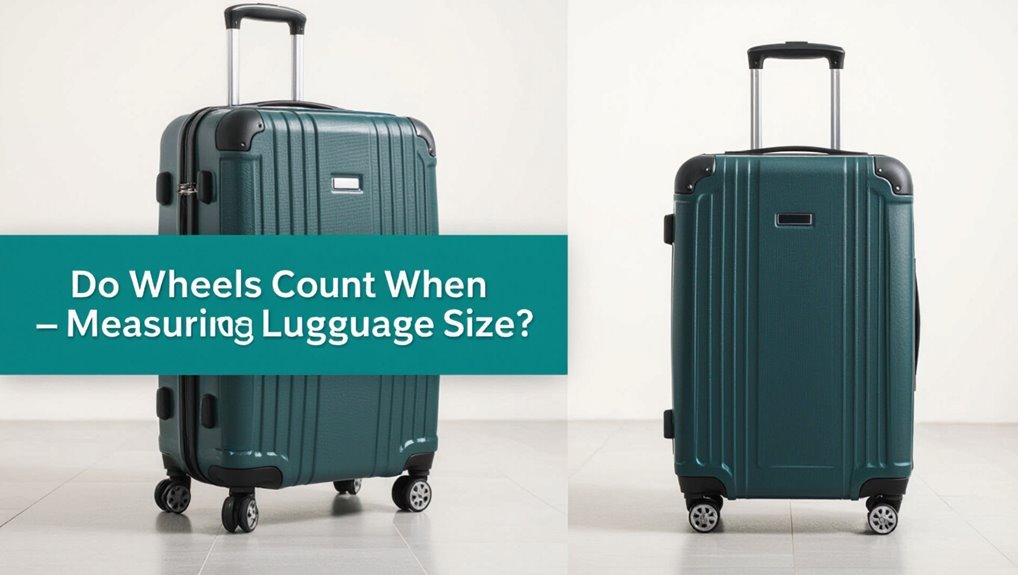
Because airlines measure the total exterior dimensions, you should count wheels and handles when checking luggage size. Carriers expect the length, width, and height to include any protruding parts, so a suitcase that meets interior capacity but sticks out with wheels or a telescoping handle can still be oversized.
You’ll measure with them extended and collapsed per airline rules, and include bumpers or side handles.
How Airlines Define Bag Size (Checked vs Carry‑On)
When you’re sizing luggage, airlines distinguish checked bags from carry‑ons by both dimensions and purpose: checked bags are measured by total exterior length + width + height and often weight, while carry‑ons must fit specific cabin-size envelopes and storage locations (overhead bin or underseat).
Airlines tell bags apart by purpose and size: checked luggage by total exterior dimensions (plus weight), carry‑ons by cabin-fit for bins or underseat.
You should confirm limits before packing to avoid fees or gate checks.
- Annoyance at surprise charges
- Relief when it fits
- Frustration with vague rules
- Satisfaction packing smart
How to Measure Your Suitcase : 3 Simple Steps
Start by laying your suitcase flat on a hard surface and closing every pocket and zipper so you’ve got the true exterior shape.
Step 1: measure length from top to bottom.
Step 2: measure width across the widest point.
Step 3: measure depth from front to back.
Record measurements in inches or centimeters and compare them to airline limits before packing.
Where to Include Wheels, Handles, Bumpers, and Pockets
Now that you’ve measured the basic length, width, and depth, you should account for any external features that add size. Include wheel housings and fixed bumpers in overall dimensions, extend telescoping handles fully when airlines require, and count external pockets that bulge.
Be precise so your bag fits rules and avoids surprises.
- frustration avoided
- confident boarding
- smoother security
- travel peace
Measuring Soft or Oddly Shaped Luggage (Special Cases)
If your bag isn’t a rigid rectangle, think regarding maximum outline rather than neat edges: press soft sides to their typical packed shape, flatten or expand oddly shaped sections to how they’ll sit in luggage sizers, and measure the longest, widest, and deepest points including any protrusions.
Note removable straps, external pockets, or compression panels; measure with them attached and in the position they’ll be during travel.
Real Examples: Spinner Carry‑On, Roller Carry‑On, and Checked Bag Sizes
You’ll often see spinner carry-ons listed with dimensions like 22 x 14 x 9 inches, so measure corner to corner including the wheels and handles.
For checked bags with wheels, add wheel and handle depth to the height and width to guarantee you’re within airline limits.
We’ll compare these real examples to typical airline size rules so you can measure confidently.
Spinner Carry-On Dimensions
Spinner carry-ons usually fall within a narrow size window—about 20–22 inches tall including wheels—because airlines set strict maximums for overhead bins; rolling a spinner close to 22 inches gives you maximum capacity without gate-check risk.
You’ll feel confident packing efficiently, avoiding surprises at boarding.
- Relief when it fits perfectly
- Pride in smart packing
- Frustration avoided
- Freedom to travel light
Checked Bag With Wheels
After you’ve got the carry-on down to the wire, it’s time to look at checked bags with wheels and how their real-world sizes differ—think 20–22″ spinners, longer roller carry-ons, and full-size checked suitcases that often hit 27–30 inches including wheels.
You should measure height, width, depth including wheels and handles, check airline limits, and pack to avoid surprises and extra fees.
How Major U.S. Carriers Treat Wheels: Delta, American, United
Three major U.S. carriers—Delta, American, and United—handle wheels differently, so it helps to know what each airline considers part of your bag’s dimensions and whether spinner wheels count toward size limits.
You’ll find:
- Delta often includes wheels; measure carefully.
- American typically counts protrusions, including wheels.
- United usually counts wheels in overall dimensions.
Check each carrier’s rules before you pack.
How Budget and International Airlines Treat Wheels Differently
When you’re flying on a budget carrier, expect stricter, more literal measurements—wheels, handles, and other protrusions are often included in the size calculation and can push your bag into an oversize fee.
Whereas many international airlines vary by region and fare class, sometimes giving more leeway for spinner wheels but still advising you to check specific policies before you pack.
You’ll need to measure carefully.
Do Trains Count Wheels? Amtrak and European Rail Rules
Curious whether train operators measure your luggage including wheels and handles? You’ll find Amtrak’s limits focus on total dimensions for checked items, while many European services are more relaxed, prioritizing storage space.
You should check specific carrier rules before travel.
- Relief when small bags fit overhead
- Frustration if dimensions overshoot limits
- Confidence from confirming rules
- Surprise at regional differences
Weighing and Sizing Your Bags at Home to Avoid Fees
Packing smart at home saves you money and stress at the airport: weigh and measure each bag before you leave so you can fix overages or redistribute items.
Use a reliable scale and tape measure, note length, width, height including handles and wheels, and compare to airline limits.
Label weights, consolidate heavy items, and repack into carry-on if possible to avoid surprise fees.
If Your Bag Is a Few Centimeters Over: Quick Fixes at Home and at the Counter
A few centimeters can make the difference between free boarding and an extra fee, so act quickly: at home, loosen straps, transfer dense items to your carry-on or personal item, or swap to a slightly larger soft-sided bag;
at the counter, ask if agents can compress the contents, remove a jacket or shoes, or gate-check the bag to avoid overweight charges.
- Panic fades when you act
- Relief when space is found
- Frustration turns into control
- Pride in clever packing
Choosing Luggage That Fits Common Airline Size Limits
When you’re shopping for luggage, pick pieces that match the size limits of the airlines you fly most—measure height (including wheels and handles), width, and depth, and compare those numbers to both carry-on and checked-size charts so you won’t be surprised at the gate.
Choose bags slightly under strict limits, note airlines’ weight rules, and prefer expandable models only if you’ll avoid overstuffing.
Packing Moves to Reduce Luggage Dimensions and Prevent Bulging
Trim down bulging luggage by arranging items to minimize thickness and fill voids strategically.
You’ll roll clothes, layer flat items, and tuck shoes along edges so the case stays slim.
Compress bulky sweaters and redistribute weight toward the center to avoid misshapen sides.
Use straps and packing cubes to lock everything in place.
- Relief when it fits
- Confidence boarding
- Frustration avoided
- Calm at security
How to Dispute an Oversize Fee or Request a Re‑Measurement
If your suitcase is tagged oversized and you disagree, ask the airline staff for an immediate re-measurement and keep your boarding pass and receipt handy as proof.
Remain calm, show dimensions you noted, and request a supervisor if needed.
Stay calm, present your measured dimensions, and politely ask for a supervisor if the issue isn’t resolved.
Take photos of the bag beside the measuring device.
If a fee is charged, get a written receipt and follow the airline’s dispute procedure promptly online.
Pre‑Travel Checklist: Measure, Weigh, Tag, and Plan
Before you head to the airport, measure your bag’s total dimensions including handles and pockets so it meets airline limits.
Weigh it with the wheels and any attached items to avoid surprises at check-in.
Tag your luggage and keep travel documents easily accessible so you can move quickly if an issue comes up.
Measure Total Bag Dimensions
Start by measuring your bag’s total dimensions—length, width, and height—including handles, wheels, and any external pockets—so you know it meets airline limits.
Measure carefully, note numbers, and compare to your carrier’s rules.
Record dimensions on your checklist and pack accordingly.
- Relief when it fits
- Frustration avoided
- Confidence boarding
- Calm during security
Weigh With Wheels Attached
Weigh your packed bag with the wheels attached so the scale reflects how the airline will measure it at check‑in.
Use a reliable luggage or bathroom scale, lift by the handle as you’ll present it, and note the weight.
If it’s over the limit, repack, remove nonessentials, or redistribute items into carry‑on.
Reweigh until you meet the airline allowance.
Tag And Travel Documents
Tags and travel documents are what make your suitcase searchable and your journey smoother, so attach a durable ID tag with your name, phone, and email, plus a covered duplicate inside in case the outer one gets torn off.
Pack photocopies of passports, boarding passes, insurance, and emergency contacts; keep originals accessible but secure.
- Relief when you spot your bag
- Confidence at security
- Calm during delays
- Reassurance abroad
Frequently Asked Questions
Do Luggage Wheels Affect Baggage Allowance for Sports Equipment or Oversized Items?
Yes — airlines usually count wheels when measuring sports gear or oversized bags, so you should include them in dimensions; check your carrier’s specific rules and allowance, or you’ll risk overweight or oversize fees and denied carriage.
Are Stroller or Car-Seat Wheels Measured With Gate-Checked Items?
Yes — when you gate-check a stroller or car seat, airlines typically include wheels in the measured dimensions, so you’ll need to account for them to guarantee the item meets size and carry/checked restrictions and avoids extra fees.
Do Cruise Lines Include Wheels in Cabin Luggage Size Limits?
Yes — cruise lines usually count wheels when measuring cabin luggage, so you’ll need to include them in dimensions; compact rolling bags often still fit, but check your specific line’s policy to avoid gate or stowage issues.
Will Rental Car Companies Charge Over-Size Fees for Wheel-Equipped Bags?
Yes — many rental car companies will charge over‑size fees if your wheel‑equipped bags exceed their stated dimensions or trunk limits. Check the vehicle’s cargo specs and measure luggage including wheels to avoid unexpected charges.
Do Airport Security or TSA Measurements Consider Wheel Protrusion Differently?
Generally, no — TSA and airport security focus on overall dimensions, not specifically wheel protrusion; you’ll be measured by total external size, so if wheels make the bag exceed limits, they’ll count toward that overall measurement.
Conclusion
Yes — wheels, handles, and external bumpers count toward your luggage size. Airlines usually measure total linear dimensions (height + width + depth) including any protrusions, so measure from the handle base to the wheel tips and include pockets. For soft or oddly shaped bags, compress them gently when measuring. To avoid fees, pick luggage within common limits, pack smartly to prevent bulging, and re‑measure at home. If charged, politely request a re‑measurement or dispute the fee.