
Can You Check a Computer in Your Luggage Safety Rules Explained
You can check a computer, but you shouldn’t unless it’s unavoidable because checked baggage increases risks of physical damage, theft, and lithium-battery hazards. Power down devices, remove or secure batteries if possible, and use a hard case with plenty of padding and internal bracing for towers or gaming rigs. Label valuables, insure high‑value items, and know your airline’s battery and liability rules. Keep backups and encryption, and keep going to learn practical packing and claim steps.
Quick Answer: Should You Check Your Computer?
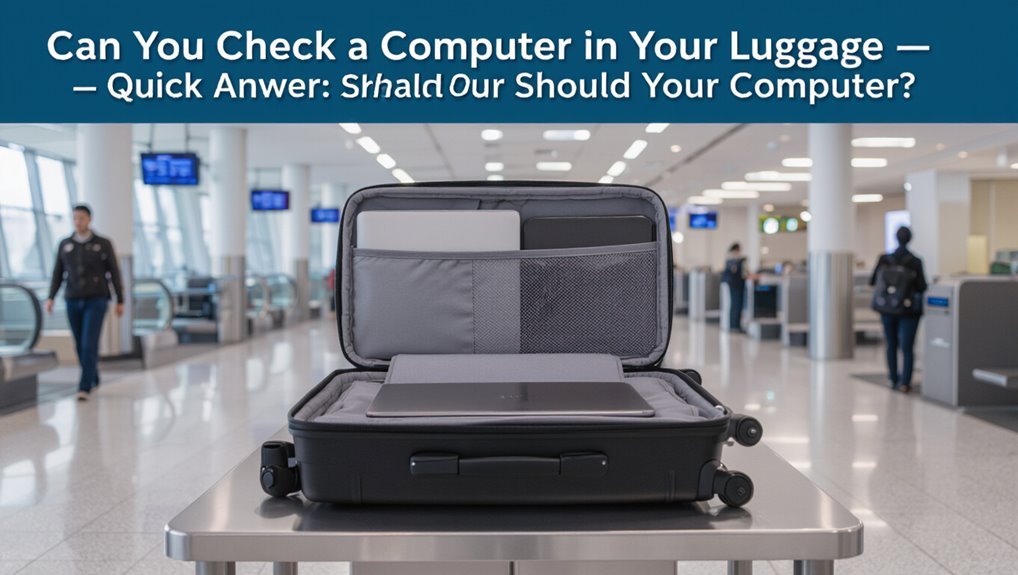
Wondering whether to check your computer? You shouldn’t, unless it’s well-protected and you have no choice.
Checked baggage risks physical damage, theft, and temperature or pressure exposure.
If you must, power down, pad it with clothing, use a hard case, and remove peripherals and sensitive data.
Prefer carrying it onboard to keep it secure and functioning.
Who This Guide Is For and How to Use It
This guide is for travelers who own laptops, tablets, or desktop components and need clear rules for checking them in luggage.
You’ll find practical advice tailored to business travelers, students, photographers, and anyone worried about damage, theft, or airline policies.
Use the sections that match your situation to quickly get steps, packing tips, and decision checklists.
Who Should Read
Who needs this guide and how will it help you?
You’re a traveler, commuter, student, or businessperson deciding whether to check a laptop, tablet, or desktop component.
You’ll learn who faces risks, when alternatives are wiser, and which rules affect you—airline staff, frequent flyers, and occasional travelers will all find targeted guidance to make a safe, informed choice.
How To Use
Now that you know who benefits from this guide, use the sections that match your travel profile and needs: quick-check summaries for occasional travelers, detailed packing and documentation steps for frequent flyers, and equipment-specific tips for students or business users carrying sensitive gear.
Read the relevant section, follow step-by-step checklists, adapt recommendations to your airline’s rules, and print or save required documents before you travel.
Can You Legally Check a Laptop or Desktop?
Wondering whether you can check a laptop or desktop in your baggage? You can sometimes check a desktop tower or powered-off laptop, but airlines often prefer electronics in carry-on for safety and theft prevention.
Check airline rules and pack carefully if checked.
Check airline rules first, and pack electronics carefully if placed in checked luggage.
- Tower wrapped in foam and double-bagged
- Laptop in padded sleeve inside hard suitcase
- Cables separated and insulated
How Aviation Authorities Classify Computers and Batteries
Because aviation safety focuses on fire risk and hazardous materials, regulators classify computers and their batteries by function and battery type to set packing rules you’ll need to follow.
You’ll see categories like portable electronics, larger equipment, and spare batteries. Each category has limits for carriage, battery watt-hours, and packaging.
You must declare restricted items and comply with airline-specific policies to avoid confiscation or delays.
Why Lithium Batteries Change Checked Baggage Rules
You need to know that lithium batteries raise the risk of fires in checked baggage because they can overheat or catch fire unexpectedly.
They can also short-circuit if damaged or improperly packed, which makes containment harder in the cargo hold.
That’s why airlines and regulators have strict safety rules about how and whether these batteries can be checked.
Fire Risk Increase
When lithium batteries short-circuit or overheat inside checked luggage, they can ignite nearby materials and start a fire that’s hard to access or extinguish during flight.
You should avoid checked devices with exposed or loose batteries because you’d increase risks to cargo and passengers.
Picture potential scenarios:
- Smoldering foam melting into wiring
- Flames spreading among clothing and paper
- Dense smoke filling the hold
Battery Short-Circuit Potential
If a lithium battery’s internal separator fails, it can rapidly short-circuit and produce enough heat to ignite nearby materials. This is why airlines restrict these cells in checked baggage.
You should avoid placing loose or spare lithium cells in checked luggage because pressure, crushing, or contact with metal can bridge terminals.
Pack devices with installed batteries and protect terminals to minimize short-circuit risk.
Airline Safety Regulations
Because damaged or loose lithium cells can spark fires in the cargo hold, airlines and regulators have tightened rules on what can go in checked baggage and how devices must be packed.
You must pack batteries in carry-on when possible, protect terminals, and follow capacity limits.
Visualize risks:
- Smoldering cell in a packed suitcase
- Melted casing, scorched fabric
- Emergency teams opening cargo container
Which Laptop Batteries Are Allowed in Checked Baggage
Wondering which laptop batteries you can pack in checked luggage? You can usually check devices with built-in lithium-ion batteries under airline limits, but spare (uninstalled) lithium batteries are typically forbidden in checked baggage.
Removable batteries should be carried in carry-on with terminals protected. Always check your airline and destination rules—some carriers restrict battery capacity or quantity even for installed laptop cells.
How to Calculate Battery Watt-Hours
Start by finding the battery label on your laptop or its battery pack to read the voltage (V) and capacity (mAh or Ah).
If capacity is given in ampere-hours (Ah) or milliampere-hours (mAh), convert mAh to Ah by dividing by 1,000.
Multiply voltage by ampere-hours (Wh = V × Ah) to get the watt-hours and compare that to airline limits.
Find Battery Label
You’ll usually find the battery’s key details on a label stuck to the battery pack or printed on the underside of your laptop.
Read voltage (V) and capacity (mAh) or Wh directly. If mAh shows, you’ll convert later. Note manufacturer, model, and any warning icons.
- Sticker with numbers and symbols
- Small print near hinge or bay
- Barcodes and certification marks
Convert Ampere-Hours
How do you turn ampere-hours (Ah) into watt-hours (Wh)?
Multiply Ah by the battery voltage (V): Wh = Ah × V.
If your device lists only Ah, find the nominal voltage (commonly 3.7V for single lithium cells or 11.1V for three-cell packs).
Use that voltage in the multiplication to get the battery’s energy in watt-hours.
Calculate Watt-Hours
When you need to know how much energy a battery holds, multiply its ampere-hours (Ah) by its nominal voltage (V) to get watt-hours (Wh): Wh = Ah × V.
You’ll check the battery label, calculate Wh, and compare to airline limits. Do this for each device so you stay compliant.
- Laptop battery: 3Ah × 11.1V = 33.3Wh
- Power bank: 10Ah × 3.7V = 37Wh
- Drone pack: 6Ah × 14.8V = 88.8Wh
Rules for Spare Batteries, Power Banks, and External Packs
Though spare batteries and power banks can make travel easier, airlines and security checkpoints treat them like hazardous items and set strict limits on capacity, quantity, and whether they can go in checked luggage.
You must carry most lithium batteries and power banks in carry-on only, keep terminals protected, declare oversized packs, and follow airline-specific rules to avoid confiscation, delays, or fines.
What Major Airlines Say About Checked Laptops and PCs
When you check a laptop or desktop in your luggage, you should know each airline’s specific policy on electronics and batteries.
Airlines spell out whether PCs are allowed in checked bags, if batteries must be removed or carried in cabin, and what safety packaging they require.
Check your carrier’s rules before you pack so you won’t face delays or confiscation.
Airline Policies Overview
Because airlines set their own rules and liability limits, you should check each carrier’s policy before deciding to check a laptop or desktop in your luggage.
You’ll find varied allowances, value caps, and packing requirements. Consider how airlines handle damage claims and lost items.
- Tight compartments and fragile-tag suggestions
- Declared-value limits and extra fees
- Required documentation for claims
Battery And Safety Rules
If you plan to check a laptop or desktop with a lithium battery, know that airlines treat batteries as a safety risk and set strict rules on package, power limits, and whether devices can go in checked baggage at all.
You should remove or disconnect batteries if possible, carry devices with batteries in carry-on when required, declare spares, and follow airline watt-hour and packaging limits.
Which Airlines Require Carry-On for Computers
Wondering which airlines make you carry laptops in the cabin?
You’ll find most major carriers — especially U.S., EU, and many Asian airlines — require lithium-battery devices in carry-on.
Check airline rules and airport security pages before flying.
Visualize packed cabin items:
- Backpack with laptop sleeve
- Briefcase tucked under seat
- Soft-sided carry-on holding spare battery
How to Pack a Desktop or Gaming PC for Checked Baggage
When you check a desktop or gaming PC, pick a sturdy hard case or flight case that can handle rough handling.
Open the case and protect internal components—remove or brace heavy GPUs, wrap drives, and cushion with foam or anti-static packing.
Pack keyboards, mice, and cables separately and secure all external peripherals so nothing shifts.
Choose A Sturdy Case
A rugged, well-built case is your first line of defense when checking a desktop or gaming PC—choose one that’s rigid, crush-resistant, and sized to keep components from shifting.
Pick a hard-shell, lockable case with foam inserts, reinforced corners, and secure latches.
Visualize:
- Thick outer shell absorbing impacts.
- Internal foam cradling the chassis.
- Strong latches and padlock points.
Protect Internal Components
Because internal components are fragile, you should secure each one so nothing shifts or collides during transit.
Remove loose cards and drives, tape or bag screws, and fasten the GPU with its bracket or foam supports.
Cushion the CPU cooler or remove it and protect the socket.
Fill gaps with anti-static foam or bubble wrap, preventing contact and absorbing shocks.
Label interior warnings.
Secure External Peripherals
Start by gathering every external item—keyboard, mouse, headset, cables, and adapters—and laying them out so you can pack deliberately.
Wrap fragile pieces individually in bubble wrap, secure cables with ties, and place small items in labeled pouches. Pack them around the PC inside a hard case or cushioned suitcase to prevent shifting.
- Keyboard wrapped flat
- Mouse and headset padded
- Cables in pouch
Which PC Parts to Remove Before Checking a Case
When you prepare to check a computer case, remove any fragile, protruding, or easily detached components that could break or shift during transit.
Take out graphics cards, aftermarket CPU coolers, loose fans, RGB light strips, and tall heatsinks.
Unplug and secure cables, remove optical drives if loose, and pack removed parts in padded bags.
Leave the motherboard and case frame intact.
How to Protect HDDs, SSDs, and NVMe Modules
After you’ve removed fragile add-ins, give special attention to storage drives, since they respond differently to shock and pressure.
Treat HDDs, SSDs, and NVMe modules differently: handle gently, secure them, and avoid bending. Pack them separately from heavy objects and label their positions. Use foam, anti-static wraps, and rigid containers.
Check connections after arrival and power on slowly to spot failures.
- Spun-platter HDDs: cushion and keep upright
- 2.5″ SSDs: protect from crush forces
- NVMe modules: shield connectors and avoid flexing
Best Protective Materials and Case Types
Because drives and components react differently to impact and pressure, pick protective materials and cases that match the specific threat—shock, crush, moisture, or static—and the form factor you’re carrying.
Use hard-shell, crush-resistant cases for laptops, padded foam or EVA inserts for drives, anti-static bags for SSDs/NVMe, and waterproof or sealed cases with desiccants for moisture.
Secure mounts to prevent movement.
How Checked Handling Can Damage Laptops and Components
When you check a laptop, airline handling can subject it to hard knocks and drops that crack screens or bend chassis.
Even if the case looks intact, pressure from stacked bags can crush ports or deform the frame and internal mounts.
Those shocks and sustained forces transfer to delicate components—spinning drives, solder joints, and connectors—which can fail without visible external damage.
Physical Impact Risks
If you check a laptop, expect it to be tossed, dropped, and stacked—airline baggage handlers move thousands of bags and your device can absorb severe shocks, pressure from heavy items, and sudden jolts during loading and unloading.
- A fall from a conveyor cracks screens and bends frames.
- Repeated impacts loosen connectors and damage solder joints.
- Sudden jolts can ruin spinning drives and displace batteries.
Pressure And Crushing
Physical impacts aren’t the only threat in checked baggage — heavy loads and tight packing can apply sustained pressure that warps casings, crushes internal components, and fractures delicate connectors. You should pad devices, avoid stacking, and use rigid cases to keep weight off screens and ports.
| Scenario | Risk | Prevention |
|---|---|---|
| Tight packing | Warping | Rigid case |
| Heavy items | Crushing | Separate compartment |
| Bent ports | Breakage | Foam padding |
Internal Component Stress
Because checked handling subjects laptops to repeated shocks, vibration, and sustained bending forces, internal components can shift, fracture, or detach even if the case looks fine.
You risk cracked solder joints, loosened connectors, and microfractures in circuit boards.
Visualize damage:
- A laptop dropped repeatedly with a cracked motherboard trace.
- A hard drive with smashed platter alignment.
- A loosened ribbon cable causing intermittent display failure.
Test Your Packed Computer Before You Fly
Before you zip the bag closed, power on your laptop or tablet to confirm it boots and the battery shows a healthy charge; this quick test helps you spot startup issues, loose connections, or unusual sounds that could get worse in transit.
Then run a brief app or file check, verify external ports work, and shut down properly.
Note any abnormalities and document them before travel.
Inspect on Arrival and Immediate Steps If Damaged
When you grab your bag, inspect it and the computer right away for cracks, loose parts, or other damage.
If you spot anything, take clear photos and note the time and location.
Report the damage to the airline or baggage handler before leaving the airport so you can file a claim.
Inspect Bag Immediately
As soon as you reach the baggage claim, open your bag and inspect the computer and its case for obvious damage, loose parts, or missing accessories.
Check for dents, cracked screens, frayed cables, and shifted padding. If you find damage, isolate the device and keep all components.
- Cracked corner, exposed circuit
- Loose hinge, rattling drive
- Torn padding, displaced charger
Document And Report
If you find damage, document it immediately with photos and notes so you have clear evidence for claims or repairs.
Check ports, screen, casing, and accessories, and record serial numbers.
Report the issue to the airline and airport baggage office before leaving, get a written report or reference number, and ask about next steps, repair options, timelines, and reimbursement procedures to protect your claim.
Declare and Insure High-Value Computers
Because customs and airline rules vary and accidents happen, declare high-value computers and insure them before you travel.
You should tag items on customs forms, get written declarations from the airline, and buy insurance covering loss, theft, and damage.
- A stamped customs declaration in your passport.
- An airline receipt noting value and condition.
- An insurance policy number and claim contact.
How to File a Lost, Damaged, or Stolen Computer Claim
Start by documenting what happened and where — note the flight number, baggage claim, and time, and get any incident or loss report from the airline or airport staff.
Then contact the airline’s baggage service promptly, submit their claim form with receipts, serial numbers, and photos, keep copies, follow up regularly, escalate to a supervisor if needed, and file with your insurer if coverage applies.
Customs and International Rules for Declaring Electronics
When you travel internationally with a laptop, tablet, or other electronics, you need to know the customs rules that apply — countries vary on whether devices must be declared, taxed, or inspected, and failing to comply can lead to fines, confiscation, or delays.
Check entry forms, keep receipts, and be ready to show devices.
List possibilities:
- Declaration forms and receipts
- Inspection queues and X‑ray trays
- Temporary import permits and stamps
Data Protection Before Travel: Backups and Encryption
If you’re traveling with a laptop, phone, or external drives, back up your data and encrypt sensitive files before you leave so you won’t lose access or expose information if your gear is inspected, lost, or stolen.
Create offline and cloud backups, verify restoration, use strong full-disk encryption and unique passwords, and keep encryption keys separate.
Test access after packing.
How to Remove Sensitive Data and Sign Out of Cloud Services
Before you travel, remove sensitive files and sign out of cloud services so nothing stays accessible if your device is inspected or stolen.
Delete local copies you don’t need, clear browser saved passwords, and revoke app tokens.
Then sign out, disable auto-sync, and wipe caches.
Visualize:
- A clean desktop with only essentials.
- A browser logged out.
- Cloud apps showing “Signed out.”
Shipping vs. Checking: When to Use a Courier
Although checking a laptop with an airline might seem convenient, you should choose a courier when you need faster delivery, better tracking, or stronger insurance coverage—especially for high-value or fragile devices.
Use a reputable carrier, pack in a sturdy, cushioned case, label clearly, and require signature-on-delivery.
Couriers handle claims more directly, let you monitor transit in real time, and reduce mishandling risk.
Cost Tradeoffs: Baggage Fees, Insurance, Replacement Risk
When you decide whether to check a laptop or carry it, weigh the immediate baggage fees against the potential costs of loss, damage, or inadequate insurance coverage.
Checked bags often cost less upfront but expose you to higher replacement risk and limited airline liability unless you buy extra protection.
Consider:
- A shattered screen after rough handling.
- A lost bag with no full reimbursement.
- Extra insurance versus higher check fees.
When to Choose Carry-On Instead of Checking Your Computer
If you value access, security, and control over your device, carry your computer in the cabin rather than checking it—doing so keeps it with you during handling, lets you avoid most baggage damage and loss scenarios, and makes it easier to manage battery rules, customs searches, or last-minute work.
Choose carry-on when your device is expensive, fragile, contains sensitive data, you need it in flight, or connections are tight.
Practical Packing Checklist for Checked Laptops and PCs
One clear checklist can save you headaches: pack your laptop or desktop components to minimize impact, pressure, and moisture damage while keeping important items accessible for inspection.
- Wrap laptop in a padded sleeve, surround with clothes, and place in center of suitcase.
- Remove batteries, tape connectors, and cushion loose parts in labeled bags.
- Add silica gel, secure hard drives, and note serial numbers for easy checks.
Tips From Frequent Travelers and IT Pros
Those packing steps will protect hardware, but experienced travelers and IT pros have extra tricks to keep gear safe and inspection-ready.
You should photograph serial numbers, encrypt drives, and carry bootable recovery media. Use tamper-evident seals, note airline screening policies, and remove batteries if required.
Pack cables and peripherals in clear pouches for quick inspection, and insure high-value items for peace of mind.
Quick Decision Guide: Check It or Carry It?
Wondering whether to check your laptop or keep it with you?
Decide fast: value, fragility, and access. If it’s pricey or contains sensitive data, carry it. If it’s bulky, replaceable, and packed well, check it.
Decide quickly: weigh value, fragility, and access—carry sensitive or expensive laptops; check bulky, replaceable ones packed well.
- Gleaming carry-on bag with laptop under your arm.
- Crushed checked suitcase with a dented case inside.
- Airport security quickly asking for your device.
Frequently Asked Questions
Can Airport Security Inspect My Checked Computer Without My Presence?
Yes — airport security can inspect your checked computer without you present; they’ll open bags, examine devices, and may detain or image drives under legal authority. You should follow instructions and secure sensitive data beforehand.
Will Checking a Computer Affect Warranty or Service Agreements?
Checking a computer in itself usually won’t void a manufacturer warranty, but damage during transit or unauthorized repairs can. You should keep proof of service terms, document condition, and contact the manufacturer before filing claims or using third-party repairs.
Are Refurbished or Used Batteries Treated Differently in Checked Luggage?
Yes — refurbished or used lithium batteries are treated like new ones: you’ll need to follow airline and IATA rules, often carry them in cabin or meet capacity/packaging restrictions, and declare them if required.
Can I Check a Computer With Custom Liquid Cooling Installed?
You generally shouldn’t check a computer with custom liquid cooling installed; airlines and security may ban liquid-filled systems due to leakage and pressure/flammability concerns. You’ll need to carry it in cabin or remove the cooling components beforehand.
Do Transit Airport Rules Differ for Checked Computers on Layovers?
Yes — transit airport rules can differ for checked computers on layovers, so you should check each carrier’s and airport’s policies, follow liquid-cooling regulations, declare batteries if required, and allow extra time for inspections.
Conclusion
You can check a computer, but you shouldn’t unless you have to. Regulations and airlines tend to prefer laptops and desktops—and especially their lithium batteries—travel in the cabin where you can monitor them. If your device isn’t allowed in carry‑on, remove or verify batteries meet airline rules, pack it cushioned and powered off, and declare it if required. When in doubt, carry your computer to avoid damage, theft, or delays.
