Can You Bring a Water Bottle on a Plane
Yes — you can bring a water bottle on a plane, but it must be empty through security; full bottles in carry-on bags must follow the 3.4 oz/100 mL liquids rule. Refillable metal, plastic, glass, and insulated bottles are fine if empty and presented for screening, then you can top up at airside fountains, cafes, or refill stations. Keep lids secure and bottles accessible during inspection. Continue for tips on refill locations, international layovers, and packing.
Can You Bring a Water Bottle on a Plane? Quick Answer
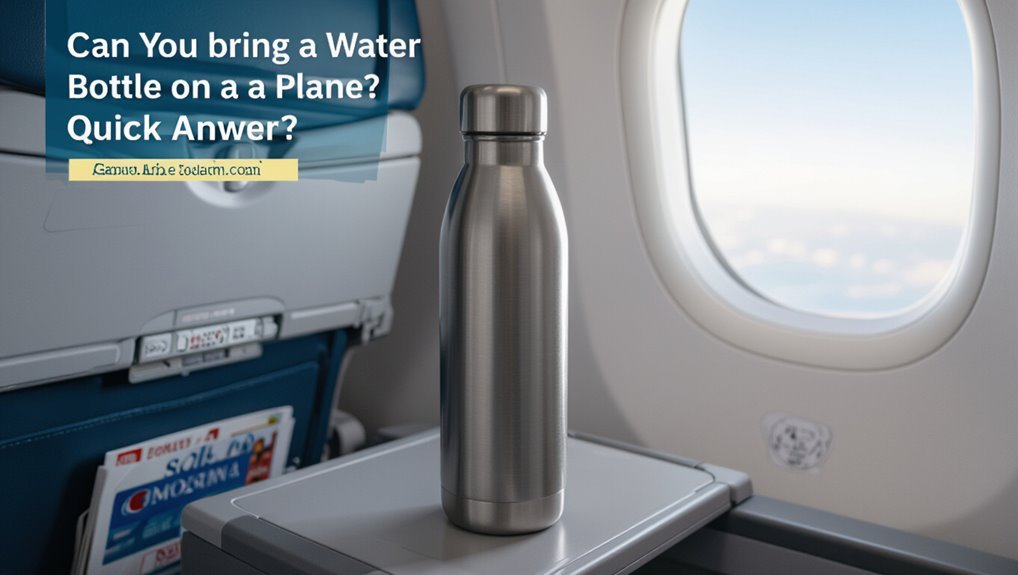
Yes — you can bring an empty reusable water bottle through airport security and onto the plane; just leave liquids over 3.4 ounces (100 mL) behind at the checkpoint.
You’ll fill it after screening at airport water fountains, café counters, or gate areas. Carry it collapsed or clean for convenience, and stow it in a bag or cup holder during boarding and turbulence for easy access.
TSA Rules for Empty vs. Full Water Bottles
You can bring empty water bottles through TSA checkpoints without issue, but full bottles are subject to the 3-1-1 liquids rule and may be confiscated.
If you want a full bottle, plan to buy one after security or fill your empty bottle at a water fountain or refill station once you’re past the checkpoint.
Knowing this difference saves you time and avoids surprises at screening.
Empty Bottles Allowed
Carrying an empty water bottle through airport security is generally allowed, and TSA officers often encourage travelers to bring one so they can refill it after screening.
You should:
- Present the bottle separately in your carry-on.
- Confirm it’s completely empty.
- Use a clear, resealable bottle for convenience.
- Refill at approved water stations post-security.
Full Bottles Restricted
While empty bottles are fine through security, full ones are subject to the TSA’s liquids rule: containers over 3.4 ounces (100 milliliters) must go in checked baggage or be discarded.
So plan to fill your bottle only after screening or buy a drink past the checkpoint.
If you bring a full bottle to screening, expect it to be confiscated or asked to be checked, so avoid that hassle.
Filling After Security
If you pass through security with an empty bottle, you can fill it at a water fountain or café beyond the checkpoint without worrying about the TSA liquids rule.
You should:
- Use only empty bottles through screening.
- Refill after security at designated stations.
- Keep bottles capped when not drinking.
- Check airline or international rules for onboard restrictions.
Why Carry-On Liquids Are Limited to 3.4 Oz
You’ll want to know that the 3.4 oz limit grew out of security concerns about liquid explosives and the need to keep potential threat quantities minimal.
The rule evolved after plots in the early 2000s showed how liquid components could be combined on board, prompting international coordination and standardized limits.
Understanding that history helps explain why security procedures for carry-on liquids are still strict today.
Security Risk Origins
Because a 2006 plot revealed how liquid explosives could be hidden in common bottles, authorities worldwide moved quickly to limit carry-on liquids to 3.4 ounces.
This size was chosen to reduce the risk of assembling a viable device in flight while still letting travelers carry small amounts of toiletries.
You should know the safety rationale and follow rules:
- Minimize quantity
- Prevent mixing
- Simplify screening
- Reduce threat potential
Historical Policy Development
Having covered why limits exist and how to follow them, let’s look at how regulators settled on 3.4 ounces as the standard. You’ll trace post-2006 risk assessments, international coordination, testing thresholds, and passenger practicality that produced the rule.
| Year | Action |
|---|---|
| 2006 | Threat revealed |
| 2007 | Immediate bans |
| 2008 | Testing limits |
| 2010 | 3.4 oz adopted |
Which Countries Follow TSA-Style Liquid Rules?
If you fly internationally, you’ll find that many countries have adopted rules similar to the TSA’s 3-1-1 liquids limit—typically allowing containers of 100 ml (3.4 oz) or less in a clear, resealable bag—though exact enforcement and exemptions can vary by region and airport.
You should expect similar limits in:
- EU Schengen countries
- UK
- Canada
- Australia
Regional Airport Security: Empty-Bottle Policies
When you fly through regional airports, security policies on empty bottles can vary widely from one terminal to the next.
Check ahead because some smaller airports follow strict TSA-like rules while others are more lenient.
Also confirm whether filling stations or water fountains are available past security so you know if you’ll need to bring an approved bottle filled after screening.
Regional TSA Variations
Because TSA procedures can vary by region and between airports, you should check local rules before you pack an empty water bottle.
Rules change by checkpoint and staff discretion, so expect variation. Before travel, verify airport websites or contact security lines to confirm acceptance.
- Check airport TSA page
- Call airport security desk
- Ask at curbside check-in
- Prepare to comply with staff
Filling Station Availability
Many airports now offer water bottle filling stations past security, so you can arrive with an empty bottle and refill it before your flight.
Check airport maps or ask TSA staff to confirm availability. If none exist, kiosks and gates may sell bottled water.
Keep an empty, reusable bottle handy—you’ll save money, reduce waste, and stay hydrated without risking security issues from carrying liquid through checkpoints.
Are Metal, Plastic, or Glass Water Bottles Allowed?
Although airport security focuses on liquids, you can usually bring empty metal, plastic, or glass water bottles through security and carry them onto the plane, provided they’re empty at the checkpoint.
Filled bottles must meet the 3.4-ounce (100 ml) liquid rule unless you’ve purchased the drink after screening or are carrying a medically necessary amount.
- Empty bottles allowed
- Fill after security
- Checked baggage can hold full bottles
- Follow airline rules
Which Leakproof and Collapsible Bottles Pass Security?
If you want a bottle that won’t slow you down at security, pick one that’s both fully leakproof when closed and collapsible only if it can stay flat without trapped liquid—security officers look for empty containers that can’t spill or be mistaken for sealed, filled bottles.
Choose silicone or TPU collapsibles with reliable valve seals, test them empty, and stow flat to show they’re void.
Can Insulated Bottles Go Through Screening?
Wondering whether your insulated bottle will clear airport screening? You can usually bring empty insulated bottles through security; they’re treated like other reusable containers.
Expect TSA agents to inspect or X-ray them, especially stainless steel or thick-walled models. If filled, follow liquid rules. Be ready to remove the bottle from bags.
TSA may X-ray or inspect insulated bottles—stainless steel types especially. If full, follow liquid rules and be ready to remove them.
- Empty first
- Expect X-ray
- Prepare for inspection
- Follow liquid rules
Packing a Water Bottle in Your Carry-On
When packing a water bottle in your carry-on, place it where TSA can easily access it for inspection—top of the bag or an outer pocket—so agents won’t have to dig through your belongings.
Secure lids, use leakproof sleeves, and cushion bottles to prevent damage.
Keep empty bottles separated from toiletries, and position them upright to avoid spills during handling and screening.
Can You Carry a Filled Water Bottle Past Security?
Really — can you bring a filled water bottle past security? You usually can’t carry liquids over 3.4 ounces (100 ml) through screening.
Still, exceptions exist for medical or baby needs with documentation. To stay compliant, follow these steps:
- Confirm liquid limits and exceptions.
- Prepare documentation if needed.
- Present the bottle separately for inspection.
- Expect potential refusal.
Where to Refill Your Bottle After Screening
Where can you refill your bottle after screening?
You’ll find water at airport shops, cafes, and restaurants past security—ask staff to fill your bottle.
Find water at airport shops, cafes, and restaurants past security—ask staff to refill your bottle.
Many terminals have designated refill stations near gates; look for signage.
If none are visible, visit an airline lounge (if you have access) or a restroom bottle-filling sink.
Keep a reusable bottle handy to avoid buying bottled water.
Airport Water Fountains vs. Bottle Refill Stations
Although both let you top up, airport water fountains and bottle refill stations serve different needs and offer different conveniences.
You’ll find fountains are ubiquitous and simple for quick sips, while refill stations are cleaner, contactless, and faster for bottles.
Consider these differences when choosing:
- Availability
- Hygiene
- Flow speed
- Bottle-friendly design
Buying Bottled Water Airside: Pros and Cons
You can grab bottled water past security for convenience, but expect steep price premiums compared with terminals or refill stations.
Buying airside saves you time and guarantees a sealed source, which helps with hydration quality control.
We’ll weigh the trade-offs between cost, security, and peace of mind so you can decide when it’s worth it.
Price Premiums Airside
Expect to pay two to four times more for bottled water once you pass security, and that price jump has clear pros and cons. You can grab water quickly, but you’ll pay for convenience.
Consider alternatives and budget accordingly.
- Convenience
- Hydration after long waits
- Limited selection
- Added travel cost
Security And Convenience
When you buy bottled water airside, security hassles from before don’t follow you—so you can skip worrying about empty bottles or gate-side restrictions and just grab a drink before boarding.
It’s convenient, saves time, and guarantees you’re allowed through checkpoints with liquid in hand.
Downsides: higher cost, limited brand choices, and potential waste from single-use plastic if you care about sustainability.
Hydration Quality Control
Although airport shops usually source bottled water from reputable brands, buying airside doesn’t guarantee consistently better quality than a bottle you packed yourself.
You’ll pay more, face limited sizes, and risk bottles sitting in heat. Consider refill options or trusted sealed bottles.
- Higher price
- Heat exposure
- Limited selection
- Convenience trade-off
When to Use a Filter Bottle for Unsafe Tap Water
If you’re traveling to areas where tap water may be contaminated or treated inconsistently, use a filter bottle anytime you can’t confirm water quality.
Rely on it for drinking, brushing teeth, and filling coffee or baby formula when bottled water isn’t available.
Choose filters rated for bacteria, protozoa, and sediment; replace cartridges per manufacturer guidance to keep flow and effectiveness.
Refill Rules for International Connections by Region
Because rules vary widely by country and airport, you should check refill and water bottle regulations for each leg of an international trip before you pack.
Local laws, terminal services, and transit visa rules affect whether you can carry, refill, or must declare bottles.
Consider regional norms:
- EU: usually refillable post-security.
- UK: similar to EU, watch transfers.
- Middle East: often strict, check carriers.
- Asia: mixed; confirm per airport.
How Long Security Queues Affect Your Water Strategy
If security looks long, you’ll want to plan wait times so you don’t run out of water before boarding.
Think about where you’ll fill your bottle—before security, at a filtered station inside the terminal, or right at the gate—and weigh convenience against access rules.
Time your drinking so you stay comfortable through the queue but aren’t rushed by restroom needs during flight.
Security Wait Time Planning
Security wait times directly shape your water strategy at the airport: a short queue means you can rely on buying or refilling at the gate, while a long line calls for carrying a full bottle through screening or sipping conservatively to stretch what you have.
- Check live wait estimates.
- Leave extra time when long.
- Bring a sealed bottle if unsure.
- Prioritize hydration before arriving.
Bottle Filling Location Options
Long wait times at the checkpoint change where you’ll fill your bottle: long lines push you to top up before screening or at the gate, while short queues let you rely on water stations past the X-ray.
Check airport maps and apps to locate fountains, kiosks, and vendor refill points. If lines are unpredictable, fill earlier; if steady and brief, wait until after security to refill.
Hydration Timing Strategies
When lines stretch unpredictably, plan your water timing around worst-case waits so you won’t end up thirsty mid-queue; when they move quickly, you can safely delay refilling until after screening.
- Bring a collapsible bottle for quick sips.
- Refill after security if lines were long.
- Use airport water fountains or kiosks.
- Monitor queue times via apps and adjust.
Preflight Checklist for Your Reusable Water Bottle
Before you head to the airport, run through a quick checklist to make sure your reusable water bottle meets rules and won’t slow you down at the gate.
Empty it before security if you’ll pass through checkpoints, confirm it’s leakproof, clean and odor-free, and that caps and straws detach easily for inspection.
Pack it accessibly in your carry-on.
What Happens If Security Flags Your Bottle?
If TSA or another checkpoint agent flags your bottle, expect them to ask you to open it and show it’s empty or let them test any liquid inside.
You may also be asked to remove caps or strainers for inspection. Stay calm, cooperate, and follow instructions.
You can usually continue once cleared, or they’ll dispose of prohibited contents.
- Comply promptly
- Remove accessories
- Accept testing
- Ask questions
If TSA Asks to Test Your Bottle: What to Expect
You’ve complied with the agent’s requests and now they’ll typically perform a quick screening to determine what’s inside.
They’ll use a handheld detector, open the bottle, or swab the cap and test the sample.
Cooperate, answer brief questions, and avoid sudden movements.
If the test clears, you’ll be allowed to keep it; if not, they’ll dispose of the contents or confiscate the bottle.
Traveling With Baby Bottles and Formula
When you’re flying with a baby, know that TSA and airlines make exceptions for baby bottles, formula, breast milk, and juice—so you can bring them in carry-on even if they exceed the usual liquid limits.
When flying with a baby, TSA allows extra formula, breast milk, and bottles in carry-on—expect screening.
Pack measured portions, keep bottles accessible for screening, and expect possible testing. Follow airline rules for heating or storing.
- Label contents
- Separate for inspection
- Bring extra supplies
- Know feeding schedule
Medicine Exceptions to Liquid Limits and Hydration
After handling bottles and formula, you’ll also want to know the rules for medicines and staying hydrated. TSA allows medically necessary liquids, gels, and aerosols in quantities greater than 3.4 ounces, but you must declare them for screening.
Carry prescriptions, original packaging, and a doctor’s note if needed.
Bring empty or refillable bottles to fill post-security and sip regularly to prevent dehydration during flights.
Can You Pack Bottles in Checked Baggage?
You can pack water bottles in checked baggage, but you’ll need to follow airline and TSA rules for liquids and hazardous materials.
Check quantity limits and local regulations, and remember caps can leak under pressure.
Wrap bottles in absorbent material and place them in sealed bags or a hard-sided compartment to protect your belongings.
Checked Luggage Rules
If you’re planning to pack bottles in checked luggage, know that most airlines allow sealed non-pressurized containers but restrict liquids over certain volumes and have rules for alcohol and fragile glass.
Pack bottles cushioned, seal caps, declare high-proof spirits, and follow airline policies. Consider insurance for valuables and check weight limits.
- Cushioning
- Sealing
- Declaration
- Weight limits
Liquid Quantity Limits
Along with cushioning and sealing, you’ll want to contemplate how much liquid is allowed in checked baggage. You can pack larger volumes in checked bags than carry-on limits, but local airline and country rules vary. Declare hazardous liquids and follow weight limits. Check restrictions for alcohol, aerosols, and pressurized containers before packing to avoid fines or confiscation.
| Item | Typical Limit | Notes |
|---|---|---|
| Water bottles | Varies | Nonhazardous usually OK |
| Alcohol | Varies by ABV | May be limited |
| Aerosols | Often restricted | May require declaration |
| Pressurized | Often prohibited | Check airline policy |
Packing And Protection
Packing bottles in checked baggage requires careful cushioning and smart placement to prevent leaks and breakage. You’ll want to wrap each bottle individually with bubble wrap, clothing, or a dedicated bottle sleeve.
- Seal caps tightly and use tape.
- Place bottles upright in center.
- Surround with soft items for shock absorption.
- Put liquids in a leakproof bag and label fragile.
Carry-On Size Limits vs. Bottle Dimensions
When you’re deciding whether a water bottle will fit in your carry-on, start by checking the airline’s published size limits for overhead bins and under-seat space and compare those to the bottle’s height and diameter.
Measure your bottle, account for insulated sleeves or caps, and verify it won’t block zippers or straps.
If unsure, pack it in checked luggage or choose a smaller bottle.
Can Flight Attendants Refill Your Water Bottle Onboard?
If your bottle fits in carry-on space, you might still wonder whether crew will refill it during the flight.
Yes, they often will, but policies and workload matter. Be polite, ask during service, and expect bottled water or a cup poured from the galley.
Consider these tips:
- Ask early.
- Offer the bottle.
- Expect limits.
- Tip or thank the attendant.
Using a Water Bottle During Long-Haul Flights
Because long-haul flights can leave you dehydrated and thirsty, bring a reusable bottle and use it regularly—drink before, during, and after meal service, refill when attendants offer, and keep it accessible in your seat pocket or a nearby bag so you won’t have to climb over neighbors to reach it.
Store it upright, sanitize hands before touching the mouthpiece, and sip often to stay comfortable without disrupting sleep or fellow passengers.
Hydration Tips to Reduce Bloating and Jet Lag
Although you’ll want to sip steadily, focus on timing and content: drink water regularly before, during, and after your flight, limit alcohol and caffeine, and include small electrolyte boosts to curb bloating and ease jet lag.
Plan sleep, move often, and choose light meals. Follow these steps:
- Sip water hourly.
- Take electrolyte tablets.
- Walk and stretch regularly.
- Avoid salty snacks.
Best Reusable Water Bottles for Air Travel
Keeping your hydration strategy practical means choosing the right bottle for the plane, and the best reusable options balance size, leakproof design, and ease of refilling through airport security and onboard. Pick bottles with wide mouths, secure caps, and durable materials. Compare choices below:
| Type | Capacity | Feature |
|---|---|---|
| Stainless | 500–750 ml | Insulated, leakproof |
| Collapsible | 300–600 ml | Packs flat |
| BPA-free plastic | 350–700 ml | Lightweight, clear bottle |
Lightweight Bottles for Short Flights
When you’re hopping on a short flight, a lightweight bottle that’s easy to stow and grab makes staying hydrated simple; aim for 300–500 ml capacity, a slim profile that fits cup holders or seatback pockets, and a secure cap to prevent spills.
You’ll want minimal weight, easy-clean parts, and quick access after security.
- Compact size
- Leakproof cap
- BPA-free material
- Easy-clean design
Insulated Bottles for Hot or Cold Trips
If your trip involves temperature-sensitive drinks or longer hours between refills, an insulated bottle is worth packing. You’ll keep beverages hot or cold for hours, reduce buys onboard, and avoid condensation in your bag. Choose vacuum-sealed, TSA-compliant sizes and a leakproof lid.
| Feature | Benefit |
|---|---|
| Vacuum seal | Temperature retention |
| Leakproof lid | No spills |
| Size options | TSA-compliant |
| Material | Durable |
| Cleaning | Easy maintenance |
Collapsible Bottles for Multi-Stop Travel
Because you’ll often switch between crowded airports, short layovers, and varied luggage limits, a collapsible bottle makes sense for multi-stop travel: it saves space when empty, slips into tight pockets, and still lets you refill at water stations along the way.
You’ll want lightweight, leakproof, and quick-dry designs that pack small and meet carry-on rules.
- Lightweight
- Leakproof
- Durable
- Compact
How to Clean Your Bottle While Traveling
When you’re on the go, a quick rinse with hot water and soap keeps your bottle usable between stops.
For deeper sterilization, use boiling water, a UV pen, or a dilute bleach solution when facilities allow.
Make sure the bottle and cap dry completely and store them open or wrapped in a clean cloth to prevent mold.
Quick Rinse Tips
A few simple steps will keep your water bottle sanitary between full cleanings:
- Rinse with hot tap water and swish vigorously to dislodge residue.
- Use a drop of dish soap and a bottle brush, then rinse thoroughly.
- Air-dry upside down with the cap off to prevent bacteria growth.
- Wipe exterior and lid threads with an alcohol wipe when taps aren’t available.
Deep Sterilization Methods
Those quick rinses work for daily upkeep, but traveling often calls for deeper sterilization to kill lingering bacteria and mold.
Pack a small bottle brush and mild dish soap, use boiling water if material allows, or wipe with a diluted bleach solution (1 tsp per quart) then rinse thoroughly.
Consider portable UV sanitizers for quick, chemical-free disinfection between uses.
Drying And Storage
1 quick shake and a short air-dry can make a big difference: after cleaning your bottle, empty it fully, remove any caps or straws, and prop it open so air circulates inside.
Then store dry parts separately and keep lids loose in a breathable bag.
Follow these steps:
- Disassemble parts
- Air-dry upside down
- Use a clean cloth for seals
- Store ventilated
Preventing Odors and Mold on the Go
Coffee-smelling or musty water bottles are avoidable when you rinse, dry, and store them correctly between uses.
On the go, empty and air-dry bottles after each refill, wipe caps and seals, and leave lids off to ventilate.
Empty and air-dry bottles after refills, wipe caps and seals, and leave lids off to ventilate.
Use a quick vinegar rinse or baking soda paste if odors start.
Replace worn seals and deep-clean weekly to prevent mold buildup.
Security-Friendly Packing Hacks for Bottles
When you’re packing a water bottle for a flight, think about security checkpoints first:
- Empty bottles save time—fill after screening.
- Use clear, collapsible bottles to show contents easily.
- Stash bottles in an outer pocket for quick removal.
- Secure lids and wrap spills with a small plastic bag to avoid messy inspections.
If Security Confiscates Your Bottle: Next Steps
If TSA or another security officer takes your water bottle, stay calm and ask why they seized it so you know your options; in many cases you can either dispose of it, retrieve it after screening, or request a supervisor for clarification.
If disposal’s required, do it promptly. If retrieval’s allowed, note where to pick it up.
Keep ID handy and follow staff instructions to speed resolution.
How to Appeal a Denied Bottle Screening Decision
Although security staff usually explain their reasons, you can appeal a denied bottle screening decision if you think it was wrong or unclear.
Ask calmly for a supervisor, document the officer’s name and time, request a written explanation or complaint form, and keep receipts or photos.
Follow up with the airport or agency within specified timelines to seek review and resolution.
- Ask calmly for a supervisor
- Record officer name/time
- Request written explanation
- Keep receipts/photos
Sustainable Travel: Ditching Single-Use Plastic
Because single-use plastics add weight to your bag and waste to the planet, switching to reusable options is one of the simplest, most effective moves you can make for greener travel. Carry a lightweight bottle, a collapsible cup, and a small detergent bar to rinse. Small changes cut waste and hassle.
| Item | Benefit | Tip |
|---|---|---|
| Bottle | Less waste | Refill often |
| Cup | Saves space | Collapsible choice |
| Soap | Clean on trip | Quick rinse |
How Much You Save Carrying a Reusable Bottle
Look up airport bottle prices and you’ll see how quickly a single bottled water can cost more than you expect.
Multiply that by several trips and you’ll notice the real savings from refilling your reusable bottle.
You’ll also dodge single-use fees and contribute less plastic waste on every journey.
Airport Bottle Price Comparison
1 simple swap—bringing your reusable bottle—can shave a surprising amount off travel costs: airport bottled water often runs $3–6, so refilling from a filtered fountain or kiosk saves you money every time you fly.
Compare typical prices and choices:
- Small bottle: $3
- Large bottle: $5
- Soda/packaged drink: $4–6
- Filtered refill: free–$1
Savings Over Multiple Trips
Now that you know airport bottles usually cost $3–6 while refills run free–$1, it’s easy to estimate how quickly a reusable bottle pays for itself.
If you travel twice a month and skip one $5 bottle each trip, you save about $120 yearly.
A $20 stainless bottle pays off in two months, then keeps saving you money on future trips.
Avoiding Single-Use Fees
If you bring a reusable bottle, you’ll sidestep single-use fees at airports, cafes, and event venues where bottled water or disposable cups carry built-in costs.
Those $3–6 impulse buys add up fast, especially on frequent trips. You’ll save money, reduce waste, and avoid extra weight from bought bottles.
Consider these annual savings scenarios:
- Save per trip
- Multiply by trips
- Factor in companions
- Add reduced waste
Health Benefits of Using Your Own Bottle
Because airport sinks and airplane tray tables can harbor germs you don’t want near your mouth, bringing your own bottle reduces exposure to unseen bacteria and viruses.
You control cleaning frequency, choose materials that resist microbial growth, and avoid shared dispensers.
Staying hydrated with your own bottle also helps soothe mucous membranes, lowering infection risk and helping you feel better during and after travel.
Lost Bottle Claims and Travel Insurance Basics
When your reusable bottle goes missing during a trip, you’ll want to know whether your travel insurance or the airline’s lost-and-found policies will cover replacement or reimbursement.
If your reusable bottle disappears on a trip, check travel insurance and airline lost‑and‑found rules for possible reimbursement.
Check your policy limits, proof requirements, and timing for claims. Document loss, file promptly with the airline, and keep receipts.
- Policy limits
- Proof of ownership
- Claim deadlines
- Receipts and photos
Special Rules for International Flights With Layovers
Traveling internationally with layovers changes the rules for carrying and refilling water bottles, so you’ll need to plan ahead for security checks, transit country regulations, and connecting-airline policies.
Empty bottles usually clear security, but refill opportunities vary by airport and customs.
Check transit visa rules, duty-free allowances, and each carrier’s carry-on restrictions to avoid confiscation or delays during connections.
Overlooked Airport Bottle Refill Locations
If your itinerary and security checks leave you with an empty bottle, don’t assume water sources are limited to obvious spots.
You can refill from less obvious places if you look: staff drinking stations, café sinks with permission, airline lounges, and interactive water walls.
Consider asking politely; many spots aren’t advertised but will help keep you hydrated before boarding.
- Staff stations
- Café sinks
- Airline lounges
- Water walls
Final Preflight Bottle Checklist
Before you head to the gate, check that your bottle’s filled to the level you want so you won’t need frequent refills.
Make sure it’s made of materials allowed by security—typically metal or hard plastic with a removable lid—or empty it before screening if unsure.
These quick checks save time and prevent last-minute hassles.
Bottle Fill Level
Since cabin rules and your thirst can both change at the last minute, check your bottle’s fill level as one of the final preflight steps.
You’ll want enough water for boarding and delays, but not so full it spills or exceeds allowed quantities before security.
Consider:
- Top up after security if possible.
- Leave space for expansion.
- Avoid overfilling in carry-on.
- Secure the cap tightly.
Security-Compatible Materials
1 clear rule: bring a bottle made of security-friendly materials so you don’t slow down the checkpoint or get turned away.
Choose clear plastic, aluminum, or stainless steel without hidden compartments or dense insulation that obscures X-ray images.
Avoid glass, lined bottles with unknown insulation, or novelty designs.
Label removable parts, empty before screening, and be ready to place it separately on the conveyor belt.
Quick FAQ: Common Water-Bottle-on-Plane Questions
Got questions about bringing a water bottle on a plane? You can usually carry empty bottles through security, refill post-screening, and use insulated or metal bottles unless restricted by specific airlines.
Follow local rules and pack safely.
- Empty through security
- Refill after screening
- Check airline rules
- Secure lid for flight
Frequently Asked Questions
Can I Bring Flavored or Vitamin-Enhanced Water Through Security?
You generally can’t bring flavored or vitamin-enhanced water through security in containers over 3.4 ounces (100 mL); you can carry smaller bottles in your carry-on or buy drinks past security, and empty reusable bottles are allowed.
Are There Limits on Carrying Multiple Empty Bottles in My Carry-On?
Yes—you can carry multiple empty bottles in your carry-on, but TSA and airline staff may inspect them; they’re allowed through security empty, though some airlines restrict quantity for space or safety, so pack reasonably and expect checks.
Do Reusable Water Bottles Count Toward My Carry-On Item Allowance?
Yes — reusable water bottles count as part of your carry-on items if you pack them inside your bag; empty ones usually don’t count as a separate personal item at security, but airline size/quantity rules still apply.
Can I Bring a Water Bottle Through In-Flight Medical Oxygen Situations?
Yes — you can bring a water bottle during in-flight medical oxygen situations, but you’ll need airline approval and must follow crew instructions; they’ll guarantee it’s safe, won’t interfere with oxygen equipment, and meets any cabin restrictions.
Will Different Airlines Enforce Onboard Refill Policies Differently?
Yes — different airlines will enforce onboard refill policies differently. You’ll find varying rules about refill stations, crew discretion, and COVID-era practices, so check your carrier’s policy beforehand and ask gate agents or flight attendants if unsure.
Conclusion
You can bring a water bottle on a plane, but you’ll need to follow rules: empty bottles are fine through security, filled ones must meet the 3.4 oz (100 ml) carry-on liquid limit unless you buy water after screening or have a security-exempt bottle. Check regional and international layover rules, refill stations, and airline policies before you fly. Emptying, labeling, or carrying documentation for special medical needs avoids delays—pack smart and hydrate safely while traveling.