Can I Put a Suitcase Inside a Suitcase for Travel?
Yes — you can put a suitcase inside another for travel, but only when sizes, weight limits, airline rules, and stability allow it. Nesting saves storage space and can protect an inner case, but it can add weight, complicate security checks, and risk extra fees if dimensions or weight exceed limits. Test zipper alignment, wheel clearance, and rollability beforehand, and prefer soft, compressible items inside; keep going to see when nesting makes sense and how to test it.
Why People Consider Nesting a Suitcase
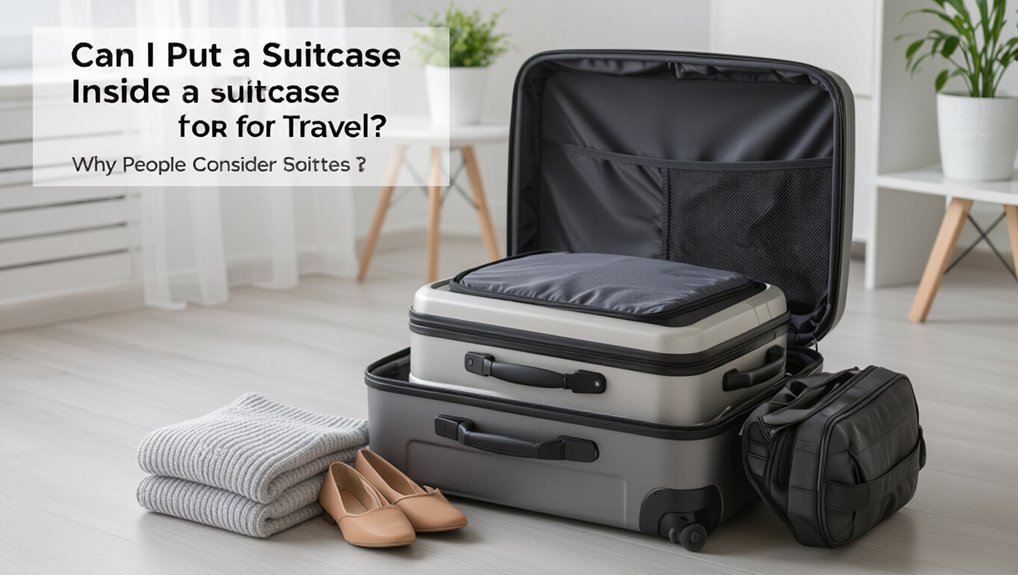
Because you want to save space, nesting one suitcase inside another can seem like an obvious shortcut when storing or moving luggage. You might picture fewer trips, tidier closets, and quicker loading.
You weigh convenience against potential scratches, hinge stress, and lost padding. You consider size compatibility, protective covers, and whether stacking compromises fast access or long-term fabric and frame integrity.
Quick Answer: Is Nesting Luggage Practical?
Yes—you can nest a suitcase inside another, and it’s practical in many short-term storage or moving situations as long as the outer bag’s structure and the inner bag’s size match.
You’ll save space, protect the inner case, and simplify transport when both fit snugly.
Don’t expect this to work with rigid, oversized, or airline-checked luggage without risking damage or extra fees.
When Nesting Actually Makes Sense for Travel
Nesting luggage can be handy for storage or moves, but for travel it’s worth being selective about when you do it.
Use nesting when you need organized packing (separating shoes, toiletries, dirty clothes), when connecting bags into one handleable unit for taxis, or when protecting fragile items inside a hard shell.
Avoid nesting for quick access or weight-restricted trips.
How Airline Size and Weight Limits Affect Nesting
If you’re thinking about putting one suitcase inside another, start by checking airline size and weight rules—carry-on and checked limits can quickly make nesting impractical because the combined dimensions or mass may push you over allowances.
- Weigh both pieces before travel.
- Measure combined dimensions.
- Compare to carry-on/checked limits.
- Consider redistributing items to meet restrictions.
Will Nesting Cut Your Checked-Bag Fees?
You’ll want to check your airline’s baggage policy before you try nesting one suitcase inside another, because carriers charge based on either weight or number of pieces.
If your airline counts pieces, stuffing a small bag into a larger one can save you a fee, but if they charge by weight you could still hit the limit and pay extra.
Always weigh your packed luggage and compare the carrier’s rules to avoid surprises at the counter.
Airline Baggage Policies
Wondering whether stuffing one suitcase into another will shrink your checked-bag fees? You need to check airline rules: nesting doesn’t change policy wording.
- Confirm allowed dimensions and declared pieces with your carrier.
- Note restrictions on oversize/oddly shaped items.
- Expect fees based on count or weight per airline terms.
- Call customer service if policies seem ambiguous before you travel.
Weight Versus Pieces
Because airlines charge either by piece count or by weight, stuffing one suitcase into another rarely reduces fees unless the carrier explicitly counts only pieces or only weight.
Even then, you’ll likely hit size or weight limits that trigger extra charges. You’ll probably add bulk and weight, so check your airline’s rules: nesting can save a bag fee only in rare, specific cases.
Can a Hard-Shell Bag Fit Inside Another Hard Shell?
Can a hard-shell suitcase fit inside another hard-shell suitcase? You can, but fit depends on shape, size, rigid walls, and handle placement.
Check dimensions precisely, remove telescoping handles, and test closure before travel. Consider these steps:
- Measure external and internal dimensions.
- Remove or retract protruding parts.
- Test nesting for stable closure.
- Redistribute weight to avoid pressure points.
Which Suitcase Materials Nest or Compress Best?
Think about the materials when nesting bags: hard shells usually only stack if their shapes match, while soft shells can flex into tighter spaces.
You’ll find fabric and padded soft-sided suitcases compress most easily for stuffing or nesting.
Consider construction and padding, because those determine how much one bag can fit inside another.
Hard Shell Compatibility
When you’re nesting suitcases, the material matters: hard-shell cases made from polycarbonate, ABS, or aluminum each behave differently, so you need to match shapes and flexibility to get a good fit.
- Polycarbonate: lightweight, slightly flexible — often nests well.
- ABS: stiffer, may require exact size matching.
- Aluminum: rigid, rarely nests without gaps.
- Rim/handle alignment: check closures to avoid damage.
Soft Shell Flexibility
While soft-shell suitcases won’t lock into each other like rigid cases, their fabric and frame let you compress and nest them more flexibly—especially models made from nylon, polyester, or canvas with collapsible frames.
You can tuck a smaller bag inside a larger one, reshape corners, and use compression straps to stabilize contents.
Choose lightweight, resilient materials to avoid permanent deformation during packing and transit.
Fabric Compressibility
Fabric compressibility determines how easily you can squash, nest, or layer suitcases without damaging them.
Materials like ballistic nylon, ripstop polyester, and canvas offer the best balance of flexibility and resilience, while hard-shell polycarbonate and ABS resist compression and won’t nest.
- Ballistic nylon: compressible, durable.
- Ripstop polyester: lightweight, flexible.
- Canvas: pliable, breathable.
- Polycarbonate/ABS: rigid, non-nesting.
How Nesting Changes Weight Distribution and Balance
Because you’re fitting one suitcase inside another, the center of mass shifts inward and can make the combined bag feel denser and more top- or bottom-heavy depending on how you pack.
You’ll notice handling changes: rolling may pull differently, lifting can feel awkward, and tipping risk increases if heavier items congregate at one end.
Redistribute weight to restore balance and ease maneuvering.
Does Nesting Reduce Protection for Fragile Items?
If you nest one suitcase inside another without padding and strategic placement, you’ll likely reduce the protection for fragile items.
You should pad, separate, and secure delicate contents to prevent impact and shifting.
- Cushion gaps with bubble wrap or clothing
- Use rigid dividers for fragile zones
- Fill voids to stop movement
- Test for wobble before travel
How Nesting Complicates Airport Security Checks
When you nest one suitcase inside another, airport security can flag the layered luggage as suspicious and slow you down, since officers need clear access to inspect contents and may ask you to unpack nested bags for screening.
You’ll face longer inspection times, possible delays to boarding, and extra handling that risks misplacement.
Prepare to demonstrate contents and be ready to repack under supervision.
Are Nested Bags Allowed by TSA and International Rules?
You’ll want to know how TSA and other security agencies treat nested bags before you pack that way.
TSA focuses on clear screening and may ask you to unpack nested items for inspection.
Individual airlines and countries can have stricter rules.
Check your airline’s baggage policy and the destination’s security guidelines to avoid surprises at the checkpoint.
TSA And Security Screening
Curious whether nesting a suitcase inside another will slow you down at airport security? You’ll likely face extra screening if x‑rays show dense layers.
Follow TSA rules: declare batteries or electronics, pack liquids accessibly, and avoid hidden compartments.
Expect:
- Possible bag inspection
- Requirement to remove inner bag for scanning
- Questions about contents
- Delays at security checkpoints
International Airline Policies
Because international rules and airline policies vary, nesting one suitcase inside another can trigger different responses depending on the carrier and destination. You should check carrier rules, customs, and weight limits before packing nested bags. Some airlines forbid untagged inner cases; others allow them if declared. Confirm dimensions to avoid fees or confiscation.
| Airline | Policy note |
|---|---|
| Airline A | May allow with declaration |
| Airline B | Prohibits inner baggage |
| Airline C | Permits if checked weight ok |
| Airline D | Subject to security discretion |
How to Measure If One Suitcase Fits in Another
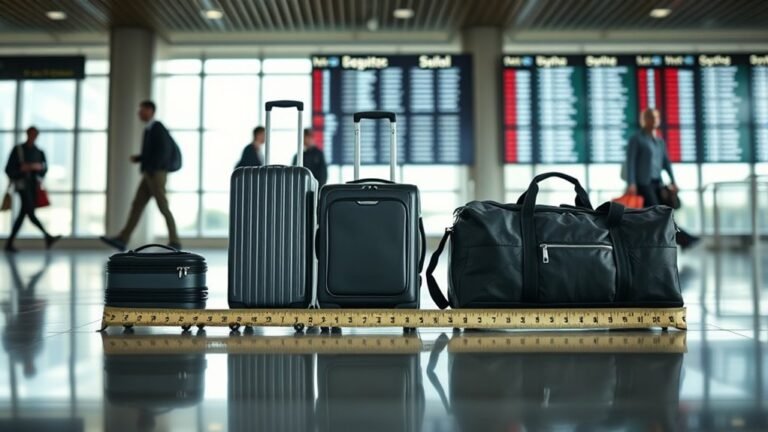
When checking whether one suitcase will fit inside another, start by measuring the exterior dimensions of the outer case and the exterior or packed dimensions of the inner case—length, width, and height—using a tape measure held straight along the longest points.
Then follow these steps:
- Record both sets of dimensions.
- Subtract inner from outer on each axis.
- Allow clearance for liners/handles.
- Confirm orientation fits.
How to Test Nested Luggage Before You Travel
Before you leave, physically test the nested setup by fitting the inner suitcase into the outer one exactly as you plan to pack it. Check zipper alignment, wheel clearance, and weight balance. Roll the outer bag short distances and lift it by handles. Use this quick checklist:
| Item | Pass/Fail | Notes |
|---|---|---|
| Zippers | ||
| Wheels | ||
| Handles | ||
| Balance |
Packing Techniques for Nesting Bags
Start by arranging items by size and fragility so you can place the sturdiest, least-used bag inside the outer suitcase first; this makes loading easier, protects delicate items, and keeps weight centered for rolling.
Begin by sorting items by size and fragility; nest the sturdiest, least-used bag inside to protect and balance weight.
Then:
- Line the inner bag with soft clothes.
- Use compression sacks for bulk.
- Pad corners with shoes or towels.
- Secure with straps to prevent shifting.
Best Inner Suitcases for Nesting
Now that you’ve got the nesting technique down, choosing the right inner suitcase makes the whole setup work better.
Pick a lightweight, soft-sided bag that compresses, fits standard carry-on dimensions, and has sturdy handles for extraction.
Look for durable zippers, internal compression straps, and a slim profile to avoid wasted space.
Confirm it’s under weight limits so nesting stays practical.
Best Outer Suitcases to Accept Another Bag
When you pick an outer suitcase to carry another bag, check the internal dimensions and opening size to guarantee a proper fit.
You’ll want sturdy construction, firm padding, and reinforced seams to protect the nested bag from impacts.
Also consider how the inner bag sits—secure straps or compression panels will keep it from shifting during travel.
Fit And Dimensions
Choosing the right outer suitcase comes down to internal dimensions, opening style, and how much spare room you want for nesting another bag. Measure the smaller bag’s height, width, and depth and compare them to the outer case’s internal measurements rather than its advertised size.
You’ll want:
- Exact internal height clearance
- Sufficient width with side pockets considered
- Depth plus lid overlap
- Opening type for easy insertion
Durability And Padding
Because you’ll be nesting one bag inside another, you want an outer suitcase built to withstand added weight and friction: look for rigid-shell or reinforced-frame designs with tough polycarbonate, aluminum, or ballistic nylon and strong corner reinforcements that resist cracking and deformation. Choose padded interiors or removable liners to protect both bags and absorb shocks.
| Feature | Benefit | Tip |
|---|---|---|
| Rigid shell | Impact resistance | Check thickness |
| Reinforced frame | Shape retention | Test flex |
| Padded lining | Protects nested bag | Removable pad |
How Nesting Affects Wheels, Handles, and Mobility
If you nest one suitcase inside another, you’ll change how the combined unit rolls, turns, and handles—often making it heavier, less stable, and harder to steer.
- Wheels: increased load strains casters, reduces smoothness.
- Handles: telescoping bars feel wobbly under extra weight.
- Balance: higher center of mass causes tipping when turning.
- Mobility: you’ll need more effort on curbs, stairs, and uneven surfaces.
How to Protect Contents When You Nest Bags
When you nest one bag inside another, start by layering soft padding like clothing, towels, or bubble wrap around fragile items to cushion them.
Then secure the inner suitcase with straps or compression bands so it can’t shift during transit.
These steps keep contents protected and make nesting practical.
Layer Soft Padding
Start by lining the inside of the outer suitcase with a soft, protective layer—think folded clothes, a plush towel, or foam sheets—so the inner bag and its contents won’t rub against hard surfaces.
Then add targeted padding around corners and fragile items.
Consider:
- Rolled shirts
- Bubble wrap
- Microfiber towels
- Thin foam panels
Secure With Straps
Buckle the inner bag in place with adjustable straps to stop shifting and compress loose items—use the suitcase’s built-in cross-straps or add removable luggage straps that clip around the nested bag. Secure straps firmly, tuck buckles away, and test stability by shaking gently. If needed, add small foam blocks to fill gaps and prevent rubbing.
| Strap Type | Use Case | Tip |
|---|---|---|
| Built-in cross-strap | Standard suitcases | Tighten fully |
| Removable strap | Extra hold | Clip outside |
| Compression strap | Compress contents | Check buckles |
How to Secure Nested Luggage to Stop Shifting
1 simple fix can make nested suitcases travel like a single pack: immobilize the inner bag so it can’t slide around inside the outer one.
You can:
- Use adjustable straps to cinch both bags.
- Fill gaps with soft items like socks.
- Add non-slip liners between shells.
- Clip lightweight carabiners through handles to anchor them.
Do these and your nested setup stays put.
When Nesting Saved Space : and When It Failed
When nesting works, it can shrink what you’d otherwise haul by tucking a smaller carry-on into a larger checked bag so you only wheel one piece through the airport.
When it fails, that same setup can jam zippers, add unexpected weight, or make retrieval a hassle at your destination.
You’ll save time loading and maneuvering through terminals, but test fit, balance, and accessibility first to avoid trapped items.
Costs: Fees, Time, and Wear on Your Bags
Putting one suitcase inside another can save space but it can also cost you: airlines may charge extra baggage or oversize fees if the combined weight or dimensions exceed limits.
It’ll take more time to pack and unpack nested bags, which matters when you’re rushing through connections or check-in.
And don’t forget the added wear and tear on zippers, wheels, and fabric from cramming and extra handling.
Extra Baggage Fees
Wondering how much it’ll cost to stash one suitcase inside another? You might avoid an extra checked bag fee, but airlines can charge for oversized or extra items.
Consider weight limits and gate-check rules. Calculate likely charges before you go:
- Checked bag fee
- Oversize/odd-size fee
- Weight overage fee
- Carry-on enforcement fee
Time To Pack/Unpack
If you stash one suitcase inside another to dodge a fee, remember you’ll spend extra time packing and unpacking at each stop, and that adds real costs beyond money.
You’ll juggle layered packing, unzip inner bags, reorganize items for access, and repack when moving on. That slows transfers, raises stress, and can make tight connections riskier, so weigh minutes lost against any savings.
Increased Wear And Tear
Beyond the extra minutes and hassle of nested packing, squeezing one suitcase into another speeds up how quickly both bags break down.
You’ll pay for repairs or replacements sooner and lose time managing damage claims. Consider these impacts:
- Zipper strain
- Frame bending
- Fabric abrasion
- Wheel misalignment
Avoid extra wear by using proper packing or a durable travel bag.
Packing-List Changes When You Plan to Nest
Once you plan to nest one suitcase inside another, you’ll tweak your packing list to prioritize lightweight, compressible items and a few rigid essentials that protect both bags. You’ll choose soft clothes, flexible toiletries, and slim electronics, limiting bulky shoes and hard cases. Use a simple checklist:
| Item type | Best choice | Avoid |
|---|---|---|
| Clothing | Compressible | Heavy coat |
| Shoes | Foldable | Boots |
| Toiletries | Travel-size | Full bottles |
Nesting for Checked vs. Carry-On: What to Know
When you’re deciding whether to nest a suitcase inside another, think about airline rules, weight limits, and how each bag will be handled—checked bags can swallow a nested bag more easily, but carry-ons face size, inspection, and gate-check risks.
- Check dimensions and weight.
- Expect rough handling for checked luggage.
- Be ready to unpack for TSA.
- Gate-checking can negate carry-on nesting.
Short-Trip Hack vs. Long-Trip Mistake: When to Nest
If you’re hopping on a short trip, nesting a small bag inside a larger one can save time and simplify packing. Just watch weight and balance so the outer suitcase doesn’t become awkward or exceed limits.
For longer trips, though, nesting often creates access problems and cuts down on usable space, so it’s usually not worth it.
Short-Term Convenience
Although nesting a smaller suitcase inside a larger one can feel like a clever shortcut, it’s really a short-term convenience best reserved for quick hops where you won’t need to unpack much.
You should use it when:
- You’re on a weekend trip.
- You won’t access the inner bag mid-trip.
- You need to save time packing.
- You expect minimal transfers.
Weight And Balance
Nesting a bag can save time on a short hop, but pay attention to how that extra luggage shifts weight and balance. You should test rollability, center heavy items, and avoid overpacking the inner bag. If handled, nesting keeps things stable for quick trips.
| Check | Action | Result |
|---|---|---|
| Roll test | Push and pull | Smoothness |
| Center load | Pack core | Stability |
| Limit weight | Weigh bag | Safer |
| Strap inner | Secure | No shift |
| Reassess | Adjust | Balanced |
Long-Trip Limitations
When you’re planning a long trip, don’t treat the short-trip nesting trick as a one-size-fits-all solution: stacking a suitcase inside another can overload zippers, hide wear points, and make accessing items or redistributing weight much harder once you’re on the road.
- Check zipper strength.
- Avoid hidden damage.
- Keep essentials reachable.
- Redistribute weight frequently.
How to Test Nested Bags at Check-In and Gate
If you want to see whether your nested bags will pass muster, start by weighing and measuring them the way the airline will—scale the outer suitcase and measure length, width, and height including any protruding handles or wheels.
At check-in, present both bags, disclose nesting, and watch staff apply size/weight rules.
At the gate, be ready to repack if agents cite carry-on limits or safety concerns.
Final Decision Guide: Should You Nest for This Trip?
Ready to decide whether to nest for this trip? You’ll weigh convenience, rules, weight, and risk.
Use this quick checklist to choose confidently:
- Airline and TSA compliance
- Total weight vs. allowance
- Ease of access at destination
- Damage and theft risk
If most answers are favorable, nest; if not, pack separately or redistribute items.
Frequently Asked Questions
Can Nesting Bags Affect Airline Liability for Lost or Damaged Luggage?
Yes — nesting bags can affect airline liability: you’re still responsible for external baggage condition and contents; airlines may limit claims for items inside additional soft or unmarked containers, so check carrier rules and declare valuables to protect claims.
Can Nesting Increase Risk of Theft or Tampering During Transit?
Yes — nesting can increase theft or tampering risk because it hides contents, creates attractive extra padding for opportunistic thieves, and may delay detection; you’ll want tamper-evident locks, secure zippers, and careful packing to deter access.
Are There Insurance or Warranty Implications When One Suitcase Nests in Another?
Yes — nesting can affect claims. You’ll need to check your policy and warranty terms, because insurers or manufacturers may limit coverage for nested or modified luggage, and you could void warranties or face reduced reimbursement.
Does Nesting Complicate Luggage Storage or Retrieval at Hotels?
Yes — nesting can complicate storage and retrieval at hotels. You’ll struggle with tight closets, elevators, and bell service; unpacking and repacking takes longer, and staff might be confused or reluctant to handle nested luggage.
Can Nesting Be Used to Discreetly Transport Prohibited Items?
Yes—you could try, but you shouldn’t. You’d be risking legal trouble, seizures, and travel bans. Authorities screen luggage; nesting won’t reliably hide contraband. You’ll face prosecution, fines, and ruined travel if caught.
Conclusion
Nesting a suitcase can be handy for short trips, moving, or storage, but you’ll want to think about airline size limits, weight rules, and how much space you actually need. If nesting keeps you under fee thresholds and fits airline dimensions, go for it. For most travel, though, you’ll be better off using one properly sized bag to avoid extra bulk, awkward handling, or surprises at check-in. Test sizes beforehand.