
Can Hair Straighteners Go in Hand Luggage
Yes — you can usually bring a hair straightener in your carry-on, but it must be powered off, completely cool, and packed safely so it can’t accidentally turn on. Check whether it has removable lithium batteries; spare cells often must be carried in the cabin and protected against short circuits. Some countries or airlines ban certain models, so verify rules for your route. Keep it accessible for inspection, and keep going if you want specifics and packing tips.
Can I Take a Hair Straightener in Carry-On?
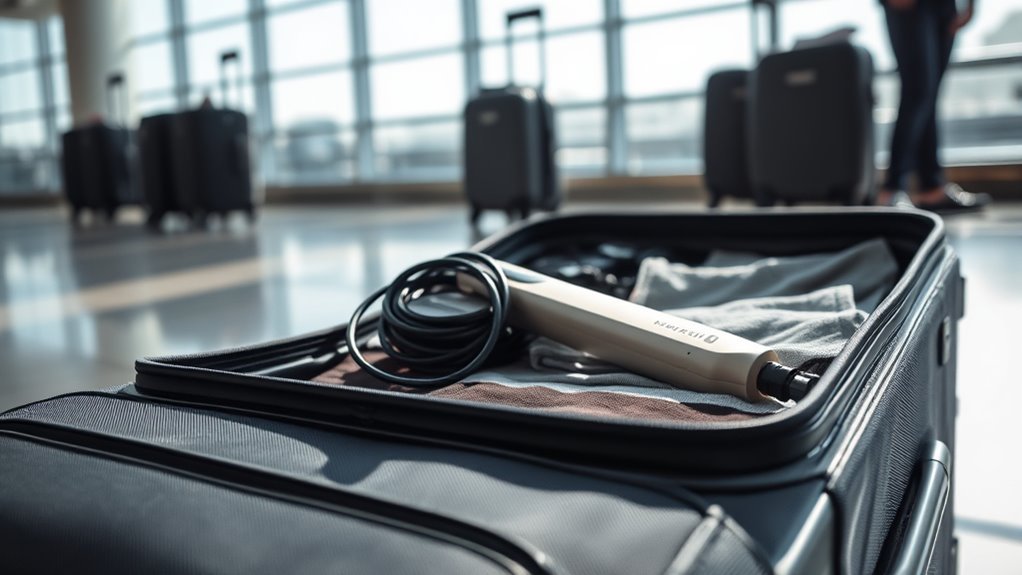
Yes — you can take a hair straightener in your carry-on, but you should follow airline and TSA rules. You’ll pack it powered off and cool, ideally in a heat-resistant pouch to protect fabrics and other items. Cord and plates should be secured to prevent accidental activation; some airlines require devices to be fully disabled.
If it uses a removable battery, carry batteries in your cabin bag per battery rules and protect terminals. Always check your airline’s specific policy before flying, since carriers may impose limits or ban certain models.
When in doubt, declare the device at security for guidance.
Quick Summary: Rules at a Glance
When you’re packing, remember that most straighteners are allowed in carry-on bags but must be switched off, cool, and secured to avoid accidental activation; keep cords tucked, use heat-resistant covers, and pack where staff can inspect them easily. You’ll want to check airline rules for battery-powered models. Below is a quick visual reference to guide you.
| Item type | Carry-on? | Notes |
|---|---|---|
| Corded straightener | Yes | Must be off and cool |
| Battery-powered | Usually | Remove battery if removable |
| Heat-resistant case | Recommended | Prevents burns and activation |
Which Aviation Authorities Allow Hair Straighteners?
Most major aviation authorities permit hair straighteners in carry-on luggage, but rules and nuances vary by region and device type.
You’ll find agencies like the FAA (United States), EASA (European Union), and Transport Canada allow flat irons in hand luggage, typically treating them as personal electronics or grooming tools.
Authorities usually focus on battery type and state — spare lithium batteries may be restricted or need carry-on placement, while integrated batteries are generally fine.
You should check local civil aviation authority guidance before travel, confirm airline-specific policies, and guarantee devices are powered off and protected to prevent accidental activation.
Countries or Airlines That Restrict Flat Irons
Before you pack your flat iron, check country-specific prohibitions because some nations ban certain heating devices.
Also review your airline’s carry-on rules, since carriers can have stricter limits than regulators.
If your straightener has a removable or non-fixed battery, that can trigger additional restrictions or require it to be in checked luggage.
Country-Specific Prohibitions
A handful of countries and some airlines ban or tightly restrict flat irons in carry-on bags because they view the heated elements or lithium batteries as fire risks. You’ll need to check specific national aviation rules and your carrier’s policy before you pack.
Many nations with strict security—like Australia, New Zealand, and parts of the Middle East—have issued advisories or outright bans on devices with exposed heating plates or non-removable lithium batteries. You should consult your destination’s civil aviation authority website and airport notices.
If rules are unclear, contact the airline directly. When in doubt, pack the straightener in checked baggage if allowed.
Airline Carry-On Rules
When you’re packing, check your airline’s carry-on policy closely since many carriers impose their own limits on flat irons—especially models with exposed heating plates or built-in lithium batteries.
Airlines like some US, European, and Asian carriers may ban or require stowage of devices that pose burn or fire risks, while others allow them if powered off and protected. You should review the carrier’s list of prohibited items, contact customer service for clarification, and note differences between cabin and checked baggage rules.
If flying codeshare, follow the most restrictive operator’s guidance to avoid delays or confiscation at security.
Battery-Powered Restrictions
Although many airlines let you carry battery-powered flat irons, some countries and carriers restrict them due to fire and smoke risks from lithium batteries, so you should check rules before you fly.
You’ll find varied limits: some require batteries removed and carried in cabin, others ban spare lithium packs, and a few prohibit certain watt-hour ratings.
Before packing, verify both airline and departure/arrival country rules.
Consider these steps to stay compliant:
- Remove batteries and carry them in your hand luggage when allowed.
- Keep spares in original packaging or insulated cases.
- Check battery watt-hour limits and airline declarations.
Battery-Powered Cordless Straighteners: Extra Rules?
If your straightener runs on a removable battery or contains a built-in lithium cell, you’ll face extra airline rules compared with corded models. Carriers and security agencies limit battery types, capacities, and how they’re packed, so check requirements before you pack.
You’ll usually need lithium-ion cells under specific watt-hour (Wh) limits. Spare batteries often must be in carry-on, insulated against short circuits (tape terminals or original cases), and sometimes require airline approval if near limit.
Disposable alkaline or NiMH batteries follow different rules.
Always verify your airline’s policy and have battery specs handy to avoid delays or confiscation at security.
How TSA and Airports Screen Straighteners
When you pass through airport security, your straightener will usually show up on the X‑ray and may be inspected for batteries or exposed heating elements.
TSA and other agencies enforce rules on lithium batteries, power banks, and whether devices must be carried in carry‑on or checked baggage.
Pack your straightener securely, remove detachable batteries if required, and be ready to answer questions at the checkpoint.
Screening Machine Detection
Because straighteners contain dense metal plates and electronic components, screening machines flag them differently than clothes or toiletries. You’ll usually see them stand out on X-ray images, prompting agents to inspect further. Carry them accessible so you can produce them quickly when asked. Expect brief testing or swabbing for traces; cooperation speeds the process.
- Place straighteners flat and separate from soft items to reveal shape.
- Remove protective covers so operators can assess heating elements.
- Keep cords coiled but visible to show electronic connections.
Follow instructions, answer questions, and you’ll clear checkpoints with minimal delay.
Battery And Power Rules
While TSA and most airports allow hair straighteners in carry-on bags, you’ve got to follow battery and power rules. If your straightener has a removable battery or is battery-powered, carry it in the cabin and keep spare batteries in your carry-on only, protected from short-circuiting.
Devices with non-removable lithium batteries are generally permitted but may be individually screened; be ready to power them on if asked.
Unplugged mains-only straighteners are fine, but cords should be neatly coiled. If security suspects a power source risk, they may test, request removal, or deny carriage per local regulations.
Carrying And Packing Tips
If you pack a hair straightener in your carry-on, expect TSA and other airport security to inspect it as part of the X-ray screening process and possibly pull it for closer examination. You should stow it where agents can easily access it, unplugged and cool, preferably in a clear toiletry bag or at the top of your bag.
Remove wraps and bulky heat covers that might obscure shapes. Carry documentation for specialty batteries or dual-voltage units if asked. Be cooperative during secondary checks to speed things up.
- Place straightener in an accessible spot
- Keep it detached from cords and batteries
- Have proof of battery specs ready
What To Do If Security Flags It
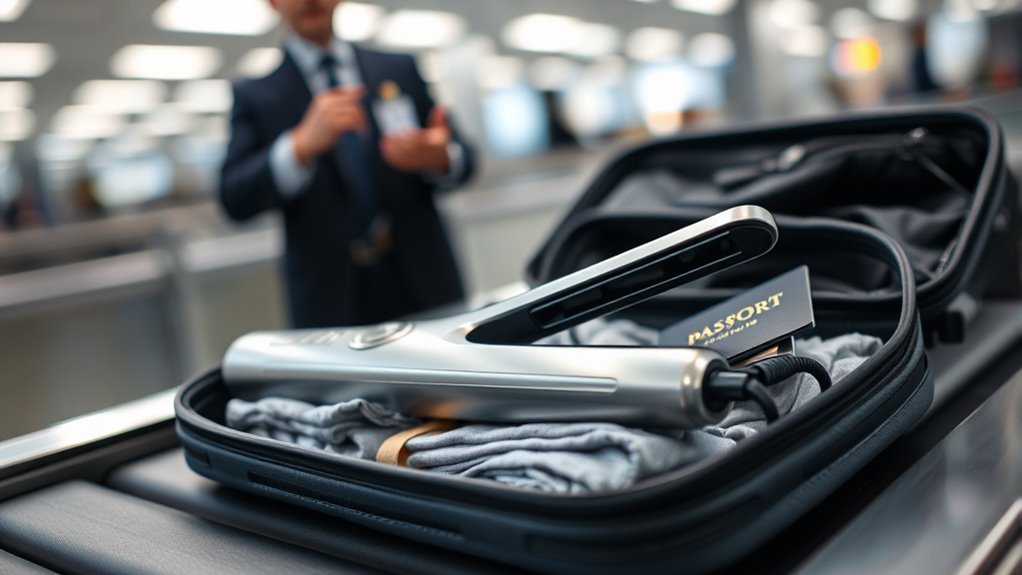
When security flags your hair straightener, stay calm and cooperate—show your boarding pass and ID, and be ready to explain the device and how it powers on.
Answer questions succinctly, demonstrating it’s a personal grooming tool.
If asked, power it off and unplug it; offer to remove it from your bag for inspection.
Follow officer instructions and don’t argue—escalate politely to a supervisor if you believe there’s a misunderstanding.
If they request disposal, ask about options rather than forcing compliance.
Retrieve any receipts or manuals on your phone to verify brand and model if needed.
Keep movements slow and clear.
How To Pack a Hot or Used Straightener
Before you stash a recently used straightener in your bag, let it cool completely and disconnect it from power; hot plates can melt fabric, trigger smoke alarms, or cause burns if packed too soon. Once cold, wipe plates of product residue so they won’t transfer to clothing.
Coil the cord loosely and secure it to avoid snagging. Place the appliance where it won’t be crushed.
- Protect surrounding items by isolating the straightener
- Prevent accidental activation by ensuring switches are off
- Keep it accessible for inspection if asked by security
Pack thoughtfully to avoid damage, hazards, or delays.
Heat-Resistant Covers and Travel Sleeves for Straighteners
You should use a heat-resistant travel sleeve to store a straightener that’s still warm or might turn on accidentally. These sleeves provide protective thermal storage that shields other items and helps prevent burns or melting inside your bag.
Pick a sleeve rated for high temperatures and with a secure closure for safer carry.
Heat-Resistant Travel Sleeves
Although your straightener’s plate may cool quickly, packing it in a heat-resistant travel sleeve gives you an extra layer of protection for both the tool and your luggage. You’ll reduce the risk of accidental burns and keep other items safe if the device is still warm.
Choose a sleeve rated for heat, with internal insulation and a snug fit to prevent movement. Look for materials that resist melting and are easy to clean. Use the sleeve every trip to avoid damage and questions at security.
- Protects luggage from residual heat
- Prevents scratches to plates
- Keeps cords and appliance contained
Protective Thermal Storage
Wondering how to keep your straightener safe and your luggage intact? Use a heat-resistant cover or travel sleeve designed for salons and travelers. Slip your cooled plates into a padded, fire-retardant case to prevent accidental burns and protect clothing from residual heat.
Choose sleeves with insulating layers, zip closures, and water-resistant exteriors to guard against spills and rough handling. Look for compact designs that fit hand luggage dimensions and a loop or strap for easy packing.
Always guarantee the device is switched off and cooled before storing. These simple precautions reduce risk and extend your straightener’s lifespan while you travel.
How To Prevent Accidental Activation in Transit
If your straightener turns on with a single button or a loose switch, secure it before packing so it can’t heat up in transit. Unplug and fully cool the tool, then lock any built‑in power switch or use its safety latch. Wrap the plates and cord separately to avoid pressure on controls.
Secure your straightener before packing: unplug, cool, lock the switch, and wrap plates and cord separately.
Place the device in a hard case or between clothing to prevent movement. Consider a cable tie or removable clip over the switch for added security.
- Use a dedicated hard case to isolate controls.
- Immobilize the plug and cord to prevent accidental contact.
- Test security before you leave for the airport.
Carry-On Checklist: Hair Straighteners and Styling Tools
When packing styling tools, check TSA rules first so you know what’s allowed in carry-on.
Make sure battery-powered devices meet airline and TSA limits and that batteries are protected.
Pack straighteners and accessories so they’re cool, insulated, and won’t switch on during transit.
TSA Rules Overview
While TSA rules generally let you bring hair straighteners and most styling tools in your carry-on, there are a few key restrictions to keep in mind. You should pack items so they’re easily accessible for inspection and verify any heated tools are fully cool.
Prohibited items like flammable styling aerosols or refill canisters aren’t allowed. Be ready to remove devices if requested during screening.
- Pack tools where they won’t trigger packing damage.
- Keep receipts or manuals for unusual devices.
- Separate cords or attachments for quick checks.
Follow agent instructions at the checkpoint to avoid delays and possible confiscation.
Battery-Powered Devices
Curious about battery-powered hair straighteners in your carry-on? You can usually bring cordless straighteners with removable batteries, but airlines and security vary.
Carry batteries in your hand luggage if allowed, keeping spare lithium batteries in original packaging or taped terminals to prevent short circuits.
Non-removable batteries are treated like electronics—expect screening and possible limits.
Check airline and country rules for watt-hour (Wh) limits; many restrict spares above 100 Wh and require airline approval for 100–160 Wh.
Always declare oversized batteries at check-in.
When in doubt, confirm with your carrier before travel to avoid surprises.
Packing And Safety
If you’re packing hair straighteners or styling tools in your carry-on, organize them so security checks go smoothly and you avoid damage or hazards. You’ll need to cool and secure devices, separate batteries if removable, and pack cords neatly to prevent tangles or breakage.
Place tools in a clear pouch for quick inspection and keep any heat-protective case accessible. Follow airline and TSA rules for lithium batteries and declared items.
- Cool and insulated: prevent burns and protect plates
- Batteries removed: store terminals taped and spare batteries in carry-on
- Accessible: ease inspection and reduce delays
Carry-On Size/Weight Rules That Affect Straighteners
Because airlines limit both dimensions and weight for carry-on bags, you’ll need to think about how your straightener fits inside your allowed baggage rather than assume it’ll go in hand luggage without checking, especially on carriers with strict size caps or small overhead bins. Measure your straightener (including case) and weigh your packed carry-on. If you’re close to limits, consider a compact model or stowing it in checked luggage. Gate checks may force you to relinquish oversized items. Always confirm your carrier’s exact carry-on policy before travel to avoid surprises at boarding.
| Item | Consideration |
|---|---|
| Size | Measure length/width |
| Weight | Total carry-on weight |
| Packing | Use slim case |
| Policy | Check airline rules |
| Boarding | Be prepared to gate-check |
Lithium Battery Rules for Cordless Straighteners
Size and weight limits matter, but if your straightener runs on a lithium battery you’ll also need to follow specific airline and safety rules. You must check battery capacity (Wh) — airlines limit removable cells and sometimes ban high-capacity units.
Carry spare batteries in your hand luggage with terminals protected; never place loose cells in checked baggage. Declare devices if requested and follow airline crew instructions.
- Confirm watt-hour rating; under 100Wh is usually allowed.
- Protect terminals and insulate against short circuits.
- Keep batteries with you and avoid checked baggage when possible.
How To Label Rechargeable Batteries for Travel
When you pack rechargeable batteries for a flight, label them clearly with their watt-hour (Wh) rating and capacity so airline staff can quickly verify they meet rules. Include the model number and whether the cell is built into a device or removable. Use a permanent marker or printed adhesive labels on both battery and device.
Add your name and contact info in case of inspection. For spare lithium batteries, mark them “SPARE LITHIUM ION BATTERY” and indicate Wh if over 100Wh. Keep labels legible and on original packaging when possible.
Photograph labels and retain a copy in your carry-on.
Alternatives When a Straightener Is Banned on Route
If your straightener’s banned on a route, consider buying travel-friendly alternatives like compact, low-watt or battery-safe models that meet airline rules.
You can also plan to use salon services at your destination for a professional touch.
For a no-heat option, pack heat-free styling tools and products to keep your look intact.
Buy Travel-Friendly Alternatives
Looking for a plan B when your straightener’s banned? You can buy compact tools that fly with you. Pick lightweight, battery-powered styler models or dual-voltage mini straighteners sized for carry-on limits.
Consider heat-free options that avoid regulations yet smooth hair effectively. Think about durability, charge time, and travel warranties so your choice lasts beyond one trip.
- Battery-powered mini straighteners: convenience without checked-bag hassle.
- Portable hot brushes: faster styling, often allowed in hand luggage.
- Heat-free styling kits: braids, wraps, and foam rollers for safe results.
Choose one that matches your routine and airline rules.
Use Salon Services
Because airlines sometimes bar heated tools, you can rely on salon services at or near the airport to get your hair styled without risking confiscation or checked-bag delays. Check airport directories or maps beforehand so you can book an appointment or find walk-in availability.
Salons have professional flat irons and blowouts, plus experienced staff who’ll work quickly between flights. Bring photos and any products you prefer; salons will often accommodate.
Factor in time for transit and service, and confirm pricing to avoid surprises. Using a salon saves you from packing restrictions and delivers a polished look when you land.
Pack Heat-Free Styling
When a salon isn’t available or heated tools are restricted on your route, pack heat-free styling options so you can still get the look you want. You’ll save space, avoid airline issues, and still leave feeling polished.
Choose lightweight tools and products that work while you travel, and practice quick, no-heat techniques that suit your hair type.
- Satin scarf or wrap for heatless waves and reduced frizz
- Flexi rods or foam rollers that set overnight without power
- Styling cream, texturizing spray, and travel-size dry shampoo for hold and refresh
Practice these methods before travel for reliable results.
Packing Professional Salon Straighteners for Flights
If you’re taking professional salon straighteners on a flight, pack them so they’re protected, easily accessible, and compliant with airline rules. Disconnect cords, let tools cool, and place each straightener in a padded heat-resistant sleeve or wrap in soft clothing to prevent scratches.
Use a clear, zippered pouch for small accessories like clips and spare plates so security can inspect quickly.
Keep straighteners in your carry-on to avoid baggage damage and to conform with most airlines. Check airline and TSA guidelines for battery or cordless models, and notify staff if you carry loose batteries to ensure a smooth screening process.
Transporting Ceramic vs Titanium Straightener Plates
After packing professional tools securely, you’ll want to take into account the plate material—ceramic and titanium behave differently during transport.
You’ll notice ceramic plates are heavier, more fragile to drops, and retain heat longer. Titanium is lighter, more impact-resistant, and heats faster.
Protect either type with a padded case and let them fully cool before stowing.
Consider which suits your travel needs: durability versus gentle heat distribution.
- Ceramic: even heat, prone to chipping if dropped
- Titanium: robust, quick heat-up, can be harsher on hair
- Protection: padded sleeve, secure placement, fully cooled
Handling Customs or Security Questions on Arrival
Wondering how to answer questions about your hair straighteners at security or customs? Be concise and honest: state they’re personal grooming devices, battery-operated or mains-powered, and whether they contain lithium batteries.
Keep original packaging or a photo handy to show model and specs. Declare batteries if required by local rules and carry any spare cells in carry-on with terminals taped.
If an officer asks to inspect them, cooperate and allow screening. Don’t argue—ask politely for clarification or a supervisor if you think rules were misapplied.
Knowing and presenting basic device details speeds resolution and avoids confiscation.
Quick Fixes for Common Checkpoint Problems
When security flags your hair straightener, stay calm and produce it quickly so screening can proceed without delay. You’ll want to explain briefly that it’s a personal grooming tool, show any removable plates or batteries, and follow the officer’s instructions. If asked to remove it from a bag, do so promptly.
- Keep chargers and batteries accessible to show separately.
- Pack straighteners in a clear pouch for easy inspection.
- Label unusual adapters or tools to avoid confusion.
Being cooperative, concise, and organized reduces delays and increases the chance you’ll pass through without further questions.
Practical Packing Examples: Domestic and International Flights
Having handled a flagged straightener smoothly, you’ll want packing examples that reflect real airline rules and everyday convenience for both domestic and international trips.
For a short domestic flight, place your straightener in a padded sleeve inside your carry-on, unplugged and cooled, with cords tucked and protective cap on plates. Keep it near toiletries for easy inspection.
For longer or international travel, use a hard-case within your carry-on, include a universal plug adapter separately, and store any travel-size heat-protectant under 100ml in a clear bag.
Always check airline and country-specific rules before packing to avoid surprises.
Frequently Asked Questions
Can I Use a Straightener on the Plane During Flight?
No, you can’t use a straightener during flight; airlines prohibit heating devices in cabins for safety. You can pack it in carry-on or checked baggage per airline rules, but you’ll need to style before boarding or after landing.
Do Hotel Rooms Allow Using Straighteners in Smoke-Free Buildings?
Yes, you can usually use straighteners in smoke-free hotel rooms, but you’ll need to follow hotel policies, avoid fire hazards, use heat-protective mats, and expect staff to intervene if smoke alarms trigger or rules explicitly forbid heated styling tools.
Are Travel Insurance Policies Covering Lost or Damaged Straighteners?
Generally, yes, travel insurance can cover lost or damaged straighteners if you add gadget or valuables cover and keep receipts; check policy limits, exclusions for unattended items, and claim excesses, and file timely police or carrier reports when needed.
Can I Check a Straightener With Fuel-Powered or Butane Attachments?
No, you shouldn’t check a straightener with fuel-powered or butane attachments; airlines typically ban or restrict devices containing pressurized fuel, so you’ll need to remove fuel, carry accessories in hand luggage if permitted, or ship separately.
Do Retail Duty-Free Outlets Sell Compliant Travel Straighteners?
Yes, many duty-free shops sell travel-friendly straighteners that meet safety rules; you’ll want to check voltage compatibility and shop labeling, and confirm airport or airline restrictions before buying to avoid surprises at security or boarding.
Conclusion
You can bring a hair straightener in your carry-on—most authorities allow them—but check airline rules and battery limits first. Corded and non-lithium cordless models are usually fine; cordless ones with lithium batteries may need paperwork or go in checked baggage. Expect security to inspect it; pack it accessibly and clean to avoid delays. If an issue arises, move it to checked baggage or ship it. When in doubt, confirm with your airline before you travel.
