
Are TSA Scanners Safe During Pregnancy?
Yes — you can safely go through modern TSA millimeter‑wave scanners while pregnant. They use non‑ionizing waves that deliver negligible energy, far below levels of concern and much lower than an X‑ray or daily background radiation. Medical groups and federal agencies consider the risk minimal, and you can ask for a private pat‑down if you prefer. Tell officers you’re pregnant and request accommodations; keep going and you’ll find practical tips and rights to help ease the process.
Quick Overview: Are TSA Scanners Safe If You’re Pregnant?
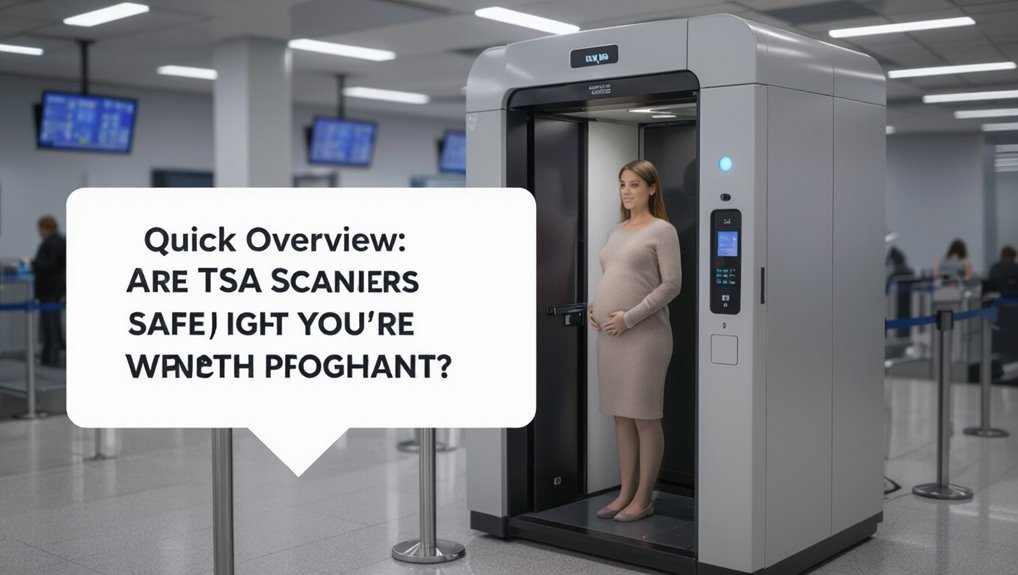
Wondering if TSA scanners are safe during pregnancy? You’ll be reassured that modern millimeter-wave scanners don’t emit ionizing radiation, so they’re not known to harm fetal development.
Most pregnant travelers can choose the scanner or a private pat-down; you can request screening preferences. If you’re concerned, talk briefly with TSA officers or your healthcare provider for personal guidance before flying.
Fast Answer: What Experts Recommend
Experts generally say the low radiation from TSA scanners is well below limits considered harmful in pregnancy, but you should check with your healthcare provider for personal advice.
If you’re concerned, opting for a manual pat-down avoids any exposure while still letting you travel.
Below we’ll summarize what medical authorities recommend, the exposure limits, and simple travel tips you can use.
Medical Expert Guidance
Although most medical organizations say the risk from TSA full-body backscatter and millimeter-wave scanners is negligible for pregnant travelers, they recommend choosing alternatives if you prefer to avoid even minimal exposure.
You can request a hand inspection or a private screening without penalty. Your obstetrician can advise based on your pregnancy history, comfort level, and any implanted medical devices, and will support reasonable precautions you choose.
Radiation Exposure Limits
If you want a quick, practical answer: radiation from TSA millimeter-wave scanners is far below regulatory limits and poses no known risk to a pregnancy, but some organizations still recommend minimizing any unnecessary exposure.
Regulators set conservative public limits; devices emit orders of magnitude less. You can rely on these standards, consult your doctor for concerns, and follow expert guidance if you prefer extra caution.
Practical Travel Tips
When you’re traveling while pregnant, follow a few simple, expert-backed steps to keep screening quick and comfortable: Bring your prenatal ID, request a private screening if you prefer, wear loose clothing, and arrive early to reduce stress.
| Tip | Action |
|---|---|
| ID | Carry prenatal documentation |
| Clothing | Choose loose, easy layers |
| Screening | Ask for private or pat-down |
| Timing | Arrive early to avoid rush |
How Airport Body Scanners Work
Because they use one of two technologies—millimeter-wave waves or backscatter X-rays—airport body scanners create a detailed image of your clothing and body surface to spot concealed items.
You step into the portal, remain still, and the machine scans quickly. Images are reviewed by an officer or automated algorithm, and alerts prompt secondary screening.
- You get a quick visual check
- Scans target surface anomalies
- Images aren’t stored by default
- Officers follow privacy procedures
Millimeter‑Wave vs. Backscatter Scanners
You’ll want to know that millimeter‑wave scanners use non‑ionizing radiofrequency energy while backscatter scanners used low‑dose X‑rays, which are ionizing.
That difference affects estimated fetal exposure levels, with millimeter‑wave exposures being effectively negligible and backscatter X‑ray exposures historically higher though still low.
Compare current safety guidelines and TSA policies to see which technology and recommendations apply to your situation.
Radiation Type Differences
Although both types of TSA scanners are meant to detect concealed items, they use very different parts of the electromagnetic spectrum: millimeter-wave systems emit low-energy non-ionizing radiofrequency waves, while backscatter scanners used low-energy X-rays that are a form of ionizing radiation.
You should note practical differences:
- Energy type: non-ionizing vs ionizing
- Penetration depth varies
- Biological interaction differs
- Regulatory standards differ
Fetal Exposure Levels
Having contrasted the radiation types and how they interact with tissue, let’s look specifically at how much energy a developing fetus could receive from each scanner.
You’d get negligible fetal dose from millimeter‑wave scanners; they use nonionizing radiofrequency that’s absorbed superficially.
Backscatter devices, largely phased out, delivered higher surface dose but still minuscule fetal exposure.
Both are far below established harmful thresholds.
Safety Guidelines Comparison
When you compare safety guidelines for millimeter‑wave and backscatter scanners, the distinctions are clear: you’ll see stricter limits and different exposure metrics for backscatter systems.
Choose accordingly and ask for alternatives if concerned.
- Millimeter‑wave: non‑ionizing, power limits, widely approved
- Backscatter: ionizing X‑ray, tighter regulatory scrutiny
- Pregnancy: request pat‑down if unsure
- Regulations: vary by country
What Type of Radiation Each Scanner Uses
Before you step into a security lane, it helps to know that the two main screening technologies—backscatter X-ray and millimeter-wave scanners—use very different types of radiation: backscatter scanners emit low-energy X-rays (ionizing), while millimeter-wave systems use non-ionizing radiofrequency waves.
You’ll encounter ionizing radiation capable of depositing energy in tissue versus non-ionizing waves that interact mainly at the skin’s surface.
How Much Radiation a Single Scan Emits
When you consider a single TSA scan, it’s helpful to compare the tiny radiation dose it delivers to everyday sources like a cross-country flight or background radiation.
You’ll also want to look at published fetal exposure estimates, which show the dose to an embryo or fetus from one scan is extremely low.
Together, those comparisons help you judge how much (or how little) risk a single screening poses during pregnancy.
Radiation Dose Comparison
A single TSA backscatter or millimeter-wave scan exposes you to an extremely small amount of ionizing energy—measured in micro- or nanograys—far below levels known to cause harm.
You’ll compare that to everyday sources so risks stay in perspective.
- Typical scan: ~0.1–0.2 µGy or less
- Chest X-ray: ~100 µGy
- Daily background: ~8 µGy/day
- Flight (8 hrs): ~40 µGy
Fetal Exposure Estimates
Although the scanner’s beam passes over your abdomen if you’re pregnant, the estimated dose to a fetus from a single TSA backscatter or millimeter‑wave scan is vanishingly small—typically orders of magnitude below levels linked to fetal harm, measured in fractions of a microgray or less.
You’d receive far less radiation than from a chest X‑ray or daily background sources, posing negligible risk per scan.
Scanner Exposure vs. Everyday Sources
Because the dose from TSA scanners is vanishingly small compared with everyday sources, you’re far more likely to get more radiation from a cross-country flight or a chest X-ray than from a single security scan.
You’ll usually encounter higher doses from routine medical imaging and cosmic rays during travel.
Consider everyday comparisons:
- Cross-country flight
- Chest X-ray
- Natural background radiation
- Dental X-rays
What Major Health Organizations Say (WHO, ACOG)
You’ll want to know what major health bodies say before deciding how to screen while pregnant.
The WHO summarizes low risk from millimeter-wave scanners but emphasizes precautionary policies, while ACOG’s statement similarly notes no known harm and recommends minimizing unnecessary exposure when feasible.
Together, these positions reflect expert consensus that routine scanner use isn’t considered dangerous in pregnancy, though individual choices and airport options can vary.
WHO Recommendations Summary
Major health organizations including the World Health Organization (WHO) and the American College of Obstetricians and Gynecologists (ACOG) say that airport security scanners pose minimal risk to pregnant travelers, and they recommend standard screening procedures while offering alternative options on request.
- WHO emphasizes low exposure and no proven harm
- Follow routine screening unless you prefer alternatives
- Request a pat-down if uncomfortable
- Discuss concerns with your provider before travel
ACOG Position Statement
Alongside WHO guidance, the American College of Obstetricians and Gynecologists (ACOG) has a clear stance on airport security screening for pregnant people: routine screening with scanners or pat-downs is considered safe and acceptable.
You can follow standard TSA procedures without special restriction; if you’re concerned, request a private screening or alternative screening methods, and inform security officers about your pregnancy for accommodation.
Expert Consensus Rationale
Because leading health bodies base their guidance on available evidence and established safety thresholds, you can trust that routine TSA scanners and standard pat-downs pose no known risk to pregnant people.
You’ll find consensus from WHO and ACOG stressing low exposure, no proven harm, and informed choice.
Consider:
- Evidence-based screening recommendations
- Clear exposure limits
- Emphasis on non-ionizing tech
- Alternative options on request
TSA Official Guidance for Pregnant Travelers
While TSA doesn’t explicitly ban pregnant travelers from any screening, it does provide clear, practical guidance to help you choose the safest option.
You can request a private screening or opt for a pat-down instead of the advanced imaging technology.
TSA advises notifying officers about pregnancy so they can offer alternatives, respect your preference, and minimize close contact when possible for your comfort and peace of mind.
FDA and CDC Positions on Airport Scanners
If you’re wondering what federal health agencies say, both the FDA and CDC have reviewed the science on airport scanners and consider them safe for pregnant travelers.
You can rely on their summaries and guidance when deciding whether to opt for screening.
- FDA: low radiation, safety standards
- CDC: no pregnancy-specific warnings
- Agencies review device testing
- Consult your provider for concerns
Key Studies on Fetal Risk From Airport Scanners
Now that federal agencies have said scanners pose minimal risk, let’s look at the actual studies that examined fetal exposure.
Researchers measured scatter radiation from millimeter-wave and backscatter systems, modeling fetal doses and comparing them to natural background and medical exposures.
You’ll find consistently negligible fetal doses, limited sample sizes, and calls for more targeted research, but no evidence of measurable harm from routine screening.
Radiation Dose, Scan Duration, and Safety Margins Explained
Because scanner emissions are extremely brief and tightly controlled, the actual radiation dose to you or a fetus from a typical airport scan is vanishingly small.
Because scanner emissions are extremely brief and tightly controlled, the actual radiation dose is vanishingly small.
You’re exposed for seconds; regulatory limits include wide safety margins. Machines are tested, calibrated, and monitored to keep doses far below harmful levels.
- Ultra‑low dose per scan
- Seconds‑long exposure
- Regulatory safety buffers
- Routine device calibration
Why Non‑Ionizing vs. Ionizing Radiation Matters for Pregnancy
When you’re pregnant, the distinction between non‑ionizing and ionizing radiation matters because they interact with tissue very differently: non‑ionizing forms (like millimeter‑wave energy used in most TSA scanners) don’t break chemical bonds, while ionizing radiation (like X‑rays) can damage DNA and increase risk to a developing fetus.
That means millimeter‑wave screening poses negligible genetic risk, unlike ionizing exposures that require strict limits.
Common Myths About Scanners and Birth Defects
You might worry that a quick TSA scan could cause birth defects, but most fears come from misunderstanding radiation types and exposure levels.
Remember that airport scanners are screening tools, not diagnostic imaging, and they use non‑ionizing energy that doesn’t damage DNA like X‑rays can.
We’ll separate myth from fact so you can make an informed choice about traveling while pregnant.
Misconceptions About Radiation
Worried that airport body scanners could cause birth defects? You shouldn’t be.
Radiation from TSA scanners is extremely low and non-ionizing; it won’t damage DNA like X-rays can. Know the facts so you’re calm and informed:
- Scanners use millimeter waves, not X-rays
- Exposure is brief, tiny
- No evidence links them to birth defects
- Medical imaging differs considerably
Screening Versus Diagnostic Tests
How do airport scanners differ from medical tests that check fetal health?
You should know scanners are screening tools, not diagnostic exams. They screen for threats to security, not fetal anomalies.
Diagnostic prenatal tests—ultrasound, amniocentesis—use targeted imaging or sampling to identify conditions.
Courthouse and Building Scanners: Are They Different?
Curious whether courthouse and building scanners differ from the airport machines you’ve seen? You’ll find similar technologies—millimeter-wave and x‑ray—used, but settings and operator protocols vary.
You can usually request alternative screening if concerned; policies differ by facility.
Common distinctions include:
- Different machine models
- Varied operator training
- Stricter access controls
- Facility-specific privacy measures
Metal Detectors vs. Body Scanners During Pregnancy
When you go through airport screening while pregnant, you’ll want to know how traditional metal detectors compare to millimeter-wave body scanners.
Current evidence shows metal detectors use only low-frequency magnetic fields with minimal risk, while millimeter-wave scanners use non-ionizing radio waves and have also shown no clear harm in pregnancy.
You’ll learn the relative risks and practical tips for choosing the screening method that makes you most comfortable.
Metal Detector Safety Evidence
Although both metal detectors and advanced imaging scanners are common at airports, they use very different technologies, and the evidence about their safety in pregnancy reflects that distinction.
You’ll find robust studies showing metal detectors emit negligible electromagnetic fields, posing minimal risk. If you’re concerned, request a wand screening or pat-down.
Consider:
- Large study data supports safety
- No ionizing radiation exposure
- Short exposure duration
- Clinical guidance favors allowance
Millimeter Wave Scanner Risks
If metal detectors reassure you because they emit negligible fields, it helps to compare that evidence with how millimeter wave body scanners work and what risks, if any, they pose during pregnancy.
Millimeter waves use very low‑energy radiofrequency pulses that don’t penetrate deeply.
Regulatory reviews find no known fetal harm from typical exposures, though you can request alternative screening if you prefer.
Choosing Screening Methods
Because you’re choosing between metal detectors and millimeter‑wave scanners, it helps to weigh how each technology works, what they actually expose you and your baby to, and what screening options are available at checkpoints.
You can request alternative screening; communicate pregnancy status; opt for pat‑down instead; and ask for private screening when needed.
- Request alternative screening
- Communicate pregnancy status
- Opt for pat‑down
- Ask for private screening
What to Expect From a TSA Pat‑Down
When you opt for or are directed to a TSA pat‑down during pregnancy, an officer will explain what they’ll do and ask for your consent before proceeding.
You’ll remain fully clothed; the officer will use a gentle, gloved touch over outer garments and may use a hand-held screening device.
You can request a same‑gender officer, and you’ll be told each step as they check for concealed items.
How to Request Alternative TSA Screening
If you prefer not to go through the scanner, tell the TSA officer you’d like a private screening instead.
Briefly explain that you’re pregnant and can show medical documentation if needed.
The officer will then guide you through the alternative screening process.
Requesting A Private Screening
Need a private screening at airport security? You can request one politely from a TSA officer before screening; they’ll arrange a private room and a same-gender officer if you prefer.
Bring ID and allow extra time. Expect a handheld wand or pat-down in private.
- Ask calmly at the checkpoint
- Mention privacy needs briefly
- Keep documentation handy
- Allow extra time for screening
Explaining Pregnancy To Officers
After asking for a private screening, tell the officer you’re pregnant and would like an alternative screening method; brief, clear wording helps move things along.
State any mobility limits, previous surgeries, or implants that affect screening.
Ask what the alternative will involve and where it’ll occur.
Stay calm, answer questions directly, and request a supervisor if you feel uncomfortable or need clarification.
Using Medical Documentation
When you prefer or require an alternative screening, bring concise medical documentation that clearly states your pregnancy-related restrictions or devices and what accommodations you’re asking for; this helps TSA officers process your request faster and with fewer questions.
- Note from provider stating restriction and reason
- Indicate needed alternative screening (pat-down, visual)
- Include contact info for verification
- Keep document brief and on you
How to Tell TSA You’re Pregnant (What to Say)
Curious how to tell TSA you’re pregnant without making things awkward? Say, “I’m pregnant and prefer a pat‑down instead of the scanner,” clearly and politely. Have documentation ready if you want. Ask for a private screening if needed.
| Phrase to Use | Purpose |
|---|---|
| “I’m pregnant” | States condition |
| “Pat‑down please” | Requests alternative screening |
Screening for High‑Risk or Complicated Pregnancies
If you have a high‑risk or complicated pregnancy, tell the TSA officer right away so they can offer an appropriate screening option.
You can request alternative screening, explain recent procedures, and insist on a private screening if needed. Keep documentation handy and ask for a supervisor if concerns arise.
- Ask for a pat‑down instead of the scanner
- Show medical records if helpful
- Request private screening
- Ask for a supervisor
Travel Timing by Trimester: Practical Advice
In your first trimester, you’ll want brief trips and easy access to medical care in case of morning sickness or early complications.
In the second trimester, when many people feel best, you can plan longer travel but should still check seating, restroom access, and TSA procedures.
In the third trimester, avoid long flights, confirm TSA and airline policies for late‑pregnancy screening, and carry your prenatal record and provider contact.
First Trimester Tips
While many women feel cautious about traveling during the first trimester, you can still take short trips with careful planning and sensible precautions.
Keep flights brief, stay hydrated, and avoid heavy lifting. Check airport screening options and carry medical info.
- Choose aisle seats for comfort
- Pack nausea remedies
- Limit travel to essential trips
- Notify TSA or your airline if needed
Second Trimester Considerations
Because your energy often returns and your bump is still manageable, the second trimester is usually the best time to travel—you’ll feel steadier, nausea has often eased, and risks are lower than later in pregnancy.
Still, check with your provider, pack prenatal records, choose aisle seats for comfort, stay hydrated, move regularly to reduce clot risk, and review TSA policies for pregnancy accommodations.
Third Trimester Precautions
As you move into the third trimester, travel needs shift and you’ll want to be more cautious about timing and logistics.
Limit long trips, check airline policies, and plan medical access. Travel later than 36 weeks is often discouraged; get a provider’s OK.
- Confirm airline and TSA rules
- Choose direct flights
- Schedule extra rest stops
- Pack medical records
When to Ask for Private Screening or a Female Officer
Wondering when to request a private screening or a female officer?
If you feel uncomfortable, have cultural or religious reasons, recent abdominal surgery, or need more time because of pregnancy-related mobility or pain, ask.
Requesting privacy or a same-gender officer is your right.
You have the right to request privacy or a same-gender officer during screening.
Inform the TSA officer politely and early; they’ll accommodate you and explain alternatives like a pat-down or private area screening.
Screening With Fetal Monitors, Insulin Pumps, or Prosthetics
If you need a private screening or a female officer, mention any medical devices at the same time so officers can plan the safest check.
Tell screeners about fetal monitors, insulin pumps, or prosthetics before imaging. They’ll offer hand inspection or alternative screening to avoid device disruption.
Expect brief pat-downs and protective covers if needed.
- Fetal monitors
- Insulin pumps
- External prosthetics
- Request alternatives
TSA PreCheck and Pregnancy: Any Differences?
If you use TSA PreCheck while pregnant, you’ll usually go through the expedited lanes but still have the same screening options available.
You can keep your shoes and light jacket on and may be able to skip the standard metal detector, yet you should still tell officers about any medical devices or fetal monitors.
Ask for alternative screening if you prefer a pat-down or if a scanner setting concerns you.
TSA PreCheck Protocols
While TSA PreCheck doesn’t change the security technology you pass through, it can make screening quicker and less intrusive when you’re pregnant.
You’ll usually keep shoes and light coat on, and laptops stay in bags, reducing contacts near your abdomen.
Use PreCheck to speed lines, but still request a private screening if you prefer.
- Faster queue processing
- Fewer physical contacts
- Keep personal items on
- Option for private screening
Pregnancy Screening Options
Having TSA PreCheck can change how you experience screening when pregnant, so it’s worth looking at whether the actual screening options differ for expectant travelers. You’ll usually bypass full-body scanners and long lines, but screening choices (pat-down or walk-through metal detector) remain available. Choose what feels safest and tell officers about your pregnancy.
| Option | Note |
|---|---|
| PreCheck lane | Less invasive |
| Standard lane | May use scanner |
| Pat-down | Alternative on request |
International Scanner Policies and Travel Advice
Because airport security standards vary by country, you should check local scanner policies and available alternatives before you travel.
Contact airlines and airport websites, request medical exemptions if needed, and plan extra time for screenings. If you’re unsure, ask a security supervisor on arrival for options and documentation.
- Check official airport/security websites
- Call your airline
- Carry medical records
- Request supervisor assistance
Clothing and Items to Ease Screening
If you want screening to go smoothly, wear simple, comfortable clothing and carry a few small items that speed checks—think slip-on shoes, a loose top without metal fasteners, and a lightweight cardigan you can remove quickly.
Pack minimal jewelry, empty pockets, and a small bag for electronics and liquids. That reduces pat-down need and keeps you comfortable while agents complete visual or scanner inspections.
Documents That Can Speed Up Screening
Want to move through TSA screening faster? Carry clear, accessible documents that confirm your needs and speed checks.
Have these ready before you reach the checkpoint:
- Government ID (driver’s license or passport)
- Boarding pass (digital or printed)
- Doctor’s note if you need alternative screening
- TSA notification card (if applicable)
Present items promptly to the officer to minimize delays.
Real Traveler Stories: Screening While Pregnant
While screening processes vary, many pregnant travelers report quick, respectful checks when they arrive prepared and communicate their needs clearly; you’ll often find officers willing to adjust screening for comfort and safety.
You might experience a pat‑down instead of a scanner, discreet conversations about medical devices, or staff offering seating.
Sharing your due date and concerns usually speeds understanding and reduces stress.
Pre‑Flight Risk Assessment Checklist
Before you head to the airport, run through a short risk assessment checklist so you can identify pregnancy‑related concerns, plan accommodations, and avoid surprises.
Check your trimester and any restrictions, pack medical records and contact info, plan seating and restroom breaks, and know TSA procedures.
- Confirm travel readiness and symptoms
- Carry prenatal ID and notes
- Arrange seating and assistance
- Time bathroom and medication stops
What to Ask Your OB/GYN About Airport Screening
How should you bring up airport screening with your OB/GYN so you get clear, personalized guidance?
Ask about any pregnancy‑specific risks from millimeter‑wave scanners, your trimester‑related sensitivity, and whether your medical history or devices (e.g., implants) change recommendations.
Ask whether millimeter‑wave scanners pose pregnancy‑specific risks, if trimester affects sensitivity, and whether implants or medical history alter guidance
Request written advice for TSA interactions, alternatives like private screening, and when to carry documentation.
Clarify follow‑up steps if you have concerns after screening.
When to Postpone Travel Because of Screening Concerns
If you’re worried that airport screening could pose a risk to you or your pregnancy, consider postponing travel until you’ve spoken with your OB/GYN and confirmed a safe plan; this is especially important if you’re in your first trimester, have pregnancy complications, or carry a medical device that might trigger additional screening.
- Severe morning sickness or dehydration
- Recent bleeding or cramping
- High‑risk pregnancy or placenta issues
- Implantable cardiac/neurological devices
Your Legal Rights at Security Checkpoints
While you’ll generally have to follow Transportation Security Administration (TSA) procedures, you also have rights—including the right to a private screening, to request a female officer for a pat‑down, and to have a travel companion or medical professional present during additional screening.
Assert those rights calmly, show ID, explain pregnancy concerns, and ask for written policies or a supervisor if you believe your treatment’s inappropriate.
Packing Tips to Avoid Extra Screening
Because extra screening often comes from flagged items, pack deliberately to minimize surprises at the checkpoint.
Because extra screening often comes from flagged items, pack deliberately to minimize surprises at the checkpoint.
You’ll streamline checks by organizing and declaring items, separating electronics, and avoiding prohibited or confusing objects. Keep essentials accessible and label medications.
- Place liquids and gels in a clear bag
- Pack medications in original containers
- Separate electronics larger than a phone
- Avoid unusual metal or dense items
Reducing Stress at TSA Checkpoints While Pregnant
When you’re pregnant, managing TSA checkpoints can feel overwhelming, so plan ahead to reduce delays and lower stress: arrive early, wear comfortable clothing and shoes that are easy to remove, keep your boarding pass and ID accessible, and let officers know you’re expecting if you need accommodations or alternative screening. Use calm breathing, request a private screening if needed, and stay hydrated.
| Tip | Action | Benefit |
|---|---|---|
| Timing | Arrive early | Less rush |
| Clothing | Wear slip-on shoes | Faster screening |
| Docs | Keep ID ready | Smooth process |
| Communication | Inform officers | Accommodations |
| Comfort | Bring water | Reduce fatigue |
Bottom‑Line Recommendations for Pregnant Travelers
Here are the key takeaways you should follow:
- Tell TSA you’re pregnant and request a private screening if uncomfortable.
- Opt for TSA PreCheck or pat-down to avoid full-body scanners when preferred.
- Carry documentation from your provider if it helps ease screening.
- Stay hydrated, allow extra time, and ask for seating or assistance when needed.
Frequently Asked Questions
Do TSA Scanners Affect Fertility or Future Pregnancies?
No, TSA scanners don’t affect your fertility or future pregnancies; they use low-dose millimeter-wave or X-ray backscatter with minimal exposure, and health authorities consider them safe—though you can request a pat-down if concerned.
Can Partners or Escorts Be Scanned With You During Screening?
Yes — you can have partners or escorts scanned with you during TSA screening; they’ll go through the same checkpoint procedures separately, and you can request assistance or explain your needs to officers to stay together as much as possible.
Are There Long-Term Cancer Risks From Repeated Scans for Flight Crew?
You’re unlikely to face long-term cancer risks from repeated TSA scanner exposure; studies show doses are extremely low, regulatory limits protect workers, and cumulative occupational exposure is monitored—still, flight crews follow safety protocols to minimize any risk.
Do Wearable Pregnancy Tests or Apps Affect Screening Procedures?
Yes — wearable pregnancy tests or apps won’t affect screening procedures. You’ll still go through the same scanners; declare medical devices if asked. They don’t trigger extra security, but show documentation if a pat-down is needed for clarification.
Can Fertility Treatments (Ivf Embryos) Be Impacted by Scanner Exposure?
No, routine TSA scanners and airport security checkpoints won’t harm IVF embryos; you won’t expose embryos to ionizing radiation there. Still, tell security about any implants or fragile samples and follow airline or clinic transport guidance.
Conclusion
If you’re pregnant, you can feel reassured: the millimeter‑wave scanners now used at most U.S. airports don’t emit ionizing radiation and are considered safe by health experts. You can always request a private pat‑down if you prefer zero exposure. Know your rights, pack sensibly to avoid extra screening, and talk with your healthcare provider if you’re especially concerned. Travel smart, stay calm at checkpoints, and choose the option that makes you most comfortable.
