Does Light Travel Faster Than Sound Explained Simply
Yes — light travels way faster than sound, so you’ll see flashes long before you hear booms. In air, light zips at about 300,000 km/s while sound crawls near 343 m/s, a ratio around 874,000 to 1, so visual events reach you almost instantly compared with audible ones. Material and weather can change those speeds a bit, but light still wins by miles; keep going and you’ll learn why and how to test it yourself.
What This Article Will Explain
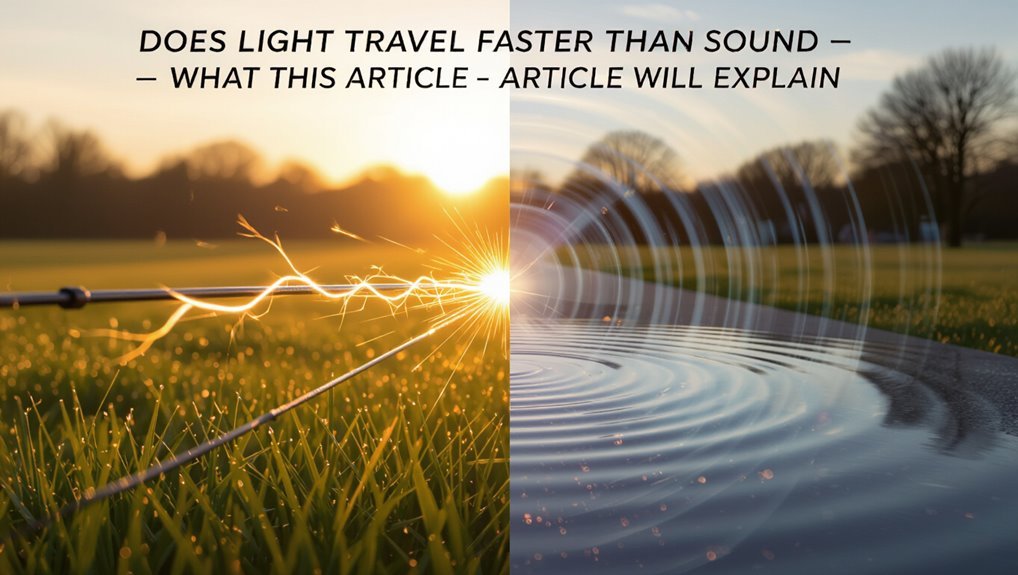
What’ll this article explain and why it matters?
You’ll learn whether light travels faster than sound, how speeds differ in air and other media, and why those differences produce familiar effects.
You’ll get clear, quantitative comparisons, simple mechanisms behind propagation, and practical implications for observations and technology.
Why This Simple Question Matters: Everyday Examples
Why do you instinctively look for lightning before you hear thunder? You rely on faster light to locate hazards, judge distance, and react—crossing streets, driving in storms, or photographing sunsets.
Understanding speeds helps you time actions, interpret warnings, and communicate clearly about events. That simple insight shapes safety, sports timing, and everyday decisions where milliseconds matter.
Quick Answer: Does Light Travel Faster Than Sound?
Yes — light travels far faster than sound, and you’ll notice it in everyday moments like seeing lightning before hearing thunder.
You’ll learn the basic speed difference (light at about 300,000 km/s vs. sound around 343 m/s in air) and why that makes visual events precede auditory ones.
These examples help you predict delays and understand why timing matters in both daily life and science.
Light Versus Sound Speed
Nearly always, light travels far faster than sound, so you’ll see lightning moments before you hear thunder; in air at sea level, visible light moves about 300,000 kilometers per second while sound averages roughly 343 meters per second.
You can compare travel times: light reaches you almost instantly over everyday distances, whereas sound takes noticeably longer, making timing differences obvious even across short ranges.
Everyday Examples Explained
You’ve already seen the basic speed difference between light and sound; now let’s look at everyday situations where that gap matters.
You notice lightning before thunder, so you can estimate storm distance. You see a far-off fireworks flash long before the boom.
On stage, visuals lead audio; speakers delay sound to sync with screens.
These examples show light’s practical speed advantage.
Defining “Faster” for Waves
When you ask which wave is “faster,” you need to define what speed means for waves — phase velocity, group velocity, or signal velocity.
Each measure describes a different aspect of how disturbances or information move through a medium, so comparing light and sound depends on which one you pick.
We’ll use these propagation measures to make a clear, apples-to-apples comparison.
Speed Definition For Waves
Speed for waves means how fast a disturbance or piece of information moves through a medium, and we call that the wave’s velocity.
You measure it by tracking a repeating feature (crest, pulse) over time. For mechanical waves it’s set by the medium’s properties; for light in materials, it’s determined by interactions with atoms.
Velocity tells you how quickly effects propagate.
Comparing Propagation Measures
How do we decide which wave is “faster”? You compare propagation measures: phase velocity, group velocity, and signal velocity.
Phase velocity tracks individual wave peaks, group velocity follows energy packets, and signal velocity marks information transfer.
For practical “faster” you use signal velocity—nothing carrying information exceeds it.
Context matters, so specify which measure you mean before claiming one wave outruns another.
Actual Speeds: Light Versus Sound in Air
Although you usually notice sound lag during storms or fireworks, light and sound travel at vastly different rates in air: you see almost instantly while sound takes seconds to minutes depending on distance. Typical speeds:
| Phenomenon | Speed |
|---|---|
| Light (air) | ~299,700 km/s |
| Sound (air) | ~343 m/s |
| Ratio | ~874,000:1 |
Why Lightning and Thunder Illustrate Speed Differences
You’ll see lightning before you hear thunder because light reaches you almost instantly while sound moves much slower through air.
That delay between flash and rumble lets you estimate how far away the storm is. Count the seconds from flash to thunder and divide by about five to get the distance in miles (or divide by three for kilometers).
Lightning Seen First
When a storm rolls in, you’ll usually see the flash of lightning before you hear thunder because light races to your eyes at about 300,000 kilometers per second while sound crawls through air at roughly 340 meters per second.
Sound Travels Slower
Because sound moves as a mechanical wave through air, it travels far more slowly than light. So when lightning strikes, you almost always see the flash before you hear the thunder.
You can feel this: light needs no medium and races instantly to your eyes, while sound relies on air molecules colliding, which slows propagation. This makes thunder arrive noticeably later despite originating simultaneously.
Distance Calculated By Delay
How far away was that lightning strike? You count seconds between flash and thunder, then divide by about five to estimate miles (or by three for kilometers).
Light arrived instantly compared to sound, so delay equals travel time. Each second roughly equals one-fifth mile; ten seconds, two miles.
This simple method uses the speed difference to turn delay into distance.
What Determines Light’s Speed in Different Materials
Although light always travels at c in a vacuum, its speed drops in materials because the electromagnetic waves interact with the atoms and molecules they pass through.
You’ll see this effect quantified by the material’s refractive index, which captures how much the medium delays the wavefront relative to vacuum.
You can predict speed by n: v = c/n, and n depends on atomic polarizability, density, and wavelength.
What Determines Sound’s Speed in Different Materials
When you push on a medium, the speed of sound there depends on how quickly neighboring particles transmit that push and how much they resist being squeezed or sheared; quantitatively, sound speed comes from the medium’s elastic properties divided by its inertia (mass density).
You’ll find stiffer materials and lower density speed sound up, while softness, viscosity, and complex microstructure slow it down.
Why Light Moves Fast: A Plain‑Language Explanation
Because light doesn’t need to shove neighboring particles to move, it travels incredibly fast: photons are massless packets of electromagnetic energy that zip through space at about 300,000 km/s.
They do so by continually regenerating their electric and magnetic fields rather than relying on matter to carry them.
You observe light instantly across distances because its propagation isn’t tied to particle collisions, so it reaches you far faster.
Why Sound Moves Slower: A Plain‑Language Explanation
Think of sound as a push that gets handed from one air particle to the next, and you’ll see why it’s slower.
Because particles collide to pass along energy, denser media with more closely packed particles can carry sound faster or slower depending on how easily those collisions transfer energy.
You’ll look next at how particle collisions, medium density, and the speed of energy transfer together set sound’s pace.
Air Particle Collisions
Air is full of tiny particles that bump into one another, and those collisions are the main reason sound moves much slower than light.
When you make a noise, molecules must knock neighbors to pass the vibration along. Each collision costs time and redirects motion, so the wave travels step by step.
Light doesn’t need that chain, so it races ahead.
Medium Density Matters
When you put sound into a material, its speed depends on how tightly the particles are packed and how easily they can jostle one another; denser materials usually slow sound because each particle has more neighbors to push and pull. You feel vibrations travel differently in air, water, rock.
| Packed | Loose |
|---|---|
| Rock | Foam |
| Metal | Air |
| Water | Gas |
| Wood | Vacuum |
Energy Transfer Speed
You felt how particle packing changes sound in different materials; now focus on why that packing makes sound slower: sound travels by passing energy from one particle to the next, and that hand‑off takes time.
You notice tighter or looser bonds alter how quickly particles push neighbors. Greater mass, weaker springs, or more disorder slow transfers, so sound propagation becomes noticeably sluggish.
How Scientists Measure the Speed of Light
Measuring light’s speed means turning abstract theory into precise experiments, and scientists have refined several clever methods over centuries to do it. You compare times over known distances, use rotating mirrors, pulsed lasers, or interference. Results converge on a constant, c.
| Method | Key idea | Typical setup |
|---|---|---|
| Fizeau | Tooth wheel timing | Lamp, wheel, mirror |
| Michelson | Rotating mirror | Mirror, detector, timing |
How Scientists Measure the Speed of Sound
You can measure sound speed by timing delays between a known source and a distant microphone or listener to get a direct speed from distance over time.
You can also use resonance and controlled frequencies in tubes or cavities to infer speed from standing-wave patterns.
In both cases you’ll correct for temperature, humidity, and pressure since environmental conditions noticeably change sound’s speed.
Timing Delay Methods
When scientists want to find the speed of sound, they often rely on timing delays between a known sound source and a distant detector. By recording the precise moment a sound is produced and the moment it’s heard, they can compute the wave’s travel time over a measured distance and consequently its speed.
You set measured distances, synchronize clocks or use a single clock, repeat trials, average results, and correct for temperature and wind.
Resonance And Frequencies
Scientists often tap resonance and frequency because standing waves let you infer sound speed from geometry and pitch: by driving a tube, string, or cavity at known frequencies and finding where strong resonances occur, you measure the wavelength directly and then compute speed as v = f·λ, correcting for end effects and temperature.
- You sweep frequency to spot peaks.
- You note mode spacing to get λ.
- You calculate v from measured f and λ.
Environmental Corrections
Because air conditions change the way sound waves travel, researchers correct their measurements for temperature, humidity, pressure, and wind before reporting a speed value.
You’ll record ambient data with calibrated sensors, apply standard atmospheric models, and adjust raw travel times. That removes systematic bias so reported sound speeds reflect the medium’s true state, letting you compare results across locations and experiments reliably.
Typical Light and Sound Speeds in Air, Water, and Steel
Think of light as nearly instantaneous compared with everyday sounds: in air at sea level, visible light races at about 3.0×10^8 meters per second, while sound only moves around 343 meters per second; in water light slows to roughly 2.25×10^8 m/s and sound speeds up to about 1,480 m/s; in steel light travels near 2.0×10^8 m/s and sound can reach roughly 5,960 m/s.
Light races ahead of sound: in air, water, or steel, photons beat pressure waves by orders of magnitude.
- You’ll notice light vastly outpaces sound.
- Fluids slow light more than solids.
- Sound speed depends on medium stiffness and density.
How Temperature Changes Sound Speed in Air
When air warms, sound travels faster—about 0.6 meters per second for every 1°C rise—because the molecules move more energetically and transfer pressure changes more quickly; so on a hot day a clap or thunder reaches you slightly sooner than it would in cold air.
You’ll notice distance cues shift: sound arrives earlier, wavelength and frequency relations stay the same, but propagation speed increases with temperature.
How Pressure and Humidity Affect Sound Speed
Although air temperature plays the biggest role, pressure and humidity also change how fast sound moves: higher pressure by itself has little direct effect at constant temperature and composition, but increasing humidity makes sound travel slightly faster because water vapor is lighter than dry air and raises the average molecular speed.
You’ll notice tiny shifts outdoors.
You can’t hear pressure changes directly.
Humidity speeds sound a bit.
How Temperature and Density Change Light Speed in Materials
Sound and light both respond to the medium they move through, but light’s speed in materials depends more on how those materials affect electromagnetic waves than on gas properties like pressure or humidity.
You’ll find that raising temperature usually alters molecular spacing and polarizability, slightly changing optical speed, while material density shifts electronic response more strongly. So denser media typically slow light more noticeably.
What Refractive Index Means for Light Speed
Because refractive index compares how fast light travels in a material to how fast it goes in a vacuum, it tells you directly how the medium slows—or barely affects—an electromagnetic wave; a refractive index n equals c divided by v, where c is the vacuum speed of light and v is the light’s phase velocity in the material.
Because n = c/v, the refractive index directly shows how much a medium slows light.
- Higher n means slower phase velocity.
- n ≈1 means almost no slowdown.
- You use n to predict refraction angles.
When Sound Can Beat Light Locally (Apparent Exceptions)
You might see sound arrive before light in practice because signal processing delays in detectors or human reaction time can mask the true travel times.
In some materials or conditions, sound actually moves faster relative to light in that medium, so medium-dependent speeds matter.
And if you’re moving fast or watching from a different frame, relativistic perception effects can reshape which signal seems to lead.
Signal Processing Delays
Although light reaches your eyes nearly instantaneously, processing delays in sensors and electronics can make sound seem faster in specific setups; when a microphone and loudspeaker chain has lower latency than a camera-plus-computer pipeline, an auditory cue can be perceived before its visual counterpart.
- You’ll notice this in live streaming or conferencing.
- Audio buffers often trump video encoding.
- Optimizing pipelines reduces misleading leads.
Medium-Dependent Speeds
When light and sound travel through different materials, sound can sometimes seem to “outrun” light over short distances because their speeds depend on the medium; in dense or highly refractive materials, light slows dramatically while sound may only be modestly affected.
Relativistic Perception Effects
How could sound ever seem to beat light when light is fundamentally faster? You notice delays, Doppler shifts, or visual cues that trick perception. Relativistic and observational effects create apparent reversals without violating physics:
- Different travel paths and reflections alter arrival times.
- Motion causes frequency and timing shifts (Doppler).
- Processing delays in your senses and instruments skew order.
Cherenkov Radiation: When Particles Outrun Light in a Medium
If a charged particle moves through a material faster than light can travel in that medium, it creates a faint, blue glow called Cherenkov radiation.
You can picture it like an optical shock wave: the particle polarizes molecules, which emit light coherently along a cone.
Detectors use this signature to identify high-speed particles and measure their velocity and direction in experiments and reactors.
Shock Waves and Sonic Booms: Sound Outrunning Itself
When you watch an object go supersonic, you’ll see its effects are dramatic and immediate.
It compresses air into a Mach cone that concentrates pressure changes along a sharp front.
That concentrated change is what produces the sonic boom you hear when the cone passes over you.
Supersonic Object Effects
Because an object moving faster than sound outruns the pressure disturbances it creates, it piles up compressed air into a sharp shock front that you hear as a sonic boom.
You notice sudden pressure jumps, brief but intense noise, and vibration that can rattle structures.
Effects include:
- sudden loud boom and ground vibration
- rapid pressure change felt on skin and windows
- possible structural damage near path
Mach Cone Formation
Picture a cone of compressed air trailing an object that exceeds the speed of sound: that’s the Mach cone, and it forms because the object outruns the pressure waves it creates.
You see overlapping wavefronts merge into a single shock front angled by Mach number. That shock carries sudden pressure changes causing sonic booms; your perception depends on distance, speed, and atmospheric conditions.
Group Speed Versus Phase Speed: What “Speed” Really Means
If you want to know which “speed” matters for a light pulse, you need to distinguish phase speed from group speed: phase speed tells you how individual wave crests move, while group speed tells you how the pulse envelope—or the information and energy it carries—propagates.
You’ll care about group speed for pulses.
Think of:
- crest motion vs packet motion
- energy transport
- pulse arrival timing
Why Information Speed Matters More Than Phase Speed
Knowing how group and phase speeds differ helps set up the next question: which of those speeds actually limits what you can send or learn about a system.
You care about information speed—the rate at which signals carrying new, decipherable changes travel. Phase ripples move without conveying new content; group or signal velocity dictates practical communication, data transfer, and how quickly you can observe cause-and-effect.
Relativity: Why Signals Can’t Beat Light in Vacuum
Because special relativity ties causality to the structure of spacetime, no signal can outrun light in vacuum without producing logical contradictions.
You rely on light speed as a universal speed limit so cause precedes effect. That keeps physics consistent and communications predictable.
- You can’t send information faster than c.
- Violating this creates paradoxes.
- Relativity enforces consistent ordering.
Can Anything Travel Faster Than Light in Vacuum?
You’ve seen that relativity sets a firm speed limit: nothing carrying information can reach or exceed light speed in vacuum.
Some theorists have imagined tachyons — hypothetical particles that would always move faster than light — but they create paradoxes and lack experimental support.
Relativity’s Speed Limit
When physicists say “nothing can travel faster than light in a vacuum,” they mean that Einstein’s theory of special relativity sets a strict speed limit — the constant c — that governs how cause and effect propagate through spacetime.
- You can’t outrun light; speeds approach c and time dilates.
- Energy demands blow up as you near c.
- C keeps causality consistent, so information can’t jump ahead.
Hypothetical Tachyon Particles
If the speed limit set by relativity has any loopholes, tachyons would be the candidates — hypothetical particles that always move faster than light in vacuum.
You’d imagine strange effects: reversed causality, imaginary mass, and instability.
Physicists haven’t found evidence and most frameworks forbid them because they break causality.
How Light Travels in Empty Space Versus in Materials
Anyone curious about why light seems to outrun sound will find that the key difference lies in what each requires to move:
- In empty space, light travels at c, needing no medium, so it’s instantaneous across vacuum distances relative to sound.
- In materials, light slows as it interacts with atoms; you’ll notice refraction and delay.
- These interactions don’t stop light, just change its effective speed.
How Electromagnetic Waves Differ From Mechanical Sound Waves
Seeing how light moves through vacuum and materials helps set up a clearer contrast with sound: electromagnetic waves are oscillating electric and magnetic fields that can propagate through empty space, while sound is a mechanical disturbance that needs a material medium to carry pressure variations.
You’ll notice light’s speed depends on electromagnetic interactions and material permittivity, whereas sound’s speed hinges on elasticity and density of the medium.
Why Sound Needs a Medium and Light Usually Doesn’t
Because sound is a pattern of pressure and particle motion in matter, it can’t travel unless those particles can push and pull on one another; they transmit the wave by colliding and restoring equilibrium.
So you need a medium with mass and elasticity. Light, an electromagnetic ripple, mostly needs no medium and travels through vacuum.
- You feel sound via vibrating molecules.
- You don’t need air for light.
- Media change speeds differently.
Practical Consequence: Why We See Before We Hear at Concerts
When the band hits a chord and the lights flash, your eyes register the change almost instantly while your ears wait—light races at about 300,000 km/s, so photons from the stage reach you in microseconds, whereas sound moves at roughly 343 m/s and takes fractions of a second to arrive, which is why you often see drumsticks strike before you hear the drum.
| Event | Light | Sound |
|---|---|---|
| Arrival | ~instant | delayed |
| Speed | 300,000 km/s | 343 m/s |
| Perception | visual first | auditory lag |
How to Estimate Distance Using Light and Sound Delays
How far away is that flash and bang? You can estimate distance by timing the delay: count seconds between flash and sound, then multiply by 343 m/s (approximate sound speed).
Quick steps:
- See flash, start counting.
- Stop when you hear the sound.
- Multiply seconds by 343.
This gives a rough distance in meters; adjust for temperature or wind if you need more accuracy.
Everyday Experiments to Compare Light and Sound at Home
Now that you can estimate distance by timing a flash and its sound, you can try simple hands-on experiments at home to directly compare light and sound.
Use a flashlight and a clicker at varied distances, record delays with a phone camera and stopwatch, and note that light appears instantly while sound lags.
Try different room sizes and materials to observe echo and attenuation differences.
Safety Note: Avoid Unsafe Tests With Lightning or Loud Explosions
Why risk it? You shouldn’t try experiments involving lightning, explosives, or anything that can cause serious harm.
Stay safe and use simple, nonhazardous demonstrations instead.
- Never chase storms or trigger loud blasts.
- Use LED flashes and claps, not dangerous setups.
- Follow local safety rules and supervise children closely.
Why Engineers Care About Signal Speed in Wires and Fibers
Because signals set the pace for everything from phone calls to data-center routing, engineers care deeply about how fast pulses travel down wires and fibers.
You optimize latency, bandwidth, and synchronization to meet application needs. Faster signal propagation reduces delay, eases timing margins, and improves network responsiveness.
You also balance speed with noise, attenuation, and cost when choosing materials, topologies, and repeaters.
How Fiber Optics Use Light Speed for Fast Communication
When you send data over fiber, pulses of light carry information at a large fraction of the speed of light in vacuum, letting networks achieve very low latency across long distances.
You rely on light confined in glass, minimal interference, and repeaters to keep signals strong.
- You’re sending rapid, precise pulses.
- You’re avoiding electrical noise.
- You’re spanning continents quickly.
How Sound Speed Matters in Sonar and Ultrasound
In sonar and medical ultrasound, the speed of sound in the medium directly shapes how you measure distance, resolve details, and interpret echoes.
Small variations in temperature, salinity, or tissue composition can noticeably change results. You calibrate devices, apply correction factors, and adjust imaging algorithms to maintain accuracy; ignoring local sound speed leads to range errors, blurred resolution, and misinterpreted echoes.
Common Misconceptions About Light and Sound Speeds
Although light does travel much faster than sound in everyday situations, that simple fact fuels several misleading assumptions you should watch out for.
You shouldn’t assume speed is identical in all media or that perception equals arrival.
Consider these points:
- Light can slow in materials; sound can speed up in solids.
- Timing you perceive isn’t signal travel time.
- Relativity and mediums change comparisons.
Short Myth‑Busters About Common Speed Claims
You’ve seen how media and perception complicate simple speed comparisons, so let’s tackle a few persistent myths head-on.
You won’t see sound outrunning light; light always moves far faster in vacuum. Light isn’t instantaneous, but delays are tiny at everyday scales.
Faster-than-light claims usually misinterpret phase/group speeds or measurement errors.
Claims of faster-than-light typically stem from misreading phase/group velocities or experimental mistakes.
Sound speed varies; light’s variation is about medium refractive index.
How Measurement Precision Improved Over History
As instruments improved and thinkers got stricter about error, our ability to tell light from sound grew dramatically: early observers guessed or relied on crude timing. Then astronomers and physicists developed repeatable methods that pushed uncertainties down from minutes to microseconds and beyond.
- You learn to trust calibrated clocks.
- You compare repeated trials to spot bias.
- You use electronics to record tiny delays.
Historical Milestones in Measuring Light and Sound
When you trace the history of measuring how fast light and sound travel, a few key experiments stand out for changing how we think and measure:
You’ll note Ole Rømer’s eclipse timing proving light’s finite speed, Fizeau and Foucault’s terrestrial apparatus refining its value, and Delisle’s and later Bouguer’s acoustic observations of storms and cannon fire that quantified sound’s slower pace over distance.
Simple Visual Aids to Explain the Difference Quickly
Knowing how scientists nailed down the speeds of light and sound helps explain why simple demonstrations work so well for teaching the difference.
You can show the gap quickly with clear, safe setups and relatable examples:
- Flashlight and clap: see then hear the event.
- Distant thunder: watch lightning, count seconds.
- LED and buzzer sync: vary distance, note lag.
These visuals make the concept immediate.
How This Knowledge Helps in Everyday Decisions
Knowing light beats sound helps you make quick safety timing choices, like when to seek shelter if you see lightning before you hear thunder.
It also sharpens weather awareness by letting you estimate storm distance from the flash-delay.
And it gives you practical communication cues—so you’ll understand delays in noisy environments and react appropriately.
Safety Timing Tips
Because light reaches you almost instantly while sound lags behind, you can judge hazards and time actions more safely—see lightning before thunder and back away, or spot an oncoming vehicle by its headlights and wait to hear it before crossing.
Use these quick safety timing tips:
- Trust visual cues first, then confirm with sound.
- Give extra space when you see lights but no noise.
- Don’t assume silence means safety; look again.
Weather Awareness Uses
Those same quick instincts you use for lights and thunder also help you read the weather: spotting darkening skies or distant lightning gives you extra seconds to seek shelter, adjust plans, or secure outdoor gear before conditions worsen.
You’ll estimate storm arrival by counting seconds between flash and sound, decide whether to postpone runs or cover plants, and act sooner when skies signal rapid change.
Everyday Communication Cues
Although light reaches you before sound, you can use that gap to read social and safety signals—glances, gestures, and distant shouts—so you react more appropriately in conversations and crowded places.
You’ll notice cues visually first, then confirm with sound. Use this to time responses and avoid surprises.
- Spot expressions before replying
- Heed visual warnings early
- Pace your speech after cues
Recap: Key Takeaways in Plain Language
In short: light reaches you far faster than sound, so you see events (like lightning) almost instantly while the accompanying sound (thunder) arrives later. You’ll notice time gaps, estimate distances from delay, and remember that mediums affect speed. Use these simple rules to interpret everyday sights and sounds.
| Concept | Quick Point |
|---|---|
| Light vs Sound | Light is much faster |
| Delay | Sound lags |
| Distance | Delay estimates distance |
| Mediums | Speed varies by medium |
What To Do Next If You Want Hands‑On Learning or Experiments
Ready to try simple experiments yourself? Grab basic materials, stay safe, and observe differences between light and sound in everyday settings.
Ready to try simple experiments? Grab basic materials, stay safe, and observe light versus sound differences.
Try these quick activities:
- Measure delay: watch a fireworks flash, count seconds until you hear the boom.
- Reflect light: use a mirror and flashlight to explore straight-line travel.
- Compare speeds: record distant claps and flashes to note sound lag.
Frequently Asked Questions
Can Light and Sound Travel at the Same Speed Under Any Conditions?
Yes — in certain media you could see light and hear sound travel at the same speed, though it’s rare. You’ll need engineered materials or extreme conditions where light slows dramatically or sound speeds up to match.
Does the Medium’s Color Affect Light’s Speed?
Yes — the medium’s color can affect light’s speed because different colors (wavelengths) interact differently with a material, so you’ll see slight speed variations due to dispersion, causing colors to refract and travel at distinct speeds.
Why Do Optical Fibers Sometimes Use Slower Light Modes?
Yes — you use slower light modes to keep signals confined and reduce modal dispersion; by intentionally guiding lower-speed modes you boost bandwidth, lower loss over distance, and guarantee reliable coupling with sources and detectors in the fiber system.
Can Sound Be Converted Into Light Directly?
No — you can’t directly convert sound into light; they’re different waves. You can, however, use devices that transduce sound into electrical signals which then drive light sources or create optical emission via nonlinear materials, sensors, or optoelectronics.
How Do Relativistic Effects Change Measured Light Speed?
Relativistic effects don’t change light’s speed in vacuum for you; you’ll always measure c locally. They alter time, length, and simultaneity, so observers in relative motion reconcile differing measurements via time dilation and Lorentz transformations.
Conclusion
You now know light outruns sound—you’ll see lightning before you hear thunder because light’s speed is vastly higher than sound’s in air. That difference matters in safety, timing, and how you interpret events from a distance. Keep using the simple rule: if you see it before you hear it, light got there first. Try the flash-and-clap timing trick or a smartphone app to feel the gap yourself and make the concept stick.