Does Sound Travel in Space Science Explained Clearly
You won’t hear explosions or voices drifting through interplanetary space because mechanical sound needs a material medium—like air, water, or solids—to carry pressure waves. Space is fundamentally a vacuum, so pressure oscillations can’t propagate to your ears; only nearby gas or dust clouds can transmit faint acoustic effects. Spacecraft interiors and planets with atmospheres do support sound, and scientists convert electromagnetic signals into audio to “listen” to space, so keep going to learn how they do that.
Quick Answer: Can Mechanical Sound Travel in Space?
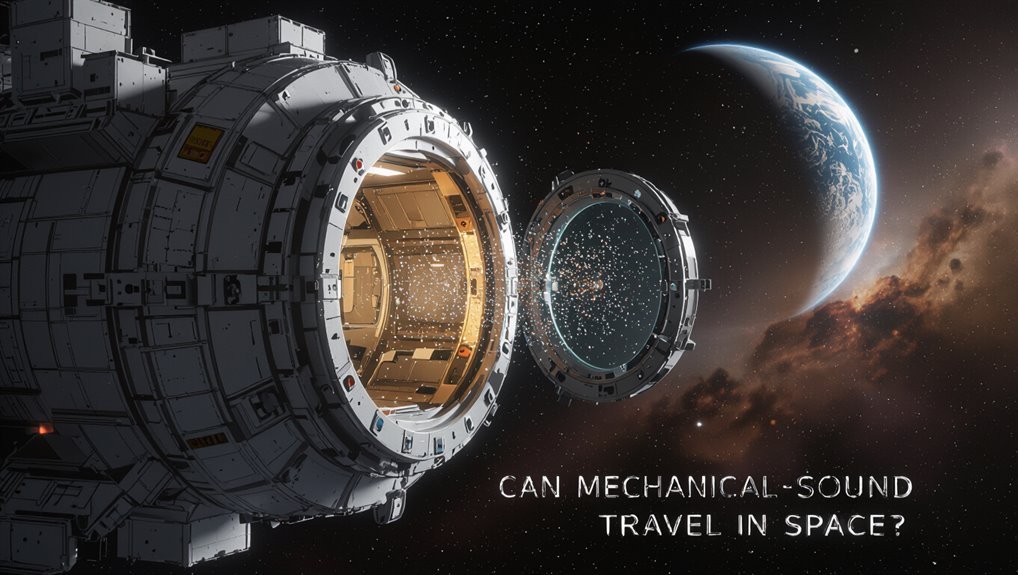
Wondering whether mechanical sound can travel in space?
You won’t hear typical sounds there because sound needs a medium—air, water, or solid—to carry pressure waves.
Space is fundamentally a vacuum, so mechanical vibrations can’t propagate over large distances.
Localized environments with gas or dust can transmit sound, but in interplanetary and interstellar space, mechanical sound effectively doesn’t travel to your ears.
Why the Question “Does Sound Travel in Space?” Matters
You probably wonder about sound in space because it ties into basic human curiosity about the cosmos.
It also matters for practical communication and safety when designing spacecraft and astronaut systems.
Clearing up this question corrects common scientific misconceptions and helps you trust the explanations you read or hear.
Human Curiosity About Space
Anyone who’s ever looked up at the night sky has felt a tug of curiosity about what the cosmos is like, and asking whether sound travels in space is a simple way to probe that mystery.
You wonder how familiar sensations change beyond Earth, so this question connects everyday experience to scientific thinking, sparks learning, and motivates exploration of physics, astronomy, and how we interpret cosmic observations.
Practical Communication Concerns
Because space lacks a dense medium, sound as is understood can’t carry between spacecraft or from astronauts to mission control.
So engineers have to rely on electromagnetic signals and special suits to keep people connected. You design redundant radio links, compress voice data, manage latency, and secure channels against interference.
Your planning guarantees clear, timely exchanges for navigation, emergencies, and scientific coordination.
Scientific Misconceptions Corrected
While the short answer is no, clearing up why sound doesn’t travel in space matters because it corrects several common scientific misconceptions that shape how people think about the universe and technology.
- You learn that waves need a medium, not a vacuum.
- You stop expecting cinematic explosions in space.
- You appreciate spacecraft communication design.
- You grasp limits of human perception beyond Earth.
What We Mean by “Sound” in Everyday Terms
Sound is the pattern of pressure changes in a medium—like air or water—that your ears and brain interpret as tone, pitch, loudness, and timbre.
You recognize sounds as events: footsteps, speech, music, or alarms. You use context, memory, and attention to locate sources, judge distance, and react.
Everyday “sound” ties sensory experience to meaning, communication, and safety.
The Physics Definition of Sound Waves
You already think of sound as events your ears pick up, but physics defines it more precisely: sound is a mechanical wave—organized, time-varying pressure and density disturbances—that travels through a material medium by local particle interactions.
- You detect pressure oscillations as pitch and loudness.
- Energy moves, not matter.
- Waveforms encode timbre and duration.
- Frequency and amplitude determine perception.
Why a Medium Is Required for Mechanical Sound
Because mechanical sound relies on pressure variations in a material, it needs something—air, water, or solids—for particles to push on their neighbors and pass the disturbance along; without that chain of interacting particles, there’s no way to transmit the oscillation and consequently no sound wave to detect. You feel silent space because nothing links vibrations into a traveling pulse.
| Hope | Loss | Quiet |
|---|---|---|
| Warm | Empty | Vast |
| Longing | Isolated | Still |
What a Vacuum Is and Where Space Is a Near-Vacuum
Having no material to carry pressure changes is what defines a vacuum, and space is close to that—an environment where particles are so sparse they rarely collide and can’t support ordinary sound waves.
- You won’t hear explosions directly in vacuum.
- Your radio signals need instruments to convert sounds.
- Vibrations travel only through structures you touch.
- Localized gas clouds can carry limited acoustic effects.
How Particle Density in Space Compares to Earth’s Air
Although space feels empty, its particle density is astronomically lower than Earth’s air: at sea level you get about 2.5 x 10^25 molecules per cubic meter, while interplanetary space often has fewer than 10 particles per cubic meter.
The near-Earth upper atmosphere drops through intermediate ranges before reaching that near-vacuum. You’d find collisions between particles so rare that continuous media assumptions for sound propagation break down.
Why Sound in Interstellar Space Can’t Travel
You can’t hear anything in interstellar space because there’s no continuous medium to carry vibrations.
The particle density is so extremely low that atoms are far apart, so collisions that create pressure waves hardly happen.
Without those pressure waves, sound simply has nothing to propagate through.
Lack Of Medium
Because sound needs particles to push against, it can’t travel through the near-vacuum of interstellar space. You rely on collisions between molecules to feel pressure waves, but emptiness offers almost none.
In short, vibrations die out without a medium, so you won’t hear stars or ships.
- No continuous air
- Few particles to transfer motion
- No chain propagation
- Vibrations damp quickly
Extremely Low Density
When space is almost empty, there aren’t enough particles to carry pressure waves, so sound can’t travel the way it does in air or water. You’d need many collisions per second for audible vibrations; interstellar density is far too low.
| Medium | Particle Density | Sound? |
|---|---|---|
| Air (Earth) | ~10^25 m^-3 | Yes |
| Interstellar | ~1 m^-3 | No |
| Vacuum | 0 | No |
Absence Of Pressure Waves
Sound needs pressure waves—organized compressions and rarefactions of a medium—to move; in interstellar space there simply aren’t enough particles to form and propagate those coherent pressure oscillations.
- You won’t hear explosions because collisions between molecules are too rare.
- Energy disperses instead of forming a wavefront.
- Any local disturbance damps before reaching you.
- Only electromagnetic signals travel efficiently there.
How Pressure and Temperature Affect Sound Transmission
Although space is mostly a vacuum, pressure and temperature still govern whether and how mechanical waves travel: you’ll find that higher local pressure and denser gas let compression waves propagate, while near-zero pressure stops them.
Temperature affects molecular speed, changing sound speed and attenuation. Extreme cold or heat in sparse regions alters collision rates, so unless medium density and conditions permit, you won’t get ordinary sound transmission.
When Sound-Like Waves Can Exist in Space Plasma
When you look at space plasmas, you’ll find pressure waves that act like sound by compressing charged particles.
You’ll also encounter magnetosonic modes, where magnetic fields and pressure work together to carry wave energy.
In regions with few collisions, these waves propagate differently than ordinary sound, so you’ll need to contemplate collisionless wave physics.
Plasma Pressure Waves
Imagine a thin, ionized gas stretched across vast distances: in that plasma, pressure disturbances can propagate much like sound in air.
You’ll find compressional waves that transport density and pressure changes, driven by particle collisions and thermal motion. They’re weaker in tenuous space but measurable.
Consider:
- Wave speed depends on temperature.
- Density controls amplitude.
- Collisions damp waves.
- Observations use plasma instruments.
Magnetosonic Wave Modes
If a magnetic field threads a plasma, pressure perturbations no longer behave like ordinary sound alone but couple to the field and produce magnetosonic waves that carry both compressions and magnetic disturbances. You’ll see fast and slow magnetosonic modes set by angle and plasma beta, letting you predict propagation speed and polarization.
| Mode | Directional dependence | Dominant restoring force |
|---|---|---|
| Fast | weak | magnetic+tension |
| Slow | strong | pressure+magnetic |
| Alfven | transverse | magnetic tension |
Collisionless Wave Propagation
The magnetosonic picture assumes frequent collisions tie particle motions to fluid quantities, but in much of space plasma that assumption breaks down and you must treat particles kinetically to know whether sound-like disturbances can propagate.
- You check particle distributions for resonance.
- You consider Landau damping effects.
- You assess magnetic field geometry.
- You evaluate wave growth versus collisionless damping.
What Plasma Is and Where It Appears in Space
Plasma is an ionized gas where atoms have lost or gained electrons, and it behaves differently from ordinary solids, liquids, or gases because its charged particles respond strongly to electric and magnetic fields.
You encounter plasma across space: the solar wind, stellar coronas, planetary magnetospheres, ionospheres, and diffuse interstellar medium.
You’ll also find it in accretion disks and nebulae.
What Plasma Waves Are and How They Behave
Now that you know where plasma shows up in space, you can look at the waves that ripple through it and the different types they come in, like electromagnetic and acoustic-like modes.
You’ll see how those waves exchange energy with particles through wave-particle interactions, changing particle speeds and trajectories.
Finally, you’ll learn how waves travel or fade—propagation depends on the plasma conditions, while damping mechanisms sap their energy.
Plasma Wave Types
Although you can’t hear them, space is full of waves in ionized gas that carry energy and information across vast distances.
- You spot Alfvén waves: magnetic tension guides ions along field lines.
- You find magnetosonic waves: pressure and magnetic forces compress plasma.
- You see Langmuir waves: electron oscillations at plasma frequency.
- You notice whistler waves: high-frequency, guided by magnetic fields and dispersing with distance.
Wave-Particle Interactions
When charged particles meet waves in a plasma, they trade energy and momentum in ways that shape both the wave and the particle distributions.
You’ll see resonant particles ride wave crests, gaining or losing energy, while nonresonant particles scatter.
These interactions drive instabilities, modify velocity distributions, and can amplify or weaken specific wave modes, linking microscopic motion to macroscopic plasma behavior.
Propagation And Damping
Because plasmas are collections of charged particles and fields, waves in them don’t just move like sound in air — they propagate according to collective behaviors and can be strongly damped or amplified by particle interactions and collisions.
- You’ll see electromagnetic and electrostatic modes.
- Landau damping removes energy via resonant particles.
- Collisions broaden and attenuate waves.
- Instabilities can grow waves, transferring particle energy into fields.
Role of Magnetic Fields in Carrying Disturbances
If you’ve ever wondered how disturbances propagate through the near-vacuum of space, magnetic fields play a central role by guiding and transmitting waves in charged plasmas where ordinary sound can’t travel.
You’ll see fields channel energy along lines, couple particle motions, and enable pressure-like responses without dense matter.
You rely on magnetic tension and plasma dynamics to carry organized disturbances across vast regions.
Alfven Waves Explained in Plain Terms
Think of Alfvén waves as ripples that travel along magnetic field lines in a plasma, where the field and charged particles tug on each other.
You’ll see that these waves carry energy and momentum without moving the whole plasma bulk, acting more like a transmission of forces than a flow of matter.
Understanding them helps you grasp how disturbances travel through space environments like the solar wind.
What Are Alfven Waves
Alfvén waves are ripples that travel along magnetic field lines in a plasma, carrying energy and momentum without needing a material medium like air; think of them as magnetic “waves” that move through charged gas.
- You’ll picture field lines guiding disturbances.
- You’ll see ions and electrons oscillate together.
- You’ll note speed depends on field strength and density.
- You’ll recognize them in solar wind and magnetospheres.
How They Move Energy
Picture a stretched magnetic rope in space that wiggles and carries energy along with the motion—Alfvén waves do just that in a plasma.
You’ll see the magnetic field and ions oscillate together, sending energy along field lines without moving mass far.
These waves transport momentum, heat, and disturbances, letting distant regions exchange energy efficiently across vast, magnetized space environments.
Magnetosonic Waves : How They Compare to Sound
While sound in air is a straightforward pressure wave, magnetosonic waves are hybrid disturbances in a magnetized plasma that combine pressure and magnetic stresses.
So they behave differently and travel under different rules.
- You’ll see two modes: fast and slow.
- They need magnetic fields and charged particles.
- Speeds depend on plasma density and field strength.
- They transfer energy like sound but via electromagnetic coupling.
Shock Waves From Explosions in Space
When a spacecraft-sized burst or a stellar detonation releases energy in a plasma, it drives a shock wave that compresses and heats the surrounding medium.
You’ll see abrupt jumps in density, temperature, and magnetic field across a narrow front. You can follow its propagation, dissipation, and particle acceleration effects via remote sensing.
Shocks reshape plasma flows, generate turbulence, and seed energetic particles without relying on conventional sound transmission.
How Supernovae Generate Pressure Waves
Because a supernova releases an enormous amount of energy almost instantly, it launches powerful pressure waves into the surrounding plasma and interstellar gas.
You watch shock fronts sweep outward, compressing and heating material. These waves carry momentum, shape remnants, and trigger chemistry.
- Compression amplifies density.
- Heating ionizes atoms.
- Momentum sculpts filaments.
- Waves seed star formation.
Sound Propagation Inside Planetary Atmospheres
If you’re standing on a planet with an atmosphere, sound travels by compressing and rarefying the local gas, and the specific speed and clarity depend on the atmosphere’s composition, temperature, and pressure. You’ll notice pitch, loudness, and attenuation change with density and molecular weight; wind and turbulence scatter waves, and temperature gradients refract them.
| Property | Effect | Example |
|---|---|---|
| Density | Slows/attenuates | Thick air |
| Temperature | Speeds/warms | Hot layers |
| Composition | Timbre changes | CO2 vs N2 |
| Pressure | Affects amplitude | High pressure |
How the Moon and Mars Carry Sound Differently Than Earth
You won’t hear anything on the Moon because its vacuum has no medium to carry sound waves.
On Mars, you’ll get muted and thin sounds since its atmosphere is much thinner than Earth’s.
Comparing these environments shows how air density dictates whether and how well sound travels.
Moon’s Vacuum Limits Sound
When you stand on the Moon, silence feels absolute: the Moon’s near-perfect vacuum can’t carry sound the way Earth’s air does, so vibrations from your voice or a hammer strike have nothing to travel through.
You’d rely on other paths and tools to sense activity.
- No airborne sound
- Vibrations travel through solid contacts
- Radio and suit comms replace hearing
- Instrument sensors detect impacts
Mars’ Thin Air Transmits
Although Mars’ atmosphere is far thinner than Earth’s, it still carries sound—just differently.
You’ll hear lower, muffled tones because fewer molecules transmit vibrations, and sounds travel slower and attenuate quicker.
Wind and dust storms create broadband noise, while close, loud events—like rover laser zaps—produce detectable pressure waves.
You’ll need sensitive instruments to capture those faint Martian sounds accurately.
Sound Inside Spacecraft: Why Astronauts Hear Normally
Because spacecraft are filled with air and other materials that carry pressure waves, astronauts hear sounds much like you do on Earth.
Inside, closed cabins keep breathable air, masks and suits only needed for spacewalks, speakers and alarms work, and conversations are normal.
Consider everyday examples:
- Crew talking during meals
- Tools clinking inside lockers
- Fans and pumps running
- Alarm tones signaling alerts
Mechanical Vibrations Through Solids in Space (Hull, Tether)
When you’re on or near a spacecraft, vibrations travel efficiently through the hull and along tethers, carrying mechanical energy even without air.
You’ll see how hull transmissions and tether wave propagation differ in speed and mode, and why joints or material changes reflect or transmit those waves.
We’ll also cover how engineers use damping and isolation to cut unwanted vibrations and protect sensitive equipment.
Vibration Transmission In Hulls
Solid structures like a spacecraft hull or tether act as efficient pathways for mechanical vibrations, so any impact, machinery, or crew movement on one side can send detectable oscillations across the structure to other areas.
- You’ll feel vibrations via contact points and mounting brackets.
- Materials and joints change transmission efficiency.
- Damping and isolation reduce unwanted propagation.
- Sensors pick up structural vibrations for monitoring and diagnostics.
Tether Wave Propagation
A long tether or structural boom carries vibrations differently than a compact hull, and you’ll notice that energy can travel far along a tensioned line with little loss.
You feel axial waves moving quickly, while transverse waves depend on tension, stiffness, and mass distribution.
Reflections occur at attachments and terminations, altering frequencies.
You can predict propagation using wave speed, impedance, and boundary conditions.
Damping And Isolation Methods
Although vibrations can travel long distances through ship hulls and tethers, you can limit their impact with targeted damping and isolation strategies.
Use tuned mass dampers, viscoelastic layers, isolation mounts, and cable dampers to reduce transmission, resonances, and fatigue.
Select materials and placements based on modal analysis to protect sensitive equipment and crew comfort.
- Tuned mass dampers
- Viscoelastic layers
- Isolation mounts
- Cable dampers
Sound in Gas Giants: How Fluids Carry Acoustic Waves
When you plunge into a gas giant’s atmosphere, you’ll find that sound travels through shifting layers of hydrogen, helium, and trace gases much like it does through air on Earth—by compressing and rarefying the fluid as pressure waves that push molecules together and pull them apart.
You’ll notice temperature, composition, and enormous pressure gradients change sound speed, damping, and propagation paths, creating complex acoustic behavior in deep, turbulent layers.
How Electromagnetic Waves Relate to “Sound” Scientists Use
You can think of electromagnetic waves as the kinds of light and radio signals that telescope instruments pick up across space.
Scientists often translate those EM signals into audible “sounds” by mapping wave properties like frequency and intensity to audio tones so you can hear patterns otherwise invisible.
This lets you explore space phenomena with your ears even though those signals aren’t true pressure-based sound waves.
Electromagnetic Waves Explained
Because space lacks a medium for pressure waves, scientists rely on electromagnetic waves—like radio, infrared, and visible light—to probe and “listen” to the universe, converting those signals into data you can interpret as sound or images.
You’ll learn how wavelengths, frequencies, intensity, and detection shape what information you receive:
- Wavelength determines resolution.
- Frequency sets energy.
- Intensity affects detectability.
- Detector choice limits sensitivity.
Translating Light Into Sound
How do scientists turn streams of photons into the sounds we hear?
You convert electromagnetic data into audio by mapping frequency, intensity, or timing to audible parameters.
Instruments record radio, X‑ray, or visible measurements, then software scales ranges, assigns pitches, and creates temporal patterns.
You’ll hear translated signals that reveal structure and dynamics otherwise invisible, aiding analysis and public outreach.
Why Radio Waves Are the Main Way We “Listen” to Space
When electromagnetic waves travel through the vacuum of space, radio waves stay useful because they’re easy to generate, detect, and carry information over vast distances without being absorbed much by interstellar gas and dust.
- You point radio dishes to faint sources.
- You tune frequencies to avoid interference.
- You use wide bandwidths to capture more signal.
- You rely on long wavelengths for penetration and range.
How Scientists Convert Radio and Plasma Data Into Audible Sound
If you want to hear what space “sounds” like, scientists translate radio and plasma measurements into audible frequencies by shifting and scaling the original signals so your ear can pick up their patterns.
You’ll convert voltage or spectral data into time-series audio, apply filters to remove noise, and speed or slow events while preserving waveform structure.
Then normalize levels for listening and analysis.
Examples: Jupiter Radio Emissions Turned Into Audio
Jupiter’s intense radio emissions offer some of the clearest examples of turning space data into sound, and researchers make them audible by mapping measured radio frequencies into the human hearing range while preserving their temporal and spectral structure.
- You hear lightning-like bursts known as S-bursts.
- You perceive long L-bursts as rumbling tones.
- You identify rotation-modulated pulses.
- You explore magnetospheric dynamics through pitch and timing.
Examples: Sun Oscillations and Helioseismology Sounds
Although you can’t hear the Sun directly, helioseismology turns its surface oscillations into audible signals so you can study the star’s internal structure.
You analyze waves caused by convection and thermal motions; scientists convert frequency patterns into sounds to reveal interior layers, rotation, and magnetic activity.
Listening lets you detect oscillation modes, infer temperature and composition, and monitor solar dynamics over time.
Examples: Black Hole Accretion Disk “Tones” Detected
When astronomers translate variations in X-ray and radio brightness from black hole accretion disks into sound, you get narrow, repeating “tones” that trace the flow of matter spiraling inward.
You can listen for patterns that reveal disk rotation rates, instabilities, and echoes from inner regions. These tones aren’t direct space sound but data mapped to audio for analysis.
- Diagnose disk dynamics
- Track frequency shifts
- Spot quasi-periodic oscillations
- Compare models to data
Sonification (Applications): Turning Space Data Into Music
Those X-ray and radio “tones” make a natural bridge to sonification, where scientists and artists map space data into audible music so you can hear structures and processes otherwise invisible.
You’ll explore pulsar rhythms, solar wind fluctuations, and cosmic background patterns rendered as pitch, rhythm, and timbre.
You can compare datasets, highlight anomalies, and engage broader audiences through performances and interactive exhibits.
What We Learn by Listening to Converted Space Sounds
Why listen to converted space sounds? You’ll gain intuitive insight into patterns, spot anomalies, and connect emotionally with data. Sonified signals reveal timing, intensity, and structure you might miss visually.
- Identify rhythms and periodic events
- Detect sudden bursts or flares
- Compare signal strengths across sources
- Foster public interest and education through accessible audio
Limitations of Sonification for Scientific Analysis
When you listen to sonified space data, you need to be cautious about misleading scientific interpretation because mapping choices can emphasize or hide features.
You’ll want to understand the data-to-sound mapping rules used, since pitch, volume, and time scaling aren’t neutral transformations.
Also check resolution and quantization effects, which can erase fine details or introduce artifacts that fool your analysis.
Misleading Scientific Interpretation
Because sonification maps non-auditory data into sound, it can make you think you’re hearing the actual physical phenomenon when you’re really hearing an interpretation shaped by choices about scaling, filtering, and parameter mapping.
- You’ll risk overinterpreting patterns as real signals.
- You’ll miss context lost in compression or normalization.
- You’ll trust pleasant or alarming timbres over statistical validity.
- You’ll need complementary analysis, not just listening, to draw reliable conclusions.
Data-to-Sound Mapping
If you rely on sonification alone, you’ll quickly hit limits imposed by the mapping choices you make: pitch, tempo, amplitude, and timbre don’t carry data neutrally, and those choices can emphasize some features while obscuring others.
You must justify mappings, test perceptual biases, and compare audio with visual or statistical methods. Otherwise you risk misrepresenting significance, patterns, or noise in scientific analysis.
Resolution And Quantization
Although sonification can make complex datasets audible, you’re constrained by the resolution and quantization of both your data and audio rendering. You must balance precision, sampling rates, bit depth, and perceptual limits so scientific features aren’t lost or distorted.
- Lower sampling blurs temporal detail.
- Limited bit depth adds quantization noise.
- Resampling can misrepresent frequencies.
- Perceptual thresholds hide subtle signals.
How Space Probes Measure Plasma and Waves Directly
When you want to know what plasma and electromagnetic waves are doing out in space, probes carry sensors that sample particles and fields directly, turning invisible motions into measurable signals.
You’ll use particle analyzers to count energies and species, electric and magnetic field antennas to record waveforms, and onboard processing to convert raw streams into spectra and moments so you can study dynamics and identify wave–particle interactions.
Instruments That Detect Space “Sound”: Magnetometers, Plasma Detectors
To hear what space is doing, spacecraft carry instruments that translate invisible fields and particles into signals you can analyze: magnetometers measure magnetic field vectors and fluctuations, while plasma detectors count and characterize charged particles and their motions.
- You use magnetometer data to track waves and turbulence.
- Plasma detectors reveal density and velocity.
- Combined signals show wave-particle interactions.
- You convert measurements into audible representations for study.
Notable Missions That Recorded Space Waves
You can look to missions like Voyager, which recorded plasma wave observations across the outer solar system, to hear how charged particles create measurable oscillations.
Cassini also captured intense radio emissions from Saturn, showing how planetary environments produce distinct wave signatures.
Together, these missions give you concrete examples of how space “sounds” are detected and studied.
Voyager Plasma Wave Observations
Although the Voyager probes left Earth decades ago, they’re still sending back plasma wave data that’s reshaped our view of space as a dynamic, noisy environment.
You can listen to converted waveforms and learn how solar wind, shocks, and planetary interactions produce sounds.
Key takeaways you’ll notice:
- Electron plasma oscillations
- Whistler-mode emissions
- Shock-related bursts
- Ambient turbulence signatures
Cassini Saturn Radio Emissions
When Cassini arrived at Saturn, its radio and plasma wave science instrument started recording a rich soundtrack of the planet’s magnetosphere, revealing bursts, tones, and drifts tied to auroras, lightning, and interactions with moons like Enceladus. You hear patterns mapped to sources; scientists translate them into plasma and magnetic activity, guiding models and discoveries.
| Feature | Source | Insight |
|---|---|---|
| Bursts | Lightning | Local storms |
| Tones | Auroras | Magnetosphere |
| Drifts | Enceladus | Plasma plumes |
How to Interpret Amplitude and Frequency in Space Datasets
Because space doesn’t carry sound the way air does, amplitude and frequency in space datasets don’t describe loudness and pitch directly; they tell you about signal strength and periodicity of the measured phenomenon.
- Amplitude shows signal intensity — stronger emissions or particle flux.
- Frequency reveals repetition rates or oscillation cycles.
- Correlate both with instrument response and background noise.
- Use spectra and time-series plots to identify sources and behaviors.
Common Misconceptions From Movies About Space Sound
You probably expect deafening explosions and instant radio chat the moment ships clash, because that’s how movies show it.
In reality, a vacuum won’t carry those booming blasts, communication has delays and requires radios, and any “rumbling” you hear inside a cockpit comes from the ship’s structure, not empty space.
Let’s separate cinematic flair from physical fact.
Loud Explosions In Vacuum
Although explosions in movies crackle and boom across the vacuum of space, real spacecraft blasts produce almost no sound for an outside observer, since sound needs a medium like air to travel and space is fundamentally a near-perfect vacuum.
- You’ll see bright flashes, not audible booms.
- Debris can collide and make sound only in atmosphere.
- Electromagnetic signals, not sound, carry information.
- Inside a pressurized cabin, you’ll hear the blast.
Instant Communication Between Ships
When ships appear to exchange urgent orders instantly in films, that’s a dramatic shortcut: real spacecraft rely on electromagnetic signals like radio or laser pulses, so any “instant” reply is limited by the finite speed of light and the need to encode, transmit, and decode data.
You’d plan for latency, signal strength, and line-of-sight, so communications take measurable time and coordination.
Rumbling Spacecraft Interiors
1 common movie trope is the ship that groans, rumbles, and shudders around its crew as if air and metal conspire to make everything loudly dramatic; in real spacecraft, though, those booming interior sounds are usually exaggerated or impossible because sound needs a medium and spacecraft cabins, vacuum outside, and structural coupling limit what you actually hear.
- You’d mostly hear vibrations through structure.
- Calm cabins mute explosion booms.
- Suited crew rely on radio audio.
- Movies amplify for tension.
Questions People Search Next About Sound in Space
Curious what else people ask about sound in space? You’ll want clear answers about mechanisms, detection, and limits. Quick topics you might search include spacecraft noise, radio-to-audio translations, and atmospheric effects on sound travel.
| Common Question | Why It Matters |
|---|---|
| Can you hear explosions? | Shows medium dependence |
| How do antennas “hear”? | Explains signal conversion |
Simple Home Demo: How Vacuum Stops Sound
You can show how a vacuum stops sound with a few simple items: a bell jar (or a large glass jar with a tight lid), a small bell or battery-powered buzzer, and a vacuum pump or a vacuum-sealed container.
- Place the buzzer inside the jar.
- Seal the lid.
- Remove air with the pump.
- Observe the sound fading as pressure drops.
Classroom Activities to Illustrate Vacuum and Sound
When you bring vacuum and sound into the classroom, pick a few hands-on activities that clearly show how removing air stops vibrations from reaching our ears; these demos let students see, hear, and reason through the same principle. You’ll run bell-in-vacuum, balloon-pop, tuning-fork-in-water, and pressure-change tasks, guiding observations and explanations.
| Activity | Purpose |
|---|---|
| Bell in jar | Shows sound loss |
| Balloon pop | Compares air/no air |
| Tuning fork in water | Visualizes vibration |
| Syringe demo | Alters pressure and sound |
How Space “Sound” Matters for Space Weather Prediction
Although true sound waves don’t travel through the vacuum of space, scientists still listen to plasma and magnetic-field vibrations because those signals carry vital information about solar storms and particle flows.
Interpreting them helps you predict space weather that can disrupt satellites, power grids, and communications.
- Monitor solar wind changes
- Detect shock fronts early
- Track energetic particle streams
- Inform protective measures
How Space Waves Affect Satellites and Communications
Information gleaned from plasma and magnetic-field vibrations also warns about conditions that can harm satellites and interfere with communications.
You monitor solar wind shocks, radiation storms, and wave-driven currents because they can degrade electronics, disrupt GPS timing, and cause radio blackouts.
You adjust antenna pointing, power modes, and data transmission schedules to reduce risk, and you rely on alerts to protect hardware and maintain link availability.
Why Future Missions Could Improve Space Acoustics Research
Because new missions will carry better instruments and reach unexplored regions, you’ll be able to map plasma and magnetic-field waves with far greater resolution and over longer timescales.
With advanced instruments and wider reach, future missions will map plasma and magnetic waves in unprecedented detail and duration
You’ll compare environments, refine models, and test mitigation techniques.
Consider practical goals:
- High-resolution wave catalogs
- Long-duration monitoring
- Cross-region comparisons
- Improved predictive models
Key Takeaways About Sound and Space Physics
When you think about sound in space, remember that what we usually call “sound”—pressure waves traveling through air—can’t move through a vacuum.
But space still hosts wave phenomena (like plasma and magnetic-field oscillations) that carry energy and can be measured and modeled.
You’ll note: sound needs a medium; space signals travel via fields and particles; instruments convert those into audio for study.
Further Reading and Datasets for Listening to the Cosmos
If you want to explore how researchers turn space phenomena into sound, start with a few foundational resources and open datasets that let you listen, visualize, and analyze signals from satellites, radio telescopes, and space probes.
- NASA Open Data — heliophysics and magnetosphere recordings.
- ESA Science Archive — probe telemetry and waveforms.
- LOFAR/CASA datasets — radio astronomy time series.
- Space Physics Data Facility — calibrated plasma and field files.
Frequently Asked Questions
Can Humans Perceive Plasma Waves Without Instrument Conversion?
No, you can’t directly perceive plasma waves without instruments; your ears need pressure waves in neutral gas. You’d need conversion to audible sound or electromagnetic signals translated by devices to detect and interpret plasma wave activity.
Do Neutrinos or Dark Matter Produce Audible Effects?
No, neutrinos and dark matter don’t produce audible effects you can hear; they’ll pass through you silently, and you’d need instruments converting their tiny interactions into signals you can detect and translate into sound or visual data.
How Would Sound Behave Inside a Rotating Space Habitat?
Sound in a rotating space habitat behaves like on Earth but with Coriolis and centrifugal effects; you’ll hear Doppler shifts, sound paths curved by rotation, and pressure gradients causing pitch and intensity variations as air and objects move relative to you.
Can Sound Travel Between Connected Spacecraft via Docking Clamps?
Yes — if spacecraft are rigidly docked, vibrations travel through the clamps and structure, so you’ll hear transmitted sound; coupling quality, contact area, and damping control how much gets through, with weak joints greatly reducing transmission.
Are There Engineered Materials That Transmit Sound in Vacuum?
Yes — you can use engineered solid or rigid coupling materials like metal, composites, or piezoelectric rods to transmit vibrations through a vacuum; they conduct mechanical waves directly, so you’ll hear through structure-borne sound, not through empty space.
Conclusion
You now know that ordinary mechanical sound doesn’t travel through the vacuum of space because sound needs a material medium to move. Instead, space is filled with other signals—electromagnetic waves, plasma waves, and particle interactions—that spacecraft and instruments pick up and translate into sounds you can hear. As missions and sensors improve, we’ll keep converting those space “vibrations” into audio, helping you explore cosmic processes without expecting literal sound to propagate in empty space.