How to Tag Luggage for Air Travel Step by Step Guide
You’ll tag luggage quickly and securely by attaching a durable external tag with your name, international phone number, and travel email, plus a hidden paper insert with alternate contact info. Use a strong loop or metal clasp suited to the handle, photograph the packed bag, and add a bright strap or sticker for easy ID. Put fragile items center-packed and consider a Bluetooth or GPS tracker. Keep going and you’ll get step-by-step tips for replacements, privacy, and tracking.
How to Tag Luggage for Air Travel: 6 Quick Steps
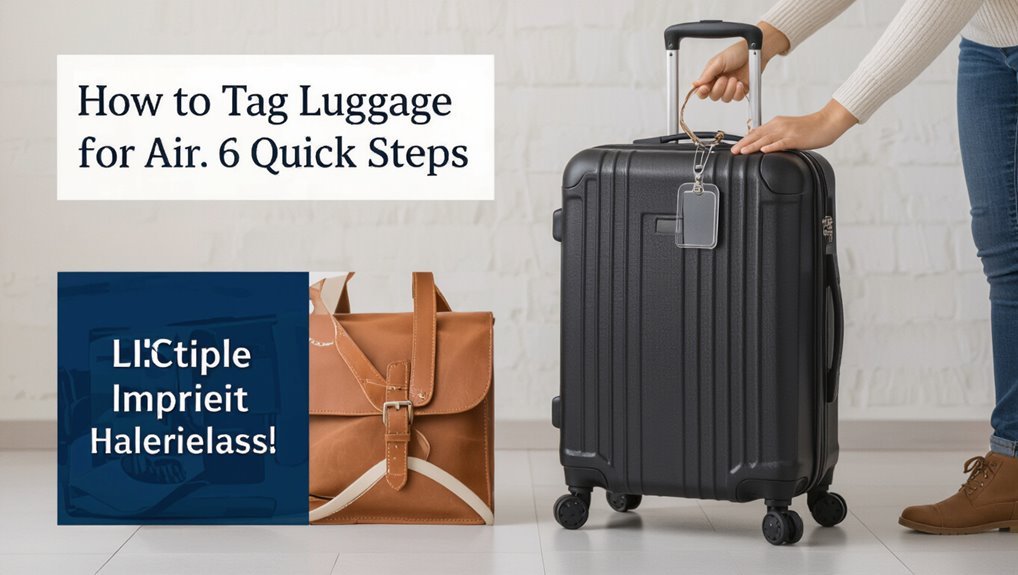
Start by removing old tags and giving your bag a clear, current ID: attach a durable external tag with your name, phone number, and at least one email, and tuck a copy of that info inside the suitcase in case the outside tag gets torn off.
Next, secure the tag, add a flight itinerary slip, lock zippers, note baggage claim number, and photograph the packed bag.
Choose Hard, Soft, or Integrated Tags
When picking a tag, think about durability and visibility: hard shell tags resist rough handling, soft fabric tags flex and won’t scratch, and integrated tags snap into the suitcase for a sleek look.
You’ll want hard tags if you toss bags often, soft tags if you prioritize lightweight or fabric suitcases, and integrated tags if you prefer built-in security.
Compare materials, attachment strength, and readability to match your travel style.
Hard Shell Tags
You’ll attach them to handles or straps with secure fasteners, choose durable materials like polycarbonate or metal, and use clear windows or embossed plates for names and contact info.
They resist tearing and water damage.
Soft Fabric Tags
If you prefer something lighter and more flexible than rigid tags, soft fabric options offer a different set of benefits.
You’ll enjoy pliability, quieter handling, and easier storage when not in use. Choose durable materials with reinforced stitching and clear ID windows.
Secure them with sturdy loops or buckles, and consider bright colors or unique patterns to spot your bag quickly on crowded carousels.
Integrated Luggage Tags
You’ll find them built into handles or zipper panels, often with a sliding cover to protect details. They won’t snag or fall off, and they speed up check-in.
Choose durable materials and readable fonts so your information stays private yet accessible.
Why Durable Materials Matter for Luggage Tags
Because your luggage tag is the first line of identification on a busy carousel, it needs to stand up to bumps, weather, and handling without fading or falling apart.
You should choose sturdy materials so your tag stays readable and attached. Consider:
- Hard plastic or metal for impact resistance
- Waterproof coatings for rain or spills
- Secure fastenings to prevent loss
What Contact Info to Include on a Luggage Tag
A few key details will make your luggage tag truly useful: include your full name, a phone number you’ll have service on during travel, and an email address that’s regularly checked. Add a secondary contact and optional home city. Keep info concise and readable.
| Name | Phone | |
|---|---|---|
| Full | Primary | Checked |
| Alt | Secondary | City |
How to Format Your Phone Number and Email for Travel
When you add contact info to your tag, use your phone’s international format (plus sign, country code, then number) so carriers can reach you abroad.
Include a travel-specific email address you check frequently rather than your long-term personal or work inbox. That way you’ll minimize missed messages and speed up any recovery.
Use International Format
Start with the phone number: format it in international style (+ country code, area code, local number) so airport staff and foreign carriers can contact you without guessing local dialing rules.
Then add an email in standard format. Follow these concise steps:
- Use + and country code.
- Remove local trunk zeros/spaces.
- Put email plainly as name@domain.com for easy reading.
Provide Travel-Specific Email
Now that your phone and email follow international formatting, pick an email address that works for travel: use a simple, professional-looking address (your name plus numbers if needed) that you’ll check regularly, and include it plainly on your luggage tag as name@domain.com so airline staff can reach you quickly.
Use a separate travel-focused account, avoid quirky nicknames, and enable notifications for timely replies.
When to Add an Alternate Contact or Itinerary Details
Ever wondered whether to include an alternate contact or itinerary details on your luggage tag? You should add them when travel is complex, someone needs to reach you if flights change, or baggage connects across carriers.
Consider adding:
- A reliable phone contact (not your hotel room).
- Flight numbers or connection cities.
- Emergency contact name and relationship for quicker reunification.
Should You Put Your Home Address on the Tag?
Should you put your home address on a luggage tag? You shouldn’t. Publicly displaying your address raises theft and privacy risks. Instead, use minimal contact info so someone can reach you without revealing where you live.
| Option | Recommendation |
|---|---|
| Home address | No |
| Phone | Yes |
| Yes | |
| Alternate contact | Yes |
| Hotel address | Optional |
Use a Business Card or Folded Paper Insert Safely
You can tuck a business card into the clear ID sleeve so your contact info stays visible without exposing your home address.
If you use a folded paper insert, secure it inside the tag pocket or with a small zip tie so it won’t fall out during handling.
Check placement before check-in to make sure the card or insert won’t slip free.
Business Card Placement
One simple trick is to slip a business card or a small folded paper inside your luggage tag’s clear window so your contact details stay visible even if the external tag gets torn or detached.
Place it:
- Behind the transparent sleeve for instant visibility.
- With name, phone, and email facing out.
- Oriented horizontally to avoid curling and reading errors.
Secure Folded Paper
When traveling, tuck a business card or a neatly folded paper into the tag’s clear sleeve so your contact info stays protected even if the outer tag tears or detaches; make sure the card sits flat, with your name and phone number facing outward. Fold once, insert snugly, and check visibility.
| Front | Fold | Back |
|---|---|---|
| Name | Fold | Phone |
| Insert | City |
How to Attach a Tag Securely to Different Luggage Handles
Attaching a tag securely depends on your bag’s handle type and the tag’s fastener, so choose a method that keeps the tag visible and locked in place.
Attach tags according to handle type and fastener—ensure visibility and a secure, locked fit for travel peace of mind.
Use these steps for common handles:
- Retractable: loop through handle bars, cinch tight, tuck excess.
- Top grab: slip around base, secure clip or knot.
- Side or strap: thread tag, double-back and lock.
Which Straps, Loops, and Clips Resist Airport Wear Best
Pick straps, loops, and clips made from durable materials and simple mechanisms so your tag survives being tossed, dragged, and snagged.
Choose nylon or reinforced polyester straps, stainless steel or brass clips, and welded loops over stitched ones.
Avoid thin plastic buckles and glued parts.
Prefer quick-release metal clasps with locking gates and wide straps to reduce abrasion and prevent accidental detachment.
How to Hide Sensitive Info While Keeping Tags Useful
After choosing rugged straps and metal clips, you’ll want to protect the personal details on your tag without making it useless to airline staff.
After choosing sturdy straps and clips, safeguard personal details so tags stay useful for airline staff.
Use partial info and quick-access cues:
- List name and flight number only.
- Add a phone prefix or email initial, not full details.
- Fold or cover extra lines with a removable flap for security and easy inspection.
When to Use Covered ID Windows Versus Exposed Tags
When you’re deciding between a covered ID window and an exposed tag, think about where you’ll travel and how your bag will be handled: choose a covered window for crowded hubs, long transfers, or overnight storage to protect personal details and prevent snagging.
Use an exposed tag when quick ID checks, frequent pickups, or tight baggage carousels make visible labels more practical and efficient.
How to Label Checked Bags Versus Carry-On Bags
If you’ve chosen between a covered ID window and an exposed tag based on handling and privacy, you’ll also want to label checked and carry-on bags differently to match how they’ll be processed and seen.
Use clear, visible info so handlers and you can act fast:
Make information clear and visible so handlers — and you — can act quickly and confidently.
- Checked: attach durable tag with name, phone, and itinerary.
- Carry-on: use smaller tag with contact only.
- Remove outdated tags.
Can Unique Tags Help You Identify Your Bag Faster?
You can spot your bag faster by adding distinctive visual markers like bright straps, stickers, or patterned covers.
Personalized identification tags with your name or a unique symbol make it quicker to confirm it’s yours at the carousel.
Together, those features cut confusion and save you time when baggage comes through.
Distinctive Visual Markers
A bright strap, a funky charm, or a bold sticker can make spotting your suitcase on a crowded carousel much faster and less stressful.
Use clear, visible markers that contrast with common colors. Consider:
- High-contrast straps for quick grabs
- Reflective patches for low light
- Unique stickers or ribbons to avoid mix-ups
These simple visuals speed identification and reduce baggage anxiety.
Personalized Identification Tags
One clear way to speed up spotting your suitcase is to use personalized ID tags that combine bold visuals with your contact details—think bright colors, a unique nickname, or a custom graphic so you can tell your bag at a glance.
Choose durable, weatherproof tags, include essential contact info, and attach them visibly. They’ll cut search time and deter mix-ups without revealing unnecessary personal details.
Use Color, Tape, and Ribbons to Spot Your Bag in Seconds
Bright, bold colors and simple ribbons let you spot your bag on a crowded carousel in seconds, cutting down wait time and stress.
Use high-contrast tape or a patterned strap so you’ll always recognize your suitcase. Add a small, unique charm for quick identification.
- Neon tape
- Patterned strap
- Distinctive ribbon or charm
Protect Fragile or Valuable Items in Checked Luggage
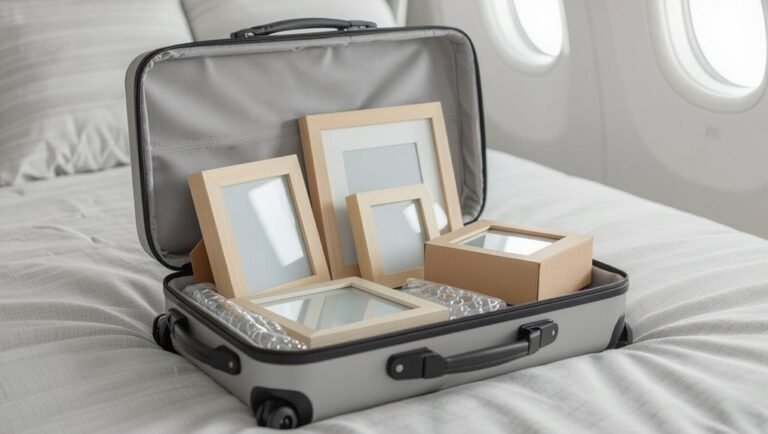
Pack fragile or valuable items thoughtfully so they survive handling and transit. Wrap each piece in bubble wrap or clothing, filling gaps to prevent shifting.
Place hard-shelled items in the center, cushioned on all sides. Use zippered or padded cases for electronics and jewelry, and consider carrying irreplaceables in your carry-on.
Label fragile on the exterior for gentler handling.
Add Internal ID Information for Lost-Bag Recovery
After cushioning fragile items, think about what happens if your bag gets misplaced: include an internal ID to help airlines return it quickly.
Put a durable card inside your suitcase with:
- Full name and phone number.
- Flight number and destination city.
- Email and a brief address.
Also add a small external tag with initials and a secondary contact.
How Airlines Scan Baggage Tags
You’ll learn how scanners read the barcode on your tag, compare it to the flight manifest, and route the bag accordingly.
You’ll also see how RFID and different tag types speed processing and improve tracking accuracy.
Finally, you’ll get a quick look at how scanned data is handled, stored, and used for recovery and logistics.
Barcode Scanning Process
Watch as the barcode scanner reads the tag and instantly links your bag to the flight’s tracking system: you’ll see a quick beep and confirmation on the screen.
Follow these steps to guarantee smooth scanning:
- Position the tag barcode facing the reader cleanly.
- Keep barcodes unwrinkled and visible.
- Re-scan immediately if the system shows an error.
RFID And Tag Types
While barcode scanners read printed tags line-by-line, many airlines now use RFID chips embedded in baggage tags to speed up tracking and reduce misreads; these tags broadcast a unique ID that readers pick up without line-of-sight, so your bag can be located even in piled carts or conveyor tunnels. You’ll see passive and active tags; choose based on range and cost.
| Type | Use |
|---|---|
| Passive | Short-range, cheap |
| Active | Long-range, pricier |
Handling Scanned Data
RFID and barcode tags only matter if their readouts get processed correctly, so airlines pair scanners with software that captures tag IDs, timestamps, and reader locations as bags move through the system.
You’ll see processing that lets staff track status, reroute missing items, and confirm transfers:
- Capture: read ID and timestamp.
- Validate: match flight and bag record.
- Update: propagate location across systems.
How to Interpret and Keep Your Paper Baggage Receipt
A single paper baggage receipt holds key details you’ll need if your bag is delayed or lost, so learn how to read it at check-in and tuck it somewhere safe.
Check the tag number, flight, destination, and your name; confirm barcode clarity.
Keep the receipt until you retrieve luggage or file a claim. Photograph it and store a copy in your phone.
Use RFID, Bluetooth, or GPS Trackers With Your Luggage
When picking a tracker, you’ll want to balance range, battery life, and whether you need RFID, Bluetooth, or GPS for your routes.
Place the device where it’s protected but still gets a signal, like a zipped interior pocket or a luggage frame, and test placement before you travel.
Finally, keep spare power options—replaceable batteries or a portable charger—so the tracker won’t go dead mid-trip.
Choosing The Right Tracker
How do you pick the right tracker for your luggage? Consider range, battery life, and coverage to match travel style. Assess:
- RFID for airport sorting and short-range detection.
- Bluetooth for close-range finding and smartphone alerts.
- GPS for real-time, long-distance tracking.
Weigh cost, privacy, and service subscriptions so you choose a reliable tracker that fits your trips.
Tracker Placement And Power
If you’re using RFID, Bluetooth, or GPS trackers, place them where they’ll stay secure, remain powered, and still be detectable—inside a zipped pocket near the bag’s top for Bluetooth, inside hard-shell compartments for GPS with an external antenna view, and attached to structural tags or inner linings for RFID readers at checkpoints.
Keep batteries charged, swap before long trips, and use power-saving modes to extend life.
Pair and Place a Bluetooth Tracker in Luggage for Best Range
Because a tracker only helps when it’s both connected and well-placed, you should pair your Bluetooth device with your phone before packing and position it where its signal won’t be blocked—near the top of the main compartment or an exterior pocket with minimal metal or dense padding between it and the cabin.
Pair your tracker before packing and place it near the bag’s top or an exterior pocket to avoid signal blockage.
- Test range in a packed bag.
- Keep battery charged.
- Avoid surrounding metal items.
Are Electronic Trackers Allowed and How to Protect Your Privacy?
Curious whether electronic trackers are allowed on flights and what that means for your privacy? You can usually bring active and passive trackers, but follow airline and TSA rules. Disable transmitters if requested, carry batteries separately, and use privacy settings. Share minimal location data and use encrypted apps.
| Allowed? | Tips | Privacy |
|---|---|---|
| Usually | Follow rules | Encrypt |
| Check airline | Remove batteries | Minimal data |
Prepare Tags for International Travel and Different Alphabets
1 simple step before international travel is making sure your luggage tags are readable and compliant across languages and systems.
You’ll prepare tags that customs and handlers can read, avoid unsupported characters, and include local translations where helpful.
- Use Latin script plus native script if needed.
- Add phone number with country code.
- Keep information concise and machine-readable.
How to Replace a Damaged Tag at the Airport Quickly
If your bag tag gets damaged, head straight to the airline’s baggage service counter and tell them what happened.
Have your ID and boarding pass ready to prove ownership so they can process the claim quickly.
They’ll issue a replacement tag and update the system so your bag keeps moving.
Locate The Baggage Service
Where do you go when your luggage tag is torn or unreadable? Head to the airport’s baggage service counter immediately; agents can reissue tags and log details.
Look for signs or ask staff, then:
- Note the airline and flight number.
- Follow staff to the service desk.
- Get a temporary tag and receipt before leaving the area.
Provide Proof Of Ownership
Because agents need quick confirmation, have proof of ownership ready so they can re-tag your bag and get you on your way.
Show a photo ID matching the ticket name, boarding pass, and any baggage claim receipt or tag stub. If luggage has unique markings or contents, point them out.
Stay calm, answer questions, and request a written receipt for the new tag.
Get A Replacement Tag
Start by heading straight to the airline counter or baggage service office and explain that your tag is damaged and needs replacing. You’ll get a new tag quickly if you:
- Show ID and boarding pass for verification.
- Point out the bag and old tag so staff can match routing.
- Ask for a receipt or confirmation number and attach the new tag securely.
Common Tagging Mistakes That Cause Lost or Delayed Bags
One of the biggest reasons bags get lost or delayed is simple tagging errors—incorrect info, loose tags, or mismatched tags and owners.
You should double-check names, phone numbers, and flight details, secure tags firmly, and remove old tags.
Don’t obscure barcodes or use flimsy materials.
Verify the tag matches you and the destination to prevent mishandling and routing mistakes.
How to Check Your Bag’s Status If It’s Delayed or Lost
Wondering where your bag went? Check status quickly: contact the airline’s baggage office, use the airline app with your bag tag number, and file a Property Irregularity Report (PIR) at the airport if present.
- Call or go to baggage desk.
- Enter tag/PNR in app or website.
- File PIR, keep reference and receipts for claims.
Packing Checklist: Final Tag and Tracking Actions Before You Fly
Before you zip up, double‑check tags and tracking so you don’t scramble later: attach a durable external tag with your name and a phone number, place a dealer or inside tag with your flight details and PNR, and take a clear photo of the barcode or tag number (and of your packed bag) to store in your phone and email to yourself.
Then lock zippers, note weight, register tags with the airline app, and confirm luggage allowance.
Frequently Asked Questions
Can I Use a Nickname Instead of My Full Name on the Tag?
Yes, you can use a nickname, but you shouldn’t. Airlines and security prefer your legal name for identification and lost-bag matching, so stick to your full name or include both full name and nickname to avoid complications.
Do Luggage Tags Need to Be Removed Before Security Screening?
No, you don’t have to remove luggage tags before security screening; TSA and most airports tolerate them. Still, check for loose or bulky tags that could snag; remove or secure anything that might trigger handling issues during screening.
Will Fragile Stickers on My Bag Affect Airline Handling?
Yes — labeling your bag “Fragile” might help, but airlines won’t guarantee gentler handling. They’ll still stack and route by space/weight. Don’t rely solely on stickers; pack delicate items securely and consider carry-on or insurance.
Can I Attach Two Tags to the Same Piece of Luggage?
Yes — you can attach two tags to one bag, and airlines usually accept that. Just guarantee both are secure, legible, include matching contact info, and avoid obstructing any official airline tag so handlers can read barcodes and routing details quickly.
Do Hotels and Shippers Accept Airline-Style Baggage Tags for Identification?
Yes — many hotels and shippers accept airline-style baggage tags for ID, but you’ll want to include a durable name/phone label inside too; some require their own tags or barcodes, so confirm policies beforehand.
Conclusion
You’ve got this—tagging luggage is quick and worth the few minutes it takes. Use sturdy materials or an integrated tag, include clear contact info (formatted internationally), and replace damaged tags at the airport right away. Avoid common mistakes like illegible handwriting or unsecured loops. If a bag’s delayed, check the airline’s tracking and file a report promptly. Follow the final checklist before you fly, and your bags are far more likely to arrive with you.