What Is the 311 Rule: Tsa Liquid Rule Explained Clearly
The TSA 3‑1‑1 rule lets you bring small amounts of liquids through security: each container must be 3.4 ounces (100 mL) or less, all containers fit inside a single clear quart‑sized resealable bag, and you get one bag per person. Gels, creams, aerosols, and liquid cosmetics count, but meds, baby formula, and breast milk are allowed separately when declared. Follow this to speed screening, avoid tossed items, and learn practical packing tips if you want more.
Quick Answer: What TSA 3‑1‑1 Lets You Carry
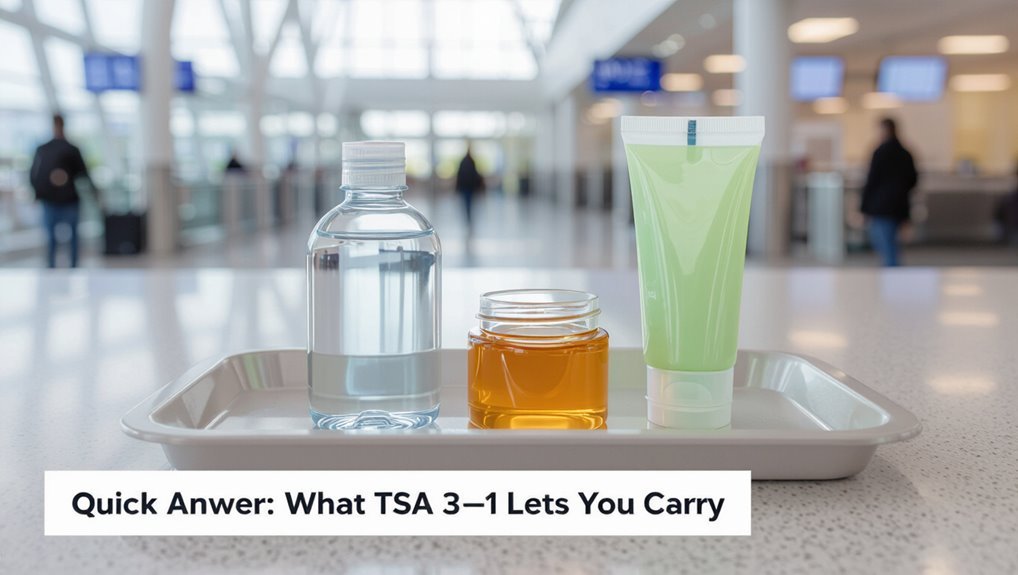
Think of 3-1-1 as the simple rule for bringing liquids, gels and aerosols in your carry-on: each passenger can carry liquids in containers of 3.4 ounces (100 milliliters) or less.
All containers must fit inside a single clear, quart-sized resealable bag, and you’re limited to one bag per person.
You can also bring medications, baby formula and breast milk in reasonable quantities, separate for screening.
Why 3‑1‑1 Exists and Who Enforces It
Because liquids can be used to make improvised explosive devices and are harder for scanners to analyze, the TSA introduced the 3-1-1 rule to reduce risk while keeping security lines moving.
Because liquids can be used in explosives and challenge scanners, the TSA’s 3-1-1 rule keeps risk down and lines moving
Federal screeners and airport authorities enforce it during the screening process.
- You follow limits at checkpoints.
- Officers inspect bags and containers.
- Violations may delay or deny boarding.
- Compliance speeds screening.
What Items Count as Liquids, Gels, and Aerosols (3‑1‑1)
The 3‑1‑1 rule covers more than just bottled water: it applies to liquids, gels, pastes, creams, and aerosols you bring through security, and you’ll need to pack them in individual containers of 3.4 ounces (100 milliliters) or less inside a single clear, quart‑sized bag.
That includes toiletries, toothpaste, hair gel, sunscreen, liquid makeup, and spray cans—anything with pourable or spreadable consistency.
What “3 Ounces” Actually Means
One common confusion is that “3 ounces” on the 3‑1‑1 rule actually refers to container capacity rather than the exact weight or volume of the liquid inside; airports and TSA screens check that each bottle, tube, or canister is 3.4 fluid ounces (100 milliliters) or smaller.
Note that the “3 ounces” rule refers to container capacity (3.4 fl oz / 100 mL), not actual contents.
So a partially filled larger container still violates the rule even if it holds less than three ounces of product.
- Check capacity
- Use travel bottles
- Label clearly
- Replace oversized containers
How the 1‑Quart Bag Rule Works
You’ll carry all your liquids, gels, and aerosols through security inside a single clear quart‑sized, resealable plastic bag.
TSA officers require that each passenger present these items together so agents can quickly inspect them without rummaging through your luggage.
Pack travel‑size containers that fit comfortably, close the bag fully, and pull it out for screening.
Larger or extra bags will be flagged.
Why Only One Quart Bag Per Passenger
You’re limited to one quart bag because screeners need to keep passenger volume manageable at checkpoints.
Allowing just one bag per person helps lines move faster and reduces the chance of missed or mishandled items.
This rule balances throughput with thorough security screening.
Passenger Capacity Limits
Bag limits keep airport security efficient and safe: TSA allows each passenger only one clear quart-sized bag for liquids, gels, and aerosols so screening lines move faster and machines aren’t overloaded.
- You manage space in overhead bins and queues.
- You reduce handling time per traveler.
- You fit standard trays and X-ray capacity.
- You simplify compliance checks for agents.
Security Screening Efficiency
Because TSA limits liquids to one clear quart-sized bag per passenger, security lines flow more predictably and agents can process trays faster.
You’ll pack efficiently, show one bag, and avoid delays from multiple containers. That single-bag rule reduces screening complexity, speeds X-ray interpretation, and lowers rechecks.
You benefit from quicker throughput, fewer hold-ups, and a smoother, more reliable checkpoint experience.
How to Measure Containers at Home
Measuring containers at home is simple: gather the container, a ruler or measuring tape, and a measuring cup, then check each dimension—height, maximum diameter or length and width for non-cylindrical shapes—and calculate volume so you can confirm it meets the 3.4-ounce (100 milliliter) carry-on limit.
- Measure height
- Measure diameter/width
- Calculate volume
- Compare to 100 mL limit
Packing for Carry‑On: A Step‑By‑Step Guide
Now that you know how to confirm each liquid fits the 3.4-ounce (100 mL) limit, you can start packing your carry‑on with confidence. Place quart‑size bag items together, secure lids, and keep the bag accessible for screening. Pack heavier items low, essentials on top, and electronics in a separate pocket.
| Item | Location | Tip |
|---|---|---|
| Liquids | Top pocket | Visible |
| Electronics | Middle | Easy access |
| Clothes | Bottom | Balance weight |
Prepacking Tips to Speed Security (3‑1‑1)
Before you zip up your carry-on, group all liquids into one clear quart bag so they’re easy to pull out at the checkpoint.
Stick to the 3‑1‑1 limits by checking container sizes and keeping only what you need in your bag.
That way you’ll move through security faster and avoid last‑minute repacking.
Pack Liquids Together
Group all your liquids in one clear, resealable bag so you can pull them out quickly at the checkpoint; doing this saves time for you and TSA by making inspection fast and simple.
- Place only 3.4 oz (100 ml) containers inside.
- Lay bottles flat to maximize space.
- Seal the bag fully to prevent leaks.
- Keep the bag accessible in your carry-on.
Carry-On Bag Limits
After you tuck your liquids into a clear bag, turn your attention to what else goes in your carry-on—airports enforce strict size and item limits that speed screening when you pack smart.
Check airline and TSA size rules, keep electronics and documents accessible, limit prohibited items, and distribute weight evenly.
A well-organized bag speeds security and reduces stress at the checkpoint.
Best Clear Bag Types That Meet TSA Standards
When you’re choosing a clear bag that meets TSA’s 3-1-1 rule, pick one that’s transparent, resealable, and sized at or below 1 quart so agents can quickly verify contents without delays.
- Vinyl zipper pouch — durable, cheap, crush-resistant.
- Reusable silicone bag — flexible, leakproof, eco-friendly.
- PVC travel pouch — lightweight, clear, easy to pack.
- Mesh-trimmed pouch — structured, visible, quick to open.
How to Reuse and Clean Your Quart Bag
Keep your quart bag clean and TSA-ready by washing it after spills and before reuse; most clear vinyl, PVC, and silicone pouches wipe clean with warm soapy water, rinse thoroughly, and air-dry upside down to prevent trapped moisture.
Inspect seals and zippers for damage, replace the bag when cloudy or cracked, and avoid storing open liquids to minimize leaks and odors between trips.
How to Consolidate Products Into One Compliant Container
When you need to consolidate products, pick a clear, travel-approved quart container so TSA agents can quickly inspect your items.
Only combine liquids that are compatible—same base (water-, oil-, or alcohol-based) and scent-free—so they won’t separate or react.
Label the container with its contents and volume to avoid confusion at security.
Choose Approved Clear Container
1 clear, compliant container makes airport security and your packing a lot easier: pick a transparent quart-sized (or litre) bag or rigid clear bottle that meets TSA/airline rules, label it if needed, and consolidate only the allowed amounts of liquids, gels, and aerosols into it.
- Use a see-through quart/litre bag.
- Choose rigid clear bottles for creams.
- Label contents and sizes.
- Keep totals within limits.
Combine Compatible Liquids
If you’re trying to fit multiple toiletries into a single compliant container, first group products by type and compatibility so you don’t contaminate or ruin them—e.g., mix travel-sized shampoo with more of the same formula, not with conditioner or face wash. Pour similar formulas, label clearly, and seal tightly. Check scent, color, and ingredients to avoid reactions.
| Product | Compatible | Tip |
|---|---|---|
| Shampoo | Shampoo | Match brand |
| Lotion | Lotion | Test small |
| Serum | Serum | Use dropper |
How to Use Travel‑Size Containers Safely and Legally
Because airport security enforces strict size and labeling rules, you should pack toiletries in clear, compliant travel-size containers to avoid delays and confiscations.
- Measure containers ≤3.4 oz (100 mL).
- Use a single quart‑size clear bag and seal it.
- Label any medicated liquids and keep prescriptions handy.
- Place the bag on top for quick screening and remove electronics if requested.
Where to Buy Travel‑Size Items at the Airport
When you forget a travel‑size shampoo or need a last‑minute refill, airport shops and kiosks usually have a compact selection of toiletries — think convenience stores, duty‑free shops, and terminal newsstands — so you can grab TSA‑compliant bottles without missing your flight.
Look for pharmacy counters, specialty beauty boutiques, and vending machines near gates; prices vary, so buy only what you need.
Packing Toiletries in Checked Baggage
Pack heavier or non‑restricted toiletries in your checked bag to free up space and simplify your carry‑on routine.
Stow bulky or unrestricted toiletries in checked luggage to save carry-on space and avoid liquid hassles.
You’ll reduce liquid limits stress and protect fragile containers.
- Securely seal shampoo and lotion bottles.
- Use zip bags for leaks.
- Wrap glass items in clothing.
- Keep prescriptions and valuables with you.
When to Choose Checked Luggage Over Carry‑On
If you’re headed out for a long trip or bringing sporting or bulky gear, checked luggage often makes more sense than a carry‑on.
You’ll have more space and won’t wrestle with overhead bin limits. Just weigh the extra cost and waiting time against the convenience before you decide.
Long Trips With Lots
For trips longer than a week, you’ll often be better off checking a bag rather than trying to cram everything into a carry‑on; checked luggage lets you bring more outfits, shoes, and bulky items without sacrificing comfort or running afoul of the 3-1-1 rule.
- Pack bulkier clothing
- Include extra shoes
- Carry full‑size toiletries
- Avoid daily laundry needs
Sporting Or Bulky Gear
When you’re bringing sports equipment or bulky gear—think skis, surfboards, golf clubs, or a full cycling kit—checked luggage is usually the smarter choice because airlines often require special handling and size limits that won’t fit in an overhead bin.
You’ll avoid damage, meet carrier rules, and simplify boarding; pack protective cases, label gear, and confirm airline policies and dimensions before you travel.
Cost Versus Convenience
Because checked bags usually cost extra and slow you down at the carousel, weigh the fee against the convenience you’ll get: skip gate-checking stress, carry more or larger items, and avoid strict liquid or size limits that would otherwise force you to leave things behind.
- Bring bulky gear only if necessary.
- Check when liquids exceed 3.4 oz.
- Prioritize valuables in carry-on.
- Compare fees vs. time saved.
Carrying Medication and Medically Needed Liquids (TSA Rules)
If you need medication or medically necessary liquids on your flight, TSA lets you bring them in amounts greater than 3.4 ounces and exempt from the standard 3-1-1 rule—just declare them at the security checkpoint and be prepared for screening.
Carry them in labeled containers, separate from carry-ons if requested, and expect visual inspection or testing; notify officers if you need assistance.
How to Document Prescriptions and Medical Needs
Although airport security lets you carry medically necessary liquids and medications beyond the 3.4-ounce limit, you’ll want to bring clear documentation to avoid delays and questions.
- Carry prescriptions with your name, medication, and dosage.
- Bring a brief doctor’s note explaining medical need.
- Keep original packaging or pharmacy labels.
- Have digital copies accessible on your phone for quick presentation.
Bringing Baby Formula, Breast Milk, and Juice
When you travel with an infant, TSA lets you carry breast milk, formula, and juice in quantities greater than 3.4 ounces, but you should declare them at the checkpoint and separate them from your carry-ons for inspection.
Pack bottles and coolers accessibly, label containers if possible, and be ready to have agents test or open items.
Keep feeding supplies within reach during screening.
How to Declare Large or Medically Necessary Liquids
You’ve already been advised to set aside bottles and coolers for inspection; the same clear approach applies to larger or medically necessary liquids.
Tell the officer, present documentation if you have it, and separate items for screening. Follow these steps:
- Declare each item verbally at security.
- Show prescriptions or doctor notes.
- Place containers on the belt.
- Cooperate with additional screening.
Duty‑Free Liquids and Alcohol: What to Expect at Security
If you’re carrying duty‑free liquids or alcohol, expect to show them separately and declare them at security so officers can verify they meet size and packaging rules; you’ll usually need receipts and sealed store bags.
Security may open packages for inspection, and alcohol over allowed limits or not properly packaged can be confiscated.
Follow instructions, keep documentation handy, and pack carefully.
How to Travel With Alcohol Within TSA Limits
Although alcohol can be part of your carry‑on, TSA limits mean you should plan carefully:
Although alcohol is allowed in carry‑ons, TSA size limits mean you should plan ahead.
- Keep bottles ≤3.4 oz (100 mL) and fit a single quart‑size bag.
- Pack duty‑free purchases in sealed tamper‑evident bags with receipt.
- Check airline policies for larger quantities in checked baggage.
- Declare any alcohol over limits at security to avoid delays.
Perfumes, Colognes, and Other Fragrances: Packing Tips
You can bring perfumes and colognes in carry-on bags as long as each bottle is 3.4 ounces (100 ml) or smaller and they all fit inside your single quart-sized bag.
To prevent leaks, seal bottles in plastic, use tape or caps, and store them upright in a padded compartment.
If you need larger bottles, pack them in checked luggage with extra cushioning and a secondary leak-proof bag.
Carry-On Bottle Limits
Most airlines follow the TSA’s 3-1-1 rule, so you’ll need to pack perfumes, colognes, and other fragrances in containers 3.4 ounces (100 milliliters) or smaller and fit them all into a single clear quart-sized bag.
Follow these carry-on bottle limits:
- Max 3.4 oz per container.
- All items in one quart bag.
- One bag per passenger.
- Present bag at security.
Preventing Leaks Tips
Secure your fragrances to prevent messy leaks by taking a few simple packing steps: cap each bottle tightly, wrap lids with masking or tape, and place bottles upright inside a sealable plastic bag or a dedicated travel case with padding.
Nestle bottles among soft items, double-bag fragile scents, and use small silicone travel bottles for decanting.
Check seals before flight.
Checked Luggage Options
After tightening caps and double-bagging fragile bottles, consider how checked luggage handles your perfumes and colognes.
Pack heavier bottles toward the center, cushion with clothing, and seal in a sturdy, leak-proof pouch. Follow TSA and airline limits for liquids.
- Wrap each bottle
- Use a hard-sided case
- Place in middle of suitcase
- Carry valuables in carry-on
Sunscreen, Lotions, and Oils: Carry‑On Rules
TSA lets you bring small amounts of sunscreen, lotions, and oils in your carry‑on, but there are strict limits you need to follow: containers must be 3.4 ounces (100 milliliters) or less and fit inside a single clear quart‑size bag.
Pack travel‑size bottles, seal caps to prevent leaks, and place the bag where security can easily inspect it.
Cosmetics: Mascara, Cream Foundation, and Cream Products
You’ll need to know mascara counts as a liquid/gel under the 3‑1‑1 rule, so keep tubes 3.4 ounces (100 mL) or smaller and stash them in your quart bag.
Cream foundations follow the same container limits, and remember solid makeup (like solid stick foundations or balm mascaras) often isn’t treated as a liquid.
Mascara: Carry-On Limits
When packing mascara and other cream cosmetics for carry-on, remember they count as liquids under the 3-1-1 rule and must fit inside your single quart-size, clear plastic bag; each item should be 3.4 ounces (100 milliliters) or smaller so security can let you keep them with your carry-on.
- Check sizes before travel.
- Keep items visible in the bag.
- Consolidate duplicates.
- Declare if asked.
Cream Foundation Container Rules
Mascara’s liquid classification also applies to cream foundation and other cream-based cosmetics, so you’ll need to pack them the same way in your carry-on.
Keep each cream product in containers of 3.4 ounces (100 milliliters) or less and place them inside a single clear quart-sized resealable bag.
Declare if asked and avoid overfilling to prevent leaks or confiscation.
Solid Vs. Liquid Products
- Mascara — considered a liquid/gel, goes in your quart bag.
- Cream foundation — treated as a cream, also in the quart bag.
- Solid foundation sticks — count as solids, can be packed outside the bag.
- Cream products (blush, eyeshadow pots) — liquid/gel category, quart bag required.
Aerosols, Deodorants, and Sprays: What’s Allowed
Aerosol cans, deodorant sticks, and pump sprays each follow the 3-1-1 rule differently, so check labels before you pack them.
You can bring aerosols and sprays if each container is 3.4 ounces (100 ml) or less and fits in your single quart bag.
Solid sticks aren’t limited by liquid rules, but pressurized or flammable items may be prohibited.
Food Items, Condiments, and Sauces: Screening Rules
Liquids like sauces, dressings, and oils must follow the 3-1-1 rule for carry-ons, so pack any containers 3.4 ounces (100 ml) or smaller inside your single quart-sized bag.
Larger jars or bottles should go in checked luggage or be left behind.
- Seal items to prevent leaks.
- Label homemade sauces.
- Expect inspection.
- Solid foods are fine.
Supplements, Powders, and Gels: What to Know
If you pack sauces and dressings under the 3-1-1 rule, remember that supplements, powders, and gels follow different screening considerations.
You can bring solid supplements freely, but powders over 12 ounces (350 mL) may need extra inspection or separate screening.
Gel-like items—like protein gels—count as liquids and must fit 3-1-1 limits or be declared for inspection.
How Security Inspects Your Quart Bag
Think of your clear quart bag as a quick visual checklist: security officers will pull it out, ask you to remove any electronics or bulky items, and spread the contents for screening so they can get an unobstructed view of each container.
- Place bottles upright and visible.
- Keep caps closed.
- Separate medications and baby items.
- Answer questions promptly and follow staff guidance.
What Happens if a Container Appears Larger Than 3 Oz?
Occasionally a bottle in your quart bag will look bigger than 3 oz, and TSA agents will treat it as potentially oversized.
They’ll ask you to remove it for closer inspection and may test or measure the container.
If it exceeds the limit, you’ll be asked to discard it, place it in checked baggage, or surrender it; follow instructions calmly to avoid delays.
How TSA Handles Ambiguous or Homemade Containers
If you bring homemade or unclear containers, TSA treats them with extra scrutiny and may require testing or disposal.
You’ll likely be asked to transfer liquids into a clear, labeled container or discard them if they can’t be identified.
To avoid problems, pack store-bought bottles or put homemade items in clearly labeled, see-through containers that meet the 3-1-1 size limit.
Homemade Containers Policy
When you bring liquids, gels, or aerosols in homemade or unlabeled containers through TSA screening, agents will treat them based on appearance and accessibility, not your intentions.
You should expect clear, firm handling and possible disposal if uncertain.
- Pack in transparent, resealable bags.
- Keep volumes within 3.4 oz (100 ml).
- Label contents when possible.
- Be prepared to surrender unclear items.
Ambiguous Container Screening
Those guidelines help, but TSA agents still need to assess any homemade or unclear container on sight.
You’ll be asked to remove it from carry-on for inspection. If contents aren’t identifiable, agents may test, X-ray, or dispose of the item.
Expect questions and possible secondary screening. To avoid delays, be ready to explain what’s inside and provide a commercially labeled alternative when possible.
Tips For Proper Packing
Packing thoughtfully cuts the chances you’ll be pulled aside for an ambiguous or homemade container. You should label, separate, and present liquids clearly to speed screening.
- Use clear, commercially labeled bottles.
- Place homemade items in sealed, transparent bags.
- Keep liquids under 3.4 oz (100 ml) and in your quart bag.
- Be ready to remove suspicious containers for inspection.
Common Mistakes That Cause Toiletries to Be Confiscated
Although you’ve probably heard of the 3-1-1 rule, it’s easy to slip up on smaller details that get toiletries taken at security—like forgetting to combine containers, bringing oversized liquids, or leaving gels and aerosols loose in your carry-on.
You’ll also get flagged for unsealed or leaking bottles, mislabeled items (like perfume samples), and failing to present your quart bag separately when asked.
How to Avoid Delays or Secondary Inspections
If you want to move through security smoothly, keep your liquids in a single clear quart bag, have your ID and boarding pass ready, and place electronics and shoes in easy-to-access spots so you can follow agents’ instructions without fumbling.
- Pack compliant bottles only.
- Seal the bag visibly.
- Remove laptops promptly.
- Answer agents clearly and briefly.
How TSA PreCheck and CLEAR Affect Liquid Screening
When you have TSA PreCheck or CLEAR, the liquid rules themselves don’t change—but the screening process often gets faster and less invasive.
You’ll usually keep liquids packed in your carry-on, but you may not need to remove them from your bag for X-ray in PreCheck lanes.
CLEAR speeds identity verification, reducing time in line so you move through checks more quickly.
Liquids During Connecting Flights: Practical Tips
Because connecting flights can mean different security checkpoints and carry-on inspections, pack and organize your liquids as if you’ll be screened more than once: put quart-sized bags, travel-size bottles, and receipts for purchases in an easy-to-reach spot so you can quickly produce or repack them between terminals.
Pack liquids like you’ll be screened multiple times: keep quart bags, travel bottles, and receipts handy for quick checks.
- Keep liquids accessible
- Use clear quart bags
- Consolidate bottles
- Note layover rules
International Flights: How 3‑1‑1 Rules Change
When you fly internationally, 3‑1‑1 can look different because some airlines and countries change carry‑on allowances and how they apply the rule.
You’ll also want to check checked baggage exceptions for items that aren’t allowed in the cabin but can go in hold luggage.
Finally, remember security screening standards vary by country, so confirm local rules before you pack.
Carry‑On Allowance Changes
If you’re flying internationally, note that the familiar 3-1-1 rule for liquids can change depending on the destination and airline:
- Check airline carry-on size limits; they affect how much you can pack.
- Some countries limit single-container volumes or total liquid weight.
- Duty-free purchases may be sealed but need receipts for connecting flights.
- Confirm security and airline policies before packing to avoid surprises.
Checked Baggage Exceptions
1 key thing to remember about checked baggage on international flights is that the 3-1-1 liquid limits that apply to carry-ons don’t automatically govern what you can pack in your hold luggage — many airlines and countries allow larger containers, but some still enforce per-container or total-weight restrictions and prohibit certain liquids altogether.
Check your airline and destination rules, pack securely, and declare restricted items to avoid fines or confiscation.
International Security Variations
Although many countries base carry-on liquid rules on the U.S. 3-1-1 framework, you’ll find important variations at security checkpoints abroad: some airports allow slightly larger containers, others enforce stricter per-item limits, and a few screen liquids more aggressively or ban certain substances outright.
- Check destination rules before packing.
- Declare medicines and baby formula.
- Use clear, resealable bags.
- Expect additional screening or confiscation.
How Other Countries’ Liquid Rules Compare to TSA
When you travel internationally, you’ll notice that many countries adopt rules similar to the TSA’s 3-1-1 limits but with key differences in container sizes, packaging, and enforcement; knowing these variations helps you pack smarter and avoid delays at foreign security checkpoints.
Some nations allow slightly larger volumes, others demand clear resealable bags or stricter liquid categorization — so check your destination’s rules before packing.
Exceptions to 3‑1‑1: Who Gets Extra Allowances
If you need to carry more than the standard 3-1-1 allotment, you’ll find several common exceptions: medications (including liquid prescriptions and diabetic supplies), baby formula and breast milk, and duty-free purchases in sealed bags are typically allowed in larger quantities.
Many airlines or TSA officers will make reasonable accommodations after inspection.
- Medications with documentation
- Baby supplies
- Duty-free sealed bags
- Medical devices and liquids
How to Legally Carry More Liquids (Travel Hacks)
Because TSA and airline rules let you carry exceptions and use smart packing, you can bring more liquids without risking delays—just follow a few clear strategies.
Use checked baggage for bulky liquids, declare medications and baby formulas, pack duty‑free and sealed purchases separately, repackage toiletries into allowed 3.4oz containers, and request gate-checked items when boarding.
Keep receipts and prescriptions handy.
Preparing for Security: Quick Checklist Before You Leave
Before you head out, run a quick security checklist to keep lines moving and avoid surprises:
- Pack liquids in a clear quart bag and place it on top of carry-ons.
- Remove laptops, tablets, and liquids before screening.
- Wear shoes you can slip off quickly and empty pockets of metal.
- Keep boarding pass and ID handy and follow TSA officer instructions immediately.
What to Do If TSA Confiscates an Item
Keep calm and ask for details: when TSA confiscates an item, request a clear reason and which regulation or prohibited-item list applies. You can ask to speak with a supervisor, document the interaction, and note officer names. Follow instructions, retrieve receipts if available, and consider filing a complaint or claim afterward.
| Step | Action | Tip |
|---|---|---|
| 1 | Ask reason | Be specific |
| 2 | Document | Get names |
| 3 | Escalate | Request supervisor |
How Airlines’ Policies Interact With TSA Liquid Rules
When packing, you’ll want to know each airline’s carry-on size and liquid allowances so your quart-sized bag fits their rules.
Also check checked baggage exceptions for larger toiletries you don’t want to risk losing at security.
And if you’re preboarding or have loyalty status, you might get extra carry-on flexibility that affects how you handle liquids.
Carry-On Allowances Explained
Airlines set specific carry-on size and weight limits that affect how many 3.4-ounce (100 mL) liquid containers you can bring and whether they’ll fit in the required quart-sized bag.
- Check airline dimensions before packing.
- Weigh bags to avoid fees.
- Consolidate liquids into compliant containers.
- Keep quart bag accessible for screening.
Checked Baggage Exceptions
Those carry-on limits matter, but checked baggage gives you more flexibility with liquids—so you’ll want to know how airline policies and TSA rules work together.
You can pack larger bottles in checked bags, but airlines may restrict hazardous liquids, alcohol content, or package size.
Check your carrier’s rules and packing requirements, seal items to prevent leaks, and declare any restricted substances to avoid fines or confiscation.
Preboarding And Loyalty Perks
Although TSA’s 3-1-1 liquid rule applies to everyone, your boarding group and loyalty status can make getting through security quicker and less stressful—especially if you travel with medication, baby formula, or duty-free purchases that need special handling.
- Priority lanes often shorten wait times.
- Preboarding lets you organize items calmly.
- Elite status may include expedited screening.
- Ask agents about exception handling for meds.
What to Do If You Lose or Have Toiletries Taken
If your checked bag or carry-on goes missing—or items like toiletries are removed—you should act quickly: file a report with the airline or TSA, document what’s missing, and keep receipts for replacements.
Also photograph damaged luggage, provide detailed item lists, follow up regularly with claim numbers, and ask about reimbursement timelines.
Consider contacting your travel insurer and saving all correspondence for evidence.
Keeping Travel Liquids Organized on Long Trips
When you’re on a long trip, keeping liquids organized saves space, prevents spills, and makes security checks painless.
You’ll streamline access and reduce waste by packing smartly:
- Group daily essentials together.
- Label bottles with dates and contents.
- Keep frequently used items near the top.
- Tuck backups in a separate, sealed pouch for emergencies.
Helpful Tools and Reusable Containers for Liquids
You’ll want a set of refillable travel bottles that are leak-proof and easy to label so you can grab what you need without guessing.
Choose TSA-approved containers (100 ml/3.4 oz or smaller) to keep security checks smooth.
With the right reusable bottles, you’ll cut waste and stay organized on every trip.
Refillable Travel Bottles
Because airport security limits carry-on liquids, refillable travel bottles make packing toiletries simple and compliant.
You’ll want durable, leakproof options, labeled clearly, and sized for the 3.4 oz limit.
Consider these tips:
- Choose silicone or PET bottles.
- Test caps before leaving.
- Use a clear quart bag.
- Clean between uses to prevent residue and odors.
TSA-Approved Containers
If you want hassle-free security checks, pick TSA-approved containers that meet the 3.4 oz (100 mL) rule and are clearly labeled and leakproof.
Choose durable, reusable bottles with secure caps and rounded edges to save space.
Use transparent pouches to speed inspection.
Look for measurement markings, BPA-free materials, and airline-friendly designs so your liquids stay compliant and damage-free.
Where to Check Current TSA Liquid Rules and Resources
When you’re preparing for a trip, the best place to get current TSA liquid rules is the TSA’s official website and its dedicated “Traveling with Liquids” pages, which list the 3-1-1 rule, exceptions, and any temporary changes.
- TSA website for official updates
- Airline pages for policy nuances
- Airport security alerts
- Trusted travel forums and apps for recent traveler reports
Frequently Asked Questions
Can I Bring Unopened Bottled Water Bought After Security on a Connecting Flight?
Yes — you can bring unopened bottled water bought after security onto your connecting flight, but some international or specific airlines might restrict it; carry it sealed and be prepared to dispose of it if security or airline rules require.
Are Solid Perfumes or Perfume Papers Exempt From 3‑1‑1 Limits?
Yes — solid perfumes and perfume papers aren’t liquids, so they aren’t subject to 3-1-1 limits. You can carry them in carry-on without those restrictions, but keep them accessible for security screening if an officer asks.
Do Duty‑Free Liquids Purchased Internationally Need Special Packaging for U.S. Reentry?
Yes — if you’re returning to the U.S., duty‑free liquids need to be in sealed tamper‑evident bags with receipt; otherwise they’ll count toward carry‑on limits and could be confiscated at security checkpoints.
Can Airline Staff Refuse Liquids That Meet Tsa’s 3‑1‑1 but Violate Airline Policy?
Yes — you can be refused. TSA’s 3‑1‑1 controls security screening, but airlines can enforce stricter carry‑on limits or safety policies, and crew members have authority to deny items that conflict with airline rules.
Is There a Fine or Penalty for Repeatedly Violating the 3‑1‑1 Rule?
No, you typically won’t face a fine for occasional 3‑1‑1 violations, but repeated noncompliance can get you denied boarding, detained for screening, or banned by an airline; security officials can escalate enforcement if needed.
Conclusion
Now you know the TSA 3‑1‑1 rule: carry liquids, gels and aerosols in containers 3 ounces (100 mL) or less, fit them all into a single clear 1‑quart bag, and present that bag at security. It exists for safety and is enforced by TSA agents. If something’s taken, you can replace it after screening. Use travel bottles, leakproof caps, and plan ahead for longer trips. Check TSA’s website for current updates before you fly.