Can I Bring Sunscreen on a Plane TSA Rules
Yes — you can bring sunscreen in your carry-on, but each container must be 3.4 oz (100 ml) or less and fit inside a single quart-sized clear bag; larger bottles need to go in checked luggage. Solid sticks are usually exempt from the liquid rule, and aerosols count as pressurized liquids with limits. Pack items upright, cap tightly, and expect extra screening for gels or sprays — keep going for packing tips, airline nuances, and international differences.
Quick Answer: Can You Bring Sunscreen on a Plane?
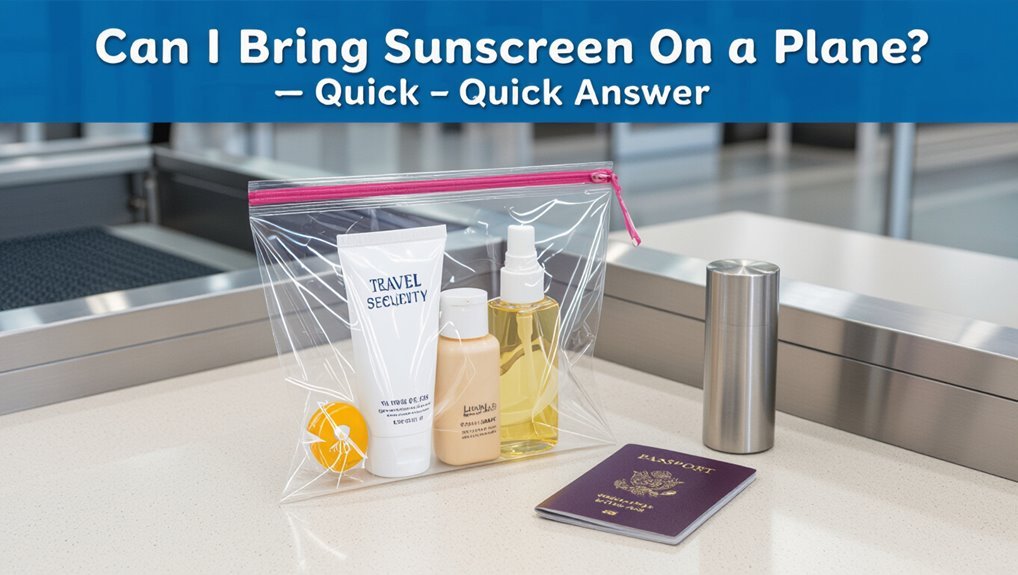
Wondering if you can bring sunscreen on a plane? Yes — you can bring sunscreen, but how you pack it matters.
Carry-on bottles must follow the 3-1-1 liquids rule and fit in a quart-sized clear bag; larger containers belong in checked luggage.
Aerosol sunscreens are allowed with quantity limits. Always check airline and TSA updates before travel.
Which Sunscreens Count as Liquids, Gels, or Aerosols?
Check the label and packaging to see whether your sunscreen is a lotion, gel, spray, or foam, since that determines if it’s treated as a liquid.
Note the active ingredient form too—chemical sunscreens are usually in creams or gels, while some mineral formulas come as thicker creams or powder sticks.
Knowing both the container type and ingredient form helps you pack to meet TSA rules.
Sunscreen Packaging Types
Most sunscreens fall into three clear packaging categories—liquids, gels/creams, and aerosols—and knowing which your product fits into determines whether you can bring it in carry-on luggage. Check volume limits and container type: liquids and gels count toward your quart bag, creams too, and aerosols are allowed if <100 mL and DOT-approved.
| Type | Example |
|---|---|
| Liquid | Pump bottle |
| Aerosol | Spray can |
Active Ingredient Forms
Sunscreen active ingredients come in two main forms—chemical (organic) molecules that dissolve into the lotion or spray and physical (mineral) particles like zinc oxide or titanium dioxide—and how they’re formulated affects whether the product behaves as a liquid, gel/cream, or aerosol for carry-on rules.
You’ll find sprays classed as aerosols, lotions and creams as liquids/gels, and sticks as solids, impacting TSA allowances.
How the 3.4-Oz (100 Ml) Carry-On Limit Applies to Sunscreen
If you’re bringing sunscreen in your carry-on, the TSA’s liquid rule treats it like any other liquid: each container must be 3.4 ounces (100 milliliters) or smaller and fit inside a single quart-sized, clear plastic bag with your other liquids.
You’ll need individual tubes or spray cans under the limit; multiples are allowed if they all fit in that one bag and pass inspection.
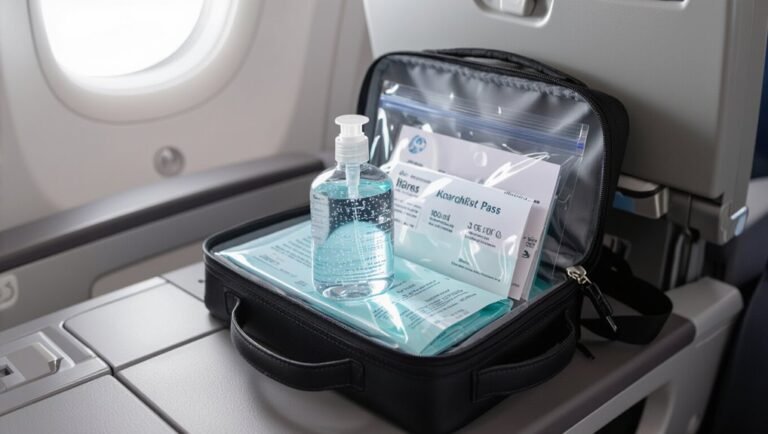
How to Pack Sunscreen in a Quart-Sized Carry-On Bag (TSA Rules)
Now that you know each container must be 3.4 ounces (100 ml) or less, here’s how to arrange those bottles and tubes inside the single quart-sized clear bag the TSA requires.
Lay flat, standing tube caps up to prevent leaks, and tuck small pumps or sprays alongside.
Lay bottles flat with caps up to avoid leaks; nest small pumps and sprays alongside for tidy packing.
Don’t overfill the bag; keep items visible and removable for screening.
Pack extras in checked luggage.
When You Must Put Sunscreen in Checked Luggage
If your sunscreen is larger than the TSA liquid limits, you’ll need to pack it in checked luggage.
You should also check aerosols or spray sunscreens, since some airlines restrict or prohibit them in the cabin.
And if you’re already carrying several liquids that would exceed your quart bag allowance together, move excess bottles to checked baggage.
When Sunscreen Exceeds Limits
When your sunscreen container goes beyond the TSA’s 3.4-ounce (100 milliliter) carry-on limit, you’ll need to stow it in checked luggage to comply with airline rules and avoid delays at security. Pack it in a sealed plastic bag, cushion against leaks, and declare if required. Check airline and destination rules for restrictions.
| Item | Action | Tip |
|---|---|---|
| Liquid | Check | Seal |
| Size | Pack | Cushion |
| Rule | Follow | Declare |
Aerosol Or Spray Sunscreen
Spray and aerosol sunscreens are treated differently from lotions because they’re pressurized — many airlines and the TSA limit or prohibit aerosols in checked bags due to fire risk.
So you’ll often have to pack them in checked luggage only if they exceed carry-on aerosol allowances.
Check label volume limits, declare large cans at check-in, and follow airline-specific rules to avoid confiscation or delays.
Packed With Other Liquids
Pack no more than the airline and TSA allow in your carry-on: liquids, gels and aerosols must fit within the 3-1-1 rule (containers of 3.4 oz/100 ml or less, all in a single quart-size bag).
So if your sunscreen would push you past that limit because it’s grouped with other liquids, you’ll need to stow it in checked baggage.
Consider:
- Count all liquid containers.
- Replace duplicates with travel sizes.
- Move excess to checked luggage.
- Declare unusual items at checkpoints.
Are Sunscreen Sticks Treated Differently by TSA?
Curious whether sunscreen sticks get different treatment from TSA? You’re in luck: solid sunscreen sticks are treated like solids, not liquids, so they generally bypass the 3.4-ounce (100 ml) carry-on liquid limit.
Keep them accessible for inspection; TSA officers may screen them separately. If they appear to be gel-like or raise concerns, expect standard security checks and possible additional screening.
Do Spray Sunscreens Count as Aerosols and Are They Allowed?
If you’re using spray sunscreen, know it’s fundamentally a liquid dispensed from a pressurized can or pump and often labeled as an aerosol.
The TSA generally classifies these as aerosols and lets them in carry-on bags only if each container follows the 3.4 oz (100 mL) rule and fits inside your quart-sized liquids bag.
Check the label and pack larger spray sunscreens in checked baggage to avoid confiscation.
Spray Sunscreen Definition
Aerosol sprays have a specific meaning for airlines and security checkpoints, and spray sunscreens usually fall into that category because they release fine particles from a pressurized can or pump; whether you can bring them depends on the container type and where you’re flying—carry-on limits typically restrict pressurized aerosols to 3.4 ounces (100 ml) or less in a clear quart-sized bag, while checked baggage may allow larger pressurized cans but still has quantity and flammability rules.
- Definition: pressurized liquid producing mist.
- Forms: pump, continuous spray, or aerosol can.
- Labeling: check “aerosol” or hazard symbols.
- Packing: follow carry-on size limits or checked-bag restrictions.
TSA Aerosol Classification
Having defined spray sunscreen types and labeling, you’ll want to know how the TSA actually treats them:
TSA classifies many spray sunscreens as aerosols. You’re allowed to bring them, but they fall under aerosol rules and security screening.
Expect inspection; agents may require removal from bags. Non-flammable, travel-sized sprays are generally permitted, while large or pressurized containers could be restricted or placed in checked baggage.
Carry-On Quantity Limits
One key rule to remember is the 3-1-1 carry-on limit: liquids, gels, and sprays must fit in containers of 3.4 ounces (100 milliliters) or less and all must fit in a single clear quart-sized bag that you can pull out for screening.
You should:
- Treat spray sunscreens like aerosols.
- Keep each under 3.4 oz.
- Pack in the quart bag.
- Check larger cans.
How to Read Sunscreen Labels to Spot Liquid vs. Solid Formats
When you check a sunscreen label, focus on the product format lines and ingredient list to tell if it’s liquid or solid: look for words like “lotion,” “cream,” “gel,” or “spray” (liquid) versus “stick,” “bar,” or “lip balm” (solid).
Scan the ingredients—water (aqua) near the top usually signals a liquid formula, while oils, waxes, or petrolatum indicate a solid or semi-solid.
Read net weight.
What to Do With Multiple Sunscreen Items at Security
If you’re carrying several sunscreens, organize them before you reach the security checkpoint so screening goes smoothly:
- Separate liquids in a clear quart-sized bag and cap tightly.
- Keep creams and sticks accessible for quick inspection.
- Place aerosols upright and label visible.
- Tell the officer you have multiple sunscreens to speed up screening and avoid surprises.
Can You Bring Travel-Size Sunscreen Samples Through TSA?
Make sure all your small sunscreens fit inside a single clear quart-sized bag to avoid delays.
Pack them accessibly so you can remove the bag quickly at the security checkpoint.
TSA Liquid Rule
Because sunscreens are liquids or creams, the TSA 3-1-1 rule applies and you’ll need travel-size containers if you want to carry them through security.
Follow these steps to comply:
- Pack samples in clear quart bags.
- Limit containers to carry-on only.
- Present the bag separately at screening.
- Remove oversized items before checkpoint for inspection.
Allowed Size Limits
Most travel-size sunscreen samples meet TSA’s 3-1-1 limits, so you can usually carry them through security as long as each container is 3.4 ounces (100 milliliters) or less and they all fit inside a single clear quart-sized bag.
You can pack multiple small bottles, but total quantity must fit the bag and pass screening; larger tubes belong in checked baggage.
Packing Tips
When packing travel-size sunscreen samples for carry-on, stick to the TSA 3-1-1 rule: each container must be 3.4 ounces (100 ml) or less, and all your liquids should fit inside a single clear quart-sized bag that you can easily remove for screening.
- Label bottles clearly.
- Seal caps with tape.
- Pack bag accessibly.
- Check airline or international variations.
Are Alcohol or Flammable Sunscreens Restricted?
Curious whether alcohol– or solvent-based sunscreens can fly with you?
You can bring nonflammable, alcohol-containing lotions in carry-on within the 3.4 oz (100 ml) liquid rule.
Aerosol or solvent-heavy sprays labeled flammable are restricted or forbidden in carry-on and may be limited in checked baggage per airline rules.
Always check labels and airline policy before travel.
How Airport Security Screens Sunscreen Products
When you bring sunscreen to the airport, TSA’s 3.4-ounce (100 ml) carry-on liquid rule and clear quart‑size bag will determine what you can keep with you.
Security uses X-ray machines and sometimes hand‑inspects or tests containers, so be ready to pull bottles out or show them to an agent.
For larger or flammable sunscreens, you’ll usually need to pack them in checked baggage and follow airline rules.
TSA Liquid Carry-On Limits
Although sunscreen is essential, TSA treats it like any other liquid: you’ll need to follow the 3-1-1 rule for carry-ons.
Pack wisely, or check larger tubes.
- 3.4 oz (100 ml) max per container
- All containers fit one quart-sized clear bag
- One bag per passenger
- Declare oversized or medically necessary lotions at security checkpoints
Screening Machines And Methods
Because sunscreen can look different on X-ray and other scanners depending on its packaging and consistency, you’ll want to be prepared to show it and possibly remove it from your bag.
Security officers may inspect tubes, bottles, spray cans, and sticks visually or with handheld detectors. If unclear, they might open containers or test samples; comply promptly to avoid delays and follow officer instructions.
Checked Baggage Considerations
If you pack sunscreen in checked baggage, expect it to be screened differently than carry-on items and subject to bulk liquid rules and airline or country-specific restrictions.
You should:
- Declare large containers if requested.
- Secure caps and seal leaks.
- Check airline and destination rules.
- Pack in sturdy, cushioned areas to prevent damage during screening and handling.
US TSA vs. Other Countries: International Differences
When you fly internationally, know that the TSA’s 3-1-1 liquid rule and sunscreen allowances are just one country’s approach—other nations may set different carry-on limits, security screening practices, or duty-free exceptions, so check the rules for each airport and airline before packing. You’ll need to verify local limits, pack accordingly, and declare purchases when required.
| Country | Typical rule |
|---|---|
| EU | 100 ml limit |
| UK | Similar to EU |
| Japan | Variable |
Airline Policies That Affect Sunscreen on Flights
Check your airline’s carry-on limits before packing sunscreen, since some carriers enforce stricter liquid rules than TSA.
If you need larger bottles, you might’ve to stow them in checked baggage and confirm the airline’s allowance for liquids and size/weight limits.
Knowing both carry-on and checked baggage policies will help you avoid delays or confiscation at the gate.
Airline Carry-On Limits
Though airlines vary, most follow strict carry-on size and quantity rules that affect how much sunscreen you can bring onboard.
You’ll need to fit liquids into your permitted bag and follow the 3-1-1 rule.
Consider these points:
- Bottle size limit (100 mL/3.4 oz).
- Quart-size clear bag for all liquids.
- Bag count limits.
- Gate-check exceptions vary by carrier.
Checked Baggage Allowances
1 important thing to know is that checked baggage rules usually let you pack larger sunscreen containers than carry-on limits allow.
You should still check your airline’s weight and size limits, and declare anything unusual.
Aerosol sunscreens may have quantity or packaging restrictions in checked bags, so confirm with the carrier to avoid disposal or fees.
Pack securely to prevent leaks.
Carrying Sunscreen When You Only Have a Carry‑On
If you’re flying with only a carry‑on, you’ll need to pack sunscreen so it meets the TSA’s liquids rule and still protects you when you land.
Carry a travel‑size (≤3.4 oz) bottle in a clear quart bag. Follow these steps:
- Choose SPF 30+.
- Use a leak‑proof container.
- Place near electronics for inspection.
- Have a backup sample pack.
Packing Sunscreen When Checking a Bag for Long Trips
When you’re checking a bag for a longer trip, you can bring full‑size sunscreen but should pack it to avoid leaks, pressure issues, and delays at baggage handling.
Place bottles upright in sealed plastic bags, cushion them with clothing, and cap tightly.
Label fragile or liquid items if helpful, and consider storing creams in hard containers to minimize crushing during transit.
Best Sunscreen Formats for Air Travel Convenience
You’ll find compact travel tubes are TSA-friendly and slip easily into carry-on pockets or toiletry bags.
Solid sun sticks are even simpler — they won’t leak and you can rub them on without getting sunscreen on your hands.
Both formats make reapplying mid-flight or upon landing quick and mess-free.
Compact Travel Tubes
You’ll appreciate control, measured doses, and easy reapplication.
Consider these tips:
- Choose ≤3.4 oz (100 ml)
- Seal caps tightly
- Store upright
- Pack in a clear quart bag for screening
Solid Sun Sticks
| Benefit | TSA | Tip |
|---|---|---|
| Spill-proof | Allowed | Pack upright |
| Mess-free | 3-1-1 friendly | Reapply often |
| Precise | Pocketable | SPF 30+ |
Tips for Packing Sunscreen in a Carry‑On Toiletry Kit
Because airports enforce strict liquid limits, plan your carry-on toiletry kit so sunscreen stays accessible and compliant:
- Choose travel-size (≤3.4 oz) bottles or single-use sachets.
- Put sunscreen in a clear quart-sized bag with other liquids.
- Keep the bag top-level for quick screening access.
- Label SPF and reapply instructions so you’re ready after security.
How to Avoid Delays at TSA When Carrying Sunscreen
Keep sunscreen in travel-size bottles that meet the TSA 3-1-1 rule so you won’t be asked to toss it.
Put those bottles in a clear, easily reachable bag and place it on top of your carry-on for screening.
Being prepared and accessible will speed you through the checkpoint.
Pack Travel-Size Bottles
Bring a travel-size sunscreen in a clear quart bag so you can quickly show TSA officers and move through the checkpoint without delays.
You should:
- Choose bottles 3.4 oz (100 ml) or smaller.
- Seal caps tightly and use leak-proof containers.
- Label bottles if possible for faster inspection.
- Group with other liquids to avoid separate screening.
Keep Sunscreen Accessible
If you want to breeze through security, keep your sunscreen where you can pull it out quickly—think the top of your carry-on or an outer pocket of your travel bag—so you won’t be fishing around when a TSA officer asks to see liquids.
Have your quart-size bag ready, place all small bottles inside, and present them separately at the checkpoint to speed inspection and avoid delays.
Can You Bring Sunscreen Wipes or Towelettes on a Plane?
Curious whether sunscreen wipes or towelettes count as liquids for air travel? You can bring single-use sunscreen wipes in carry-on, but check packaging—wet wipes are treated like liquids if saturated.
Follow these tips:
- Keep original sealed packaging.
- Pack in quart-size bag if visibly wet.
- Store unused packs in checked luggage if concerned.
- Declare if agent asks.
Does Sunscreen Formula (Mineral vs. Chemical) Affect TSA Rules?
Whether your sunscreen is mineral (zinc or titanium-based) or chemical doesn’t change the TSA’s basic rules, but you should know how the formula often determines its form.
Mineral sunscreens are commonly thicker or in stick/solid formats that may bypass some liquid restrictions, while chemical ones are more often lotions or sprays that count toward your liquids limit.
When you pack, consider both the product’s state (liquid vs. solid) and how it will appear during security screening.
Mineral Vs. Chemical Basics
Although mineral and chemical sunscreens work differently on your skin, neither formula changes TSA rules for carry-on liquids. You should still follow size limits and packing guidelines.
Consider these basics:
- Mineral uses zinc/titanium dioxide.
- Chemical absorbs UV with organic compounds.
- Both protect skin when applied properly.
- Choose based on skin type, not travel rules.
Liquid Versus Solid Forms
If you’re packing sunscreen for a flight, the TSA cares about whether it’s a liquid, gel, cream or solid — not whether it’s mineral or chemical.
You’ll follow the 3-1-1 rule for liquids: containers 3.4 ounces (100 mL) or less in one quart-sized bag.
Solid stick sunscreens are usually treated as non-liquid, so you can pack larger sticks in carry-on without that restriction.
Security Screening Considerations
Anyone packing sunscreen for a flight should know that the TSA doesn’t base its liquid rules on whether a product is mineral (zinc oxide/titanium dioxide) or chemical — it looks at the product’s physical form instead.
You should:
- Pack liquids in 3.4 oz (100 ml) containers.
- Place them in a clear quart bag.
- Expect separate screening at checkpoints.
- Declare unusual items to officers.
Traveling With Medicated or Prescription Sunscreen: Rules
When you need medicated or prescription sunscreen, TSA and airline rules still apply, but there are helpful exceptions:
Carry medications in original labeled containers, bring a doctor’s note or prescription if possible, and declare them at screening.
Liquid limits may be waived for medically necessary items, but you should separate them for inspection and follow airline guidelines for checked or carry-on storage.
Bringing Sunscreen for Kids and Infants Through Security
If you’re traveling with kids or infants, know the TSA limits on sunscreen sizes and how exceptions may apply for children’s products.
You can usually bring small sunscreen containers in carry-on bags, but larger or medically necessary amounts might need to be declared at security.
Also plan for easy application: keep wipes or a travel-size lotion handy and tell the officer if you need to apply sunscreen right after screening.
Sunscreen Size Limits
TSA allows you to bring sunscreen for kids and infants through security, but size and packaging rules change depending on whether it’s a liquid, cream, or aerosol and on whether you’re carrying it in carry‑on or checked baggage.
Follow these limits and tips:
- Carry-on liquids/creams: 3.4 oz (100 mL) per container in a quart bag.
- Aerosols: must be 3.4 oz or less in carry-on.
- Larger sizes go in checked baggage.
- Label and separate baby-specific products for easy screening.
Applying Through Security
Because kids squirm and lines move fast, plan to apply sunscreen before you reach the security checkpoint so you’re not holding up the line; you can also bring a small, travel‑size bottle or spray in your carry‑on to reapply after screening if needed.
Keep wipes and mineral stick sunscreen for quick touchups; liquids over 3.4 oz go in checked bags, and be ready to show baby items if asked.
TSA Rules for Baby Formula, Meds, and Medical Exemptions
When you’re traveling with breast milk, formula, or medications, airport security makes clear exceptions so you can bring what your child or medical needs require; you should declare these items at the checkpoint, separate them from your carry-on, and be prepared for additional screening.
Follow these tips:
- Tell the TSA officer.
- Pack clearly labeled containers.
- Allow extra screening time.
- Bring prescriptions or doctor notes.
What to Do With Spray Sunscreens That Exceed Aerosol Limits
If your spray sunscreen comes in a can larger than airport aerosol limits, don’t just toss it in your carry-on—plan for checked luggage or bring a compliant alternative.
You can transfer sunscreen into travel-size spray or lotion containers under 3.4 ounces, buy compliant bottles after security, or pack the oversized can in checked baggage following airline hazardous-material rules.
Check limits before travel.
What Happens If TSA Confiscates Your Sunscreen Item?
If TSA confiscates your sunscreen, it’s usually because it violates the liquids or aerosol rules or poses a safety concern.
You can ask an agent why it was taken and whether you can return it after screening or pick it up later.
If neither option’s available, you’ll need to replace it at your destination or buy an approved size at the airport.
Why Items Are Confiscated
Because TSA officers must keep security consistent, they’ll confiscate sunscreens that don’t meet the rules — and you’ll be told why and given options.
You should understand common reasons so you can avoid issues:
- Over 3.4 ounces (100 mL) liquid/gel size.
- Unlabeled or suspicious packaging.
- Excess quantity suggesting commercial intent.
- Item fails security screening tests.
Options After Confiscation
1 common outcome is that TSA will dispose of the sunscreen and tell you why, but you’ll also be offered simple options like placing it in checked baggage (if time allows), mailing it home, or surrendering it permanently. You can ask to speak with a supervisor, accept disposal, or follow posted procedures to retrieve receipts.
| Option | What to expect |
|---|---|
| Disposal | Item thrown away |
| Checked baggage | Accepted if time allows |
| Mail home | Possible at your expense |
| Surrender | Permanent loss |
Repacking Tips After an Airport Security Check
After security inspects your sunscreen and other liquids, quickly reassemble your toiletry bag so items sit upright and zippers close easily; this prevents leaks and speeds up any additional checks.
Then follow these steps:
- Wipe caps and seals before packing.
- Place liquids in a clear, resealable bag.
- Cushion bottles with cloth or clothing.
- Keep receipts or labels visible for verification.
Can You Buy Sunscreen Past Security or on the Plane?
If you forget your sunscreen, you can often buy a travel-sized bottle in airport shops or pick up SPF wipes and sprays at many terminals.
Some airlines even sell small skincare items on board. Check shop hours and duty-free limits; liquids bought past security can usually board.
Prices vary, so consider bringing SPF from home when possible to save money and guarantee your preferred protection.
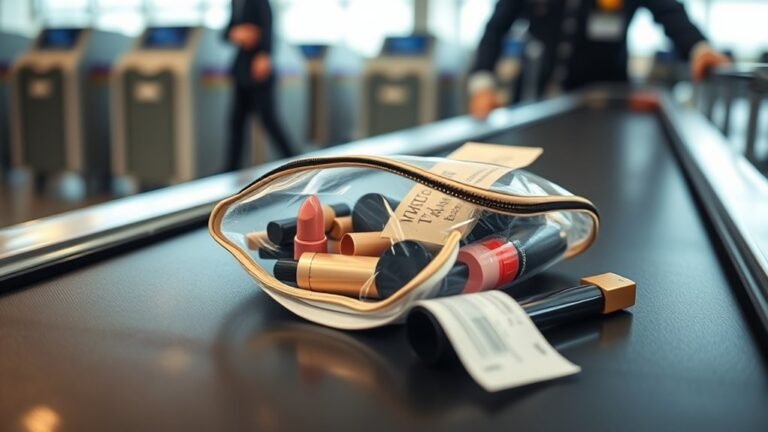
How to Carry Sunscreen in a Clear Toiletry Bag to Speed Screening
Pack one clear, quart-sized toiletry bag and place your sunscreen upright and visible so TSA officers can quickly verify it meets the 3.4-ounce (100 ml) limit;
keep tubes and bottles closed and tucked next to travel-sized lotions or wipes to avoid spills and speed inspection.
- Put sunscreen front-facing.
- Group similar items.
- Seal gaps with wipes.
- Keep bag accessible.
Combining Sunscreen With Other Liquids Under the 3.4-oz Rule
If you’re packing sunscreen with other liquids, remember each container must be 3.4 oz (100 ml) or less.
You’ll need to fit all those small bottles into a single quart-sized clear bag, so plan what you really need.
Keep in mind medications are allowed extra exceptions, so pack prescription creams separately and declare them if asked.
Combining Small Containers
When you’re trying to fit sunscreen into your carry-on, remember the 3.4‑ounce rule applies to each individual container, not the total of all your liquids—so you can’t merge multiple small bottles into one larger one to get around it.
You should:
- Keep each bottle ≤3.4 oz.
- Use labeled containers.
- Avoid combining different products.
- Present them in a clear bag.
Single Quart Bag Limit
You can carry multiple 3.4‑ounce containers—sunscreen, toothpaste, contact solution—so long as they all fit inside a single clear quart‑size bag.
TSA limits the bag itself to one per passenger, so organize your liquids to avoid overflow and delays at screening.
Zip the bag fully, pack upright if possible, and consolidate duplicates to maximize space; remove it for separate screening.
Exceptions For Medications
Alongside your quart bag of travel‑size toiletries, TSA allows medical liquids, medications and certain creams to be carried in amounts greater than 3.4 ounces; this matters if you need a prescription sunscreen or have bulk meds that won’t fit the bag.
You should:
- Declare oversized meds at screening.
- Bring prescriptions or doctor’s note.
- Keep items accessible.
- Pack extras in checked luggage when possible.
How to Show Prescription or Specialty Sunscreen to TSA
Medical documentation makes the checkpoint process smoother: carry your prescription label, a doctor’s note, or original pharmacy packaging to show that your sunscreen is prescribed or medically necessary. Present items clearly, answer TSA questions, and request inspection if needed.
| Item | Purpose |
|---|---|
| Prescription label | Verifies medication |
| Doctor’s note | Confirms necessity |
| Pharmacy packaging | Shows dispensed item |
| Bottle | Identifies product |
Bringing Sunscreen in Carry‑On During International Connections
When you have international connections, plan for both the departure and arrival countries’ liquid rules so your sunscreen stays with you through security and transfers.
You should:
- Check each country’s 100ml/3.4oz limits.
- Pack compliant bottles in a clear bag.
- Keep receipts or prescriptions if needed.
- Move sunscreen to checked baggage if a connection enforces stricter limits.
How to Declare Large Sunscreen Quantities at Security
If you’re carrying more than the allowed carry-on limit, tell the TSA or local security officer as soon as you reach the checkpoint so they can advise you on declaration, inspection, or moving the sunscreen to checked baggage.
Be prepared to show receipts, explain purpose (medical or bulk), and open containers if requested. Follow officer instructions; noncompliant items may be confiscated or require repackaging.
Packing Sunscreen for Sports Trips: Spray vs. Stick vs. Cream
After you handle declaration and packaging at the checkpoint, pick the sunscreen format that works best for your sport and travel setup.
Choose based on application speed, sweat resistance, and portability:
Pick sunscreen by how fast it goes on, how it handles sweat, and how easy it is to carry.
- Spray — quick coverage, watch wind and inhalation.
- Stick — precise, pocket-friendly, great for face.
- Cream — best for dry skin, full-body protection.
- Gel — cooling, good for high-activity zones.
Travel-Size Sunscreen Brands and Formats That Pass TSA
Pick travel-size sunscreens that meet TSA’s 3-1-1 rule and suit how you’ll apply them: look for 3.4 oz (100 ml) or smaller spray, stick, cream, or gel formats from reputable brands like Neutrogena, La Roche-Posay, EltaMD, Sun Bum, and Supergoop!
Pack tubes or sticks in your quart bag, label SPF clearly, and choose leakproof caps or solid sticks to avoid spills and security hassles.
Travel Tips for Reef‑Safe and Eco‑Friendly Sunscreens
Because some sunscreens harm coral and local wildlife, choose reef-safe options and packaging that minimize waste when you travel. You’ll protect ecosystems and pack smart.
- Buy mineral formulas with zinc or titanium dioxide.
- Pick recyclable or refillable bottles.
- Bring solid sunscreen sticks to cut leaks.
- Check ingredient lists for oxybenzone and octinoxate-free labels before you fly.
How Temperature and Pressure Affect Sunscreen in Checked Bags
Keeping sunscreen reef-safe and well-packed is important, but you should also think about how cabin altitude and cargo-hold conditions affect the product when it’s checked.
Pressure changes can cause pumps or sealed tubes to expand or leak. Extreme heat can degrade active ingredients and alter texture, while cold may thicken formulas.
Store bottles upright, avoid fragile containers, and expect modest performance shifts after travel.
Tips to Avoid Leaks and Mess From Sunscreen in Luggage
1 simple step will cut the chances of sunscreen making a mess in your luggage: seal and cushion every container. You’ll want to:
- Use leakproof travel bottles with tight caps.
- Wrap caps in tape or plastic wrap.
- Place bottles in zip bags, squeezed of excess air.
- Nest bottles among soft clothes to absorb any spills and prevent crushing.
How to Store Sunscreen for Multi‑Day Travel Without Refrigeration
After you’ve sealed and cushioned your sunscreen for the trip, think about how you’ll keep it stable and effective over several days without refrigeration.
Store bottles upright in a cool, shaded part of your bag, away from direct sunlight and heat sources. Use insulated pouches or wrap in clothing to buffer temperature swings.
Check texture daily, and discard if smell or consistency changes.
Packing After‑Sun and Sunscreen Replacement Items for Flights
When you pack sunscreen, don’t forget after‑sun care and quick replacements so you’re ready for burns, smudges, or lost bottles midtrip.
Pack travel‑size aloe gel, a small lotion, and resealable plastic bags. Consider backups and permits for liquids you’ll carry.
- Aloe vera gel
- Moisturizing lotion
- Travel sunscreen tube
- Resealable bag for leaks
Common TSA Checkpoint Misconceptions About Sunscreen
Although TSA rules are straightforward, a few myths about sunscreen at checkpoints keep circulating and can make packing feel confusing, so it helps to know what’s true.
You don’t need a prescription to carry sunscreen, aerosol SPF follows liquid limits, travel‑size bottles must fit the quart bag, and unopened retail tubes aren’t exempt.
Declare oversized medical sunscreen to the officer.
One-Page Sunscreen Packing Checklist for Flights
Now that you know the rules and common myths, here’s a compact, one-page checklist to make packing sunscreen for flights quick and stress-free.
- Carry-on: 3.4 oz (100 ml) tube in clear quart bag.
- Checked bag: larger bottles OK, seal to prevent leaks.
- Spray cans: follow aerosol rules, pack upright.
- Extras: SPF lip balm, compact after‑sun in carry‑on.
Packing Scenarios: Weekend, International, and Carry‑On Only
3 common trip types — a quick weekend, an international journey, and carry-on‑only travel — call for different sunscreen strategies.
For a weekend, pack a travel‑size spray or stick in checked or carry‑on.
For international trips, check local restrictions, bring sealed full‑size in checked luggage and a compliant travel bottle for your bag.
For carry‑on only, stick to 3.4 oz (100 ml) containers.
How to Stay Updated on Changing TSA and Airline Rules
Because rules can shift quickly, make checking TSA and airline policies part of your pre-trip routine so you don’t get caught off guard at the airport.
Stay current by:
- Visiting TSA.gov for official updates.
- Checking your airline’s baggage rules page.
- Following TSA and airlines on social media.
- Signing up for airline alerts and travel newsletters.
Confirm limits before packing.
Practical Pre‑Flight Checklist for Sunscreen and Sun Care
Before you head to the airport, run a quick checklist to make sure your sunscreen and sun-care items meet TSA rules and fit your travel needs. Pack ≤3.4 oz (100 ml) containers in a quart bag, label prescriptions, and stow larger lotions in checked baggage. Reapply after flights, and carry lip balm and aloe wipes.
| Item | Size | Action |
|---|---|---|
| Sunscreen | ≤3.4 oz | Quart bag |
| Lotion | >3.4 oz | Checked bag |
| Lip balm | Any | Carry-on |
Where to Find Official TSA Guidance and Airline Policy Links
Want the official word on sunscreen rules? Check authoritative sources before travel so you’re compliant.
- TSA official website — search “sunscreen” for carry‑on/liquid limits.
- TSA Contact Center — ask via phone or social media for clarifications.
- Your airline’s baggage policy page — some carriers add restrictions.
- Airport security pages — local rules or temporary notices may apply.
Frequently Asked Questions
Can I Ship Extra Sunscreen to My Destination Ahead of Travel?
Yes — you can ship extra sunscreen ahead. Choose a reliable carrier, check their hazardous materials rules for aerosol or flammable ingredients, package securely, label clearly, secure the parcel, and track delivery to guarantee it arrives safely.
Are Sunscreen Deodorants or Antiperspirants Subject to Liquid Rules?
Yes — if the sunscreen deodorant or antiperspirant’s consistency’s liquid, gel, cream, or aerosol, you’ll need to follow the 3-1-1 liquid rule; solid stick antiperspirants usually aren’t subject to those liquid restrictions.
Do Airport Medical Stations Provide Sunscreen if Mine Is Confiscated?
Usually they don’t stock sunscreen, but some airport medical stations might have sample tubes or can direct you to nearby shops. If yours was confiscated, ask the station and airport staff — they’ll help you find or buy replacement.
Can I Bring Powdered Sunscreen or Sunscreen Capsules on a Plane?
Yes — you can bring powdered sunscreen or sunscreen capsules in your carry-on; they’ll need screening and may be limited if over the TSA powder threshold (12 ounces/350 mL), so pack excess in checked luggage to avoid issues.
Are There Limits for Sunscreen Carried for a Group or Family Trip?
Yes — you can bring sunscreen for a group, but you’ll need to follow carry-on liquid limits: each passenger’s containers must be 3.4 ounces (100 ml) or less, fit in a quart bag, or be packed in checked luggage.
Conclusion
You can bring sunscreen on a plane, but remember the 3.4-oz (100 ml) carry-on limit for liquids, gels, and aerosols—larger bottles go in checked luggage. Keep travel-size sunscreen in your quart-sized clear bag, and declare or separate anything that looks liquid at security. For long trips or international flights, check airline and destination rules beforehand. Pack reef-safe and broad-spectrum options, and carry lip balm and after-sun care to stay protected during travel.