Can I Replace the Wheels on My Luggage
Yes — you can usually replace your luggage wheels yourself or have a repair shop do it, and it often costs far less than buying new baggage. Check wheel type (bolt-on, riveted, snap-in), measure diameter and axle, and weigh parts plus tool or labor costs against bag value. DIY saves money if you’ve got tools and skill; pros offer speed and warranty. Keep going for tips on choosing parts, measuring, and installation.
Why Replace Luggage Wheels?
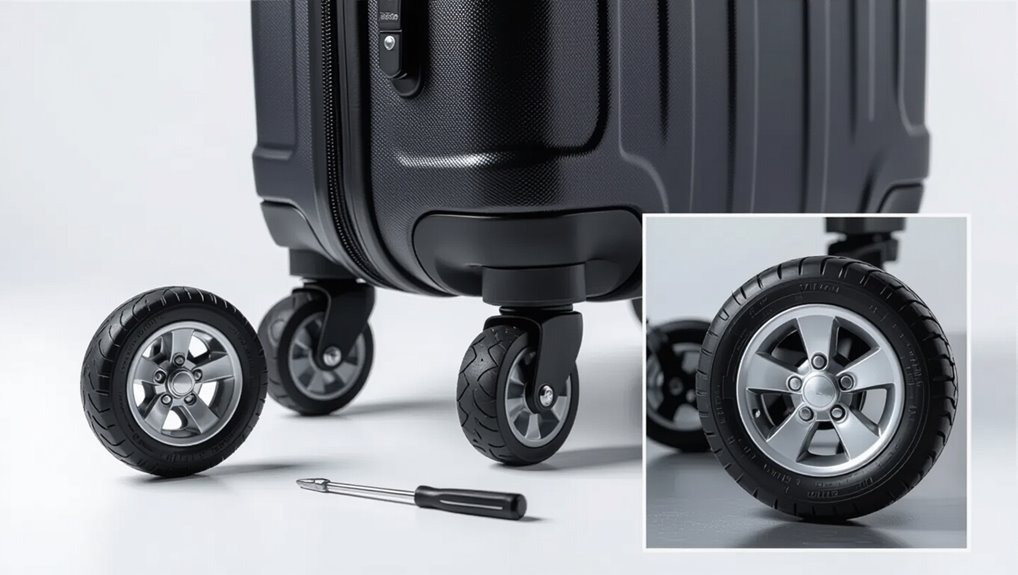
Wheels wear out, break, or seize up, and when they do they make your suitcase hard to steer and easy to damage; replacing them restores smooth mobility and prevents further stress on zippers and handles.
You’ll save money versus buying new luggage, avoid damaged contents, and reduce travel frustration.
New wheels improve maneuverability, protect structural seams, and extend the bag’s usable life.
Quick Answer: Can You Replace Luggage Wheels?
If your suitcase is struggling because of worn or broken casters, you’ll be glad to know you can usually replace luggage wheels rather than buy a whole new bag.
You can swap wheels yourself or hire a cobbler or luggage repair shop. Parts are often available online or from manufacturers.
Check mounting style and measurements to ascertain compatibility before ordering replacements.
Decide: Repair Wheels or Buy a New Bag?
You’ll want to weigh the cost versus the value of fixing a wheel—if repairs approach half the price of a new bag, replacement often makes more sense.
Consider repair complexity too; simple wheel swaps are cheap, but frames, axles, or hard-shell damage can be time-consuming and costly.
Use those two factors to decide whether a quick fix or a fresh bag gives you the best long-term value.
Cost Versus Value
Deciding whether to repair your luggage or replace it comes down to comparing the repair cost, the bag’s remaining life, and how much convenience and reliability matter to you.
Tally parts and labor versus a new bag’s price. If repair is cheap and the carry holds up, fix it.
If costs approach replacement or reliability’s doubtful, buy new for peace of mind and fewer surprises.
Repair Complexity
When evaluating whether to repair your luggage wheels or buy a new bag, weigh the mechanical difficulty and required tools against your comfort level and budget.
Simple wheel replacements can be quick DIY jobs, but damaged axles, molded housings, or welded frames often need a pro—or a new suitcase.
Inspect mounting hardware, check for proprietary parts, estimate labor or repair shop costs, and decide if replacement yields reliable longevity.
When Replacing Wheels Saves Money
If your suitcase rolls unevenly or squeaks but the shell and handle are still sound, replacing the wheels can cost far less than buying a new bag.
You save when damage is isolated, brand or model parts are available, and labor is minimal.
Compare wheel kit and repair costs to current bag value, include shipping or shop fees, then decide.
Types of Luggage Wheels and Why They Matter
Repairing wheels can save you money, but choosing the right replacement depends on understanding the types of luggage wheels and how they perform.
You’ll encounter molded plastic, polyurethane, and rubber varieties; each differs in durability, noise, and floor grip.
Match material and mounting style to your travel habits, surface types, and weight needs to guarantee smoother, longer-lasting repairs.
Spinner vs. Inline Wheels: How to Tell
You can tell spinners from inline wheels by how they sit and move: spinners swivel on multi-directional bearings while inline wheels run front-to-back on fixed axles.
Check the bearing and swivel mechanism to see if the wheel rotates freely around a vertical axis or just rolls forward.
That difference explains why spinners offer greater maneuverability and inline wheels usually feel more stable.
Wheel Orientation And Movement
Start by looking at how the wheels sit and move: spinners swivel 360 degrees on mounted casters so they glide beside you, while inline (roller) wheels are fixed and roll only forward and back. Decide based on handling: spinners offer maneuverability; inline wheels give straight tracking and durability.
| Type | Movement |
|---|---|
| Spinner | 360° swivel |
| Inline | Forward/back |
Bearing And Swivel Mechanism
While examining a luggage wheel, look closely at the hub and axle to tell spinners from inline wheels: spinners have a visible swivel mechanism and bearings that let the wheel rotate around a vertical post, whereas inline wheels sit on a fixed axle and rely on simple ball or roller bearings for forward motion only.
- Check the pivot and race
- Spot sealed vs. open bearings
- Note mounting plate vs. axle
Stability And Maneuverability Differences
Although both spinner and inline wheels let you move luggage, they deliver different balances of stability and maneuverability that affect how the bag handles in real situations.
You’ll find spinners offer effortless turning and upright balance on smooth floors but can wobble on uneven terrain.
Inline wheels track straight, resist tipping and roll better over rough surfaces, though they need tilting to steer.
Fixed, Double, and Recessed Wheels Explained
Curious which wheel type will make your suitcase easier to roll and repair? You’ll weigh tradeoffs: maneuverability, durability, and repair access.
- Fixed: simple, sturdy, best for straight-line rolling, easier to replace.
- Double: smoother turns, extra support, slightly more complex to swap.
- Recessed: protected from knocks, neater profile, can be harder to access for repairs.
Common Wheel Materials: Plastic, Urethane, Rubber, Metal
Pick the right wheel material and you’ll notice a big difference in how your suitcase rolls, sounds, and holds up over time.
Plastic wheels are cheap and lightweight but chip easily.
Urethane offers smooth, quiet rolling and good wear resistance.
Rubber absorbs shock and grips uneven surfaces.
Metal cores or bearings boost durability and load capacity but may add weight and noise.
How Wheel Mounts Affect Replacement Options
Now that you’ve considered wheel materials, the way those wheels attach matters just as much for replacement.
Now that wheel materials are set, attachment type matters equally for replacement and proper fit.
You’ll check mount types to know what fits and what tools you’ll need.
- Bolt-on: secure but needs correct bolt size.
- Riveted: often permanent; may require drilling.
- Snap-in: easy swap if you find matching housing.
Match mount, not just wheel, for a proper fix.
How to Identify Your Wheel Type in Minutes
Start by examining the wheel mounting style to see if it’s bolted, riveted, or housed in a wheel pod.
Measure the wheel diameter and width so you can match replacements accurately.
Finally, check how the wheel attaches—axle bolt, clip, or snap-fit—so you know what hardware you’ll need.
Examine Wheel Mounting Style
1 clear way to speed repairs is to examine how your luggage wheel is mounted—it’s the key to identifying the replacement you need.
Check attachment type, fasteners, and housing fit so you can order the right part.
- Exposed axle vs. recessed plate
- Screw-in stem vs. riveted mount
- Removable module vs. glued housing
Measure Wheel Dimensions
A quick set of measurements will tell you which replacement wheel fits: grab a tape or caliper and note the wheel diameter, tread width, axle diameter, and the distance between mounting holes (or the stem length).
Then compare those numbers to the part specs so you don’t order the wrong size. Measure twice, record values, and photograph dimensions for reference when shopping or contacting suppliers.
Check Wheel Attachment Type
Once you’ve recorded the wheel measurements, check how the wheel fastens to your suitcase so you know what replacement to buy.
Inspect attachment points: screws, rivets, or axle mounts. Note orientation and whether the housing is integral or removable.
Then match replacement type and hardware. Consider professional help if rivets are involved.
- Screw-mounted
- Riveted
- Axle/housing-mounted
Finding the Model or Part Number on Your Suitcase
Wondering where to start? Check labels, tags, and the interior seam for brand and model codes. If none, inspect the zipper tape, handle base, or a sewn-in care tag. Note serials and SKU numbers; take photos.
| Location | What to look for |
|---|---|
| Exterior tag | Brand/model |
| Interior seam | Serial/SKU |
| Handle base | Stamped code |
| Zipper tape | Printed code |
Measuring Wheels, Axles, and Mounts for a Match
Measure the wheel diameter so you match rotation and clearance.
Check the axle thickness to guarantee a snug fit and proper bearings.
Inspect the mounting pattern on the suitcase to confirm bolt spacing and orientation.
Measure Wheel Diameter
Start by getting a clear wheel measurement so you can match replacements accurately: Measure across the tire from edge to edge at the widest point.
Record whether it’s inside or outside diameter. Note mount style separately.
- Use a ruler or caliper for precision.
- Measure twice to confirm.
- Write down metric and imperial values for sourcing.
Check Axle Thickness
Next, check the axle thickness so replacement wheels fit snugly and the mount stays secure: remove the wheel if possible and use a caliper or micrometer to measure the axle diameter at its narrowest point, recording the result in millimeters and inches.
If the axle is threaded or has a shoulder, note thread pitch and any step-downs too. Then compare measurements to replacement specs before ordering.
Inspect Mounting Pattern
Before you order replacement wheels, verify the mounting pattern so the wheel, axle, and bracket line up perfectly. Measure carefully and note orientation, hole spacing, and bracket type.
Then:
- Measure axle diameter and length.
- Measure hole center-to-center spacing on the mount.
- Check bracket shape and screw size.
Match these to the replacement specs so installation is secure and wobble-free.
How to Photograph Wheels to Order Replacements
Want accurate replacements fast? Photograph each wheel from three angles: front, side, and the wheel hub where it mounts.
Include a clear close-up of any part numbers, bearings, or broken bits. Place a ruler or coin for scale and shoot in bright, diffuse light on a neutral background.
Label photos with wheel position (front-left, rear-right) before ordering.
Where to Buy Luggage Wheel Replacements
With clear photos and measurements in hand, you can now find exact replacement wheels faster.
With clear photos and precise measurements, locating the exact replacement wheels becomes quicker and hassle-free.
Search online marketplaces, specialty luggage parts shops, and hardware stores. Compare specs, prices, and return policies.
Check seller ratings and ask questions if fitment’s unclear.
- Online marketplaces
- Specialty luggage parts retailers
- Local hardware or repair shops
Official OEM Parts vs Aftermarket Wheels
When you’re choosing replacement wheels, decide whether to stick with official OEM parts or go aftermarket based on fit, durability, and cost; OEM wheels match original specs and warranty terms, while aftermarket options often offer lower prices, varied materials, and sometimes improved performance but can vary in quality and fit.
You’ll prefer OEM for guaranteed compatibility; choose aftermarket for budget or specific upgrades.
How to Evaluate Aftermarket Wheel Quality and Reviews
How do you tell a well-made aftermarket luggage wheel from one that’ll fail after a few trips? Check materials, bearings, and mounting before buying.
Consider these review cues:
- Reviewer describes long-term use and terrain.
- Photos show wear and axle fit.
- Consistent praise for smooth roll, low noise, and solid attachment.
Trust patterns, not single glowing reviews.
Which Replacement Wheels Fit Common Luggage Brands
When choosing replacements, you’ll first check wheel size compatibility to make sure the new wheels sit flush and roll smoothly.
You’ll also confirm the mounting style matches your suitcase’s axle, plate, or stem configuration so installation is straightforward.
Comparing those two specs against your luggage brand’s original parts helps you pick the correct replacement.
Wheel Size Compatibility
Although designs vary between brands, most luggage wheels follow a few common size standards, so you can usually find replacements that fit without modifying the case.
You should measure wheel diameter, axle diameter, and housing width.
Common sizes:
- 50–55 mm wheels for compact carry-ons.
- 65–70 mm for medium suitcases.
- 75–80 mm for large checked bags.
Mounting Style Match
Because mounting styles vary as much as wheel sizes, you’ll need to match the attachment type to your suitcase before ordering replacements.
Check whether your case uses screw-on, riveted, stem, or plate mounts. Identify bolt spacing, stem diameter, and plate hole patterns.
Consult brand manuals or photos of the wheel housing. Picking the correct mount guarantees fit, stability, and avoids damaging your luggage.
Matching Wheel Size, Axle Diameter, and Mounting Plate
If you want your replacement wheels to roll true and mount securely, you’ll need to match three things precisely: wheel diameter, axle diameter, and the mounting plate or bracket pattern.
- Measure wheel diameter so ground clearance and handling stay the same.
- Check axle diameter and length for a snug fit and proper bearings.
- Match plate screw pattern to avoid drilling or stress.
Tools You’ll Need for Luggage Wheel Replacement
Now that you’ve confirmed wheel diameter, axle size, and plate pattern, gather the right tools so the swap goes smoothly.
You’ll need a set of screwdrivers (Phillips and flat), a socket or wrench matching the axle nut, pliers, replacement fasteners, and a small hammer or rubber mallet.
Keep a clean tray for parts and a torch or headlamp for visibility.
Replace a Spinner Wheel (Step‑by‑Step)
When you’ve got your tools and replacement wheel ready, start by laying the suitcase on its side so the spinner assembly is easy to access; this keeps parts from rolling away and gives you a stable work surface.
Follow these steps:
- Remove fasteners, note orientation, pull old wheel assembly.
- Fit new spinner, align axle and bearings.
- Tighten fasteners, spin to test and recheck.
Replace an Inline Skate‑Style Wheel (Step‑by‑Step)
Now you’ll learn how to swap an inline skate–style wheel, starting with the specific tools you’ll need to remove the axle and bearings.
I’ll walk you through the precise reinstallation steps so you can seat the bearings, align the wheel, and torque the axle correctly.
Follow each step in order and keep parts organized to avoid mistakes.
Wheel Removal Tools
Gather a few basic tools before you start: a Phillips or flat-head screwdriver, an adjustable wrench or hex key that fits the axle, and a small pry tool or blunt pick to remove retaining clips.
You’ll also want pliers and a magnetic tray for fasteners.
Use these:
- Screwdriver and wrench/hex key
- Pry tool and pliers
- Magnetic tray for screws and clips
Wheel Reinstallation Steps
With your tools and fasteners set aside, you’re ready to put the inline skate–style wheel back on.
Align the wheel and bearings on the axle, slide the axle through the wheel and bracket, then secure with the washer and nut or retaining clip.
Tighten snugly but don’t over-torque; spin the wheel to confirm smooth rotation and no wobble before finishing.
Removing Rivets: When and How to Drill Them Out
If the wheel assembly is secured with rivets, you’ll usually need to drill them out to remove the old hardware; this step is quick but requires the right drill bit and steady hands.
You’ll center the bit on the rivet head, drill slowly, and punch out the leftover shaft.
Steps:
- Secure luggage and wear eye protection.
- Use a matching metal bit, low speed.
- Tap out and clean the hole.
When to Reuse Screws and When to Replace Fasteners
Check each fastener for wear, corrosion, or stripped threads before deciding to reuse it.
Make sure replacement screws match the original materials and thread type so they won’t corrode or stress the luggage frame.
And always tighten fasteners to the manufacturer’s recommended torque to avoid over- or under-tightening.
Inspect Fastener Condition
Before you reattach wheels, inspect each screw, bolt, and rivet for wear: stripped heads, rounded edges, corroded threads, and visible fatigue mean you should replace the fastener rather than reuse it.
Check fit and torque; don’t force damaged hardware.
Consider these steps:
- Replace stripped or corroded fasteners immediately.
- Reuse clean, undamaged screws that hold torque.
- Swap fatigued or bent pieces for safety.
Consider Material Compatibility
After you’ve assessed fastener condition, think about what the screws and bolts are made of and how they’ll interact with the luggage frame and replacement wheels.
Use stainless or zinc-plated fasteners with metal frames to avoid galvanic corrosion; choose nylon or coated hardware for plastic shells to prevent cracking.
Replace stripped, corroded, or mismatched fasteners—reuse only clean, undamaged ones that fit securely.
Follow Manufacturer Torque
1 essential rule: follow the manufacturer’s torque specs when reusing or replacing screws so you don’t overtighten and strip threads or leave fasteners loose.
You should inspect hardware, use proper torque tools, and swap damaged screws.
- Check torque spec and tool
- Reuse only undamaged fasteners
- Replace stripped or corroded screws immediately
Installing Threaded Axles and Bushings
When you’re ready to fit threaded axles and bushings, gather the correct-size axle, matching bushings, a wrench, and threadlocker so the assembly sits true and won’t loosen in use.
Slide bushings onto the axle, align wheel and housing, hand-thread nuts, then tighten with the wrench while holding alignment.
Apply a drop of threadlocker to prevent vibration loosening, wipe excess, and test rotation.
How to Retrofit a Different Wheel Style to Your Bag
Before you swap in a different wheel style, check that the new wheels match your bag’s axle diameter, mounting pattern, and clearance so they’ll fit and roll true.
Measure the mounting points and compare bolt or screw sizes, then decide if adapters or new brackets are needed.
Finally, pick hardware that’s rated for luggage loads and corrosion-resistant to guarantee a secure, lasting retrofit.
Wheel Compatibility Check
If your bag’s original wheels are damaged or you just want a smoother roll, you’ll need to check compatibility before you buy replacements—measure the axle diameter, wheel hub width, mounting plate size, and the clearance in the wheel cavity to make sure the new style will fit and function.
- Verify axle and hub match.
- Confirm clearance for rotation.
- Check wheel diameter for stability.
Mounting And Hardware
A few key hardware changes let you retrofit a different wheel style to your bag without overhauling the frame.
Measure axle diameter, bolt pattern, and mounting plate depth. Choose compatible bearings, spacers, and longer bolts or adapter plates if needed.
Reinforce thin panels with backing plates or adhesive patches.
Test alignment and secure fasteners with thread locker to prevent loosening during travel.
Warranty Risks of Wheel Mods
When you modify or replace your luggage wheels, you may void the manufacturer’s warranty because most brands consider non-factory repairs or parts alterations as user-caused damage.
Modifying or replacing luggage wheels can void the warranty, since many makers view DIY repairs as user-caused damage.
You should weigh risks and document changes. Consider these steps:
- Check warranty terms before altering.
- Contact manufacturer for approval or authorized service.
- Keep receipts, photos, and original parts for potential claims.
Safety Checks After Wheel Replacement
Beyond warranty concerns, you’ll want to run a few quick safety checks after replacing luggage wheels to make certain the repair holds up in real use.
Inspect fasteners for tightness, confirm axle nuts or rivets aren’t loose, and verify no sharp edges or protrusions were created.
Check the wheel housings for cracks and ensure the replacement doesn’t interfere with foldable handles or frame integrity.
Test Wheel Alignment and Rotation Smoothness
Before you wheel the suitcase down the hall, spin each new wheel to check alignment and rotation smoothness—this tells you if bearings seat properly, axles are straight, and nothing drags or wobbles.
- Roll each wheel and watch for wobble or tilt.
- Listen for grinding, clicking, or uneven noise.
- Press and pivot to confirm steady, centered rotation and even contact with the surface.
Lubrication and Maintenance for New Wheels
Once your new wheels are spinning smoothly, you’ll want to apply a small amount of silicone or PTFE lubricant to the bearings to keep them rolling quietly and freely.
Check wheel mounting, axle nuts, and bearing play every few months or after long trips to catch wear or looseness early.
A quick visual and spin test before each journey will save you from surprises on the road.
Wheel Lubrication Tips
If you want your new luggage wheels to roll smoothly and last longer, regular lubrication is key.
Use a few drops of silicone or PTFE oil, avoid heavy greases, and wipe excess. Tighten fasteners after lubing.
- Apply sparingly to bearings and axles.
- Spin to distribute lubricant.
- Reapply every few months or after wet trips.
Routine Wheel Inspection
Check your new wheels every few weeks to catch wear, debris, or loose fasteners before they cause problems.
Inspect tread, bearings, and axle mounts for cracks or wobble. Remove trapped dirt, tighten screws, and spin each wheel to test smoothness.
Apply a drop of light lubricant to bearings if needed, wipe excess, and store luggage on a flat surface to prevent pressure damage.
Troubleshooting Common Replacement Problems
When a replacement wheel doesn’t roll smoothly or feels loose after installation, you’ll want to diagnose the cause quickly so you can fix it before more damage occurs.
- Check mounting hardware for missing or stripped screws and guarantee proper tightness.
- Inspect axle alignment and wheel seating for debris or misfit.
- Verify wheel size and type match the original to prevent stress or wear.
Fixes for Wobble, Squeak, and Binding
Because wobble, squeak, and binding usually come from a few specific causes, you can often fix them quickly with targeted steps. Inspect axles, tighten loose fasteners, clean debris, and lubricate bearings. Replace damaged bushings or realign wheel housings if needed.
| Problem | Quick Fix |
|---|---|
| Wobble | Tighten/replace axle |
| Squeak/Bind | Clean and lubricate |
When New Wheels Upset Your Suitcase Balance
After fixing wobble, squeak, or binding, you might find the suitcase handles differently or pull unevenly once new wheels are installed.
Check balance quickly and adjust.
Check balance quickly and make small adjustments so your suitcase rolls smoothly and evenly.
- Inspect wheel alignment and tighten mounts.
- Swap a wheel if one rolls faster or drags.
- Repack items to center weight and test on flat ground.
Cost: DIY Parts vs Professional Repair
You can save money by buying replacement wheels and hardware yourself, and I’ll break down typical parts costs so you know what to expect.
Compare those prices to common professional repair fees, which can include labor and shop overhead. Knowing both sides helps you decide whether to fix it yourself or pay for a service.
Parts Cost Breakdown
A quick parts cost comparison helps you decide whether to tackle wheel replacement yourself or hire a pro:
- Replacement wheels: $8–$30 each depending on size and brand.
- Mounting hardware and bearings: $3–$12 total; specialty screws raise cost.
- Tools (if you don’t own them): $10–$40 one-time expense.
Add shipping or sourcing time when comparing total DIY expenses.
Professional Repair Pricing
Several shops charge between $25 and $80 per wheel for professional replacement. You’ll pay labor, parts, and sometimes diagnostic or shipping fees.
Compare that to DIY wheel kits costing $10–$40 each plus tools. If you lack skills or time, pros deliver speed and warranty; if you’re handy, DIY usually saves money.
Factor luggage value before deciding.
When to Use Manufacturer Repair or Warranty Service
If your suitcase still has an active warranty or the manufacturer offers repair services, you should consider those options first since they’ll often cost less and preserve the original fit and finish.
- Check warranty terms and proof of purchase.
- Use manufacturer repair for structural or cosmetic issues.
- Opt for warranty service when replacement parts are original and free or discounted.
When to Take Your Luggage to a Professional Repair Shop
When manufacturer service isn’t available, affordable, or can’t address the specific damage, take your luggage to a professional repair shop; they’ll handle complex wheel assemblies, frame alignment, or parts-forced fits that home repairs usually can’t fix and can save you money versus replacing the bag. You should go when wheels wobble, bearings seize, frames bend, or attachments fail.
| Issue | Why pro helps |
|---|---|
| Wobble | Precision truing |
| Seize | Bearing replacement |
| Bent frame | Realignment |
| Broken mount | Custom parts |
How to Evaluate Repair Shops and Pricing
You should check shop reputation first—read reviews and ask for referrals to spot reliable repairers.
Compare written estimates side by side so you’re clear on labor, parts, and turnaround time.
Confirm warranties and ask which parts they’ll use so you won’t be surprised later.
Shop Reputation Check
How do you pick a repair shop that won’t leave you with a worse problem or a surprise bill? Check reputation quickly and confidently:
- Read recent reviews for consistency and response to complaints.
- Verify certifications, warranties, and transparent pricing policies.
- Ask for before/after photos and references from similar repairs.
Trust shops with clear communication, documented guarantees, and fair, itemized estimates.
Estimate Comparison Strategy
Start by getting at least three written estimates so you can spot outliers and common charges. Compare labor, parts, and turnaround time, and note warranties. Ask if they’ll match a competitor’s price. Prioritize clear itemized estimates and shop responsiveness.
| Item | What to look for |
|---|---|
| Labor | Rate, hours, clarity |
| Parts | Type, cost, source |
Warranty And Parts
When choosing a repair shop, focus on the warranty terms and the parts they’ll use so you know exactly what protection and performance to expect.
You should ask about coverage length, transferable guarantees, and whether they honor factory parts.
Compare prices against part quality and labor.
Check reviews for warranty fulfillment and get everything in writing.
- Ask specifics
- Inspect parts
- Compare quotes
Upgrading Wheels for Better Durability and Performance
If you want your suitcase to glide reliably through airports and streets, upgrading its wheels is one of the most effective changes you can make.
Choose tougher materials like polyurethane, larger diameters for smoother rolls, and sealed bearings to resist grit.
Match axle size and mount type, balance cost versus lifespan, and consider professional installation if fittings are complex to guarantee peak durability and performance.
Choosing Quieter Wheels for Airports and Travel
Because noisy wheels draw attention and wear you down over long walks, choosing quieter casters can make travel less stressful and more discreet.
Noisy wheels exhaust you and attract attention—opt for quieter casters to make long walks calmer and more discreet.
You’ll want to:
- Pick soft-rubber or polyurethane wheels for smoother, quieter rolling.
- Choose larger-diameter wheels to reduce vibration on tile and pavement.
- Confirm tight bearings and secure fittings to eliminate rattles and maintenance headaches.
Weatherproof and Stain‑Resistant Wheel Options
While traveling through rain, slush, or dusty terminals, you’ll want wheels that shrug off water and stains so they keep rolling cleanly and require less upkeep.
Choose sealed‑bearing hubs and nonporous wheel faces—thermoplastic polyurethane (TPU) or hard rubber—that resist absorption and scrub off grime.
Look for smooth sealed seams and easy‑clean profiles to prevent buildup and extend service life.
Eco‑Friendly and Recycled Wheel Materials
Consider choosing luggage wheels made from recycled and bio‑based materials when you want to cut environmental impact without sacrificing performance.
Consider luggage wheels made from recycled and bio‑based materials to lower impact without sacrificing performance
You can pick options that perform like traditional wheels while lowering footprint.
Think about:
- Recycled plastics for durable, affordable treads.
- Bio‑resin cores for reduced petrochemical use.
- Natural rubber blends for quiet, flexible rolling.
Check certifications and supplier transparency.
How to Extend the Life of Replacement Wheels
If you want your replacement wheels to last, start with proper installation and regular care: fit them tightly, torque any fasteners to the manufacturer’s spec, and check alignment so they roll true.
Clean debris and lubricate bearings periodically, avoid overloading, store luggage upright on smooth surfaces, and swap damaged wheels promptly.
Inspect before trips to catch wear early and maintain smooth travel.
Decision Checklist: Repair, Retrofit, or Replace?
When deciding whether to repair, retrofit, or replace your luggage, weigh cost, downtime, and long-term performance: fix small issues like worn wheels when parts and labor are cheap; retrofit upgraded wheels for better handling or durability if the frame’s sound; and replace the bag if its frame, handle, or shell are cracked or repairs outstrip a new purchase.
- Repair: quick, cheap fixes.
- Retrofit: improve function.
- Replace: when structure fails.
Real‑World Examples: Successful Wheel Replacements
You’ll find plenty of real-world examples where swapping out wheels transformed a battered bag into reliable travel gear: a budget spinner restored with OEM casters, a carry-on upgraded with rugged inline skate wheels for smoother rolling, and a checked suitcase that got new double-wheel assemblies to fix wobble and uneven wear.
You’ll notice improved handling, fewer repairs, and extended service life after proper replacement.
Resources and Suppliers for Luggage Wheel Parts
Although finding the right replacement wheels can seem overwhelming, plenty of reliable sources make the process straightforward.
You can locate parts and help from several places:
- Manufacturer customer service for exact-match wheels and guidance.
- Specialty luggage repair shops offering parts and installation.
- Online marketplaces and parts retailers with measurements and customer reviews.
Compare prices, check return policies, and confirm compatibility before buying.
Frequently Asked Questions
Can Airline Damage Claims Cover Wheel Replacement Costs?
Yes — airlines may cover wheel replacement costs if you file a timely damage claim, provide proof of loss, and the carrier accepts liability; check airline policies, keep receipts, and insist on written denial before pursuing further remedies.
Will Replacing Wheels Affect My Luggage Weight Allowance?
No, replacing wheels usually won’t change your airline weight allowance; you’ll still be bound by the total permitted weight. But if new wheels add significant weight, you might exceed the limit and face extra fees.
How Do I Dispose of Old Wheels Responsibly?
You should recycle or dispose of old wheels at a local recycling center or scrap metal facility; if they’re mixed materials, separate components, donate usable parts, or check with municipal hazardous or bulky-waste programs for proper disposal options.
Can I Add GPS or Tracking Devices During Wheel Replacement?
Yes, you can add GPS or tracking devices when replacing wheels, as long as they fit and you secure them safely; you’ll want to avoid interfering with wheel function, comply with airline rules, and protect batteries from damage or shorting.
Do Replaced Wheels Affect TSA or Security Inspections?
No, replaced wheels won’t usually affect TSA or security inspections, but you should guarantee they’re sturdy, don’t hide prohibited items, and won’t trigger damage concerns; agents may open bags for inspection regardless of wheel changes.
Conclusion
Yes — you can often replace luggage wheels yourself and save money, but weigh repair against replacement first. If the frame’s intact and the wheels are standard, swapping them cuts waste and extends use. Choose durable wheel types, install properly, and maintain bearings and axles to avoid repeat repairs. When damage is extensive, or parts aren’t available, buy a new bag. Use the decision checklist and supplier resources to guide your choice.