Can I Take a Powerbank on a Plane
Yes — you can bring a power bank on a plane, but only in your carry‑on and only if its lithium battery capacity meets airline limits. Most carriers let devices up to 100 Wh without approval; 100–160 Wh may need airline permission, and over 160 Wh is usually banned. Keep the pack accessible, labeled, and protected from short circuits, and check your airline’s rules before travel — continue for details on capacity, packing, and approval.
Quick Answer: Can You Bring a Power Bank on a Plane?
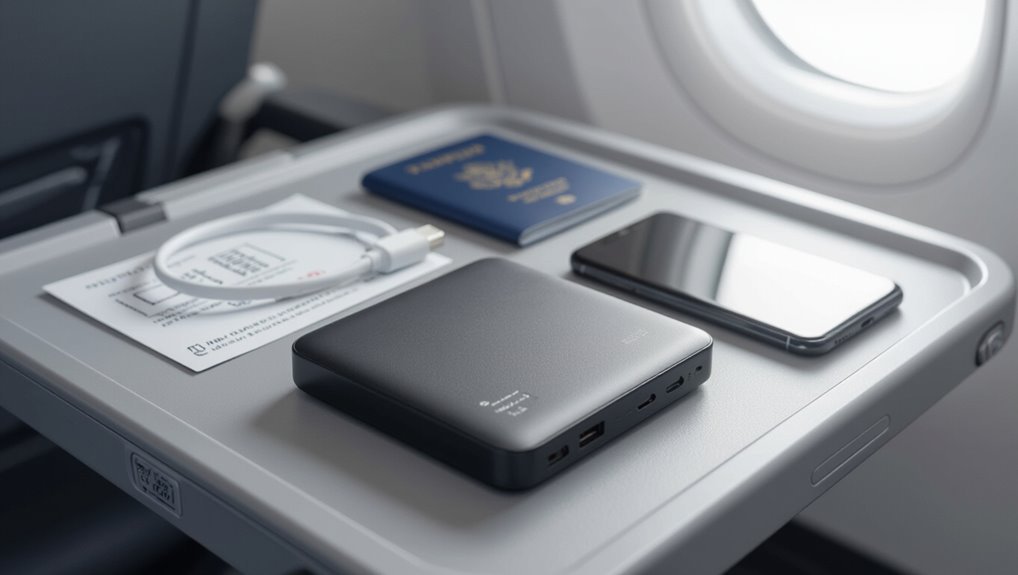
Yes — you can usually bring a power bank on a plane, but there are limits you need to follow.
You’ll need to carry it in your carry-on, not checked luggage, and airlines restrict capacity.
Carry power banks in your carry-on — never checked luggage — and ensure they meet airline capacity limits.
If it’s within allowed watt-hour limits and under any airline-specific rules, you’re fine.
Always check your carrier’s policy before travel to avoid confiscation or delays.
Which Batteries Are Power Banks (Li‑ion vs Li‑poly)
Most power banks use either lithium‑ion (Li‑ion) or lithium‑polymer (Li‑poly) cells, and they behave slightly differently in weight, shape, and heat tolerance.
You can usually identify the type from the label, specs sheet, or by the product’s shape and weight—Li‑poly packs are often flatter and lighter.
Knowing which cell your power bank uses helps you understand safety and airline rules.
Li‑Ion Vs Li‑Poly Differences
When you’re picking a power bank, you’ll usually encounter two cell types: lithium‑ion (Li‑ion) and lithium‑polymer (Li‑poly).
You’ll find Li‑ion offers higher energy density, lower cost, and established reliability, while Li‑poly provides lighter weight, flexible shapes, and slightly better safety under impact.
Both behave similarly for air travel rules; choose based on size, weight, and device fit.
Identifying Your Powerbank Type
Wondering which kind of battery is inside your power bank? Check the label: manufacturers usually list “Li‑ion” or “Li‑poly” and capacity (Wh or mAh).
If the label’s missing, consult the manual or product page using the model number.
Li‑poly packs are slimmer and flexible, Li‑ion are cylindrical or rectangular cells.
Knowing the type helps with airline rules and safe handling.
How to Find Your Power Bank’s Capacity in Wh
Start by checking the power bank’s label for a Wh rating — many list it right on the case.
If you only see mAh, convert to Wh by multiplying mAh by voltage (usually 3.7V) and dividing by 1000.
If the label’s unclear, look up the exact model on the manufacturer’s website for official specs.
Check Label For Wh
Curious about your power bank’s watt-hour rating? Check the device label or packaging first — manufacturers often print Wh directly.
If you see “Wh” followed by a number, that’s the capacity airlines care about. Look on the back, the bottom, or near regulatory markings.
If it’s faded, use a flashlight or magnifier. Keep that information handy for travel compliance.
Convert mAh To Wh
Most power banks list capacity in milliamp-hours (mAh), but airlines use watt-hours (Wh), so you’ll need to convert mAh to Wh to know if your device meets limits. Use Wh = (mAh × V) / 1000. For typical 3.7V cells, divide mAh by ~270. Check results against airline limits.
| Example | Calculation |
|---|---|
| 10000mAh | (10000×3.7)/1000=37Wh |
| 20000mAh | (20000×3.7)/1000=74Wh |
| 5000mAh | (5000×3.7)/1000=18.5Wh |
| 30000mAh | (30000×3.7)/1000=111Wh |
Manufacturer Specs Online
After you convert mAh to Wh, double-check the manufacturer’s listed watt-hour rating to be certain your power bank meets airline rules.
Visit the maker’s website, product page, or manual for the official Wh figure. If it’s missing, contact support or look for a spec sheet or FCC listing.
Use those numbers to confirm compliance with airline and TSA limits before travel.
How to Calculate Wh From mAh and Volts
If you want to know whether your powerbank meets airline limits, convert its capacity from mAh to watt-hours (Wh) using the battery voltage; multiply milliamp-hours (mAh) by volts (V) and divide by 1000 — Wh = (mAh × V) / 1000.
Find the nominal cell voltage (commonly 3.7V). Multiply that by the listed mAh, divide by 1000, and you’ll get Wh for comparison.
Why Capacity Matters: Wh Limits and Safety Rationale
Because battery capacity determines how much energy a powerbank can store, airlines use watt-hour (Wh) limits to balance passenger convenience with safety: higher Wh means more potential heat and energy release during faults, which raises fire and thermal runaway risks in a confined aircraft cabin.
You should check Wh ratings, prefer lower-capacity units, and follow airline rules to reduce risk and simplify screening.
Carry‑On vs Checked Baggage Rules for Power Banks
Where should you pack your powerbank — in carry‑on or checked luggage? You should carry it in your carry‑on: airlines and safety regs typically forbid lithium batteries in checked baggage due to fire risk. Keep it accessible for inspection, protected from short circuits, and follow airline capacity limits.
| Location | Allowed? | Notes |
|---|---|---|
| Carry‑on | Yes | Inspection, protection |
| Checked | No | Fire risk, typically banned |
| TSA/Carrier | Varies | Check carrier rules |
Power Banks Under 100 Wh: Rules and Best Practices
Now that you know to keep power banks in your carry-on, let’s look at units under 100 Wh, which most airlines treat more leniently.
You can usually carry them without airline approval, but always check airline-specific limits.
Keep them in original packaging or insulated against short circuits, label capacity if unclear, and pack each separately.
Declare any high-count batteries at security if asked.
Power Banks 100–160 Wh: Airline Approval and Limits
If your power bank is between 100 and 160 Wh, you’ll need airline approval before flying.
Carriers also limit how many of these units you can bring and require them to be carried in carry‑on baggage with proper packaging.
Always check your airline’s specific rules and get written permission if it’s required.
Airline Approval Needed
Need airline approval? If your power bank is between 100–160 Wh, you’ll need the airline’s written approval before boarding.
Contact the carrier in advance, provide the battery’s Wh rating and model, and get confirmation of permission.
Keep approval documentation with you at check-in. Without prior approval, the carrier can refuse carriage or require additional screening.
Quantity And Packaging Limits
When you’re carrying power banks rated 100–160 Wh, airlines typically limit how many you can bring and require each to be individually protected from short-circuiting (terminals taped or in original packaging).
You’ll usually need airline approval, often limited to two units per passenger.
Pack them in carry-on only, declare them if asked, and follow any additional carrier-specific documentation or labeling requirements.
Over 160 Wh: What to Do and Shipping Options
Because powerbanks rated over 160 Wh pose significant fire risks, airlines generally won’t let you carry them in checked or carry-on baggage, and you’ll need to follow specific shipping rules or get airline approval before you travel. You should contact the airline or a hazardous-goods shipper. Consider freight with proper packaging, approvals, and declared battery specs.
| Option | When to use |
|---|---|
| Airline approval | Rare exceptions |
| Freight shipping | Large batteries |
Labeling, Documentation, and Airline Enforcement
Check the battery capacity label on your powerbank and make sure the Wh or mAh rating is clear and legible.
If your device exceeds airline limits or requires approval, you’ll need to complete any declaration forms the carrier asks for.
Be prepared for airline staff to inspect labels and documentation, and follow their instructions to avoid delays or confiscation.
Battery Capacity Labels
Wondering how battery capacity labels affect whether you can bring a powerbank on a plane? You’ll check mAh and Wh labels—airlines base rules on Wh. If only mAh is shown, convert using voltage (usually 3.7V). Keep readable labels; faded or missing info can lead to denial.
| Label Type | Info Shown | Action |
|---|---|---|
| mAh | milliamp-hours | Convert to Wh |
| Wh | watt-hours | Compare to limit |
| Missing | no info | Airline may refuse |
Declaration And Forms
When you bring a powerbank to the airport, airlines expect clear labeling and, in some cases, a written declaration or form for high-capacity units.
You should carry proof of capacity (printed or digital), complete airline or security forms if requested, and disclose spare batteries at check-in.
Keep documentation accessible; staff may verify records and deny carriage if information’s missing or inconsistent.
Airline Inspection Procedures
Because airlines must manage safety and regulatory risk, staff will inspect powerbanks for clear capacity labeling, intact casing, and proper documentation before you board. You’ll show labels, permits, or manufacturer specs if asked. Officers may refuse carriage or require removal from carry-on. Follow instructions to avoid delays.
| Item | Action |
|---|---|
| Label | Verify mAh/Wh |
| Damage | Inspect casing |
What Airlines Define as a Power Bank
Airlines usually treat a power bank as a portable external battery pack designed to recharge devices like phones, tablets, and laptops while you’re away from a wall outlet.
You should view it as a consumer rechargeable battery in a case, often with USB outputs and no integrated SIM or cellular functions.
Carried spare or installed, it’s regulated by capacity limits and carriage rules.
Power Bank Safety Features Airlines Look For
When you pack a power bank, airlines first check its capacity in watt‑hours to make sure it meets limits.
They’ll also want built‑in protections like overcharge and short‑circuit prevention to reduce fire risk.
Finally, look for proper certification and clear labeling so staff can verify compliance quickly.
Capacity And Watt-Hours
If you’re packing a power bank for your flight, the key spec to check is its capacity in watt-hours (Wh), since airlines use Wh to decide whether a battery’s allowed, restricted, or outright banned.
Convert mAh to Wh (Wh = mAh × V ÷ 1000) when voltage’s labeled.
Generally, under 100 Wh is fine; 100–160 Wh needs airline approval; over 160 Wh is prohibited.
Overcharge And Short-Circuit Protection
Because power banks sit in your carry-on near heat and other electronics, you’ll want units that include overcharge and short-circuit protection to prevent fires and sudden failures.
You’ll also look for thermal cutoffs and current limiting so the device shuts down safely. These features reduce risk and help airlines accept your pack.
- Thermal cutoff
- Current limiting
- Automatic shutdown
Certification And Labeling
Although you’ll rely on specs and seller claims, airlines and security teams look for clear certification marks and accurate labeling on power banks to verify safety and capacity.
You should check for UN38.3, CE, FCC, or RoHS marks, correct watt-hour or mAh ratings, manufacturer contact info, and serial numbers.
Missing or falsified labels can lead to confiscation or denied boarding.
How to Pack a Power Bank for Security Screening
When you pack a power bank for security screening, place it in your carry-on where it’s easy to access and remove for inspection; most airlines and security agencies require lithium batteries to be screened separately.
Keep capacity labels visible and carry documentation if needed. Follow staff instructions calmly.
- Position in an outer pocket or top compartment
- Confirm it’s switched off
- Remove tangled cables for quick checks
Preventing Shorts: Terminals, Covers, and Protection
After you’ve placed your power bank where security can easily inspect it, take a moment to protect its terminals to prevent short circuits during handling and transit.
Cover exposed contacts with electrical tape or the manufacturer’s terminal cap, slip the unit into a padded pouch, and keep it separated from metal objects and loose cables.
Check covers are secure before boarding.
Traveling With Multiple Power Banks: Rules and Tips
If you’re carrying more than one power bank, keep them in your carry-on since checked baggage usually isn’t allowed.
Check each unit’s watt-hour (Wh) rating—most airlines let devices up to 100 Wh without approval and 100–160 Wh with airline permission, while anything above 160 Wh is typically prohibited.
Count and declare them if required, because some carriers limit the number of spare batteries you can bring.
Carry-On Limits
Wondering how many power banks you can bring? You’ll need to keep them in carry-on luggage, declare extra units if asked, and follow airline-specific piece limits.
Check each carrier’s policy before packing.
- Keep power banks on you or in cabin baggage
- Separate terminals or use protective covers
- Present spares at security if requested
Battery Capacity Rules
Most airlines and regulators limit power banks by watt-hours (Wh), so you’ll need to check each battery’s rating before packing. You can carry smaller banks (usually ≤100Wh) freely, need airline approval for 100–160Wh, and can’t bring >160Wh. Keep them in carry-on, label capacity, and avoid checked luggage.
| Wh Range | Permission | Notes |
|---|---|---|
| ≤100 | Allowed | No approval |
| 100–160 | Approval needed | Limit quantity |
| >160 | Prohibited | Check exceptions |
Can You Charge Devices in Checked Baggage?
Can you safely charge devices placed in checked baggage during a flight? No — airlines and regulators forbid operating or charging batteries in checked luggage because of fire risk and inaccessibility.
You should keep devices and power banks in carry‑on, powered off, and protected.
- Fire hazard: thermal runaway is hard to detect in cargo
- Accessibility: crew can’t reach checked items
- Regulations: strict prohibitions and penalties
Using Power Banks on Board: In‑Flight Rules
How should you use a power bank during a flight?
Keep it in your carry‑on, not checked baggage, and switch it off or disable charging when not in use.
Use approved cables and avoid jury‑rigged connections.
Don’t block aisles or exits with charging devices.
Follow crew instructions and airline policies; they can ask you to stop using or stow the power bank for safety.
International Differences: Country and Regulator Rules
Rules change by country and regulator, so you’ll need to check local watt‑hour limits before you travel.
Some airlines add their own restrictions on top of those limits, and they may require advance approval for larger batteries.
Also be aware that security rules at certain airports can block or confiscate powerbanks that don’t meet national or airline policies.
Varying Watt-Hour Limits
Because regulators and airlines set their own watt-hour caps, what you can carry varies by country and carrier, and you’ll need to check limits before you travel.
You should verify legal thresholds, labeling requirements, and declaration rules to avoid confiscation.
Consider common distinctions:
- 100 Wh and under: usually allowed in carry-on.
- 100–160 Wh: may need approval.
- Over 160 Wh: typically prohibited.
Airline-Specific Policies
Those general watt‑hour brackets give you a baseline, but airlines and national regulators interpret them differently.
So you’ll need to check specific carrier policies before you fly. Some carriers ban spare lithium batteries above lower thresholds, others require airline approval for 100–160 Wh units, and a few restrict quantity per passenger.
Confirm rules on the carrier website or contact customer service to avoid surprises.
Country Security Regulations
Different countries treat spare lithium batteries and powerbanks differently, so check the regulator rules for every country you’ll pass through.
You’ll need to follow national security limits, packing rules, and declaration requirements to avoid confiscation or fines.
- Some countries ban high-capacity powerbanks in checked baggage.
- Others require airline approval above specific Wh.
- Declare oversized batteries at security.
Airline‑Specific Quirks: Major Carriers Compared
Curious how rules change from carrier to carrier? You’ll find differences: some airlines cap watt‑hours strictly, others allow multiple smaller banks, and a few require airline approval for high‑capacity units.
Low‑cost carriers often enforce carry‑on only policies. Always check your airline’s website before flying, note declared limits, and carry original packaging or specifications to avoid surprises at the gate.
How Security Screening Usually Handles Power Banks
When you pass through security, agents will treat power banks as lithium battery devices that must go in your carry‑on, not checked luggage.
When passing security, treat power banks as lithium batteries — keep them in carry‑on, not checked luggage.
They’ll often ask you to place them in a separate bin for X‑ray inspection. You should be ready to show capacity labels and remove cases if requested.
- Keep watt‑hour (Wh) ratings visible.
- Limit use to approved quantities.
- Follow officer instructions promptly.
If TSA or Security Flags Your Power Bank: Steps to Take
What should you do if TSA flags your power bank? Stay calm, remove it from your bag, and follow officer instructions.
Show packaging, proof of capacity, or receipts if asked. Answer questions briefly; don’t argue.
If they confiscate it, request a receipt and the reason. If denied boarding or you disagree, ask about appeal procedures or supervisor review before leaving the checkpoint.
Buying a Travel‑Friendly Power Bank: Features to Prioritize
Because you’ll rely on it during travel, choose a power bank that balances capacity, portability, and airline rules.
Because you’ll rely on it while traveling, pick a power bank that balances capacity, portability, and airline rules.
Pick one under 100Wh for hassle-free carry-on, with fast charging and multiple ports so you can power devices simultaneously.
Look for durable casing and pass-through charging.
Consider weight versus mAh to keep packing efficient.
- Capacity under 100Wh
- Fast charging, multiple ports
- Lightweight, sturdy build
Alternatives to Power Banks for Long Flights (Travel‑Safe)
Looking for ways to keep devices charged on long flights without a power bank? You can use in-seat USB or AC outlets when available, carry spare charged devices, pack battery-efficient gadgets and low-brightness settings, download offline content to conserve power, and bring charging cables for airport lounges.
Consider a solar charger for layovers and portable device cases with extended battery life.
If Your Power Bank Is Damaged or Recalled: Next Steps
If your power bank shows damage, behaves erratically, or appears on a recall list, stop using it immediately and isolate it in a non-flammable container or away from flammable materials to reduce fire risk.
Then follow manufacturer and regulator guidance, and don’t attempt repairs yourself.
- Contact the manufacturer or retailer for recall instructions and refund/exchange options.
- Check airline and TSA rules before travel.
- Dispose of it at an approved e-waste facility.
Packing Hacks: Carry‑On Size, Weight, and Convenience
When you’re packing a power bank for carry-on, prioritize size and weight so it fits airline limits and stays easy to reach; choose slim, lightweight units and tuck them in an exterior pocket for quick removal. Keep documentation handy if needed.
| Item | Tip |
|---|---|
| Size | Slim models |
| Weight | Lightweight units |
| Access | Exterior pocket |
Power Bank Etiquette in Airports and on Planes
After you’ve packed your power bank for easy access, remember how your behavior affects fellow travelers and staff: keep it powered off or in airplane mode during boarding, avoid monopolizing outlets in crowded gate areas, and don’t let charging cables trail into walkways.
Pack your power bank for easy access, stay considerate—airplane mode on, share outlets, and keep cables tidy.
Be courteous, follow crew instructions, and secure devices during turbulence.
- Share outlets and rotate charging time
- Coil cables to prevent trips
- Respect seatmate space when charging
Pre‑Flight Power Bank Checklist
Before you leave for the airport, run through a concise power bank checklist so you won’t get stopped at security or stranded mid‑flight:
confirm capacity (mAh or Wh) is within airline limits,
carry it in your hand luggage,
make certain terminals are protected,
pack charging cables separately,
verify it’s powered off,
check airline or destination rules,
and keep receipts for high-capacity units.
Frequently Asked Questions
Can I Bring a Power Bank in My Checked Luggage During International Connections?
No, you shouldn’t pack a power bank in checked luggage during international connections; airlines and many countries require you to carry spare lithium batteries in your carry-on, so keep it with you and follow watt-hour limits and labeling.
Are Power Banks With Built‑In Cables Allowed on Planes?
Yes — you can bring power banks with built‑in cables, but you’ve got to carry them in your cabin baggage, comply with airline and country watt‑hour limits (usually ≤100Wh without approval), and avoid checked luggage.
Do Power Banks Count Toward My Carry‑On Weight Allowance?
They usually don’t. Carried powerbanks are counted as part of your carry‑on weight, but many airlines and security rules exempt small batteries from strict limits—check your airline’s policy and declare large capacity units to avoid surprises.
Can Airlines Confiscate a Power Bank Without Offering a Refund?
Yes, airlines can confiscate a power bank without offering a refund if it violates safety rules, lacks required labeling, or breaches capacity limits; you’ll usually have no compensation, so check airline and TSA regulations beforehand.
Are Power Banks Subject to Additional Fees or Taxes at Security Checkpoints?
Generally no, you won’t pay extra fees or taxes at security for a power bank; authorities may inspect or confiscate it if noncompliant, and customs duties could apply when entering some countries, so check local rules beforehand.
Conclusion
You can bring a power bank on a plane, but you’ve got to follow rules: carry it in your carry‑on, check its watt‑hours, and keep spare batteries out of checked luggage. Most lithium power banks under 100 Wh are fine; 100–160 Wh need airline approval; over 160 Wh are usually forbidden. Don’t use damaged or recalled units, label capacity if needed, and pack it for easy screening. Do a quick pre‑flight check so you avoid surprises at the gate.