Does a Pillow Count as a Personal Item on Flights?
You can usually bring a pillow on board, but whether it counts as your personal item depends on size, compressibility, and the airline’s rules; small neck or inflatable pillows typically fit under the seat and won’t use your personal-item allowance, while bulky memory-foam or oversized pillows may be treated as a carry-on or gate-checked. Measure pillows compressed, watch visible straps or attachments, and mention medical pillows at security — keep going to learn specific airline tips and packing tricks.
Quick Answer: Does a Pillow Count as a Personal Item?
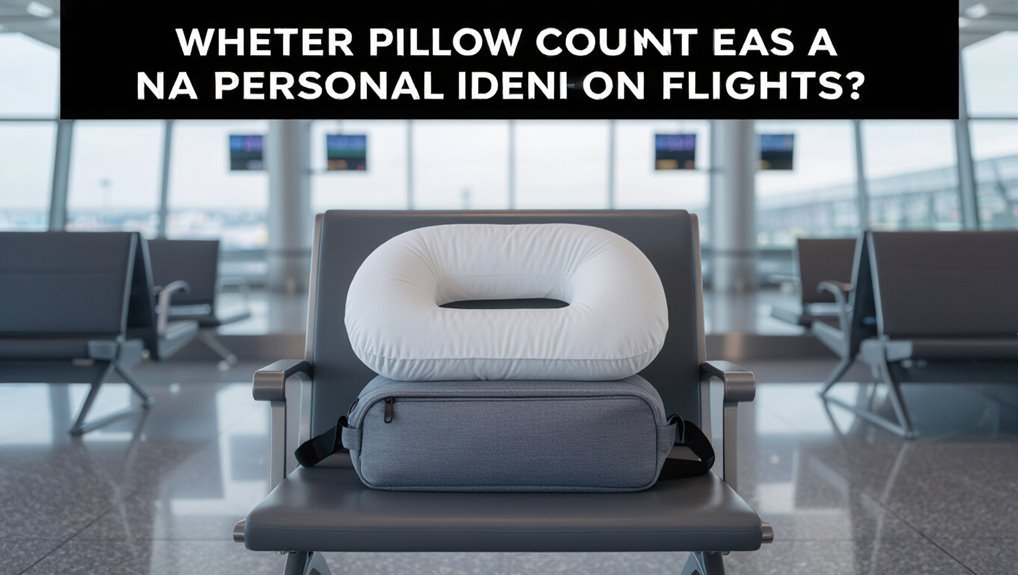
Short answer: usually no — a pillow by itself typically doesn’t count as your airline “personal item.”
You’ll likely need to stow it inside a bag or carry it as part of your allowed personal item.
Some carriers may treat small travel pillows differently, so check specific airline rules before flying to avoid gate hassles or unexpected fees.
What Airlines Mean by “Personal Item” vs. Carry-On
You should check both size and fit when deciding if your pillow counts as a personal item or carry-on.
Airlines set specific dimensions and may say a personal item must fit under the seat in front of you, while carry-ons go in the overhead bin.
Read the airline’s policy before you pack so you don’t get surprised at the gate.
Size And Fit
When airlines talk about a “personal item” versus a carry-on, they’re making a practical distinction based on where the item fits: a personal item is something that should slide under the seat in front of you, while a carry-on is sized to go in the overhead bin. Measure your pillow compressed; if it fits under the seat, it’s a personal item.
| Item | Fit |
|---|---|
| Neck pillow | Under seat |
| Travel pillow | Depends |
| Large pillow | Overhead |
| Duffel with pillow | Overhead |
| Compressed pillow | Under seat |
Airline Policies
Now that you’ve considered how a pillow fits, it’s helpful to look at how airlines define a “personal item” versus a carry-on and why that definition matters.
Each carrier sets size limits and placement rules: personal items must fit under the seat, carry-ons go in overhead bins.
Check your airline’s dimensions and policy—what counts varies, and enforcement can be strict at boarding.
Pillow Size Limits That Matter (How to Measure)
You’ll want to measure your pillow’s length, width, and any bulging seams to get its true packed size.
Compare those dimensions to the airline’s stated personal-item limits, since some carriers specify exact inches or centimeters.
If your pillow exceeds their maximums, you’ll need to stow it as a carry-on or check it.
Measuring Pillow Dimensions
Because airlines set strict size limits for personal items, measuring your travel pillow correctly matters — and it’s simple to do.
Use a tape measure to record length, width, and thickness at the fullest points. If it’s compressible, measure both uncompressed and compressed sizes.
Note any straps or attachments that add bulk. Record measurements in inches or centimeters for easy comparison.
Airline Size Restrictions
When you’re checking whether your travel pillow counts as a personal item, the first thing to look at is the airline’s size limits—each carrier sets specific length, width and depth allowances that determine what fits under the seat or in the overhead bin. Measure pillows compressed and uncompressed, compare to carrier rules, and choose a packable option.
| Airline | Max personal item | Notes |
|---|---|---|
| A | 45x35x20 cm | Underseat |
| B | 40x30x20 cm | Strict |
| C | 46x36x25 cm | Flexible |
Pillow Weight Limits: Why Weight Rarely Matters
Most airlines don’t weigh personal items like pillows, so you rarely need to worry about a few extra ounces; security and cabin space matter more than strict weight limits.
Gate agents focus on size and safety rather than exact mass. You can carry a pillow without stressing over its pounds, but keep it compact, avoid blocking aisles, and follow crew instructions if space gets tight.
Which Pillow Types Are Allowed on Board?
If you’re wondering what kinds of pillows you can bring on board, airlines generally allow most common travel pillows—memory foam neck pillows, inflatable travel pillows, small lumbar cushions, and soft throw or down pillows—as long as they don’t obstruct aisles or emergency equipment. You should stow bulky or wet pillows in carry-ons; inflatable options save space and meet requirements.
| Pillow Type | Notes |
|---|---|
| Memory foam | Compact, comfy |
| Inflatable | Space-saving |
| Lumbar | Supports back |
| Throw/down | Bulky if large |
| Specialty | Check size/security |
How Major U.S. Airlines Treat Travel Pillows
When you pack a travel pillow, you’ll want to know whether airlines count it as your personal item or part of your carry-on allowance.
Major U.S. carriers vary — some treat compact pillows as personal items while others expect them to fit inside your carry-on bag.
Check each airline’s policy before you fly so you’re not surprised at the gate.
Carry-On vs. Personal
Airlines handle travel pillows differently, so you’ll want to check each carrier’s rules before deciding whether to stash yours under the seat or pack it with your carry-on. You can usually carry a pillow as your personal item if it fits under the seat; otherwise count it against carry-on allowance. Use the chart to compare placement, size, and ease.
| Airline | Placement | Notes |
|---|---|---|
| Delta | Under seat | Compressible ok |
| United | Carry-on | Bulky counts |
| Southwest | Personal | Often allowed |
| JetBlue | Under seat | Depends on bag |
Airline Policy Differences
Because policies vary by carrier, you should check each airline’s specific rules before assuming your travel pillow will be treated as a personal item or a carry-on.
You’ll find differences in size, inflation, and storage allowances. Know that some airlines count a pillow only if bulky, others allow it free, and some expect it stowed under the seat.
- Delta: small pillows usually allowed
- United: bulky items may count
- American: typically allowed if compact
- Southwest: free but space-dependent
How Major International Airlines Treat Travel Pillows
Most major international carriers treat travel pillows as part of your carry-on allowance rather than a separate personal item, but policies can still vary by airline and fare class.
You should check your carrier’s specific rules before packing, since some low-cost or premium cabins set different size or item limits.
Gate agents can enforce limits, so stow or wear pillows to avoid issues.
When a Pillow Becomes Part of Your Carry-On
When you pack a travel pillow inside or attach it to a larger bag, it usually counts toward your carry-on allowance, not as a separate personal item.
If tucked inside or attached to your bag, a travel pillow typically counts toward your carry‑on allowance.
You’ll need to take into account size, airline rules, and whether gate agents object. Pack strategically to avoid overweight fees and boarding delays.
- Stuffed inside your carry bag
- Strapped externally to a roller
- Compressible memory foam packed flat
- Bulky inflatable stowed separately
How to Pack a Travel Pillow for Flight
Pick a travel pillow that matches your sleeping style and compressibility needs so it fits your carry-on without bulking up your bag.
If you have a compressible or inflatable pillow, tuck it inside your suitcase or strap it to the outside of your carry-on to save space.
For bulkier foam pillows, wear it or pack it in a dedicated pocket to keep your main bag organized.
Choose The Right Pillow
Because your neck and sleep quality hinge on the shape and support of the pillow, choose one that matches your sleeping style and packing limits.
Pick memory foam for contouring, inflatable for compactness, a microbead option for flexible shape, or a thin compressible foam for upright naps.
Consider weight, bulk, hygiene covers, and ease of cleaning.
- Memory foam contouring
- Inflatable compact
- Microbead flexible
- Compressible thin
Pack Efficiently In Carry-On
Now that you’ve chosen the right pillow for your sleep style, think about how to pack it so it fits and stays clean in your carry-on.
Compress inflatable or memory foam pillows into their stuff sack or case.
Tuck soft pillows into gaps around clothes to save space and protect fabric.
Keep straps or clips accessible for gate-checking or attaching to your bag.
Gate Check vs. Carry-On: What Happens to Your Pillow
When you board, your pillow will either stay with you as a carry-on or get gate-checked and sent to the hold — and which happens depends on its size, the airline’s rules, and how full the cabin is.
On boarding, your pillow either rides with you or gets gate-checked — size, airline rules, and crowding decide.
- You tuck a neck pillow under your jacket and keep it at your feet.
- A bulky pillow gets tagged and taken at the jet bridge.
- Gate-checked pillows return at baggage claim.
- Small pillows fit in overhead bins or under seats.
How to Present a Pillow at the Gate to Avoid Fees
If you want to avoid gate-check fees, present your pillow as a personal item—keep it compact, stow it under your arm or inside a tote, and tell the gate agent it’s part of your carry-on so they see it as fitting under the seat.
Show how it fits under the seat if asked, consolidate with other small items, and be polite but firm about its placement.
Special-Case Pillows: Medical, Inflatable, Memory-Foam Rules
Gate agents will usually accept a compact pillow as a personal item, but special-case pillows—medical, inflatable, or memory-foam—have their own rules you’ll want to know.
- Medical pillows may qualify as medical devices; bring documentation and notify staff.
- Inflatable pillows should be deflated for storage; check airline size limits.
- Memory-foam ones can be bulky; compress or carry in a bag.
- Gate policies vary; ask ahead.
Security Screening: What TSA and Other Agencies Check
Because security rules focus on safety, you’ll want to know how TSA and other agencies treat pillows at screening: they check for hidden items, assess size and material, and may ask you to remove or unpack a bulky or unusual pillow for X‑ray inspection or hand screening.
You should follow officer instructions, declare medical or oversized pillows, and expect possible additional checks if density or shapes trigger alarms.
Preboarding Checklist for Your Pillow
After screening, make a quick preboarding checklist for your pillow so you won’t hold up boarding or face surprises at the gate.
Check fit under your seat, verify any strap or cover is tidy, confirm it’s clean and odor-free, and decide if it’ll be stowed or kept with you.
- Foldable or compressible?
- Strap tucked?
- Visible stains?
- Stored or carried?
Common Mistakes That Lead to Surprises at the Gate
When you’re juggling bags and boarding passes, small oversights about your pillow can suddenly turn into a gate-time scramble—bringing an uncompressed cushion, forgetting a visible strap, or not knowing the airline’s carry rules are common slip-ups that cause delays and extra fees.
Check size and compressibility, attach straps visibly, know carry-on allowances, and stow inflatable or novelty pillows in checked or gate-checked luggage when required.
Frequently Asked Questions
Can I Bring a Pillow on a Budget Airline That Charges for Carry-Ons?
Yes — you can usually bring a pillow, but airlines differ. Check the carrier’s personal item rules and dimensions; if it fits under the seat or meets their definition, you’re fine, otherwise you might pay for a carry-on.
Do Seatback Pillows Provided by Airlines Count as Personal Items?
No, seatback pillows provided by airlines usually don’t count as your personal item because they’re airline property and stored in the seat; you won’t need to include them in your carry-on allowance, though policies can vary by carrier.
Can I Buy a Pillow in the Airport and Bring It Onto the Plane?
Yes — you can buy a pillow in the airport and bring it onto the plane, but you’ll need to fit it within your carry-on allowance; airlines might require it to count as a carry-on or personal item based on size.
Will My Pillow Be Subject to Quarantine or Disposal on International Routes?
Usually no — you won’t face automatic quarantine or disposal just for a pillow on international flights, but customs or health authorities can inspect, require cleaning, or seize items if they suspect biohazardous contamination or local quarantine rules apply.
Can Infants Share My Travel Pillow Instead of Using a Separate One?
Yes—you can share your travel pillow with an infant, but check airline and safety guidance; secure the baby properly, keep it clean, and avoid loose bedding during takeoff, landing, or if the infant can’t maintain their own airway.
Conclusion
Yes — generally a pillow can count as your personal item if it fits under the airline’s seat-size limits, but rules vary. Check dimensions for “personal item” vs carry-on, and measure your pillow compressed. Inflatable, memory-foam, and medical pillows are usually allowed, though medical pillows may need documentation. Expect TSA screening; keep your pillow tidy and stowed during checks. Avoid oversized or overly bulky pillows to prevent gate surprises and possible gate-checking.