How Do Airport Scanners Detect Drugs in Luggage
You’ll see scanners use X‑rays, CT and advanced imaging to spot suspicious shapes, densities and hidden cavities, while dual‑energy and spectral systems help distinguish plastics, organics and powders. Trace swabs, portable mass specs and sniffer dogs pick up residue or chemical signatures, and AI highlights areas for closer inspection. Manual secondary checks follow strict chain‑of‑custody steps when alerts occur. Keep going and you’ll find details on technologies, limits and what to expect at screening.
How Airport Screening Detects Drugs : Quick Summary
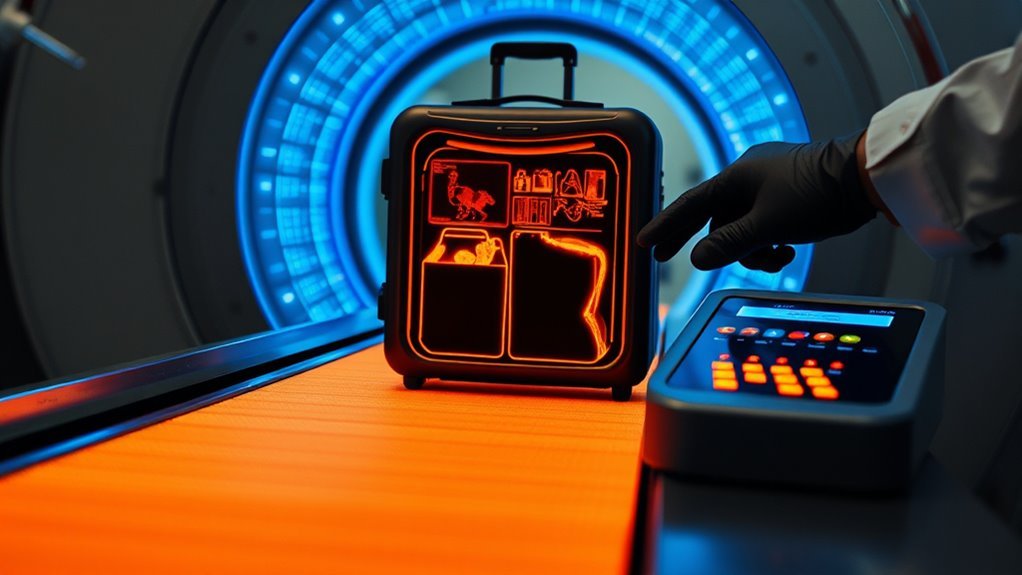
When you pass your bags through airport screening, machines and trained officers work together to spot drugs quickly and reliably. You’ll see X-ray images flagged for unusual densities, swabs tested for trace residues, and trained officers checking suspicious items.
Canine teams and explosives- or drug-detection devices add layered checks. Officers compare indicators against risk profiles and passenger behavior, then decide on secondary inspections.
These steps prioritize speed and accuracy while minimizing disruptions. You’re unlikely to face invasive searches unless screens or tests show clear signs.
Scanners Used to Detect Drugs in Luggage
Although most luggage screening relies on standard X-ray systems, airports also deploy a range of specialized scanners to find drugs, from trace-detection swab analyzers to advanced CT, dual-energy X-ray, and mass spectrometry units.
You’ll encounter devices that detect residues, identify chemical signatures, and image concealed compartments. Operators combine rapid screening with targeted follow-up to reduce false positives and keep throughput moving.
You can expect procedural checks, handheld sniffers, and laboratory confirmation when needed.
- Trace residue analyzers for surface detection
- CT and dual-energy imaging for structural analysis
- Portable mass spectrometers for chemical ID
What X‑Ray Systems Reveal About Suspicious Objects
Beyond chemical tests and handheld sniffers, X‑ray systems give you the first clear picture of what’s hidden inside a bag. You see shapes, densities, and object layering that let you flag suspicious items quickly.
Different materials show distinct contrasts: metals are bright, organic materials appear darker, and complex shapes suggest concealment. You can spot anomalies like inconsistent packing, dense blocks, or hidden compartments.
Dual‑energy X‑rays help differentiate plastics from organics, aiding initial judgments. While not definitive for drug ID, these images guide targeted searches and secondary screening, directing you to items needing closer inspection or chemical testing.
How CT Improves Drug Detection
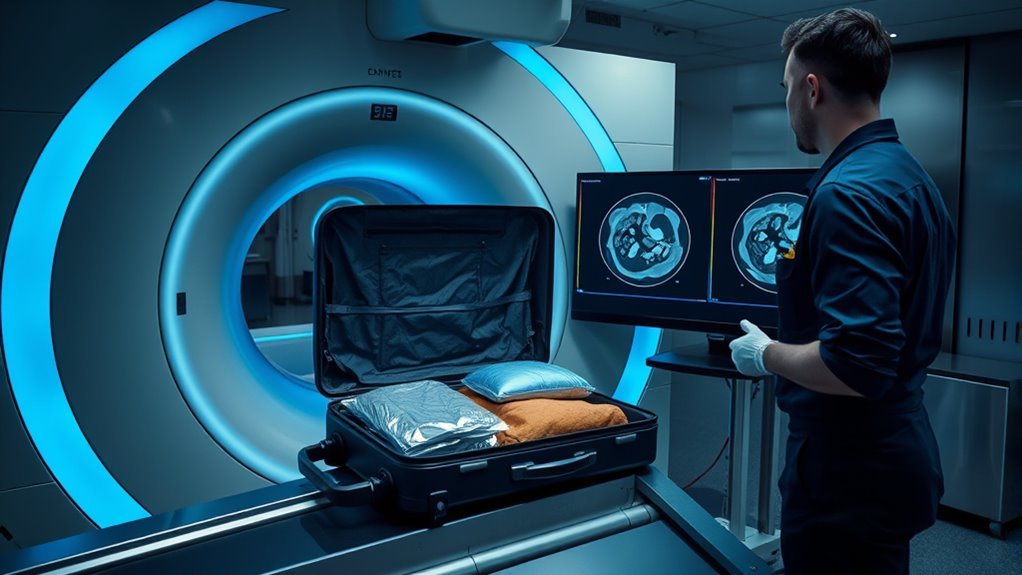
With CT you get higher-resolution imaging that makes small or concealed quantities easier to spot.
It also differentiates materials by density and composition so you can tell organic drugs from harmless items.
And because CT supports automated threat detection, the system can flag suspicious patterns for you faster and more reliably.
Higher-Resolution Imaging
When you need to spot small or well-hidden packets, computed tomography (CT) gives inspectors far sharper, three-dimensional images than traditional X‑rays, letting them distinguish shape, density, and internal structure more reliably. You can rotate views, slice through layers, and detect subtle anomalies without unpacking.
CT’s higher resolution reveals fine edges, compacted material, and tiny cavities that suggest concealment. You’ll see clearer contours and continuity across objects, making pattern recognition and automated flagging more accurate.
Faster multi-angle scans reduce false alarms and improve throughput.
- Enhanced edge definition
- Minute structural detail
- Rapid volumetric slicing
Material Differentiation
Although CT still uses X‑rays, it separates materials by how they absorb and scatter those rays, so you can tell organic drugs from plastics, metals, and innocuous items more reliably.
You see colorized or density-mapped images where organic compounds show distinct signatures compared with metals and ceramics. You can rotate 3D views to inspect suspicious shapes and assess composition based on attenuation values.
That lets you prioritize physical inspection of likely drug containers and reduces false alarms from harmless materials. By combining spatial context with material contrast, CT improves your ability to spot concealment methods like multilayered wraps or disguised organic payloads.
Automated Threat Detection
Because CT scanners combine high-resolution 3D imaging with material discrimination, they let automated algorithms flag likely drug threats faster and more accurately than older X‑ray systems. You’ll get alerts based on shape, density, and chemical signatures, reducing missed contraband and false alarms.
The software highlights suspicious items for your review, prioritizes scans, and learns from operator feedback to improve detection rates. Integration with databases lets you compare patterns across flights.
You’ll spend less time on benign items and more on true threats, while operators retain final judgment.
- Shape recognition refines object classification
- Density thresholds reduce false positives
- Machine learning adapts from analyst input
What Millimeter‑Wave and Terahertz Scanners Detect
If you’ve ever passed through a checkpoint and wondered what those millimeter‑wave or terahertz units actually see, they’re tuned to pick up the unique electromagnetic fingerprints of materials—differences in how plastics, ceramics, metals, and organic compounds absorb and reflect energy at mm-wave and THz frequencies.
You’ll notice shape, density contrasts, and layering: concealed objects behind clothing or inside containers alter the returned signal pattern. Systems create a 3D map highlighting anomalies and nonmetallic threats you might hide in luggage.
They don’t identify chemical traces by vapors; they reveal structural and dielectric differences for operator or algorithmic review.
How Trace Chemical Detectors (ETD) Screen Luggage
You’ll often see Explosive Trace Detectors (ETDs) adapted to screen for drug residues by collecting microscopic particles from bags or swabs. The device either sniffs vapors or ionizes collected material to analyze chemical signatures with mass spectrometry or ion mobility techniques.
Understanding how sampling and analysis work helps explain why ETDs can flag trace amounts even when bulk drugs are hidden.
How ETDs Work
When you hear about ETDs—explosive trace detectors—think of them as sensitive sniffers that don’t look for bulk substances but for tiny particles and vapors that cling to surfaces. You guide, operators place swabs or expose air to the detector; the device concentrates residues and uses chemical-specific sensors to flag suspicious signatures.
You’ll see rapid results, clear alerts, and protocol-driven responses to positives. ETDs act as an early warning, narrowing items needing deeper inspection without revealing detailed chemistry. They complement imaging and K9 teams, boosting detection confidence while minimizing invasive searches.
- Rapid, non-destructive screening
- Chemical-specific sensing
- Integrates with security procedures
Sampling And Analysis
Having covered how ETDs detect tiny residues, let’s look at how they actually sample and analyze luggage: operators collect swabs or pull air through the device to capture particles and vapors from bag surfaces and compartments.
Then the detector concentrates those traces and runs them past chemical sensors tuned to known explosive or drug signatures. You position swabs into seams, pockets, and hard-to-reach areas or let the sampler flow over whole bags.
The instrument desorbs and concentrates molecules, then uses ion mobility, mass spectrometry, or sensor arrays to compare patterns to a library. If a match appears, the system flags the item for inspection.
How Ion Mobility Spectrometry (IMS) Finds Drug Residues
Although it operates behind the scenes, ion mobility spectrometry (IMS) gives you a fast, sensitive way to spot trace drug residues by separating and identifying charged molecules in the air or on swabs. You guide swabs or air samples into the IMS; molecules are ionized, then drift through a gas under an electric field.
Different substances travel at characteristic speeds, creating a mobility pattern you compare to known signatures. IMS flags likely matches in seconds, prioritizing samples for further testing. You rely on it for screening due to speed, portability, and low false-negative risk.
- rapid screening
- characteristic drift times
- on-site portability
How Mass Spectrometry Confirms Suspect Samples
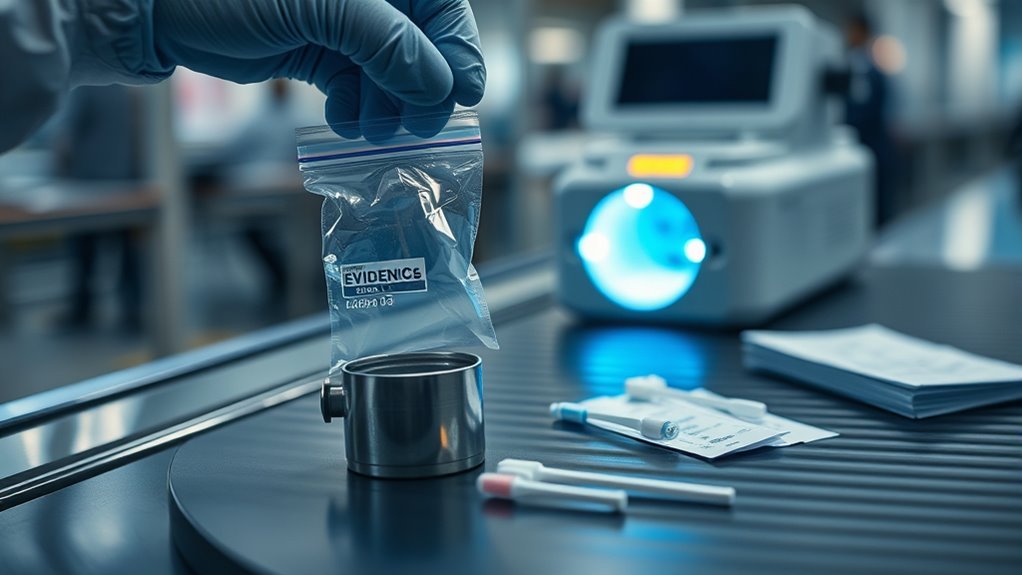
Because IMS gives you fast screening, you send suspect swabs or vapor samples to mass spectrometry for definitive identification.
In the lab, you ionize molecules, separate them by mass-to-charge ratio, and record a spectrum that acts like a molecular fingerprint.
You compare spectra to reference libraries and check fragment patterns to confirm specific drugs, reducing false positives.
Quantitative MS methods estimate amounts, guiding further action.
High-resolution mass spectrometers resolve similar compounds, while tandem MS verifies structure through controlled fragmentation.
Your chain-of-custody and instrument calibration ensure results stand up in reports and legal procedures.
How Scent‑Detection Dogs Complement Machines
When machines flag a bag, you often call in scent‑detection dogs to provide an independent, mobile check; their noses detect trace odors machines can miss and they can follow scents across complex packaging and mixed materials.
You guide handlers and dogs to verify alerts, narrow search areas, and prioritize inspections. Dogs work around electronics, liquids, and layered wrapping without opening items, reducing invasive searches.
Their training targets odor signatures rather than imagery, so they catch concealed or masked substances.
Handlers document alerts for chain‑of‑custody and follow legal protocols before samples go to lab confirmation.
- Rapid, flexible screening
- Odor pattern recognition
- Noninvasive inspection
How AI Analyzes Baggage Images and Flags Drugs
Scent dogs give a mobile, odor‑based check, but AI systems provide continuous, scalable image analysis that spots suspicious shapes and materials across thousands of bags.
You feed AI labeled X‑ray and CT images so it learns patterns linked to concealment, unusual densities, and packing anomalies. It scores regions of interest, prioritizes high‑risk items, and highlights them for human review.
You’ll see alerts when confidence passes thresholds; operators verify and decide next steps. Systems keep improving with new data, reducing false positives while catching novel concealment tactics.
You still rely on human judgment for context and legal action.
Physical Signals That Indicate Narcotics in Scans
Although X‑ray and CT images don’t smell anything, they reveal physical signatures that often signal narcotics: uniform low‑density masses, layered or blocky packing, masking materials that alter expected densities, and hidden voids or air gaps around condensed cargo.
You learn to spot anomalies by comparing texture, shape, and density against common travel items. Irregular homogeneity, sharp geometric edges, or oddly isolated soft regions raise suspicion.
You use context — location within a bag, surrounding items, and symmetry — to prioritize inspection. Common cues include:
- Smooth, consistent grayscale zones suggesting compacted powders
- Rectilinear blocks or repeated identical shapes
- Unexpected internal cavities or surrounding packing
How Packaging and Concealment Methods Hide Drugs
Concealers and packers tailor materials and layouts to confuse scanners, so you learn to recognize common tricks fast. You spot layered wrapping—multiple plastic, foil, or vacuum seals—that mask texture and density changes.
Concealers and packers use layered wraps—plastic, foil, vacuum seals—to mask textures and confuse scanners.
You’ll notice items hidden inside hollowed electronics, books, or toiletry containers where shapes mimic normal components. Smell-proof bags and odor absorbers won’t affect imaging but indicate intentional concealment.
Dense packing with clothing or toiletries creates clutter that obscures small packets. You check for irregular seams, recent repairs, or glued sections.
Noting inconsistent weight distribution and oddly placed dense blocks helps you target further inspection.
Why Some Drugs Show Poorly on X‑Ray and CT
Because X-ray and CT systems rely on material density and atomic number differences, certain drugs can blend into surrounding items and appear faint or invisible on scans. You’ll notice detection depends on contrast: low-density powders, organic materials, or thin layers mimic clothing, plastics, or food, reducing visibility.
Shape and orientation matter too; flat or dispersed loads produce weak signatures. Small quantities drop below system noise and reconstruction limits, so they’re easily missed. Consider these factors when interpreting imagery:
- Low atomic number and density approach common benign materials
- Thin, dispersed, or layered concealment reduces contrast
- Small mass falls under detection thresholds
How Operators Combine Signals to Decide on Alerts
Knowing how drugs can hide on scans helps explain why operators don’t rely on a single image to raise an alarm. You’ll compare multiple data streams: dual-energy X-ray contrasts, computed tomography slices, and automated material discrimination algorithms.
You’ll look for consistency between color signatures, density maps, and object geometry. If signals align—anomalous attenuation, suspicious shape, and algorithmic flag—you’ll prioritize intervention.
If one channel contradicts others, you’ll lower the alert probability and review manually. You’ll also factor context: item location, packing density, and travel patterns influence your judgment.
Your combined-signal approach reduces false positives while keeping detection reliable.
Typical Secondary Screening Steps After an Alert
When a scanner flags a bag, you’ll usually see an operator open it for a manual inspection to check contents and packaging.
If the alert persists or looks suspicious, trained dogs may sniff the luggage or technicians can perform on-the-spot chemical swabs. These steps confirm whether further action or authorities are needed.
Manual Bag Inspection
After an alert, security officers will pull your bag for a hands-on inspection to look for anything the scanner couldn’t conclusively identify. You’ll be asked to open compartments while they systematically examine contents, comparing shapes and materials against what the machine flagged.
They may re-arrange items to better view interiors, check dense clusters, and use handheld scanners for closer imaging. Stay cooperative and answer brief questions about ownership and items.
Officers document findings and let you repack. If they find prohibited substances or unclear materials, further procedures may follow.
- Officers inspect pockets and lining
- Items are re-arranged for clarity
- Findings are recorded and photographed
Canine Or Chemical Testing
If a manual inspection doesn’t settle concerns, officers may call in trained sniffer dogs or perform rapid chemical swabs to pinpoint traces of drugs or explosives.
You’ll see dogs quickly screen luggage; handlers watch behavioral alerts that suggest odor presence. If a dog signals, or if staff prefer, they’ll use swabs on surfaces or contents, then apply colorimetric tests or handheld detectors that react to specific compounds.
You’ll be asked to wait while technicians interpret results. Positive indications lead to containment, documentation, and law-enforcement involvement.
Negative results typically end the secondary screening and let you reclaim your belongings.
How Chain‑of‑Custody and Legal Rules Shape Testing
A clear chain‑of‑custody and strict legal rules dictate how samples from scanners move from detection to courtroom, so you’ll see procedures designed to preserve evidence, document handling, and limit contamination.
You’ll witness immediate sealing, timestamping, and restricted access to prevent challenges later. Technicians log transfers, use tamper‑evident packaging, and follow validated testing protocols so results hold up under scrutiny.
Your role as operator or analyst includes documenting every step, preserving original samples, and ensuring testing methods meet accreditation standards. Transparency and reproducibility reduce dispute risk and protect both public safety and individual rights.
- Sealing and labeling
- Transfer logs
- Accredited methods
Common False Positives and How They’re Resolved
Because many screening technologies trade speed for specificity, scanners sometimes flag benign items as drugs, and you’ll need to know the usual culprits and how staff clear them. Common false positives include legal powders (talcum, protein), certain spices, cosmetics, medications, and residues on containers.
When alerted, officers isolate the bag, perform visual inspection, swab suspected areas for chemical analysis, and consult X-ray or CT imagery with an expert.
Field tests may show presumptive positives that lab GC‑MS later refutes. You’ll see documentation, chain‑of‑custody steps, and release of luggage when definitive testing clears the item.
How Contraband Still Gets Through Security
You’ll see that contraband still slips through because smugglers use hidden compartments and clever packaging that mask signatures scanners expect.
Detection tech has limits — resolution, material discrimination, and algorithmic blind spots — so some threats look innocuous.
Add human error and procedural gaps, and you’ve got the conditions that let items pass.
Hidden Compartments And Packaging
When smugglers want to beat scanners, they hide contraband in cleverly modified cavities and deceptive packaging that mimic ordinary items. These hidden compartments—false bottoms, hollowed-out electronics, and vacuum-sealed layers—exploit limits in resolution, material discrimination, and operator attention.
You’ll notice tricks: layered household goods, disguised toiletries, and dense items masked by benign shapes. You inspect images and rely on procedures, but some designs blend into clutter. Awareness, targeted probing, and cross-referencing manifest info help you spot anomalies.
Typical concealment methods include:
- Multi-layer decoys that imitate expected densities
- Reused commercial packaging to avoid suspicion
- Integrated cavities inside common electronics
Limitations Of Detection Technology
Although scanners catch a lot, they’ve clear blind spots and trade-offs that smugglers exploit. You’ll face limits: resolution can miss tiny amounts or items overlapped by denser objects, and some materials mimic benign signatures.
Advanced imaging flags anomalies but can’t chemically identify everything; spectrometers sample only surface traces and need proper placement. Throughput demands mean machines use preset sensitivity settings to avoid false alarms, so subtle concealment can slip by.
Shielding, clever packing, and novel materials reduce detectability. Technology improves, but inherent physics, speed requirements, and cost constraints leave exploitable gaps.
Human Error And Procedural Gaps
Technical limits create openings, but human error and procedural gaps are what smugglers most often exploit to get contraband past checkpoints. You rely on operators to interpret images, follow protocols, and escalate anomalies; when they don’t, gaps appear.
Fatigue, complacency, inconsistent training, and rushed lanes create predictable failures. Procedures that aren’t enforced or updated let novel concealment methods slip through.
To tighten security, you need regular proficiency testing, clear escalation paths, and adaptive procedures that reflect evolving threats.
- Regular, realistic operator training and assessment
- Enforced, updated escalation and inspection protocols
- Duty rotation to reduce fatigue and complacency
How Airports Train Staff to Spot Drug Smuggling
If you’re wondering how staff reliably spot hidden drugs, airports combine targeted training with practical tools so officers can recognize suspicious behavior, concealment methods, and telltale packaging in baggage and on people. You learn behavioral cues, scanning anomalies, and interview techniques through simulations, supervised shifts, and periodic assessments. K9 teams and visual inspection skills are integrated into checkpoints, and legal procedures are reinforced so you act within rights. Continuous feedback and case reviews sharpen judgment. Training emphasizes safety, evidence preservation, and escalation protocols, so you respond swiftly and lawfully when scanners or instincts indicate a potential smuggling attempt.
| Focus | Method |
|---|---|
| Behavior | Role-play |
| Concealment | Hands-on labs |
| Procedure | Legal drills |
Emerging Technologies Airports Are Testing to Detect Drugs
You’ll see airports piloting real-time trace detection systems that can flag minute drug residues on bags as they move through checkpoints.
They’re also testing hyperspectral imaging sensors that analyze materials’ chemical signatures without opening luggage.
Together, these technologies could speed screening and cut false positives.
Real-Time Trace Detection
While traditional scanners flag suspicious shapes, real-time trace detection goes a step further by sniffing for microscopic particles of drugs and explosives as luggage moves through checkpoints. You’ll see sensors that sample air or surfaces, analyze chemical signatures instantly, and alert officers only when matches appear. This lets screening focus resources and reduce false positives, speeding throughput while improving interdiction.
- Air-sampling pumps capture aerosols for on-the-spot mass spectrometry
- Swab-based sensors detect residues from handling or packaging
- Automated algorithms compare patterns to illicit-substance libraries in milliseconds
You’ll get faster, targeted responses without invasive searches.
Hyperspectral Imaging Sensors
Real-time trace detectors pick up tiny residues, but hyperspectral imaging adds a different layer by reading chemical and material signatures across dozens to hundreds of narrow wavelength bands.
You’ll see sensors capture images where each pixel holds a spectrum; algorithms compare those spectra to known chemical fingerprints to flag suspect items without opening bags.
You can detect concealed powders, liquids, and certain plastics based on subtle spectral features.
Integration with conveyor systems and machine learning improves accuracy and reduces false alarms, though lighting, packing density, and mixed materials can complicate interpretation.
Deployment is expanding as processing power and spectral libraries grow.
What Passengers Should Expect and Practical Tips
Because security screens flag items for further inspection, expect occasional bag checks and short delays as officers verify alerts. You should stay calm, follow instructions, and answer questions briefly.
Keep liquids, electronics, and medications accessible to speed inspections. Declare prescriptions when asked.
- Pack prescriptions in original labeled containers and carry a note from your provider if needed.
- Use clear toiletry bags and separate electronics to remove quickly for scanning.
- Label valuables and avoid hidden compartments that trigger deeper searches.
Being cooperative and organized minimizes delays and misunderstandings, helping you move through security efficiently and respectfully.
Frequently Asked Questions
Can Personal Medical Prescriptions Trigger Drug-Detection Alerts?
Yes, they can. You should carry prescriptions and original packaging to show officers, declare controlled medications, and be ready to explain dosages. Doing so usually clears alerts, but additional screening or testing might still occur.
Do Privacy Laws Limit Detailed Imaging of Personal Items?
Yes, privacy laws can limit detailed imaging of personal items; you’ll generally have protections against indiscriminate exposure, and authorities must follow strict rules, use minimal-resolution images, and justify further inspection before revealing intimate details.
How Are International Airports’ Detection Standards Harmonized?
International airports harmonize detection standards through ICAO and IATA guidance, mutual agreements, and shared certification protocols; you’ll follow common performance criteria, joint training, data-sharing, and regular audits so procedures stay consistent worldwide.
What Happens to Confiscated Drugs After Seizure?
After seizure, you’ll see drugs cataloged, tested for evidence, and stored under chain-of-custody; they’re later used in prosecutions, forfeited, then destroyed or retained for investigation, with records kept and occasional audits ensuring compliance.
Can Damaged or Degraded Drugs Evade Chemical Detectors?
Yes, damaged or degraded drugs can sometimes evade chemical detectors because their molecular signatures change, reducing detection probability; you’ll still often get flagged by residue, odors, or other sensors, so concealment isn’t reliably foolproof.
Conclusion
You’ve seen how scanners — X‑ray, CT, millimeter‑wave and terahertz — and trained staff work together to spot hidden drugs, yet determined smugglers still exploit limits and human factors. Expect detailed imaging, occasional secondary checks and occasional delays. Follow packing rules, declare medicines, carry prescriptions and keep valuables with you to avoid complications. New tech is coming, but vigilance and cooperation from passengers remain the fastest way to keep flights safe and screenings efficient.