How Much Luggage Is Allowed in International Flights for Students
You can usually take one carry-on plus a personal item and one or two checked bags on international flights, but limits vary by airline, fare class, and whether you booked a student fare. Carry-ons are typically ~22×14×9 in and 7–10 kg, while checked bags are often 20–23 kg each for economy (up to 30 kg in higher classes) or piece/weight-based allowances. Check your carrier’s rules and documentation for student perks to avoid fees—keep going to see specifics and tips.
How This Guide Helps Students Find Luggage Rules

When you’re planning study abroad or an international trip, this guide quickly shows the luggage rules that matter to you—carry-on limits, checked baggage allowances, and essential size and weight restrictions—so you can pack confidently and avoid surprises at the airport.
You’ll find step-by-step checks: how to confirm airline-specific policies, interpret baggage charts, and spot exceptions for student fares or backpacks.
You’ll learn to compare fees, note transfer carrier rules, and prepare documentation for oversized items.
Use the checklist to decide what to bring, what to ship, and when to buy extra allowance so your journey is smooth and budget-friendly.
Quick Answer: Typical International Carry-On Limits for Students
You’ll usually get one carry-on and one personal item, so check size limits for both before packing.
Airlines often set specific dimensions for the carry-on and looser rules for the personal item like a backpack or laptop bag.
Weight limits vary by carrier and route, so confirm your airline’s allowance to avoid surprises at the gate.
Carry-On Bag Size
Although rules vary by airline and destination, most international carriers let students bring one carry-on plus a personal item without extra charge. You should size your carry-on to meet common limits—generally 22 x 14 x 9 inches (56 x 36 x 23 cm) including handles and wheels—so it fits overhead bins.
Weighing rules differ, so check before packing. Fit essentials, valuables, and a change of clothes inside. Keep liquids in compliant containers and in a clear bag.
- Measure exterior dimensions and test fit in bin simulations.
- Opt for soft-sided bags for flexible packing.
- Confirm limits with your airline before travel.
Personal Item Rules
After sizing your carry-on, check rules for your personal item: most international airlines let students bring one smaller bag—like a backpack, tote, or laptop case—that fits under the seat in front of you.
You should place essentials there: passport, tickets, medication, electronics, chargers, and a light sweater.
Measure dimensions beforehand to avoid gate checks and know that some carriers enforce strict shape and size limits.
Keep prohibited items out and verify liquids follow carry-on regulations.
If you need extra space, use compression packing or move heavier items into checked luggage before boarding to stay within the airline’s allowance.
Weight Limits Explained
Because airlines set both size and weight limits for carry-ons, knowing the typical weight allowances helps you avoid surprises at the gate. You’ll usually see limits between 7–10 kg (15–22 lbs) in Europe and Asia.
While North American carriers often emphasize dimensions over strict weight, staff may enforce 7–10 kg for smaller cabins. Low-cost airlines commonly impose tighter rules and charge for overweight items.
Check your carrier before packing, weigh your bag, and redistribute items into your personal item if needed.
- Typical limit: 7–10 kg (15–22 lbs)
- Weigh bags before leaving
- Expect stricter low-cost rules
Quick Answer: Typical International Checked-Bag Limits for Students
If you’re traveling internationally as a student, most airlines let you check one standard bag free on long-haul or full-fare tickets and often allow an extra piece or increased weight on student fares or partner agreements.
Typically you’ll see one or two checked bags allowed, each 20–23 kg (44–50 lb) on economy and 23–32 kg (50–70 lb) on higher classes.
Some carriers set size limits (linear dimensions) instead of strict weight.
Low-cost carriers may charge for all checked bags.
Always check your ticket, student fare rules, and partner airline policies before packing to avoid fees.
What Airlines Mean by a “Piece” of Luggage

When an airline talks about a “piece” of luggage, they’re defining either a single bag by count or specific dimensions and weight you’re allowed.
You’ll want to check both size limits and the number of pieces permitted, since carry-on rules differ from checked-bag rules.
Knowing whether a piece means a tote, backpack, suitcase, or duffel helps you avoid surprises and extra fees.
Defining A “Piece
A “piece” of luggage is simply one item airlines count toward your baggage allowance — like a suitcase, duffel, or backpack — and they expect each piece to meet specific size and weight limits rather than combining multiple bags into a single allowance.
You’ll treat each piece as an individual unit: one carry-on equals one piece, one checked bag equals one piece. Know the carrier’s definition before packing so you don’t get surprised at check‑in.
- A piece is counted per ticketed passenger, not per family.
- Personal items sometimes count separately; check your fare rules.
- Overlimit fees apply per piece, not per item inside.
Size Versus Count
Because airlines count luggage both by size and by number of pieces, you’ll want to check both limits before you pack. You’ll find airlines define a “piece” by dimensions and sometimes weight, so a bulky soft bag can count differently than a hard suitcase. Measure length + width + height and compare to the carrier’s piece allowance. If you exceed size, it may be treated as extra or oversized, regardless of count. Know your fare’s piece limit and size rules to avoid fees or gate checks.
| Term | Meaning |
|---|---|
| Piece | Individual bag |
| Size | L+W+H |
| Weight | Per-piece limit |
| Oversize | Extra fee |
Carry-On Versus Checked
After checking size and piece limits, you’ll also want to know how airlines distinguish carry-on from checked baggage—each is counted as a “piece” differently and carries different rules and fees. You should pack valuables, documents, and a change of clothes in your carry-on since it stays with you. Checked bags hold heavier items but may incur fees and longer wait times. Know weight limits, prohibited items, and connection policies to avoid surprises.
- Carry-on: one bag plus personal item, measured and weight-checked on some carriers
- Checked: counted per piece, often weight-based fees
- Overweight: charged or repacked
Piece-Based vs Weight-Based Systems Explained
When you’re comparing piece-based and weight-based baggage systems, focus on how airlines count and charge.
In piece-based systems, you get a set number of bags, each with its own size and weight limit; you’ll pay extra per additional piece.
In weight-based systems, you share a total weight allowance across all checked bags, so fewer heavy items can cost you less than many light pieces.
For students, that’ll affect packing choices and fee risk on connecting carriers.
Check both systems for your route, note per-piece weight caps and total allowances, and pack strategically to avoid surprise fees.
Common Carry-On and Personal-Item Size Limits
If you’re packing for a trip, know that carry-on and personal-item size limits vary by airline but usually fall into clear ranges so you can avoid gate-checks and fees. You’ll usually get one cabin bag plus a personal item; dimensions matter more than weight on many carriers.
Measure your suitcase including handles and wheels, and fit the personal item under the seat. Watch for strict low-cost-carrier rules and international differences.
- Typical carry-on: about 55 x 40 x 20 cm (21.5 x 15.5 x 7.5 in)
- Personal item: laptop bag or small backpack
Check airline specs before departure
Typical Checked-Bag Weight Tiers: 20 Kg, 23 Kg, 30 Kg
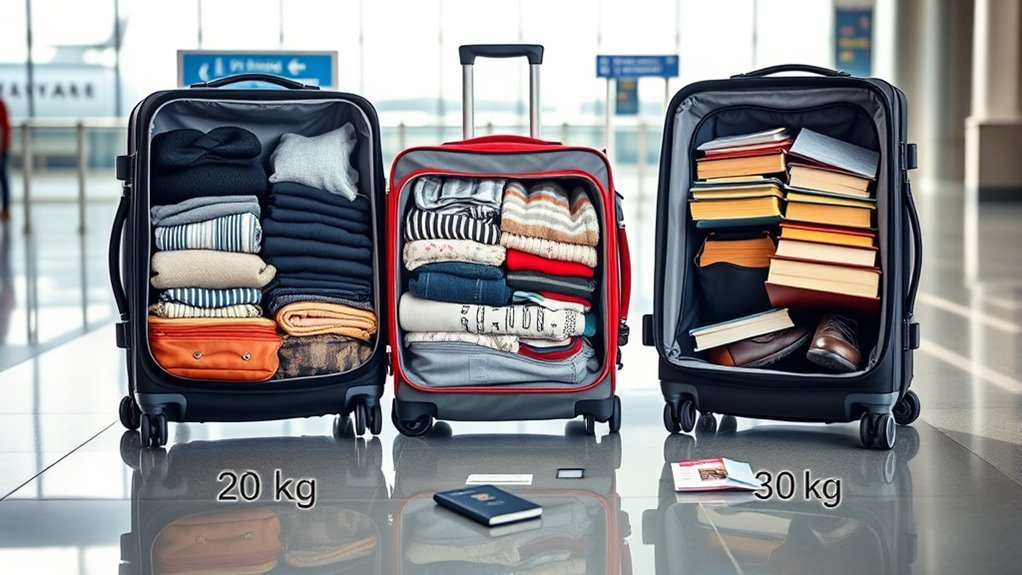
Airlines usually set checked-bag tiers at 20 kg, 23 kg, or 30 kg, so you’ll want to check which applies to your route.
Pick the tier that matches your packing needs and avoids excess fees—20 kg for light travel, 23 kg for standard allowances, and 30 kg if you’re moving or carrying bulky items.
Compare fares and baggage policies before booking so you don’t pay more than necessary.
Typical Weight Limits
Though rules vary by carrier and route, most international airlines follow a few common checked-bag weight tiers you should expect: 20 kg, 23 kg, and 30 kg. You’ll see 20 kg on budget or economy fares, 23 kg on many standard international economy allowances, and 30 kg on higher-tier or long-haul checked baggage.
Weight limits apply per piece, so you’ll need to distribute items accordingly and weigh bags before departure. Overweight fees rise quickly, and some carriers enforce strict limits at check-in. Know the exact kilogram allowance listed on your ticket to avoid surprises.
- 20 kg: entry-level economy
- 23 kg: common standard allowance
- 30 kg: premium or long-haul tiers
Choosing The Right Tier
Now that you know the common 20 kg, 23 kg, and 30 kg bands, you’ll want to pick the one that matches your itinerary, budget, and packing habits.
Choose 20 kg if you travel light, move frequently, or expect university housing to supply basics; it cuts fees and forces efficient packing.
Opt for 23 kg for a balanced approach—enough room for clothes, modest electronics, and textbooks without steep surcharges.
Select 30 kg when you’re relocating, carrying bulky items, or avoiding multiple shipments.
Check airline fees, weigh bags at home, and prioritize items to avoid costly overweight charges at the airport.
How Ticket Class Changes Baggage Allowances
Because your ticket class determines the rules that apply, you’ll often see very different baggage limits and fees depending on whether you booked economy, premium economy, business, or first class. You should check your fare’s allowance before packing; airlines grant larger checked and carry-on limits, heavier weight caps, and complimentary extra pieces as you move up classes.
Expect clearer refund and upgrade options too, which affect how you can adjust baggage later. Compare classes on the airline site or your itinerary to avoid surprises.
- Economy: basic allowance, fees for extras
- Premium economy: more weight, occasional extra piece
- Business/first: generous limits, complimentary extras
What to Expect From Student Fares and Discounts
When you hunt for student fares, check the eligibility rules closely—some airlines require full-time enrollment or an ID card.
You’ll typically see discounts of 10–25%, but baggage allowances and extras can vary.
Be aware of booking restrictions like advance-purchase windows, limited refundability, and blackout dates.
Student Fare Eligibility
If you’re a student planning international travel, expect eligibility rules to vary by airline and route: some carriers limit student fares to full-time students with valid ID and age caps, while others extend discounts to recent graduates or youth travelers.
You should check documentation requirements, booking windows, and whether fares are refundable or changeable. Verify if your school-issued ID, international student card, or enrollment letter is accepted, and note passport age rules.
Eligibility can affect baggage allowances and standby options, so confirm details before booking.
- Check accepted IDs and enrollment proof.
- Note age limits and graduate cutoffs.
- Confirm booking and change policies.
Typical Discount Amounts
Many student discounts fall in a predictable range, so you can plan your budget: expect savings typically between 5% and 20% off standard fares, with some special promotions or partner deals pushing discounts to 30% or more on select routes. You’ll often see modest fixed-percentage reductions, limited-time promo codes, or bundled savings when combining flights with student services. Compare carriers and student travel providers to spot the best value. Typical examples:
| Discount Type | Typical Range | When to Find |
|---|---|---|
| Standard | 5–15% | Regular fares |
| Promo codes | 10–30% | Sales/events |
| Partner deals | 15–30%+ | Bundles/partners |
Booking Restrictions and Rules
Although student fares can feel flexible, they usually come with specific booking rules you’ll need to follow. You’ll often face limits on changes, required proof of student status, and blackout dates that affect cheaper seats. Read terms before you book so you’re not surprised at check-in or when packing.
- Change and cancellation fees may be higher or non-refundable.
- You’ll need valid student ID or agency confirmation at booking and sometimes at boarding.
- Discounts might exclude peak travel dates, connecting flights, or baggage upgrades.
Plan early, keep documentation handy, and compare total costs, not just the headline fare.
Low-Cost International Carriers: Limited or No Free Checked Bags
When you fly with low-cost international carriers, expect stricter baggage rules and little to no complimentary checked allowance—these airlines keep fares low by charging for nearly every extra, including larger carry-ons on some routes. You’ll pay for checked bags, priority boarding, and sometimes even larger cabin bags. Check size and weight limits before booking, compare add-on prices, and prepay online to save. Pack efficiently, use compression cubes, and weigh luggage at home. Know the fee schedule and refund rules so you don’t get surprised at the gate.
| Tip | Action |
|---|---|
| Prepay | Save on fees |
| Weigh | Avoid surprises |
| Compress | Fit more |
| Compare | Choose best fare |
Legacy Carriers: Piece-Rate Allowances and Student Perks
Because legacy airlines follow long-established rules, you’ll usually see piece-rate checked-bag allowances and clearer student benefits. You can expect one or two free checked pieces on many international routes, defined by count rather than weight, and student fares often include flexible change policies or discounted extra-bag fees. Check enrollment documentation requirements and booking codes to secure perks. Compare policies before you fly to avoid surprises.
- Verify number-of-pieces limits and dimensions for your route.
- Ask about student fare add-ons like waived excess fees or priority handling.
- Keep digital proof of student status and fare class handy.
How Destination Rules Change Student Luggage Limits
When you plan student travel, remember that carrier-specific allowances can vary widely even on the same route.
You’ll also need to follow country customs restrictions that limit what and how much you can bring in.
If you have connections, check connecting flight variations since transfer carriers or airports may enforce different size or weight rules.
Carrier-Specific Allowances
Although airlines set the baseline for student baggage, your actual allowances often shift depending on the carrier and the destination’s rules. Each airline pairs its fare class with specific weight, size, and piece limits that can change for international routes. You should check carrier policies early, compare cabin and checked allowances, and note whether student fares include extra baggage or discounts.
Pay attention to exceptions for interline flights and codeshares, since the operating carrier’s rules usually apply. Before you pack, confirm limits to avoid fees.
- Compare fare classes and official baggage tables
- Confirm operating carrier on multi-leg itineraries
- Note seasonal or route-specific surcharges
Country Customs Restrictions
If you’re crossing borders as a student, remember that customs rules at your destination can effectively change what you’re allowed to bring and how much it’ll cost you; governments set limits on duty-free allowances, restricted items, and import taxes that may apply even if your airline permits the baggage.
Check the host country’s allowances for alcohol, tobacco, gifts, and high-value electronics, and declare items exceeding thresholds. Some countries ban or restrict food, plants, medicines, or academic equipment without permits.
Keep receipts, itemize valuables, and research tax refund or duty payment procedures to avoid fines or seizure at arrival.
Connecting Flight Variations
Customs rules at your destination can affect more than what you declare on arrival — they also shape how connecting carriers treat your baggage en route. When you book through multiple airlines, the strictest country’s rules often govern carry-on size, duty-free allowances, and prohibited items during transfers.
You should check each carrier’s policy plus the destination’s customs limits before packing.
- Confirm whether your luggage is checked through or needs re-screening at the connection.
- Note if duty-free purchases at a stopover count toward destination allowances.
- Prepare documentation for student exemptions and be ready to repack if rules differ.
Airline Alliance Baggage Benefits for Students
When you fly with airlines that belong to the same alliance, you can often combine or extend baggage allowances and perks across partner carriers, which makes planning student travel simpler and more cost-effective.
Check alliance rules before booking: some let you use the most generous checked baggage or carry the higher weight limit from one carrier to the whole itinerary. Also watch for shared elite benefits like extra free bags or priority handling if you hold status through a student program or credit-card partnership.
Confirm baggage rules on every ticketed carrier, note transfer requirements, and keep documentation handy to avoid unexpected fees at the airport.
Carry-On Packing Checklist to Avoid Gate Refusals
Because gate agents enforce strict size, weight, and prohibited-item rules, you should pack your carry-on with intention to avoid refusals and last‑minute checked-bag fees. Check your airline’s dimensions and weigh your bag at home, keep essentials accessible, and remove banned items before you leave. Use compression cubes, a slim toiletry kit, and a compact electronics organizer to stay tidy. Stash medications and travel documents in an outer pocket, and pair down duplicates.
Pack your carry‑on intentionally: check dimensions, weigh it, keep essentials accessible, and remove banned items before you leave.
At security, present liquids and electronics quickly to prevent delays. Plan a final five‑minute sweep of pockets so nothing surprises you at the gate.
- Verify dimensions and weight
- Separate liquids and meds
- Do a final pocket sweep
How to Distribute Weight Across Multiple Bags
Split weight evenly between checked bags so no single suitcase tips the scales, and keep heavier items near the bag frames to stay within limits.
Put your most essential heavy items—like a laptop charger or medication—in a carry-on you can lift easily. Use your carry-on strategically to balance weight and avoid overweight fees at the counter.
Balance Weight Between Bags
If you’re carrying more than one bag, spread heavier items across them so no single piece hits the airline’s weight limit and triggers an oversize fee. Check each bag on a scale as you pack, aiming to keep weights within allowed limits while staying balanced for easy lifting.
Use soft items to fill gaps and stabilize dense items. If one bag gets close to the limit, move a few items to the other bag or your carry-on, keeping essentials accessible.
- Weigh bags frequently during packing.
- Redistribute bulky items evenly.
- Keep one bag slightly lighter for gate handling.
Prioritize Heavy Essentials
Start by identifying the heaviest items you must bring—laptop, textbooks, toiletries, and any gear—and assign them to the bags you’ll carry or check so no single bag becomes overloaded. You’ll split weight by placing dense items near wheels in checked luggage and medium-weight essentials in a secondary bag. Keep fragile heavy items close to you. Use a simple checklist to distribute items evenly and weigh bags before leaving. If one bag edges close to the limit, move a small heavy item to another bag to avoid fees.
| Item | Placement | Reason |
|---|---|---|
| Laptop | Carry | Protection |
| Textbooks | Checked | Weight |
| Toiletries | Carry | Access |
| Gear | Split | Balance |
Use Carry-On Strategically
When you’re packing carry-ons, think of them as functional extensions of your checked bag: put valuables and fragile items in your personal item for protection, keep a change of clothes and must-have documents in your carry-on for easy access, and distribute medium-weight items (chargers, snacks, a paperback) between both to balance weight and meet airline limits.
Use weight distribution to avoid fees and strain: keep heavier items low and centered in the checked bag, lighter but bulkier things in your carry-ons, and evenly split similar weights. Review airline size limits before finalizing.
- Essentials in personal item
- Evenly split medium items
- Heavier items low
Choosing Luggage Sizes to Match Common Allowance Tiers
Although airline rules vary, you can save time and fees by picking luggage sizes that fit the most common allowance tiers—carry-on (usually ~22 x 14 x 9 inches), checked medium (around 24–26 inches), and large checked (about 28–30 inches).
Choose a carry-on that fits overhead bins and meets weight caps; it keeps essentials accessible and avoids gate-check hassles.
For semester moves, a medium checked bag balances capacity and lower overweight risk.
Use a large checked only when you need extra items and expect to pay or combine allowances.
Measure packed dimensions and weigh before travel to prevent surprises.
Pack Textbooks and Electronics to Save Weight
Start by packing your heaviest items like textbooks and chargers at the bottom of your bag to keep the weight balanced.
Swap bulky backpacks or cases for lightweight alternatives to shave off kilos. You’ll notice the difference when you weigh your luggage before heading to the airport.
Pack Heavy Items First
Why put heavy items like textbooks and laptops in the center of your suitcase? You’ll keep the bag balanced, protect fragile gear, and avoid awkward heft at the top or edges.
Pack heavy items first, placing them close to the wheels or spine to stabilize rolling and reduce strain when you lift. Distribute weight evenly between compartments and layers so one side doesn’t sag.
Use padding around electronics and compress clothing around books to lock items in place. Follow this simple sequence to make handling easier and prevent damage during transit:
- Place textbooks and laptop near the suitcase center
- Surround with soft clothing for cushioning
- Balance weight side-to-side
Use Lightweight Cases
If you want to shave pounds off your luggage, choose a lightweight case and pack textbooks and electronics strategically to keep overall weight down.
Pick a bag made from durable, ultralight materials with strong zippers and reinforced seams so you don’t sacrifice protection.
Put dense items like textbooks and power bricks near the wheels to stabilize the bag and distribute weight evenly.
Carry slim electronics in your personal item to avoid checked baggage fees.
Use protective sleeves to prevent damage without bulky cases.
Weigh your packed bag at home, adjust contents, and aim to stay comfortably within airline limits.
Use Compression Cubes and Vacuum Bags Smartly
When you need to maximize limited suitcase space, compression cubes and vacuum bags let you pack more without adding bulk. You’ll sort clothes by type, compressing bulkier items while keeping fragile garments separate. Use cubes for organization and vacuum bags for bulky sweaters or bedding.
Remember airport security may ask to reopen vacuumed items, so keep essentials accessible.
- Roll thin items before compressing to reduce wrinkles and save space.
- Reserve one cube for documents, chargers, and small valuables you’ll need mid-journey.
- Test vacuum bags at home to avoid over-compressing delicate fabrics and seams.
Avoid Overweight Fees: Weigh and Repack Before Check-In
Before you check in, use a quick scale check to confirm your bag’s weight and avoid surprises at the counter.
If it’s heavy, redistribute items between carry-on and checked luggage or move bulky items into your personal bag.
Prioritize essentials-only packing so you can drop nonessentials and stay under the limit.
Quick Scale Check
Because airlines enforce strict weight limits, do a quick scale check at home so you can weigh and repack without the stress of airport lines. Use a reliable scale—bathroom or luggage—to confirm each bag meets limits, and adjust before you leave.
Check pockets and extras, zip and weigh again. If you hit the limit, prioritize essentials and move items between carry-on and checked where allowed.
- Weigh each bag separately for accuracy.
- Note airline limits and target a small buffer.
- Keep travel documents and valuables in carry-on to avoid last-minute shifting.
Redistribute Weight Smartly
If your suitcase looks close to the limit, split heavy items between bags and carry-on so you don’t get hit with overweight fees at the counter. Weigh bags at home, move dense items (books, shoes, chargers) into your carry-on, and keep fragile or bulky items in checked luggage. Zip and compress soft items, redistribute toiletries into travel sizes, and tuck heavier things near the wheels for balance. Recheck weight after adjustments. Use this quick checklist:
| Action | Tip |
|---|---|
| Weigh at home | Use a luggage scale |
| Shift heavy items | Carry-on for dense goods |
| Reweigh | Avoid last-minute fees |
Essentials-Only Packing
When you’re aiming to dodge overweight fees, pack only the essentials and weigh your bags one last time before check-in. Prioritize versatile clothing, essential documents, and compact toiletries; leave nonessentials or send extras ahead. Use compression bags, roll items, and choose multipurpose gear to shrink bulk.
Weigh your bag on a reliable scale at home, then reconfigure: move items to carry-on, remove duplicates, or consolidate shoes. At the airport, check again if possible. These steps cut surprises and stress, saving money and time while keeping you prepared for study abroad.
- Versatile clothing and layers
- Important documents and meds
- Compact toiletries and chargers
When to Buy an Extra Bag vs. Upgrade Your Ticket
Deciding whether to buy an extra bag or upgrade your ticket comes down to the size and weight of what you’re carrying, how often you’ll check bags, and the total cost difference.
You should compare one-off extra-bag fees versus the upgrade’s baggage allowance, seat benefits, and change flexibility.
If you travel rarely or have a single overweight item, pay the extra-bag fee.
If you’ll check regularly, need higher weight limits, or want better boarding and refund options, upgrade.
Also factor in connecting flights’ rules and potential overweight surcharges; choose the option that saves money and reduces hassle over your trip.
Pre-Purchase Baggage Online: Where to Save Most
Because airlines charge much more at the airport, buying baggage online ahead of time is the fastest way to save — you’ll often pay a fraction of the gate price and lock in a known fee. You should compare options on the airline site, use the booking reference to add bags, and watch for timed promotions.
Consider bundled fares if you need multiple pieces; sometimes pre-purchase is cheaper than upgrading. Pay in advance to avoid surprises and guarantee weight allowances.
- Add baggage via the airline’s manage-booking page.
- Compare total cost vs. add-on bundles.
- Buy early to catch lower rates and promos.
Student ID and Baggage-Fee Discounts Explained
Pre-buying baggage usually saves you money, but you can sometimes cut costs even further with student discounts tied to your ID or membership. Check airlines’ student programs and third-party student travel platforms; they often waive fees or offer reduced rates for checked baggage when you book under a verified student profile.
Keep your student ID, enrollment letter, or digital verification ready—airlines vary on acceptable proof and timing for validation. Note expiry dates for student status and whether discounts apply to international routes, partner carriers, or code-shares.
Always confirm baggage size, weight limits, and refund policies after discount application.
Musical Instruments: Carry-On vs. Checked Rules
If you’re bringing a guitar, violin, flute, or another instrument, know that airlines treat them very differently—some let small instruments ride in the cabin as carry-on items if they fit in the overhead or under the seat, while larger or fragile instruments may require a special carry-on policy or checked baggage handling.
You should check airline size rules, book a seat for oversized cases if allowed, and pack fragile instruments in hard cases or with extra padding.
Confirm fees and liability limits before flying.
- Contact the airline in advance for instrument policy.
- Use hard cases and padding.
- Consider seat purchase for extra space.
Traveling With Sports Gear: Fees and Packing Rules
When you fly with sports gear, check each airline’s equipment policies so you know what counts as carry-on, checked, or oversized.
Pack and protect items like clubs, boards, and rackets with hard cases or padding to avoid damage and excess weight.
Be prepared for extra fees or special allowances and compare costs before you book.
Airline Sports Equipment Policies
Although airlines vary widely, you’ll usually face specific rules and fees for bringing sports gear, so it’s important to check each carrier’s policy before you pack. You should verify size, weight limits, and whether equipment counts as checked baggage or oversized items.
Some carriers let you reserve space in advance; others charge a per-item fee or require special handling. Know liability limits for damage or loss and whether you need a waiver.
Carry documentation for expensive gear and arrive early to process oversized items. Follow these checklist points before travel:
- Confirm size and weight allowances
- Note per-item or oversize fees
- Check liability and reservation rules
Packing And Protection Tips
Because sports gear often gets tossed, stacked, or squashed in transit, you’ll want to pack it to absorb shocks and keep components organized. Wrap fragile items in bubble wrap or clothing, use padded bags or hard cases for bats, rackets, and boards, and secure loose parts with tape or zip ties.
Drain liquids, deflate inflatable gear, and protect edges with foam or pipe insulation. Label cases with your contact info and add a bright tag for easy ID.
Keep small tools, screws, and repair kits in clear bags inside the case so you can access them quickly.
Extra Fees And Allowances
If you’re packing sports gear for an international flight, expect airlines to treat it differently from regular luggage and to charge extra for oversize or specialty items. You’ll need to check each carrier’s rules: some count items as checked baggage, others require a sports fee.
Pack smart to avoid damage and surcharges, use approved bags or hard cases, and declare items like bikes or surfboards in advance.
Compare fees and dimensions, and consider shipping bulky gear or renting at your destination to save money.
- Confirm carrier fees, size limits, and advance notice.
- Use protective cases and label gear.
- Weigh items to avoid surprises.
Ship Heavy Study Materials vs Check an Extra Bag: Costs
When deciding whether to ship heavy textbooks or check an extra bag, you’ll want to compare upfront fees, weight limits, and hidden charges like oversize or fuel surcharges.
Shipping can be cheaper for bulk, gives door-to-door tracking, and avoids airline per-piece penalties, but you’ll pay longer delivery times and possible customs fees.
Checking an extra bag is convenient at the airport, often faster, and may waive shipping paperwork, yet airlines charge steep per-bag or overweight rates.
Calculate total cost by weighing book weight, speed needs, insurance, and potential airport surcharges to pick the most economical option.
Carrying Lab Equipment and Fragile Academic Items Safely
Although airlines and customs rules vary, you can transport lab equipment and fragile academic items safely by planning packaging, documentation, and handling in advance.
Pack fragile items in sturdy, cushioned cases; use bubble wrap, foam inserts, and rigid outer boxes. Label contents “Fragile” and include a clear inventory and contact info inside and attached.
Carry delicate or irreplaceable items as carry‑on when allowed; confirm size and weight limits. Notify the airline ahead for special handling or gate check options.
Keep receipts and calibration certificates if applicable to prove ownership and value. Follow battery and hazardous material restrictions strictly.
- Use rigid containers and internal padding
- Carry critical items as cabin baggage
- Keep documentation and contact details with the items
Customs Rules for Books, Electronics, and Samples
Because customs rules vary by country, you should check limits and declarations for books, electronics, and samples before you travel. You’ll usually carry personal books duty‑free, but new textbooks or large quantities may need declaration. Electronics often require receipts; high‑value items can incur duties or temporary import paperwork. Samples for study or research should be documented, labeled, and accompanied by permits if biological or restricted. Keep originals or scans of invoices and permits accessible. Use the table below to summarize typical categories and actions.
| Item | Typical rule | Action |
|---|---|---|
| Books | Personal usually free | Carry invoice if new |
| Electronics | Value limits apply | Keep receipts |
| Samples | May need permits | Obtain documentation |
Handling Lost, Delayed, or Damaged Luggage as a Student
If your luggage gets lost, delayed, or damaged, act quickly: report the issue to the airline and airport staff, get a written report (or reference number), and keep copies of your boarding pass and baggage tags so you can file a claim and track progress.
Stay calm, note contact details, and ask about interim essentials the airline offers. Photograph damage and keep receipts for replacement items.
- File claims within the airline’s stated timeframe and follow up regularly.
- Keep all correspondence, repair estimates, and proof of value for valuable items.
- Know your rights under the carrier’s contract and applicable international rules.
Student Travel and Baggage Insurance Options
When you’re heading abroad for study, getting the right travel and baggage insurance can save you time, money, and stress—especially if your luggage is lost, stolen, or damaged.
You should compare policies that cover delayed essentials, baggage contents, and replacement costs, noting limits for electronics and valuables.
Check whether your student visa, university, or credit card already includes coverage to avoid duplicate plans.
Look for 24/7 claims support, reasonable deductibles, and emergency assistance for urgent purchases.
Keep receipts, itemized inventories, and photos to speed claims.
Buy insurance before departure and confirm coverage dates match your study period.
Frequent-Flier Status and Baggage Upgrades to Watch
Although you might focus on ticket price and housing, your frequent-flier status can meaningfully change how much luggage you can bring and what upgrades cost, so check your tier benefits before booking.
You’ll often get extra checked bags, priority handling, or discounted overweight fees—so log into your loyalty account and confirm allowances for international routes.
Pay attention to partner airlines’ rules and seasonal promotions; elite perks vary by carrier.
Use upgrades sparingly when cost-effective, and document any promised benefits before travel to avoid disputes at the counter.
- Extra checked bags or waived fees
- Priority baggage handling
- Discounted upgrade or overweight rates
Combining Multiple Airlines: How Allowances Add Up
Layering different carriers on an itinerary can change your baggage allowances more than you expect, so check each segment’s rules rather than assuming one policy covers the whole trip.
When you fly on codeshares or mix legacy and low-cost carriers, the most restrictive carrier’s limits often apply for international journeys. That can affect weight, size, number of checked bags, and fees.
You should note transfer rules at connecting airports and whether separate tickets require rechecking luggage.
Pack to the strictest allowance, budget for possible extra fees, and confirm with each airline before you leave to avoid surprises.
Read an Airline’s Baggage Policy Fast (Find the Fine Print)
If you want to avoid surprise fees and gate-side hassles, scan an airline’s baggage policy with a clear checklist: allowed dimensions, weight limits, number of free checked bags, carry-on rules, and fees for oversize or overweight items. You’ll save time by targeting the fine print: class fares, partner carrier rules, and season-specific limits.
Note transfer minimums and exemptions for students or sports gear. Keep screenshots and the rule effective date.
- Confirm size and weight per bag
- Verify whether partner airlines follow the same allowance
- Check fees for excess, special items, and last-minute upgrades
Apps and Tools to Track Weights, Sizes, and Fees
When you’re packing for an international flight, a handful of apps and simple tools can stop weight and size surprises before you reach the airport. Use luggage-scale apps paired with a portable digital scale to confirm weight at home; they’re more reliable than guessing.
Try airline-specific fee calculators to compare checked-bag charges, size limits, and carry-on allowances across carriers.
Measure luggage with a tape measure or folding ruler and log dimensions in a notes app. Keep photos of tags and receipts for refunds or disputes.
Sync data to cloud storage so you can check limits anytime from your phone.
Packing Scenarios: Weekend, Semester, Month-Long Trips
Although your core needs—documents, a few versatile outfits, and chargers—stay the same, packing for a weekend, a semester, or a month requires different priorities and planning.
You’ll prioritize light carry-ons and one outfit swap for weekends, compact essentials and laundry access for month-long stays, and durable luggage plus study materials for semesters.
Think about frequency of washing, climate, and academic supplies so you don’t overpack.
- Weekend: minimal clothes, toiletries, charger, one pair of shoes.
- Month: three to five outfits, small laundry kit, versatile shoes.
- Semester: full wardrobe subset, textbooks, storage-friendly luggage.
10 Pre-Flight Baggage Money-Savers for Students
Since baggage fees can eat into a tight student budget, plan ahead to avoid surprises at the airport. Check your airline’s allowance and weigh bags at home so you won’t pay overweight charges.
Baggage fees drain student budgets—check allowances and weigh bags at home to avoid overweight surprises.
Join loyalty programs or student discount portals for occasional fee waivers.
Pack versatile clothing, compress with packing cubes, and wear bulkiest items on the plane.
Share checked allowances with travel companions when allowed.
Prepay baggage online—it’s usually cheaper than at the desk.
Consider a lightweight carry-on that meets size limits to skip checking entirely.
Know transfer rules to avoid unexpected fees on connecting carriers.
Reference Table: Common Allowance Examples by Carrier Type
Because airlines vary so much, you’ll want a quick reference that shows typical baggage rules by carrier type. Use this snapshot to plan packing, avoid fees, and choose routes that suit student budgets. Check each carrier’s website for exact limits and exceptions.
- Full-service international: usually 1–2 checked bags (23–32 kg each) plus a carry-on and a personal item; some routes include free baggage.
- Low-cost carriers: often charge for all checked bags; carry-on limits stricter; buy allowance online to save.
- Regional/short-haul: typically smaller size and weight caps; one free personal item common.
Frequently Asked Questions
Can I Bring Food or Homemade Goods in Checked Luggage Internationally?
Yes, you can sometimes pack food or homemade goods in checked luggage, but you’ll face strict customs, quarantine, and airline rules; declare items, avoid perishables or restricted products, and check destination regulations before flying to prevent confiscation.
Are Power Banks Allowed in Checked Bags or Only Carry-On?
Power banks aren’t allowed in checked bags; you’ve got to carry them in your carry-on. Airlines and regulators require them onboard due to fire risk, so pack them in your hand luggage and follow capacity limits.
Do International Luggage Rules Differ for Study-Abroad Visa Types?
Yes — luggage rules can differ by visa type and country; you’ll need to check airline baggage allowances plus any customs or visa-related import limits, and you’ll want documentation proving student status to avoid extra fees or seizures.
Can I Use a Student Bank or University Address to Receive Shipped Luggage?
Yes, you can often use a student bank or university address to receive shipped luggage, but you’ll need permission, confirm mail acceptance policies, provide tracking, and be prepared for customs duties or storage limits—check with the institution first.
What Proof Is Needed to Claim Duty-Free Exemption for Used Textbooks?
You’ll need proof like a student ID, passport, flight ticket, and the textbooks showing used condition; customs may also want a receipt, declaration form, or written statement from your university, so carry originals and copies.
Conclusion
Now you know the typical limits and how airlines count bags, so you can plan smarter, avoid surprises, and pick the cheapest options. Before you fly, check your carrier’s rules, weigh and measure at home, use apps or a digital scale, and pack versatile clothes. For longer trips, prioritize shipped items or extra baggage bought in advance. With a little prep, you’ll keep costs down, breeze through check-in, and focus on studying or exploring.