What Happens if Luggage Is Overweight
If your luggage is overweight, you’ll be stopped at check‑in and asked to either pay a surcharge, repack or move items to carry‑on, or ship things ahead before boarding. Fees depend on the airline, route and weight bands, and can be higher at the desk than online. Staff may open bags to rebalance them or ask you to wear bulky items. Keep your scale handy — keep going and you’ll find tips on limits, fees and cheaper alternatives.
Who This Guide Is For and What You’ll Learn
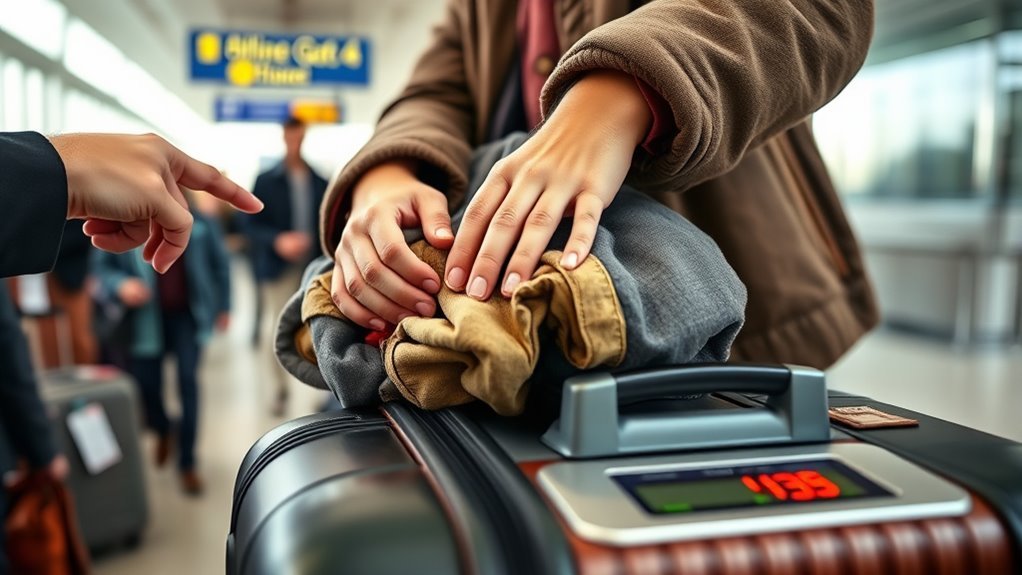
If you’re prepping for a trip and worried about baggage rules, this guide is for you: travelers who check or carry luggage, whether you’re a first-timer, a frequent flyer, or booking a one-off trip.
You’ll learn practical steps to avoid fees, how to unpack or redistribute weight, and when to pay or negotiate at the counter.
You’ll get quick tips for weighing bags, choosing carry-on versus checked, and packing to meet size limits without sacrificing essentials.
You’ll also know what documentation or photos help if disputes arise, and how to stay calm and efficient when staff enforce limits.
Airline Definitions of Overweight Baggage
You’ll find that airlines set different weight limits for carry‑on and checked bags, so know your carrier’s specific numbers before you pack. They also use varied measurement methods—some weigh at check‑in, others enforce size plus weight—so your bag could pass one carrier and fail another.
Finally, fee structures for overweight luggage differ widely, from flat surcharges to tiered rates based on pounds or kilograms.
Weight Limits Defined
How do airlines decide when a bag is too heavy? You’ll find limits set by carrier, fare class, and flight type. Checked and carry-on maximums differ, and excess weight triggers fees or refusal. Know that limits protect safety, aircraft balance, and handling staff.
- Checked baggage: common 23 kg or 32 kg thresholds
- Carry-on: stricter, often around 7–10 kg
- Oversize vs overweight: size rules separate from weight
- Frequent flyer or premium tickets: sometimes higher allowances
Always check your airline’s published allowance before packing to avoid surprises at the counter.
Measurement Methods Explained
Airlines measure overweight baggage mainly by two criteria: actual weight and linear dimensions, and they’ll use the stricter of the two when enforcing limits.
You’ll be weighed at check-in on calibrated scales; some carriers also require self-service kiosks or counter checks.
For linear size, they sum length, width, and height, including handles and wheels, and compare that total to carry-on or checked size caps.
If your bag exceeds either threshold, staff will classify it as oversized or overweight.
Know each carrier’s definition before you pack, because measurements—not just your packing guess—determine compliance.
Fee Structures Varied
Baggage fee structures vary widely, so you should check each carrier’s overweight and oversize definitions before you travel. You’ll find differences in weight limits, dimensions, fee tiers, and exceptions.
Know that policies change by route and fare class, so planning avoids surprises.
- Weight thresholds (e.g., 23 kg, 32 kg)
- Size limits (linear inches or cm)
- Fee levels (incremental or flat rates)
- Exceptions (elite status, infant, military)
When you compare carriers, read baggage pages, use calculators, and call customer service. Pack smart or redistribute items to dodge costly overweight charges.
Typical Weight Limits by Ticket Type and Carrier
Though rules vary by carrier and fare class, you’ll usually see clear weight bands: economy tickets commonly allow 23 kg (50 lb) for checked bags, while premium economy, business, and first-class fares often permit 32 kg (70 lb) per piece.
Regional and low-cost carriers may set lower limits or charge for any checked bag, while many international carriers stick to the 23/32 kg split.
Frequent flyer status, bundled fares, and certain co-branded credit cards can raise or waive limits.
Always check your carrier’s website before packing so you know whether your ticket grants extra weight or triggers checked-bag fees.
How Oversized and Overweight Rules Differ
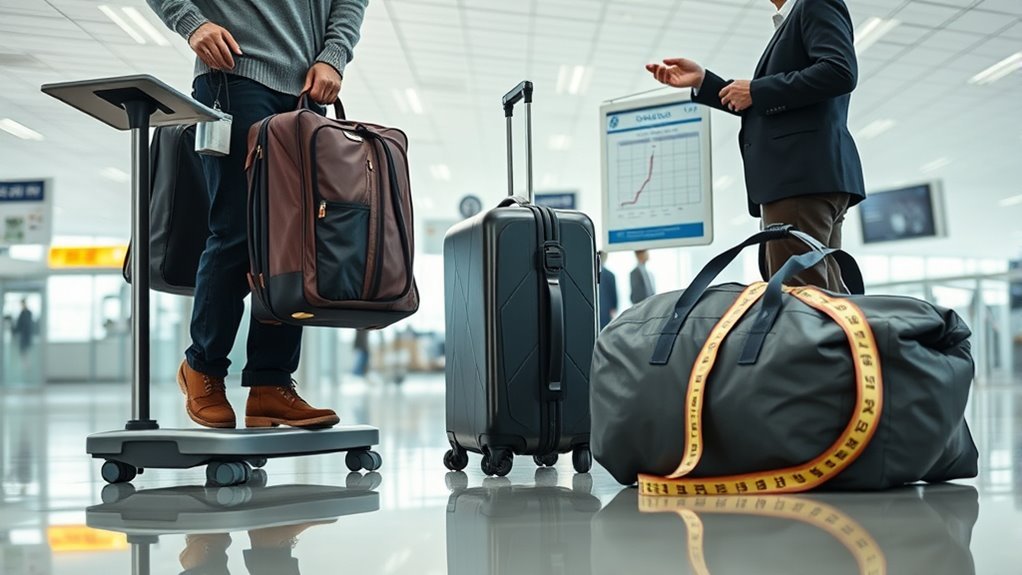
Weight and size look similar on paper, but they trigger different rules at check-in: carriers treat overweight as a matter of safety and handling, while oversized items usually fall under special-acceptance or bulky-item policies. You’ll face separate fees, limits, and routing options depending on whether your bag exceeds weight or linear dimensions. Know the distinctions so you can pack and plan.
- Overweight: charged per kilogram/pound; may be refused for safety.
- Oversized: charged flat bulky fee; may need gate-checking.
- Combining: some airlines cap both and apply higher penalties.
- Mitigation: redistribute, ship, or buy upgraded allowance.
What Happens at Check‑In When Your Bag Is Overweight
When you check in and your bag is overweight, airline staff will inspect its weight and contents and tell you the options.
You’ll usually be offered to pay additional baggage fees or buy another allowance if available.
If you’d rather avoid the charge, you can repack items into another bag or your carry-on — the agents can often help with that.
Airline Staff Inspection
If your suitcase goes over the airline’s limit, check‑in staff will weigh it on the counter scale, flag the excess, and tell you your options—pay the fee, move items to carry‑on, or repack.
They’ll inspect the bag visually and may open it if they suspect prohibited items or uneven distribution. You’ll be asked to remove fragile or heavy items for better balance.
Staff work quickly and follow policy; stay cooperative and have ID and booking info ready.
Consider these steps when repacking:
- Prioritize essentials
- Shift dense items to carry‑on
- Redistribute weight evenly
- Zip and secure seams
Additional Baggage Fees
Although it’s never fun, you’ll usually be given clear choices at check‑in if your bag exceeds the allowance: pay the overweight fee, move items to another bag, or remove items and repack.
If you choose to pay, staff will tell you the exact charge—often per kilogram or per pound beyond the limit—or a flat extra baggage rate. Have your card ready; payments are usually processed on the spot. Keep the receipt in case of disputes.
Some airlines limit payments to specific thresholds and may refuse excessively heavy items, requiring cargo arrangements. Policies vary, so ask about fees before you agree.
Bag Repacking Options
You’ll often be asked to repack at the check‑in desk as one of the alternatives to paying a fee. You’ll open bags, move items, and decide quickly what stays. Staff’ll suggest shifting heavy items to carry‑on or removing extras.
If you can’t meet the limit, they may offer to gate‑check, ship, or charge you.
- Move dense items to your carry‑on.
- Remove nonessentials or gifts.
- Redistribute weight between checked bags.
- Ask about shipping or discounted oversize handling.
Be prompt and cooperative; efficient repacking saves time and usually avoids extra charges.
Repacking and Redistributing at the Counter
When your bag tips the scale at check-in, agents will usually offer a chance to repack or redistribute items right at the counter so you can avoid extra fees. You’ll be invited to move items into carry-on, another checked bag, or a gate-checked item. Act quickly: remove heavy items like shoes, toiletries, or electronics and balance weight across bags.
Use available bins or packing straps and ask for assistance if needed. Keep valuables and essentials with you. Once balanced, reweighing is common. If limits still exceed allowance, you’ll decide whether to pay the surcharge or adjust contents again.
When Airlines Move Bags to Cargo and Why
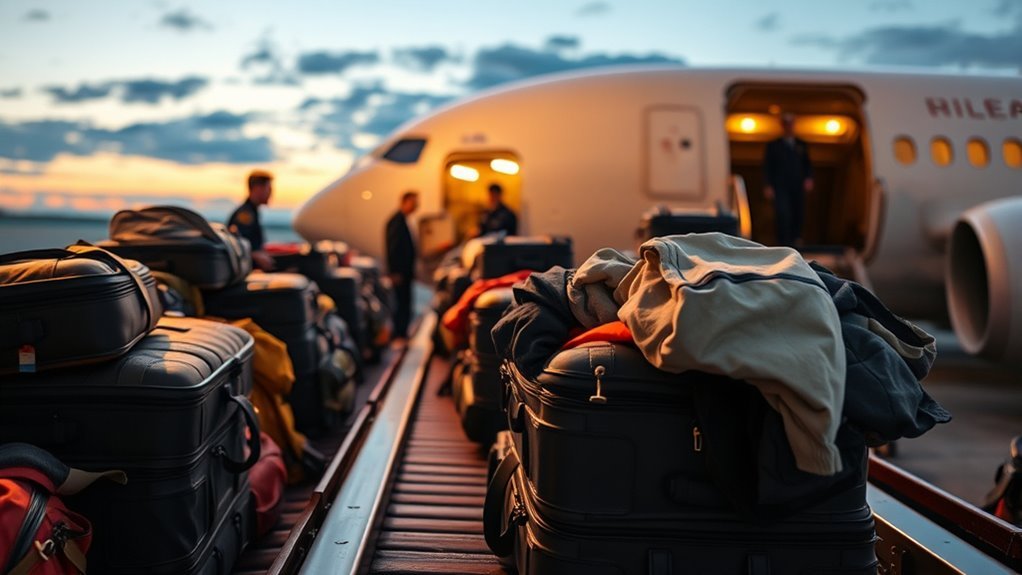
If repacking at the counter can’t fix an overweight bag or it’s unsafe to carry certain items on board, airlines will move luggage to the aircraft cargo hold instead of the cabin. You’ll have your checked bag screened, weighed, and tagged for the hold when size, weight, or content rules require it. This protects safety, balance, and cabin space.
You should expect different handling and restricted access during flight. Reasons include:
- weight distribution and aircraft balance
- prohibited or limited carry-on items
- oversized or bulky luggage that won’t fit overhead bins
- operational needs like full cabins or gate constraints
Common Overweight Baggage Fees and How They’re Calculated
Because airlines treat overweight bags as a different service level, you’ll usually pay a per-bag surcharge that increases with weight and sometimes size—often set in weight bands (e.g., 23–32 kg, 32–45 kg) or per kilogram/pound over the allowance.
You’ll also see flat fees for simply exceeding the marked allowance, higher charges on international routes, and steeper penalties for oversized pieces.
Carriers may cap maximum permissible weight and refuse check-in beyond that.
Fees are calculated at check-in and shown on your receipt; if you prepay online you’ll often save.
Always check your carrier’s exact table to avoid surprises.
Which Items Staff Often Ask You to Remove
If your bag’s over the limit, staff will often ask you to remove obvious weight first, like extra clothing layers you’re wearing to save space.
They may also flag toiletry containers that exceed liquid limits or seem bulky and ask you to take them out.
Be prepared to transfer items into your carry-on or discard oversized toiletry containers to meet weight and safety rules.
Excess Clothing Layers
Ever wondered why airport staff sometimes ask you to remove coats or boots at the gate? You might be wearing extra layers to dodge bag fees, but staff often request bulky items so checked luggage meets weight limits. Removing them can shift pounds back into your carry-on without violating limits.
Consider what to peel off and stash wisely:
- Heavy winter coat
- Multiple sweaters
- Insulated boots
- Bulky scarves or hats
You’ll want to consolidate, wear the heaviest piece, and pack lighter textiles in your carry-on to avoid surcharges and speed up boarding.
Restricted Toiletry Containers
When gate agents spot oversized toiletry containers, they’ll often ask you to remove them so bags meet carry-on rules and security guidelines.
You’ll want to check liquid limits before packing: typically 3.4 ounces (100 ml) per container in a quart-sized bag for carry-ons.
Large shampoo bottles, bulk lotion jars, and aerosols are common targets; you’ll be asked to gate-check, discard, or transfer contents into compliant travel-sized bottles.
Solid toiletries like soap or deodorant sticks usually pass.
Have spare travel bottles, know airline specifics, and pack valuables separately so removing items is quick and doesn’t delay boarding.
How Busy Flights and Staffing Change Enforcement
Because gate agents juggle tight schedules and passenger loads, enforcement of weight limits often depends on how busy a flight is and how staffed the airport is. You’ll notice stricter checks during peak times and lighter scrutiny on quiet days.
Staff shortages or long lines mean agents prioritize safety and boarding flow over perfect rule enforcement. Prepare for variability by packing predictably and arriving early.
Factors that influence enforcement include:
- Flight occupancy levels
- Number of available agents
- Time pressure before departure
- Ground crew capacity
Expect practical, safety-first decisions rather than uniform application.
If Your Bag Can’t Fly: Pay, Repack, or Ship It?
If your bag’s over the limit at the counter, you’ll usually have three choices: pay the overweight fee, repack items into another suitcase or carry-on, or ship the excess ahead.
Paying can be quick but costly, repacking might save money if you have time, and shipping can be the most convenient for bulky items.
Decide fast based on cost, time, and what’s in the bag.
Pay Overweight Fee
Airlines will usually give you three choices if your bag exceeds the weight limit: pay an overweight fee, repack items into other luggage, or ship the excess separately.
If you choose to pay, you’ll be charged based on the airline’s brackets—expect higher costs the heavier the bag. You should check fees online or ask at the counter to avoid surprises. Pay with card at check-in or at a kiosk, get a receipt, and keep it.
Consider whether the fee beats replacing or leaving items behind.
- Know the fee tiers.
- Compare to checked-bag cost.
- Ask about limits.
- Get a receipt.
Repack Or Ship
When your bag’s over the limit and paying the fee isn’t worth it, you can often avoid the charge by repacking or shipping items—so act quickly at the counter. You’ll first remove nonessentials: liquids, shoes, souvenirs, or bulky coats.
Redistribute weight into your carry-on or a partner’s bag, keeping TSA rules in mind. If carry-ons are full, ask the agent about shipping options; airlines or airport kiosks sometimes offer courier services or discounted rates.
For valuable or fragile items, ship with tracking and insurance. Decide fast, weigh again, and confirm any new tags to prevent surprises at boarding.
How to Dispute an Overweight Fee at the Airport
Wondering how to challenge an overweight luggage charge? You can act calmly and confidently at the counter. Ask for the scale reading and a supervisor if the weight seems wrong. Take photos of the displayed weight, your bag, and tags.
Challenge an overweight baggage charge calmly: request the scale reading, ask for a supervisor, and photograph the weight and tags.
Politely explain any mitigating circumstances, like uneven weight distribution or checked items missing from your flight allowance.
- Request supervisor review
- Ask for scale re-weigh
- Show documentation/photos
- Offer to remove items or redistribute
If the agent refuses, note names and file a written complaint before you leave; you’ll have stronger evidence for follow-up.
How to Dispute a Fee After You Leave the Airport
If you get home and think the fee was unfair, act quickly because airlines often have strict appeal windows and deadlines.
Gather clear evidence—your boarding pass, weight ticket (if available), photos of the packed bag, and any receipts for checked items—to support your claim.
Submit a concise written appeal through the airline’s customer service portal or email and keep records of all correspondence.
Appeal Window And Deadlines
Although you’ve already left the airport, you still have options: most airlines let you contest an overweight baggage charge within a limited appeal window. Act quickly — deadlines vary, often 7–30 days after travel. Check the airline’s website for exact timelines and required forms. Missing the window usually forfeits dispute rights.
- Note the exact deadline on the carrier’s policy page.
- File online or via customer service before that date.
- Request written confirmation of your submission.
- Keep a dated copy of your complaint and any ticket numbers.
Prompt action preserves your chance to reverse the fee.
Evidence To Support Claim
What proof will sway the airline? Gather clear, dated evidence: receipts, photos, and weight logs. You’ll want objective items showing baggage weight, payment errors, or inconsistent scale readings. Submit everything promptly with a concise explanation.
| Item | Why it helps |
|---|---|
| Photo of scale/display | Shows measured weight at time of check |
| Receipt or boarding pass | Proves flight, date, paid fees |
| Email or witness note | Captures agent statements or errors |
Attach PDFs or screenshots, label files, and keep originals. Be polite and factual in your appeal; don’t speculate. Clear, verifiable evidence raises your chance of a fee reversal.
Tips to Avoid Overweight Baggage Fees Before Travel
When you’re planning your packing, weigh your suitcase at home and compare it to the airline’s limits so you can adjust before you get to the airport. Use these practical steps to avoid fees and stress. Pack heavier items near the wheels, distribute weight evenly, and eliminate duplicates. Consider wearing bulky clothes to reduce suitcase mass. Also, prepay baggage online if allowed.
- Use a reliable scale and retest after changes.
- Know weight limits for each carrier and fare type.
- Remove nonessentials and replace with lighter alternatives.
- Use compression bags sparingly to avoid hiding excess weight.
Best Carry‑On Packing Strategies to Prevent Overweight Checked Bags
Since carry-ons stay with you, packing them smartly can keep checked bags under the limit and save you from excess fees. Start by placing heavier items—shoes, toiletries, electronics—in your carry-on to shift weight off checked luggage. Wear bulky layers on the plane to avoid packing them.
Use compression cubes for clothes and organize fragile items between soft garments. Keep liquids within carry-on limits and pack chargers, medications, and travel documents there for easy access.
Weigh both bags at home with a luggage scale, adjust contents, and prioritize essentials so you won’t face surprises at the gate.
Shipping and Forwarding as Alternatives to Overweight Baggage
If you’re facing hefty overweight fees, shipping or forwarding items ahead can be a cost-effective alternative to cramming everything into your checked bag. You can send bulky or heavy items to your destination or a trusted contact, avoiding last-minute repacking at the airport.
Consider transit time, tracking, and insurance so your belongings arrive when and where you need them. Choose carrier pickup or drop-off for convenience, and pack to postal standards.
Plan for transit time, tracking, and insurance; choose pickup or drop-off and pack to postal standards for safe delivery.
- Identify nonessentials to ship
- Compare delivery speed options
- Insure valuable items
- Confirm recipient availability
Cost Comparisons: Shipping vs. Airline Overweight Fees
How much can you save by shipping instead of paying airline overweight fees? Compare the total costs: airline fees are per bag or per pound and can spike at check-in, while shipping charges depend on weight, dimensions, distance, and speed.
You should get quotes from carriers and factor in packaging, pickup, insurance, and delivery times. For bulky but nonurgent items, ground shipping often beats surchargeed baggage.
For short trips or heavy, valuable items, airline fees might be simpler. Run the math: multiply airline per-pound rates by excess weight and compare to carrier estimates to choose the cheaper, practical option.
What Travel Insurance and Credit‑Card Benefits May Cover
You’ve run the numbers on shipping versus airline fees, but don’t forget to check what your travel insurance and credit‑card benefits can cover before you decide. You’ll find policies vary: some reimburse excess-baggage costs if delayed luggage forces you to repurchase essentials, others cover luggage loss or damage including prorated value limits. Review terms, claim windows, and required receipts.
Also confirm whether airline-imposed overweight fees qualify.
- Baggage delay reimbursement
- Lost or damaged baggage coverage
- Emergency replacement of essentials
- Reimbursement for airline fees (if specified)
Call your insurer or card provider to confirm details.
Quick Checklist to Prevent Surprises at Check‑In
Before you head to the airport, run through a quick checklist to avoid surprise fees. Weigh each bag at home with a reliable scale and adjust contents to meet airline limits. Check your airline’s baggage allowance, including size, weight, and free bag counts for your fare class or loyalty status.
Pack heavy items in checked bags and keep essentials and valuables in carry‑on. Prepay any extra baggage online when possible—it’s cheaper than airport rates.
Label bags with contact info, secure zippers, and use a luggage strap to prevent overpacking. Confirm connecting‑flight rules to avoid unexpected charges.
Frequently Asked Questions
Can Overweight Baggage Damage My Checked Luggage and Void Its Warranty?
Yes — if you overload your checked luggage, you can damage it and the manufacturer may void the warranty if the damage results from misuse or exceeding weight limits, so you should follow weight guidelines and pack carefully.
Will Overweight Fees Vary for Connecting Flights on Different Carriers?
Yes — fees can vary when you connect on different carriers. Each airline sets its own weight limits and charges, so you’ll pay according to the carrier operating the relevant segment unless a single-ticket contract states otherwise.
Are Pets Counted Toward My Checked Baggage Weight Allowance?
Generally, no — pets don’t count toward your checked baggage weight allowance; airlines treat pets as cargo or carry-on with separate fees and limits, so you’ll need to follow the specific carrier’s pet policies and pay any applicable charges.
Do Airlines Waive Overweight Fees for Medical Equipment or Mobility Aids?
Generally no—airlines won’t automatically waive overweight fees, but many exempt mobility aids and essential medical equipment from charges if declared and documented; you should contact the airline ahead, provide medical documentation, and request assistance or fee waivers.
Can Loyalty Status or Elite Perks Prevent Overweight Charges?
Yes — some airlines waive or reduce overweight fees for elite members, but it isn’t universal. You should check your carrier’s terms, call customer service, and show loyalty credentials; perks vary by airline and route.
Conclusion
Now you’re ready to avoid surprises and extra costs. If your bag’s overweight, expect fees, repacking, or having items shipped—so weigh and pack smart, check your ticket’s limits, and know your carrier’s rules before you head to the airport. Compare airline overweight charges with shipping costs, and see if travel insurance or card benefits help. Use the quick checklist to double‑check limits and pack strategically; a little planning saves time, money, and stress.