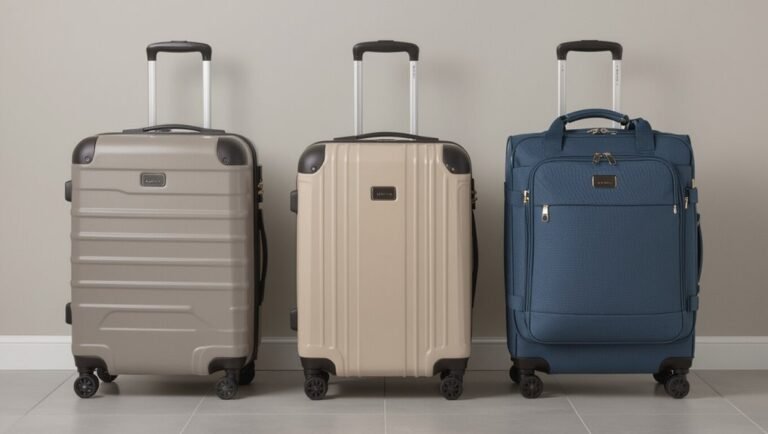
What Is the Largest Size Duffle Bag You Can Carry on a Plane
You can usually carry a soft-sided duffel up to about 22 x 14 x 9 inches (56 x 36 x 23 cm) on most full-service airlines, but low-cost carriers often have smaller or weight-only limits, so check first. Measure your packed bag—including straps, pockets and wheels—and aim for flexible materials that can be squished under the seat or into the bin. Weigh it at home to avoid gate fees, and keep going to get sizing, packing and gate-ready tips.
Quick Answer: Largest Duffel You Can Usually Carry On
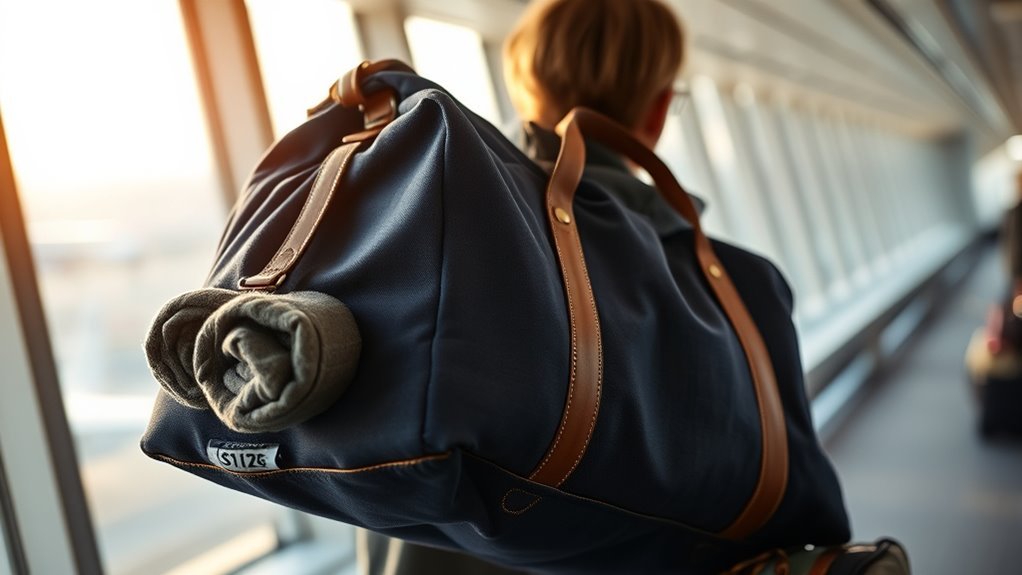
Because airlines set carry-on size limits, you’ll usually be fine with a duffel that fits within about 22 x 14 x 9 inches (56 x 36 x 23 cm) — the common maximum for major U.S. carriers.
Aim for a soft-sided bag that compresses slightly to ease overhead bin placement. If your duffel has wheels or a rigid frame, it may count as a checked item on some airlines.
Pack efficiently: prioritize essentials, use packing cubes, and avoid overstuffing.
For international or regional carriers, expect smaller allowances.
When in doubt, choose a slightly smaller duffel to prevent surprises at the gate.
How to Measure Your Duffel Correctly
To make sure your duffel meets airline limits, measure its length, width, and height with a tape measure held straight.
Don’t forget to include any handles, straps, and wheels in your dimensions since airlines count those.
Record the total dimensions and compare them to the carrier’s size rules before you pack.
Measure Length, Width, Height
Start by laying your duffel flat on the floor with all straps and pockets tucked or zipped so you’re measuring its largest packed shape. Measure length from end to end, width across the widest side, and height from base to top when filled to typical capacity. Use a rigid tape and press gently to mimic airline checks. Note each dimension, add them if airline uses linear inches, and compare to allowance. Record measurements clearly.
| Dimension | How to measure |
|---|---|
| Length | End to end |
| Width | Widest side |
| Height | Base to top |
Include Handles And Wheels
When you measure your duffel, include any protruding handles, straps, and wheels so airlines see its true packed size. Extend telescoping handles to their full length and account for fixed handles and wheel housings when recording height and length.
Check wheels’ bulge and axle placement, then measure from the outermost point on one side to the outermost on the other.
Fold or tuck removable straps as they sit when packed, but measure fixed loops as they are.
Note that soft fabric can compress yet carriers may still enforce rigid dimensions. Record the largest measurements to avoid surprises at the gate.
How Soft-Sided Duffels Can Squeeze Past Rigid Measurements
Although airlines list strict size limits, soft-sided duffels often slip past rigid measurements because you can compress or mold them into overhead bins and tight spaces. You’ll benefit from flexible fabric and minimal structure: squeeze bulging items toward the center, flatten straps, and twist corners to lower perceived dimensions.
Pack strategically—place bulky but pliable items first, fill gaps with clothing, and avoid rigid gear that defeats compression. When boarding, present a neatly shaped bag; gate agents often judge fit visually.
Still, don’t rely on generosity—overpacking or ignoring rules risks gate-checking or fees, so plan accordingly.
Standard Carry-On Size Limits (Dimensions to Know)
If you want to rely on soft-sided flexibility without surprises at the gate, you should know the carry-on dimensions most airlines enforce. Typically, major U.S. carriers cap bags around 22 x 14 x 9 inches (including wheels and handles).
International airlines vary—many allow similar totals but list centimeters, often near 55 x 40 x 20 cm.
Low-cost carriers may set smaller limits; some measure linear inches (sum of length, width, height).
Measure your duffel packed and with straps extended. If uncertain, check your airline’s website before flying to avoid gate fees or forced check-in.
Typical Personal-Item Size Limits and Examples
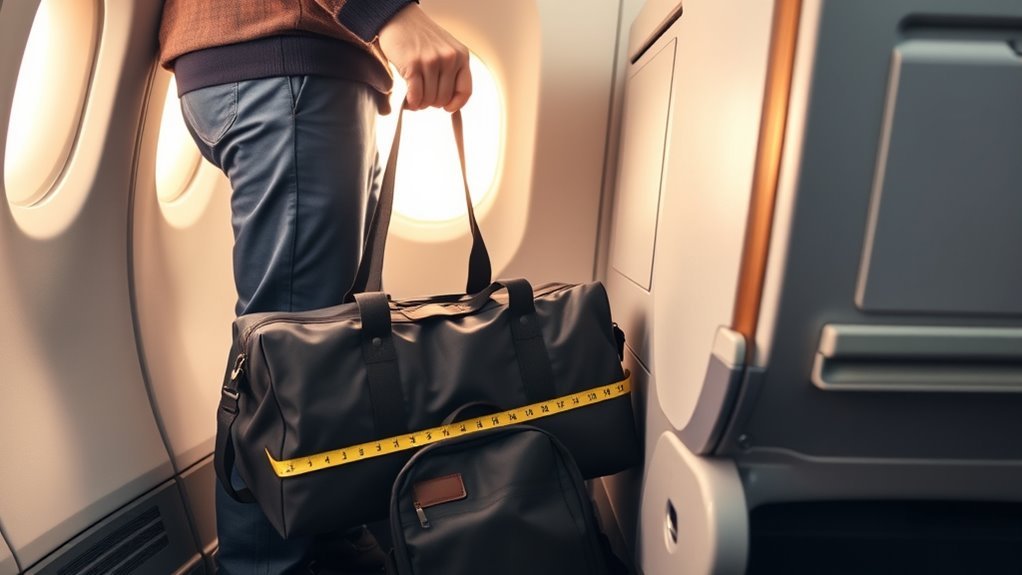
Because airlines treat personal items as the one bag that must fit under the seat, you’ll usually see much smaller limits than for carry-ons—common maximums are about 18 x 14 x 8 inches (45 x 35 x 20 cm) on U.S. carriers and similar dimensions worldwide.
You’ll find examples like a small duffel, slim backpack, tote, or briefcase.
Budget airlines sometimes shrink limits to 16 x 12 x 6 inches; legacy carriers may allow a touch more if the item compresses.
Measure packed dimensions, not empty size. If in doubt, choose a flexible bag that squashes to fit under the seat.
When a Duffel Counts as a Personal Item vs. a Carry-On
Knowing your airline’s personal-item dimensions is only the first step; whether your duffel is treated as a personal item or a carry-on comes down to size, shape, and how you pack it.
Knowing the airline’s size rules is step one; shape and packing decide if your duffel is a personal item or a carry-on
If your duffel fits under the seat in front of you when packed, airlines usually accept it as a personal item. Taller, bulkier duffels that need the overhead bin will be counted as carry-ons.
Firm frames, wheeled bases, or side pockets that increase depth can push it into carry-on territory.
Pack strategically: compress soft items, avoid rigid structures, and test fit under a seat before you board.
Major US Airlines: How They Treat Duffel Carry-Ons
When you fly within the U.S., each major carrier has its own size limits and informal practices for duffel bags, so what passes as a personal item on one airline might be a carry-on on another.
You’ll find most domestic airlines—Delta, American, United—set carry-on maximums around 22 x 14 x 9 inches and allow a small personal item, like a compact duffel, under the seat.
Low-cost carriers (Spirit, Frontier) enforce stricter fees and smaller free personal item dimensions.
Alaska and JetBlue are more flexible but still expect compliant overhead fit.
Always check your airline’s current rules before packing to avoid surprises.
Major International Carriers: Duffel Carry-On Rules

Although international carriers vary widely, most set clear size and weight limits for duffel bags carried on board, and you’ll need to meet both to avoid gate checks or fees. Check each airline’s published dimensions—typically around 55 x 40 x 20 cm—and maximum carry-on weight, often between 7–10 kg for European and Asian carriers, higher for some full-service airlines.
Soft duffels can squeeze into overhead bins, but you still must comply. Measure packed dimensions and weigh your bag at home.
Note differing rules for business versus economy cabins, and always confirm allowances before travel to prevent surprises.
Low-Cost Carriers: Stricter Size and Weight Enforcement
On low-cost carriers, you’ll face strict carry-on dimensions that often leave little room for oversized duffels. They also enforce weight limits at the gate, so your bag can be weighed and refused if it’s too heavy.
Expect steep fees for any oversized or overweight bags if you need to check them.
Strict Carry-On Dimensions
Because low-cost carriers rely on tight turnarounds and extra fees, they enforce carry-on size and weight much more strictly than full-service airlines. You’ll likely face gate checks or fines if your duffle even slightly exceeds their limits.
Check each airline’s published dimensions before packing; many cap linear measurements (length + width + height) and prohibit soft bags that bulge.
Measure your duffle fully packed, including handles and wheels. Use a luggage sizer or tape measure at home to avoid surprises.
If your bag fits within the listed linear allowance, you’ll keep it with you; otherwise, expect to gate-check it.
Weight Limits Enforced
Wondering why budget airlines make such a fuss about your duffel’s weight? You’ll face strict limits: carriers cap carry-on and checked weights tightly to squeeze space and cut handling time. You should weigh bags at home, redistribute items to personal items if needed, and pack lighter fabrics. Staff will enforce limits at boarding and check-in, and if your bag exceeds weight, they’ll require repacking or gate check. Below is a quick comparison to help you plan.
| Carrier Type | Typical Weight Limit |
|---|---|
| Low-cost (carry) | 7–10 kg |
| Low-cost (checked) | 15–23 kg |
| Full-service | 8–10 kg |
Fees For Oversized Bags
Want to avoid surprise charges at the gate? You’ll pay attention to low-cost carriers’ strict rules: they enforce both size and weight and levy steep fees for oversized or overweight duffle bags. Check the airline’s published dimensions and weight limits before you pack.
If your bag exceeds limits, expect charges ranging from modest flat fees to amounts comparable with a checked bag—sometimes higher for last-minute gate claims. Prepaying or upgrading online is usually cheaper than paying at the airport.
Consider redistributing items, using a smaller duffle, or shipping bulky gear to avoid hefty surprise fees.
Weight Limits That Affect Duffel Carry-On Status
While airlines set size limits for carry-ons, weight limits often decide whether your duffel stays with you or gets checked. You’ll need to know both the maximum weight and how strictly staff enforce it.
Check your carrier’s published carry-on weight—often 7–22 kg (15–50 lb)—and note differences for basic economy or international routes.
Check your airline’s carry-on weight limit—commonly 7–22 kg (15–50 lb)—and watch for economy or international differences.
Weigh your packed duffel at home to avoid surprises at the gate.
Overweight items can incur fees or require checking, and gate agents may be stricter on crowded flights.
Distribute weight into personal items or wear heavier clothing to stay within limits.
How to Pack a Duffel to Maximize Usable Space
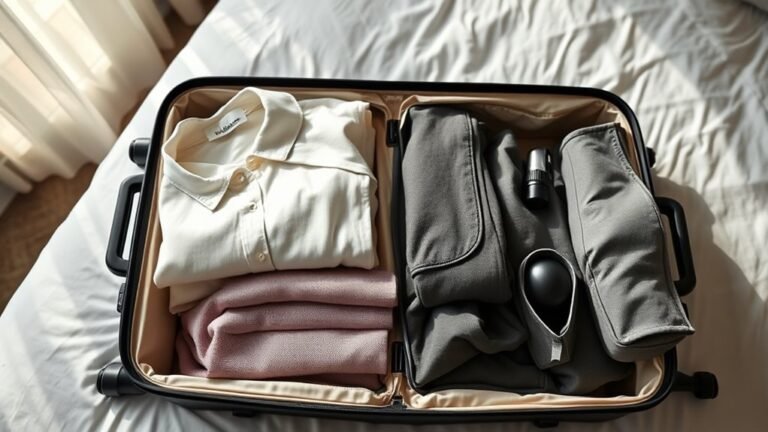
Start by rolling clothes tightly to cut bulk and layer heavier items at the bottom to keep the bag balanced.
Use built-in pockets and small pouches for accessories, shoes, and toiletries so everything has a place.
That way you’ll squeeze more into your duffel and find items quickly when you need them.
Layering And Rolling
If you want to fit more into your duffel without bulging seams or wasted gaps, layer strategically and roll clothes tight. Start with heavier, less-flexible items on the bottom, then add rolled garments to conform to corners. Use alternating roll directions to create a stable core and fill remaining voids with socks or underwear. Compress layers as you build them so the bag stays balanced and zippers close smoothly.
- Roll shirts and pants tightly to reduce air and create uniform cylinders.
- Lay delicate items flat between rolled layers.
- Stuff shoes with small items before packing.
- Re-roll any loose areas before closing.
Use Compartments Strategically
Because duffels lack rigid structure, using internal and external compartments smartly keeps gear accessible and prevents wasted space. You’ll separate items by frequency and fragility: place shoes and dirty clothes in side or bottom pockets, toiletries in a sealed toiletry compartment, and electronics in padded pockets.
Use compression pouches for bulkier clothes to free central space. Tuck flat items like documents or chargers into internal sleeve pockets to avoid crushing.
Clip small gear to D-rings or stash them in zippered exterior pockets for quick access. Label or color-code pouches so you can grab what you need fast.
Packing List and Compression Tricks for Duffels
When space is tight, packing smart makes all the difference: prioritize versatile clothing, toiletries in travel sizes, and items you’ll actually wear more than once.
Roll shirts and layer them with thin packing cubes to compress outfits; tuck socks and chargers into shoes to save room.
Use a lightweight compression sack for bulkier items like jackets, and keep essentials in an easily reachable pocket.
Balance weight so the bag stays manageable and meets carry limits.
- Roll and cube combinations
- Compression sack for bulky gear
- Shoe stuffing for small items
- Clear pouch for liquids and meds
How to Fit a Duffel in Overhead Bins
Want your duffel to slide into the overhead bin on the first try? Pack flat items at the bottom, roll clothing to save space, and use compression cubes to keep shape consistent.
Choose a duffel with soft sides so you can squish it slightly, and keep straps tucked to avoid snags.
When boarding, lift by the center and angle the bag so its longest side goes in first. Place heavier items toward the bin wall for stability.
If space’s tight, open zippers slightly to conform to the gap.
Retrieving items? Move lighter things to the top for easy access.
Airline Overhead Bin Sizes: What to Expect and Check
Although overhead bin dimensions vary by airline and aircraft, you can usually find the exact measurements on the carrier’s website or by checking the specific plane model before you travel. Check those specs so you know if your duffel fits lengthwise, heightwise, and with other bags present.
Overhead bin sizes vary—check your airline and plane model so your duffel fits lengthwise, heightwise, and with other bags.
Note that regional jets often have smaller bins than mainline planes.
- Measure your packed duffel’s largest dimensions.
- Compare to the airline’s listed bin size for your flight.
- Consider soft-sided bags that compress into tight spaces.
- Remember that airlines may enforce firm size limits at boarding.
What to Do If Your Duffel Is Borderline at the Gate
If your duffel looks like it might barely fit—or won’t fit—into the overhead bin at the gate, act quickly and calmly: check the bag sizer if one’s available, try compressing or repositioning items to shave off inches, and ask the gate agent whether you can gate-check it or stow it in a closet or underseat space.
Remove bulky items like shoes or jackets and put them in your personal item. Use straps or compression cubes to slim the duffel.
If you must check it, remove valuables and lock zippers. Stay polite and decisive to speed resolution.
Why Gate Agents Make You Check a Bag
Because gate agents manage tight cabin space and strict safety rules, they’ll ask you to check a bag when it won’t fit, blocks aisles, or risks shifting during takeoff and landing. You’re expected to comply so exits remain clear and weight distribution stays safe.
Agents enforce airline dimensions and boarding order to keep schedules moving. If your duffel looks oversized or unstable, they’ll make a quick call to prevent delays or injuries.
Pack thoughtfully and know the rules to avoid surprises.
- Safety: unsecured bags can become projectiles
- Access: aisles and bin space are limited
- Compliance: airlines set hard size rules
- Efficiency: boarding stays on time
Alternatives If Your Duffel Is Denied at Boarding
If your duffel is denied at boarding, ask about gate check options so it can travel in the hold but stay with the aircraft.
If that’s not available, look for a quick repacking spot near the gate to move essentials into a smaller bag or personal item.
Acting fast usually keeps your trip on schedule and your important stuff with you.
Gate Check Options
Should your duffel be refused at the gate, don’t panic — you’ve got a few practical options to keep your trip on track. Ask the gate agent about gate-checking: they’ll tag and stow it in the hold, often free of charge. Remove valuables and fragile items first.
Expect to collect it at the aircraft door or baggage claim depending on airline policy. If gate-check isn’t allowed, request curbside or counter check as an alternative.
- Gate-check with a tag and protective bag
- Remove electronics and documents before handing it over
- Verify retrieval point (door vs. baggage claim)
- Ask about fees or liability limits
Quick Repacking Spots
When your duffel gets denied at the gate, look for quick repacking spots nearby—airline counters, gate areas with extra seating, or even the airport lounge if you have access—so you can redistribute essentials into your carry-on and a personal item.
Move toiletries, medications, electronics, and travel documents first. Use seat-back trays or counter space to organize swaps quickly.
Ask gate agents for temporary access to a staff area if crowded.
Keep bulky items like jackets or shoes handy to compress your duffel.
Seal liquids in plastic bags to meet rules.
Finish by tagging checked items and boarding calmly.
Recommended Duffel Dimensions for Weekend, Business, and Long Trips
Because trip length and purpose change what you need to carry, choose duffel sizes that match the itinerary.
For weekend getaways, pick a compact 20–30L duffel that fits under the seat and keeps outfits minimal.
For business trips, opt for 30–40L with organized compartments to separate work items and a blazer.
For longer vacations, go 50–70L if you check it or split between a 40L carry-on and a 30–40L personal bag.
Measure dimensions against your airline’s limits and think volume, not just inches, to avoid surprises at the gate.
- Weekend: 20–30L, under-seat
- Business: 30–40L, organized
- Long: 50–70L, checked
- Combine: 40L + 30–40L
Best Duffel Features for Carry-On Compliance
Choosing the right size is only half the battle; features determine whether your duffel will actually pass muster at the gate. You’ll want structured sides to keep dimensions stable, a compressible option for tight spaces, and quick-access pockets for boarding essentials. Lightweight materials and smooth zippers speed handling, while a luggage pass-through keeps your hands free.
| Feature | Benefit | Look for |
|---|---|---|
| Structured sides | Maintains size | Reinforced panels |
| Compressibility | Fits overhead | Roll-top or cinch |
| External pockets | Easy access | Passport pocket |
| Lightweight fabric | Avoids over-limit | Ripstop nylon |
| Luggage sleeve | Hands-free travel | Wide, secure slot |
Top Duffel Brands and Models That Fit Carry-On Rules
If you want a carry-on duffel that won’t give you a gate-check headache, focus on brands known for consistent sizing, durable materials, and practical pockets. You’ll want lightweight builds, reinforced handles, and easy-access compartments that match airline limits. Choose models with clear dimensions and tested carry-on fit.
Prioritize consistent sizing, durable materials, and easy-access pockets to avoid last-minute gate-check hassles.
- Patagonia Black Hole Duffel (45L) — rugged, compressible, fits most overhead bins.
- Timbuk2 Command Duffel — organized pockets, laptop sleeve, slim profile.
- Eagle Creek Wayfinder Duffel — durable fabric, multiple carry options, compressible.
- Osprey Transporter Duffel — sturdy frame, easy to stow, reliable zippers.
When to Buy a Convertible Duffel/Backpack or a Rollaboard
When you need versatility for varied trips—city days, weekend hikes, or flights with uneven terrain—consider a convertible duffel/backpack; it gives you the hands-free carry of a pack and the packing space of a duffel.
Choose a convertible when you’ll hike to lodgings, navigate crowded terminals, or want adjustable carrying options.
Pick a rollaboard if you prioritize effortless airport mobility, heavier loads, or long paved transfers.
Look for sturdy wheels, comfortable straps, and lockable zippers.
Check airline size and weight limits before buying.
Balance how you’ll move between destinations against storage needs to decide which design serves you best.
Returning With Souvenirs: How to Handle Expanded Packing
You’ll probably buy more than you left with, so plan packing expansion before you go. Consider compression cubes, wearable packing, or a lightweight foldable bag for the return trip.
Also check your airline’s size and weight limits so that your expanded duffel won’t trigger fees.
Packing Expansion Strategies
Because souvenirs often add unexpected bulk, plan for expansion before you leave—choose a duffle with compression straps, a dedicated expander zipper, or room for a packable daybag so you can stash purchases without exceeding carry limits. You’ll want strategies that keep weight centered and shape manageable.
Use modular packing, prioritize flexible items, and set a return-item limit. Consider where extra weight goes to avoid awkward bulges that alarms gate agents.
- Pack a lightweight foldable tote for impulse buys.
- Use compression cubes to squeeze garments.
- Reserve an internal pocket for fragile souvenirs.
- Weigh your bag before heading to the airport.
Airline Size Limits
Souvenirs can easily push your packed duffle past airline size limits, so check both carry-on and checked dimensions before you head to the airport. You’ll measure height, width, depth and compare them to airline policies. If souvenirs make your bag borderline, redistribute items, compress clothing, or ship items home. Know weight limits too—oversize fees add up. Have a backup plan: a collapsible tote or wearable layers. Confirm limits for connections; different carriers vary. Keep receipts for duty or claims, and weigh your bag at home to avoid surprises at the gate.
| Item | Action |
|---|---|
| Carry-on | Measure before packing |
| Checked | Note max dimensions |
| Weight | Weigh at home |
| Fees | Check fees ahead |
| Backup | Bring collapsible tote |
Pre-Flight Checklist: Confirm Your Duffel Is Carry-On Ready
Before you head to the airport, run through a quick checklist to confirm your duffel meets carry-on rules and won’t slow you down at the gate. Check dimensions against your airline’s published limits and measure with straps compressed. Weigh the packed bag on a scale you trust. Ensure exterior pockets are accessible for boarding essentials and keep liquids under 100ml in a clear pouch. Lock or secure zippers but avoid fixed locks that TSA can’t open.
- Measure length, width, height with straps tucked
- Weigh the duffel fully packed
- Organize liquids and documents for screening
- Test zipper function and accessibility
Quick Troubleshooting Cheatsheet for Gate Surprises
If a gate agent questions your duffel, stay calm and know they’ll measure dimensions against the airline’s carry-on rules.
If it’s too big, you can quickly switch to a personal item, gate-check it, or pay the carry-on fee depending on the agent’s options.
Use boarding order and polite persistence to avoid surprises and extra charges.
Gate Agent Measurement Rules
When a gate agent asks to measure your duffle, stay calm and cooperate—knowing the common rules lets you resolve surprises fast. You’ll be measured for linear dimensions and sometimes weight; agents use a sizer box and a scale. If it fits, you keep it; if not, expect gate check fees or carry-on reassignment.
Politely ask for the airline’s size policy or a manager if confused. Document measurements with your phone photo.
- Have dimensions ready (length + width + height)
- Remove straps or items that alter shape
- Know your fare’s carry-on allowance
- Ask for a supervisor if disputed
Quick Carry-On Alternatives
So you’ve hit a gate snag and your duffle won’t pass muster—here’s a quick cheatsheet of carry-on alternatives to get you on the plane without a meltdown.
First, compress gear into a smaller backpack or personal item—roll clothes, use packing cubes.
Wear bulky items (coat, boots) to free space.
Redistribute heavier items into pockets or a jacket.
Ask a companion to hold overflow in their allowed bag.
Move non-essential items to checked luggage at the counter if time allows.
Buy an approved gate-checked tag and retain valuables on you.
Stay calm and be cooperative with agents.
Fees And Boarding Tips
Because gate agents can be strict about bag size and weight, expect potential fees and have a quick plan to avoid delays. You’ll want to check airline baggage rules, prepay any extra carry-on charges, and be ready to repack at the gate. Keep receipts and note loyalty perks that waive fees.
Use a lightweight duffle and compress items to fit overhead or underseat. If asked to gate-check, tag valuables for carry and confirm retrieval location.
- Know your airline’s size and weight limits before packing.
- Prepay fees online to save money and time.
- Have a compact tote for valuables.
- Volunteer to gate-check if the flight’s full.
Frequently Asked Questions
Can Duffels With External Wheels Count as Carry-Ons?
Yes — carriers usually treat wheeled duffels as carry-ons if they meet size and weight limits. You’ll need to check your airline’s specific dimensions and weight allowance, because policies and overhead bin space vary between carriers.
Are Liquids in a Duffel Subject to Different TSA Rules?
No — liquids in a duffel follow the same TSA 3-1-1 rule as any carry-on and must be in a clear quart-sized bag; exceptions apply for medications, baby formula, and duty-free purchases, which you should declare.
Do Airline Alliances Share Carry-On Size Allowances?
No, airline alliances don’t uniformly share carry-on size allowances; you’ll need to follow the specific carrier’s rules for your flight, since alliances coordinate routes but don’t standardize baggage dimensions or enforcement.
Will Inflatable Duffel Inserts Affect Gate Measurements?
Yes — inflatable duffel inserts can affect gate measurements because you’ll be judged by packed dimensions. If deflated they’re fine, but inflated bulk may exceed sizer limits, so check airline rules and pack strategically to avoid fees.
Can Medical Devices in a Duffel Be Exempt From Size Restrictions?
Yes — you can, but you’ll need documentation and coordination. Airlines and TSA generally exempt essential medical devices from size limits, so notify your carrier, carry prescriptions or doctor’s notes, and arrive early for inspection and assistance.
Conclusion
You’ve got the gist: measure your duffel (height, width, depth), compare it to your airline’s carry-on and personal-item limits, and choose a soft-sided or convertible option if you want flexibility. When in doubt, pack smart—compress, use packing cubes, and know the gate policies. Confirm dimensions before you leave, and be ready to gate-check if needed. Do that and you’ll avoid surprises, save time, and keep your trip stress-free.